International Scientific Journal – ISSN: 1679-9844 Nº 3, volume 12, article nº 8, July/September 2017 D.O.I: http://dx.doi.org/10.6020/1679-9844/v12n3a8 Accepted: 12/05/2017 Published: 30/09/2017
DIAGNOSIS OF THE POTENTIAL FOR SOYBEANS
OUTFLOW THROUGH PORTS IN THE STATE OF PARÁ: A
BIBLIOGRAPHICAL AND DOCUMENTARY ANALYSIS
André Cristiano Silva Melo1, Amanda Thais Santos Vieira2, Bruna Adriele Furtado Cordeiro3
1
Universidade do Estado do Pará (UEPA), Belém-PA, Brasil,
2
Universidade do Estado do Pará (UEPA), Belém-PA, Brasil,
3
Universidade do Estado do Pará (UEPA), Belém-PA , Brasil,
Abstract: With increases in grain harvests in 2015, which reached 209 million tons, 8.2% above the previous harvest, and the high export rate, sufficient to balance the drop of grain prices in the same year, it is notorious that agribusiness growth in Brazil comes against the current context of economic and political crisis in the country. In this sense, the present article addressed the relationship between the growth in the production of one of the most profitable commodities in Brazil, soybean, and its logistical impacts in the current export infrastructure, also considering new possibilities for the export of these grains through the north region gates of Brazil. The research was discussed focusing on the possibility of transferring part of the soybean export demand from the southeast and south regions, currently operating with overload of its port capacity, to the north region, seeking to reduce costs, improve the quality of transportation and expansion of export capacity. A bibliographic survey was conducted to characterize the growth of commodity production in Brazil and the imbalance of the transport matrix for export, relating the excess of demand of Santos and Paranaguá to the current operational bottlenecks and analyzing the North Arc as a new option for grain exports. In addition, through a qualitative analysis, a diagnosis of the ports of Pará with the potential to surplus soybean demand was conducted. The results showed the current operational context of the north and northern ports of Brazil, the main
opportunities for commodities outflow and the major infrastructure bottlenecks that the region faces in order to expand its capacity and meet the high demand.
Keywords: Soybean, Outflow, Export, Ports, Logistic cost.
Resumo: Com os aumentos das safras de grãos, em 2015, que chegaram a 209 milhões de toneladas, 8,2% acima da safra anterior e do elevado índice de exportação, suficiente para neutralizar a queda nos preços desses grãos, no mesmo ano, é notório que crescimento do agronegócio no Brasil vem na contramão do atual contexto de crise econômica e política no país. Neste sentido, o presente artigo abordou a relação entre o crescimento na produção de uma das
commodities mais rentáveis do Brasil, a soja, e seus impactos logísticos na atual
infraestrutura de exportação, considerando ainda novas possobilidades de escoamento para exportação desses grãos pela região norte do país. A pesquisa foi discutida com foco na possibilidade de transferir parte da demanda de exportação de soja das regiões sudeste e sul, atualmente operando com sobrecarga de sua capacidade portuária, para a região norte, em busca de redução de custos, melhoria da qualidade do transporte e ampliação de capacidade de exportação. Para tal considerou-se um levantamento bibliográfico para caracterizar o crescimento da produção de commodities no Brasil e o desequilíbrio da matriz de transporte para exportação, relacionando-se o excesso de demanda para os portos de Santos e Paranaguá aos atuais gargalos operacionais e analisando o Arco Norte como nova opção para exportação de grãos. Além disso, por meio de análise qualitativa, foi realizado um diagnóstico dos portos paraenses com potencial para escoamento da demanda excedente de soja. Os resultados encontrados mostraram o atual contexto operacional dos portos do norte do Brasil, as principais oportunidades de escoamento de commodities e os principais gargalos de infraestrutura que a região enfrenta para expandir sua capacidade e atender à alta demanda.
Palavras-chave: Soja, Escoamento, Exportação, Portos, Custo logístico.
1. Introduction
The notorious growth in agribusiness in Brazil comes against the current context of economic and political crisis (CANAL RURAL, 2016). After increases in 2015, the grain harvest reached the mark of 209 million tons, 8.2% above the previous harvest; Export index high enough to counteract the fall in the price of the grain commodity in the same year (PORTAL BRASIL, 2015). Driven by grain production, agribusiness faces the need to adapt to the country's structural difficulties; The produced volume grows and exerts pressure on the transport infrastructure, unable to support such scale (NET, 2013).
The national production of the largest volume of grain (Central-West) is mostly drained through the transport network of the Southeastern region of Brazil, whose
articulations of port access roads present very adverse conditions. Not only the road network is inadequate, but also the saturation of exportation ports, whose quality service capacity is lower than the current demand, generating queues of trucks and ships, according to Antaq (2016).
The Ministry of Agriculture (2016) points out that, in this scenario, an alternative route that proves to be viable and is target of investment planning in infrastructure, is the outflow of other regions of equal or lesser proximity, such as North Arc, a region that Extends from Rondônia to Bahia. Signing as one of the main flow corridors, North Arc carried out 20% of total shipments in the country in 2015, 54% higher than in 2014 (MINISTÉRIO DA AGRICULTURA, 2016). Due to the continental dimensions of Brazil, economies with logistics can represent a competitive differential of sustainability and growth to agribusiness, especially for productive areas far from the exit ports.
The reduction of logistical costs of exporting through new routes is fundamental to sustain the competitiveness of national grain production while facing countries such as the United States and India, which, along with Brazil, lead the world production of soybeans (CONAB, 2016). In this context, the objective of this work is to diagnose the situation of the ports of the state of Pará, that present vocation for exportation of soybeans, identifying operational indicators and, in view of the logistical failures in the current outflow, to analyze their capacity to receive part of the exceeding demand of the main exportation ports, leading to a reduction in the associated logistics costs, generated by the better distribution of demand between the ports of North and South.
2. Theoretical Framework
2.1. The expansion of grain production in Brazil
Brazil is the second largest producer of soybeans in the world, only behind North American harvest, with a production corresponding to 95.631 million tons in 2015, of which 42.5 million were destined for domestic consumption and the rest, exported in the form of grains and other soybean derivatives (NAÇÕES UNIDAS BRASIL, 2016).
The soybeans production is concentrated in the states of the Center-South portion, the State of Mato Grosso leads the production ranking, responsible for about 27% of the national production, followed by the State of Paraná (17.8% of the total) and Rio Grande do Sul (16.9%), according to Embrapa (2016).
The agribusiness trade balance currently accounts for 46.2% of Brazil's commercial revenue, the highest share of agribusiness since the beginning of the historical series (AGÊNCIA ESTADO, 2016). Notably, the soybean complex (bran, oil and soybean) is the most prominent product in the Gross Production Value (VPB); every year, national agriculture reaches new levels in grain production; In 2017, production is estimated to reach 210.3 million tons, 1.3% above the previous harvest (PORTAL BRASIL, 2016).
In this agribusiness expansion scenario, the promotion of infrastructure should keep pace with production, adding competitiveness to the national product against large competitors in the world grain market. Despite the enormous weight of domestic production, facts such as structural constraints such as poor distribution in the transportation matrix, exportation focus in congested ports and inability to meet exceeding demand in the north of the country, direct up to 29% to 34% of the price of grain sales for freight costs (EMBRAPA, 2012).
2.2. The logistics of soy and excessive demand in the current exportation ports
The deficiency in the brazilian transport matrix negatively affects the trade balance, reducing the international competitiveness of exported products, especially low value-added goods such as grain commodities. The gap between the grain farmer and the outlets is a considerable constraint on the development of production and the need to use road transport over long distances generates high freight costs, which can account for up to 30% of production revenue, according to distance (EMBRAPA, 2012).
Responsible for 81% of Brazil's grain production, the ports of the Center-South region contribute greatly to the high logistics costs for the producer. There are 10 main corridors of the Mato Grosso production’s outflow, of which the ports of
Santos (SP), Paranaguá (PR) and Rio Grande (RS) accounted for 68% of exports in the 2014/2015 harvest, when soybean exports reached 61.5 million tons, according to the Ministry of Agriculture (2015). In this context, the most representative ports in grain movement were Santos (17.5), Paranaguá (13.8) and Rio Grande (10.8). Table 1 shows that, for the main ports of soybean flow, the product has a great impact on the exports of each port operation.
Table 1: Soy impact on port exportation and operational indicators Santos Total export (ton) Soy export (ton) Relevance soybean/port
2014 76.574.936 16.464.584 21,50%
2015 87.565.704 17.772.632 20,30%
Paranaguá Total export (ton) Soy export (ton) Relevance soybean/port
2014 14.793.767 10.413.223 70,39%
2015 16.140.000 12.600.000 78,07%
Source: Antaq (2017).
The access corridors to the Santos and Paranaguá ports represent the best outflow structure in the country. The transport bottlenecks are mainly the need of revitalization of highways, the existence of tolls and slow urban traffic, that, along with the difficulties of port operation, generate the need to reduce demand, in order to improve operational indicators that have a greater impact on freight costs for producers, such as waiting for mooring and operation (LOTO & GOMES, 2005).
In Santos, soybeans and derivatives are the most traded product, accounting for 20.3% of export operations (PORTO DE SANTOS, 2017). In Paranaguá, the soybean representativeness is even greater, accounting for 78% of port export activities. The ports, however, face significant logistical difficulties, given the high numbers of demand for general product outlets (ANTAQ, 2017). Table 2 shows indicators related to the logistic difficulty in the main export ports.
Table 2 identifies the high waiting time for berthing, especially in Paranaguá, where soybeans are the product of the highest traffic. The presented indicators have a direct impact on the service level and quality and cost of transportation. Prolonged waiting time and long stay contribute to fact that Santos and Paranaguá are among the port services of highest costs in the country (Porto de Santos, 2017).
Table 2: Operational indicators in the main soy export ports in 2016
Port Moorings per year (unit)
Average time at berth (hour)
Average waiting time for berthing (hour)
Waiting time for operation (hour)
Santos 2.746 31,2 102,6 1,9
Paranaguá 1.205 60,7 354,9 1,8
Rio Grande 2.099 26,1 106,5 2,7
Source: Antaq (2017).
2.3. North Region as an otion: reduction of logistics costs
Logistics is considered one of the major challenges for grain producers in Mato Grosso, given the distance to the main exportation ports in Brazil (GLOBO RURAL, 2016). Therefore, the alternative route to the flow of production by the North region appears as a viable solution. The highlight is the several logistic corridors located in the North Arc, specifically in Pará, which operates so that the grains originated in the north of Mato Grosso follow to the north of Brazil, crossing the State by the BR-163, to a transhipment terminal in Miritituba district, municipality of Itaituba, where the product is shipped on ferries that leads to Barcarena, traveling more than 1,000 km in river distance. The Barcarena terminal, in the Metropolitan Region of Belém, receives river barges and trucks with soy, making it possible to export through a shorter route to international markets such as Asia and Europe (AGROESTE, 2014).
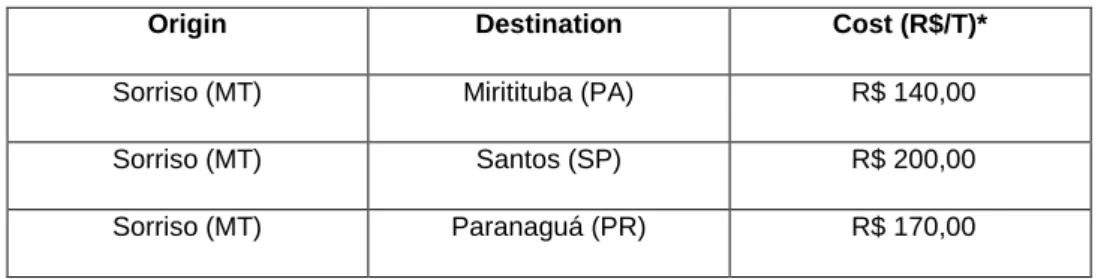
As shown in Table 3, starting from Sorriso-MT, one of the states’s largest soybean producer, the freight cost per ton becomes much lower towards Miritituba-PA, in detriment of the Santos and Paranaguá ports, so that, transporting 10 thousand tons of the grain, for example, would represent an economy of R$ 600,000.00 and R$ 300,000.00, respectively.
According to Companhia Docas do Pará - CDP (2014), seven other similar logistics systems in regards to soybean flow in Miritituba and the embarkation in Barcarena, must be built, requiring R$ 6.2 billion in investments. Still, as reported by CPD (2014), as of the consolidation of the investments, in 2022, Barcarena will have the largest grain export terminal in Brazil, with a capacity of 22 million tons.
Table 3: Comparison of freight costs from Sorriso-MT
Origin Destination Cost (R$/T)*
Sorriso (MT) Miritituba (PA) R$ 140,00
Sorriso (MT) Santos (SP) R$ 200,00
Sorriso (MT) Paranaguá (PR) R$ 170,00
*Sem taxa da transportadora e sem ICMS. Fonte: Autores (2017) adaptado de Aprosoja (2016).
3. Methodology
The present paper aimed to diagnose the current situation of the main ports identified as options for exporting soybeans through Pará, seeking to base future work on reallocation of Brazil's surplus demand for grain export to the ports of the State, currently sourced through the ports of the Center-South. This article was a qualitative research, with the objective of evaluating the level of port service in Pará and its capacity to receive higher demand. It also presented an exploratory character, based entirely on bibliographical and documentary research. The research considered the development of a theoretical reference that characterized the growth of the production of commodities in Brazil and the imbalance of the matrix of transport for exportation; lastly related exceeding demand of the ports of Santos and Paranaguá to the current operating bottlenecks analyzing the North Arc as a potential export option.
In addition, through bibliographical research and qualitative analysis, the following diagnostic steps were performed:
- Definition of the ports of Pará with potential to receive the exceeding soybean demand, considering indicators of export potential, operational indicators and structural characteristics that indicate the capacity to move a high demand;
- Comparison of routes between ports in the South/Southeast and ports with potential in Pará;
- Lighthouse of opportunities: SWOT analysis of the flow of commodities by ports in Pará;
- Mato Grosso’s production flow to ports in the North Arc: distance, modal conditions, route options through bibliographic research.
4. Diagnosis
4.1. The ports in the State of Pará
The State of Pará has a strategic and privileged location due to its multimodal vocation. Close to markets such as Europe and China (by the Panama Canal), Pará represents some of the best routes for exporting products in the country. The waterway modality is the one with the greatest development potential in the region, with a further 20,000 km navigable and 5 main waterways with navigation potential in the interior of the State and considerable cargo handling capacity (INVESTPARÁ, 2013).
The port area called Complexo do Pará, managed by Companhia das Docas do Pará (CDP), is composed of 9 public ports, of which Belém and Vila do Conde (both in the metropolitan area) represent 75.46% of the total number of annual movements. The main movements are minerals, fuel, grains and live cargo (CDP, 2017). Table 4 shows data from the ports of CDP, vocation of goods and soybean movement in relation to total movement.
Table 4: Data from public ports managed by CDP in 2015
Port Annual movements (ton) Main goods Soy movement (ton)
Belém 473.409 Wheat, wood, containers 172,84
Miramar Terminal 2.197.253 Liquid bulk -
Outeiro Terminal 123.977 Ores, wheat, liquid bulk -
Vila do Conde 15.217.328 Ores, caustic soda 292,11
Santarém 4.984.091 Corn, soy, fertilizers 985.373,77
Itaituba 671.477 Corn, soy 101.510
Óbidos 3.658 LPG, automobile, fabric -
Source: CDP (2017).
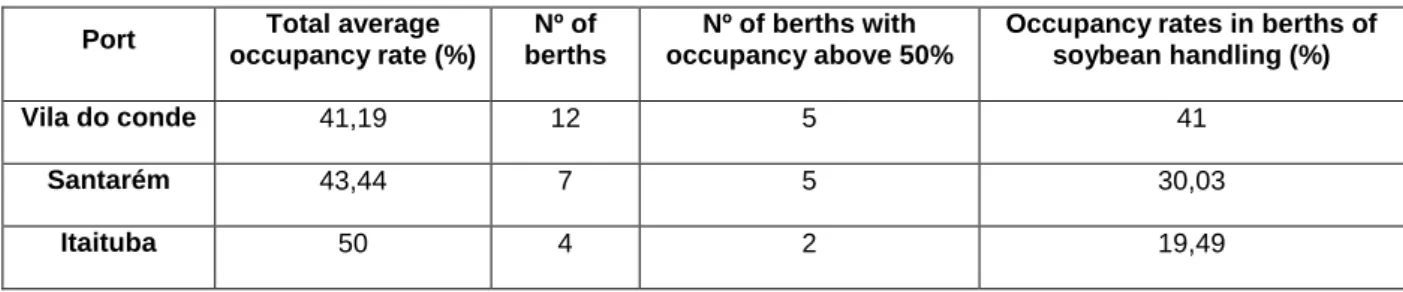
According to Table 4, the soy movement is consolidated in Santarém-PA and Itaituba-PA, whose vocation is the movement of grains. There is also potential for outlets in Vila do Conde, located in the industrial complex of Barcarena-PA. To analyze the capacity of the ports, the occupancy rate indicator (%) was used, which demonstrates the percentage of use of cradles for operations. Table 5 presents this indicator for the analyzed ports. From the low numbers of occupancy rate, it is possible to note the idleness of the berth of soybeans handling, indicating the opportunity to increase the demand for outlets for exportation at these ports, in order to increase their profitability and reduce the distances between the Soybean production centers and outflow.
Table 5: Occupancy rate of ports with vocation for soybean movement in 2015.
Port Total average
occupancy rate (%)
Nº of berths
Nº of berths with occupancy above 50%
Occupancy rates in berths of soybean handling (%)
Vila do conde 41,19 12 5 41
Santarém 43,44 7 5 30,03
Itaituba 50 4 2 19,49
Source: CDP (2017).
Table 6 presents a comparative scheme between the ports of the North and Center-South of the country, considering the routes between the production center, based in Sorriso (MT), and these ports as outflow points. It is possible to observe the relative decrease of distance of the routes to the North, allowing to infer that, among the main causes for the demand discrepancy directed to the regions, are the conditions of highways access to the highways in the North region, in this context, specifically in Pará.
Table 6: Access conditions to ports of soybean flow
Port Distancy - Sorriso (MT)
Land
route Conditions
Vila do conde 1999 km BR158 Bad – Over 50km of irregular/non-existent asphalt, bad signaling Santarém 1374 km BR163 Poor - High Traffic Index, 104km without asphalt, regular signaling
Itaituba 1081 km BR163 Poor - High Traffic Index, 192km without asphalt, regular signaling Santos 2017 km BR163 Regular - slow urban traffic, about 10 tolls on the route Paranaguá 2196 km BR163 Regular - slow urban traffic, about 10 tolls on the route
Source: Globo Rural (2016).
The ports of Pará, in addition to having similar access conditions, also resemble operational characteristics. Vila do Conde is consolidated as the port of higher demand and billing of the State, since it is located in an industrial complex, presenting a structure capable of making large scale movements (see Table 7).
Santarém has solid movements with focus on grain goods and, despite a few piers, the port is situated at an ideal depth, with capacity to serve large vessels. Both ports have operational structure conditions to receive large demands (CDP, 2017). The port of Itaituba, in Miritituba district, has recently entered the port investment lighthouse, presenting a relatively small size and exceptionally strategic location with proximity to production and the international consumer market (INVESTPARÁ, 2013).
Tabela 7: Informações operacionais de Vila do Conde e Santarém*
Vila do Conde Santarém
Maximum Draft (m) 2,3 - 10,7 1,3 - 11,5
Depth (m) 12,0 - 13,0 15
Length of ship (m) 107 – 255 130 – 260
Gross Ship Size (TBP) 12.000 - 60.000 12.000 - 60.000
Piers 4 1
Berths 10 7
Source: CDP (2017). * Information unavailable for the port of Miritituba
As mentioned, the new logistics corridor, that places Miritituba district as a strategic point, opens a new route for the export of soybeans harvested around the municipalities of Sinop, Sorriso, Nova Mutum and Lucas do Rio do Verde, cut by the BR-163 (AMAZON, 2013). The objective is to transform Itaituba-PA into a kind of hub, capable of receiving production from the Mid-North of Mato Grosso and distributing it in barge trains to the exporting ports of Santarém (PA), Santana (AP) and Vila do Conde (PA) (AMAZON, 2013).
According to Portos e Navios (2016), Itaituba Cargo Transhipment Station, located in a privileged position, on the right bank of the Tapajós river in Miritituba, has a complete port structure composed of reception, analysis station, scales, elevators, bulk storage silos (55,000 tons), conveyor belts and floating terminal with capacity to move up to 3 million tons per year.
In comparative terms, a truck carrying soy from Mato Grosso to the port of Santos travels more than 2,000 kilometers on the asphalt, while the cargoes to the north take part of the way through waterways, increasing the product's competitiveness and providing a margin gain of the production chain for the exporters (BRASIL 247, 2014). In addition to these benefits, according to the Ministério do Transporte, Ports and Civil Aviation (2017), each barge that leaves Miritituba towards the ports, transports the equivalent of 60 trucks. This replacement reduces congestion in the ports of the Southeast region and brings a reduction in transportation costs to producers. In Figure 1, routes from the mentioned ports are shown, whose traffic conditions are characterized in Table 6.
Source: Amazônia (2013).
It should be noted that there are several routes linking the production centers to the outlets to all exportation ports; those corresponding to the ones with the shortest land route were highlighted in this paper, as of the relevance of the modal in the transport matrix and easier accessibility to it by soy producers.
4.3 SWOT analysis
Table 8, based on the identified references, shows a SWOT analysis, describing the main forces, weaknesses, opportunities and threats to the soybean production from Mato Grosso, using the routes to the north of Brazil, specifically those in Pará. As it shows, ports of Pará have as their main competitive advantage the privileged geographic location, related to the soybean production chain. It points out, however, the considerable need for investments, especially in the adaptation of the region's road network.
Table 8: SWOT analysis of the outflow for export of soybeans by the State of Pará
In
te
rn
· Geographic proximity to the north of Mato Grosso, the main soy producing region of Brazil;
· Geographic proximity of the American and European markets; · Proximity to the Panama Canal (route to the Chinese market); ·Hydrographic basin with several waterways, allowing intermodality and reducing the use of the road modal and prioritizing the use of waterways.
· Road modal in lagged conditions; · Absence of rail modal that reaches the main ports of Pará.
Ex
te
rn
- Saturation of the main ports of soybean flow (Santos-SP and Paranaguá-PR);
· Investments in logistics infrastructure through public-private partnerships;
· Interest of the MT producers in the cost reduction of the grain production flow through North routes;
· The occupation rate in the berths of the main ports of Pará below 50%, allowing the fulfillment of new demands
· Political instability;
· No conclusion of strategic works, such as the total paving of the BR-163;
· New logistics corridor, which crosses a fairly preserved area of the Amazon Forest, exposing social and environmental
concerns.
Source: Authors (2017).
In this context of opportunity, some investments planned for operational improvements and increases of the capacity of the ports are presented in Table 9.
Table 9: Planned investments for the main ports of Pará
Vila do Conde Santarém Miritituba/Itaituba
TMU2 Deployment - Multiple Use Terminal
Implantation of a Terminal of Solid Bulks of Vegetable Origin
Implantation of Cargo Transhipment Station.
Implantation of TEFRON - Fronteira Norte Port Terminals, with exclusive berth for soybeans
Expansion of TMU 1 and construction of TMU 2 with capacity up to 1,000 tons per ship.
Construction of access to ports by BR-230
Construction of the Açailandia-Barcarena stretch of the Norte-Sul Railway
Concession of the Itaituba-Santarém section of Br-163
Concession of the Itaituba-Santarém section of Br-163
Source: Programa de Aceleração de Crescimento - PAC (2016).
5. Conclusions
This study aimed to diagnose the operability and capacity to receive new demand, as well as to evaluate the logistic system of access to ports in Pará: Santarém, Vila do Conde and Itaituba (Miritituba), according to their vocations for soybean handling. The aim was to verify the viability of these ports to the soybean production in the
north of the State of Mato Grosso, given the overload and high cost of freight to the current exporting ports.
It is well known that there is a need for revitalization and investment in access roads to the ports of Pará, with special attention to the road network, such as BR-163, that presents harsh transport conditions in many stretches. Despite the urgent need for improvements, the route of the soybean towards the north is still more advantageous, considering three strategic conditions: the proximity of the producers to ports in Pará; the proximity of these with American, European and Asian markets, and the multimodality allowed by the region, being part of the route of the soybean to the ports by waterway, enabling the movements of larger loads.
The relative indicators analysis showed adequate conditions for reception of additional demand. In addition to the current consolidated structures and public-private investments in progress, all the ideal navigational conditions, the presented ports operate with an occupancy rate of less than 50% in soybeans destined berths. The analysis showed that it is not only feasible, but the outflow of the Mato Grosso soybean through the ports of Pará, highlighted in this study, is an economic competitive advantage to Brazilian producers, mainly those moving grains in minor proportions, maximizing the gained profit by reducing the impact of the freight in the cashflow. The results open space for the future works that could aim at the quantification of the exceeding export demand to be realocated, the products that are still drained by the ports of the Center-South and by the North ports.
References
CANAL RURAL. Mesmo com crise, agronegócio projeta desempenho positivo em
2016. Disponível em:
<http://www.canalrural.com.br/noticias/agricultura/mesmo-com-crise-agronegocio-projeta-desempenho-positivo-2016-61128>. Acesso em dez de 2016.
PORTAL BRASIL. Safra de grãos bate recorde com 209 milhões de toneladas. Disponível em: <http://www.brasil.gov.br/economia-e-emprego/2015/09/safra-de-graos-bate-recorde-com-209-milhoes-de-toneladas>. Acesso em dez de 2016..
NETO, J., 2013. O mercado de exportação de soja e os portos brasileiros.
Disponível em
<http://www.antaq.gov.br/Portal/pdf/Artigos/20150123_Artigo_Jose_Goncalve s_Moreira_Neto.pdf> Acesso em fev de 2017.
MINISTÉRIO DA AGRICULTURA. Centro Oeste produz cerca de 42% da safra
brasileira. Disponível em:
<http://www.agricultura.gov.br/comunicacao/noticias/2015/10/centro-oeste-produz-cerca-de-42porcento-da-safra-brasileira-de-graos>. Acesso em dez de 2016.
MINISTÉRIO DA AGRICULTURA. Exportações de soja e milho pelos portos do Arco
Norte cresceram 54% em 2015. Disponível em:
<http://www.agricultura.gov.br/comunicacao/noticias/2016/02/exportacoes-de- soja-e-milho-pelos-portos-do-arco-norte-cresceram-quase-54porcento-em-2015>. Acesso em dez de 2016.
NAÇÕES UNIDAS NO BRASIL. Brasil deve substituir EUA como maior exportador de soja em 2025, diz FAO. Disponível em <https://nacoesunidas.org/brasil-deve-substituir-eua-como-maior-exportador-de-soja-em-2025-diz-fao/>
Acesso em jan de 2017;.
EMBRAPA. Soja em números (safra 2015/2016). Disponível em <https://www.embrapa.br/soja/cultivos/soja1/dados-economicos> Acesso em jan de 2017;
AGÊNCIA ESTADO. Agronegócio: 43% da balança comercial brasileira. Disponível em <http://www.apla.org.br/agronegocio-43-da-balanca-comercial> Acesso em dez de 2016.
PORTAL BRASIL. A produção de grãos deve chegar em 210,3 milhões de toneladas. Disponível em <http://www.brasil.gov.br/economia-e-
emprego/2016/03/producao-de-graos-deve-chegar-a-210-3-milhoes-de-toneladas> Acesso em dez de 2016.
EMBRAPA. Soja, transporte. 2012. Disponível em
<http://www.agencia.cnptia.embrapa.br/gestor/soja/arvore/ CONTAG01_15_271020069131.html> Acesso em dez de 2016.
MINISTÉRIO DA AGRICULTURA. Volume exportado de soja em grão, milho, café, frango e celulose bate recorde em 2015. Disponível em <C> Acesso em dez
de 2016
LOTO, R.A. GOMES, R.L. Estudo da logística de transportes da soja no estado do Mato Grosso. In: 48º Congresso da Sociedade Brasileira de Economia, Administração e Sociologia Rural (SOBER), 2005, Ribeirão Preto. Instituições, Eficiência, Gestão e Contratos no Sistema Agroindustrial: SOBER, 2005
RESUMO DAS MOVIMENTAÇÕES DE CARGA NO PORTO DE SANTOS.
Disponível em
<http://www.portodesantos.com.br/imprensa.php?pagina=resano> Acesso em jan de 2017.
ANTAQ, 2017. Sistema de informações gerenciais. Disponível em <http://www.antaq.gov.br/Portal/ServicosOnline.asp#> Acesso em jan de 2017.
GLOBO RURAL. Nova rota diminui custo de transporte da soja produzida em MT.
Disponível em:
<http://g1.globo.com/economia/agronegocios/noticia/2016/03/nova-rota-diminui-custo-de-transporte-da-soja-produzida-em-mt.html>. Acesso em jan de 2017.
AGROESTE. Brasil abre nova rota para escoamento de soja pelo norte. Disponível em: <http://www.agroeste.com.br/noticia/4447/brasil-abre-nova-rota-para-escoamento-de-soja-pelo-norte>. Acesso em jan de 2017.
APROSOJA. Fretes interestaduais da soja. Disponível em: <
http://www.aprosoja.com.br/soja-e-milho/historico-cotacao/fretes-interestaduais-da-soja>. Acesso em jan de 2017.
COMPANHIA DOCAS DO PARÁ. Exportação de soja ganha atalho pelo norte.
Disponível em:
<https://www.cdp.com.br/conteudo?id=44517851&estrutura=39151>. Acesso em jan de 2017.
INVESTPARÁ, 2013. Logística e Infraestrutura. Disponível em < http://www.investpara.pa.gov.br/pt-br/node/57> Acesso em jan de 2017. CDP, 2017. Informações Operacionais. Disponível em <
https://www.cdp.com.br/seguranca-na-navegacao-porto-belem > Acesso em jan de 2017.
AMAZÔNIA. Mega investimento abre nova rota para soja. Disponível em:
BRASIL 247. A soja mais competitiva do Brasil abre caminhos pelo Norte. Disponível em: <http://www.brasil247.com/pt/247/agro/140937/A-soja-mais-competitiva-do-Brasil-abre-caminhos-pelo-Norte.htm>. Acesso em jan de 2017.
PORTOS E NAVIOS. Cianport, em Miritituba (PA) e porto de Santana (AP) iniciam
operação em junho. Disponível em:
<https://www.portosenavios.com.br/noticias/portos-e-logistica/33898-cianport-em-miritituba-pa-e-porto-de-santana-ap-iniciam-operacao-em-junho>. Acesso em jan de 2017.
MINISTÉRIO DOS TRANSPORTES, PORTOS E AVIAÇÃO CIVIL. Ministério dos transpotes faz visita técnica ao Pará. Disponível em: <http://www.transportes.gov.br/ultimas-noticias/4001-minist%C3%A9rio-dos-transportes-faz-visita-t%C3%A9cnica-ao-par%C3%A1.html>. Acesso em jan de 2017.
GLOBO RURAL 2016. BR 163 tem 92km sem asfalto. Disponível em <http://revistagloborural.globo.com/ Noticias/Infraestrutura-e- Logistica/noticia/2016/01/br-163-precisa-de-192-km-de-asfalto-entre-sinop-e-santarem-diz-aprosoja-mt.html> Acesso em jan 2017.