DOCUMENTOS DE TRABALHO
WORKING PAPERS
GESTÃO
MANAGEMENT
Nº 02/2008
THE SPECIFICATION OF HIGH INTERACTION SERVICE
PROCESSES
Sofia Salgado Pinto
THE SPECIFICATION OF HIGH INTERACTION SERVICE PROCESSES
Sofia Salgado Pinto1
Catholic University of Portugal, Portugal ABSTRACT
This paper reports a study of the nature of specifications in high interaction service processes. It builds on two exploratory case studies of airline companies to describe the elements that are used to define and control service processes. The findings reveal the service specification as a combination of several elements in different degrees of explicitness and in a range of shapes. The combination of the specification elements appears to be shaped by contextual variables, namely the process size and the degree of customer interaction.
INTRODUCTION
It is widely accepted that delivering service quality entails the provision of reliable and consistent service (Chase and Youngdahl, 1992; Berkley and Gupta, 1995; Globerson, 1997) and that consistency is demanded along time, among different employees and customers, and even probably between different locations. Typically, from the operations management perspective, consistency is doable through carefully designed and controlled specifications.
It is also acknowledged that a debate exists regarding the control possibilities of service processes based on their standardization (Levitt, 1972; Levitt, 1976). Some questions then emerge: How can managers keep control of multiple operations without tightening service to a set of strict rules and formal instructions which mechanize service? Likewise, when the economic conditions of the market determine subcontracting a service once delivered by the company, how can the company control the subcontracted service? It appears that the lack of understanding of service specifications is creating practical problems to managers. Nonetheless, though service specifications seem to have an important role to play in operations management, the topic seems to be under-researched.
The previous managerial challenges prompted some research questions about service specifications, specifically:
RQ1. What do service specifications look like? RQ2. What types of service specifications exist?
RQ3. How is a service specification communicated and controlled throughout the processes?
This paper reports a research of service specifications from an operations management perspective. It begins with a review of the literature that highlights several gaps, in particular the lack of knowledge about the specification of high interaction service processes. Then it details the methodology used in the study, as well as considerations of the quality of the research design. Afterwards, it presents the findings, which are followed by a discussion of possible implications. The paper ends with the main conclusions, managerial implications and with a few directions for further research.
1
The author acknowledges the financial support of the Portuguese Foundation for Science and Technology and the “Programa Operacional Ciência e Inovação 2010”.
SPECIFICATIONS
In the management context, the word “specification” may be used to refer different things. One first differentiation might be justified by the stage of the design-implementation and control process, and another might be based on its nature. According to the stage of the design-implementation and control process, specification might mean:
• Customer requirement (Parasuraman et al., 1985), which is the external specification that is translated by operations managers and marketers into a design specification. It is typically a marketing focus and has been addressed as “gap one” by Zeithaml et al. (1990);
• Internal specification, which translates the design concept (i.e. the external specification) into product and process specifications. This internal perspective of specification is mainly a concern of operations managers and may be implicit in “gaps two and three” of Zeithaml et al. (1990).
This research takes the internal perspective of operations management. It focuses on the product and process specification which enables the consistent delivery among different employees, across time, and in different locations of high interaction services processes. According to the nature of specifications, it stems from the literature review that specifications may address three elements: the object of the specification, the form and source of specifications, and the content of specification.
The object of specifications may be the output (e.g. size, form, finish, taste, dimensions, operational characteristics, and safety features) as well as the process which delivers it (employees and customers, types of equipment, tools and facilities) (Bowen, 1986; Garvin, 1988; Johnston, 1989; Evans and Lindsay, 2002). Though not explicitly stated, the process seems to include a set of inputs such as components, facilities and human resources.
Specifications may be of different forms, namely: written descriptions, drawings or any pictorial or graphical information (Shostack, 1984; Slack et al., 2004), photographs, physical samplings or even oral instructions articulating ideas and memories (Juran and Gryna, 1988). Along with the form of specification it comes out another element that helps understanding the nature of specification. It is the source of specifications. Typically the source of written descriptions and of pictorial and graphical information would be operations manuals, internal memos or training materials, while the source of oral instructions may be training exercises or instructions conveyed during the operation.
The content of specifications appears to detail more or less comprehensively targets and tolerances for product or service characteristics. It provides the employees with information on the flow of components, steps, information and customers throughout the delivery process (Bitran and Pedrosa, 1998; Evans and Lindsay, 2002).
Therefore, a specification can detail the form, the function and the overall purpose of the product or service, and the benefits it will provide. It identifies all the basic products and services that are needed to provide and support the concept (input, process and outcome). And it describes the way in which components, products and services will be coupled in order to produce or deliver the output (i.e. the interrelation between the different elements). From the literature it also seems that the sources of specifications can be explicit (e.g. as written descriptions or instructions), implicit (e.g. as training examples or photographs), or even tacit (e.g. as hazy memories or experience).
However, it is not clear if these different degrees of articulation of the specifications imply different types of control. And if they do, there is no knowledge on the specific relations
between the objects and the forms of specifications, and between the forms of specifications and their control, or even if these specific relations may be considered different types of specification.
In summary, the literature review has clarified the elements that compose a specification, but it has also highlighted some gaps in it.
SERVICE SPECIFICATIONS AND SERVICE CHARACTERISTICS
Some authors claim that it is more difficult to define and to measure service specifications than product specifications ( (Chase and Tansik, 1983; Juran and Gryna, 1988; Kellogg and Chase, 1995; Hill, 2000; Chase et al., 2004). This difficulty is due to specific service characteristics. From several characteristics cited in services literature in the last 20 years, some emerged as specifically important with regard to service specifications (for more details see Pinto (2005)), in particular:
Intangibility “High intangibility is at the root of most difficulties (…). It makes the precise definition of a concept and its subsequent design difficult at best” (Bitran and Pedrosa, 1998: p.170). The service delivery is often characterised by an experience that cannot be touched, measured, smelled, seen, displayed and that it is difficult to quantify, but is just lived (Laroche et al., 2001; Shaw and Ivens, 2002; Smith and Wheeler, 2002).
Customer contact
“Service facilities characterized by high customer contact are perceived as being inherently limited in their production efficiency because of the
uncertainty that people introduce into the service creation process. This uncertainty derives from individual differences in customers’ attitudes and behaviours” (Chase, 1981: p.700). “Control is more difficult to effectuate in high-contact systems because of the customer being an uncertain input to the process being controlled” (Chase and Tansik, 1983: p. 1043).
Customer interaction
“Other servicescapes are very complicated, with many elements and many forms. They are termed “elaborate” environments” (Bitner, 1992: p.59). Bitner elaborates on the customer and employee interaction with and within the physical surroundings of the service delivery, as it seems that such interaction influence in many ways the definition of the service delivery.
Customer contact, simultaneity and customer interaction, and customer participation are used most of the time indistinctively to indicate exactly that situation where the customer is a part of the service process. Although with different connotations “what underlies the notion of customer contact, customer interaction and customer participation, is that the customer, by his/her presence, interaction and/or participation, in some way influences the service process” (Kellogg and Nie, 1995, p. 325).
Degree of customiza-tion and level of discretion
The importance of the distinction between a standard service and a customised one lays in the fact that the former allows more of a manufacturing approach (Wyckoff, 1984; Johnston and Morris, 1985) of routine tasks and procedures that can be detailed and formalised. But the specificity in the service context lies in the fact that, due to simultaneity, customisation occurs with the customer in the process. Therefore, while in the process the customer can ask for changes and variations, which will be different to manage from the situation where the customer specifies a priori the result intended. The customization during the process links with the level of discretion allowed to its intervenients.
Shostack (1987) uses ‘divergence’ to define that concept: “the degree or freedom allowed or inherent in a process step or sequence” (Shostack, 1987, p. 35). Collier and Meyer (1998), use the term applied in a customer perspective. According, they analyse the level of discretion allowed to the
customers, i.e. the degree of freedom that they can exercise to change by themselves the service provision. ‘Discretion’ is therefore a term associated with the intervention and freedom allowed to human beings. The management and control of the human factor (either the customer or the employee or both) becomes a critical factor when some discretion is allowed (Shostack, 1987). Certain service characteristics appear to influence the specification and control of processes. However, the authors who affirm the differences or difficulties in service specifications seem not to detail what elements appear to differ or how differently service specifications are used. It was concluded that service characteristics are an important element to distinguish between different processes and they provide a structure for setting the context of the empirical study of service specifications.
RESEARCH METHOD
It was claimed that certain service characteristics determine the need for certain design and control decisions. However, little is known regarding those decisions and their specific context. The case study seems to be appropriate in this research because there is some knowledge about specifications but much is still unknown about the particularities of service specifications. Moreover, exploratory (e.g. what) and how questions are being posed, and the researcher is focused on a contemporary phenomenon within its real-life context (Yin, 1994).
The research objective was to study the definition of service processes and their control within an operations management perspective. Hence, attention was drawn to each single process, which was the study’s unit of analysis. Different processes within one company can have diverse patterns or norms. So, more than one process is studied in each single case to allow for the emergence of patterns and to understand the influences of the different elements or the interrelations between them.
The processes and cases were selected to allow replication (Yin, 1994), which would increase the external validity of the research findings. They were also selected in order to fulfill the following criteria:
• Processes were characterized as having direct customer contact and high customer interaction, as suggested by the literature review;
• It would be feasible to study more than one process in each case for synergy reasons and richness of the analysis. The analysis of processes that share the same context, allowed in its cross comparison for the emergence of relations between specific characteristics of the processes and service specifications particularities;
• Access to the companies, to data on the processes and to front-line employees was feasible;
This rationale led to the choice of processes in the airline industry because all the criteria could be fulfilled. The study of service specifications was then carried out with two cases in Portugal (the TAP Air Portugal and the PGA Portugália Airlines cases), through the collection and analysis of data from several processes from ground handling services, in particular: check-in, boarding and disembarking, customer service, complaints handling process, lost & found, special assistances (e.g., VIP or unaccompanied minors), lounge service, and quick transfer centre. Data were collected from interviews, documents and observation.
The interviewees included people from different functional areas (operations, marketing, and human resources management) and from different hierarchical levels (front line employees, supervisors, station manager, head of department and executive vice-president). Specifically, the analyzed documents were: company annual reports, legislation, manual of procedures, training manuals and seminars, manual of employee appearance and uniforms, service level agreements, internal memos, employee selection and recruitment criteria. In order to gain some insights for the interviews, the researcher carried out observations of the processes with an underlying interest in the way people accomplished their everyday activities. For example, the interest was in identifying procedures and actions that employees perform almost automatically without being aware of it.
In each case, data were analyzed in two different ways and at two different moments. The first analysis was the preliminary analysis that focused on data from each single process. In this first analysis, a selection of quotations from some of the interviewees was analyzed along with a summary of the documentary data. The idea was to become familiar with each process and then with each group of processes. Data grouped by processes were then codified and reduced with a systematic approach following the rationale proposed by Miles & Huberman (1994). The results from both analyses were used in a second moment to perform cross-processes analysis and cross case analysis. The cross analysis was performed under a set of controls guaranteeing its reliability and replicability. This cross case analysis boosted generalizability by deepening an understanding of the structural conditions underlying service specifications.
FINDINGS
The study results pointed out in two main perspectives of the service specification. One, related to the content of the specification, i.e. the clarification of its elements. Another related to the nature of the specification, i.e. the degree of explicitness of the elements of the specification.
With regard to the content of specification, data showed that processes, outcomes and inputs are specified, and that each of these objects is further detailed in a series of attributes or elements. For example, with regard to the check in process, the output and the sequence of steps in the process that need to be verified in order to achieve that output are clarified in the manual of procedures. For instance, to confirm the passenger ID, to control hand luggage, to weight and label luggage, to follow other security procedures, and to issue the boarding card. In addition, data showed that these objects and their attributes are defined by different forms and sources of specifications. This means that they are written in training manuals and manuals of procedures, and are orally transmitted through direct supervision. The source of specification is then defined by this study as the place where the specification is described, written, detailed or by which is transmitted.
Analysis of the data suggests that there is an interrelation between the different elements of the specification. The multiple forms and sources and their possible interrelation explain the content of specifications seen as combinations of elements. Cross process analysis evidenced the importance of coherence between the sources, forms and content of specifications and their control. Otherwise, there may be inconsistency between what people are told to do, what they are trained to do, what they are assessed on, and the skills they have, with consequences in lack of control and/or poor quality.
The findings allowed further clarification of a form of specification (learning by doing that can be seen as experience). The cases findings reveal that in the absence of detailed instructions to deal with new and/or different situations, employees tend to use what proved to work successfully in the past. This use of experience (i.e. tacit specifications) when shared in the same context is a form of standardisation of skills, which in turn will help solve
new problems in the future. For example, when dealing with complaining or troublemaking passengers employees make use of learned procedures and developed skills along with their own personality and education. This means that without the right supervision and coaching an effective but less adequate resolution of a problem would tend to be used again and again in similar situations. This means that if operations managers want to drive specific behaviour in the process or outcome, then it seems that the employee experience of the operation should be controlled, and from its beginning. The study suggests that this seems possible through selection, training, coaching and work in teams. The absence of control of the employee experience of the process may have consequences in the reliability and consistency of the operations. Because the different employees would tend to use their own specifications defined on that or in other operations (e.g. previous jobs or other ad hoc experiences).
With regard to the nature of specification, each source of specification implies one or several forms of specification and different levels of explicitness of content (i.e. training examples may include oral instructions or simulated situations for the learning of tacit details). The analysis suggests that some sources of specifications are explicit, while others tend to convey implicit instructions. A further category conveys tacit instructions. For example, a manual of procedures may explicitly state that the employee should first welcome the passenger by saying “good morning, or hi, or good evening”, then ask him/her “can I help you?”, and only after that ask and analyze carefully the passenger ID. But a manual of procedures with regard to the same object can include more implicit instructions such as “the passenger should be offered help, preceded with a greeting, and only after that should the examination of the passenger ID be carefully carried out”. Both instructions seem to lead to the same process and the same result. However, the first one is more objectively detailed. The second instruction requires more information so that the employee can execute it appropriately. A third situation could be imagined of a supervisor giving oral instructions to an employee indicating that s/he should pay attention to details of the passenger ID after addressing the passenger properly. Or that supervisor could even show the employee, in the real operation, how to do it in what we called a tacit instruction. These examples help in understanding the use of different elements of the specification with different degrees of explicitness. Certain elements of the specification appear to have the particularity of assuming any degree of explicitness, which can enable translation of tacit elements, to implicit details or to explicit examples, as is the case of direct supervision.
DISCUSSION
In the literature review it was argued that specifications define with more or less detail attributes of the output, process and inputs (i.e. the objects of specifications) of service processes (Bowen, 1986; Johnston, 1989; Bitran and Pedrosa, 1998; Evans and Lindsay, 2002). It was also claimed that specifications may be of different forms (e.g. written or oral instructions, photograph, pictorial information, samples, and hazy memories) (Juran and Gryna, 1988; Slack et al., 2004).
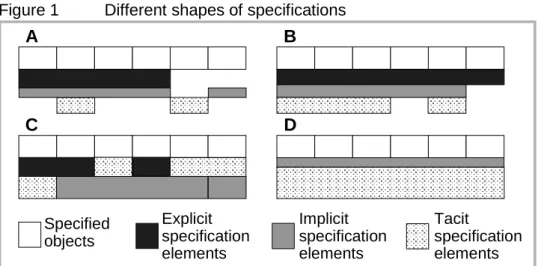
A service specification is clarified by this study as a combination of elements (objects and attributes, and sources, which in turn have implied forms and contents) which in interrelation define a process and its outcome. However, consideration should be made of situations where processes are defined lacking some of those elements. For example, a process in which the steps, the flow of information, the employee and the customer role are communicated to the employees orally or through the observation of examples, from the team leader or from the entrepreneur, with almost no use of explicit instructions (see shape D in Figure 1) . This is the case of small project teams. These situations do not appear to present problems of reliability or consistency, only some questions concerning replicability in different locations. Moreover, these may be the situations pointed out in the literature as not being specified (Teboul, 1991; see for example, Evans and Lindsay, 2002), that were
clarified by this research. One thing is the absence of specifications that results from lack of managerial ability, which may imply problems of reliability; another is the reduced use of explicit specifications but an increased use of implicit or tacit specifications, which in turn seems to foster reliability and consistency because it allows adaptation.
Different situations appear to be those where there is no place for implicit or tacit elements (though they are inherent to human beings) (see shapes A and C in Figure 1). These may be the situations identified in the literature as “manufacturing type” (see for example, Levitt, 1972; Levitt, 1976). At the extreme it could be considered to be an explicitly defined and carefully detailed process with regard to steps, elements and people involved, where people interactions would be completely scripted. This could be the case of a call centre. However, human interaction always carries connotation through the tone of voice or the use of words with subjective meanings that require interpretation. If there is no place for the interpretation of those interactions, through for example implicit instructions, or for some skills developed through trained examples (implicit) or through coaching (tacit), then the empirical data has shown that the shared learning by doing in a specific context tends to provide the employee with the tacit and implicit meanings s/he needs to deal sooner or later with similar situations. In summary, this research adds a definition of service specification, as a combination of explicit, implicit and tacit elements which in interrelation are used to define the delivery of the process. These different combinations can be called different shapes or types of specification and can be pictured as configurations of building blocks as shown in Figure 1. This study also contributes to the understanding of the use of specifications through the description of the elements in their different degrees of explicitness. The study alerts about the need of coherence between the elements that compose a specification due to its impact on people performance. If not, there may be inconsistency between what people are told to do, what they are trained to do, what they are assessed on, and the skills they have.
Figure 1 Different shapes of specifications
The cross process and cross case analysis expanded the existing knowledge, allowing the identification and understanding of the contextual variables that seem to influence the shape of service specifications. This means the contextual variables that may justify the use of more sources or forms of specification than others, and with a specific interrelation. These contextual variables are: the process size and/or age, and the process flexibility and customer interaction.
Process size and/or age
From the literature, more mature processes and/or processes within a bigger organisation structure (measured in terms of number of employees) could be expected to evidence usage of more explicit specifications, and draw less on implicit or tacit instructions (see for
Tacit specification elements Implicit specification elements Explicit specification elements Specified objects A B C D
example, Greiner, 1972). The cross process analysis within each case showed that younger processes appear to be less explicitly defined, as are smaller processes (measured in terms of number of employees, e.g. the complaint processes both at TAP and PGA). However, the cross case analysis did not support that association. The different processes in the two analysed cases make use of multiple elements of specification with all the degrees of explicitness. When comparing the PGA processes with the TAP processes it appeared that PGA relies more on tacit and implicit elements of specifications than TAP, both in big and small processes. PGA is younger and smaller than TAP but these differences do not appear to be the justification for the different shapes of specification found between the two cases. On the other hand, both companies make use of explicit specifications in some of the processes (e.g. check in and boarding processes) which seems to be justified by the mature industry where both operate. Therefore, similarities between the cases appeared to be justified by the fact that they share the same industry context, whereas differences between the cases seem rather to be justified by factors other than process characteristics, such as management style, type of ownership or strategic options.
Process flexibility and customer interaction
Increased customer interaction (e.g. check in and boarding) in the processes appeared to influence the use of explicitness in an opposite direction to size or age. Data from various processes in the two cases evidenced that the greater the customer interaction in the process, the more explicit instructions (e.g. manual of procedures) are complemented with implicit (direct supervision) and tacit elements (e.g. coaching and team working) of the specification. And the same rationale applies with regard to requisites of flexibility in the process. However, contrary to expectations (see for example, Levitt, 1972; 1976), processes with less or indirect customer contact seem to rely more on implicit and tacit elements of the specification and not so much on explicit and written elements. From the cross process and cross case analysis it can be argued that the decreased use of written instructions in low contact and interaction processes is justified by the small size of the processes (all up to twelve employees), though in both cases the processes belong to big organisation structures (of nearly 1,000 in one case and more than 2,000 in the other case). It can be contended that requisites of increased flexibility and interaction seem to explain the lower use of written specifications, but that these are also influenced in the opposite direction by the process age. Hence, the requisites of tight management dictated by high volume processes may be solved in high interaction contexts through the use of tacit (skills and shared experience) and implicit (direct supervision and training) elements complementary to some use of explicit (e.g. objective, clear and written) elements.
From this study it can be advanced that the size and age of the process may influence the need for explicit elements of a specification, while high degrees of interaction and requisites of process flexibility (e.g. for customisation purposes) influence the need to draw on implicit and tacit elements of a specification to provide meaning and detail to the explicit elements in all the situations. Further research with different processes and in different industries may confirm or refute this theory.
CONCLUSIONS, MANAGERIAL IMPLICATIONS AND FURTHER RESEARCH
This study answering RQ1 expands existing knowledge by identifying the service specification as a combination of several elements in a range of shapes. It fostered understanding of the elements that compose a service specification: it clarified the objects and their attributes, it added to the forms (written, oral, pictorial, skills) and to the sources (manuals, training, legislation, recruitment, coaching, etc.), and it clarified their use in different degrees of explicitness (explicit, implicit or tacit). This study clarified that less explicit elements of specifications seem to be controlled through less explicit means and
types of control, and that more explicit specifications may also be controlled by less explicit means. RQ3 is answered through the identification of sources of specification and through the recognition and clarification of their explicit, implicit and tacit nature.
Furthermore, this study contributes to existing theory by suggesting that different combinations of the specifications elements in different shapes may be considered different types of specification, and as such provides an answer to RQ2. Further research is needed to clarify what may define the boundary between the specification types. Notwithstanding the need for clarification of the boundaries between specification types, this study proposes that the process size and age may justify an option for more explicit specifications, whereas high degrees of customer interaction and requisites of process flexibility may influence the option for more implicit and tacit service specifications. Further research with different processes and in different industries may confirm or refute this theory.
There seems to be a two order implication of this study for service management. The first practical implication seems to be the attention that needs to be drawn to the management of more loose specifications (i.e. the coherent definition and control of more implicit and tacit elements). In fact, the absence of intervention (in terms of definition and control) in certain tacit and implicit elements of the specification (e.g. details of behavior) might have consequences on the reliability and consistency of the operations along time and among different employees, and on their replicability along sites.
The second order managerial implication appears to be the clarification of the link between operations, human resources and marketing managers. At the design stage, the interrelation between functional areas is required for the definition of the appropriate employee and customer skills, and for customer training. At the implementation stage, interaction is necessary to ensure coordination between operational goals, training, supervision, systems and customer participation. Both at the design and implementation stages a holistic perspective of the processes replaces a shared view of multiple elements. This means that overlooking certain elements and their interaction may prove to impact on performance management and so on operations effectiveness.
To the useful progress of theory development about specifications and of service specifications, it would be also interesting to further the study of the specifications of inputs and the details of its control, to explore in more depth the characteristics of these tacit elements and to compare their management in other contexts (e.g. in processes delivering low volume or low variety). It would also be interesting the further test of the findings of this research in the same or in a different industry through quantitative methods in a more positivist approach.
REFERENCES
Berkley, B. J. and Gupta, A., (1995), "Identifying the information requirements to deliver quality service", International Journal of Service Industry Management, 6, (5) 16-35. Bitner, M. J., (1992), "Servicescapes: the impact of physical surroundings on customers and
employees", Journal of Marketing, 56, (April) 57-71.
Bitran, G. and Pedrosa, L., (1998), "A structured product development perspective for service operations", European Management Journal, 16, (2) 169-189.
Bowen, D. E., (1986), "Managing customers as human resources in service organisations", Human Resource Management, 25, (3) 371-383.
Chase, R.B., (1981), "The customer contact approach to services: theoretical bases and practical extensions", Operations Research, 29, (4) 698-706.
Chase, R. B. and Tansik, D. A., (1983), "The customer contact model for organization design", Management Science, 29, (9 - September) 1037-1050.
of Operations and Production Management, 18, (12) 1223-1244.
Evans, J. R. and Lindsay, W. M., (2002), The management and control of quality, United States, South-Western, Thomson Learning.
Globerson, S., (1997), "Discrepancies between customer expectations and product configuration", International Journal of Project Management, 15, (4) 199-203.
Greiner, L. E., (1972), "Evolution and revolution as organizations grow", Harvard Business Review, July-August, 37-46.
Johnston, R., (1989), "The customer as employee", International Journal of Operations and Production Management, 9, (5) 15-23.
Johnston, R. and Morris, B., (1985), "Monitoring and control in services operations", International Journal of Operations and Production Management, 5, (1) 32-38.
Juran, J. M. and Gryna, F. M., (1988), Juran's Quality Control Handbook, United States, McGraw-Hill.
Kellogg, D. L. and Nie, W., (1995), "A framework for strategic service management", Journal of Operations Management, 13, 323-337.
Laroche, M.; Bergeron, J., and Goutaland, C., (2001), "A Three-Dimensional Scale of Intangibility", Journal of Service Research, 4, (1) 26-38.
Levitt, T., (1972), "Production-line approach to service", Harvard Business Review, September-October, 41-52.
---, (1976), "The industrialization of service", Harvard Business Review, September-October, 63-74.
Maister, D. H. and Lovelock, C. H., (1982), "Managing facilitator services", Sloan Management Review, Summer, 19-31.
McLaughlin, C. P. and Fitzsimmons, J. A., (1996), "Strategies for Globalizing Service Operations", International Journal of Service Industry Management, 7, (4) 43-57.
Miles, M. B. and Huberman, A. M., (1994), Qualitative Data Analysis, Second Edition, Sage Publications.
Ouchi, W. G., (1977), "The relationship between organizational structure and organizational control", Administrative Science Quarterly, 22, 95-113.
Parasuraman, A.; Zeithaml, V. A., and Berry, L. L., (1985), "A conceptual model of service quality and its implications for future research", Journal of Marketing, 49, (Fall) 41-50. Pinto, S. S. (2005), Understanding Service Specifications, Unpublished PhD Dissertation
submitted for the award of the degree of Doctoral in Philosophy and Business Studies at the University of Warwick, UK.
Schmenner, R. W., (1986), "How can service businesses survive and prosper", Sloan Management Review, Spring) 21-32.
Shaw, C. and Ivens, J., (2002), Building Great Customer Experiences, New York, Palgrave Macmillan.
Shostack, G. L., (1984), "Designing services that deliver", Harvard Business Review, January-February) 133-139.
---, (1987), "Service positioning through structural change", Journal of Marketing, 51, (January).
Slack, N.; Chambers, S., and Johnston, R., (2004), Operations Management. Fourth Edition, England, Prentice Hall.
Smith, S. and Wheeler, J., (2002), Managing the Customer Experience, Great Britain, Prentice Hall - Financial Times.
Teboul, J., (1991), Managing quality dynamics, Prentice Hall International.
Wyckoff, D. D., (1984), "New Tools for Achieving Service Quality", Cornell Hotel and Restaurant Administration Quaterly, November.
Yin, R. K., (1994), Case Study Research: design and methods, Second Edition, United States, Sage Publications.
Zeithaml, V. A.; Parasuraman, A., and Berry, L. L., (1990), Delivering quality service. New York: The Free Press.