CONTRIBUTIONS TO THE AUTOMATIC
RECOGNITION OF PORTUGUESE SIGN
LANGUAGE
CARLOS JORGE ALVES DA HORA MARTINS
DISSERTAÇÃO DE MESTRADO APRESENTADAÀ FACULDADE DE ENGENHARIA DA UNIVERSIDADE DO PORTO EM ENGENHARIA DA INFORMAÇÃO
iii
Resumo
Este trabalho insere-se num projeto de investigação com vista ao desenvolvimento de uma plataforma móvel de reconhecimento automático de línguas gestuais e foi realizado sobre uma base de dados da Língua Gestual Portuguesa (LGP) criada recentemente. As contribuições do mesmo para o projeto passaram pelo estudo diferentes tipos de características que podem ser usadas para classificar gestos estáticos e dinâmicos, e pela avaliação do impacto que a inclusão de informação de profundidade pode ter no reconhecimento de línguas gestuais.
No que concerne aos gestos estáticos, verificou-se que as características regionais, baseadas na silhueta dos objetos, são as que melhor descrevem a mão, em detrimento de características baseadas em medidas estatísticas ou de histogramas de orientação de gradiente. Além da base de dados da LGP, foi também utilizado o conjunto de dados de Triesch que corresponde a uma base de dados de referência para o estudo de gestos estáticos. A comparação dos resultados obtidos evidenciou que a naturalidade de execução dos gestos da base de dados LGP influenciou negativamente a classificação obtida.
Para os gestos dinâmicos, com componente de movimento, foram avaliados dois tipos de características: baseadas na posição absoluta das mãos e no seu movimento relativo. As características baseadas no movimento relativo foram as que retornaram melhores resultados, mostrando-se mais resilientes às velocidades de execução dos gestos e posição das mãos relativamente ao corpo.
No presente estudo a informação de profundidade existente não revelou melhorias significativas na classificação de gestos estáticos ou dinâmicos, embora se reforce a sua importância para a definição de novas representações das mãos, baseadas na estrutura das mesmas e não apenas na sua aparência.
v
Abstract
The present work is integrated in a research project which aims the development of a mobile platform of sign language automatic recognition and was realized over a recently created Portuguese Sign Language (LGP) database. The contributions for the project were the study of features that can be used in the classification of static and dynamic gestures and the impact evaluation of the depth information inclusion in the recognition of sign languages.
In what concerns the static gestures, it was observed that the regional features, based on the object’s silhouette, are the ones which best describe the hands, surpassing the performance of features based on statistical measures and gradient orientation histograms. Besides the LGP database, the Triesch dataset, which corresponds to a benchmark database for the study of static gestures, was also addressed. The obtained results comparison revealed that the LGP gestures execution naturalness affected negatively the obtained classification.
For the dynamic gestures, with movement component, two types of features were evaluated: the first based on the hands absolute position and the second on the relative movement. The relative movement based features returned the best results, proving to be more resilient to the gesture execution speed and hand position with respect to the body.
No meaningful improvements in the classification of static and dynamic gestures were revealed by the inclusion of depth information. However, this type of information has a high potential to be used in new forms of hand representation, based not only on the hands' appearance, but also on their structure.
vii
Agradecimentos
Este trabalho não teria sido possível sem o apoio...
... do Professor Jaime Cardoso e da Doutora Ana Rebelo que me orientaram ao longo de todo o trabalho, sendo decisivos nos momentos chave, e que estiveram disponíveis sempre que foi necessário;
... do Doutor Ricardo Sousa e do Pedro Ferreira que integram o projeto e que contribuíram para a definição inicial dos objetivos;
... das Professoras Ana Sofia Paiva e Ana Rio que despenderam algum do seu tempo para nos ensinar Língua Gestual Portuguesa;
... da Escola Artística de Soares dos Reis e do Agrupamento de Escolas Eugénio de Andrade: Escola EB 2/3 de Paranhos cujos alunos colaboraram na construção da base de dados;
... do VCMI que me acolheu e em particular do Pedro Monteiro que me auxiliou no tratamento da informação de profundidade;
... do INESC enquanto instituição de acolhimento.
A todos o meu sincero agradecimento,
ix
Contents
Chapter 1 ... 1
Introduction ... 1
Chapter 2 ... 3
Sign Languages Overview ... 3
2.1 The Sign Languages Importance ... 3
2.2 The Sign Languages History ... 3
2.3 The Portuguese Sign Language ... 5
Chapter 3 ... 8
State-of-the-Art ... 8 3.1 Segmentation ... 10 3.2 Manual Features ... 11 3.3 Recognition ... 13 3.4 Databases ... 153.4.1 Purdue RVL-SLLL ASL Corpus ... 15
3.4.2 RWTH-BOSTON Corpora ... 15
3.4.3 SIGNUM Corpus ... 16
3.4.4 Other Databases ... 17
Chapter 4 ... 18
Data and its Treatment ... 18
4.1 The LGP Database ... 18 4.2 Data Treatment ... 19
Chapter 5 ... 22
Static Gestures ... 22 5.1 Datasets ... 22 5.2 Hand features ... 24 5.2.1 Regional Features ... 24 5.2.2 Hu Moments ... 255.2.3 Gradient Orientation Histograms ... 26
x
5.3 Classification ... 28
5.3.1 Gaussian Naïve Bayes... 28
5.3.2 Support Vector Machines ... 29
5.3.3 Validation ... 31
5.4 Results and Discussion ... 32
5.4.1 Triesch Dataset Results ... 33
5.4.2 LGP Dataset Results ... 36 5.4.3 Results Conclusions ... 38
Chapter 6 ... 39
Dynamic Gestures ... 39 6.1 Gestures selected ... 39 6.2 Features Extracted ... 41 6.2.1 Cartesian Coordinates ... 42 6.2.2 Relative Features ... 43 6.3 Classifiers ... 436.3.1 Dynamic Time Warping... 43
6.3.2 Hidden Markov Models ... 45
6.3.3 Validation ... 48
6.4 Results and Discussion ... 48
6.4.1 DTW Results ... 48 6.4.2 HMM Results ... 51 6.4.3 Results Conclusions ... 55
Chapter 7 ... 56
Conclusions ... 56References ... 58
Appendix A ... 61
xi
List of Figures
Figure 3.1 - Data acquisition methods: data gloves; gloves with colored fingers; gloves with distinct color; studios with contrasting background and long sleeves; unconstrained
environment and depth images. ... 9
Figure 3.2 - Some vision based hand gesture recognition techniques... 9
Figure 3.3 - Holden, et al. [12] proposal to deal with occlusion. ... 11
Figure 3.4 - (left) Angles extracted by Holden, et al. [12] to compute the feature vector. (right) Cooper and Bowden [13] grid division. ... 12
Figure 3.5 - (left) Example of parallel HMM from Von Agris, et al. [15]. (right) Grammar structure used by Holden, et al. [12]. ... 14
Figure 4.1 - Capturing conditions of the LGP database. ... 19
Figure 4.2 - Color and depth pair of images. ... 19
Figure 4.3 - Examples of the utilization of the software Interactive Segmentation Tool. ... 20
Figure 4.4 - Example of the discrepancy between the color and depth images. ... 20
Figure 4.5 - MatLab tool to apply the affine transform. ... 21
Figure 5.1 - Different backgrounds used by Triesch. ... 23
Figure 5.2 - Different levels of segmentation applied. Segmentation level 1 on the left and Segmentation level 2 on the right. ... 23
Figure 5.3 - Gesture eight of the LGP performed by five subjects. ... 24
Figure 5.4 - (left) Masked grayscale image. (right) Gradient orientation image representation. .. 27
Figure 5.5 - SVM hyperplane and margin representation. ... 30
Figure 5.6 - k-fold cross validation. ... 32
Figure 5.7 - Triesch dataset gestures. ... 34
Figure 5.8 - Gestures 1 (left) and 7 (right) of the LGP dataset performed by the two subjects. .. 37
Figure 6.1 - Cartesian coordinates features. ... 42
Figure 6.2 - Angle based features representation. ... 43
Figure 6.3 - HMM representation. ... 45
Figure 6.4 - Three state left-to-right HMM... 46
xii
List of Tables
Table 3.1 - Some characteristics of the most important databases. ... 17
Table 5.1 - Naïve Bayes accuracies to Triesch dataset with segmentation level 1. ... 33
Table 5.2 - SVM accuracies to Triesch dataset with segmentation level 1. ... 33
Table 5.3 - Confusion Matrix of the Triesch dataset. ... 34
Table 5.4 - Naïve Bayes accuracies to Triesch dataset with segmentation level 2. ... 35
Table 5.5 - SVM accuracies to Triesch dataset with segmentation level 2. ... 35
Table 5.6 - Comparison of the results from different studies. ... 35
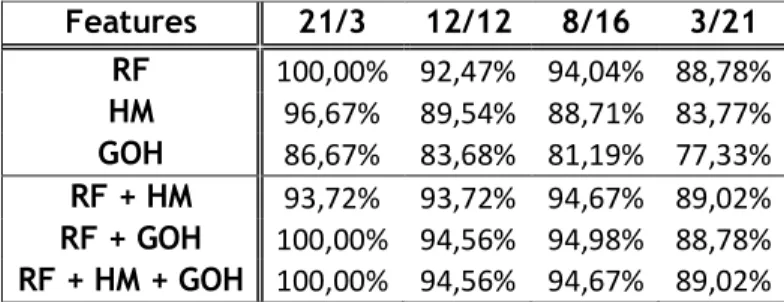
Table 5.7 - Classification accuracies of the LGP dataset. ... 36
Table 5.8 - Confusion Matrix of the LGP dataset. ... 37
Table 5.9 - Accuracies of the leave one subject out classification with the RF. ... 38
Table 5.10 - Accuracies of the leave one subject out classification with the RF + DF. ... 38
Table 6.1 – Class of the gesture with smaller DTW. ... 49
Table 6.2 - Subset S1 confusion matrix. ... 49
Table 6.3 – Class mode of the five gestures with smaller DTW. ... 50
Table 6.4 - Training set classification accuracies with Cartesian features. ... 52
Table 6.5 - Leave-one-subject-out results with Hand shape features. ... 52
Table 6.6 - Leave-one-subject-out classification results with Cartesian features. ... 53
Table 6.7 - Leave-one-subject-out classification results with Cartesian features and gestures grouped by their similarity. ... 53
Table 6.8 - Training set classification accuracies with Relative features. ... 54
Table 6.9 - Leave-one-subject-out classification results with Relative features. ... 54
xiv
List of Acronyms
DF Depth Features
DTW Dynamic Time Warping
GOH Gradient Orientation Histograms HM Hu Moments
HMM Hidden Markov Models
LGP Língua Gestual Portuguesa (Portuguese Sign Language) RF Regional Features
SL Sign Language
SLR Sign Language Recognition SVM Support Vector Machines
1
Chapter 1
Introduction
Communication is one of the most fundamental characteristics of the human evolution. Its implications go far beyond the communication with each other. It defines how our brain is structured and so the way how we relate to the world around us. Most of us have the ability of communicate with the voice and audition, using the sound as medium. For those who are not able to use these senses the relation with their environment is a bit different. Sign Languages emerged inside the deaf communities as the preferential way of communication. They are spread around the world with a wide variety and complexity and can be as rich as spoken languages.
The technological evolution to which the world has assisted since the end of past century, created several forms of everyday life simplification. We have cellphones and computers for communication and work, medical devices to treat us when we are diseased or internet for almost everything, to name just a few examples. It is quite natural to imagine that we can use these resources to facilitate our communication with who does not know our language or cannot use the same communication medium. Sign Language computational recognition has a fundamental role in the communication with deaf people in the upcoming future.
Sign Language Recognition (SLR) systems have several applications. They can be used in translation systems to convert signs in sound and vice versa. This is important not only to ease the communication between deaf and hearing people but also increase the amount of contents to which the deaf can access. The creation of a visual dictionary is another interesting possibility. There are already dictionaries which show us the gestures correspondent to a given spoken word but it is not possible yet to know the meaning of a given gesture. Academically, SLR systems are a particularly interesting case study of the gesture recognition field which has applications in the new man-machine interaction systems.
This work is a contribution to the study of SLR systems and is integrated in a research project which aims the development of a mobile platform of SLR. A recently created database of Portuguese Sign Language (LGP) was used. This database was created at INESC with the
2 Introduction
2
cooperation of some native signers, and is composed of several isolated signs and sentences. At the moment there are no studies or applications in LGP automatic recognition and so, this work provides the first tools and will enhance new paths of investigation.
The study is divided in two main types of gestures: the static gestures, which only have hand shape component, and the dynamic gestures which have also movement and position with respect to the body. Several features that can be used to describe each type are presented associated to the state-of-the-art models that can be used to classify them. Given the existence of depth information in the LGP database, the use of this type of information is also evaluated.
This work is divided in the following way: Chapter 2 is described briefly what is a Sign Language and is presented the LGP in more detail. In Chapter 3 is summarized the State-of-the-Art in SLR. Chapter 4 presents the LGP database and the preprocessing applied to the data. In Chapter 5 the static gestures classification performed are explained and in Chapter 6 the same is done to the dynamic gestures. In the end Chapter 7 presents the final conclusions of this work.
3
Chapter 2
Sign Languages Overview
2.1
The Sign Languages Importance
The communication development is one of the most important aspects that enabled the human evolution as we know. It defines our structure of thought and the way how we develop ourselves inside our communities and societies. Languages are in a process of constant evolution and result directly from the interaction between their users. By just looking to the different spoken languages across the world it is possible to see these evidences and the distinction between them is more sharp as more isolated the communities are. While very important to the development of spoken languages, these aspects of the communication evolution contributed to the isolation and marginalization of deaf and mute people.
All children are born with the innate ability to learn a language. Especially during the first years it is fundamental, to the cognitive development, that the children are surrounded of a communication environment. In the case of the deaf children however this condition may be hard to guarantee. A deaf can learn spoken languages, training lipreading. This is not possible however while they are growing and need to learn fundamental concepts as the notion of father or mother. The SL is then the best option to teach and help these children in their development because it uses a medium of information transmission that is accessible to them.
The importance of this form of communication is enormous to the deaf communities and is mandatory that a society that prizes the integration of everyone and especially of the disadvantaged, that provides the means to teach and disseminate the Sign Languages to whoever needs it.
2.2
The Sign Languages History
There is not much information on how deaf people behave inside their communities before sixteenth century. It is quite easy however to imagine that they probably grouped themselves and
4 Sign Languages Overview
4
developed their own ways of communicate with each other. Even the ones that born deaf inside hearing families, without contact with other hearing impaired people, might have created some form of making their relatives understand them. The ability of communicate is natural to the human condition, independently of the medium in which it is carried. Even the hearing people execute unconscious gestures when explaining an idea to the others, sometimes on the telephone.
One of the first teachers known of hearing impaired people was Frey Ponce de Leon to who was trusted the education of Spanish nobles on the middle of sixteenth century. The deaf education at that time was a luxury because a deaf without a title was not even considered as a person according to the law in force. To his successor, João Pablo Bonet, is due the first SL known book [1].
According to Stokoe [2], until the eighteen century the teaching of deaf people was performed by tutors that taught few pupils with unclear or secret methods. The language taught was the local spoken language, with the same grammar and lexicon, and the words where spelled letter by letter using the correspondent sign. L'Épée demonstrated however that it was possible to habilitate someone to decode a letter or a sign without really understand it, showing the disadvantages of the methodologies used until then. He was one of the first to understand the naturalness of sign communication and created a teaching method based on signs from deaf communities. L'Épée founded a school to teach sign languages to deaf people in 1750 and his work was one of the most important contributions to the evolution of sign languages around the world as we know now.
Some years later, Gallaudet was sent from Connecticut, USA, to Europe to acquire knowledge about the teaching methods of sign languages. He was received by Sicar, one of the L'Épée successors, which sent Clerc with him to aid in the creation of school for hearing impaired people in USA. This is the reason why the American Sign Language (ASL) is much more similar to the French Sign Language (LSF) than with the British Sign Language (BSL) and is also a proof that there is not necessary correspondence between some local sign and spoken language. The same happen with the Portuguese Sign Language (LGP) and the Brazilian Sign Language (LIBRAS).
The discussion around the Sign Language existence and definition as a language was far from being over. A few years after the creation of the SL school in USA, it was opened a lively discussion opposing the combined method of Edward Gallaudet to Alexander Bell, a supporter of the oral method. This discussion was carried in 1880 to the Second International Congress on Education of the Deaf, the famous congress of Milan, where several resolutions were approved, from which the following stand up [3]:
Resolution 1: “The Convention, considering the incontestable superiority of articulation over
signs in restoring the deaf-mute to society and giving him a fuller knowledge of language, declares that the oral method should be preferred to that of signs in education and the instruction of deaf-mutes.”
Sign Languages Overview 5
5
Resolution 2: “The Convention, considering that the simultaneous use of articulation and
signs has the disadvantage of injuring articulation and lip-reading and the precision of ideas, declares that the pure oral method should be preferred.”
While in Europe every country accepted and implemented the Congress resolutions, USA and Britain opted to maintain their combined method. The technological progress observed after the Second World War brought new devices able to increase the auditory capacity of the deaf. However, the results were not very satisfactory and the deaf continued showing a retarded development when compared to the hearing people, contributing to their social exclusion.
Only in 1962, with the study of Stokoe [2], the first SL linguist, the ideas behind the Milan resolutions which defended that the SL was poor, rudimentary and without structure were abolished. Stokoe demonstrated that the SL is equivalent to the verbal languages, with own grammar and phonetic level. As result of this remarkable work the SL was adopted as the first language of deaf people all over the world.
In Portugal the LGP definition starts only in the decade of 1980 when it was collected the first signs of the LGP lexicon and defined a first grammar. In 1997 the Portuguese Sign Language gain the legal status of official language of the deaf community. It is now, hand in hand with the Portuguese Language and Mirandês, an official language of Portugal.
2.3
The Portuguese Sign Language
Since the Portuguese sign language was recognized as a language there were developed several works [4-6] with the purpose of homogenize all known "dialects" in a single language. Given the communication isolation of the deaf communities, it is quite normal the existence of regional variations, sometimes so pronounced that almost constitute a different language. Wittmann [7] did a comparative study of several sign languages across the world and classified them according to their origin and similitude. He states that LGP was created from Swedish Sign Language (STS) that, by its turn, is related to the BSL.
The Portuguese Sign Language has its own grammar, lexicon and syntax. The information is organized in sentences that in turn are composed of isolated signs. An isolated sign can be divided in cheremes, the equivalent to the phonemes of spoken languages. These cheremes are the basic structural unit of sign language gestures and are constituted of 5 elements: hand configuration, place of articulation, movement, orientation and facial or body expressions [6].
• Hand Configuration
In the LGP the hands do not have the same importance. There is a dominant hand, which carry the most relevant information, and a supporting hand that is used to complement some gestures. The choice of the right or left hand as dominant hand is free to the signer. Hands can adopt countless configurations by just moving the fingers. There are several gestures which require specific hand configurations as the alphabet or the ordinal numbers.
6 Sign Languages Overview
6
Many words Portuguese words, like the names of people or cities, do not have a correspondent gesture in the LGP. It is usual in this case to sign them character by character using the correspondent signs.
• Orientation
The hand orientation is directly related to the hand configuration and is defined by the palm placement. In some cases the hand orientation inversion alone indicates the gesture opposite.
• Place of Articulation
Since the sign language information is carried through the visual medium, the place where the gestures are realized is extremely important. There are two main places where the gestures can be realized: the virtual rectangle in front of the signer and the plane of the signer body where some spots can be used as references to some signs.
• Movement
Some gestures are static, as the cardinal numbers which do not use movement to transmit information, while others are dynamic, as verbal subjects that have the movement as the main component. The gestures speed and duration may have also an interpretation.
• Facial and Body Expression
The facial and body expression has also an important role. This kind of information can be used to complement other gestures and from them may depend the distinction of a statement from a question.
The organization of sentences follows a Subject-Object-Verb (SOV) structure in opposition to what happen in the spoken languages. The next example shows how the sentence - "The cat eats fish" - would be pronounced in the LGP. The sentence is in the gloss format that is normally used to represent signs with text.
EL: The cat eats fish. LGP: CAT + FISH + EAT//
Nevertheless, there are some situations where the structure Object-Subject-Verb (OSV) can be used.
In the same sentence the negation can be transmitted just by adding the gesture /NOT/ after the verb neutral form.
EL: The cat does not eat fish. LGP: CAT + FISH + EAT + NOT//
Sign Languages Overview 7
7
The time notion is transmitted using a similar approach. The following two examples show how to express the idea of past or future respectively.
EL: The cat ate fish.
LGP: CAT + FISH + EAT + PAST// EL: The cat will eat fish tomorrow. LGP: CAT + FISH + EAT + TOMORROW//
The inclusion of facial and body expression can be used as a complement of other gestures. The time notion for example can be reinforced by performing the same gesture in a plane further away from the signer, to the front to represent future or to the back to the past.
8
Chapter 3
State-of-the-Art
SLR is an interesting case study of gesture recognition and there are already many studies and research teams working on it. This section aims to present some of the most relevant contributions in this field that serve as basis to the current work.
The first step to be considered is data acquisition method. There are two main ways of gather information from sign language gestures: using wearable hardware equipment or in a vision based way [8]. The wearable hardware equipment corresponds to the use of data gloves or similar equipment that store information of the hand and fingers position and their relative movement. This is the most accurate way of recording gesture information and some studies [9, 10] have reported good results in the SLR with this kind of data. However, this approach is not real world scenario. A system that aims to ease the interaction with deaf people should be vision based.
Vision based data is harder to handle in terms of features extraction because of the difficulties of correctly segment the hands and face in the images. Most of the analyzed studies, used data recorded in controlled environments and some of them with visual markers to aid the hand and finger tracking. It is the example of Holden and Owens [11] that used gloves with colored finger joints to ease the features extraction. The majority of the studies, e. g. [12-14], used images recorded in studios with dark background and signers wearing clothes with non-skin color and long sleeves. There are few examples of systems created to be used in uncontrolled environments without background restrictions [15]. More recently, with the emergence of depth cameras like Kinect from Microsoft, some authors presented systems that used this type of information [16]. Figure 3.1 shows different data acquisition methods used in SLR.
The state-of-the-art techniques exposed are mostly based on systems that used vision based data without optical markers. This field can be divided in three main areas as presented in Figure 3.2: segmentation and tracking, features extraction and recognition. Section 3.1 describes briefly the segmentation stage, section 3.2 presents the most common features used to represent gestures according to the literature and in section 3.3 is shown a review of the recognition
State-of-the-Art 9
9
methodologies. In the end, in section 3.4, is presented a selection of available databases that can be used in SLR.
Figure 3.1 - Data acquisition methods: data gloves; gloves with colored fingers; gloves with distinct color; studios with contrasting background and long sleeves; unconstrained environment and depth
images.
10 State-of-the-Art
10
3.1
Segmentation
In order to create a system able to recognize SL gestures it is necessary to get information from images. An image is a set of pixels with values representing colors. The direct appreciation of this type of data by a computer is not very informative. To use images it is necessary the application of some kind of transformation. In the particular case of gesture recognition the first step of this transformation is the face and hands segmentation. The segmentation can be divided in two main areas: detection and tracking. Detection comprises all methodologies applied to individual frames in order to identify the hands, face and other body parts considered relevant. The tracking in other hand, corresponds to the use of previous or posterior information of the position of the objects in study and predict the current position.
In gestures that are performed without gloves, a good characteristic that can be used is the color of the skin. Most of the studies in SLR used skin color models to distinguish skin pixels from the rest of the image. Jones and Rehg [17] presented a histogram based model to identify skin pixels in the RGB space. The model got good performances in the distinction of images with or without people for Web filtering purposes. Posterior studies suggested the use of color spaces with the chromatic component separated from the luminance. It is the case of Khan, et al. [18] that did a comparative study between several clustering methods in different color spaces and determined that the 2D color spaces based on the hue and saturation returned the best results. Cooper and Bowden [13] presented a color model that is refined by the color of the face. The faces are detected using Viola-Jones algorithm and from them a skin color Gaussian model of the signer skin is obtained.
In real world scenarios these models may detect background objects as skin or even detect other people. There are not, yet, satisfactory answers in the literature to surpass this difficulty in approaches based in the skin color. A solution is proposed by Von Agris, et al. [15] that suggest a background model, corresponding to the median of a set of initial images, which can be used to filter the background in the sequence.
Motion and shape information are also addressed in some works but without satisfactory results in terms of accuracy and computation speed. Awad, et al. [19] presented a system to segment the skin that combines skin color, motion and position models. The authors defined motion in a two-step process: first they computed the difference between the correspondent pixels of two subsequent images and then they transformed these distances in probabilities, assigning higher probabilities to pixels that were previously defined as skin. A regular Kalman filter was used to estimate the position of the hands from one frame to the other. After that, the distance between the image and the predicted template was computed and normalized in order to be in the form of a probability. The final decision was done by combining the results of the three models. Another segmentation difficulty is deal with occlusion. Many gestures in all sign languages are performed in front of the face or with the hands touching or hiding each other and forming a blob in the computer vision point of view. Some authors [15, 20] choose to deal with these blobs as single objects without trying to divide it. Holden, et al. [12] proposed the use of
State-of-the-Art 11
11
an active contour model combined with temporal variance information to distinguish overlapped object. Figure 3.3 is an example of this method results.
Figure 3.3 - Holden, et al. [12] proposal to deal with occlusion.
Segmentation still is a critical area of the SLR. The majority of the studies analyzed have strong restrictions in terms of background and clothing which ease the objects detection, improving the performance of the respective systems, but are far to be a real world scenario.
3.2
Manual Features
Messages in sign languages have two main components: the manual and non-manual. Manual component includes all information that can be carried by the hands. It can be divided in: hand shape, motion and position with respect to the body. The non-manual component by its turn includes the facial expressions and the movement of the head and body. Below are described some of the state-of-the-art features that can be extracted from the hands.
The field of gesture recognition starts with the identification of static hand shapes. Freeman and Roth [21] propose a system based on the histogram of orientations that was independent of luminance but it was not independent of hand orientation and identifies different postures as the same. Chang, et al. [22] used Zernike Moments (ZMs) and Pseudo-Zernike Moments (PZMs) in the identification of 6 hand gestures. They worked with binary images and got some miss classifications due to segmentation inefficiencies. Kelly, et al. [23] used size functions based on hand contour and Hu moments as features to represent the hand shapes. The authors claim accuracies above 95 % in the identification of the alphabet letters from the ISL dataset with 24 signers.
12 State-of-the-Art
12
Most of the SL gestures include motion together with the hand shape. Frequently, different hand motion with the same hand shape represents a totally different sign and vice-versa. Starner, et al. [20] suggested the use of regional characteristics as features. After detecting the hands blobs the authors extracted from each the x and y position, their derivatives, the blobs area, the angle of the eigenvector of least inertia and its length and the eccentricity. This corresponds to feature vector of sixteen elements that was further used to training. These values were not normalized turning this method dependent of the signer and of the distance to the camera. To deal with occlusion the authors propose the computation of the features of the joint blob and the use of it to both hands.
A similar approach was used by Von Agris, et al. [15] but with 11 features of each hand and non-manual features from the facial expressions. To turn their model independent, the authors normalized the absolute features according to the head position and shoulders distance estimation. Occlusion was also treated differently. The features of each hand during the occlusion periods were linearly interpolated from the conditions before and after occlusion. This method however is still dependent of a correct normalization that may be difficult due to signer morphological independence, e. g. in terms of hand size. It also did not address the importance that the relative position of the hands with each other and with the head. Holden, et al. [12] propose the use of features based only on the relative position of the hands and face as the left scheme of Figure 3.4 shows. The feature vector was: cos θ1, sin θ1, cos θ2, sin θ2, cos θ3, sin θ3, DRt, DLt and SRt / SLt. DRt and DLt correspond to the roundness of the right and left hand
respectively and S corresponds to the area of the hands. Yang, et al. [14] used a similar method but with a different set of features.
Figure 3.4 - (left) Angles extracted by Holden, et al. [12] to compute the feature vector. (right) Cooper and Bowden [13] grid division.
A different approach was introduced by Cooper and Bowden [13]. The authors proposed a method to classify each viseme according to its category [24]: placement, movement and
State-of-the-Art 13
13
arrangement. Their method consists on binarizing the image according to the skin and then quantizing the result with a grid defined by the face location. Each square of the grid has a quarter of the area of the face that is located in the upper center of the grid as shown in the right image of Figure 3.4. Each square is turned white if more than 50% of it is skin and in black otherwise. From the resultant image they computed several measures like the image moments.
With the emergence of depth cameras some authors propose systems based on 3D information. It is the case of Kurakin, et al. [16] that used a feature vector with speed, rotation and shape information. The authors modeled the shape using two components. The first consisted on dividing the hand bounding box with a grid and building a feature vector with the information of hand percentage in each square. The second corresponds to the division of the same bounding box in a polar grid centered in the mass center of the segmented hand and registration of the distance from this center to the hand boundary in each polar division.
The diversity of features used in SLR studies is a reflex of the embryonic state in which this area is. Almost all studies use a different set of features, sometimes corresponding to variations of the existent but usually being entirely different. The problem with this diversity is that these studies do not compare the results of their features with others previously proposed and since almost all of them use different gestures, it is hard to take conclusions about the features quality and applicability. This lack of normalization in terms of procedures make this area very dispersed and hampers the use of previous works to develop new ones.
3.3
Recognition
The SL recognition can be divided in two main areas: the recognition of isolated signs and the recognition of continuous signs. An isolated sign corresponds to the execution of a single gesture that represents a single word or idea. Martínez, et al. [25] divided the isolated signs in three parts: 1) movement from rest position to the place where the sign starts; 2) the sign itself; 3) movement of returning to the rest position. In continuous sign language recognition the objective is the detection of sign language sentences. These sentences correspond to a sequence of gestures that alone represent words. The gestures execution is realized in a continuous manner without returning to the rest position during the gestures transition. The transition is done naturally from the end position of one gesture to the start position of the next and it is called sign epenthesis [26]. This is a source of confusion to the recognition task and it is the reason why many initial studies only work with isolated signs. Additionally, the study of isolated signs provides interesting clues of what type of features should be used in SLR.
One of the simplest methods to recognize gestures is the motion comparison, ignoring the hands shape and position with respect to the body. Athitsos, et al. [27] used the Dynamic Time Warping (DTW) metric to compare the movements of the test set of gestures to the training and then classifying according to the smallest value obtained. Chai, et al. [28] proposed a similar
14 State-of-the-Art
14
approach with 3D movement data from Kinect with an equivalent comparison measure. Instead of using the standard DTW the authors computed the Euclidean distance between trajectories.
The most common method to recognize signs are the Hidden Markov Models [12, 15, 20]. One of the first works that applied this method in a computer vision environment was proposed by Starner, et al. [20]. After tuning the model, the authors determine that the best results correspond to an HMM with four states. A similar approach was proposed by Von Agris, et al. [15] but with parallel HMMs classifying different aspects of the same gesture. The left scheme of Figure 3.5 shows an example of how this method works.
Figure 3.5 - (left) Example of parallel HMM from Von Agris, et al. [15]. (right) Grammar structure used by Holden, et al. [12].
Continuous sign language recognition brings additional difficulties. A continuous gesture corresponds to sentence composed of two or more words. These words are normally organized according the grammar structure of the correspondent sign language. Holden, et al. [12] included grammar constraints to ease the sentence level recognition as right image of Figure 3.5 shows. This type of imposition prevents the model of identifying some words in the wrong position of the sentence. Sign languages have characteristics that do not exist in spoken languages. One of them is the existence of non-intentional signs, as the previously mentioned epenthesis, that might confuse the recognition system or even the interlocutor. An automatic system must be able of distinguish each individual word in a sentence. Recently several studies proposed methodologies that are able to handle with this problem. Yang, et al. [14] proposed a model based on Conditional Random Fields able to distinguish between vocabulary signs from non-vocabulary signs. A different approach is proposed by Yang, et al. [14] who handled the problem using Dynamic Programing.
State-of-the-Art 15
15
3.4
Databases
The sign language recognition with computer vision data requires the acquisition of a significant amount of different gesture videos. To improve the classification accuracy, each gesture should be performed several times and, in systems that intent to be signer independent, the acquisition process should be repeated by each subject. Additionally, videos must be annotated in a frame-by-frame basis to allow posterior classification. This is an onerous and expensive process that requires the cooperation of native signers or interpreters.
Many of the presented studies on this field work with their own databases that are not easily or totally accessible to consult. This hampers the comparison between systems that work with different datasets and so the conclusions to take about their performances. To surpass these difficulties some benchmark datasets were created with the respective annotations. They can be organized in two groups depending on the recognition task to which they can be used for: the isolated sign recognition and the continuous sign recognition. In the following subsections are presented some of the more relevant databases in SLR.
3.4.1
Purdue RVL-SLLL ASL Corpus
The Purdue RVL-SLLL ASL Corpus (2002) is an available database based of the American Sign Language (ASL) presented in [25]. It has 2 parts, one composed of isolated signs and the other of continuous. The first part contains a set 39 gestures that the authors called primitive motion, corresponding to basic hand movements in ASL, and 62 gestures representing the English alphabet and the numbers from one to twenty. Each gesture was done only once by each signer in the most accurate way possible. The second part includes 10 groups of two sentences (paragraphs) performed sequentially and recorded in the same video. The two sentences, corresponding to different utterances, were not divided which can present some problems to the recognition task.
The experiment was performed by 14 native ASL signers in two different light environments: with diffused light to reduce the shadows and with directed light to increase contrast. The studio of the experiment had a uniform and contrasting background but it is not referred any clothing constraint.
3.4.2
RWTH-BOSTON Corpora
The RWTH-BOSTON Corpora is a set of databases summarized in [29]. These databases were created to serve as benchmark datasets of ASL to SLR studies. The acquisition conditions were the same to all databases: dark studio background and the signers clothing was constrained with long sleeves and non-skin color. Each gesture was recorded by 4 cameras: two in the front, to stereo vision purposes, one on the side and the other in the front, with close zoom on the face. The last one stored the images in RGB and the others in grayscale.
RWTH-BOSTON-50 Corpus (2005) was the first database created to be used in isolated sign recognition. It is smaller than the correspondent of Purdue, with only 3 signers and a vocabulary
16 State-of-the-Art
16
of 50 words. In contrast to what was done in the Purdue database, each gesture was repeated more than once in a total of 483 utterances.
The RWTH-BOSTON-104 database (2007) was one of the first benchmark databases created to continuous sign recognition and is still one of the more relevant and used. It has more than 15k annotated frames corresponding to 201 sentences performed by 3 native signers. More recently [30], on this database was annotated information about hand and head position for tracking purposes.
The last and larger database is the RWTH-BOSTON-400 database (2008). It has a total of 843 sentences and vocabulary of 104 words, performed by 4 native signers. This corresponds to almost 70k images that, for now, do not have ground-truth information. One particularity of this dataset is that it does not have only the annotation of the glosses but also of the English translation.
3.4.3
SIGNUM Corpus
The presented databases are not yet suitable to signer-independent continuous sign language recognition. The Purdue database has a small number of sentences and the RWTH-BOSTON because it has only 4 signers. A more complete database is presented by von Agris and Kraiss [31], the SGNUM database of the German Sign Language (DGS). It is the larger database recorded until now for recognition and tracking purposes with approximately 55 hours of videos, performed by 25 native signers, which correspond to almost 31k videos. It can be divided in two parts: one with only isolated signs and the other with sentences.
The isolated sign part has a vocabulary of 450 words selected with the requirement of be the most common in several books and videos used in DGS learning. The continuous part is composed of 780 sentences that vary in number of words from 2 to 11. In terms of video recording, it was performed in a very controlled environment with dark blue background and dark clothing with long sleeves.
State-of-the-Art 17
17
3.4.4
Other Databases
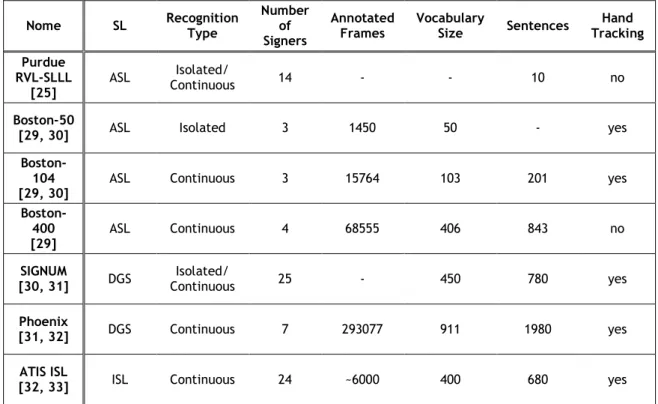
There are already other SL databases available. Dreuw, et al. [30] present and compare some of them in terms of study application and annotated number of frames. Table 3.1 summarizes some important database characteristics.
Table 3.1 - Some characteristics of the most important databases.
Nome SL Recognition Type Number of Signers Annotated Frames Vocabulary Size Sentences Hand Tracking Purdue RVL-SLLL [25] ASL Isolated/ Continuous 14 - - 10 no Boston-50
[29, 30] ASL Isolated 3 1450 50 - yes
Boston-104 [29, 30]
ASL Continuous 3 15764 103 201 yes
Boston-400 [29] ASL Continuous 4 68555 406 843 no SIGNUM [30, 31] DGS Isolated/ Continuous 25 - 450 780 yes Phoenix [31, 32] DGS Continuous 7 293077 911 1980 yes ATIS ISL
[32, 33] ISL Continuous 24 ~6000 400 680 yes
18
Chapter 4
Data and its Treatment
4.1
The LGP Database
The LGP database was recently created at INESC and is the first database oriented to the SLR based on the Portuguese sign language. This database is composed of 182 isolated signs, including the alphabet and the ordinal numbers as well as pronouns, verbs or common expressions, some realized with one hand and others with both. These signs include not only the informative part but also the movement from rest position and the return to it, since it is hard to determine the exact frame where the gesture start and ends. It also has 40 sentences with a variable number of isolated gestures. The list of all isolated signs and sentences used can be consulted in Appendix A.
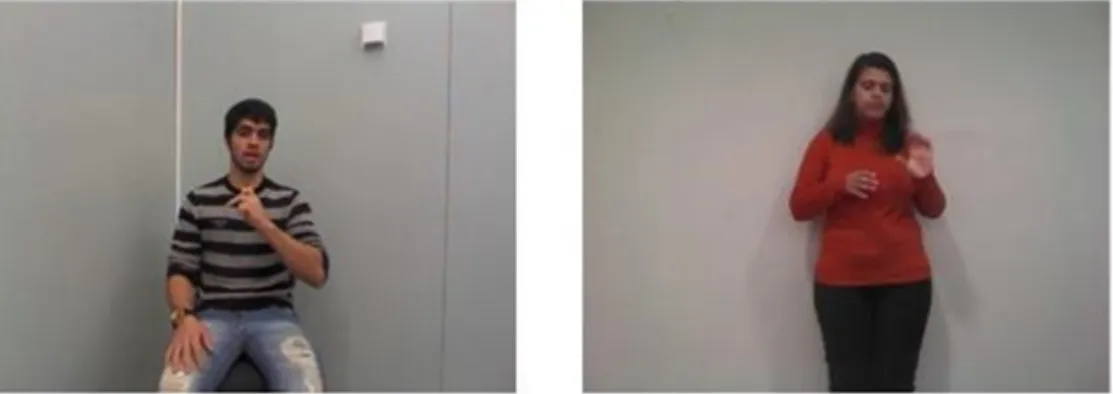
The gestures were performed by 13 native deaf, of male and female gender, in a free and natural expression environment, without clothing restrictions but with a uniform background. Some of the subjects realized their gestures standing up while others were seated in a chair. In Figure 4.1 are shown two examples of gestures performance conditions.
This dataset is one of the few with depth information associated to the RGB images obtained using the Microsoft Kinect camera. The images were captured with rate of 20 frames per second and with a resolution of 640x480 pixels. The depth capturing technology is still in an initial stage and so, there exist some noise associated to surfaces normal to the capturing plane and non-rigid materials as hair. Figure 4.2 is an example of a pair of color and depth images.
It does not have yet annotated frames for classification or marks for tracking but the existence of depth information may open new paths of investigation which make the use of this database very promising.
Data and its Treatment 19
19
Figure 4.1 - Capturing conditions of the LGP database.
Figure 4.2 - Color and depth pair of images.
4.2
Data Treatment
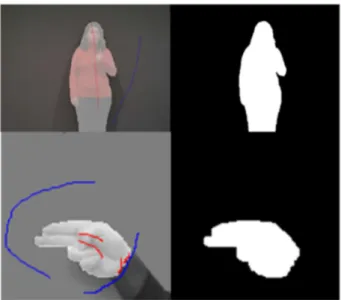
One of the most important tasks of SLR systems is the segmentation of the images to isolate the hand or the face from the rest of the image. This is not however the focus of this study. The segmentation performed was done manually using the software Interactive Segmentation Tool [34] developed by Kevin McGuinness from the Dublin City University. As the name indicates, this software allows the segmentation of an object from its background interactively by simply indicating with lines the areas corresponding to the foreground and background. It possesses several segmentation algorithms as the Seeded Region Growing Segmenter [35], that had the best performances in the segmentation of the body from the background, and the Interactive Graph
Cuts Segmenter [35] that was used to segment the hands. Figure 4.3 shows two examples of the
20 Data and its Treatment
20
Figure 4.3 - Examples of the utilization of the software Interactive Segmentation Tool.
In some cases however, it is hard to segment the images even with this tool. When the cloth color is similar to the subject skin, when the hand is in front of the face or when it is moving and appears associated to blurring effects, it is difficult to determine the hand boundaries. To surpass this difficult over the color images, the edges of the correspondent depth images was superimposed. The existence of boundaries from other sources improved the software performance and increased the segmentation speed.
This approach raised a new problem. The depth and color images had different enlargements and the subjects were not in the same positions. Figure 4.4 is an example of type of discrepancy existent.
Data and its Treatment 21
21
The solution found was to transform the depth images using an affine transform. This operation remaps the points , to the location to the new location , ′ as shown in Equation (4.1). It is a combination of linear and translation operations which keep the parallelism between lines and the ratios between them. This involves some loss of information but, since the difference between images is small, it is negligible.
′ ′
1 0 0 1 1 (4.1)
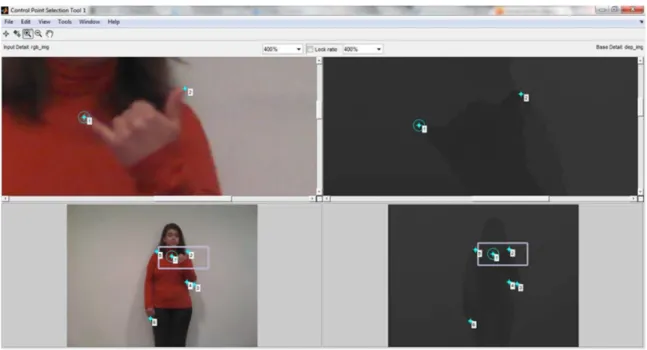
To compute the coefficients of this transformation it is necessary to select manually some matching points of both images. Since the used transformation has 6 parameters at least 3 points of both images are needed. The Image Processing Toolbox of MatLab has already an implementation of this transformation technique that is shown in Figure 4.5.
Figure 4.5 - MatLab tool to apply the affine transform.
The edge image was then obtained using a Sobel edge detector and overlapped in the color image. This configuration was chosen because the segmentation software has better performances over the color images than over the depth images.
22
Chapter 5
Static Gestures
The current chapter presents a study of several features that can be used to classify hand images according to the shape. Two distinct datasets were selected with this purpose: the Triesch dataset and the LGP dataset. The former is a benchmark dataset created by Triesch and von der Malsburg [36] to be adopted in hand shape classification systems while the second corresponds to a selection of images from the LGP Corpus.
Several features were computed from the hand images which are the following: Regional Features, Hu Moments and Gradient Orientation Histograms. These features were used to classify the images individually and combined with each other. In the case of the LGP dataset the depth information was also added in the classification process.
Two distinct classifiers were evaluated in order to understand their behavior with each type of features: the Naive Bayes and Support Vector Machines. Each classifier and the validation procedures are briefly described below.
This chapter is divided into the following way: section 5.1 describes both datasets in more detail and the manual segmentation procedure adopted. In section 5.2 are exposed the different features used and section 5.3 presents the classifiers used and the validation methodology adopted for each dataset. In the end, section 5.4 presents the results obtained and their discussion.
5.1
Datasets
The Triesch dataset was created to evaluate the performance of hand shape recognition systems. It is composed by a set of 10 different hand-shapes, which represent the letters a, b, c,
d, g, h, i, l, v and y of the American Sign Language. These signs were performed by 24 different
Static Gestures 23
23
introduced to test the performance of recognition systems in different conditions, with the complex background corresponding to the most challenging scenario. Figure 5.1 shows the sign d performed with different backgrounds.
Figure 5.1 - Different backgrounds used by Triesch.
This study did not involve the application of automatic segmentation and so it was realized manually as previously described. However, in order to enable the comparison between the results obtained and the ones presented by Kelly, et al. [23] the images with complex background were excluded.
To evaluate the robustness of the features, the images were segmented with two distinct levels of detail. The first, that from now on will be called segmentation level 1, corresponds to the most accurate contour possible of the hand with the wrist separating the hand from the arm, similarly to what Kelly, et al. [23] did in their study. The second level, segmentation level 2, corresponded to a coarser segmentation with less attention to the contour detail and inclusion of the arm. Figure 5.2 shows the same image with segmentation levels 1 and 2.
Figure 5.2 - Different levels of segmentation applied. Segmentation level 1 on the left and Segmentation level 2 on the right.
24 Static Gestures
24
Ten gestures from five subjects were selected from the LGP dataset, corresponding to the cardinal numbers from zero to nine. These gestures were chosen by their relationship an absence of movement. In order to improve the classification conditions five images of each subject gesture were included, corresponding to five consecutive frames.
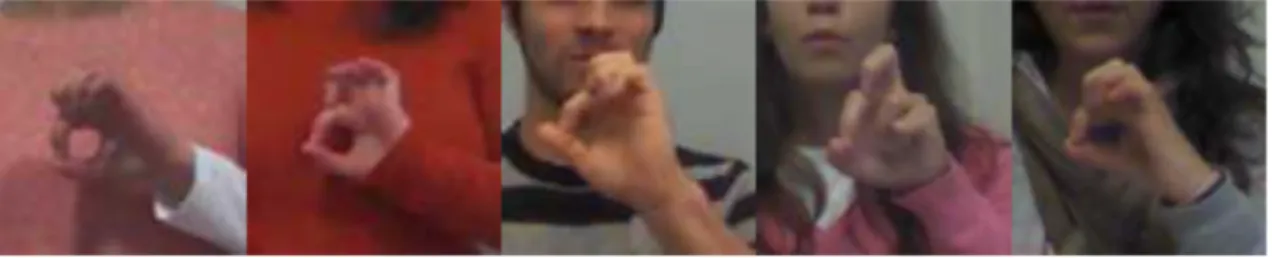
The naturalness of the gestures realization has a high cost in terms of classification performance. While in the Triesch dataset the gestures were realized with some precision by the signers, the LGP gestures were performed in a natural manner which means that to the same gesture may correspond different hand shapes. Figure 5.3 is an example of this variation to the gesture eight. From it can be seen not only different hand orientations and openings, but also different positions with respect to the body. This was the reason why the images of this dataset were only subjected to the first level of segmentation previously mentioned.
Figure 5.3 - Gesture eight of the LGP performed by five subjects.
5.2
Hand features
Several studies with the purpose of classify gestures based on the hand shape were developed. The features considered more relevant to the SLR study are described in the current section. They can be divided into the following way: Regional Features, Hu Moments and Gradient Orientation Histograms. The following subsections describe each group in detail.
5.2.1
Regional Features
Regional Features (RF) are the most widely used features in SLR systems. Starner, et al. [20] and Von Agris, et al. [15] are just two examples of studies that used this kind of features. They can be computed directly from the segmented hand contour and correspond direct measures that can be taken from it. In order to enable the comparison of hands with different sizes or distances to the camera, only relative features were selected. The Regional Features (RF) used are the following:
• Solidity: Area of the segmented hand divided by the correspondent convex area;
Static Gestures 25
25
• Orientation 1 and 2: Sine and Cosine, respectively, of the angle between the major
axis and the horizontal direction of the bounding box. This angle varies between -90º and 90º;
• Inertia ratio: Ratio between the minor and major axis;
• Eccentricity: Corresponds to the inertia ratio of an ellipse with the same second
order moments of binary object;
• Perimeter proportion: Hand perimeter divided by the area;
• Bias: Euclidean distance between the segmented object centroid and the bounding
box center, divided by the object Area.
The Bias feature was created with the purpose of measure the deviation of the object center of mass relatively to the bounding box center. Some of the Hu Moments carry a similar type of information. It is important to denote at this point that this type of features does not provide any information about the interior of the segmented object.
5.2.2
Hu Moments
Image moments are statistical measures of an image which can be used as descriptors of the hand shape. Equation (5.1) represents the general expression of an image moment .
, (5.1)
The moment is the (p+q)-th order moment of an M x N image.
Central moments ! of an image are invariant to translation and can be computed as shown in Equation (5.2).
! = − ̅ − $ , , (5.2)
where ̅ and $ are the coordinates of the image centroid:
̅ = $ = (5.3)
26 Static Gestures
26
& !!' (5.4)
( ) + +2 + 1 (5.5)
Hu Moments (HM) were introduced by Hu [37] and correspond to a set of combinations of normalized central moments which are independent of the object position, size and orientation. The seven Hu Moments are represented by the following expressions.
- = &. + & . ,
-.= &. − & . .+ 4&.,
-0= &0 − 3& . .+ 3&. − &0 .,
-2= &0 + & . .+ &. + &0 .,
-3= &0 − 3& . &0 + &. 4 &0 + & . .− 3 &0 + &. .5 + 3&. − & 0 &. + &0 43 &. + &0 .−
&. + & 0 .5,
-6= &. − & . 4 &0 + &. .− &. + & 0 .5 + 4& &0 + &. &. + & 0 ,
-7= 3&. − & 0 &0 + &. 4 &0 + &. .− 3 &. + &0 .5 − &0 − 3&. &. + & 0 43 &0 + &. .−
&. + & 0 .5.
5.2.3
Gradient Orientation Histograms
Gradient Orientation Histograms are widely applied nowadays in image analysis to match key points of different images and detect if both correspond to a representation of the same object. Freeman and Roth [13] proposed a hand recognition system based on the histogram of the image gradient orientations, computed over the entire hand bounding box. Despite of the weak results obtained, it was decided to include these features in this study because they are among of the few that provide information about the interior of the segmented hand and not only about the contour.
The image gradient ∇ is computed over grayscale images. It represents the magnitude and orientation of pixels intensity variation in each direction of the image and has the following expression (Equation (5.6)):
Static Gestures 27
27
9 :;; ,;; <= >? , ? @= (5.6)
From it can be computed the magnitude G and orientation θ of the image intensity variation as shown in the Equations (5.7).
A B? .+ ? . C tan ?
? (5.7)
The Gradient Orientation Histograms (GOH) were computed from orientation matrix using 8 bins from 0 to 7H 4I radians with a bin size of H 4I radians and normalized in order to sum 1. The gradient was computed using only the hand region – see Figure 5.4 for an example.
Figure 5.4 - (left) Masked grayscale image. (right) Gradient orientation image representation.
5.2.4
Inclusion of depth and features combination
The existence of depth information in the LGP dataset raised the possibility of including it as a feature. Depth cameras are a relatively recent technology and there are not yet many studies with this type of information. Kurakin, et al. [16] created an hand shape recognition system based on depth images. Nevertheless, they did not use the depth as a direct feature but as mean to segment the hand from the rest of the body.
28 Static Gestures
28
In this work the selected Depth Features (DF) correspond to the percentile 0.1, 0.5 and 0.9. The 0.5 percentile is the depth median while the others aim the representation of the limit values of depth. The 0.1 margin was used to exclude some outliers in the form of noise.
The depth extraction was preceded of a normalization procedure. The value of the closest pixel to the camera was subtracted to the whole depth image. This procedure allowed the comparison of different images, independently of the distance to the camera.
The features were used alone and combined with each other. The adopted combinations were the following: • RF + HM; • RF + GOH; • RF + HM + GOH; • RF + DF; • RF + HM + DF.
Other combinations of features were also tested but without relevant results.
5.3
Classification
To test the quality of the features, two distinct classifiers were encompassed in terms of behavior: Gaussian Naive Bayes and Support Vector Machines (SVMs). Naive Bayes is a probability based model as the Hidden Markov Models (HMM) which will be used in the next chapter with moving gestures. This common characteristic makes its evaluation interesting in the static gestures context. SVM is a linear classifier with very good performances and was used in several studies of hand shape recognition. Sections 5.3.1 and 5.3.2 present a brief description of these classifiers.
The validation was done in different ways to each dataset because of the available amount of data. The adopted classification systems are described in Section 5.3.3.
5.3.1
Gaussian Naïve Bayes
Gaussian Naive Bayes [38] is a probabilistic classifier based on the Bayes Theorem. It assumes that the features are independent from each other which is a strong assumption and the reason why it is called naive.
In the training stage, the prior probabilities of each class are estimated from the training set. Then the distribution that best fit the data according to each feature is determined to each class. In the case of Gaussian distribution, its expression is the one presented in Equation (5.8) and it requires the estimation the mean and variance from the training data.
)J |LMN 1
2H O .IP∑MPI.
Static Gestures 29
29
D is the number of features, !M is the average vector of class j and ΣM represents its covariance matrix.
It is then possible to compute the posterior probability by the Bayes Theorem of Equation (5.9).
)JLM| N ∑ ) |L)J |LMN)JLMN V ) LV O
V , (5.9)
The classification of test set consists in determine the class which maximizes the posterior probability given the features values – see Equation (5.10).
LW XX = YZmaxM )JLM| N, (5.10)
Naïve Bayes is one of the simplest classifiers available and, despite of the assumption of features independence, it is fast in both training and classification stages, can handle real and discrete data and it is not sensitive to the effect of irrelevant features.
5.3.2
Support Vector Machines
The Support Vector Machine [38] classifier (SVM) was created based on the work of Vladimir Vapnik and in its initial formulation it is a linear classifier. To understand the concept behind SVM lets define the dataset D, represented by Equation (5.11), which has n points with dimension p and two classes.
] = ^ V, V ; V ` ℝ , V ` b−1,1cd, ∀ f = 1, 2, … , h (5.11)
SVM consists in find the hyperplane which best splits the data according to the correspondent class. This hyperplane can be defined by the normal vector w and the offset to the origin ‖k‖i . Equation (5.12) represents the general expression of such hyperplane.
30 Static Gestures
30
l ⋅ + 0 (5.12)
It is now possible to determine the class of a given point just by looking to its position in relation to this hyperplane. However, the number of hyperplanes that respect this condition is infinite and some of them may classify new points wrongly. The solution is to find the hyperplane with the higher margin or, in other words, the hyperplane which has the higher distance to the closest points of both classes, the support vectors. The margin is limited by the two hyperplanes, represented in Equation (5.13), which are parallel and cross the support vectors. Figure 5.5 is a schematic representation of this method.
n l ⋅ +l ⋅ + "11 (5.13)
Static Gestures 31
31
The vector w and parameter b can be determined by solving the quadratic problem of Equation (5.14).
mink,i 12 ‖l‖.
Xp q rs: V l ⋅ + − 1 ≥ 0, ∀f = 1, … , h
(5.14)
Nevertheless, usually the data is not perfectly linearly separable. In many cases the classes are mixed and so, to find the hyperplane which separates them better is hard. To ease this difficulty it can be attributed some weights vV ` 0,15, allowing the existence of some points inside of the margin or misclassified. This procedure softens the margin rigidity and is the reason why it is called SVM with Soft margins. The problem can be given by Expression (5.15).
min k,i,w 1 2 ‖l‖.+ L x vV y V z Xp q rs: V l ⋅ + ≥ 1 − vV, vV≥ 0, ∀f = 1, … , h (5.15)
The parameter C regulates the margin relaxation and the parameter optimization complexity. As defined until now, SVM is able to classify with good results data that is linearly separable, even if there is some noise and is necessary to use soft margins. In many problems, despite this, the separation is non-linear. SVM works with linear separations and so, in order to be useful it is necessary to project the data to a higher dimensional space where the data is linearly separable. This operation is called the kernel trick. There are several types of kernels like the Polynomial, RBF or Sigmoidal and its choice should be based in some prior knowledge about the data. Nonetheless, when the data distribution or behavior is unknown, to test different Kernels and select the one that returns the best results is a normal procedure.
5.3.3
Validation
The validation is very important to evaluate the classification performance. Since the Triesch dataset is larger than the LGP, different validation procedures were used.
Let us first look to the Triesch dataset validation. Following the work of Kelly, et al. [23] our procedure of validation adopted was the leave-k-subjects-out technique. As the name indicates it consists in separate the data of k subjects to test and train with the remaining. Given that the

![Figure 3.4 - (left) Angles extracted by Holden, et al. [12] to compute the feature vector](https://thumb-eu.123doks.com/thumbv2/123dok_br/15471608.1034486/28.892.179.774.708.933/figure-left-angles-extracted-holden-compute-feature-vector.webp)