UNIVERSIDADE DE LISBOA FACULDADE DE LETRAS
CHINESE ENGLISH:
A CONTRIBUTION TO THE STUDY OF ITS IMAGE AND INTELLIGIBILITY
YAO YI
Dissertação orientada pela Prof.ª Doutora Rita Queiroz de Barros,
especialmente elaborada para a obtenção do grau de Mestre em Estudos Ingleses. MESTRADO EM ESTUDOS INGLESES E AMERICANOS
ÁREA DE ESPECIALIZAÇÃO EM ESTUDOS INGLESES
CHINESE ENGLISH:
Acknowledgments
First of all, I would like to thank my supervisor, professor Doctor Rita Queiroz de Barros, who not only provided me with essential support and feedback throughout the entire process, but also led me to a deeper understanding of the meaning and purpose of academic writing.
I would also like to thank my parents, who provided me with the financial support which allowed me to finish my studies, and my friend Merve Erçin, who always encouraged me and offered help when I had difficulties.
Finally, I want to thank Maria Inês Almeida and Francis Shimell, who made this dissertation a better work by improving my English writing.
It is due to the support and encouragement of all these people that I have been able to complete this dissertation.
CHINESE ENGLISH:
Abstract
As English has spread around the world, it has been localized under the influence of local cultures and local languages. As a result, new varieties of English which are linguistically different from one another have emerged. Due to the divergences between them, mutual intelligibility is now an issue so English can function as a lingua franca around the world. At the same time, out of the divergences between perceived ‘nonstandard varieties’ and ‘standard varieties’ of English, a discussion about people’s attitudes towards ‘nonstandard varieties’ of English has also arisen. After many decades of contact with the Chinese culture, there is no doubt that English in China has developed typically Chinese characteristics which make it different from any other variety of the language.
This survey is a contribution to the study of this recent form of English, aiming(i) to trace the present image of ChE in the world; and (ii) to examine to what extent ChE in its present form can be understood well by other speakers of English and thus accomplish its mission as a lingua franca.
To this purpose, a questionnaire was presented to a sample of 35 speakers of English with different first languages (henceforward L1). And the results suggested that, firstly, Chinese English has high level of intelligibility especially when it is spoken in a language context; secondly, Chinese English has achieved recognition as a variety of English, being no longer considered as merely improperly spoken English. However, Chinese English is not considered a pleasant and accurate variety and most respondents consider that it is still not systematic enough to be regarded equally with other more established varieties of English, or at least with native English varieties.
Key words: Chinese English, intelligibility, language attitudes, English as a Lingua
Resumo
O inglês é hoje a língua franca internacional. O processo de difusão da língua inglesa pelo globo envolveu, naturalmente, a sua adaptação aos novos locais e circunstâncias de uso, sofrendo a influência de outras culturas e línguas. Surgiram assim, em tempos mais recentes, novos ingleses, novas variedades da língua com diferenças entre si. Essas diferenças, por vezes significativas, tornam pertinente o debate em torno da inteligibilidade dessas diferentes variedades, requisito indispensável para que o inglês funcione como língua franca global. Esta nova realidade veio ainda contribuir para a tradicional comparação entre variedades padrão e não-padrão e as atitudes que os falantes têm a propósito das mesmas.
Após um período longo de presença na China, e na sequência do contacto daí decorrente com a cultura chinesa, o inglês apresenta aí, como noutros países, características típicas que o diferenciam das demais variantes da língua. O que é hoje por vezes referido como o inglês da China tem cerca de 400 milhões de falantes, número que supera a soma das populações dos países em que o inglês é a língua materna da maioria dos falantes (Kirkpatrick, 2007: 30); é, por isso, parte muito relevante da anglofonia contemporânea, e tem, consequentemente, sido objeto de interesse no meio académico, a propósito tanto do desenvolvimento do inglês como língua de comunicação global, como das implicações desta nova realidade para o ensino do inglês como língua estrangeira. Neste contexto, e porque a minha permanência em Portugal no ambiente multicultural e
multilingue do Curso de Português para Estrangeiros da Faculdade de Letras da Universidade de Lisboa me colocou em condições ideais para tanto, dediquei-me ao estudo das percepção do inglês da China no estrangeiro e da inteligibilidade desta variedade junto de falantes do inglês com diferentes línguas maternas, incluindo falantes nativos e não nativos da língua inglesa. Os principais objetivos desta dissertação são os seguintes: (1) descrever qual é a percepção do inglês da China, entre falantes não chineses e chineses, propósito que implicou a averiguação do reconhecimento, ou não, deste uso da língua enquanto variedade autónoma do inglês e a identificação das atitudes sobre a mesma; (2) examinar até a que ponto o inglês da China, em particular a sua pronúncia, é inteligível junto de falantes de outras variedades e pode cumprir a sua missão de língua franca.
Estes objetivos foram prosseguidos por via de um estudo empírico, em que se procedeu à recolha de dados por via de um questionário. Este foi feito junto de uma amostra de 35 falantes de inglês, todos alunos da Faculdade de Letras de Lisboa no ano lectivo de 2018/2019 mas de diferentes nacionalidades. As perguntas e tarefas que integram este questionário garantiram a recolha de informação acerca dos respondentes (género, língua materna, frequência de contacto com falantes de inglês da China, e ainda outros fatores que pudessem influenciar os resultados), a compilação de informação que pudesse reflectir a sua percepção do inglês da China e a sua opinião acerca do mesmo, e finalmente, a inteligibilidade do mesmo.
A imagem do inglês chinês foi analisada através de perguntas directas e indirectas. De modo a averiguar a inteligibilidade do inglês da China, foram recolhidas diferentes amostras áudio desta variedade junto de falantes nativos do chinês, as quais incluíam palavras isoladas, frases e discurso livre. Estas amostras foram apresentadas aos 35 inquiridos, provenientes de 7 países diferentes (Estados Unidos, Reino Unido, Malásia, Nigéria, Portugal, Turquia e China). Após ouvir as amostras, os inquiridos executaram as seguintes três tarefas: identificação de palavras pronunciadas sem qualquer contexto; identificação de palavras contextualizadas (em frases); e avaliação da inteligibilidade do uma sequência de discurso espontâneo.
Os resultados destas questões indicaram, primeiramente, que o inglês da China possui um alto nível de inteligibilidade, principalmente quando em contexto. Isto significa que o inglês da China é capaz de cumprir o seu papel como língua franca entre falantes de inglês nativos do chinês e de outras línguas. Os resultados também indicam que, quando não é oferecido nenhum contexto linguístico, os falantes nativos de chinês percebem melhor o inglês da China que outros inquiridos, mesmo os falantes nativos de inglês. Contudo, quando é fornecido um contexto linguístico, o inglês da China torna-se mais inteligível aos falantes nativos do inglês que aos inquiridos de outros países, mesmo os falantes nativos da língua chinesa. Em segundo lugar, os resultados sugerem que o inglês da China alcançou o reconhecimento como variedade autónoma do inglês, apesar de não ser considerado agradável ou preciso; para além disso, os participantes
consideram que o inglês da China não é suficientemente sistemático para ser equiparado a outras variedades do inglês mais estabelecidas. Em terceiro lugar, não se identificou qualquer interferência de variáveis controladas no nível de inteligibilidade do inglês da China, com a excepção do facto de o inglês ser a língua materna dos inquiridos, o que aumenta a sua capacidade de descodificação das amostras com que foram confrontados.
Esta dissertação começa com uma introdução explicativa do contexto e da fundamentação desta dissertação (Capítulo 1, ‘Introduction’), incluindo o uso do inglês como língua franca, o surgimento de diferentes variantes do inglês, o papel do inglês na China e a potencial relevância deste ou de estudos parecidos.
A dissertação prossegue (Capítulo 2, ‘Theoretical framework’) com uma apresentação do seu enquadramento teórico, em particular dos estudos acerca dos conceitos de inglês da China (Chinese English), atitudes e inteligibilidade linguísticas. Cada um destes conceitos é explicado com o auxílio de estudos anteriores, em especial aqueles que consideraram também o uso do inglês na China.
O Capítulo 3, ‘Chinese English pronunciation: a short description’, tem como objetivo a apresentação das características do inglês da China, mais precisamente das suas especificidades fonético-fonológicas, e constitui-se como um enquadramento linguístico das seções seguintes. Neste capítulo consideram-se, em primeiro lugar, as divergências entre os sistemas sonoros das variedades padrão do inglês e do chinês, que em parte esclarecem porque os falantes do chinês tendem a pronunciar o inglês de uma
forma particular. Na segunda secção, são apresentadas as principais particularidades fonológicas do inglês da China com base em estudos prévios sobre a matéria, como os de Deterding (2006), Ho (2003) e Li e Sewell (2012). Na última secção, comparam-se as características típicas do inglês da China com o ‘Lingua Franca Core’ postulado por Jenkins (2000), ou seja, a lista de elementos fonológicos que, segundo Jenkins, são imprescindíveis à inteligibilidade da língua inglesa.
O Capítulo 4, ‘Methodology’, apresenta um relatório detalhado dos métodos de pesquisa usados neste estudo, em termos de organização do questionário, da constituição de amostras de áudio do inglês da China, da selecção dos participantes e da aplicação do questionário.
A imagem do inglês da China e a sua inteligibilidade são examinadas no capítulo seguinte. O Capítulo 5, ‘ Results and discussion’, analisa os resultados obtidos pelo questionário, que esclarecem a percepção que os inquiridos têm do inglês da China e a inteligibilidade desta variedade. Além disso, equaciona-se a correlação entre as informações acerca do contexto dos respondentes (i.e. género, idade, percurso escolar, língua materna, círculo linguístico, frequência de comunicação em inglês com falantes nativos do chinês), por um lado, e a imagem que os mesmos têm do inglês da China e o nível de inteligibilidade desta variedade.
O Capítulo 6, ‘Conclusion’, resume as principais conclusões do estudo e as implicações das mesmas, em particular para o ensino da língua inglesa na China. Neste
contexto, ponderam-se os objetivos e o modelo que devem nortear o ensino do inglês na China, tendo em conta os resultados do estudo e os novos contextos de uso do inglês no mundo e na China.
Table of Contents
Acknowledgments...I Abstract... III Resumo...V List of figures and tables... XIII List of abbreviations...XV
Chapter 1 - Introduction...1
Chapter 2 - Theoretical framework...6
2.1 The spread of English: new contexts and new issues...6
2.2 Chinese English...14
2.2.1 What is Chinese English?... 14
2.2.2 Previous research on Chinese English...17
2.3 Language attitudes... 21
2.3.1 What are language attitudes?... 22
2.3.2 Previous research on attitudes toward varieties of English...24
2.3.3 Previous research on attitudes toward Chinese English...26
2.4 Intelligibility...28
2.4.1 What is intelligibility?...28
2.4.2 Previous research on the intelligibility of varieties of English... 31
Chapter 3 - Chinese English pronunciation: a short description... 34
3.1 A comparison between the English (RP) and the Chinese (Mandarin) sound systems...35
3.1.1 Consonants...38
3.1.2 Vowels... 43
3.2 Phonological characteristics of Chinese English...48
3.3 Chinese English and the Lingua Franca Core...53
Chapter 4 - Methodology... 56
4.1.1 Part A: information on the respondents... 56
4.1.2 Part B: image of Chinese English...57
4.1.3 Part C: intelligibility... 61
4.2 Research participants... 67
4.2.1 The speakers...67
4.2.2 The respondents... 69
Chapter 5 - Results and discussion... 71
5.1 Image of Chinese English... 71
5.1.1 Results...71
5.1.2 Discussion... 77
5.2 Intelligibility of Chinese English...78
5.2.1 Results...78
5.2.1.1 Identification of words out of context... 78
5.2.1.2 Identification of words in context...81
5.2.1.3 Intelligibility rating...83
5.2.2 Discussion... 86
Chapter 6 - Conclusion and implications...90
6.1 Main findings... 90
6.2 Implications... 错误!未定义书签。 References... 94
List of figures and tables
Figure 2.1. Kachru’s Three Circles Model of World Englishes…………. 9
Figure 2.2. The development of research on ChE ………..18
Figure 3.1. English vowels (monophthongs)……….. 44
Figure 3.2. Chinese vowels………...44
Table 3.1. Chinese initials and finals (Pinyin transcription) ………….... 36
Table 3.2. Chinese consonants and vowels………... 36
Table 3.3. Chinese initials and consonants compared………... 37
Table 3.4 Chinese finals and vowels compared………... 37
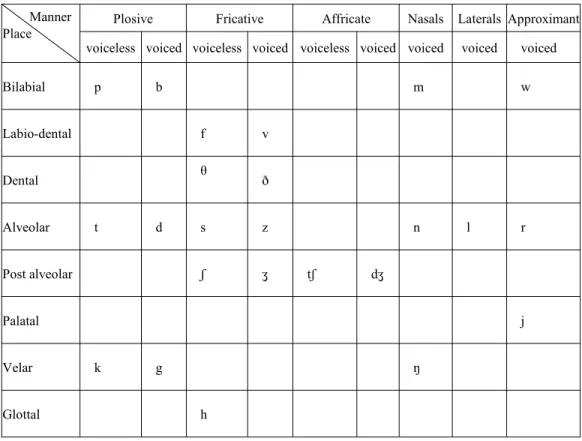
Table 3.5. English consonants………... 38
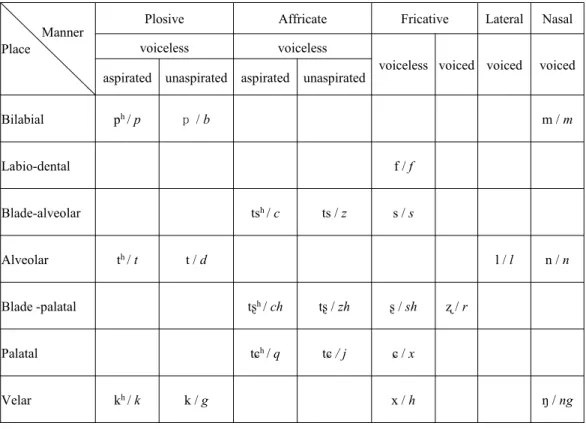
Table 3.6. Chinese consonants……….. 39
Table 3.7. English and Chinese vowels……….43
Table 4.1. Q8-Q12 of the questionnaire………58
Table 4.2. Q13-Q15 of the questionnaire……….59
Table 4.3. Q16-Q18 of the questionnaire……….60
Table 4.4. Q19 -Q22 of the questionnaire………..61
Table 4.5. Word list………63
Table 5.1. Respondents’ awareness and labelling of the use of English 72 by native Chinese speakers: results………...… Table 5.2. Assessments of ChE: results ………... 74
Table 5.3. The status of ChE: results...75
Table 5.4. How ChE should be treated: results………..76
Table 5.5. Words out of context correct identification: results…………. 79
Table 5.6. Words in context correct identification: results……….81
Table 5.7. Intelligibility perception: results………83
Table 5.9. Correlation between ChE intelligibility and English as an L1
List of abbreviations
-ChE: Chinese English
-CET: College English Test
-CEFR: Common European Framework of Reference for Language -ELF: English as a Lingua Franca
-EFL: English as a foreign language -ELT: English language teaching
-GA: General American
-IPA: The International Phonetic Alphabet
-LFC: Lingua Franca Core
-L1: First language
-L2: Second language
-NS: Native speaker
-NNS: Non-native speaker
Chapter 1 - Introduction
Though one of the world’s 7,111 known living languages (Eberhard et al, 2019, n.p.), English has a special status in the globe, since no other language enjoys such a wide reach globally. Crystal (2008, p. 5) estimated that there are almost two billion English speakers around the world. Furthermore, as noted by Jenkins, currently there are “approximately seventy-five territories where English is spoken either as a first language or as an official (i.e. institutionalised) second language in fields such as government, law and education” (2003, p. 2). Kachru noted as early as 1992 that “for the first time a natural language has attained the status of an international (universal) language”, used for “cross-cultural communication” across the globe, which obviously includes China (1992, p. 67).
Due to globalization and to The Reform and the Development of Open Door
Policies in China since 1978, it has become common for Chinese people to use English to
communicate with native speakers (henceforward NS) of English and, more often, with other non-native speakers (henceforward NNS) of the language. In accordance with this recent spread of English, part of globalization, the de facto goal of English Language Teaching (ELT) in China and in the countries where English is used as a non-native language is now “more often” to prepare learners “to use English as a lingua franca in communication with other non-native speakers, i.e. as an international language, than as a foreign language in communication with its native speakers” (Jenkins, 2000, p. 1).
However, this goal is meaningful only if mutually intelligible Englishes are used among non-native speakers, even if such Englishes differ. As a consequence, research on the intelligibility of Chinese English (henceforward ChE) is significant for Chinese, as it can aid them to teach and use English as a Lingua Franca (hereinafter referred to as ELF) in international contexts.
Though English as spoken by Chinese may not have achieved legitimacy as a variety on its own yet, it is still crucial to understand its degree of intelligibility and the attitudes existing towards it, including the attitudes of (i) Chinese people using the language and (ii) non-Chinese people with whom Chinese people communicate in English. Research on these respects is worth developing if we are to better understand the place of ChE in the world, or even to influence its development in a positive way.
My personal circumstances have allowed for this kind of study. In fact, studying in Portugal for two years, I have had access to speakers of English with different L1s, who could provide the information needed with regard to the intelligibility of the English used by Chinese speakers and to people’s attitudes towards it.
Naturally, English education in China has developed within its own context and faces specific challenges in terms of meeting the above-mentioned goal of giving Chinese speakers access to English as a language of international communication. The history of ELT in China began in the early 19th century, when English teaching was mainly carried out by missionaries from Britain, the British Empire and the U.S. and was used as a language of business. ELT was later developed officially by the Chinese government, at
the end of 20th century. Since then, although progress has not always been smooth, English education in China has achieved great success. Today English is a compulsory course in Chinese primary and secondary schools, as well as in many kindergartens. Furthermore, according to the figures released by the Research Center for Chinese Science Evaluation (RCCSE), more than 80% of universities in China offer majors related to English. University students who do not major in English are also required to pass the College English Test Band 4 (CET-4) or the College English Test Band 6 (CET-6), both of which correspond to Level B2 of the Common European Framework of Reference for Language (CEFR).
However, hidden behind the enormous spread of English education in China lies the fact that the competence of Chinese learners of English does not seem to satisfy either China’s needs in the context of globalization, or individual’s English requirements for academic, economic, educational, or travel purposes. It is probable that both the necessity for the use of English to a certain standard in China and the proficiency in English of its speakers will grow with time. An important aspect of this development would therefore be the improvement of the efficiency and quality of ELT in order to meet the increasingly urgent needs of high-level learners of English as a Foreign Language (EFL). It should also be noted that correct educational policies only emerge from a thorough understanding of the situation. Understanding the situation of ChE, including its characteristics, its intelligibility, and its image inside and outside of China, is prerequisite to improving English learning and teaching.
Against this background, the particular aims of this dissertation are the following: (i) to trace the present image of ChE in the world; and (ii) to examine to what extent ChE in its present form can be understood well by other speakers of English and thus accomplish its mission as a lingua franca. To fulfill this first aim, I will consider not only people’s familiarity with English as spoken by Chinese and the labels that are usually attributed to it, but also the attitudes they display towards such use of English.
Given the space and time limitations that are characteristic of MA dissertations, I will consider the above-mentioned goals only as far as the phonological specificities of ChE are concerned. More precise reasons for this choice are presented below.
Though language systems include various components, namely phonology, morphology, syntax, lexis, semantics and discourse (Owens, 2005, p.18), “pronunciation, more than any other aspect of a foreign language, will always be influenced by very personal factors such as learner’s attitude to the target language and to the speakers of that language, by individual differences in ability and motivation to learn, etc.” (Dalton and Seidlhofer, 1994, p. 72). Pronunciation is also less stable and more variable than other components of language systems. It is more prone to variation among speakers and to change over time. So, pronunciation differences are perhaps more likely to come up in different varieties of English and very often have an effect on mutual intelligibility. It has therefore been chosen as the focus of this work.
Following this introduction, this dissertation includes, as Chapter 2, a presentation of the theoretical framework adopted, considering in particular studies on the concepts of
ChE, language attitudes and intelligibility. Chapter 3, after comparing the English and Chinese standard sound systems, presents the pronunciation that has been considered characteristic of ChE by previous research on the subject (e.g. Deterding, 2006a; Ho, 2003; and Li and Sewell, 2012). The image and intelligibility of ChE are examined in the following three chapters. Chapter 4 presents the empirical methodology adopted to achieve the goals of the present study; Chapter 5 analyzes the results obtained; Chapter 6 reflects upon their implications and presents the main conclusions of the study.
Chapter 2 - Theoretical framework
2.1 The spread of English: new contexts and new issues
It was by no means an accident that English was able to become the lingua franca of the world: there are deep-rooted historical causes which can be traced back to the 16th century (King, 2006, p. 19). In her work World English: A study of its development (2002), Brutt-Griffler concluded that there are three main phases in the spread of English. The first phase is characterized by the spread within the British Isles themselves, a stage that is often overlooked today. Although this process did not involve the creation of global English, it is still important because it established English as the dominant local language in so far as it “to a large extent displaced the Celtic languages that had existed there” and, as a result, “the vast majority of the population, between 95.0% and 98.0%, throughout the British Isles speak English as a mother tongue” (2002, p. 113). The second phase, which started at the beginning of the 17th century, is characterised by the spread of English to English colonies, such as North America and Australasia (2002, p. 113). This led to “the establishment of English as the national language of a number of new nations, including the United States, Canada, Australia, New Zealand” (2002, p. 113) and as a powerful second language (henceforward L2) in others, as India or Nigeria. The last phase refers to the spread of English to the rest of the world; it was at this stage that “English came to take on the econocultural functions that made its transition to a world language” (2002, p. 116).
Giving rise to constant contacts between English and various local languages (Bhatt, 2001, p. 529), the globalization of the language has involved both “universalizing and particularizing tendencies” (Robertson, 1997, p. 2). In fact, “once English was adopted in a region, whether for science, technology, literature, prestige, elitism, or ‘modernization’, it went through a reincarnation process, which is unique to another culture” (Kachru, 1992, p. 6); the language has been and is, therefore, being endowed with new characteristics, resulting from the influence of other languages and cultures. Many different varieties of English have thus been generated, including those that are now known as World Englishes, and other more recent and more hybrid varieties, such as Hinglish in India and Taglish in the Philippines (Schneider, 2016).
One result of these developments is that contradictory attitudes have arisen towards the different varieties of English and towards the ownership of this special language. In the words of Crystal, that is the question of whether “who has learned it now owns it (...) and has the right to use it in the way they want” (1997, p. 2-3). The traditional view is that the native varieties of English, such as British English or American English, are superior to non-native national varieties of the language. This attitude is well summed up by Quirk, who states that it is necessary to have a substantial standard for English composed of “‘American English’ and ‘British English’ and (...) one or two others with standards rather informally established, notably Australian English” (1990, p. 18), since other, non-native varieties “are inherently unstable, ranged along a qualitative cline, with each speaker seeking to move to a point where the varietal
characteristics reach a vanishing point, and where thus, ironically, each variety is best manifest in those who by common sense measures speak it worst” (1990, p. 5-6). He adds “[it] is neither liberal nor liberating to permit learners to settle for lower standards than the best” (1990, p. 9).
In opposition to this view, it might be pointed out that the pursuit of the native standard is not as necessary as it used to be. Furthermore, through constant contact with other local languages, English is arguably being enriched in terms of its cultural pluralism and linguistic diversity. In this context, not only speakers but also linguists - as Kachru (1985), McArthur (2003), Crystal (2003), Ferguson (2009) or Jenkins (2003) – began to defend the rights of those speakers of non-native English varieties to speak English in their own way, and claimed that these varieties should be appreciated on their own terms, not merely as deviations from particular NS varieties (Jenkins, 2003, p. 25). As a consequence, if non-native varieties are also legitimate ways to use English, the global language is no longer English simply as spoken by natives (Ferguson, 2009, p. 118); rather, the ownership of English must be shared with speakers of non-native varieties, and “a totally uniform, regionally neutral, and unarguably prestigious variety” cannot be said to exist on a global scale (Crystal, 2003, p. 111).
Several models have been devised in order to systematize the emergence of new varieties and uses of English in the world. Among them is Kachru’s Three Circle model of World Englishes, which represents, in his words, ‘the type of spread, the patterns of acquisition and the functional domains in which English is used across cultures and
languages” (1985, p. 12). This model divides the territories in which English is spoken into three circles reproduced in Figure 2.1:
Figure 2.1. Kachru’s Three Circles Model of World Englishes (adapted from Crystal, 1997)
This diagram is explained by Kachru in the following terms (1985, p. 366-367):
The current sociolinguistic profile of English may be viewed in terms of three concentric circles (…). The Inner Circle refers to the traditional cultural and linguistic bases of English. The Outer Circle represents the institutionalised non-native varieties (ESL) in the regions that have passed through extended periods of colonization. (...) The Expanding Circle includes the regions where the performance varieties of the language are used essentially in EFL contexts.
The countries of the Expanding Circle are those of greatest interest with regard to the use of English as the international lingua franca, since, containing an immense number of
speakers of English with different L1s, they represent the main component of ELF users. Among Expanding Circle nations, China, with around 400 million speakers of English, which surpasses the combined population of the countries in which English is the native language of most speakers (Kirkpatrick, 2007, p. 30), naturally represents an important focus of study, both with regard to the development of English as an international language used for communication on a global scale, and to the changing implications of this for ELT.
In fact, the changing nature and role of English around the world naturally impact upon ELT, mainly in the perspective of its goals and the models used.
With regards to the goals of ELT, the main controversy lies in whether intelligibility or native-like English should be the aim. In 1985, Kachru described the inner circle as including the norm-providing varieties, since L1 varieties are ‘norm makers’ or ‘models for emulation’; the outer and expanding circles were therefore treated as ‘norm breakers’ instead. The outer circle was seen as being composed of norm-developing varieties, the expanding circle of norm-dependent varieties. However, as opposed to the outer circle varieties, which are both endonormative and exonormative, the expanding circle is essentially exonormative (1985, p. 16-17). It is based on the same assumption that, for a long time, most of English learners and teachers in the expanding circle have believed that “the ideal goal is to imitate the native speaker of the standard language as closely as possible” (Andreasson 1994, p. 402).
native-like proficiency, more and more people regard intelligibility, which in Munro’s words “is the single most important aspect of communication” (2011, p. 13), as the main goal of ELT. This is because, firstly, as Medgyes (1992, p. 342) points out, “non-native speakers can never achieve a native speaker’s competence” easily and, secondly, speakers of other varieties have a justifiable right to speak English in their own way. In the developing context of ELF, as suggested by Mckay, more and more people believe that the goal of ELT “needs to be to ensure intelligibility among the speakers of English”, considering the fact that “the spread of English has, as is natural, brought with it language changing and variation” (2002, p. 127).
Standing side by side with the controversy over what the goals of ELT should be is the debate about which teaching models should be used in the English classroom. In the context of World Englishes and English used as Lingua Franca, Kirkpatrick (2007) suggested that there are three main potential models that can be adopted: an exonormative NS model, an endonormative nativised model, and a lingua franca approach.
The exonormative NS model is chosen by most non-native English-speaking countries, including China, mainly because of its prestige and perceived legitimacy, and the easy access to high quality teaching materials (Kirkpatrick, 2007, p. 184).
The endonormative nativised model has been adopted as the teaching model in some outer circle countries though, but it is still not a widely advocated model.
Tomlinson’s (2004, p. 3) words articulate the rationale for choosing this model very well. He states that non-native English learners should:
learn what they want to learn from what is available to them. And what is available to them is much more than what they are taught; it’s also the language they are exposed to, the language they produce themselves, the paralinguistic expressions of the people they interact with, the whole context of the learning environment inside the classroom and outside in the real world, both during and after a course.
Based on the fact that the major global role of English today is as a lingua franca, another teaching model suggested by Kirkpatrick is the Lingua Franca approach, which, in Kirkpatrick’s words, would “allow for effective communication across linguistic and cultural boundaries” as “the focus of the classroom moves from the acquisition of the norms associated with a standard model to a focus on learning linguistic features, cultural information and communicative strategies that will facilitate communication” (2007, p. 194).
This approach, emphasizing the importance of the linguistic characteristics, cultural difference and communicative strategies (Kirkpatrick, 2007, p. 194),is worthy of consideration for several reasons. First of all, it will allow teachers to become more confident since they will no longer need to unequivocally promote a variety of English
that they do not speak themselves; secondly, “the cultural content of the classes becomes significantly broadened” because this model allows more attention to be paid to the culture of all the countries that speakers will interact with, instead of focusing principally on native English speaking countries; thirdly, it will motivate learners, because it will encourage them to learn lingua franca, a language belonging to all speakers instead of a language which belongs first and foremost to someone else (Kirkpatrick, 2006, p. 79).
Kirkpatrick also claims that “the choice over which variety to adopt must depend on the local context, including the reasons why people are learning English and the extent to which a local endonormative model is appropriate” (2007, p. 193). China usually adopts native English, particularly British English and American English, as the teaching model in English classrooms, and uses teaching goals which aim at native-like English. However, considering the accelerating development of the role and importance of English in China, the model used for ELT in China might need to be reconsidered.
With the above mentioned issues in mind – the development of new non-native varieties of English, the rise of different attitudes towards those varieties, the current discussion on the right goals of ELT, and the proper English models used for ELT in a lingua franca context (intelligibility vs native-like proficiency) - this study considers the particular case of English as spoken by Chinese. It accepts the view that there are various legitimate varieties of English, not all of which developed in countries where English was the native language of most speakers. Furthermore, considering the role of English in the world today, it assumes that there is space for new varieties of English to develop, of
which a Chinese variety can be said to be one. In this context, this study will test and explore the intelligibility of English as spoken by native Chinese speakers’, both from the perspective of natives and non-natives, and investigate the attitudes towards that use of English, also with a view to gaining a better understanding of the potential implications of these factors for ELT in China in terms of its goal and models.
2.2 Chinese English
2.2.1 What is Chinese English?
English spoken by speakers of Chinese has been referred to by scholars by means of different terms, including Chinglish (Wang, 2009), Chinese-coloured English (Huang, 1988), China English (Ge, 1980), Sinicized English (Cheng, 1992), and ChE (Xu, 2010). With several terms that convey similar and sometimes the same meanings in use, it is important to make clear why the term ChE is used in the current study, and what precisely is meant by it, in order to avoid confusion.
Among the terms mentioned above, Chinglish, China English, and ChE are the most widely used. But they have different implications. Chinglish refers to “a nonsensical form of language, identifiable as an attempt at English, but usually produced by deficient translation devices or speakers/writers with a low skill level” (Megan, 2011, p. 65). So, it has usually negative implications. China English and ChE, on the contrary, have more positive connotations (Ge, 1980; Wang, 1991; Li, 1993; Xu, 2010), although there are no universally accepted or standard definitions of them.
The term China English, first coined by Ge Chuangui in 1980, has been further theorized by several scholars (Wang, 1991; Jia and Xiang, 1997). Wang defines it as “the English used by the Chinese people in China based on standard English and having Chinese characteristics” (1991, p. 7). This definition is often considered a milestone in the study of English spoken by Chinese, since it defines it as a variety of English for the first time (Xu, 2010, p. 17). However, it was criticized by some scholars, such as Li (1993), because of the controversial term “standard English” and its restriction to “Chinese people in China”. Various other linguists have contributed their own explanations of China English, such as Li (1993), Xie (1995), and Jia and Xiang (1997). Although they present other definitions of China English and have a different view on how to define the speakers of China English and the core of China English, the majority of them hold the similar view that China English is “a variety of English used by speakers of Chinese (...) and with inevitable Chinese characteristics or characteristics that help disseminate Chinese culture” (Jia and Xiang, 1997, p. 11).
As to the term ChE, it is also widely used to refer to the English spoken by Chinese. It is defined as follows by Xu (2006, p. 287):
a developing variety of English, which is subject to ongoing codification and normalization processes. It is based largely on the two major varieties of English, namely British and American English. It is characterized by the transfer of
Chinese linguistic and cultural norms at varying levels of language, and it is used primarily by Chinese for (...) international communication.
The above definitions, whichever term is used, all suppose that there is a developing variety of English associated with NSs of Chinese both in and out of China. Both terms emphasize a positive understanding of English as spoken by Chinese, i.e. that it has particular characteristics which are legitimate variations of the language, not merely failed attempts at imitating NS varieties. However, in this dissertation, the term ChE is chosen to refer to the English spoken by NSs of Chinese, with a focus on mainland China. The choice of the term ChE does not result from the conviction that the alleged Chinese variety of English should be viewed as a developing standardised variety, though it is hoped that the conclusions drawn will contribute to the understanding of the actual characteristics of the language, but because it parallels the names of other varieties of English - like Indian English, Australian English, etc. ChE, as used in this study, refers to the English spoken by NSs of Chinese in mainland China, and to a form of English aiming at correctness which nonetheless contains characteristics resulting from the influence of Chinese language, culture and thought. Although ChE will be the term adopted in this study, when studies on the same issue conducted by other authors are mentioned, the original choices made by these authors will be followed.
And it is also important to note that no consensus has yet been reached as to whether ChE can be regarded as a variety of English or simply non-native English spoken
by Chinese. On the one hand, some linguists insist that ChE should be considered a variety of English. Wang, as early as 1991, claimed that “English widely used in a non-native area with certain characteristics of indigenization, whatever its function might be, can be regarded as an English variety. There are no reasons to deny the fact that Chinese English is an objective language phenomenon in China” (1991, p. 1). On the other hand, some linguists hold the view that ChE has not yet developed in a systematic enough way, in terms of the structural aspects of the language, to stand alongside well-established Asian varieties of English, such as Singapore English and Indian English (Sun, 1989, p. 21; Lin, 1998, p. 16).
2.2.2 Previous research on Chinese English
Six Chinese and English keywords were used to search for studies on ChE: Chinglish, ChE, China English and their equivalents in Chinese 中式英语, 中国式英语, and 中国 英语. Two of the most widely used scholarly databases outside and inside of China were consulted — Google Scholar and China National Knowledge Infrastructure (CNKI) — to access research on the development of ChE. The results of these searches show that the development of the study of ChE can be divided into three phases based on the number of studies published: the embryonic phase (before 1980), the slow development phase (1981-2000), and the climactic phase (2001-2019) (see Figure 2).
Figure 2.2. The development of research on ChE.
During the first phase — before 1980 — most scholars throughout the world held negative attitudes towards English spoken by Chinese and regarded it as broken English corresponding to a very low proficiency in English. Cheng’s work, An Analysis of
Typical Errors in English Made by Chinese Students (1965), as the title suggests, is a
representative work. Although negative attitudes were mainstream, just like with other non-native Englishes, it was also during the first phase that the concept of ‘China English’ was first put forward by Ge (1980). He argues that some Chinese expressions translated into English, such as ‘four books’ (referring to four important books about Confucianism), convey a culture unique to China, and are therefore examples of a special Chinese variety of English, which he terms ‘China English’ (1980, p. 2). However, his ideas did not attract much attention from scholars at that time.
During the second phase, from 1981 to 2000, scholars paid more attention to English as spoken by Chinese, as evidenced by the increasing number of studies. During this phase, scholars realized that not all characteristics of English as spoken by Chinese
were merely caused by low proficiency, and that there were also some language phenomena influenced by the Chinese culture, language, and mindset. They stated that there was a need to distinguish this kind of English from broken English (Huang, 1988; Cheng, 1992; Jiang, 1995). Given this new understanding, one of the research focuses during this phase was how to define English as spoken by speakers of Chinese. Wang
states that ChE is “the English used by the Chinese people in China, based on standard English and having Chinese characteristics” (1991, p. 3). Cheng considers that “the varieties of English spoken by native Chinese around the world presumably share certain characteristics because of common language background” (1992, p. 162). As said before, Jia and Xiang define China English as “a variety of English used by speakers of Chinese, based on standard English, and with inevitable Chinese characteristics or characteristics that help disseminate Chinese culture” (1997, p. 11). Although there is no fixed definition of China English or ChE even now, these studies reinforced the development of ChE by admitting its existence. During this phase, scholars began researching ChE as a variety of English. Regarded as a milestone in the studies of English spoken by Chinese, Wang’s (1991) definition was the first to treat ChE as a variety of English (Xu, 2010, p.17). Later research assumed the same premise, such as Li (1993), and Jia and Xiang (1997), though some scholars maintained that it was too early to categorize ChE in this way (Sun, 1989; Lin, 1998).
Research on English spoken by Chinese has entered an unprecedented high-tide phase after 2001. As shown in Figure 2, there has been 25 times more literature on ChE
than in the 20 years prior to 2001. In this phase, discussion on the status of ChE as a variety of English was carried on, with new perspectives that would have been only hardly considered or ignored during the previous two phases. That is the case of the consideration of the characteristics of ChE: why do those characteristics exist, how should we view them in the context of World Englishes and ELF. It was during this phase, in 2010, that the first book-length work investigating the linguistic characteristics of ChE was published in China, namely Xu’s Chinese English: Features and implications; outside of China, another very important work appeared, namely Bolton’s Chinese
Englishes — A Sociolinguistic History, dated 2003, which examines the history and the
development of ChE.
In this book, Bolton explores the history of English in China from the arrival of the first ‘English-speaking traders in the early seventeenth century to the present” (2003, p. I). And with the help of the “early wordlists, satirical cartoons and data from journals and memoirs, as well as more conventional sources” (2003, p. I), he recovers the development of English in China: the arrival of English in the 17th century; the development of the ‘Canton Jargon’ from the end of the 18th century to the early 19th century; the use of ‘pidgin’ and ‘China Coast’ English from the 19th century to the early 20th century; and finally the development of Hong Kong English and other varieties of English in contemporary China. Mun underlines the significance of this work, writing that Bolton “has broken new ground in Chinese Englishes. Not only has he demonstrated
how varieties of English in the outer circle [sic] could be studied, but he also has a firm grip on the complexities of the subject, integrating important data” (2008, p. 166-167).
As to research on the linguistic properties of ChE, it has dealt with phonological characteristics (Chang, 1987; Wang 1991, Deterding, 2006a; Li and Sewell, 2012; Ho, 2003), lexical characteristics (Gao, 2001; Zhang, 2002; Yang, 2005; Xu, 2010), syntactic characteristics (Liu et al., 2017; Xu, 2008) and discourse characteristics (Kirkpatrick and Xu, 2002).
Of course, as mentioned earlier in this study, ChE was not one of the first varieties of English to attract scholars’ attention; there are several other varieties of English, especially those belonging to the outer circle of Kachru’s Three Circles Model of World Englishes, which have been discussed by numerous studies from various perspectives (see e.g. Platt and Weber, 1980; Stanlaw, 2009; Trudgill and Hannah, 2017). In studies done on both ChE and on other varieties of English, issues related to the characteristics, intelligibility and attitudes towards different varieties of English are very widely discussed. Though these studies arose in the already-existing context of English used as a global language, they can also promote English in a way which allows it to better play its role as a lingua franca by deepening people’s understanding of this context of English use.
2.3 Language attitudes
examining the image of Chinese English in this study, a brief introduction to the concept of language attitudes will be presented in this section.
Language attitudes are regarded as “an essential component of sociolinguistics” (Garrett, 2001, p. 626). Baker even suggests that “in the life of a language, attitudes to that language appear to be important in language restoration, preservation, decay or death” (1992, p. 9). Several studies have therefore been conducted on this issue, from different perspectives and using different methods.
Research on language attitudes towards different regional native-speaker (henceforward NS) accents have a long history within the sociolinguistics of English; studies on non-native-speaker accents emerged later, especially due to the worldwide spread of English. And Bamgbose recognized as soon as 1998 that the prevalent attitude towards the new varieties of English, namely acceptability, is, with codification, the most important factor for deciding on their status; without them, innovations will continue to be labeled as errors instead of regional norms (1998, p. 4). In the following paragraphs, I will review some concepts put forward by such studies.
2.3.1 What are language attitudes?
Sarnoff defines language attitude as a disposition to react favorably or unfavorably to a language or language variety (1970, p. 279). Crystal follows this idea and considers language attitudes to be “the feelings people have about their own language or the languages of others” (1997, p. 215), which can be positive, negative or neutral. This
definition is in line with Garrett’s understanding of language attitudes, which he defines as the “prejudice held against or in favor of regional or social varieties of language”, adding that “they include allegiances and affiliative feelings towards one’s own or other groups’ speech norms and stereotypes of speech styles” (2005, p. 1251).
In 1960, Rosenberg and Hovland introduced the ABC model of attitudes, which states that there are three main components of attitude: the affective, the behavioral and the cognitive. According to Garrett, the ‘affective component’ of attitude refers to people’s feelings and emotions about the attitude object. It is a “barometer of favourability and unfavourability, or the extent to which we approve or disapprove of the attitude object”; the “cognitive component” of attitudes reflects people’s thoughts and beliefs about an attitude object; and the “behaviour component” of attitudes concerns “the predisposition to act in a certain way, and perhaps in ways that are consistent with our cognitive and affective inducements” (2010, p. 23). In order to make it easier to understand, Garrett provides an example, namely a student’s attitude towards Spanish as a foreign language. He explained that “we could talk about a cognitive component (she believes that learning Spanish will give her a deeper understanding of Spanish cultural), an affective component (she is enthusiastic about being able to read literature written in Spanish), and a behavioural component (she is saving money to enrol on a Spanish course) ” (2010, p. 23).
attitudes, and refer to respondents’ opinions about ChE, namely whether they consider ChE accurate and pleasant, whether they accept it as a variety of English, and whether, in their opinion, it can or should be used as a teaching model in China.
2.3.2 Previous research on attitudes toward varieties of English
As mentioned above, several studies have been conducted which explore attitudes towards varieties of English. Ryan, Carranza, and Moffieet (1977) investigated the attitudes towards Spanish-accented English in the United States. One hundred university students were asked to listen to recordings of a text read with Spanish accents and then to evaluate those accents. The results suggested that “Spanish-accented English is negatively stereotyped and that the more accented the speech, the stronger the stereotype” (Ryan, Carranza, and Moffieet, 1977, p. 267). In a previous study by Mulac, Hanley and Prigge (1974), recordings of 26 foreign-born and 6 American-born speakers were presented to 52 respondents who rated those recordings based on three categories: social-intellectual status, aesthetic quality, and dynamism. The American-born accent received more positive evaluations in all three dimensions. These studies suggest that native varieties are seen more positively than non-native varieties. This result was reinforced by other studies, such as Ryan and Bulik (1982), Cargile (1997) and Lippi-Green (1997).
In Britain, Giles (1970) explored people’s attitudes to different British reginal and foreign accents of English using a matched guise technique which involves asking
listeners to evaluate the language varieties or language speakers after listening to the use of different accents of English by the same speaker. An important number of secondary school students - 177 - were then required to answer questions - for example, how pleasant they thought the accents sounded. The results showed that Received Pronunciation (RP), the British traditional standard accent, obtained the most positive
answers in all the three dimensions examined - i.e. aesthetic
(pleasantness-unpleasantness), status and communicative efficiency - among other accents, including British regional and foreign accents. Later on, Stewart, Ryan and Giles (1985) explored attitudes toward RP and General American (GA). In this research, two speakers recorded the same material, and listeners evaluated intelligibility, social attractiveness, sincerity, among other parameters. The results showed that speakers with an RP accent were perceived as having higher social status than speakers with a GA accent, though the former were judged less attractive than the latter. Schmied (1991) expanded the focus and examined attitudes towards different varieties of English in Africa by analyzing issues related to language attitudes in letters written to African newspapers: he also found that RP was perceived more positively than other varieties.
More recently, Tokumoto and Shibata (2011) examined the attitudes of University students from Japan, South Korea, and Malaysia toward their L1‐accented English by means of a questionnaire. The results showed that the Malaysian students had a positive attitude towards their accented English, while the Japanese and Korean respondents disliked their own varieties of English pronunciation and preferred native English accents.
Similarly, in Europe, Forche (2012) investigated the attitudes of 52 Erasmus students coming from 23 European countries towards European varieties of English. The results indicate that, although a new variety of English seems to be developing in Europe, most of the respondents preferred to aim for standardized norms, at least in situations where they were paying conscious attention to their language use.
These overall results suggest that traditional standard varieties are evaluated more positively than the others, and so we can expect that native varieties will still be viewed more positively than non-native ones.
2.3.3 Previous research on attitudes toward Chinese English
Attitudes toward ChE have also been considered in previous research, although not as often and extensively as other varieties. Examples of this approach to ChE can be found in Cargile (1997), He and Li (2009), Wang (2011) and Yu (2017).
Cargile (1997) investigated attitudes toward Chinese-accented English. The results suggested that Chinese-accented speakers were evaluated to be not as attractive as the speakers using a standard American accent. A similar conclusion was found by He and Li (2009), who investigated the attitudes of 1,030 college teachers and students from 4 different Chinese universities toward ChE by using questionnaires, the matched-guise technique, and interviews. The results suggested that people agreed that ChE should be a variety of English, but the standard varieties of the language, especially GA and British English, are still preferred in mainland Chinese classrooms.
Wang (2011) examined the acceptability of China English (i.e. ChE in this study) and Chinglish for NSs of English. The results reveal that China English is acceptable for respondents, especially for those who have lived in China for a long time. However, respondents think Chinglish does cause some troubles in their life in China, although they regard it as an interesting cultural phenomenon. Yu (2017) investigated attitudes of Chinese teachers of English towards China English (i.e. ChE in this study). The results indicate that, on the one hand, most of the respondents agree that China English can convey Chinese culture, but, on the other hand, they are unwilling to use China English as the teaching model in the English classroom.
The studies just quoted do however present some limitations. Those investigating Chinese people’s attitudes mainly focused on students and teachers, who represent only a small part of speakers of English in China; those exploring foreigners’ attitudes mainly concentrated on NSs of English. Therefore, there is still a noticeable lack of evidence about attitudes towards ChE, particularly from other NNSs of English. Since, as claimed by Lewis, “knowledge about attitudes is fundamental to the formulation of a policy as well as to success in its implementation” (1981, p. 262), it seems important to try to fill this gap. This study will therefore investigate attitudes toward ChE from both the perspectives of Chinese people who are not necessarily teachers or students, and of non-Chinese speakers of English.
2.4 Intelligibility
The spread of English to different regions has reinforced its natural variability. According to Nelson, “the widest imaginable context of cultures and other languages has brought about an immense degree of variation in all aspects of English’s forms and functions” and, as a result, “what people call ‘English’ in one place is likely to sound or function differently from the ‘English’ in another place” (2011, p. 2). So, as English is nativized in different places, will English speakers, as predicted by Sweet (1877), speak “mutually unintelligible languages owing to their independent changes of pronunciation” (1877, p. 196) or, conversely, as argued by Crystal, could this kind of dissimilarity “be balanced by a pull imposed by the need for intelligibility, on a world scale, which will make them increasingly similar, through the continued use of Standard English” (1997, p. 178)? With this question in mind, and in the context of English functioning as a lingua franca and therefore requiring similarities among dissimilar varieties of English, intelligibility constitutes a key issue.
2.4.1 What is intelligibility?
Intelligibility, one of the main goals of ELT under the framework of ELF, is a well-established concept that has received different definitions since it was first described by Catford in his work ‘Intelligibility’ as “(i)f the hearer understands the words”, and more specifically, “if his response is appropriate to the linguistic forms of the utterance” (1950, p. 8).
Among subsequent studies which have discussed intelligibility, Smith and Nelson’s understanding of the term is one of the most influential explanations. They consider intelligibility to mean “word/utterance recognition”, and distinguish intelligibility from two other layers of language decodification: comprehensibility, i.e recognizing “the meaning of a word or an utterance”; and interpretability, i.e. “perception and understanding of the speakers’ intention” (1985, p. 334). Here intelligibility focuses on the recognition of the language form, while comprehensibility and interpretability refer to the understanding the meaning and purpose conveyed through the language form.
However, although Smith and Nelson (1985) distinguish the above mentioned three levels of communication by using three different words respectively, these distinctions have not always been adopted in the work of subsequent scholars, who have tended to use the word ‘intelligibility’ in a more general sense, or in accordance with their own specific research purposes. In fact, the term ‘intelligibility’ is commonly used by scholars to refer to all the three layers proposed by Smith and Nelson (1985), in accordance with different contexts and different research purposes, and perhaps their own definitions of the term. This is perhaps unsurprising, as, whichever terminology is adopted, there will always be a complex and dynamic interaction between various formal and contextual factors which takes place in order for meaning to be transmitted during language communication.
Jenkins considers the concept of ‘phonological intelligibility’, which she defines as “the production and recognition of the formal properties of words and utterances and,
in particular, the ability to produce and receive phonological form” (2000, p. 78). This definition parallels Smith and Nelson’s (1985) definition of intelligibility. However, even within the confines of such an apparently limited interpretation, she adds that, instead of the recognition of form being a straightforward, unilateral matter, intelligibility is dynamically negotiable between speaker and listener (2000, p. 79). This means that intelligibility can be increased through effective interactions between speakers and listeners, such as asking a speaker to repeat what they have said, or to clarify their meaning.
On the other hand, James defines intelligibility in more general terms, calling it “the accessibility of basic, literal meaning, the propositional content encoded in an utterance” (1998, p. 212), which puts no specific emphasis on the formal properties of particular words or phrases and, as such, is more similar to Smith and Nelson’s notion of comprehensibility. Similarly, Munro, Derwing and Morton define intelligibility as “the extent to which a speaker’s utterance is actually understood”, and offer a different notion of comprehensibility from that of Smith and Nelson, considering it “the listener’s estimation of difficulty in understanding an utterance” (2006, p. 2). This is interesting in that it seems to locate comprehensibility in a different sphere to that of actual comprehension: rather than the ability to understand what has been said, comprehensibility is seen as a value judgement which may or may not be relevant to successful communication.
intelligibility, most of the scholars reviewed seem to agree that it is necessary to make a distinction between the recognition of language forms and the recognition of meaning. Kirkpatrick, Deterding and Wong (2008, p. 361), with reference to previous studies and with the specific purposes of his own research in mind, concludes that intelligibility “technically speaking” refers to “the ability of listeners to recognise individual words”, but “generally speaking” refers to “the ability of people to ‘understand’”. In other words, “intelligibility” can and has been used in both the limited sense of formal recognition, and the broader sense of communication of meaning, which might encompass Smith and Nelson’s “comprehensibility” and “interpretability” as well.
Following this practice, in the present study, intelligibility will be taken to refer to the accessibility of English with Chinese characteristics, including both the forms and the meaning conveyed through the forms, so as to assess if it can function as a communication tool within the context of ELF. Intelligibility will therefore encompass both the limited sense of formal recognition, and the broader sense of communication of meaning.
2.4.2 Previous research on the intelligibility of varieties of English
Previous research has examined the international intelligibility of different varieties of English. That is the case of Bansal (1969); Smith and Rafiqzad (1979); Suenobu, Kanzaki and Yamane (1992); Brown, Deterding and Low (2000); McArthur (2003); Deterding and Kirkpatrick (2006), and Tsuzuki and Nakamura (2009)
Smith and Rafiqzad (1979) investigated the intelligibility of nine varieties of English - from Hong Kong, India, Japan, Korea, Malaysia, Nepal, the Philippines, Sri Lanka and the USA - to listeners from eleven countries. For that purpose, they required listeners to complete tasks including blank space filling and listening comprehension tests based on audio recordings of speech produced by speakers of the nine varieties. The test results revealed that American English, which was predicted to be the variety with the highest average intelligibility, was curiously always among the bottom three in intelligibility. This result suggests that the hypothesis that “educated native speakers were more likely to be intelligible to others than the educated non-native speakers” (Smith and Rafiqzad, 1979, p. 375) is not always supported by the evidence. This finding is regarded as the study’s most important contribution to intelligibility studies.
Brown, Deterding and Low (2000) explored the intelligibility of Singapore English; Suenobu, Kanzaki and Yamane (1992) and Tsuzuki and Nakamura (2009) examined the intelligibility of Japanese English; and Deterding and Kirkpatrick (2006) have made significant contributions to the intelligibility of Asian English(es).
As to ChE, several studies have investigated its intelligibility in particular, specifically Bent, Bradlow and Smith (2007); Kirkpatrick, Deterding and Wong (2008); and Zhang (2015). Bent, Bradlow and Smith (2007) discuss the impacts of phonological, segmental characteristics on the intelligibility of English spoken by Chinese: their results revealed that the accuracy of vowel and of sounds in word-initial position correlates with intelligibility (p. 331). Kirkpatrick, Deterding and Wong (2008) examined the
intelligibility of the English of educated Hong Kong speakers whose L1 was Cantonese. Their results showed that 81% of the English spoken by Hong Kong people was understood, suggesting that Hong Kong English has a high degree of intelligibility. These results contrast with Zhang’s (2015); he investigated the intelligibility of ChE produced by 45 Chinese students and directed to 45 listeners from 22 different countries and the average intelligibility score was found to be of 5.8 from a total of 9.
Given the contradictory findings just mentioned, there is definitely room for further research on the intelligibility of ChE.
Chapter 3 - Chinese English pronunciation: a short description
In their study entitled International English Usage, Hancock and Todd (1990, p. 118) state that “no set of points can fully comprehend the variation that occurs in English in China, due mainly to mother-tongue dialect influences and to the country of origin of the teachers”. Nonetheless, systematizing the most common characteristics of ChE as much as possible is necessary in order to better understand it.
This chapter focuses on pronunciation for the reasons mentioned in chapter 1. In the first section it considers the divergences between the English and the Chinese sound systems, as they may give some insights into why Chinese speakers speak English in the way they do. The common phonological peculiarities of ChE are presented in the following section. Given time and space limitations, this dissertation focuses primarily on segmental characteristics (i.e. characteristics related to individual sounds or phonemes), which have a higher level of teachability, than on suprasegmental ones (i.e. phonological properties extending over more than one segment in an utterance, as e.g. pitch and stress) (Dalton and Seidlhofer, 1994, p. 72-74).
In the interest of readability, and if not otherwise stated, in the following sections the phonetic transcriptions using the International Phonetic Alphabet (IPA) are primarily presented in square brackets; however, when it is obvious that the IPA refers to phonemes, but not allophones, slashes will be used; traditional transcriptions of Chinese words into Roman letters (Pinyin) will be presented in italics. When symbols are used to
refer to IPA and Pinyin at the same time, they will be in bold. Where it would be otherwise unclear, examples will be preceded by the tags ‘EN’ or ‘CH’, meaning English and Chinese respectively.
3.1 A comparison between the English (RP) and the Chinese (Mandarin) sound systems
Contrary to the English, the spelling system of Chinese is composed of logograms, i.e. of symbols which represent meanings instead of sounds. Given this fact, different means have been created to present the pronunciation of the Chinese characters to both locals and foreigners. ‘Pinyin’ is one of them. It is a transliteration of the Chinese characters, which makes use of the Latin alphabet and is meant to indicate the pronunciation of Chinese. It has been commonly used in China since it was approved in the fifth session of the First National People’s Congress in 1958 (Duanmu, 2007, p. 6) and is still the main method used to learn the pronunciation of Chinese in China. The Pinyin system will be described in the following paragraphs, because some of the conventions that link symbol and pronunciation in Pinyin are transposed to English when Chinese speakers learn English, giving rise to some of the pronunciation characteristics of the Chinese variety of English.
Pinyin resorts to two methods to analyze the Chinese syllables: (i) the final, initial and tone analysis and (ii) the phone analysis (Wang, 1995, p. 153).
The initial, final, and tone analysis is a traditional Chinese method of speech analysis. It results from the fact that most Chinese words consist of only one syllable and this is composed of an initial (its first part), a final (its second part) and a tone (Kurpaska, 2010, p. 15). For example, the pronunciation of wǒ (‘我’, EN ‘I’) consists of the initial w, the final o and a tone ‘ˇ’. Initials and finals can consist of more than one segment; for example, in guì (‘贵’, EN ‘expensive’), the final – ui - has two phones, u and i. In the Pinyin system, there are twenty-three initials (including y and w) and thirty-five finals in total (see Table 3.1).
Table 3.1 Chinese initials and finals (Pinyin transcription) (Shi, 2016, p. 587)
Initials b p m f d t n l g k h j q x zh ch sh r z c s y w
Finals a o e i u ü ai ei ao ou an en ang eng ong ia ie iao iou ian in ia ing
ion ua uo uai uei uan uen uang ueng üe üan ün
As to the phone analysis, it is based on the western method of phonetic analysis, so that it presents the smallest phonetic sound units that compose each Chinese word. For example, kāi, the Pinyin for the character ‘开’ (EN ‘open’), contains three phones: [kh], [a] and [i]. These phones correspond to vowels and consonants; the Chinese sound system is composed of ten vowels and twenty-two consonants (Hung, 1986; Huang and Liao, 2002) (see table 3.2).
Table 3.2 Chinese consonants and vowels (Shi, 2016, p. 580-582) Consonants Pinyin
transcription
b p m f d t n l g k h j q x zh ch sh r z c s ng