A R T I G O O R I G I N A L
P R E V A L E N C E O F R H E U M A T I C O C C U P A T I O N A L D I S E A S E S
–
P R O U D S T U D YLuís Cunha-Miranda
*, Filomena Carnide
**, M. Fátima Lopes
****Reumatologista, Médico do Trabalho, Instituto Português de Reumatologia
**Ergonomista, Professora da Faculdade de Motricidade Humana ***Médica do Trabalho, em representação da Sociedade Portuguesa de Medicina do Trabalho
Trabalho realizado no Âmbito do Plano Nacional de Luta Contra as Doenças Reumáticas da Direcção Geral de Saúde
lence was observed in the lower limbs with lower limb tendonitis of 0.08% (n=336, 0.01% of total WRMSDs).
Discussion/Conclusion: Our work was represen-tative of 11% of the working Portuguese populati-on. We have found a prevalence of clinically rele-vant WRMSD of 5,9%. If we extrapolate for the to-tal of the working population we would have 220 467 workers with WRMSDs.
Our data are in conflict with national social se-curity services regarding these diseases with much lower reported diseases that proves the inefficacy of the national reporting system.
There are clear differences in our data when compared with the literature. We found a higher number of back pain, and in proportion of cervical pain, and lower numbers of upper and lower limb WRMSDs. In the upper limb we found a higher le-vel of hand tendonitis and a decrease of elbow ten-donitis and carpal tunnel syndrome.
This work was a first effort to characterize WRMSDs in Portugal. Due to the study design we believe that further studies aimed for higher risk populations should be performed.
Keywords: Occupational Health; Work Related Musculoskeletal Diseases (WRMSDs); Tendonitis; Back Pain.
Introduction
Currently, work related musculoskeletal diseases (WRMSDs) are a worldwide problem, constituting a public health issue with remarkable social and economic impact.
As stated before, WRMSDs have a worldwide economic impact. For example, in 2002, in Canada, the costs were over 16 billion dollars in medical ex-penses and reduction in incomes and productivity, numbers surpassed only by cardiovascular disea-ses. The increase of figures from 1991 to 2001 was progressive, with more than 500,000 cases reported
Abstract
Introduction: Work related musculoskeletal disea-ses (WRMSDs) have a huge social and economic impact being a public health problem.
Objectives: To determine the prevalence of WRMS-Ds in Portuguese active workers.
Methods: A questionnaire was sent by regular mail to the occupational physician of 822 large dimen-sion companies in Portugal (over 250 employees). This questionnaire was addressed to the physician and contemplated data on file from the occupati-onal medical doctor of clinically relevant WRMSDs (rather than addressing workers complaints). A re-ply form and a telephone reminder were used to as-sure a higher number of respondents.
Results: Of the selected 822 companies, 515 res-ponded (response rate of 62.3%) involving a total population of 410 496 workers.
The prevalence of clinically relevant WRMSD was of 5.9% (24 269 cases). The more prevalent WRMSD were back pain with a prevalence of low back pain of 2.27% (n=9310 , 38.4% of total WRMSD). Dorsal pain 0.82% (n= 3379, 13.9% of to-tal WRMSDs) and cervical pain 1.13% (n=4651, 19.2% of total WRMSD). Back pain accounts for 4.22% (n= 17340) and a total of 74.9% of all WRMSDs.
Regarding the upper limb we found a prevalen-ce of 1.61% (n= 6493). From this total, shoulder ten-donitis was 0.59%(n= 2398, 9.9% of total WRMS-Ds), carpal tunnel syndrome 0.29% (n=1170, 4.8% of total WRMSDs), elbow tendonitis 0.29% (n=1202, 5% of total WRMSDs) and hand tendonitis 0.44% (n=1823, 7.5% of total WRMSDS). A lower
preva-P R O U D S T U D Y
from 1996 to 2001 (representing a 2% increase)1,2.
In 1994, 332,000 WRMSDs were reported in the United States, which represents 65% of all occupa-tional diseases. The associated costs were of 2.1 billion dollars in wage costs and of 90 millions in indirect costs per year3. In United Kingdom,
occu-pational rheumatic diseases are the most frequent in the workplace. In 1995, 1 million workers belie-ved that the muscle skeletal diseases had been cau-sed or aggravated because of the working condi-tions4. In 2003, the WRMSDs in France represented
2/3 of the occupational diseases; the incidence rate was higher than 1 per 1,000 workers5.
WRMSDs cover a wide range of inflammatory and degenerative conditions affecting muscles, tendons, nerves, joints and vessels. These diseases include clinical syndromes, such as tendinopathies and related conditions (tendonitis, tenosynovitis, epicondylitis and bursitis), compression of nerves (Carpal tunnel syndrome, sciatica) and osteoar-thritis. These also include myalgia, low back pain and other regional painful syndromes with an un-known aetiology.
The body regions more frequently affected are the lumbar area, cervical spine, shoulders, elbows, hands and also, with a lower incidence, the lower limbs.
Incidence and prevalence indicators of the mus-cle skeletal injuries present discrepancies among different geographic areas. This fact seems to be re-lated with the definition given by each country to what is legally considered a professional disease and, within this one, what is understood by occu-pational muscle skeletal disorders. Therefore, the-re athe-re several classification of occupational disor-ders. This fact does not allow to accurately asses-sing the real dimension of the problem and it makes the evaluation of the impact on the active working population harder to achieve.
Effectively, workers’ compensation statistics are probably showing only one part of the occupatio-nal muscle skeletal injuries, not only because its clinical definition is not perfectly clear (i.e. of what is considered an acceptable complaint), but also because other mechanisms may be involved and may have an impact on the number of disorders re-gistered (e.g. high turnover or the "healthy worker effect").
In Portugal there are few data on the prevalen-ce of occupational muscle skeletal disorders, as the responsible organizations, namely Social Security and insurance institutions, do not treat them
syste-matically. The pathology is frequently unidentified and included in a wider undifferentiated group.
Social Security data points out to an increase in certified occupational rheumatic diseases without incapacity that includes tendonitis, tenosynovitis and chronic myotenosynovitis, humeroscapular periarthritis among others. From 296 cases in 2003, 662 in 2004 we achieved 1,274 in 2005 and 1,103 in 2006.
If we consider the certified occupational disea-ses with occupational incapacity within the same period, we can find 321 in 2003, 751 in 2004, 201 in 2005 and 164 in 2006. This evidences that, unlike in other countries, there are no sustained results. These are extremely variable in each year, with an increase of around 100% from 2003 to 2005 in the diseases without incapacity followed by a reduc-tion in 2006. Even less understandable was the in-crease of diseases with incapacity in 2003 and 2004 (increase of 2.3 folds) followed by a reduction in 2005 and 2006 (to values 4 to 5 folds lower to the ones from 2004).
A better strategy to assess WRMSDs in Portugal would be the use of a method similar to the one used in the United Kingdom, where there are two different methods to report WRMSDs: one is focu-sed on the rheumatologist (MOSS musculoskele-tal occupational surveillance scheme) and the other one on the occupational physician (OPRA – occupational physicians reporting activity).
Although there are two different methods of data collecting we still can find some discrepan-cies. The annual mean/million rate of this disea-ses reported by the occupational physicians was of 1,643 and rheumatologists reported an annual mean rate/million of 94 mean rate/million. This difference may demonstrate that only a minority of patients is seen by a rheumatologist. Many are assessed by primary health care providers or do not seek for any medical help apart from the occu-pational physician6.
Several active population self-questionnaires have reported a prevalence of upper limbs symp-toms of approximately 20 to 30%5.
Low back pain and wrist injuries have received a major attention in literature because of the high prevalence and the high costs associated to inju-ries affecting these body segments7-16.
Cervical pain prevalence has been increasing in the last years. This contributes to a higher demand for health services and resources and it also has an impact in work absenteeism and reduced working
L U Í S C U N H A-M I R A N D A E C O L.
capacity17. In 1998, in United Kingdom, the cost
associated to low back pain was calculated in 12 million pounds. From these costs the higher per-centage was due to lower productivity and health costs.
This concurs to the wide increase in subsidies due to disease and disability associated to low back pain. If we consider that only low back pain is a huge burden to society we can see however that this disease is just a fraction of the total burden of WRMSDs18.
In recent years there is an increase of work-as-sociated injuries involving the shoulder joint that are currently the second site most frequent for in-jury, because of that there is a growing need to con-centrate efforts to conduct epidemiologic studies, as well as of developing ergonomic and correspon-dent validation of ergonomic interventions in this specific area19-22.
This work has the purpose of assessing the Por-tuguese prevalence of occupational muscle skele-tal disorders within the active population in gene-ral and by economic activity sector and also trying to understand the best surveillance strategy for these injuries.
Material and Methods
A questionnaire was sent to the occupational physician from 822 large dimension companies in Portugal (with more than 250 collaborators), in ac-cordance to the data supplied by the Ministry of Work. This instrument was elaborated for collec-ting data regarding the muscle skeletal injuries diagnosed by a specialist: cervical pain, shoulder tendonitis, wrist/hand tendonitis, carpal tunnel syndrome, thoracic pain, low back pain and lower limbs tendonitis – and included questions about demographic characteristics of the company wor-kers, the sector of activity and complementary in-formation concerning the diagnosis and preven-tion measures. The clinical quespreven-tionnaire referred to clinically significant diagnoses, which required the occupational physician’s intervention rather than complaints self-referred by the patient. The patient was maintained anonymous and only the global numbers of each company was considered. The questionnaire was sent by the Direcção Ge-ral da Saúde (Portuguese Health Authority) by re-gular mail at the attention of the occupational physician of the selected companies. A one-month
deadline was established for the reply. The return of the questionnaire was also made by regular mail through a RSF envelope. This last stage took place between June and July 2006.
After the pre-established deadline, a contact by telephone was conducted to the companies that did not reply and the questionnaire was sent again, this time by e-mail. The data collection process was concluded in November 2006.
The statistical evaluation was conducted with the statistic analysis software SPSS, version 14.0®.
Taking into consideration the information concer-ning the number of injuries diagnosed, the demo-graphic characteristics and the type of activity, a descriptive statistical analysis was obtained as well as a Spearman bivariate correlation statistical ana-lysis. A Kruskal-Wallis test for the analysis of the multiple and confirmatory comparison of the bi-variate analysis was applied assuming the relevant results of the previous treatment.
Results
From the 822 selected companies 515 replied to the inquiry. 3 companies were excluded because they did not fulfil the eligibility criteria. This resul-ted in a response rate of 62.3% This corresponds to a total amount of 410,496 workers.
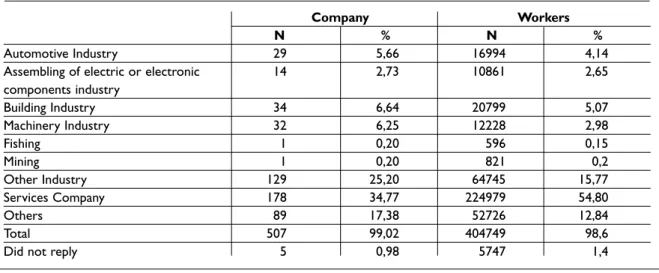
The relative frequency of responses was higher among the “Services” companies (34.8%), followed by “Other Industry” (25.2%) (Table I).
Among the studied companies, a balance in the distribution of the mean number of workers per sex, activity sector and mean age was observed (Ta-ble II).
From the 515 companies that replied, we had a total amount of 410,496 workers, which represents 11.1% of the Portuguese working population and 0.3% of the Portuguese companies. If we take the micro-enterprises (less than 9 workers) out of the-se figures, we obthe-serve that the univerthe-se of workers reaches 19.8% of the Portuguese working popula-tion, which corresponds to 11.1% of all companies in these conditions.
There is a predominance of man in our group with a mean age of 39,5 years. Workers are mostly from the production activity sector.
When we analysis by activity sector, it has been observed that the prevalence of male workers oc-curs mainly in the auto Industry, construction in-dustry, Fishing and Mining. The production areas
P R O U D S T U D Y
with mainly female labour are the Electric and Electronic Components Industry and Services Companies (Table III).
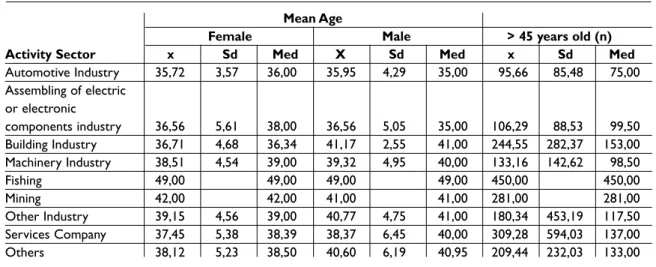
If we consider the distribution of workers per age over 45 years, in relation to sex and activity sec-tor we found that the Fishing and Mining secsec-tors present workers with mean age higher than 49 and 42 years, respectively. All workers present a medi-an value, for both sexes, higher thmedi-an 35 years old. In other sectors of activity we found a relevant hi-gher age (over 45 years) in construction industry and service industry (Table IV).
Globally, the higher prevalence of muscle skele-tal injuries was reported for the three segments of the vertebral spine and shoulder.
The most prevalent injury was low back pain (X=18.2), followed by cervical pain (X=9.1), dorsal pain (X=6.6) and shoulder tendonitis (X=4.7) (Table V).
Regarding the total amount of workers involved in the study, it may be observed that the number of clinically relevant injuries was of 5.9% (24 269 ca-ses). From these, 4.22% (17,340 cases) resulted from diagnoses of back pain, 1,13% (4,651 cases) of cervical pain; 0.82% (3,379 cases) of dorsal pain and 2.27% (9,310 cases) of low back pain. The other identified injuries involved the upper limb, in which the number of cases was higher for the shoulder tendonitis – 0.6%.
Analyzing the distribution of the injuries preva-lence by activity sectors, we have observed that, in the Construction Industry, Machinery and “Other Industry”, low back pain prevail (2.85%, 2,92%, 3,66%, respectively), and that in the Automobile, Electric and Electronic Components Assembly In-dustries, the upper limbs injuries are the most pre-valent ones (2.43%, 2.16% and 1.5%, respectively),
Table I. Absolute and relative frequency of the number of companies per economic activity sector
Company Workers
N % N %
Automotive Industry 29 5,66 16994 4,14
Assembling of electric or electronic 14 2,73 10861 2,65
components industry Building Industry 34 6,64 20799 5,07 Machinery Industry 32 6,25 12228 2,98 Fishing 1 0,20 596 0,15 Mining 1 0,20 821 0,2 Other Industry 129 25,20 64745 15,77 Services Company 178 34,77 224979 54,80 Others 89 17,38 52726 12,84 Total 507 99,02 404749 98,6
Did not reply 5 0,98 5747 1,4
Table II. Description of the parameters of the demographic characteristics main trend
Nr. of Workers N Mean sd Median Min. Max.
Sex Female 498 425 1524 165 1 22760 Male 497 3990,4 7060,8 233 3 9647 Sector Administrative 462 1440,4 402,9 60,5 2 5749 Production 408 478,5 642,4 294 3 5905 Age
More than 45 years old 486 221,9 436,3 123 1 5605
Female mean 461 37,9 5,1 38 18 55
especially shoulder and wrist tendonitis. The pre-valence differences were owed, very likely, to the specificity of the nature of the working conditions. In the Mining and Fishing activity sectors we found and very high level of diseases but because of the small numbers of companies evaluated we cannot extrapolate for the hole of this activity sec-tor. However this numbers should be viewed as an indicator of severity.
These facts have been confirmed by the multi-ple comparison analysis results, in which it was possible to observe significant statistic differences between the activity sectors in the number of diag-nosed cases of, shoulder tendonitis, carpal tunnel syndrome, elbow tendonitis and wrist tendonitis (Table VI).
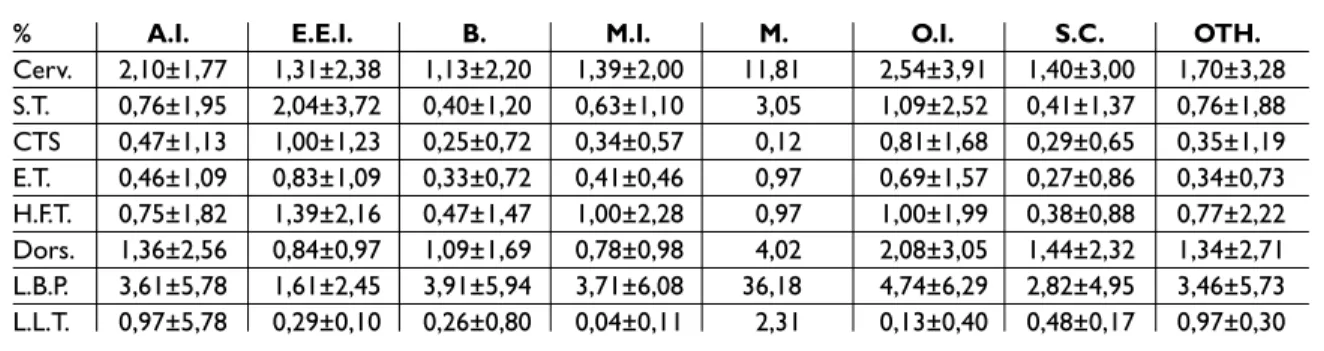
Along with the absolute mean values of muscle skeletal injuries, the relative frequency analysis of injuries by activity sector was also conducted in relation with the total number of operators in each sector (Table VII). We found that the relative values kept the same trend of the observed for the analy-sis of the absolute values of the injuries, i.e., the predominance of low back pain, followed by the other injuries in the vertebral spine. The Electric and Electronic Components Assembly Industry and Services presented higher prevalence relative values of muscle skeletal injuries related to work. Sex is positively correlated with all injuries (with the exception of lower limbs tendonitis). In males, there are correlations only with the elbow and lo-wer limbs tendonitis (Table VIII).
L U Í S C U N H A-M I R A N D A E C O L.
Table III. Distribution of workers per gender, regarding the activity sector
Gender
Male Female
X Sd Med X Sd Med
Automotive Industry 433,93 495,02 312 152,07 175,05 62
Assembling of electric or 311,71 318,59 311,71 464,07 367,75 373,50 electronic components industry
Building Industry 553,65 575,82 403,00 58,09 42,00 42,00 Machinery Industry 315,25 239,84 256,00 66,88 46,00 60,19 Fishing 473,00 473,00 123,00 123,00 Mining 756,00 756,00 65,00 65,00 Other Industry 263,77 454,13 197,00 246,03 431,35 162,00 Services Company 522,56 1048,72 218,00 811,77 2526,10 263,00 Others 322,76 342,20 226,50 290,34 352,74 193,50
Table IV. Characterization of the mean age and number of workers with more than 45 years old, by activity sector
Mean Age
Female Male > 45 years old (n)
Activity Sector x Sd Med X Sd Med x Sd Med
Automotive Industry 35,72 3,57 36,00 35,95 4,29 35,00 95,66 85,48 75,00 Assembling of electric or electronic components industry 36,56 5,61 38,00 36,56 5,05 35,00 106,29 88,53 99,50 Building Industry 36,71 4,68 36,34 41,17 2,55 41,00 244,55 282,37 153,00 Machinery Industry 38,51 4,54 39,00 39,32 4,95 40,00 133,16 142,62 98,50 Fishing 49,00 49,00 49,00 49,00 450,00 450,00 Mining 42,00 42,00 41,00 41,00 281,00 281,00 Other Industry 39,15 4,56 39,00 40,77 4,75 41,00 180,34 453,19 117,50 Services Company 37,45 5,38 38,39 38,37 6,45 40,00 309,28 594,03 137,00 Others 38,12 5,23 38,50 40,60 6,19 40,95 209,44 232,03 133,00
When performing the same analysis per activity sector, we found positive correlations between the Administrative Sector and the shoulder tendonitis. In the Production Sector, we found positive corre-lations in all pathologies analyzed.
The results confirm the ones previously obtai-ned for the characterization of the companies in which there is a balanced distribution of workers per sex and a predominance of effective workers in the production sector. It must also be mentioned that 26% of the workers have more than 45 years
old (Table IX).
Regarding the distribution of workers per sex, we observe that the automobile, construction and machinery industries active population is mostly male, contrasting to the services companies whe-re thewhe-re awhe-re mostly female effective workers.
As for the organization of sectors, most workers are integrated in the production sector, indepen-dently of the company’s economic activity sector. Finally, the sectors of Construction, Machinery Industry, Services Companies and Other Activity P R O U D S T U D Y
Table V. Description of central trend parameters of the injuries studied, concerning the number of evaluated companies
N Mean Sd Median Min Max
Cervicodynia 511 9,1 24,4 2 0 400
Shoulder tendinitis 512 4,7 27,9 1 0 600
Carpal tunnel syndrome 512 2,3 5,8 0 0 70
Elbow tendinitis 511 2,4 5,8 0 0 60
Hand and fist tendinitis 512 3,6 9,3 1 0 110
Dorsal pain 510 6,6 14,2 2 0 200
Low back pain 512 18,2 40,4 2 0 500
Lower limb tendinitis 512 0,7 2,7 0 0 36
Table VI. Results of the multiple comparation analysis between activity sectors by type of analyzed injury
Carpal Hand and Lower
Shoulder tunnel Elbow fist Dorsal Low limb
Cervicodynia tendinitis syndrome tendinitis tendinitis pain back pain tendinitis
QK 43,53 46,86 44,72 34,08 16,69 15,29 15,39 12,62
Df 8 8 8 8 8 8 8 8
pp 0,000 0,000 0,000 0,000 0,034 0,054 0,052 0,125
Table VII. Relative frequency of skeletal muscle injuries in relation with activity sector
% A.I. E.E.I. B. M.I. M. O.I. S.C. OTH.
Cerv. 2,10±1,77 1,31±2,38 1,13±2,20 1,39±2,00 11,81 2,54±3,91 1,40±3,00 1,70±3,28 S.T. 0,76±1,95 2,04±3,72 0,40±1,20 0,63±1,10 3,05 1,09±2,52 0,41±1,37 0,76±1,88 CTS 0,47±1,13 1,00±1,23 0,25±0,72 0,34±0,57 0,12 0,81±1,68 0,29±0,65 0,35±1,19 E.T. 0,46±1,09 0,83±1,09 0,33±0,72 0,41±0,46 0,97 0,69±1,57 0,27±0,86 0,34±0,73 H.F.T. 0,75±1,82 1,39±2,16 0,47±1,47 1,00±2,28 0,97 1,00±1,99 0,38±0,88 0,77±2,22 Dors. 1,36±2,56 0,84±0,97 1,09±1,69 0,78±0,98 4,02 2,08±3,05 1,44±2,32 1,34±2,71 L.B.P. 3,61±5,78 1,61±2,45 3,91±5,94 3,71±6,08 36,18 4,74±6,29 2,82±4,95 3,46±5,73 L.L.T. 0,97±5,78 0,29±0,10 0,26±0,80 0,04±0,11 2,31 0,13±0,40 0,48±0,17 0,97±0,30
A.I.– Automotive Industry; E.E.I.– Assembling of electric or electronic components industry; B.I.– Building Industry.; M.I.– Machinery Industry; M.– Mining; O.I.– Other Industry; S.C.– Service Company; OTH.– Others Cerv.– Cervicodynia; S.T.– Shoulder Tendinitis; CTS– Carpal tunnel syndrome;
L U Í S C U N H A-M I R A N D A E C O L.
T
able
VIII. Correlative analysis between demographic variables and the number of injuries diagnosed
Carpal Hand Lo w Lo w er Shoulder tunnel Elbo w and fist Dorsal back limb Cer vicodynia tendinitis syndr ome tendinitis tendinitis pain pain tendinitis Nr .of f emale w ork ers Cor relation Coefficient 0,09 0,15 0,24 0,12 0,20 0,11 0,09 0,06 Sig. (2-tailed) 0,05 0,00 0,00 0,01 0,00 0,02 0,04 0,16 N 497 498 498 497 498 496 498 498 Nr .of male w ork ers Cor relation Coefficient 0,05 0,07 -0,07 0,11 -0,03 0,03 0,06 0,13 Sig. (2-tailed) 0,31 0,10 0,14 0,01 0,56 0,51 0,15 0,00 N 496 497 497 496 497 495 497 497 Nr .of w ork ers fr om the Cor relation Coefficient 0,07 0,10 0,03 0,08 0,01 0,01 0,03 0,09 Administrativ e Sector Sig. (2-tailed) 0,13 0,04 0,53 0,09 0,85 0,90 0,47 0,06 N 461 462 462 461 462 460 462 462 Nr .of w ork ers fr om the Cor relation Coefficient 0,13 0,19 0,17 0,26 0,21 0,13 0,16 0,19 Pr oduction Sector Sig. (2-tailed) 0,01 0,00 0,00 0,00 0,00 0,01 0,00 0,00 N 407 408 408 407 408 407 408 408 Nr .of w ork ers with Cor relation Coefficient 0,18 0,17 0,13 0,14 0,08 0,13 0,18 0,20 mor e than 45 y ears old Sig. (2-tailed) 0,00 0,00 0,00 0,00 0,08 0,00 0,00 0,00 N 485 486 486 485 486 484 486 486
Mean age of the f
emale Cor relation Coefficient 0,11 0,05 0,05 0,04 -0,03 0,05 0,06 0,12 w ork ers Sig. (2-tailed) 0,02 0,27 0,31 0,35 0,47 0,30 0,21 0,01 N 461 461 461 460 461 459 461 461
Mean age of the male
Cor relation Coefficient 0,13 0,02 0,07 -0,01 -0,04 0,07 0,11 0,09 w ork ers Sig. (2-tailed) 0,01 0,60 0,14 0,78 0,44 0,12 0,02 0,05 N 462 462 462 461 462 460 462 462
Sector present a marked frequency of workers with more than 45 years old (>30%) (Table X).
Considering the total amount of the workers’ sample, we identified that the most prevalent pa-thologies were low back pain and cervical pain
(Ta-ble XI).
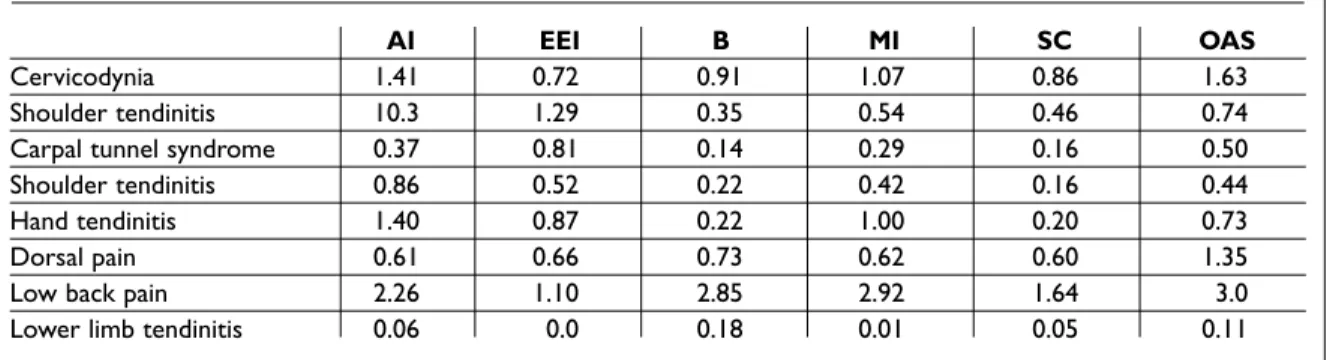
In an identical analysis by the activity sector, it has been observed that, along with these patholo-gies, others deserve to be mentioned, such as shoulder tendonitis (automobile industry, electric and electronic components assembly industry, mi-ning and other sector of activity), hand tendonitis (auto industry, machinery industry and mining), lower limb tendonitis (mining) and dorsal pain (other activity sector) (Table XII).
Discussion
In our study the presence of clinically relevant WRMSDs is of 5.9% in a population of 410,496, which is thought to be representative of the Portu-guese business sector, i.e. 24,269 workers have a muscle skeletal pathology related to work consi-P R O U D S T U D Y
Table IX. Characterization of the companies' workers by gender, sector and older than 45 years old (absolute and relative frequency)
N % Sex Female 212012 51,56 Male 198484 48,35 Sector Administrative 66701 16,25 Production 107841 47,56
Age > 45 years old 107841 26,27
Table X. Characterization of the companies' workers by gender, sector and older than 45 years old (absolute and relative frequency), in relation with activity sector.
Sex Sector Age higher
Female Male Administrative Production than 45 y.o.
N(%) N(%) N(%) N(%) N(%) 222012 (51,6) 198484 (48,4) 66701 (16,3) 195225 (47,6) 107841 (26,3) AI 4410 (26%) 12584 (74%) 3086 (18,2) 13185 (77,6%) 2274 (26,3) E.E.I. 6497 (59,1%) 4364 (40,2%) 1996 (4,4%) 8419 (77,5%) 1488 (13,7) B (1975 (9,5%) 18824 (90,5%) 3109 (14,9%) 16517 (79,4%) 8070 (38,8%) MI 2140 (17,5%) 10088 (82,5%) 1943 (15,9%) 10032 (82%) 4261 (34,8%) SC 137189 (61%) 87790 (39%) 30113 (13,4%) 69406 (30,9%) 49484 (30%) OAS 56215 (47,9%) 61256 (52,2%) 25432 (21,7%) 71533 (60,9%) 40525 (34,5%)
A.I.– Automotive Industry; E.E.I.– Assembling of electric or electronic components industry; B.I.– Building Industry.; M.I.– Machinery Industry; S.C.– Service Companies; OAS– Other Activity Sectors
Table XI. Characterization of the pathologies diagnosed in the replying companies (absolute and relative frequency)
Absolute Frequency Relative Frequency WRMSIs Percentage
Cervicodynia 4651 1,13 19,2
Shoulder Tendinitis 2398 0,59 9,9
Carpal tunnel syndrome 1170 0,29 4,8
Elbow Tendinitis 1202 0,29 5
Hand/Fist Tendinitis 1823 0,44 7,5
Dorsal Pain 3379 0,82 13,9
Low Back Pain 9310 2,27 38,4
Lower Limb Tendinitis 336 0,08 0,01
dered to be clinically relevant by the occupational physician.
The good response rate (62.3%) is probably re-lated, on the one hand, with the fact that the ques-tionnaire was sent in the scope of a relevant natio-nal entity within the clinical practice and, on the other hand, with the simplicity and reduced size of the questionnaire. This simplification had impro-ved the response rate but limited some of the con-clusions intended. Nevertheless, the balance between simplicity and relevance seemed to have been achieved.
The request for a clinically relevant diagnosis to the occupational physician and not just a com-plaint, and the fact that the occupational physici-an was the one that made de diagnosis is conside-red to be a strength of this work. The absence of cre-dible and large dimension national data makes this work a simple first approach of the WRMSDs im-pact in Portugal.
With these results, we point out the predomi-nance of back pain, with the prevalence for low back pain of 2.27% (n = 9,310, 38.4% of the WRMSDs), dorsal pain of 0.82% (n= 3,379, 13.9% of the WRMSDs) and cervical pain of 1.13% (n=4,651, 19.2% of the WRMSDs). Back pain corres-ponds to 4.22% (n = 17,340) and to 74.9% of all WRMSDs identified.
Upper limb injury showed a prevalence of 1.61%, corresponding to 6,493 collaborators with upper limb injuries, divided in shoulder tendino-pathy 0.59% (n = 2,398, 9.9% of the WRMSDs), car-pal tunnel syndrome 0.29% (n = 1,170, 4.8% of the WRMSDs), elbow tendinopathy 0.29% (n = 1,202, 5% of the WRMSDs) and hand tendinopathy 0.44% (n = 1,823, 7.5% of the WRMSDs). We had a much lower value for lower limb tendinopathy, with
0.08% (n = 336, 0.01% of the WRMSDs).
From the literature, we know that the muscle skeletal disorders of the upper limbs and neck are a common cause of morbidity and, in some pro-fessional groups, represent an important contri-bution to the loss of time derived from work23-27.
Community-based inquiries have stated a pre-valence of 4-20% in specific places for neck pain and upper limb, with prevalence throughout life as high as 60%28-30.
In another study involving inquiry directed to the population (n = 5,133), it was assessed a pain prevalence in the last month of 50.5% (2,539/5,032) of the ones replied. The prevalence of pain in each one of the areas was as follows: neck, 24.0%; shoul-der (s), 31.7%; elbow (s), 13.9%; forearm(s), 14.9%; hand(s), 19.2%.
The prevalence of pain associated to work was around 44%31.
In OPRA (Occupational Physicians Reporting Activity) study, from 1996 to 1999, 800 occupatio-nal physicians observed that 49.1% of the reported cases were of WRMSDs, with an annual incidence of 20.6 per 100,000 workers, in a total amount of 21,480 cases preferentially distributed by the upper limb (37.5% of the cases), lower spine and trunk (27.9%), elbow (9.5%), cervical and thoracic spine (7.7%), shoulder (7.4%) and, in a lower per-centage, hip and knee (4.8%)32.
In the subsequent registry, OPRA demonstrated that 47% of the reported occupational diseases were WRMSDs, preferentially distributed by the upper limbs (54%), vertebral spine (35%), lower limbs (6%) and other diagnosis (4%). In the United Kingdom, 12% of the working population has ac-cess to an occupational physician.
After 6 years, this registry reached a total amount L U Í S C U N H A-M I R A N D A E C O L.
Table XII. Characterization of the pathologies diagnosed in the companies that responded to the questionnaire, by activity sector (absolute and relative frequency)
AI EEI B MI SC OAS
Cervicodynia 1.41 0.72 0.91 1.07 0.86 1.63
Shoulder tendinitis 10.3 1.29 0.35 0.54 0.46 0.74
Carpal tunnel syndrome 0.37 0.81 0.14 0.29 0.16 0.50
Shoulder tendinitis 0.86 0.52 0.22 0.42 0.16 0.44
Hand tendinitis 1.40 0.87 0.22 1.00 0.20 0.73
Dorsal pain 0.61 0.66 0.73 0.62 0.60 1.35
Low back pain 2.26 1.10 2.85 2.92 1.64 3.0
of 66.000 cases of occupational diseases from the-se 48% WRMSDs. In another registry of rheumatic occupational diseases conducted by rheumatolo-gists (MOSS - Musculoskeletal Occupational Sur-veillance Scheme) in the first 3 years, revealed 8,442 new cases reaching hand/wrist (44%), shoulder (12%), elbow (10%), neck/spine (25%), hip/knee (3%) and foot/ankle (4%) in most of the cases attributable to repetitive traumas and not single trauma33.
In other countries, the WRMSDs prevalence data are similar. In one Canadian study, 1.3 million occupational diseases were found. Approximately 50% were WRMSDs. 63.3% of these were upper limb diseases and 36% were in the spine and lower limbs. The most affected areas were wrist/hand (39%), shoulder (29%) and elbow (27%)2.
In Netherlands, on the other hand, the prevalen-ce of low back pain is of 44%, prevalen-cervical pain is of 31%, shoulder pain is of 30%, elbow pain 11% and wrist pain of 18%.
It is known that, given the prevalence, the mul-tiple location in these cases is frequent and, and patients who report pain in more than one loca-tion, may vary from 37% to 66%. In a study Ijzelen-berg W, et confirmed that patients with low back pain had a higher possibility (68%) of having other co-morbidities and that these are associated to the intensity of low back pain reported34.
In a population based study in a region of Fran-ce that corresponded to 5% of the country wor-kers, there was an upper limb WRMSDs prevalen-ce rate of 58% in women and 53% in men throu-ghout the 12 previous months and 35% of women and 27% of men reported symptoms during the last week. The clinically diagnosed injuries were of 11% in men and 15% in women. The most preva-lent situations were the rotator cuff syndrome (6.8% of men and 9% of women), followed by car-pal tunnel syndrome (2.3%/4%) and epicondylitis (2.2%/2.7%)5.
Over the last years, the carpal tunnel syndrome (CTS) has become a very relevant disease within WRMSDs. For example, in the United States, in 1993, it represented 13% of all WRMSDs and it was estimated that 50% of all CTS cases had an occu-pational origin. In this study, there are in Portugal obvious differences from what was observed in the international literature. On one hand, there is a lar-ger supremacy of the back pain and, relatively, an important cervical pain value; on the other hand, there is a clear decrease in the values of upper and
lower limbs WRMSDs.
Furthermore, within upper limb WRMSDs, a higher value for hand tendinopathy and a reduced value of the elbow tendinopathies and of the car-pal tunnel syndrome were observed.
The reason for this fact may not be clear. As this is the first transversal study on the prevalence of WRMSDs within the large Portuguese companies, these results may demonstrate only that the Por-tuguese business sector, of its working population and the anthropometric, social, and labour trai-ning characteristics, result in relevant clinical pa-thologies different from the international literatu-re. Another explanation is that the clinical relevan-ce given by Portuguese occupational physicians may be different from the one given by physicians from other countries or by patients themselves in international studies.
Finally, and given the simplicity of this ques-tionnaire, these results may have several design or response biases that were not anticipated by its authors.
The global data found is clearly contrary to the social security data, in what concerns to the repor-ted occupational diseases and, therefore, corrobo-rate the deficit in the national registry system of these diseases.
If we consider that our work review the impact of WRMSDs in 11% of the Portuguese working for-ce and found a prevalenfor-ce of 5,9% (24,249 patients) we could try to extrapolate to the entire Portuguese workforce and we would found 220,467 workers with a relevant pathology for the occupational physician. This is not so linear and it is just an exercise because other issues can influence the re-sult of the global work force (type of activity, size of the company, presence of occupational health services etc.).
Nevertheless, in the 2005 Social Security data reported 1,274 occupational diseases without in-capacity and 201 with inin-capacity, in a total amount of 1,475 certified WRMSDs35. The important
ques-tion here is to understand the reason for this diffe-rence. Maybe the occupational physicians do not systematically report the diseases because of dif-ficulties related with the occupational medicine practice in Portugal or maybe they do not percei-ve them as important for the workers or for the country. Other reasons would be the inexistence of a simplified system for working pathologies or maybe it is understood that the sending of this in-formation for the Centro Nacional para Prevenção
das Doenças Profissionais (National Centre for the
Prevention of Occupational Diseases) (CNPRP) does not give any added-value for the workers, for the company or for the occupational physician it-self. In any case, these pathologies correspond to 40.7% of all diseases certified in Portugal in 2005 which, despite being below the numbers from other countries, demonstrates its clinical and so-cial importance36-38.
Conclusion
WRMSDs have replaced other occupational disea-ses worldwide, such as deafness or respiratory pa-thology, in terms of labour and social impact.
However, the data that we have obtained de-monstrate that, in Portugal, there are still some obvious needs in the appreciation of these disea-ses and in the occupational physicians, employers and state structure responsibility.
The absence of clinical guidelines and the diffi-cult in identifying these diseases has been influen-cing for many years the true reality of these inju-ries in Portugal. New registry and clinical guidan-ce systems must be implemented in order to pre-vent a non-controlled increase of these injuries, with clear implications in the use of health re-sources.
The data obtained, which point out to a preva-lence of around 6%, was obtained by of a short and simple questionnaire , the number of replies and the sample size as well as clinical evaluation ins-tead of workers complaints are a strength of this study. However we should consider some weak-nesses. The non-identification of the diseases re-lation with the type of work or a better characteri-zation of the affected group in relation to sex, age and work description has weakened the extrapo-lations we could have obtained. Nevertheless, the-se limitations were contemplated in the study de-sign having into account the multiple types of trai-ning of the specialists who replied, the type of con-tract, the time to reply to the questionnaire, the several types of registry systems for medical appo-intments and diseases implemented by the seve-ral occupational physicians and the need to de-sign a representative study of the Portuguese bu-siness sector.
With this study, we were able to have a better vision on the number, location and type of WRMSDs in Portugal.
This study was a first epidemiologic approach to
the theme and, due to its design, it will be neces-sary to perform further studies focused on speci-fic pathologies or added-risk activity sectors, in or-der to more accurately unor-derstand the real impact of these diseases in Portugal.
Acknowledgments
The authors would like to sincerely acknowledge Dr. Carlos Pipa, from the Direcção Geral da Saúde (Health General Directorate), Dr. Pedro Aguiar, from the Escola Nacional de Saúde Pública (National School of Public Health) – Universidade Nova de Lisboa, Prof. Doutor Jaime Branco, Coordinator of the National Plan Against Rheumatic Diseases, Prof. Doutor António Sousa-Uva, from the Escola Nacional de Saúde Pública (National School of Public Health) - Universidade Nova de Lisboa and Dr. Mário Carreira, from the Direcção Geral da Saúde (Health General Directorate).
Correspondence to
Luís Cunha-Miranda
Rua da Benificência nº 7 1050-034 Lisboa E-mail: [email protected]
References
1. Tjepkema M. Repetitive strain injury. Health Rep 2003;14:11-30.
2. Ratzlaff C R, Gillies J H, Koehoorn M W. Work related repetitive strain injury and leisure-time physical acti-vity. Arth & Rheum 2007;57;495-500.
3. Piligian G, Herbert R, Hearns M, Dropkin J, Landsbergis P, Cherniack M. Evaluation and manage-ment of chronic work-related musculoskeletal disor-ders of the distal upper extremity. Am J Ind Med 2000;37:75-93.
4. Cherry N M, Meyer J D, Chen Y, Holt D L, McDonald J C. The reported incidence of musculoskeletal disease in the UK: MOSS 1997-2000. Occup Med 2001;51: 450-455.
5. Roquelaure Y, Ha C, Leclerc A et al. Epidemiological surveillance of upper-extremity musculoskeletal di-sorders in the working population. Arth & Rheum 2006;55:765-778.
6. Chen Y, McDonald JC, Cherry NM. Incidence and suspected cause of work-related musculoskeletal di-sorders, United Kingdom, 1996-2001. Occup Med 2006;56:406-413.
7. Armstrong TJ, Foulke JA, Joseph B, Goldstein S. In-vestigation of cumulative trauma disorders in a poul-try processing plant. American Industrial Hygiene Association Journal 1982;43:103-116.
8. Burdorf A, Van Riel M. Design of strategies to assess lumbar posture during work. International Journal of Industrial Ergonomics 1996;18:239-249.
9. Devereux JJ, Buckle P, Vlachonikolis IG. Interactions between physical and psychosocial risk factors at work increase the risk of back disorders: an epide-miological approach. Occupational Environmental Medicine 1999;56:343-353.
10. Hagg G, Milerad E. Forearm extensor and flexor exer-tion during simulated gripping work - an electro-myographic study. Clinical Biomechanics 1997; 12:39-43.
11. Hagg G, Oster J, Bystrom S. Forearm muscular load and wrist angle among automobile assembly line workers in relation to symptoms. Applied Ergono-mics 1997;28:41-47.
12. Loslever P, Ranaivosoa A. (1993). Biomechanical and epidemiological investigations of carpal tunnel 13. Marras W, Schoenmarklin RW. Wrist motion in
in-dustry. Ergonomics 1993;36:341-351.
14. Moore A, Gard A. Upper extremity disorders in a pork processing plant: Relationships between job risk fac-tors and morbility. American Industrial Hygiene As-sociation Journal 1994;56:443-458.
15. Riihimaki H. Hands-up or back to work-future chal-lenges in epidemiologic research on musculoskeletal diseases. Scandinavian Journal of Work Environment & Health 1995;21: 401-403.
16. Van der Beek AJ, Frings-Dresen MH, van Dijk FJ. Loa-ding and unloaLoa-ding by lorry drivers ans musculoske-letal complaints. International Journal of Industrial Ergonomics 1993;12:13-24.
17. Walker-Bone K, Cooper C. Hard work never hurt anyone: or did it? A review of occupational associa-tions with soft tissue musculoskeletal disorders of the neck and upper limb. Ann Rheum Dis 2005;64:1391--1396.
18. Harkness EF, Macfarlane GJ, Silman AJ, McBeth J. Is musculoskeletal pain more common now than 40 ye-ars ago? Two population-based cross-sectional stu-dies. Rheumatology 2005;44:890-895.
19. Sommerich C, McGlothing JD, Marras W. Occupatio-nal risk factors associated with soft tissue disorders of the shoulder: a review of recent investigations in the literature. Ergonomics 1993;36:697-717.
20. Van der Windt D, Thomas E, Pope D et al. Occupatio-nal risk factors for shoulder pain: a systematic review. Occupational Environmental Medicine 2000;57:433--442.
21. Viikari-Juntura ER. The scientific basis for making guidelines and standards to prevent work-related musculoskeletal disorders. Ergonomics 1997;40: 1097-1117.
22. Winkel J, Westgaard RH. Occupational and individual risk factors for shoulder-neck complaints. Part II-The scientific basis (literature review) for the guide. International Journal of Industrial Ergonomics 1992;10:85-104.
23. Nakaseko M, Tokunga R, Hosokawa M. History of oc-cupational cervicobrachial disorder in Japan. J Hum Ergol 1982;11:7–16 .
24. Hocking B. Epidemiological aspects of “repetitive strain injury” in Telecom Australia. Med J Aust 1987;147:218–222.
25. Gun RT. The incidence and distribution of RSI in South Australia 1980–81 to 1986–87. Med J Aust 1990;153:376–380.
26. Darmawan J, Vallenburg HA, Muirden KD, Wigley RD. The prevalence of soft tissue rheumatism - a WHO-ILAR copcord study. Rheumatol Int 1995;15:121–124. 27. Palsson B, Horstmann V, Attewell RG, Ohlsson K,
Skerfving S. Sickleave and disability pensions among female assembly workers. Eur J Public Health 1997;7:162–168.
28. Bergenudd H, Lindgarde F, Nilsson B, Petersson CJ. Shoulder pain in middle age. A study of prevalence and relation to occupational work load and psycho-social factors. Clin Orthop 1988;231:234–238. 29. Jacobsson L, Lindgarde F, Manthorpe R. The
commo-nest rheumatic complaints of over six weeks’ durati-on in a twelve-mdurati-onth period in a defined Swedish population. Prevalences and relationships. Scand J Rheumatol 1989;18:353–360.
30. McCormack RR Jr, Inman RD,Wells A, Berntsen C, Imbus HR. Prevalence of tendonitis and related di-sorders of the upper extremity in a manufacturing workforce. J Rheumatol 1990;17:958–964.
31. Sim J, Lacey RJ, Lewis M. The impact of workplace risk factors on the occurrence of neck and upper limb pain: a general population study. BMC Public Health 2006;6:234.
32. Cherry NM, Meyer JD, Holt DL, Chen Y, McDonald JC. Surveillance of work-related diseases by occupati-onal physicians in the UK: OPRA 1996-1999. Occup Med 2000;50:496-503.
33. Chen Y, Turner S, Hussey L, Agius R. A study of work-related musculoskeletal case reports to The Health and Occupation Reporting network (THOR) from 2002 to 2003. Occup Med 2005;55:268-274.
34. Ijzelenberg W, Burdof A. Impact os musculoskeletal co-morbidity of neck and upper extremities on he-althcare utilization and sickness absence for low back pain. Occup Environ Med 2004;61:801-810. 35. http://www2.seg-social.pt/left.asp?02.21.03.07 last
accessed on May 5, 2009.
36. http://www.ine.pt/xportal/xmain?xpid=INE&xpgid= ine_publicacoes&PUBLICACOESpub_boui=70759 76&PUBLICACOESmodo=2 last accessed on May 5, 2009.
37. http://www.ine.pt/xportal/xmain?xpid=INE&xpg id=ine_indicadores&indOcorrCod=0001543&contex-to=pi&selTab=tab0 last accessed on May 5, 2009. 38. http://www.ine.pt/xportal/xmain?xpid=INE&xpgid=
ine_indicadores&indOcorrCod=0001544&contex-to=pi&selTab=tab0 last accessed on May 5, 2009.