Genetic diversity and population structure of
Vriesea reitzii
(Bromeliaceae), a
species from the Southern Brazilian Highlands
Luis Eduardo Soares
1, 2,*, Márcia Goetze
1*, Camila M. Zanella
1,3and Fernanda Bered
1 1Universidade Federal do Rio Grande do Sul, Instituto de Biociências, Programa de Pós-graduação em
Genética e Biologia Molecular, Porto Alegre, RS, Brazil.
2
Department of Molecular Developmental Biology, Faculty of Science, Radboud Institute for Molecular Life
Sciences, Radboud University, Nijmegen, The Netherlands.
3The John Bingham Laboratory, National Institute of Agricultural Botany (NIAB), Cambridge, UK
Abstract
The Southern Brazilian Highlands are composed by a mosaic of Mixed Ombrophilous Forest (MOF) and grassland formations, an interesting landscape for the study of population structure. We analyzed the genetic diversity within and among populations of the MOF-endemic bromeliadVriesea reitzii by genotyping seven nuclear microsatellite loci in 187 individuals from six populations. We characterized levels of genetic diversity and assessed the genetic structure among populations.Vriesea reitzii populations showed high levels of genetic variation (number of alleles 28 - 43, allelic richness 3.589 - 5.531) and moderate levels of genetic differentiation (FST= 0.123,RST= 0.096). The high levels of genetic diversity may be explained by species life-history traits, such as habit and mating system. The mod-erate structure may be a product of the combination of ancient and contemporary gene flow, resulting from the ex-pansion of the forest in the Holocene, and/or due to facilitated dispersal mediated by the MOF’s mosaic landscape. The genetic results indicated no imminent threat to this bromeliad. However, the species is highly associated with the MOF, putting landscape conservation at the center of conservation efforts for the species’ maintenance.
Keywords: Mixed Ombrophilous Forest, bromeliad,Araucariaforest, gene flow, conservation.
Received: March 06, 2017; Accepted: July 22, 2017.
Introduction
The Brazilian Atlantic rainforest (BAF) represents the second largest tropical moist forest in the world and is recognized for its high levels of biodiversity and endemism (Ledruet al., 2016). The BAF is an ecogeographically sub-divided biome. By its broadest definition, it includes sev-eral types of vegetation, including semi-deciduous and mixed forests, in addition to the ombrophilous forest of the coast (Oliveira Filho and Fontes, 2000; Goetze et al., 2015). At the southernmost limit of the BAFsensu latolies the Mixed Ombrophilous Forest (MOF), orAraucaria For-est, which extends up to 700 km inland (Oliveira Filho and Fontes, 2000). It is disjunctly distributed across the south-ern plateau of Southeastsouth-ern Brazil, between 24° and 30° S, at altitudes between 500 and 1400 m above sea level (Behling and Pillar, 2007).
The Araucaria Plateau is a geomorphological unit that occupies approximately three-quarters of the southern area of South Brazil, between the Iguaçú and Uruguay Rivers (Behling and Pillar, 2007; Calegariet al., 2017). Its vegetation is characterized by a mosaic of MOF and grass-land formations. In the grassgrass-land areas it is common to find
Araucaria angustifoliain an irregular distribution, together with “capões”(clumps of trees) and gallery forest, whose floristic composition is similar to that of the MOF (Calegari
et al., 2017). The origin of this mosaic, which is character-istic of the Southern Brazilian highlands, has been widely debated. According to Behlinget al.(2005), several palaeo-ecological studies carried out in this region have proven that extensive areas of grassland vegetation existed on the highlands throughout the glacial, early and mid-Holocene periods, with forests restricted to deep valley refuges. Mounting evidence suggests that around 3000 years ago, during the Holocene, the MOF expanded from the gallery forests along the rivers as a result of increasing tempera-tures and humidity (Behlinget al., 2004).
Starting around the First World War, fueled by diffi-culties in commercializing pine wood from Latvia, Europe-ans began to explore the Brazilian pineAraucaria
angus-Send correspondence to Fernanda Bered. Universidade Federal do Rio Grande do Sul, Instituto de Biociências, Programa de Pós-graduação em Genética e Biologia Molecular, Avenida Bento Gonçalves 9500, P.O. Box 15053, 91501-970, Porto Alegre, RS, Brasil. E-mail: [email protected].
tifolia. As a consequence, the MOF has suffered a further drastic reduction in its geographic distribution, giving way to the current patchwork of pasture, monoculture stands of
Pinus andEucalyptus, and open fields interspersed with
Araucariafragments (Fonsecaet al., 2009; Boelteret al., 2011). In spite of these known – ancient and more recent – factors, the origin of the formation of this mosaic remains unknown, and the effect of human impact on the overall biodiversity of the region throughout time is ill understood.
In fragmented or mosaic landscapes, genetic ex-change among plants tends to be restricted, and high ge-netic differentiation among spatially isolated populations might be expected as a result of random genetic drift, re-stricted gene flow or selection (Freiet al., 2012; Devittet al., 2013; Mauriceet al., 2016). Studies addressing plant population structure in the MOF are restricted almost ex-clusively toAraucaria angustifolia(e.g., Bittencourt and Sebbenn, 2007; Danneret al., 2013; Medina-Macedoet al., 2015). In order to develop a better understanding of the dy-namics of this particular mosaic of forest and grassland in the Southern Brazilian Highlands, the contribution of data from other species is crucial.
The family Bromeliaceae is widespread across the Neotropical region and occupies most distinct environ-ments in the American continent (Brown and Gilmartin, 1989; Smith and Till, 1999; Benzing, 2000; Givnishet al., 2014). Within the BAF, the bromeliads are one of the spe-cies richest and most diverse families, therefore represent-ing an important component of this biome (Martinelliet al., 2008).Vrieseais the third largest bromeliad genus. It com-prises approximately 290 species, 94.8% of which are en-demic to Brazil (Costaet al., 2014; Barfusset al., 2016). The main center of diversity of the genus lies in the BAF (Costaet al., 2014), and most population genetic studies on
Vrieseafocus on species from the coastal regions, or BAF
sensu stricto(Alveset al., 2004; Palma-Silvaet al., 2009; Zanellaet al., 2012, 2016). Additional studies have investi-gated the genetic patterns of bromeliads restricted to higher altitudes of Andean landscape, such as Puya raimondii
(Sgorbatiet al., 2004), as well as tropical inselbergs and outcrops (Barbaráet al., 2009; Boisselier-Dubayleet al., 2010; Domingueset al., 2011; Ribeiroet al., 2013; Lavoret al., 2014). However, little is known about species endemic to the MOF.
Here, we investigate the genetic diversity within and among populations of the MOF-endemic bromeliad Vrie-sea reitziiLeme & A.F. Costa, across its entire geographic distribution.Vriesea reitziiis an epiphytic bromeliad that occurs in MOF fragments at altitudes ranging from 750 to 1200 m (Rech-Filhoet al., 2005; Alveset al., 2006). Due to its morphological similarity withV. philippocoburgii,V. reitziiwas, for a long time, neglected as a species. How-ever, morphological and ecological characteristics have led to the recognition of two distinct taxonomic units (Leme and Costa, 1991). Due to this very recent description ofV.
reitziias a separate species there is an almost complete lack of data on its breeding system, life history and demograph-ics. However, based on the great resemblance betweenV. reitziiandV. phillipocoburgii, it is reasonable to hypothe-size that the two species share the same or very similar characteristics.Vriesea phillipocoburgiiis an epiphyte bro-meliad pollinated by hummingbirds, whose seeds are dis-persed by the wind (Machado and Semir, 2006; Fischer EA, 1994, Master’s thesis, Universidade Estadual de Campi-nas). In the only previously published report on the demog-raphy and life history ofV. reitzii, Favretto and Geuster (2012) found that the species bloomed during the spring in the municipality of Joaçaba, Santa Catarina. According to the authors, the species reaches high population densities in places with a good exposure to light.
In addition to the potential conservation implications of our work, this study is motivated by a desire to under-stand the genetic structure of populations from an ex-tremely fragmented mosaic landscape, the Southern Brazil-ian Highlands, usingV. reitziias model. We hypothesized that the populations ofV. reitziiwould show a high level of genetic structure, similar to other bromeliad species that have been studied on inselbergs. However, there are no re-ports of genetic population studies in MOF bromeliads, and their genetic structure remains unknown. The specific aims of the present study were: (i) to assess the intra- and inter-population genetic diversity of V. reitzii using nuclear DNA; (ii) to quantify the degree of genetic differentiation among populations and discuss the results in the light of the particularity of the forest and grassland mosaic covering the Southern Brazilian Highlands; (iii) to provide data as a basis for conservation actions for the species.
Material and Methods
Sampling and DNA extraction
1% agarose gel stained with GelRed (Biotium, Hayward, CA, USA), in comparison withlphage DNA.
Molecular markers and genotyping assays
All samples were genotyped for seven nuclear micro-satellite loci described for different bromeliads species: e6B and e19, from Tillandsia fasciculata (Boneh et al., 2003); PaA10, fromPitcairnia albiflos(Paggiet al., 2008), and VgB10, VgC01 and VgF02, from Vriesea gigantea
(Palma-Silvaet al., 2007). We also genotyped VgF05, an unpublished locus isolated from V. gigantea (primers F:
TGGGATCATTTCCTTGTTCC, R:
CATTCTTGTTTCGCCCAAAT). Amplification reactions were carried out in a TC-412 Thermal Cycler (Techne, Burlington, New Jersey, USA), as described by Palma-Silvaet al.(2007). The microsatellite alleles were resolved on an ABI 3100 DNA Analyzer Sequencer (Applied Bio-systems, Foster City, CA, USA) and sized against the GS500 LIZ molecular size standard (Applied Biosystems) using GENEMARKER Demo version 1.97 (SoftGenetics, State College, PA, USA).
Data Analyses
The genetic diversity of each population was charac-terized using the number of alleles (A), number of private alleles (AP), allelic richness (RS), expected (HE) and
ob-served (HO) heterozygosities, and the inbreeding
coeffi-cient (FIS; Weir and Cockerham, 1984), using the programs
FSTAT 2.9.3.2 (Goudet, 1995) and MSA 4.05 (Dieringer and Schlötterer, 2003). To examine departures from the Hardy–Weinberg equilibrium (HWE), exact tests were car-ried out in GENEPOP 4.0 (Raymond and Rousset, 1995). The data were also tested for genotyping errors resulting from stuttering, short allele dominance, and null alleles us-ing a Monte Carlo simulation of expected allele-size differ-ences implemented in MICRO-CHECKER 2.2.3 (van Oosterhoutet al., 2004).
Each population was tested for recent population size reductions (e.g., genetic bottlenecks), using a hetero-zygosity excess test implemented in the software BOTTLENECK 1.2.02 (Piryet al., 1999). The analysis was carried out using a two-phased mutation model (TPM), with 12% variance and 95% stepwise mutations. Statistical significance was assessed in 10,000 replicates using a one-tailed Wilcoxon signed-rank test. In addition, the occur-rence of a genetic bottleneck was tested by estimating the
M-ratio, the mean ratio of the number of alleles (k) to the range in allele size (r) using the software ARLEQUIN 3.5.2.2 (Excoffier and Lischer, 2010). This method takes advantage of the size specificity of microsatellite allelic states. Significance for each population was assessed by comparison ofM-ratios with the critical values (Mcvalues)
obtained by simulating the distribution ofM-ratios under specific demographic and mutational conditions using the software CRITICAL_M.EXE (http://swfsc.noaa.gov/ textblock.aspx?Division=FED&id=3298) according to Goetzeet al.(2016). Population genetic differentiation was assessed based onFST(Weir and Cockerham, 1984), on the
standardized genetic differentiation measure G’ST
(He-drick, 2005), and on Slatkin’sRST (Slatkin, 1995), which
estimates the contribution of stepwise-like mutations to ge-netic differentiation. All these parameters were calculated
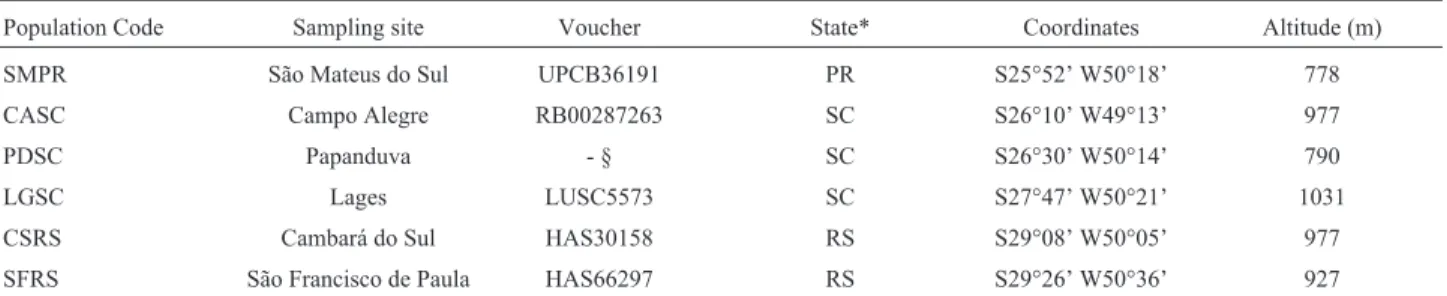
Table 1- Populations ofVriesea reitziisampled, with their vouchers and geographical parameters.
Population Code Sampling site Voucher State* Coordinates Altitude (m)
SMPR São Mateus do Sul UPCB36191 PR S25°52’ W50°18’ 778
CASC Campo Alegre RB00287263 SC S26°10’ W49°13’ 977
PDSC Papanduva - § SC S26°30’ W50°14’ 790
LGSC Lages LUSC5573 SC S27°47’ W50°21’ 1031
CSRS Cambará do Sul HAS30158 RS S29°08’ W50°05’ 977
SFRS São Francisco de Paula HAS66297 RS S29°26’ W50°36’ 927
*Brazilian Federal States: RS, Rio Grande do Sul; SC, Santa Catarina; PR, Paraná. § Unable to retrieve voucher from this population.
UPBC, Herbarium Departamento de Botânica, Universidade Federal do Paraná; RB, Herbário do Jardim Botânico do Rio de Janeiro; LUSC, Herbarium Lages da Universidade Federal de Santa Catarina; HAS, Herbário Prof. Dr. Alarich Rudolf Holger Schultz, Museu de Ciências Naturais da Fundação Zoobotânica do Rio Grande do Sul.
in the FSTAT software. Pairwise comparisons ofFST
be-tween populations were carried out using the program ARLEQUIN. The partitioning of genetic diversity within and among populations was examined by Analysis of Mo-lecular Variance (AMOVA; Excoffieret al., 1992) imple-mented in the software ARLEQUIN. The hypothesis that populations are differentiated because of isolation-by-dis-tance (Wright, 1965) was tested by calculating the correla-tion between geographic and genetic distance matrices (FST), with a standardized Mantel test (Sokal and Rohlf,
1995) using GENEPOP. We also used a Bayesian assign-ment approach to investigate the population structure ofV. reitzii, using STRUCTURE 2.3.4 (Pritchardet al., 2000), aiming to assign individuals to genetic clusters (K) and to estimate admixture proportions (Q) for each individual. The proportion of membership for each cluster was calcu-lated without the consideration of sampling localities. The analyses were carried out under the admixture model as-suming independent allele frequencies and using a burn-in period of 250,000, run lengths of 106and 10 iterations per
K,forKranging from 1 to 8, to confirm stabilization of the summary statistics (Pritchardet al., 2000). To determine the most likely number of clusters (K), we used the method proposed by Evannoet al.(2005), which is based on anad hocmeasure ofDKthat evaluates the second-order rate of change of the likelihood function with respect toK. The cal-culation of DKwas done with STRUCTURE HARVES-TER version 0.6.94 (Earl and von Holdt, 2012).
The effective number of migrants (Nem) between
pairs of populations was estimated using a coalescent the-ory and maximum-likelihood-based approach using MIGRATE 3.0.3 (Beerli and Felsenstein, 1999), as de-scribed by Barbaráet al.(2007). Computations were car-ried out under both the infinite allele model (IAM) and the Stepwise Mutation Model (SMM), and mutation rates (m)
for each locus were estimated from the data.
Results
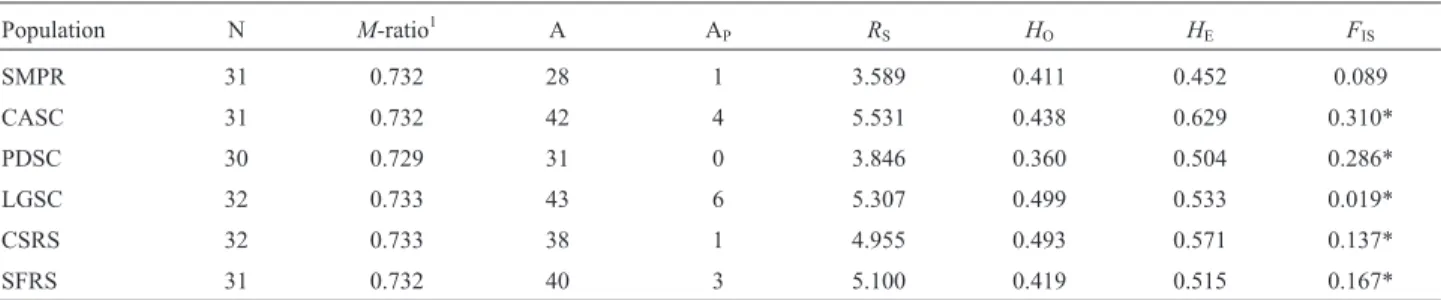
Relatively high levels of genetic variation were found inV. reitziipopulations (Table 2). The number of alleles at each locus ranged from 28 to 43, and the allelic richness ranged from 3.589 to 5.531, both in SMPR and CASC, re-spectively. The observed heterozygosity ranged from 0.411 to 0.499, with the expected heterozygosity ranging from 0.452 to 0.629. With the exception of PDSC, all popula-tions had private alleles. Inbreeding coefficients ranged from 0.089 to 0.310, and with the exception of SMPR, all populations departed significantly from HWE with an ex-cess of homozygotes (Table 2). Micro-Checker analysis de-tected the presence of null alleles at six loci in different populations (data not shown). No signs of reduction in pop-ulation size were detected by any of the methods used (Bot-tleneck analysis and M-ratio) for any of the populations investigated.
Moderate levels of genetic differentiation were de-tected amongV. reitzii populations (FST= 0.123, G’ST =
0.120 andRST= 0.096). The pairwiseFSTvalues also
sug-gest low to moderate structure between pairs of popula-tions, and geographical proximity does not seem to be the main factor determining theFST (e.g., CASC and PDSC
showed a significant FST = 0.100 (P < 0.001) and are
108 km apart, whereas SMPR and CSRS showed a non-significantFST= 0.030 and are 360 km apart (see Figure 1
and Table 3). Accordingly, the Mantel test revealed that geographical distances were not significantly correlated with genetic differentiation as estimated byr2= 0.0001 (P= 0.364), suggesting the absence of isolation-by-distance.
AMOVA results indicated that the largest percentage of variation (87.42%) was attributed to the within popula-tions component and only a small portion of the genetic variance (12.58%) was attributed to the between popula-tions component (P< 0.0001).
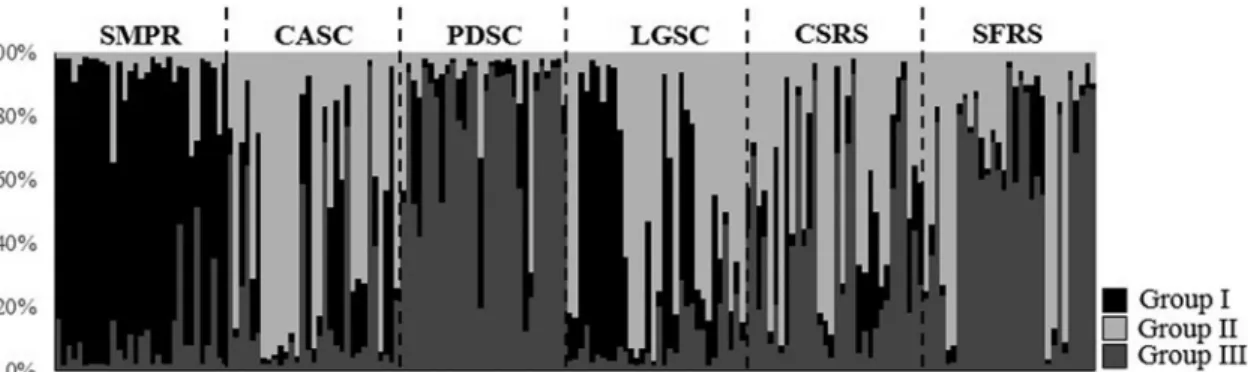
Bayesian analysis confirmed that a model ofK= 3 groups best captured the variation in the data fromV. reitzii
(Figure S1). The admixture proportions (Q) for each indi-vidual are shown in Figure 2. The number of migrants per
Table 2- Characterization of genetic variability in six populations ofVriesea reitzii.
Population N M-ratio1 A AP RS HO HE FIS
SMPR 31 0.732 28 1 3.589 0.411 0.452 0.089
CASC 31 0.732 42 4 5.531 0.438 0.629 0.310*
PDSC 30 0.729 31 0 3.846 0.360 0.504 0.286*
LGSC 32 0.733 43 6 5.307 0.499 0.533 0.019*
CSRS 32 0.733 38 1 4.955 0.493 0.571 0.137*
SFRS 31 0.732 40 3 5.100 0.419 0.515 0.167*
N, number of individuals;M-ratio, mean ratio of the number of alleles to the range in allele size; A, number of alleles; AP, number of private alleles;RS, allelic richness;HO, observed heterozygosity;HE, expected heterozygosity;FIS, inbreeding coefficient.
1population is considered to have undergone a bottleneck if itsM-ratio value falls below the threshold of criticalM-ratio calculated (0.61). No bottlenecks
were detected in the six populations.
generation inV. reitziipopulations varied from 0.145 to 2.671 (Table 3), with approximately half of the compari-sons between populations pairs exceeding 1, which is equi-valent to > 1 migrant per generation. The minimum migra-tion required for maintaining species cohesion has traditionally been regarded to be one migrant per genera-tion (Morjan and Rieseberg, 2004). Confidence intervals for the effective number of migrants (Nem) are presented in
Table S2.
Discussion
Genetic diversity within populations
We investigated the genetic diversity and population structure ofV. reitzii, a species endemic to the MOF, by us-ing nuclear microsatellite markers. Mountains, islands and even forest fragments are often rich in endemism, but these habitats are commonly at risk of depauperization, causing a reduction of genetic diversity of its populations (Krucke-berg and Rabinowitz, 1985). According to Furtado and Menini-Neto (2015), the particular features of mountainous regions confer them high indices of species richness and cause them to harbor important forest remnants in the form of vegetation islands. However, these ecosystems can be very sensitive to anthropogenic disturbances (Zhao and Gong, 2015). Here, despite the fact thatV. reitziiis endemic to the southern region of Brazil and restricted to the MOF, a
highly particular mountain environment with high anthro-pogenic influence, we did not find low levels of genetic diversity in the populations sampled across its geographical range. Our results revealed that the levels of genetic diver-sity in this species are relatively high (Table 2). Although a direct comparison of genetic diversity levels between spe-cies is complicated by the use of different methods, the lev-els of diversity found forV. reitziican be considered high when compared to other studies on Bromeliaceae that are based on many of the same SSR loci (Table S1) used in the present study (Palma-Silvaet al., 2009; Zanellaet al., 2011, 2016; Cascante-Marín et al., 2014; Lavor et al., 2014; Goetzeet al., 2015, 2016). The genetic diversity encoun-tered withinV. reitziipopulations suggests that these popu-lations have not yet been impacted by habitat fragmenta-tion, and genetic drift has not yet decreased within-population genetic diversity. Therefore, although the MOF has suffered a long history of natural fragmenta-tion (Fonsecaet al., 2009),V. reitziipopulations have been able to maintain a moderate to high genetic diversity.
Many recent studies have demonstrated that the rarity or endemicity of a species is not necessarily synonymous with low genetic diversity. Instead, genetic diversity can be influenced by species life-history traits, such as a recent ori-gin from widespread congeners, hybridization, mainte-nance of genetic diversity within refugial populations, as well as ecological traits, habit and mating system (Torres-Díazet al., 2007; Ægisdóttiret al., 2009; Hardcastle and Gentry, 2009; Eliades et al., 2011; Goetze et al., 2015; Turchettoet al., 2016). The relatively high genetic diversity found in populations ofV. reitzii(RS= 3.589-5.531 andHO
= 0.360-0.499) may be related to its life history, such as clonality and an outcrossing reproductive system. Out-crossing plants generally have high within-population ge-netic diversity (Hamrick and Godt, 1996), and clonal prop-agation can increase the longevity of genets (Orive, 1993; Goetzeet al., 2015). The combination of genet longevity and outcrossing may maintain genetic diversity in frag-mented populations (Xiaoet al., 2015). The reproductive biology ofV. reitziiand its breeding system have not yet been studied. However, we assume that it has a mixed
mat-Table 3- Pairwise genetic divergence (FST) below the diagonal and num-ber of effective migrants (Nem) per generation above the diagonal, for Vriesea reitziipopulations based on seven microsatellite loci.
SMRS CASC PDSC LGSC CSRS SFRS
SMRS 0.377 0.145 1.161 0.748 0.933
CASC 0.097 1.605 1.103 2.541 2.671
PDSC 0.044 0.100 0.663 0.584 0.741
LGSC 0.129 0.015 0.150 1.611 1.200
CSRS 0.030 0.029 0.039 0.048 0.923
SFRS 0.066 0.129 0.106 0.169 0.043
FSTvalues in bold were significant atP< 0.001.
ing system, like mostVrieseaspecies studied to date (Za-nellaet al., 2012; Lavoret al., 2014). We also presume that, like its sister species V. phillipocoburgii and V. altoda-serrae, it is pollinated by hummingbirds (Machado and Semir, 2006). Moreover, although the species’ clonality has not yet been formally studied, we observed evident clonal reproduction on our field trips.
Another factor potentially explaining the occurrence of high levels of genetic diversity in this mountain species is that its population may have been founded by multiple genetically diverse individuals. This initial diversity may have been maintained in the stable mountainous conditions throughout the Quaternary glacial/interglacial cycles (Behling and Pillar, 2007), thanks to a combination of rela-tively large population sizes and recurrent interpopulation gene flow, as reported in the terrestrial orchidOreorchis patensfrom the Korean mountains (Chung et al., 2012). SinceV. reitziiis highly associated with theAraucaria for-est, the expansion of theAraucariaforest over the Southern Brazilian Highlands from the late Quaternary until ~1500–1000 years ago (Behlinget al., 2004) might have in-creased population connectivity, thereby representing one possible reason for the great allelic richness encountered here.
Despite their high levels of genetic diversity, almost all populations significantly departed from HWE. Hetero-zygote deficiency may result from many factors, such as genetic drift and inbreeding. Alternatively, it can occur due to the presence of null alleles (Lavoret al., 2014; Turchetto
et al., 2016). We found null alleles at all loci in different populations; however, to relate the excess of homozygotes to biparental inbreeding or drift, we would need to have ac-cess to demographic data of the populations. Assuming that
V. reitziihas a mixed mating system, as many other species of the genusVriesea(Paggiet al., 2007; Lavoret al., 2014), mating among relatives may potentially occur within popu-lations. In the only existing record on ecological and demo-graphic aspects ofV. reitzii, Favretto and Geuster (2012) report that the species is rare in environments with very dense vegetation, but abundant in places with more dis-persed trees, and that it is one of the few species that colo-nizesAraucaria angustifoliain the region of Joaçaba, Santa Catarina, Brazil. In the same study, the authors describe the occurrence of 360 individuals across 2000 m2, demonstrat-ing that, wherever they occur, V. reitzii populations are abundant; this is consistent with our own observations. High population densities may influence the amount of pol-len available for outcrossing in mixed mating species and may have an affect on the rate of selfing and inbreeding (Duminilet al., 2016). In the congenerV. minarum,an ex-cess of homozygotes has been attributed to selfing or biparental inbreeding, since that species has a mixed repro-ductive strategy (Lavoret al., 2014). Considering that simi-lar results had been found in many species studied so far,
Lavor and colleagues also speculated that their findings might reflect a general pattern characteristic of the family. It would be interesting to compare the patterns of di-versity found in the present study with those of other spe-cies endemic to the MOF, however, our exhaustive search turned up very few studies with a genetic focus, and most of these were onAraucaria angustifolia(Auleret al., 2002; Bittencourt and Sebbenn, 2007; Medina-Macedo et. al., 2015).Dicksonia sellowianais a species of the MOF whose populations were severely reduced due to direct exploita-tion. Montagnaet al.(2012) compared the genetic diversity of populations from conservation units to that of popula-tions outside conservation units and found a significant dif-ference in Ho between these two groups. Martins et al.
(2015) studied populations ofOcoteaspp. in protected and unprotected areas of the MOF and found highHo indexes and a small heterozygous deficit. However, none of the studies focused on understanding the dynamics and genetic structure of populations from the mosaic landscape charac-terizing the MOF, highlighting the importance of the pres-ent work in contributing to an improved understanding of the dynamics of MOF species.
Genetic differentiation among populations
Mountainous and fragmented environments are char-acterized by landscape heterogeneity, with the mountain ridges or mosaic formations expected to represent major barriers to gene flow among populations (Zhanet al., 2009; Freiet al., 2010). However, against this expectation, we ob-served an average FST of 0.123 and an average RST of
0.0964, indicating only a moderate differentiation among
V. reitziipopulations (Balloux and Lugon-Moulin, 2002). The similarity betweenFSTandRSTestimates suggests that
drift and mutation are jointly responsible for the observed level of population differentiation (Balloux and Lugon-Moulin, 2002). The results of studies on differentiation among populations in this kind of landscape can vary wide-ly from species to species (Byarset al., 2009). In the Bro-meliaceae, various studies have estimated the variation among populations from outcrops and inselbergs. Domin-gues et al. (2011), Barbará et al. (2009) and Boisselier-Dubayle et al. (2010) found a high level of population structure in several bromeliad species. Other authors have reported moderate indices of genetic structure, similar to our results forV. reitzii(Ribeiroet al., 2013; Lavoret al., 2014).
re-gion’s topography did not reveal any obvious features that could have led to the formation of the groups found. The next step will be to use plastidial markers in a phylo-geographic approach to assess the historical structure of the populations and indicate possible vicariance events under-lying the observed pattern. The weak genetic structure be-tween groups, paired with the high number of migrants per generation found in at least half of the population pairs (Ta-ble 3), points towards reasona(Ta-ble levels of gene flow among localities. In order to explain this moderate structure and the estimated effective number of migrants, it is possible to relate them to ancient and contemporary factors.
Concerning contemporary gene flow, to date, there are no studies on the pollinator and seed dispersal mecha-nisms ofV. reitzii. However, if the species is pollinated by hummingbirds, an effective contemporary gene flow a-mong the populations sampled may occur. Hummingbird behavior varies between species, but some species can mi-grate up to 2000 km, enough to cover the inter-population distances ofV. reitzii, which range from 38 km to 360 km (Bertholdet al., 2013). Furthermore,V. reitziihas plumose seeds (LES personal observation; Leme and Costa, 1991), which is characteristic of the subfamily Tillandsioideae (Benzing, 1990) and can facilitate seed dispersal by wind over long distances. In a study of the bromeliadV. gigantea, an epiphyte inhabiting the understory of the Atlantic Forest, Paggiet al.(2010) showed that seed dispersal occurs over short distances, although the species’ seeds are plumose and wind-dispersed, as they probably are inV. reitzii. On the other hand, Lavoret al.(2014) reported that seed dis-persal in V. minarum is more effective and not directly comparable to the results of Paggiet al.(2010). Vriesea minarumis restricted to rocky systems in open environ-ments, where the high incidence of winds can enhance seed dispersal. In addition, the usually low stature of the ru-picolous vegetation poses fewer obstacles to dispersal than a forested area.
With regard to ancient patterns of gene flow, the cur-rent design of genetic structure may have been modeled by past events, such as the expansion of theAraucariaforest during the Holocene (Behling and Pillar, 2007) that may have contributed to decrease the distance between popula-tions and increase the gene flow between them. Chunget al.
(2012), studying orchids of the genusOreorchis, suggested a scenario of high levels of historical gene flow among neighboring populations along the main mountainous ranges in the Korean Peninsula. In a study on the altitudinal gradients ofSilene ciliate, García-Fernándezet al.(2012) proposed that the high genetic similarity among popula-tions from different mountains may be due to historical population movements related to glacial contractions and expansions throughout the Quaternary period. Many mon-tane-adapted species exist as isolated populations under todays relatively warm climate; during cooler glacial cy-cles, these species would have experienced range
expan-sions, increasing population connectivity and gene flow (Devitt et al., 2013). Moreover, both the results of the heterozygosity excess test (Bottleneck program) and the
M-ratio found here indicate thatV. reitziipopulations did not suffer a bottleneck or reduction of genetic diversity (Ta-ble 2), emphasizing that factors involved in the evolution-ary history of the MOF might have significantly contrib-uted to genetically homogenize the populations. In this context, it would be interesting to collect data from addi-tional species from the MOF in order to further investigate this hypothesis.
Therefore, the current genetic pattern of V. reitzii
populations may have been shaped by a range of factors, in-cluding the mosaic landscape of alternating grasslands and forests. TheAraucariaPlateau, where we sampledV. reitzii
populations, is formed by lightly to markedly undulating terrain at altitudes between 600 and < 1400 m. The MOF’s current mosaic landscape has been shaped by the phases of forest expansion and retraction resulting from climatic changes during the Holocene (Calegariet al., 2017). Cou-pled with the intense fragmentation of this environment in the twentieth century (Fonsecaet al., 2009), the patchwork pattern of this landscape may have influenced the current patterns of diversity and population structure found inV. reitzii. In summary, the moderate structure encountered in
V. reitziimay be due to ancient gene flow, facilitated dis-persal mediated by the mosaic landscape of the MOF, or a combination of these two factors.
Implications for Conservation
Vriesea reitzii populations showed high genetic di-versity and moderate genetic structure, indicating no immi-nent threat to this bromeliad. However, as an epiphyte, this species is highly associated with the MOF, and the conser-vation of this landscape is therefore paramount for the spe-cies’ maintenance. Only 12.6% of theAraucariaForest’s original cover remains, and those remnants are mostly dis-tributed in small fragments amid various anthropogenic habitats, such as pasture, agriculture and exotic tree mono-cultures of Pinus and Eucalyptus (Ribeiro et al., 2009; Emer and Fonseca, 2011). The Araucaria Forest should therefore be considered as critically threatened.
Despite the moderate levels of genetic differentiation betweenV. reitziipopulations, almost all have private al-leles (Table 2), emphasizing the importance of the conser-vation of this genetic diversity. The CASC and LGSC populations have four and six private alleles respectively; they therefore deserve special attention in any conservation measures.
Acknowledgments
The authors thank the staff of C. Migliavacca, Parque Nacional Aparados da Serra and Parque Natural Municipal João José Theodoro da Costa Neto for helping to collect samples. We also thank IBAMA (Instituto Brasileiro do Meio Ambiente e dos Recursos Naturais Renováveis) for processing collection permits as well MV Büttow and F Capra for assistance during the field work and C Palma-Silva for help in the analysis. Research was supported by CNPq (Conselho Nacional de Desenvolvimento Científico e Tecnológico) and PPGBM (Programa de Pós Graduação em Genética e Biologia Molecular — UFRGS).
References
Ægisdóttir HH, Kuss P and Stöcklin J (2009) Isolated populations of a rare alpine plant show high genetic diversity and consid-erable population differentiation. Ann Bot 104:1313-1322. Alves GM, Filho AR, Puchalski A, Reis MS, Nodari RO and
Guerra MP (2004) Allozymic markers and genetic charac-terization of a natural population ofVriesea friburgensisvar.
paludosa, a bromeliad from the Atlantic Forest. Plant Genet Resour 2:23-28.
Alves GM, Dal Vesco LL and Guerra MP (2006) Micropro-pagation of the Brazilian endemic bromeliadVriesea reitzii
trough nodule clusters culture. Sci Hort 110:204-207. Auler NMF, dos Reis MS, Guerra MP and Nodari RO (2002) The
genetics and conservation ofAraucaria angustifolia: I. Ge-netic structure and diversity of natural populations by means of non-adaptive variation in the state of Santa Catarina, Brazil. Genet Mol Biol 25:329-338.
Balloux F and Lugon-Moulin N (2002) The estimation of popula-tion differentiapopula-tion with microsatellite markers. Mol Ecol 11:155-165.
Barbará T, Martinelli G, Fay MF, Mayo SJ and Lexer C (2007) Population differentiation and species cohesion in two closely related plants adapted to neotropical high-altitude ‘inselbergs’, Alcantarea imperialis and Alcantarea geni-culata(Bromeliaceae). Mol Ecol 16:1981-1992.
Barbará T, Martinelli G, Palma-Silva C, Fay MF, Mayo S and Lexer C (2009) Genetic relationships and varitation in re-productive strategies in four closely related bromeliads adapted to neotropical ‘inselbergs’:Alcantarea glaziouana,
A. regina,A. geniculataandA. imperialis(Bromeliaceae). Ann Bot 103:65-77.
Barfuss MHJ, Till W, Leme EMC, Pinzón JP, Manzanares JM, Halbritter H, Samuel R and Brown GK (2016) Taxonomic revision of Bromeliaceae subfam. Tillandsioideae based on a multi-locus DNA sequence phylogeny and morphology. Phytotaxa 279:1-97.
Beerli P and Felsenstein J (1999) Maximum-likelihood estimation of migration rates and effective population numbers in two populations using a coalescent approach. Genetics 152:763-773.
Behling H and Pillar VD (2007) Late Quaternary vegetation, biodiversity and fire dynamics on the southern Brazilian highland and their implication for conservation and manage-ment of modernAraucariaforest and grassland ecosystems. Phil Trans R Soc 362:243-251.
Behling H, Pillar VD, Orlóci L and Bauermann SG (2004) Late QuaternaryAraucariaforest, grassland (Campos), fire and climate dynamics, studied by high resolution pollen, char-coal and multivariate analysis of the Cambará do Sul core in southern Brazil. Palaeogeogr Palaeoclimatol Palaeoecol 203:277-297.
Behling H, Pillar VD and Bauermann SG (2005) Late Quaternary grassland (Campos), gallery forest, fire and climate dynam-ics, studied by pollen, charcoal and multivariate analysis of the São Francisco de Assis core in western Rio Grande do Sul (southern Brazil). Rev Paleobot Palinol 133:235-248. Benzing DH (1990) Vascular Epiphytes: General Biology and
Re-lated Biota. Cambridge University Press, Cambridge, 354 p. Benzing D (2000) Bromeliaceae: Profile of an Adaptive
Radia-tion. Cambridge University Press, Cambridge, 690 p. Berthold P, Gwinner E and Sonnenschein E (2013) Avian
Migra-tion. Springer Science & Business Media, Heidelberg, 610 p.
Bittencourt JVM and Sebbenn AM (2007) Patterns of pollen and seed dispersal in a small fragmented population of the wind-pollinated tree Araucaria angustifolia in southern Brazil. Heredity 99:580-591.
Boelter CR, Zartman CE and Fonseca CR (2011) Exotic tree monocultures play a limited role in the conservation of At-lantic Forest epiphytes. Biodivers Conserv 20:1255-1272. Boisselier-Dubayle MC, Leblois R, Samadi S, Lambourdière J
and Sarthou C (2010) Genetic structure of the xerophilous bromeliadPitcairnia geyskesiion inselbergs in French Gui-ana - a test of the forest refuge hypothesis. Ecography 33:175-184.
Boneh L, Kuperus P and Van Tienderen PH (2003) Microsa-tellites in the bromeliads Tillandsia fasciculata and Guz-mania monostachya. Mol Ecol Notes 3:302-303.
Brown GK and Gilmartin AJ (1989) Chromosome-numbers in Bromeliaceae. Am J Bot 76:657-665.
Byars SG, Parsons Y and Hoffmann AA (2009) Effect of altitude on the genetic structure of an Alpine grass,Poa hiemata. Ann Bot 103:885-899.
Calegari MR, Paisani SDL, Cecchet FA, Ewald PLL, Osterrieth ML, Paisani JC and Pontelli ME (2017) Phytolith signature on theAraucarias Plateau - Vegetation change evidence in Late Quaternary (South Brasil). Quatern Int 434:117-128.
Cascante-Marín A, Oostermeijer G, Wolf J and Fuchs EJ (2014) Genetic diversity and spatial genetic structure of an epi-phytic bromeliad in Costa Rican montane secondary forest patches. Biotropica 46:425-432.
Chung MY, López-Pujol J, Maki M, Kim KJ, Chung JM, Sun BY and Chung MG (2012) Genetic diversity in the common ter-restrial orchid Oreorchis patens and its rare congener
Oreorchis coreana: Inference of species evolutionary his-tory and implications for conservation. J Hered. 103:692-702.
Costa AF, Gomes-da-Silva J and Wanderley MGL (2014)Vriesea
(Bromeliaceae, Tillandsioideae): taxonomic history, and morphology of the Brazilian lineage. J Torr Bot Soc 141:338-352.
Danner MA, Ribeiro JZ, Zanette F, Bittencourt JVM and Sebbenn AM (2013) Impact of monoecy in the genetic structure of a predominately dioecious conifer species,Araucaria angus-tifolia(Bert.) O. Kuntze. Plant Syst Evol 299:949-958. Devitt TJ, Devitt SEC, Hollingsworth BD, McGuire JA and
structure in the Large-blotched Ensatina salamander. Mol Ecol 22:1650-1665.
Dieringer D and Schlotterer C (2003) Microsatellite Analyser (MSA): A platform independent analysis tool for large mi-crosatellite data sets. Mol Ecol Notes 3:167-169.
Domingues R, Machado MA, Forzza RC, Melo TD, Wohlres-Vianna S and Viccini LF (2011) Genetic variability of an en-dangered Bromeliaceae species (Pitcairnia albiflos) from the Brazilian Atlantic rainforest. Genet Mol Res 10:2482-2491.
Doyle JJ and Doyle JL (1990) Isolation of plant DNA from fresh tissue. Focus 12:13-15.
Duminil J, Daïnou K, Kaviriri DK, Gillet P, Loo J, Doucet JL and Hardy OJ (2016) Relationships between population density, fine-scale genetic structure, mating system and pollen dis-persal in a timber tree from African rainforests. Heredity 116:295-303.
Earl DA and von Holdt BM (2012) Structure Harvester: A website and program for visualizing Structure output and imple-menting the Evanno method. Conserv. Genet Resour 4:359-361.
Eliades NGH, Gailing O, Leinemann L and Finkeldey BFR (2011) High genetic diversity and significant population structure in Cedrus brevifolia Henry, a narrow endemic Mediterranean tree from Cyprus. Plant Syst Evol 294:185-198.
Emer C and Fonseca CR (2011)AraucariaForest conservation: Mechanisms providing resistance to invasion by exotic tim-ber trees. Biol Invasions 13:189-202.
Evanno G, Regnaut S and Goudet J (2005) Detecting the number of clusters of individuals using the software STRUCTURE: A simulation study. Mol Ecol 14:2611-2620.
Excoffier L, Smouse PE and Quattro JM (1992) Analysis of mo-lecular variance inferred from metric distances among DNA haplotypes: Application to human mitochondrial DNA re-striction data. Genetics 131:479-491.
Excoffier L and Lischer HEL (2010) Arlequin suite Version 3.5: A new series of programs to perform population genetics analyses under Linux and Windows. Mol Ecol Resour 10:564-567.
Favretto MA and Geuster CJ (2012) Parque Natural Municipal Rio do Peixe, Joaçaba, Santa Catarina, Vol II, Plantas Epí-fitas. Edited by the author, Joaçaba, 85 p.
Fonseca CR, Ganade G, Baldissera R, Becker CG, Boelter R, Brescovit AD, Campos LM, Fleck T, Fonseca VS, Hartz SM,et al.(2009) Towards an ecologically-sustainable for-estry in the Atlantic Forest. Biol Conserv 142:1209-1219. Frei ES, Bodin J and Walther GR (2010) Plant species’ range
shifts in mountainous areas: all uphill from here? Bot Helvet 120:117-128.
Frei ES, Scheepens JF and Stöcklin J (2012) High genetic differ-entiation in populations of the rare alpine plant species Cam-panula thyrsoideson a small mountain. Alp Bot 122:23-34. Furtado SG and Menini-Neto L (2015) Diversity of vascular
epiphytes in two high altitude biotopes of the Brazilian At-lantic Forest. Braz J Bot 38:295-310.
García-Fernández A, Iriondo JM, Vallès J, Orellana J and Escu-dero A (2012) Ploidy level and genome size of locally adapted populations ofSilene ciliataacross an altitudinal gradient. Plant Syst Evol 298:139-146.
Givnish TJ, Barfuss MHJ, Van Ee B, Riina R, Schulte K, Horres R, Gonsiska PA, Jabaily RS, Crayn DM, Brown GK,et al.
(2014) Adaptive radiation, correlated and contingent evolu-tion, and net species diversification in Bromeliaceae. Mol Phylogenet Evol 71:55-78.
Goetze M, Büttow MV, Zanella CM, Paggi GM, Bruxel M, Pinheiro FP, Sampaio JAT, Palma-Silva C, Cidade, FW and Bered F (2015) Genetic variation in Aechmea winkleri, a bromeliad from an inland Atlantic rainforest fragment in southern Brazil. Biochem Syst Ecol 58:204-210.
Goetze M, Palma-Silva C, Zanella CM and Bered F (2016) East-to-west genetic structure in populations ofAechmea caly-culata(Bromeliaceae) from the southern Atlantic rainforest of Brazil. Bot J Linn Soc 181:477-490.
Goudet J (1995) FSTAT (Version 1.2): A computer program to calculate F- statistics. J Hered 86:485-486.
Hamrick JL and Godt MJW (1996) Conservation genetics of en-demic plant species. In: Avise JC and Hamrick JL (eds) Con-servation Genetics: Case Histories From Nature. Chapman and Hall, New York, pp 281-304.
Hardcastle EL and Gentry JL (2009) Conservation genetics of
Delphinium newtonianum Dw. Moore (Moore’s Delphin-ium) [Ranunculaceae], a rare endemic of the interior high-lands. Castanea 74:41-52.
Hedrick P (2005) A standardized genetic differentiation measure. Ecology 59:1633-1638.
Kruckeberg AR and Rabinowitz D (1985) Biological aspects of endemism in higher plants. Annu Rev Ecol Syst 16:447-479. Lavor P, van den Berg C, Jacobi CM, Carmo FF and Versieux LM (2014) Population genetics of the endemic and endangered
Vriesea minarum (Bromeliaceae) in the Iron Quadrangle, Espinhaço Range, Brazil. Am J Bot 101:1167-1175. Ledru MP, Montade V, Blanchard G and Hély C (2016)
Long-term spatial changes in the distribution of the Brazilian At-lantic Forest. Biotropica 48:159-169.
Leme EMV and Costa A (1991) A new species from Southern Brazil: A tribute to Father Raulino Reitz. J Brom Soc 41:195-198.
Machado CG and Semir J (2006) Fenologia da floração e biologia floral de bromeliáceas ornitófilas de uma área da Mata Atlântica do Sudeste brasileiro. Rev Bras Bot 291:163-174. Martinelli G, Vieira CM, Gonzalez M, Leitman P, Piratininga A,
Costa AF and Forzza RC (2008) Bromeliaceae da Mata Atlântica Brasileira: Lista de espécies, distribuição e conser-vação. Rodriguésia 59:209-258.
Martins EM, Lamont RW, Martinelli G, Lira-Medeiros CF, Quinet A and Shapcott A (2015) Genetic diversity and popu-lation genetic structure in three threatenedOcoteaspecies (Lauraceae) from Brazil’s Atlantic Rainforest and implica-tions for their conservation. Conserv Genet 16:1-14. Maurice T, Matthies D, Muller S and Colling G (2016) Genetic
structure of colline and montane populations of an endan-gered plant species. AoB Plants 8:plw057.
Medina-Macedo L, Sebbenn AM, Lacerda AEB, Ribeiro JZ, Soccol CR and Bittencourt JVM (2015) High levels of ge-netic diversity through pollen flow of the coniferous Arau-caria angustifolia: a landscape level study in Southern Brazil. Tree Genet Genomes 11:814.
Morjan CL and Rieseberg LH (2004) How species evolve collec-tively: Implications of gene flow and selection for the spread of advantageous alleles. Mol Ecol 13:1341-1356.
Oliveira Filho AT and Fontes MAL (2000) Patterns of floristic differentiation among Atlantic forests in southeastern Brazil and the influence of climate. Biotropica 32:793-810. Orive ME (1993) Effective population size in organisms with
complex life-histories. Theor Pop Biol 44:316-340. Paggi GM, Palma-Silva C, Silveira LCT, Kaltchuk-Santos E,
Bodanese-Zanettini MH and Bered F (2007) Fertility of
Vriesea giganteaGaud. (Bromeliaceae) in Southern Brazil. Am J Bot 94:683-689.
Paggi GM, Palma-Silva C, Bered F, Cidade FW, Sousa ACB, Souza AP, Wendt T and Lexer C (2008) Isolation and char-acterization of microsatellite loci inPitcarirnia abiflos (Bro-meliaceae), and endemic bromeliad of Atlantic Rainforest, an cross-amplification in other species. Mol Ecol Resour 8:980-982.
Paggi GM, Sampaio JAT, Bruxel M, Zanella CM, Goetze M, Büttow MV, Palma-Silva C and Bered F (2010) Seed dis-persal and population structure inVriesea gigantea, a bro-meliad from the Brazilian Atlantic Rainforest. Bot J Linn Soc 164:317-325.
Palma-Silva C, Cavallari MM, Barbará T, Lexer C, Gimenes MA, Bered F and Bodanese-Zanettini MH (2007) A set of poly-morphic microsatellite loci forVriesea giganteaand Alcan-tarea imperialis (Bromeliaceae) and crossamplification in other bromeliad species. Mol Ecol Notes 7:654-657. Palma-Silva C, Lexer C, Paggi GM, Barbará T, Bered F and
Bodanese-Zanettini MH (2009) Range-wide patterns of nu-clear and chloroplast DNA diversity in Vriesea gigantea
(Bromeliaceae), a Neotropical forest species. Heredity 103:503-512.
Piry S, Luikart G and Cornuet JM (1999) Bottleneck: A computer program for detecting recent reductions in the effective pop-ulation size using allele frequency data. J Hered 90:502-503. Pritchard JK, Stephens M and Donnelly P (2000) Inference of population structure using multilocus genotype data. Genet-ics 155:945-959.
Raymond M and Rousset F (1995) GENEPOP (version 1.2): Pop-ulation genetics software for exact tests and ecumenicism. J Heredity 86:248-249.
Rech-Filho A, Dal Vesco LL, Nodari RO, Lischka RW, Müller CV and Guerra MP (2005) Tissue culture for the conserva-tion and mass propagaconserva-tion ofVriesea reitziiLeme and Cos-ta, a bromeliad threatened of extinction from the Brazilian Atlantic Forest. Biodiv Conserv 14:1799-1808.
Ribeiro MC, Metzger JP, Martensen AC, Ponzoni FJ and Hirota MM (2009) The Brazilian Atlantic Forest: How much is left, and how is the remaining forest distributed? Implications for conservation. Biol Conserv 142:1141-1153.
Ribeiro PCC, Pinheiro LC, Domingues R, Forzza RC, Machado MA and Viccini LF (2013) Genetic diversity of Vriesea cacuminis(Bromeliaceae): an endangered and endemic Bra-zilian species. Genet Mol Res 12:1934-1943.
Sgorbati S, Labra M, Grugni E, Barcaccia G, Galasso G, Boni U, Mucciarelli M, Citterio S, Benavides Iramátegui A, Venero Gonzalez L,et al.(2004) A survey of genetic diversity and reproductive biology ofPuya raimondii(Bromeliaceae), the endangered queen of the Andes. Plant Biol 6:222-230. Slatkin M (1995) A measure of population subdivision based on
microsatellite allele frequencies. Genetics 139:457-462.
Smith LB and Till W (1999) Bromeliaceae. In: Kubitzki K (ed) The Families and Genera of Vascular Plants. Springer, Ber-lin, pp 74-99.
Sokal RR and Rohlf FJ (1995) Biometry. 3rd edition. W.H. Free-man, New York, 887 p.
Torres-Díaz C, Ruiz E, González F, Fuentes G and Cavieres LA (2007) Genetic diversity inNothofagus alessandrii (Faga-ceae), an endangered endemic tree species of the coastal Maulino Forest of Central Chile. Ann Bot 100:75-82. Turchetto C, Segatto AL, Mäder G, Rodrigues DM, Bonatto SL
and Freitas LB (2016) High levels of genetic diversity and population structure in an endemic and rare species: impli-cations for conservation. AoB Plants 8:plw002.
van Oosterhout C, Hutchinson WF, Wills DPM and Shipley PF (2004) MICRO-CHECKER: For identifying and correcting genotyping errors in microsatellite data. Mol Ecol Notes 4:535-538.
Weir BS and Cockerham CC (1984) Estimating F-statistics for the analysis of population structure. Evolution 38:1358-1370. Wright S (1965) The interpretation of population structure by
F-statistics with special regards to system of mating. Evolu-tion 19:395-420.
Xiao YE, Jiang K, Tong X, Hu YH and Chen XY (2015) Popula-tion genetic structure of Iris ensataon sky-islands and its implications for assisted migration. Conserv Genet 16:1055-1067.
Zanella CM, Bruxel M, Paggi GM, Goetze M, Büttow MV, Cidade FW and Bered F (2011) Genetic structure and phe-notypic variation in wild populations of the medicinal tetra-ploid speciesBromelia antiacantha(Bromeliaceae). Am J Bot 98:1511-1519.
Zanella CM, Janke A, Palma-Silva C, Kaltchuk-Santos E, Pi-nheiro FG, Paggi GM, Soares LES, Goetze M, Büttow MV and Bered F (2012) Genetics, evolution and conservation of Bromeliaceae. Genet Mol Biol 4:1020-1026.
Zanella CM, Palma-Silva C, Goetze M and Bered F (2016) Hy-bridization between two sister species of Bromeliaceae:
Vriesea carinata and V. incurvata. Bot J Linn Soc 181:491-504.
Zhan A, Li C and Fu J (2009) Big mountains but small barriers: Population genetic structure of the Chinese wood frog (Rana chensinensis) in the Tsinling and Daba Mountain region of northern China. BMC Genetics 10:17.
Zhao YJ and Gong X (2015) Diversity and conservation of plant species in dry valleys, southwest China. Biodivers Conserv 24:2611-2623.
Supplementary material
The following online material is available for this article: Figure S1 - Magnitude ofDKfrom structure analysis ofK. Table S1 - Genetic characterization for seven microsatellite loci.
Table S2-Confidence intervals of number of effective mi-grants (Nem) estimated for Vriesea reitzii populations
based on seven microsatellite loci.
Associate Editor: Loreta B. Freitas