
Alessandra Amaral Schwanke
I, Mitzy Tannia Reichembach Danski
I, Letícia Pontes
I,
Solena Ziemer Kusma
I, Jolline Lind
II Universidade Federal do Paraná. Curitiba, Paraná, Brazil.
How to cite this article:
Schwanke AA, Danski MTR, Pontes L, Kusma SZ, Lind J. Central venous catheter for hemodialysis: incidence of infection and risk factors. Rev Bras Enferm [Internet]. 2018;71(3):1115-21. DOI: http://dx.doi.org/10.1590/0034-7167-2017-0047
Submission: 03-19-2017 Approval: 06-19-2017
ABSTRACT
Objective: To measure the incidence of infection in short-term central venous catheter for hemodialysis and to identify the associated risk factors. Method: Prospective cohort study conducted in a teaching hospital from September 2015 to April 2016. Patients requiring central venous catheter for hemodialysis were included and data was collected through direct and systematic observation of the catheter insertion procedure by the researchers. Results: The fi nal sample consisted of 69 patients, who used 88 catheters. The incidence of infection was 9.1%, and the risk factors were length of hospital stay and insertion of the catheter in the left femoral vein.
Conclusion: The observation of the actions performed during the insertion of the catheter made it possible to identify the risk factors associated with infection, and the research protocol may have contributed to the reduction of infection rates.
Descriptors: Renal Dialysis; Catheterization, Central Venous; Catheter-Related Infections; Risk Factors; Clinical Nursing Research.
RESUMO
Objetivo: Mensurar a incidência de infecção em cateter venoso central de curta permanência para hemodiálise e identifi car os fatores de risco associados. Método: Coorte prospectiva, desenvolvida em hospital de ensino no período de setembro de 2015 a abril de 2016. Foram incluídos pacientes com necessidade de cateter venoso central para hemodiálise, mediante observação direta e sistemática do procedimento de inserção do cateter pelos pesquisadores. Resultados: A amostra fi nal foi de 69 pacientes, que fi zeram uso de 88 cateteres. A incidência de infecção foi de 9,1%, e os fatores de risco foram o tempo de internamento e a inserção do cateter em veia femoral esquerda. Conclusão: A observação das ações realizadas na inserção do cateter possibilitou identifi car os fatores de risco associados a infecção, e o protocolo de pesquisa utilizado pode ter contribuído com a redução nos índices de infecção.
Descritores: Diálise Renal; Cateterismo Venoso Central; Infecções Relacionadas a Cateter; Fatores de Risco; Pesquisa em Enfermagem Clínica.
RESUMEN
Objetivo: Medir la incidencia de infección en catéter venoso central de permanencia corta para hemodiálisis e identifi car los factores de riesgo asociados. Método: Cohorte prospectivo, desarrollado en un hospital de enseñanza, durante el período comprendido entre septiembre de 2015 y abril de 2016. Se incluyeron pacientes con necesidad de catéter venoso central para hemodiálisis, mediante observación directa y sistemática del procedimiento de inserción del catéter por los investigadores.
Resultados: La muestra fi nal fue de 69 pacientes, que hicieron uso de 88 catéteres. La incidencia de infección fue del 9,1%, y los factores de riesgo fueron el tiempo de internación y la inserción del catéter en vena femoral izquierda. Conclusión: La observación de las acciones realizadas en la inserción del catéter posibilitó la identifi cación de los factores de riesgo asociados a infección y el protocolo de investigación utilizado puede haber contribuido con la reducción de los índices de infección.
Descriptores: Diálisis Renal; Cateterismo Venoso Central; Infecciones Relacionadas a Catéter; Factores de Riesgo; Investigación en Enfermería Clínica.
Central venous catheter for hemodialysis:
incidence of infection and risk factors
Cateter venoso central para hemodiálise: incidência de infecção e fatores de risco
Catéter venoso central para hemodiálisis: incidencia de infección y factores de riesgo
Alessandra Amaral Schwanke E-mail: [email protected]
INTRODUCTION
A short-term central venous catheter (CVC) is a widely used alternative for hemodialysis, especially in emergency situa-tions when there is no permanent and viable venous access for treatment. It is estimated that, among 91.2% of the hemo-dialysis patients in Brazil, 16.6% use the CVC as the access route and, of these CVCs, 9.2% are of short-term(1).
There are a lot of advantages to the CVC; however, when com-pared to other types of accesses, it is a major risk factor for primary bloodstream infection (BSI). It is also associated with an increase in the risk of mortality and/or in the risk of other complications, such as endocarditis, epidural abscess and arthritis(2-4).
The criteria for the diagnosis of BSI are determined by the Brazilian Health Regulatory Agency (ANVISA) and include: laboratory BSI (presence of one or more positive blood cul-tures in which the pathogen is not related to infection in an-other site; or presence of signs and symptoms such as fever, hypotension and oliguria associated with the presence of two or more positive blood cultures) and clinical BSI (signs and symptoms such as fever, hypotension and oliguria, not related to infection in another site and associated with negative or un-recorded blood culture and antimicrobial therapy for sepsis)(3).
Several factors may lead to these infections, such as the pres-ence of comorbidities, inadequate nutrition and uremia, duration of catheterization, insertion site, and manipulation of the catheter by the health professionals in charge of the hemodialysis(5-8). An-other factor that may also contribute to the development of infec-tion is not following aseptic techniques during the inserinfec-tion of the catheter, therefore, strictly following the international recommen-dations for skin preparation, hand hygiene, maximal sterile barrier precautions and proper choice of insertion site is necessary.
OBJECTIVE
To measure the incidence of infection in short-term central venous catheter for hemodialysis and to identify the associ-ated risk factors.
METHOD
Ethical Aspects
This study was approved by the Research Ethics Commit-tee of the Clinic’s Hospital of the Federal University of Paraná (UFPR). The recommendations in the Guidelines and Stan-dards for Research involving Human Beings established in Resolution 466/2012 of the National Health Council were respected. The participation in the research occurred after the patient or family signed a Consent Form (CF).
Design, setting and period
This is a prospective cohort study conducted in a teaching hos-pital in the city of Curitiba/PR, in the following units: semi-intensive
care unit (SICU) and the intensive care unit (ICU) and nephrology — which is focused exclusively on hemodialysis and receives pa-tients from different hospitalization units of the hospital. The data was collected from September 2015 to April 2016.
Sample, inclusion and exclusion criteria
The study participants were patients who required a central venous catheter for hemodialysis. Inclusion criteria were: re-quiring a short-term central venous catheter for hemodialysis and having the catheter inserted in the presence of a research-er. Exclusion criteria were: patients who had a previous diag-nosis of primary bloodstream infection. In the convenience sample, 69 patients, who were accessible for a period of time(9) and had used 88 catheters, were consecutively included.
Study Protocol
Data was collected every day, including weekends and hol-idays, in the morning and afternoon, following a previously established scale. The team responsible for data collection was composed of the main researcher, a master’s degree stu-dent, a PhD student and four Scientific Initiation Scholarship Program1 students (undergraduates), all previously trained to ensure homogeneity in data collection.
The participants were included after the team of researchers observed the catheter insertion procedure. The procedure was di-rectly and systematically observed by the research team, using a pre-prepared checklist instrument. The instrument included socio-demographic and clinical variables and variables related to the catheter. All actions performed during insertion of the catheter were recorded: preparation of the skin, hand hygiene of the pro-fessional in charge, use of maximal sterile barrier and choice of insertion site. All professionals responsible for the insertion of the catheters were previously aware of the research and were only observed after signing a specific consent form.
Patients were followed up until the removal of the catheter, which could occur due to recovery of renal function, cath-eter dysfunction, suspected infection or death. Follow up also stopped when the patient was discharged with the catheter to continue treatment at hemodialysis clinics.
Analysis of results and statistics
The outcome assessed was primary bloodstream infection, ac-cording to the diagnosis criteria for laboratory BSI determined by ANVISA(3). All infections were confirmed and notified by the Hos-pital Infection Control Service (HICS) in the hosHos-pital where the research was conducted. Statistical analysis was performed with the Statistical Package for the Social Sciences (SPSS®) version 20.0 and Bioestat version 5.0. The chi-square test and the Fisher’s exact test were used for the qualitative variables and the Student’s t-test was used for the quantitative variables. P-value <0.05 was con-sidered to indicate statistical significance. The Kaplan-Meier curve was applied to identify the survival time of the catheter until the occurrence of infection.
RESULTS
A total of 69 patients who used 88 cath-eters were included in the study. Of these, 8 developed primary BSI, an incidence of 9.1%. There was a predominance of male patients (69.6%), Caucasians (73.9%), with a mean age of 54.57 years (± 15.90). Among the comorbidities presented by the patients, 58% had systemic arterial hyper-tension, 21.7% had diabetes mellitus and 42% had other associated comorbidities.
The majority of the patients were hos-pitalized in the SICU (39.1%), and the mean length of hospital stay was 26.29 (± 25.29) days. The main medical diagnosis on admission was related to diseases of the genitourinary system (44.9%), followed by digestive tract disease (17.4%). The main reason for hemodialysis was acute kidney injury (AKI) (66.7%). The other patients had acute chronic renal failure, which required immediate hemodialysis. The majority of the patients did not have a surgical proce-dure (76.8%), had no confirmed source of infection (63.8%), used antimicrobial agents during the hospitalization period (59.4%) and had intact skin in the catheter insertion site (97.2%).
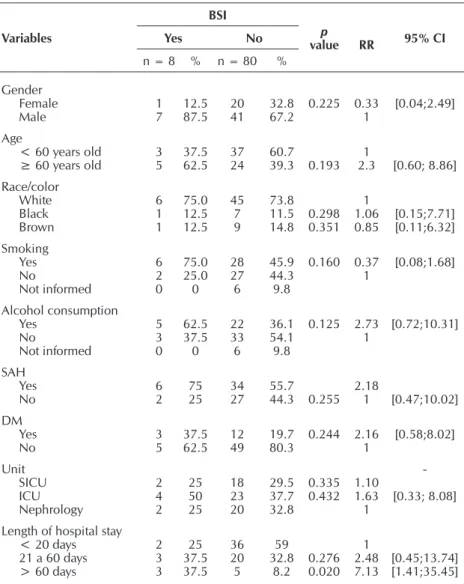
The results regarding socio-demo-graphic and clinical characteristics in-dicate that patients older than 60 years old are at higher risk (RR = 2.3) of de-veloping infection, as are the patients who consumed alcohol (RR = 2.73) or had comorbidities such as SAH (RR = 2.18) and DM (RR = 2.16). The length of hospital stay was statistically significant when compared to the development of
infection: hospital stays longer than 60 days increased the risk of developing infection in 7.13 times (p = 0.020) (Table 1).
The maximum number of catheters used by the patients dur-ing the study period was four. Eight catheters presented infec-tion, of which 62.5% (n = 5) were the first catheter used by the patient. The results indicate that the use of a third catheter increased the risk (RR = 2.68) of developing infection. As for the catheter insertion site, the jugular vein was predominant, but the insertion of the catheter in the left femoral vein increased the risk of infection in 10.67 times (p = 0.038). The mean duration of catheterization was 8.53 (± 4.97) days (Table 2).
The analysis of the catheter survival time shows that the infection occurred in the first days after insertion, especially until the tenth day, with a lower frequency after this period.
During the insertion of the catheter, all the actions performed by the professionals were observed. Skin disinfection was per-formed in most procedures. Among the catheters with infection only 1 (12.5%) was not preceded by disinfection; however, this
absence increased the risk of infection (RR = 5.33). Hand hy-giene was performed by all the professionals observed, and the use of povidone-iodine increased the risk (RR = 3.62) of infec-tion compared to chlorhexidine, as shown in Table 3.
The main reason for removal of the catheter was recovery of renal function (32.9%), followed by catheter dysfunction (21.5%), suspected infection (12.5%) and death (15.9%). In addition, 17% of the patients were discharged with the cath-eter to continue treatment in specialized clinics. As for the microorganisms isolated in blood culture, there was a pre-dominance of gram-positive cocci, specially Staphylococcus aureus (4), followed bycoagulase-negative staphylococci (2),
Staphylococcus epidermidis (1), Enterococcus faecalis (1) and
Estreptococcus agalactiae (1).Among the gram-negative cocci isolated were Klebsiela pneumoniae carbapenemase (1), Aci-netobacter baumanii (1) and Serratia marcescens (1). It should be noted that in some blood cultures, more than one microor-ganism was isolated.
Table 1 – Analysis of socio-demographic and clinical variables associated with the occurrence of primary bloodstream infection in patients on he-modialysis, Curitiba, Paraná, Brazil, 2016
Variables
BSI
p
value RR 95% CI
Yes No
n = 8 % n = 80 %
Gender Female Male 1 7 12.5 87.5 20 41 32.8 67.2 0.225 0.33 1 [0.04;2.49] Age
< 60 years old ≥ 60 years old
3 5 37.5 62.5 37 24 60.7 39.3 0.193 1
2.3 [0.60; 8.86] Race/color White Black Brown 6 1 1 75.0 12.5 12.5 45 7 9 73.8 11.5 14.8 0.298 0.351 1 1.06 0.85 [0.15;7.71] [0.11;6.32] Smoking Yes No Not informed 6 2 0 75.0 25.0 0 28 27 6 45.9 44.3 9.8 0.160 0.37 1 [0.08;1.68] Alcohol consumption Yes No Not informed 5 3 0 62.5 37.5 0 22 33 6 36.1 54.1 9.8 0.125 2.73 1 [0.72;10.31] SAH Yes
No 62 7525 3427 55.744.3 0.255 2.181 [0.47;10.02]
DM Yes No 3 5 37.5 62.5 12 49 19.7 80.3 0.244 2.16 1 [0.58;8.02] Unit SICU ICU Nephrology 2 4 2 25 50 25 18 23 20 29.5 37.7 32.8 0.335 0.432 1.101.63
1
-[0.33; 8.08]
Length of hospital stay < 20 days 21 a 60 days > 60 days
2 3 3 25 37.5 37.5 36 20 5 59 32.8 8.2 0.276 0.020 1 2.48 7.13 [0.45;13.74] [1.41;35.45]
Table 2 – Analysis of the variables related to the hemodialysis catheter associated to the occurrence of primary BSI, Curitiba, Paraná, Brazil, 2016
Variables
BSI
p value RR 95% CI ]
Yes No
n = 8 % n = 80 %
No. of the catheter used First
Second Third Fourth
5 2 1 0
62.5 25.0 12.5 0
62 12 4 2
77.5 15.0 5.0 2.5
0.380 0.444
1 1.91
2.68 [0.38;18.75][0.41;8.89]
No. of attempts Only one More than one
6 2
75 25
39 41
48.8
51.3 0.147
1
0.35 [0.07;1.63]
Duration of procedure Less than 15 min More than 15 min
5 3
62.5 37.5
33 47
41.3
58.8 0.216
1
0.46 [0.12;1.79] Duration of catheterization
< 7 days
≥ 7 days 26 2575 2540 38.561.4 0.360 1.761 [0.38;8.12]
Insertion site Jugular R Jugular L Femoral R Femoral L Subclavian R
5 0 0 2 1
62.5 0 0 25 12.5
39 14 11 1 15
48.8 17.5 13.8 1.3 18.8
0.461
0.038
1.82
10.67
1 [0.23;14.40]
Number of lumens 2
3
7 1
87.5 12.5
70 10
87.5
12.5 0.287
1
[0.14;7.37]
Note: RR = Relative Risk; 95% CI = 95% Confidence Interval; BSI = bloodstream infection.
Table 3 – Distribution of absolute (n) and relative (%) frequencies of variables observed at the beginning and at the end of each hemodialysis, Curitiba, Paraná, Brasil, 2016
Variable
BSI
p value RR 95% CI
Yes No
n = 8 % n = 80 %
Skin disinfection
Chlorhexidine Povidone-iodine Not performed
1 6 1
12.5 75.0 12.5
31 44 5
38.8 55.0 6.3
1 0.159 0.356
3.84
5.33 [0.48;30.43][0.38;74.08]
Time of rubbing
> 30 seconds < 30 seconds Not performed
7 0 1
87.5 0 12.5
71 4 5
88.8 6.3
5.0 0.458
1
-1.86 [0.27;12.72]
Hands hygiene ChlorhexidinePVPI 17 12.587.5 2951 36.363.8 0.168 3.621 [0.47;28.08]
Maximal Sterile Barrier IncompleteComplete 80 1000 791 98.71.3 0.909
Skin antisepsis ChlorhexidinePVPI 62 75.025.0 5822 72.527.5 0.395 0.891 [0.19;4.11]
DISCUSSION
Only 8 of the 88 catheters included and monitored during the study period presented an infection, representing an inci-dence of 9.1%. This reduced rate of infection is partially due to the data collection process through direct and systematic observation, which may lead professionals to be more atten-tive to the actions performed.
The patients who developed infection were predominant-ly male, Caucasian and older than 60 years old. The latter characteristic showed an increased risk of infection. The other characteristics did not present a significant relationship with the occurrence of the outcome, as in other studies found in the literature(4,8,10). Smoking and alcohol consumption were also reported by patients who developed infection, and those who consumed alcohol had a higher risk of infection than the others. These characteristics are important — especially smok-ing, which is a risk factor for the progression of renal disease(11) — and may be further investigated in future research.
Among the patients included in the research, 58% reported being hypertensive and 21.7% diabetic; the presence of these two comorbidities increased the risk of developing infection. The presence of multiple comorbidities is common among hemodialysis patients, and when these are associated with inadequate nutrition, uremia and immunological deficiency, they represent an important risk factor for infection(5-6).
Most of the patients were hospitalized in the SICU, since this unit receives patients from emergency care units from all over the city. The mean length of stay in the hospital was 26.29 ± 25.29 days, and those who remained hospitalized for more than 60 days had a 7.13 times higher risk of developing
infection than those who remained hospitalized for less time. Other studies in the literature also found a relationship be-tween length of stay and infection(12-13).
Hospitalization is common among hemodialysis patients. In the United States admission for hemodialysis patients is 1.7 per patient year and 37% of these were followed by rehospi-talization within 30 days(14). Furthermore, this study found a prolonged length of hospital stay compared to other studies in the literature. This may be related to the complexity of the pa-tients, since most of them had an ARF possibly resulting from other factors, which required longer treatment.
The majority (75%) of the patients who developed infection required only one puncture attempt and the procedure lasted less than 15 minutes (62.5%). These characteristics were not significant for the development of the outcome; however, they are important because they demonstrate how patients are ex-posed to difficult procedures for long periods of time. The number of lumens of the catheter was also not related to the development of infection. The hemodialysis catheter is used only for the treatment, but the triple lumen catheter has an ac-cessory pathway that allows the infusion of medications even when the patient is not on hemodialysis. This characteristic is important for patients with difficult venous access; however, a lower number of lumens should be chosen whenever possible in order to avoid excessive manipulation(15).
As for the insertion site, the jugular vein was predominant, but the insertion in the left femoral vein increased the risk of developing infection in 10.67 times. The insertion of the hemodialysis catheter in the femoral vein is still widely used, since insertion in the subclavian vein is not recommended because of the risk of stenosis(15).
The mean duration of catheterization was 8.53 (± 4.97) days and 75% of the patients who developed infection re-mained with the catheter for more than 7 days. In the present study, the mean duration of catheterization was not related to the occurrence of the outcome, but other studies in the literature present a higher mean duration(8). The short-term hemodialysis catheter should only be used in emergency situ-ations in hospitalized patients and should remain for up to seven days, according to the recommendations of the Kidney Disease Outcomes Quality Initiative(16).
The Kaplan-Meier curve showed that the development of infection occurred mainly in the first days after catheter in-sertion, especially until the tenth day, even when the recom-mendations for the catheter insertion were followed. This may indicate that other factors related to the development of the infection, such as the patient’s clinical condition, should also be considered, especially for critically ill patients admitted to intensive and semi-intensive care units.
All the actions performed by the professionals responsible for the catheter insertion procedure were observed, and, in general, the standard recommendations for catheter insertion were followed. These recommendations are described in the infection prevention guidelines, known asbundles, from the Centers for Disease Control and Prevention(15). Only 12.5% of the patients who developed the outcome did not receive skin disinfection. This increased the risk of infection for these Follow up (days with catheter)
Survival Curve
1,0
0,8
0,6
0,4
0,2
0,0
0 5 10 15 20 25
Cum sur
viv
al
Survival Function Censored
patients. Among those who received skin disinfection, the most used solution was povidone-iodine (75%). Hand hy-giene was performed in all observations and the povidone-iodine was also the most used solution (87.5%). The use of povidone-iodine increased the risk of infection when com-pared to chlorhexidine. All catheters that presented infection were inserted with maximal sterile barrier precautions and skin antisepsis, mainly with a 0.5% chlorhexidine solution (75%). These variables did not represent a significant differ-ence in the outcome.
All these actions are part of a global strategy for prevention of catheter-related infections(15). However, even when they are strictly performed, patients are not exempt from this complica-tion, since it can also be related to several other factors. Ac-cording to a strategy defined by the CDC, disinfection should preferably be performed with 2% chlorhexidine and skin an-tisepsis with 0.5% chlorhexidine alcohol. In both procedures, in the absence of chlorhexidine, iodine-based solutions can be used. In the present research, there was no difference be-tween the solutions used to prepare the skin. However, stud-ies in the literature have already found reductions in infection rates when using chlorhexidine instead of povidone-iodine(17).
The main reason for catheter removal was the recovery of renal function (32.9%), since the majority of the patients had an ARF. The second main reason was catheter dysfunction (21.5%), which is a consequence of partial or total occlusion of the catheter lumen, is defined as a blood flow rate less than or equal to 300 ml/minute during the first 60 minutes of he-modialysis(16). This dysfunction is very frequent in temporary catheters and may be responsible for their early removal(18). Suspected infection was the reason for the removal of 12.5% of the catheters, and death, for 15.9%. In addition, 17% of the patients were discharged with the catheter to continue treat-ment in specialized clinics.
The predominant microorganism isolated in blood cul-ture was the Staphylococcus aureus. It is the main agent that
causes hemodialysis catheter infections, a fact already identi-fied in several studies in the literature(4,10,14).
Limitations of the study
The direct observation method can be considered a limita-tion of this study. This type of data colleclimita-tion may lead profes-sionals to be more attentive to the actions performed during catheter insertion. However, this method was extremely im-portant and indispensable for the identification of all actions carried out by the health team.
Contributions to the area of health
The present study demonstrated that the risk factors asso-ciated with the central venous catheter for hemodialysis are not exclusively related to the professionals’ practice. However, these practices should still be regularly evaluated, with the support of educational measures that, along with the imple-mentation of protocols, can promote practices based on the best available evidence.
CONCLUSION
The incidence of infection in the study population was 9.1%, a lower rate when compared to previous statistics. This may be related to the study protocol (direct and systematic observation of the catheter insertion procedure), since it can make professionals more attentive to their practices. The risk factors found in the pres-ent study were “length of hospital stay” and “catheter insertion site”, a result that corroborates other studies in the literature.
The use of the central venous catheter for hemodialysis is common and brings many benefits to the patient who needs immediate treatment. For this reason, it is extremely important to identify the risk factors for infection, in order to guide the elaboration and adoption of protocols. These measures con-tribute to reduce infection rates and, consequently, can guar-antee quality of care for patients who require hemodialysis.
REFERENCES
1. Sesso RC, Lopes AA, Thomé FS, Lugon JR, Martins CT. Inquérito Brasileiro de Diálise Crônica 2014. J Bras Nefrol [Internet]. 2016 [cited 2017 Jan 10];38(1):54-61. Available from: http://www.scielo.br/pdf/jbn/v38n1/0101-2800-jbn-38-01-0054.pdf
2. Ravani P, Palmer SC, Oliver MJ, Quinn RR, MacRae JM, Tai DJ, et al. Associations between hemodialysis access type and clinical outcomes: a systematic review. J Am Soc Nephrol [Internet]. 2013 [cited 2017 Jan 10];24:465–73. Available from: http://jasn. asnjournals.org/content/24/3/465.full.pdf+html
3. Brasil. Agência Nacional de Vigilância Sanitária. Critérios diagnósticos relacionados a assistência de saúde. Série: Segurança do Paciente e Qualidade em Serviços de Saúde [Internet]. Brasília: Anvisa; 2013 [cited 2017 Jan 10]. Available from: http://www20. anvisa.gov.br/segurancadopaciente/images/documentos/livros/Livro2-CriteriosDiagnosticosIRASaude.pdf
4. D’Amato-Palumbo S, Kaplan AA, Fein RS, Lalla RV. Retrospective study of microorganisms associated with vascular access infections in hemodialysis patients. Oral Surg Oral Med Oral Pathol Oral Radiol [Internet]. 2013[cited 2017 Jan 10];115:56-61. Available from: https://www.ncbi.nlm.nih.gov/pmc/articles/PMC3880246/pdf/nihms-423307.pdf
5. Fram SD, Taminato M, Ferreira D, Neves L, Belasco AGS, Barbosa DA. Prevenção de infecções de corrente sanguínea relacionadas a cateter em pacientes em hemodiálise. Acta Paul Enferm [Internet]. 2009[cited 2017 Jan 10];22:564-8. Available from: http:// www.scielo.br/pdf/ape/v22nspe1/24.pdf
7. Grothe C, Belasco AGS, Bittencourt ARC, Vianna LAC, Sesso RCC, Barbosa DA. Incidência de infecção da corrente sanguínea nos pacientes submetidos à hemodiálise por cateter venoso central. Rev Latino-Am Enfermagem [Internet]. 2010[cited 2017 Jan 14];18(1):[08 telas]. Available from: http://www.scielo.br/pdf/rlae/v18n1/pt_12.pdf
8. Borges PRR, Bedendo J. Risk factors associated with temporary catheter-related infection in patients on dialysis treatment. Texto Contexto Enferm [Internet]. 2015[cited 2017 Jan 14];24(3):680-5. Available from: http://www.scielo.br/pdf/tce/v24n3/0104-0707-tce-24-03-00680.pdf
9. Hulley SB, Cummings SR, Browner WS, Grady DG, Newman, TB. Delineando a pesquisa clínica. 4. ed. Porto Alegre: Artmed; 2015.
10. Dalgaard LS, Norgaard M, Jespersen B, Jensen-Fangel S, Ostergaard LJ, Schonheyder HC, et al. Risk and prognosis of bloodstream infections among patients on chronic hemodialysis: a population-based cohort study. PLoS ONE [Internet]. 2015[cited 2017 Jan 14];10(4):e0124547. Available from: http://journals.plos.org/plosone/article/file?id=10.1371/journal.pone.0124547
11. Elihimas Jr UF, Elihimas ECS, Lemos VM, Leão MA, Sá MPBO, França EET, et al. Tabagismo como fator de risco para a doença renal crônica: revisão sistemática. J Bras Nefrol [Internet] 2014[cited 2017 Jan 14];36(4):519-28. Available from: http://www. scielo.br/pdf/jbn/v36n4/0101-2800-jbn-36-04-0519.pdf
12. Gnass M, Gielish C, Acosta-Gnass S. Incidence of nosocomial hemodialysis-associated bloodstream infections at a county teaching hospital. Am J Infect Control [Internet]. 2014[cited 2017 Jan 14];42(2):182-4. Available from: https://www.ncbi.nlm.nih. gov/pubmed/24485373
13. Fram D, Okuno MFP, Taminato M, Ponzio V, Manfredi SR, Grothe C, et al. Risk factors for bloodstream infection in patients at a Brazilian hemodialysis center: a case–control study. BMC Infect Dis[Internet]. 2015[cited 2017 Jan 14];15:158. Available from: https://www.ncbi.nlm.nih.gov/pmc/articles/PMC4377039/pdf/12879_2015_Article_907.pdf
14. United States. Renal Data System. USRDS 2015. Annual Data Report, Volume 2: ESRD in the United States.
15. O’Grady NP, Alexander M, Burns LA, Dellinger P, Garland J, Heard SO, Lipsett PA, et al. Guidelines for the prevention of intravascular catheter-related infections. EUA. Center for Disease Control and Prevention; 2011.
16. National Kidney Foundation. KDOQI. Clinical practice guidelines for vascular access and Clinical Practice Recommendations. Prevention and treatment of catheter and port complications guideline 7. New York; 2006.
17. Mimoz O, Lucet JC, Kerforne T, Pascal J, Souweine B, Goudet V, et al. Skin antisepsis with chlorhexidine–alcohol versus povidone iodine–alcohol, with and without skin scrubbing, for prevention of intravascular-catheter-related infection (CLEAN): an open-label, multicentre, randomised, controlled, two-by-two factorial trial. Lancet Oncol[Internet]. 2015 [cited 2017 Jan 14];386(21):2069-77. Available from: http://www.thelancet.com/pdfs/journals/lancet/PIIS0140-6736(15)00244-5.pdf
![Table 2 – Analysis of the variables related to the hemodialysis catheter associated to the occurrence of primary BSI, Curitiba, Paraná, Brazil, 2016 Variables BSI p value RR 95% CI ]YesNo n = 8 % n = 80 %](https://thumb-eu.123doks.com/thumbv2/123dok_br/16135974.704259/4.892.79.818.129.591/analysis-variables-hemodialysis-catheter-associated-occurrence-curitiba-variables.webp)

