1
A Work Project, presented as part of the requirements for the Award of a Master
Degree in Finance from the NOVA – School of Business and Economics
Growth and exchange rate regime: The analysis of the effect of
France on Morocco through interest rates and exports
Mehdi Dahioui
Student number: 34077
A Project carried out on the Master in Finance Program, under the supervision of:
Dr. André Castro Silva
2 Abstract
This paper looks at the connection between both Morocco and France, and how the latter is affecting real GDP growth in the former, given that Morocco has been pegging its currency against the Franc, then the euro. In addition to that, France being the main trading partner of the kingdom for so many years now. The results show that for each 1% increase in short term nominal interest rates in France, Morocco’s real GDP growth goes up by 0.83%, and might even go further to 0.98% depending on the model. Exports to base hasn’t been found to significantly affect Morocco’s real output, despite having a negative coefficient.
Keywords: Interest rates, Exchange rate regime, International Trade
This work used infrastructure and resources funded by Fundação para a Ciência e a Tecnologia (UID/ECO/00124/2013, UID/ECO/00124/2019 and Social Sciences DataLab, Project 22209), POR Lisboa (LISBOA-01-0145-FEDER-007722 and Social Sciences DataLab, Project 22209) and POR Norte (Social Sciences DataLab, Project 22209).
3 Table of contents
1) Introduction ... 4
2) History of the Moroccan dirham and the exchange rate regime ... 6
3) Literature review ... 7
4) Empirical model ... 9
a) Methodological framework ... 9
a) Data ... 10
5) Empirical Results ... 11
a) Model 1: The Comprehensive Model ... 11
b) Model 2: Foreign Interest Rate Channel ... 15
c) Model 3: Export to base channel ... 17
d) Robustness checks ... 18
e) Limitations of the model ... 19
6) Current situation of the exchange rate regime ... 19
7) Conclusion ... 23
8) References ... 24
4 1) Introduction
In our today’s connected world, choosing the right exchange rate regime is key to have a competitive and stable economy, especially for countries such as Morocco that are doing a lot of business abroad. The reason being is that the regime chosen has a direct impact on how much room is available for maneuvering, in addition to any other macroeconomic adjustments needed. Moreover, this also affects the attractiveness of foreign investment. As Morocco has been adopting a basket peg for few decades now, this has been a big constraint relative to mobility of capital. Despite the fact that a flexible exchange rate regime improves the competitiveness of economies, it is risky. Whereas a fixed exchange rate helps enhance growth since it reduces transaction cost, and creates a predictable environment for international traders, as it usually moves within a fixed range.
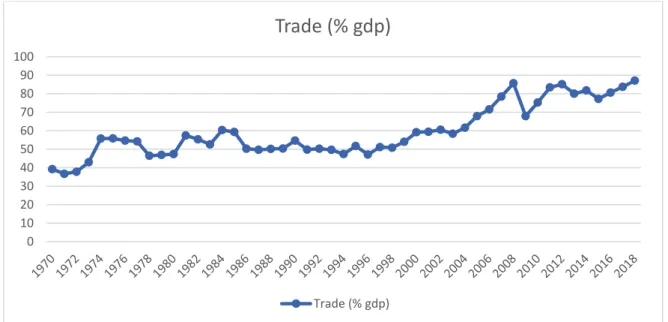
Morocco has been historically a very trade oriented country, where we can see from the graph below that trade as a % of GDP has been on a constant increase since 1970, to reach an all-time high value 87% in 2018:
Figure 1 – Time-series plot of Trade (% GDP), source: WorldBank
0 10 20 30 40 50 60 70 80 90 100
Trade (% gdp)
Trade (% gdp)5 Thanks to its strategic location, as a gateway to Europe and Africa, one of the main trading partners of Morocco has always been the European Union, and more specifically France. The situation is showcased in the graph below, with an average of 27.45% of exports towards that country alone, for a time span of the last 48 years:
Figure 2 – Time-series plot of exports to France as a % of all Moroccan exports, source OEC
database
However, in the last couple of years, Spain has been increasing its share of trade with the kingdom to become in 2017, the country’s biggest trading partner in terms of imports and exports. Based on those information, our objective through this paper, is to see how correlated are both, the Moroccan and the French economy. The main channel that we will look at here is foreign interest rates. Additionally, we will also look at one other potential channel, which is exports to base, and how that might have any effect on the country’s output.
Below is a plot of the 1970 – 2018 real GDP growth in Morocco against the short term interest rate: 0,00 5,00 10,00 15,00 20,00 25,00 30,00 35,00 40,00
6 Figure 3 – Time-series plot of real GDP growth in Morocco against the short term nominal
interest rate in France, sources: Worldbank & OECD
One flagrant notice is that there are some periods where both variables move in the same direction, especially during the first 10 years, which might suggest that there is a positive effect from interest rates in France on GDP growth in Morocco. The same effect is less appearing during the last couple of years where interest rates were very stable around the 0 percentage point. This paper is related to a comparative study done by di Giovanni & Shambaugh (2007) who looked at how countries with different exchange rate regimes were responding differently to interest rates in major industrial economies. The major difference is instead of looking at the long run relationship, which is the case here, they looked at how pegged economies were affected during important business cycles.
2) History of the Moroccan dirham and the exchange rate regime
The country took down the dirham, and replaced it with the Franc from 1912 until 1960, which were the years of the French protectorate. Few years after, the Bretton Woods system collapsed, and a specific quotation was set up by the Moroccan authorities in order to protect the currency from any random fluctuation, and thus was using the French Franc as the main
7 reference in its basket of currencies (Kantox, n.d.). As a matter of fact, the basket was composed of eight currencies, which were carefully chosen given the foreign trade structure of Morocco. Since then, Moroccan authorities have been constantly redesigning the dirham basket in order to:
Keep exports and employment high
Increase the value of remittances from Moroccans living abroad Encourage any foreign investment
Since April 25th, 2001, Morocco has been using what the IMF classifies as, “an exchange rate anchor”, by tying up the local currency to a basket of the two major trading partners’ currencies, which were the USD and the Euro. Weights were fixed by the Moroccan authorities in order to maximize the competitiveness of the local currency, in addition to offset any inflation differential between Morocco and its group of partners. In 2015, because of the devaluation of the euro, which left the dirham extremely exposed, the country’s central bank took down the former’s weight from 80% historically, to 60% (Kantox, n.d.). Similarly, the weight of the USD went from 20 to 40% as a conservative measure to hedge the dirham’s exposure, and those have been the weightings used until the beginning of 2018, where the country moved into a “controlled floating” regime. One important note is that despite the fact that the Moroccan Dirham is considered as a convertible currency, its sale and purchase are still very limited until today, with the currency being tightly monitored by the Moroccan Foreign exchange office.
3) Literature review
Literature has debated for many decades now concerning what is the most suitable foreign exchange rate regime, but each has its own pros and cons. Nevertheless, no one can deny that because of how markets are interconnected, fluctuations in major economies do spill
8 over to smaller ones, and foreign interest rate was found to be one of the most important channels through which that happens.
Meade in 1951 was one of the first people to argue that a flexible exchange rate system is capable of buffing real shocks coming from abroad. As he explains it, flexible rates allow countries to adjust more rapidly in terms of relative prices, while leaving the door open for any macroeconomic variables to smoothly respond to external shocks. On the other hand, countries with a fixed rate regime can only maneuver under certain boundaries, which results in larger fluctuations in terms of output (Meade, 1951). Few years later, Friedman was arguing something similar, and recognized that flexible regimes are better at absorbing shocks compared to the fixed ERR (Friedman, 1953). According to him, adopting a floating exchange rate regime is crucial in order to meet a country’s basic economic objective. Problems such as liberalization of trade, internal and external controls and harmonization of fiscal and monetary policies are much easier to fix under a flexible exchange rate regime (Friedman, 1953). Cruciniet and Crucuruet (2009) claimed that markets, without any form of distortions, are able to achieve the optimal level of efficiency and maximize the country’s welfare. For Chit, Rizov & Willenbockel (2010), a country in South East Asia found that policies initiated by policy makers were triggering exchange rate volatility, which is why they claimed that policies have a strong impact on international trade between countries affected. For Oleg & Roberto (2011), there is a co-integration relationship between exchange rate fluctuation and import price, in other words, movements in the former due to policies are transferred through goods and services prices.
Finally, there was a lot of research done to see how industrial economies were affecting less-developed one. An example is Dombush in 1985, who looked at how business cycles in large countries were driving commodity prices and affecting developing economies. Reinhart and Reinhart (2001) also looked at North-South links, and reached the conclusion that the US real
9 interest rate was indeed having an impact on growth on some regions. Giovanni and Shambaugh (2007) focused on the effect of business cycles and economic growth’s slow-down caused by foreign interest rates. They claimed that pegging one’s currency comes with costs, and those have important repercussions on the economy. The main channel through which this happens is interest rates. For pegged economies, they found that base-country interest rates that are 1% higher than their domestic counterpart push the annual GDP growth into a 0.2% decline in the pegged economies, while no change was witnessed in floating countries. Finally, Nadav Ben Zeev (2018) through his research, found out that during credit shocks, countries with a fixed exchange rate regime were getting hit harder compared to their floating counterpart:
Stock prices were falling much more in the fixed ERR
The country’s credit spread increases by a lot more compared to the floating economies Capital outflow is very severe in bad times in the fixed ERR
4) Empirical model
a) Methodological framework
For the purpose of our study, we will use a time series panel regression of different independent variables, most of them are very specific to Morocco, and some are for France, against the yearly real GDP growth for Morocco on the left hand side. The values range from 1970 to 2018, giving us a total of 49 observations for our time series analysis. All the values were put in log terms, but were adjusted beforehand since some values were negative. This paper will include the following regression models:
A comprehensive model, which will include both potential channels, foreign interest rates and exports to base:
1) Log Real GDP growth in Morocco = α + β1 * Log Short term nominal interest rates in France + β2* Log Inflation, consumer prices (annual %) + β3* Log Trade
10 (% GDP) + β4* Log Agriculture, forestry, and fishing, value added (% GDP) + β5* Log exports to France (as a % of all Moroccan’s exports) + β6* Log Short term nominal interest rates in Morocco + β7* Log exchange rate MAD/(Franc and Euro) + β8* Log Central Government Debt (% of GDP) + β9* Log General government final consumption expenditure (annual % growth) + β10* Log gross domestic savings (% GDP)
One focus model for foreign interest rates:
2) Log Real GDP growth in Morocco = α + β1 * Log Short term nominal interest rates in France + β2* Log Inflation, consumer prices (annual %) + β3* Log Central Government Debt (% of GDP) + β4* Log Agriculture, forestry, and fishing, value added (% of GDP) + β5* Log Short term nominal interest rates in Morocco + β6* Log OPEC oil prices in MAD + β7* Log gross capital formation (% GDP) + β8* Log General government final consumption expenditure (annual % growth) One focus model for exports to base:
3) Log Real GDP growth in Morocco = α + β1* Log Exports to France (as a % of all Moroccan’s exports) + β2* log Trade (% GDP) + β3* Log Exchange rate MAD/(Franc and Euro) + β4* Log Agriculture, forestry, and fishing, value added (% of GDP) + β5* Log Central Government Debt (% of GDP)+ β6* Log gross domestic savings (% GDP)
a) Data
A list of the variables used, their format and their respective source is in the appendix. Most of the data was retrieved from the World Bank’s World Development indicators. Interest rates used are both nominal and short term, the French one comes from OECD, and the Moroccan one from the IFS database. Oil price was found on Statista and the Moroccan
11 exchange rate against the franc and the euro comes from the European central bank and the African Development Bank. France moved from the French Franc to the Euro in 2001, so in order to come up with one exchange rate for the whole period, that variable has been standardized against each exchange rate’s mean and standard deviation. The results were not very different from using the French franc/Euro and then converting it to the MAD/Euro, so we kept the standardized form as the exchange rate variable used in this paper.
5) Empirical Results
a) Model 1: The Comprehensive Model
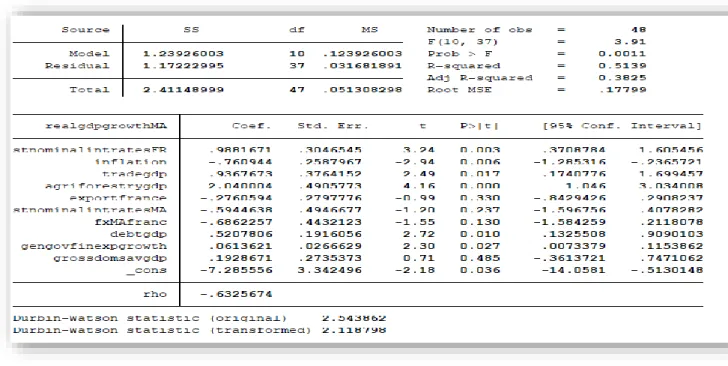
Table 1 - OLS estimates for the comprehensive model after being corrected using the Cochrane-Orcutt procedure
Based on our output table, we can see there is indeed a significant impact from France’s interest rate on Morocco. As a matter of fact, we can affirm, by a 95% confidence level, that when the short term nominal interest rate goes up in France, real output in Morocco goes up too. Using our coefficients, a 1% increase in short term nominal interest rates in France causes real GDP growth in Morocco to increase by almost 0.99%. This confirms the literature research
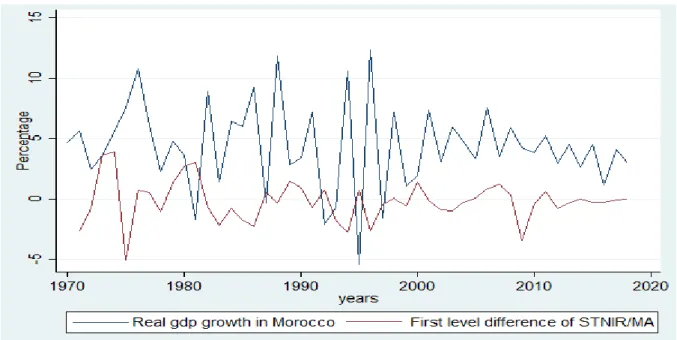
12 that was investigating effects of large industrial economies, and how those affect business cycles in developing countries. An interesting point is when plotting our real GDP growth in Morocco against the first level difference of short term nominal interest rate in France, we see that the effect moves from a positive one, to a negative one.
Figure 4 - Time-series plot of real GDP growth in Morocco against the first level difference
of short term nominal interest rate in France, sources: Worldbank & OECD
Similar results were found by Giovanni and Shambaugh (2007), which shows that the short run effect of our main variable of interest on real output growth in Morocco is negative. On the other hand, the long run effect, which is showcased from our regression model, is a positive coefficient at the 1% significant level. Moreover, there is also a negative coefficient when looking at the effect of short term nominal interest rate in Morocco, even though not being significant at the 10% level.
One specific variable that was added into the model is agriculture, forestry, and fishing, value added as a % of GDP, with a very strong coefficient impact on our dependent variable illustrates how important that factor is to the Moroccan economy. According to the U.S Department of Commerce, Agriculture has always been a key variable to the Moroccan GDP, contributing to
13 around 15% of it when the right weather conditions are met. Moreover, this sector alone employs about 45% of the country’s total workforce (Morocco - Agricultural Sector, 2019). Based on our regression, it is clear that this variable is strongly affecting real output growth in the country, with a 1 percentage point increase as a value of GDP leading to a 2.04 percentage point increase in real GDP growth, ceteris paribus.
The other potential channel that we are looking at is the export to base. From our comprehensive regression model, that variable is not significant at the 10% level, but still has a negative effect on the Moroccan’s GDP. Trade as a % GDP, on the other hand, has a strong positive and significant effect on the real GDP growth in Morocco, this does make sense since Morocco is a trade oriented country. For each 1% increase in trade as a % of GDP, real GDP growth in the country goes up by 0.94%. According to literature, trade and financial openness are usually strongly correlated, and the more open a country is, the more impacted it is by foreign interest rates (Giovanni & Shambaugh, 2007). One important note to make is Morocco has always had a deficit trading balance, which is showcased in the graph below:
Figure 5 - Time-series plot of the external balance of goods and services for Morocco, as a %
of GDP, source: Worldbank
That explains why the country’s exchange rate, with respect to the Euro or the franc before that, is having a negative coefficient, as it is crucial to keep a fairly stable exchange rate for Morocco.
-25,00 -20,00 -15,00 -10,00 -5,00 0,00 5,00 1960 1970 1980 1990 2000 2010
14 Otherwise, any devaluation of the currency with respect to the Euro specifically can have huge costs. Finally, debt to GDP being positive at almost the 1% significance level. There are numerous research that have been done in literature in order to come up with the different threshold levels for each economy in terms of debt, as a % of GDP. From our regression model, since there is a strong positive effect of debt on real output growth, we can assume that Morocco has not yet reached that level, and instead, debt is having more positive effects on the economy as a whole than negative with a 1% increase in that variable leading to almost a 0.52% increase in real GDP growth, ceteris paribus. An important series of papers published by Reinhart and Rogoff in 2010 affirm that there is indeed a threshold above which, debt start having contractionary effects on the economy for emerging markets.
Figure 6 - External Debt, Growth and Inflation: Selected Emerging Markets, 1970 – 2009,
Sources: International Monetary Fund, World Economic Outlook, World Bank, Global Development Finance, and Reinhart and Rogoff (2009b)
The above figure shows the results of that study, where after the 90% debt/GDP mark, the average effect on real GDP growth start becoming negative. However, levels around 60% of GDP were having the opposite effect (Reinhar & Rogoff, 2010). It is worth mentioning that for emerging markets, there is a huge increase in inflation when debt/GDP exceeds 90%. In the
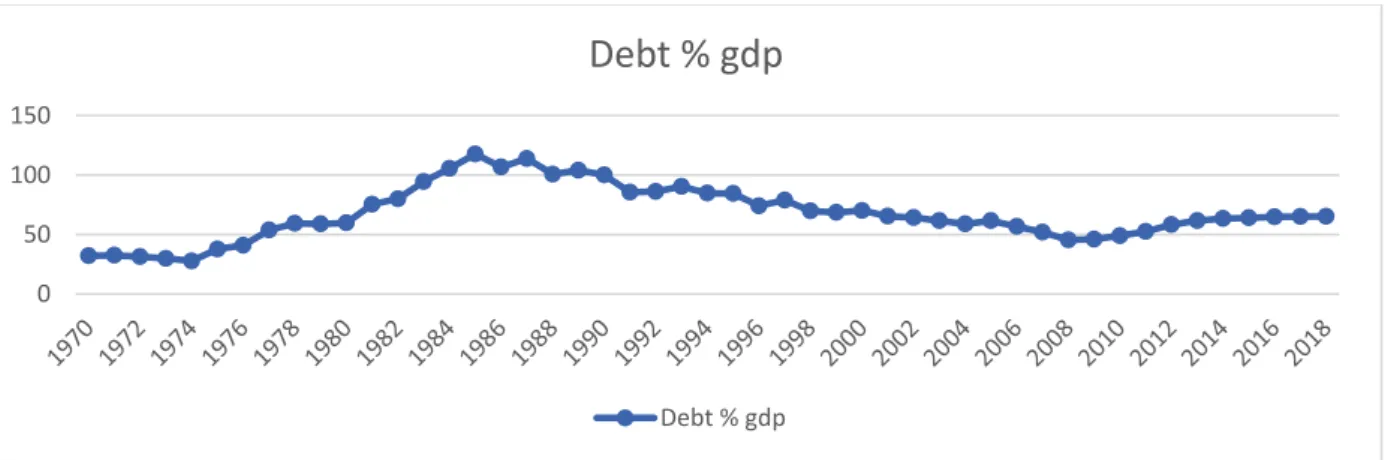
15 case of Morocco, figure 7 showcases that the level has been fluctuating around 64% in the last 5 years, and where the value has been kept relatively low after the 2008 crisis:
Figure 7 - Time-series plot of Morocco’s debt as a % of GDP, source: Worldbank
b) Model 2: Foreign Interest Rate Channel
Table 2 - OLS estimates for the channel of foreign interest rates
For our second model, we want to look at the short term nominal interest rate in France in a more focused model. The output table shows that this variable is still significant at the 5%
0 50 100 150
Debt % gdp
Debt % gdp16 level, with once again, a positive coefficient. Consequently, we can assume that foreign interest rate is an important channel through which France affects Morocco’s output growth. One major change from the last model is the short term nominal interest rate in Morocco being significant at the 5% level, with a stronger negative coefficient compared to before, which proves that the higher the money market rate in the country, the higher the decrease of the country’s real GDP growth. In our case, for each 1% increase in short term nominal interest rates in Morocco, real GDP growth goes down by 0.97%. The standard economic theory claims that the natural interest rate, which is the short term real rate where the economy is working at full regime with the maximum employment level possible, is positively related to real GDP growth rate (Leduc & Glenn, 2014). Yet, we can see that we’re having a negative coefficient in that case, and this might be explained by the fact that in open economies with a lot of international financial flows, interest rates do not depend solely on developments in a single country, rather, on the interaction of savings, growth and investment in the global world (Leduc & Glenn, 2014). In addition to that, in case of a high demand on money market rates, investors are usually not very optimistic about the economy, and instead of investing in longer maturities’ instruments, prefer to put their money in financial assets with shorter terms.
Gross capital formation also seems to heavily affect the country’s real output, by being significant at the 1% level. This variable represents any investment that is done by the country in terms of fixed assets, creating jobs and any other initiative that creates value. In this case, this pushes the country to grow its real output by 1.25% for each 1% increase in this variable.
17 c) Model 3: Export to base channel
Table 3 - OLS estimates for the channel of exports to base
Our final model concerns exports to France, as another potential channel through which France affects Morocco. Trade continues to be a significant variable affecting output growth in Morocco, just like in our comprehensive model, with a 1% increase in trade as a % of GDP leading to a 0.85% growth in the country’s GDP. Export to France in both models doesn’t seem to significantly affect real GDP growth, which allows us to assume that, it is not a viable channel through which France impacts Morocco’s growth, despite the fact that the coefficient is negative in both. Giovanni & Shambaugh (2007) were also unable to find a significant effect of exports to base on real GDP growth for pegged economies. For the exchange rate, we are getting similar results as previously, with a negative coefficient, but this time being significant at the 10% level. For a trade oriented country where more than 70% of both total exports and imports are from/to Europe, adding to that a current account deficit, any devaluation in the local currency will have tremendous impact on the country’s foreign reserve, and economic growth
18 as a whole. That is why we see that for each 1% increase in the exchange rate between the Moroccan dirham and the franc/euro, real GDP growth in Morocco goes down by 0.79%. Finally, gross domestic saving, which is composed of savings from the household sector, public and private corporate sector has a strong positive effect on that variable on the real GDP growth. In Morocco, since for each 1% increase in it, output growth goes up by 0.73%. The saving rate has always been looked at as an important component affecting economic growth and a lot of papers in literature found similar results where the higher the domestic saving rate, the higher the economic growth rate, one example is Krieckhaus (2002).
d) Robustness checks
In order to make sure that our coefficients are accurate, we must test for some of the important assumptions related to OLS estimates. That include normality of residuals, heteroscedasticity and serial autocorrelation. Any violation of those assumptions will lead to biasness, and eventually incorrect conclusions.
Values were transformed into log-terms in order to meet our normality assumption. A normality test was also run on the comprehensive model in order to make sure that the data used is normally distributed, which is the case. As we are dealing with only 49 observations, it is important to check for this assumption, as it tends to hold for larger samples (OriginLab Corporation, n.d.).
Next, a Breusch-Godfrey, and a White test were run on all the models, with the results being in the appendix. A Durbin-Watson was also run on the comprehensive model. Based on that, we can safely assume that our models are free from any form of heteroscedasticity, and serial autocorrelation except for our comprehensive model. Hence, the Cochrane-Orcutt procedure was applied in order to correct for the presence of any serial autocorrelation, with the adjusted regression present in the empirical result part (Statistics Solutions, n.d.).
19 e) Limitations of the model
As for the limitations, there are few of them that can be attributed to the models used in this paper. First one being the inclusion of all the years during the timespan of the study, without controlling for global shocks and crisis time that affected global economies. That mainly includes the 2008 financial crisis, in addition to the dot com bubble of the year 2000, which eventually had undeniable effects on interest rates, trade balance and many other variables used in this paper’s models. Another limitation is the usage of yearly data, which accentuates the effect of those global shocks compared to using monthly data, but that can also be explained by the scarce of relevant data for countries such as Morocco. Then, some endogeneity concerns related to omitted variables, as there are so many factors that affects a country’s output.
6) Current situation of the exchange rate regime
In 2006, the IMF was in a mission in Morocco collecting economic and financial data, and concluded that Morocco should move towards a more flexible exchange rate regime. For a country with a trade openness such as Morocco, a flexible regime is optimal in order to achieve a high economic competitiveness. According to Ahmed Derrab, general secretary of the Moroccan association of citrus producers: “A more flexible exchange rate is necessary to boost the competitiveness of Morocco, and it should not cause any major risk for exports if authorities move cautiously” (AllAfrica, 2018). One important issue that a lot of people raised, was the impact of this transition on the purchasing power of Moroccans. However, the governor of the Moroccan central bank claimed that all scenarios have been studied cautiously and that everything was under control to allow this transition to happen in smooth conditions, he added: A possible devaluation of the currency by 0.2% during the year of
20 Inflation, in extreme cases, might increase by 0.4% and reach a rate of 1.9% to 2%. The example given included diesel, which would increase by 0.15 dirham in that case, and go from 9.6 to 9.75 MAD/Liter.
The plan was originally scheduled for July 2017, but was postponed at the last minute because investors and companies purchased huge amounts of foreign currency in order to profit from the immediate devaluation of the dirham. This can be seen on the graph below of the Moroccan’s foreign reserves:
Figure 8 - Morocco’s foreign exchange rate’s reserves from September 2013 to August 2019.
Taken from https://knoema.com/WBGEM2017Mar/world-bank-global-economic-monitor-monthly-update
From it, we can see that the strongest 2 months decline in the last 4 years, where more than 3 billion US$ vanished between April and June 2017. This represents a 12% decline from the 25 billion US$ level in February of the same year. Eventually, the first phase of the switch was launched in January 2018, and included a widening of the fluctuation band of the Moroccan currency by 2.5% in both sides against hard currencies (El Yaakoubi, 2018).
Nevertheless, there is one very important aspect that needs to be considered, and that concerns the Moroccan’s current account repartition.
21 Figure 9 - Morocco’s current Account Components Source: MOROCCO 2019 ARTICLE IV
CONSULTATION, IMF Country Report
There are two key conclusions that can be drawn from the above figure:
The current account/GDP has been negative from 2009 to 2018, which is going to drain a lot of money in case the floating leads to an important devaluation of the Moroccan’s currency.
The second point is that the two biggest sources of revenues in terms of foreign currency are tourism, and remittances from Moroccans living abroad. Since both together are unable to cover the huge trade deficit of Morocco, the country will be obliged to seriously invest and find other sources of revenues in order to reach the competitive level aimed for.
As it is still very early to draw any conclusions, we can have a look at the country’s currency against the Euro and the Dollar following the first stage of the transition:
22 Figure 8 - Historical data on the USD/MAD quotation from late 2014 to 2019, taken from
https://www.bloomberg.com/quote/USDMAD:CUR
Starting the implementation of the plan in January 2018, the Moroccan dirham has been gradually depreciating against the US$, moving from a 9.2 close to a 9.65 MAD/USD in November 2019.
Figure 9 - Historical data on the EUR/MAD quotation from late 2014 to 2019, taken from https://www.bloomberg.com/quote/EURMAD:CUR
Similarly for the euro, the Moroccan currency has been depreciating as well starting 2018, but then started appreciating few months after, to reach close to a 10.7 MAD/EUR in November 2019. The government decided to put the transition on a hold in January 2019, because of new variables coming into play that were previously not taken into account (AllAfrica, 2018). That includes not only the increasing burden of the Moroccan’s debt, but also the global trade war happening between the US and china, the slowing of global economies and the awaiting for the next crises, driving a huge cloud of uncertainty in the world. Yet, in late October of 2019,
23 the Moroccan Central Bank claims that now is the right time to pursue with the second phase of the transition.
7) Conclusion
Our objective through this paper was to see if there was any kind of impact coming from France on Morocco following two important channels: foreign interest rates and export to base. We decided to look at the case of France since it has been historically, the country against which Morocco pegged its currency, and has also been the biggest trading partner of the kingdom until being dethroned recently by Spain. Results show that there is a strong positive impact coming from short term nominal interest rates in France on the annual real GDP growth of Morocco. For each 1% increase in that variable, real output growth goes up by 0.83%, and can even reach 0.99% depending on the model. On the other hand, export to base doesn’t seem to be a significant variable to Morocco’s real output growth. Robustness checks have also been performed on the three models used, where they appear to not suffer from any non-normality of residuals, serial autocorrelation or heteroscedasticity. This paper does follow what literature claimed about large economies affecting emerging markets, and the case is even more interesting with countries such as Morocco that are pegging their currencies.
As we have said in the previous section, Morocco started moving towards a flexible exchange rate regime, and is embarking on the second phase of that transition starting January 2020. With so many variables creating uncertainty in global markets at the moment, is it indeed the right period to embark on that second stage? Only time, and a good monitoring of the transition will tell.
24 8) References
AllAfrica. 2018. “Morocco: Exchange Rate Regime Reform Is a ‘Sovereign Decision’, Says Governor of Morocco's Central Bank.”, Accessed November 5, 2019.
https://allafrica.com/stories/201801190553.html.
Ben Zeev, Nadav. 2019. Global credit supply shocks and exchange rate regimes. Journal of International Economics, Elsevier, vol. 116(C), pages 1-32.
Crucini, M. et al. 2009. The Law of One Price without Borders: The Role of Distance versus
Sticky Prices. National Bureau of Economic Research, working paper no. 14835
Curcuru, S. et al. 2009. The Decomposition of the U.S. External Returns Differential. Journal of International Economics, forthcoming.
Carmen M. Reinhart & Vincent R. Reinhart. 2001. What Hurts Most? G-3 Exchange Rate or
Interest Rate Volatility. NBER Working Papers 8535, National Bureau of Economic
Research, Inc.
Di Giovanni, J., Shambaugh, J.C. 2008. The impact of foreign interest rates on the economy:
the role of the exchange rate regime. Journal of International Economics 74 (2),
341-361.
El Yaakoubi, A. 2018. “Morocco looks for smooth transition to more flexible exchange-rate system”. Retrieved December 5, 2019, from
https://www.reuters.com/article/morocco-currency/morocco-looks-for-smooth-transition-to-more-flexible-exchange-rate-system-idUSL8N1P90D0.
Friedman, Milton, and Marilyn Friedman. 1953. Essays in Positive Economics. Chicago/London: The University of Chicago Press.
Gopinath, G., Oleg, I., & Roberto R. 2011. Currency Choice and Exchange Rate
Pass-Through. American Economic Review, vol. 100(1), pp. 304-36
Kantox. n.d. “Moroccan Dirham.” Accessed November 5, 2019.
https://www.kantox.com/en/glossary/moroccan-dirham/.
Krieckhaus, J. 2002. Reconceptualizing the Developmental State: Public Savings and
Economic Growth. World Development, Vol. 30 Nr 10
Meade, James. 1951. The Theory of International Economic Policy, 2 volumes. Morocco - Agricultural Sector. 2019. Accessed November 15, 2019.
https://www.export.gov/article?id=Morocco-Agricultural-Sector.
Myint Moe Chit; Marian Rizov and Dirk Willenbockel. 2010. Exchange Rate Volatility and
Exports: New Empirical Evidence from the Emerging East Asian Economies. The
25 OriginLab Corporation. n.d. “17.1.7 Normality Test.”. Accessed November 13, 2019.
https://www.originlab.com/doc/Origin-Help/Normality-Test.
Reinhart, Carmen M., and Kenneth S. Rogoff. 2010. "Growth in a Time of Debt." American
Economic Review, 100 (2): 573-78.
Rudiger Dornbusch. 1985. Policy and Performance Links between LDC Debtors and
Industrial Nations. Brookings Papers on Economic Activity, Economic Studies
Program, The Brookings Institution, vol. 16(2), pages 303-368.
Statistics Solutions. n.d. “Autocorrelation.” Accessed November 5, 2019.
https://www.statisticssolutions.com/autocorrelation/.
Sylvain Leduc & Glenn D. Rudebusch. 2014. "Does slower growth imply lower interest rates?," FRBSF Economic Letter, Federal Reserve Bank of San Francisco.
26 9) Appendix
Table A1 - Overview of the data list
Table A2 – Descriptive statistics of the variables
27 Table A4 – Skewness & Kurtosis test on the comprehensive model
Figure A1 – Normality plot of the comprehensive model
28 Figure A3 – Durbin-Watson test for the comprehensive model
Table A5 – Breusch-Godfrey test on the comprehensive model
Figure A4 – White test for the foreign interest rate focus model
29 Figure A5 – White test on the export to base focus model