Patricia Angélica Milani Calgaro Adilson Yoshio Furuse
Gisele Maria Correr Bárbara Pick Ornaghi Carla Castiglia Gonzaga
MestradoProfissional em Odontologia Clínica, Universidade Positivo - UP, Curitiba, PR, Brazil.
Corresponding Author: Carla Castiglia Gonzaga
E-mail: [email protected]
Influence of the interposition of ceramic
spacers on the degree of conversion
and the hardness of resin cements
Abstract: This study evaluated: I) the effect of photo-activation through ceramics on the degree of conversion (DC) and on the Knoop hardness (KHN) of light- and dual-cured resin cements; and II) two different protocols for obtaining the spectra of uncured materials, to determine the DC of a dual-cured resin cement. Thin ilms of cements were photo-activated through ceramics [feldspathic porcelain (FP); lithium disilicate glass-ceramics of low translucency LT), medium opacity (e.max-MO) and high translucency (e.max-HT); glass-iniltrated alumina com-posite (IC) and polycrystalline zirconia (ZR)] with thicknesses of 1.5 and 2.0 mm. DC was analyzed by Fourier transform infrared (FTIR) spec-troscopy. Two protocols were used to obtain the spectra of the uncured materials: I) base and catalyst pastes were mixed, and II) thin ilms of base and catalyst pastes were obtained separately, and an average was obtained. KHN assessment was performed with cylindrical specimens.
The results were analyzed by ANOVA and Tukey’s test (α = 0.05). The
light-cured cement showed higher DC (61.9%) than the dual-cured
ce-ment (55.7%). The DC varied as follows: FP (65.4%), e.max-HT (65.1%),
e.max-LT (61.8%), e.max-MO (60.9%), ZR (54.8%), and IC (44.9%). The
light-cured cement showed lower KHN (22.0) than the dual-cured (25.6) cement. The cements cured under 1.5 mm spacers showed higher KHN (26.2) than when polymerized under 2.0 mm ceramics (21.3). Regard-ing the two protocols, there were signiicant differences only in three groups. Thus, both methods can be considered appropriate. The physi-cal and mechaniphysi-cal properties of resin cements may be affected by the thickness and microstructure of the ceramic material interposed during photo-activation.
Descriptors: Resin Cements; Ceramics; Polymerization.
Introduction
All-ceramic restorations have become popular because of their excel-lent esthetics, high color stability, wear resistance, and
biocompatibil-ity.1,2 Even though the mechanical and optical properties of the ceramic
materials are important, many variables may contribute to the predict-ability and clinical longevity of all-ceramic restorations, including the adhesive and luting system used, the curing mechanism, the light-curing
unit, and the microstructure and thickness of the ceramic.3
Resin cements are necessary to bond porcelain and glass-ceramic
resto-Declaration of Interests: The authors certify that they have no commercial or associative interest that represents a conflict of interest in connection with the manuscript.
Submitted: Mar 08, 2013
rations to ensure high strength,4 better esthetics and
longer clinical survival.5 In some situations,
light-cured resin cements have been indicated, because
of their color stability and longer working time.6
However, their maximum degree of conversion (DC) cannot be ensured in situations where light has been attenuated. Therefore, dual-cured luting materials
are good options.7 However, some studies have
dem-onstrated that they depend on photo-activation to
reach high DC and good mechanical properties.8,9
The light transmission through a ceramic res-toration may affect the degree of polymerization of light- or dual-cured resin cements, because the amount of light that reaches the cement layer is
decreased.10 In general, the factors affecting light
transmission through a ceramic material include the thickness and shade of the ceramic material, its mi-crostructure, and the presence of defects and
porosi-ties.11,12 Thus, it is important to understand that the
performance of light- and dual-cured resin cements will be determined by the amount of light that is transmitted through the restoration and that is able to reach the luting material.
The objectives of this study were:
I. to evaluate the effect of photo-activation through
different ceramic spacers of 1.5 and 2.0 mm thickness on the DC and Knoop hardness num-ber (KHN) of light- and dual-cured resin ce-ments, and
II. to compare two different protocols for obtaining
the initial spectra of the uncured materials, to determine the DC of a dual-cured resin cement.
The null hypotheses to be tested were that there would be no difference in the degree of conversion and Knoop hardness between the light- and dual-cured cements, regardless of the thickness and type of ceramic during photo-activation, and that there would be no correlation between the values of de-gree of conversion of the dual-cured resin cement when using two protocols to obtain the initial spec-tra of uncured materials.
Methodology
The spacers were fabricated with different ce-ramics:
• feldspathic porcelain (FP; IPS InLine,
Ivoclar-Vivadent, Schaan, Liechtenstein);
• lithium disilicate glass-ceramics (IPS e.max
Press, IvoclarVivadent) of low translucency (e.max LT), medium opacity (e.max MO) and high translucency (e.max HT);
• glass-iniltrated alumina composite (IC;
In-Ce-ram Alumina, Vita Zahnfabrick, Bad Säckingen, Germany) and
• polycrystalline zirconia (ZR; Ceramill Zi,
Amanngirrbach, Koblach, Austria).
Feldspathic porcelain was prepared in a single layer (1.5- and 2.0-mm-thick). Spacers were pre-pared for other materials, in two layers of 0.5 or 0.8 mm thick core material veneered with 1.0 or 1.2 mm of veneer ceramic. All spacers were fabri-cated according to the manufacturers’ instructions in the corresponding A2 shade.
Two resin cements were evaluated:
• a light-cured version (RelyX Veneer, 3M ESPE,
St. Paul, USA) and
• a dual-cured (Variolink II, IvoclarVivadent)
ver-sion.
For the purpose of determining the DC, portions
of ≈0.05 g of the non-cured cements were dispensed
between two plastic ilms and pressed in a pneu-matic press (Simadzu Corp., Kyoto, Japan) at 10 kN
to obtain thin ilms of ≈0.1 mm. These ilms were
light-cured for 40 s through the different ceramic spacers, performed by a LED curing unit (Translux Power Blue, Heraeus Kulzer GmbH, Hanau, Ger-many), with an irradiance of 1000 mW/cm².
Since it is dificult to obtain an accurate spectra of uncured materials for dual-cured resin cements, two different protocols were used for this purpose:
I. base and catalyst pastes were mixed and pressed
in order to obtain a thin ilm, and
II. thin ilms of base and catalyst pastes were
ob-tained and analyzed separately, and an average of the resulting two spectra was arrived at.
After photo-polymerization, the specimens
(n = 3)13,14 were submitted to Fourier transform
tem (p < 0.001); however, the thickness was not
sig-niicant (p = 0.322). All interactions were signiicant
(p < 0.05). The light-cured cement was statistically
superior, as compared with the dual-cured cement
(61.9% and 55.7%, respectively). FP (65.4%) and
e.max HT (65.1%) spacers showed higher DC for
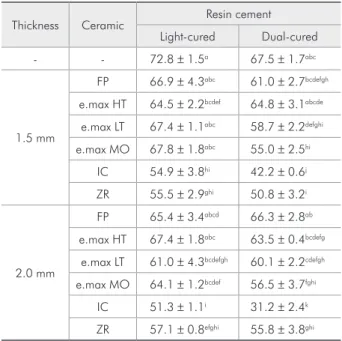
both resin cements. DC results for multiple compari-sons are shown in Table 1.
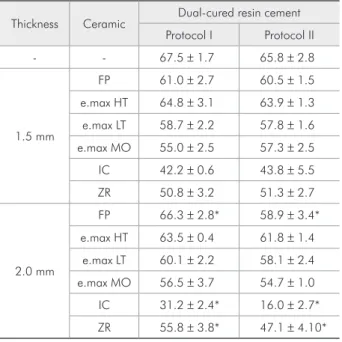
The results for the two different protocols used to obtain the spectra of the uncured materials of the dual-cured resin cement are shown in Table 2. There were statistically signiicant differences between the DC values only when 2.0 mm-thick FP, IC and ZR spacers were used. There was a positive correlation (r = 0.94) between the DC values (Figure 1).
KHN results indicated signiicant differences for
all individual factors (p < 0.001). All interactions
were signiicant (p < 0.001), except for luting cement
× thickness (p = 0.209). Comparing the luting
mate-rials, the light-cured cement showed a lower KHN value than the dual-cured cement (22.0 and 25.6, respectively). Light-cured materials under 1.5 mm ceramics showed higher KHN values than those un-der 2.0 mm ceramics (26.2 and 21.3, respectively). Cements cured through e.max HT (27.2), FP (27.1)
Kyoto, Japan), at 4 cm–1 resolution, and to 32 scans
ranging from 4000 to 800 cm–1. The absorption
peaks of the aromatic double bonds were recorded at
1608 cm-1 (Abs 1608), and the peak of the
aliphat-ic double bonds were registered at 1636 cm-1 (Abs
1636). The DC of each specimen was estimated as a relative percentage, by using the 2-frequency meth-od and the tangent baseline technique. The readings were performed immediately for the light-cured resin cement, and after 10 min for the dual-cured resin ce-ment. This enabled the chemical polymerization of the dual-cured resin cement to attain an advanced
stage, as recommended by ISO 4049.15
The DC (in percentage terms) was determined as follows:
DC(%) = 100(1 - Rcured
/
Rnon-cured)where R is the ratio between Abs 1636 and Abs
1608, calculated for both cured and non-cured resin cement.
For the purpose of determining the KHN (kgf/ mm²), the specimens were prepared using a Tef-lon mold (diameter of 10.0 mm and thickness of 1.0 mm) and light-cured through the ceramic spac-ers for 40 s (Translux Power Blue). KHN was de-termined using a microhardness tester (MHT-230, Leco Corp., St Joseph, USA) on the top surface of the specimens (load of 10 g and dwell time of 10 s). Five indentations per sample (n = 5) were performed. The light-cured resin cement specimens were evalu-ated immediately after curing and the dual-cured resin cement specimens were evaluated 10 min after photo-activation.
Both the DC and the KHN data were submitted
to three-way ANOVA and Tukey’s test (α = 0.05),
taking into account the luting cement, the ceramic system, and the ceramic thickness. The two differ-ent protocols used to obtain the spectra of the un-cured material to evaluate the DC were analyzed
us-ing Student’s t test (α = 0.05).
Results
Signiicant differences for DC were observed for
the luting cement (p < 0.001) and the ceramic
sys-Table 1 - Means and standard deviations for the degree of conversion (in percentage).
Thickness Ceramic Resin cement Light-cured Dual-cured - - 72.8 ± 1.5a 67.5 ± 1.7abc
1.5 mm
FP 66.9 ± 4.3abc 61.0 ± 2.7bcdefgh e.max HT 64.5 ± 2.2bcdef 64.8 ± 3.1abcde
e.max LT 67.4 ± 1.1abc 58.7 ± 2.2defghi e.max MO 67.8 ± 1.8abc 55.0 ± 2.5hi
IC 54.9 ± 3.8hi 42.2 ± 0.6j ZR 55.5 ± 2.9ghi 50.8 ± 3.2i
2.0 mm
FP 65.4 ± 3.4abcd 66.3 ± 2.8ab e.max HT 67.4 ± 1.8abc 63.5 ± 0.4bcdefg
e.max LT 61.0 ± 4.3bcdefgh 60.1 ± 2.2cdefgh e.max MO 64.1 ± 1.2bcdef 56.5 ± 3.7fghi
IC 51.3 ± 1.1i 31.2 ± 2.4k ZR 57.1 ± 0.8efghi 55.8 ± 3.8ghi
and e.max MO (26.4) showed higher values. Mul-tiple comparisons for KHN can be seen in Table 3.
A positive correlation (r = 0.58) was observed between the DC and the KHN (Figure 2). Individ-ual correlation curves are also shown (r = 0.86 and r = 0.80 for light- and dual-cured resin cements, re-spectively).
Discussion
The irst null hypothesis was rejected.
Differ-ences in the behavior of the two cements may be the result of differences in composition, amount of chemical activator and photo-initiators, and also of the general composition of the cement, including
type and proportion of monomers.16 Furthermore,
DC results may be explained by differences in the reaction rates between the two activation mecha-nisms. Photo-activation is described as resulting from quick initial curing, whereas chemical activa-tion is characterized by a slower and more
progres-Table 3 - Means and standard deviations for the Knoop hardness number (KHN).
Thickness Ceramic Resin cement Light-cured Dual-cured - - 27.6 ± 2.3def 33.6 ± 2.7a
1.5 mm
FP 27.7 ± 2.5de 32.2 ± 1.8ab e.max HT 24.5 ± 4.4ghi 30.8 ± 1.8bc e.max LT 24.4 ± 3.4ghij 31.0 ± 3.2abc e.max MO 29.0 ± 4.4cd 28.4 ± 1.8cde IC 20.0 ± 1.8kl 21.7 ± 2.6jk ZR 21.8 ± 3.0ijk 23.0 ± 2.0hij
2.0 mm
FP 22.4 ± 1.9hijk 26.0 ± 2.0efg e.max HT 24.9 ± 2.4fgh 28.4 ± 2.2cde e.max LT 19.0 ± 3.0lm 26.9 ± 1.5defg e.max MO 21.8 ± 2.5ijk 26.6 ± 2.4defg IC 11.7 ± 1.8o 14.2 ± 2.5no ZR 16.6 ± 2.0mn 17.6 ± 2.0lm
Values followed by the same letter are statistically similar (p > 0.05).
Table 2 - Means and standard deviations for the degree of conversion (in percentage) obtained for the dual-cured resin cement when using two different protocols to obtain the spectra of uncured materials.
Thickness Ceramic Dual-cured resin cement Protocol I Protocol II
- - 67.5 ± 1.7 65.8 ± 2.8
1.5 mm
FP 61.0 ± 2.7 60.5 ± 1.5 e.max HT 64.8 ± 3.1 63.9 ± 1.3 e.max LT 58.7 ± 2.2 57.8 ± 1.6 e.max MO 55.0 ± 2.5 57.3 ± 2.5 IC 42.2 ± 0.6 43.8 ± 5.5 ZR 50.8 ± 3.2 51.3 ± 2.7
2.0 mm
FP 66.3 ± 2.8* 58.9 ± 3.4* e.max HT 63.5 ± 0.4 61.8 ± 1.4
e.max LT 60.1 ± 2.2 58.1 ± 2.4 e.max MO 56.5 ± 3.7 54.7 ± 1.0 IC 31.2 ± 2.4* 16.0 ± 2.7* ZR 55.8 ± 3.8* 47.1 ± 4.10*
In each line, the asterisks indicate statistically significant differences (p < 0.05).
Figure 2 - Correlation between DC and KNH. The solid lines are individual regressions to light- and dual-cured cements. The dashed line indicates the regression for all data points. Figure 1 - Correlation between the DC determined when
sive polymerization process.17
In the present study, the results indicated that the microstructure of ceramics seemed to inluence both the KHN and the DC. IC and ZR spacers accounted for a greater decrease in the KHN and DC values of the two cements, as compared with ceramic spac-ers with a higher content of glass matrix (porcelain and glass-ceramics). The effect of the ceramic mi-crostructure on the properties of resin cements has
also been previously reported in the literature.18 The
opacity, rather than the thickness, seems to be the main factor accounting for the differences found in DC and KHN among the groups in the present study. However, the thickness of indirect materials interposed during photo-activation is a key factor for light attenuation, and polymerization generally
decreases as thickness increases.12
Some studies employing FTIR or FT-Raman used
thick (from 0.5 to 1.0 mm) specimens,14,19
approxi-mately 10 to 20 times thicker than those used in the adhesive luting of indirect restorations. Furthermore, there is a difference in the behavior of thin ilms as
opposed to bulk specimens.20 In the present study,
thin specimens were used to determine the DC, striv-ing to simulate clinical situations of lutstriv-ing indirect restorations adhesively. Thus, the comparison of the results between DC and KHN may have been dis-parate (low coeficient of correlation), because thin ilms were used to determine the DC, and thicker specimens were used to determine the KHN.
Some studies have evaluated light-cured resin
ce-ments through ceramics.3,18,21,22 Overall, they
corre-lated low KHN to low values of DC. However, in addition to the C = C conversion, indirect activation through ceramic materials may affect hardness by reducing the intensity of the light reaching the ce-ment, favoring the formation of polymers with a
small number of cross-link bonds.23 Additionally,
other characteristics may also interfere with hard-ness, including the chemical structure of the mono-mers and the type and density of the cross-link
bonds.24 This means that the relation between DC
and hardness is not always straightforward.25
Although light-cured resin cements are usual-ly indicated for cementation of thin porcelain and glass-ceramic veneers, as well as inlays and onlays,
in the present study, this cement was also evaluated under IC and ZR, for the purpose of comparison with the maximum polymerization achieved by cur-ing without any spacer. Thus, a measure of maxi-mum and minimaxi-mum conversion of resin monomers could be established. By evaluating what the lowest DC would be by employing opaque ceramic spacers, the light attenuation caused by the decrease in the light transmittance through the different ceramics may be better understood.
The second null hypothesis was also rejected. In general, there is not much information on how the initial spectra of uncured materials can be ob-tained, thereby complicating the reproduction of the test method. This issue is important for dual-cured cements, because their polymerization starts imme-diately after mixing the base and catalyst pastes, making it dificult to obtain the spectra of uncured materials accurately. Because most studies indicate that the spectra of uncured materials are acquired right after mixing the base and catalyst pastes, it was decided that another protocol would be evalu-ated, in which thin ilms with equal amounts (by weight) of base and catalyst pastes would be obtai-ned and analyzed separately, and an average of these two spectra would then be arrived at. In theory, this protocol would avoid obtaining the spectrum of a material already in the initial stages of polymeriza-tion. A similar method (with thin ilms of the indivi-dual pastes) has been described in the literature, but there was not much information on how the data
was dealt with.26 Furthermore, other studies
compa-ring these two protocols were not found.
(-11.26%), ZR (-15.68%) and IC (-48.66%)]. Since there were no other studies to compare and validate these results, more studies are needed so that this alternative protocol may be used as another option to determine the DC of dual-cured resin cements, eliminating the bias of determining the spectra of uncured materials after the polymerization reaction has already started.
The physical and mechanical properties of resin cements may be affected by the thickness and mi-crostructure of ceramic restorations. It is important to emphasize that light-cured resin cements should receive an adequate energy density to reach good polymerization and mechanical properties. Further-more, only effective photo-activation may ensure
clinically acceptable hardness levels of dual-cured resin cements, mainly in critical areas. Considering these issues, further studies are needed to ind a way to compensate light attenuation aggravated by the interposition of indirect restorative materials.
Conclusions
The interposition of ceramic spacers during pho-to-polymerization signiicantly inluenced the DC and the KHN of the resin cements evaluated. A pos-itive correlation between the DC and KHN values was observed. Regarding the two different protocols used to obtain the uncured spectra of dual-cured resin cements, both methods seem appropriate for determining the DC.
References
1. Olivera AB, Marques MM. Esthetic restorative materials and opposing enamel wear. Oper Dent. 2008 May-Jun;33(3):332-7. 2. Samra AP, Pereira SK, Delgado LC, Borges CP. Color stability
evaluation of aesthetic restorative materials. Braz Oral Res. 2008 Jul-Sep;22(3):205-10.
3. Rasetto FH, Driscoll CF, Prestipino V, Masri R, von Fraunho-fer JA. Light transmission through all-ceramic dental materi-als: a pilot study. J Prosthet Dent. 2004 May;91(5):441-6. 4. Rosenstiel SF, Land MF, Crispin BJ. Dental luting agents:
A review of the current literature. J Prosthet Dent. 1998 Sep;80(3):280-301.
5. Malament KA, Socransky SS. Survival of Dicor glass-ceramic dental restorations over 16 years. Part III: effect of luting agent and tooth or tooth-substitute core structure. J Prosthet Dent. 2001 Nov;86(5):511-9.
6. Archegas LR, Freire A, Vieira S, Caldas DB, Souza EM. Co-lour stability and opacity of resin cements and flowable com-posites for ceramic veneer luting after accelerated ageing. J Dent. 2011 Nov;39(11):804-10.
7. Santos Jr GC, El-Mowafy O, Rubo JH, Santos MJ. Hardening of dual-cure resin cements and a resin composite restorative cured with QTH and LED curing units. J Can Dent Assoc. 2004 May;70(5):323-8.
8. Braga RR, Cesar PF, Gonzaga CC. Mechanical properties of resin cements with different activation modes. J Oral Rehabil. 2002 Mar;29(3):257-62.
9. Moraes RR, Boscato N, Jardim PS, Schneider LF. Dual and self-curing potential of self-adhesive resin cements as thin films. Oper Dent. 2011 Nov-Dec;36(6):635-42.
10. Heffernan MJ, Aquilino SA, Diaz-Arnold AM, Haselton DR, Stanford CM, Vargas MA. Relative translucency of six
all-ceramic systems. Part I: core materials. J Prosthet Dent. 2002 Jul;88(1):4-9.
11. Lee IB, An W, Chang J, Um CM. Influence of ceramic thickness and curing mode on the polymerization shrink-age kinetics of dual-cured resin cements. Dent Mater. 2008 Aug;24(8):1141-7.
12. Soares CJ, Silva NR, Fonseca RB. Influence of the feldspathic ceramic thickness and shade on the microhardness of dual resin cement. Oper Dent. 2006 May-Jun;31(3):384-9. 13. Papazoglou E, Rahiotis C, Kakaboura A, Loukidis M. Curing
efficiency of a photo- and dual-cured resin cement polymerized through 2 ceramics and a resin composite. Int J Prosthodont. 2006 Jan-Feb;19(1):34-6.
14. Papazoglou E, Rahiotis C, Kakaboura A, Loukidis M. Po-lymerization efficiency of dual-polymerized resin cements light-irradiated through ceramics and laboratory-processed resin composite. Eur J Prosthodont Restor Dent. 2008 Mar;16(1):15-9.
15. International Organization for Standardization. ISO 4049:2009 - Polymer-based filling, restorative and luting materials. 4th ed. Geneva: ISO; 2009. 28 p.
16. Peutzfeldt A. Dual-cure resin cements: in vitro wear and effect of quantity of remaining double bonds, filler volume, and light curing. Acta Odontol Scand. 1995 Feb;53(1):29-34. 17. Fonseca RG, Cruz CA, Adabo GL. The influence of chemical
activation on hardness of dual-curing resin cements. Braz Oral Res. 2004 Jul-Sep;18(3):228-32.
19. Franca FA, Oliveira M, Rodrigues JA, Arrais CA. Pre-heated dual-cured resin cements: analysis of the degree of conver-sion and ultimate tensile strength. Braz Oral Res. 2011 Mar-Apr;25(2):174-9.
20. Moraes RR, Brandt WC, Naves LZ, Correr-Sobrinho L, Piva E. Light- and time-dependent polymerization of dual-cured resin luting agent beneath ceramic. Acta Odontol Scand. 2008 Oct;66(5):257-61.
21. Ilie N, Hickel R. Correlation between ceramics translucency and polymerization efficiency through ceramics. Dent Mater. 2008 Jul;24(7):908-14.
22. Pick B, Gonzaga CC, Steagall Junior W, Kawano Y, Braga RR, Cardoso PE. Influence of curing light attenuation caused by aesthetic indirect restorative materials on resin cement polymerization. Eur J Dent. 2010 Jul;4(3):314-23.
23. Schneider LF, Moraes RR, Cavalcante LM, Sinhoreti MA, Correr-Sobrinho L, Consani S. Cross-link density evaluation
through softening tests: effect of ethanol concentration. Dent Mater. 2008 Feb;24(2):199-203.
24. Calheiros FC, Daronch M, Rueggeberg FA, Braga RR. Degree of conversion and mechanical properties of a BisGMA:TEGDMA composite as a function of the applied radiant exposure. J Biomed Mater Res B Appl Biomater. 2008 Feb;84(2):503-9.
25. Furuse AY, Mondelli J, Watts DC. Network structures of Bis-GMA/TEGDMA resins differ in DC, shrinkage-strain, hard-ness and optical properties as a function of reducing agent. Dent Mater. 2011 May;27(5):497-506.