www.bjorl.org
Brazilian
Journal
of
OTORHINOLARYNGOLOGY
ORIGINAL
ARTICLE
Tinnitus
prevalence
in
the
city
of
São
Paulo
夽
,
夽夽
Jeanne
Oiticica
∗,
Roseli
Saraiva
Moreira
Bittar
DepartmentofOtorhynolaryngology,HospitaldasClínicas,FaculdadedeMedicina,UniversidadedeSãoPaulo(USP),SãoPaulo, SP,Brazil
Received16November2013;accepted20July2014 Availableonline27December2014
KEYWORDS
Tinnitus; Epidemiology; Prevalence
Abstract
Introduction:ThepublicandprivatehealthcareinthecityofSãoPaulohasnodataontinnitus prevalence.
Objective: DeterminetinnitusprevalenceinSãoPaulocity.
Studydesign:Seriesstudy.
Methods:Cross-sectionalstudybyfieldquestionnairewith1960interviews.Predictorvariables includedgender,age,tinnitus.
Results:The prevalence oftinnitus was22%. Itaffects more women(26%) thanmen (17%) and increaseswithadvancing age.Approximatelyone thirdofcases (32%)assert thatthey haveconstanttinnitus(i.e.,‘‘ringing’’),whilemostdescribeintermittenttinnitus(68%).The majority(64%) reportedfeeling annoyed,while others(36%)deniedany annoyance.Among women,theoccurrenceofanannoyingtinnituswassignificantlyhigher(73%)thanamongmen (50%).Thepercentageswere:mildlyannoying(11%),moderatelyannoying(55%),andseverely annoying(34%).Tinnitusinterfereswithdailyactivitiesin18%ofthosereportingtobeannoyed.
Conclusion: ThepopulationinthecityofSãoPaulosufferingfromtinnituswasmoreprevalent thanpreviouslyestimated.Generally,itaffectsmorewomenandthosewithoutoccupation, andincreasessignificantlywithage.Mostrespondentsdescribedthetinnitusasannoying,and thiswasmoreprevalentinfemales.ThedegreeofdiscomfortmeasuredbyaVisualAnalogue Scaleshowedmoderatetinnitus,withresponsesaveraging6.3.
© 2014Associac¸ãoBrasileira de Otorrinolaringologiae CirurgiaCérvico-Facial. Publishedby ElsevierEditoraLtda.Allrightsreserved.
夽
Pleasecitethisarticleas:OiticicaJ,BittarRS.TinnitusprevalenceinthecityofSãoPaulo.BrazJOtorhinolaryngol.2015;81:167---76.
夽夽
Institution:EscoladeMedicina,UniversidadedeSãoPaulo(USP),SãoPaulo,SP,Brazil.
∗Correspondingauthor.
E-mail:[email protected](J.Oiticica).
http://dx.doi.org/10.1016/j.bjorl.2014.12.004
PALAVRAS-CHAVE
Epidemiologia; Prevalência; Zumbido
PrevalênciadozumbidonacidadedeSãoPaulo
Resumo
Introduc¸ão:AsredespúblicaeprivadadesaúdenacidadedeSãoPaulonão possuemdados sobreaprevalênciadezumbido.
Objetivo:Determinaraprevalênciadozumbidonapopulac¸ãopaulistana.
Desenhodoestudo:EstudodeSérie.
Método: Estudotransversalporquestionáriodecampototalizando1960entrevistas.
Resultados: A prevalênciadezumbido observadafoi de22%.Acomete maismulheres (26%) doquehomens(17%).Observou-secrescimentoprogressivodaprevalênciacomoaumentoda idade.Cercade1/3doscasos(32%)têmzumbidoconstante,enquantoamaioriareferezumbido intermitente(68%).Amaioria(64%)declarousesentirincomodada,osdemais(36%)negaram qualquerincomodo;nestequesitoopercentualdemulheresfoisignificantementemaior(73%) que ode homens (50%).Os percentuais observadosforam: incômodo leve(11%), incômodo moderado(55%),eincomodosevero(34%).Ozumbidointerferenasatividadesdiáriasem18% dossujeitos.
Conclusão:OzumbidonacidadedeSãoPaulomostrou-semaisprevalentedoqueopreviamente estimado.Acometemmaisfrequentementemulhereseindivíduossemocupac¸ão,aumentando significantementecomaidade.Amaioriarefereseincomodarcomozumbido,sendoaqueixa maisprevalentenasmulheres.Oincômodomédioaferidopelaescalavisualanalógicaapontou zumbidomoderadocomnotade6,3.
©2014Associac¸ãoBrasileira deOtorrinolaringologiaeCirurgiaCérvico-Facial.Publicadopor ElsevierEditoraLtda.Todososdireitosreservados.
Introduction
TinnitusisacommonsymptominENToutpatientclinicsand canbedefinedastheperception of soundinthe absence of any external sound stimulus. The presence of tinnitus may indicate that something is wrong somewhere in the auditorysystem.Thissymptom canalsobetheresultofa numberof health conditions,such asnoise-induced hear-ingloss,acoustictrauma,presbycusis,metabolicdisorders, use of medication, ear infections, somatosensory impair-mentand/orchronicco-morbidities.Itmayalsobepresent inindividualswithnormalhearing.1
Despite itshigh prevalence, in Braziland in São Paulo
there are no epidemiologic studies of the general
popu-lation to determine the frequency of tinnitus. Estimates
of the prevalence of tinnitus vary among different
exist-ingepidemiologicalstudies;butpreviouslypublishedresults
indicateafrequencyofapproximately10---15% ofthe
gen-eraladultpopulation.2---8 Thedifficultiesinconductingthis
typeofstudyandthesourceofuncertaintyin
epidemiologi-calstudiesarebasedontwokeyfacts:tinnitusseveritycan
onlybeassessedbythepatient,andthereisnoobjective
measureforthesymptom.9
Accordingtotheliterature,mostindividualswith
tinni-tusarenotbotheredbythesymptom,withonly25%ofthose
seekingprofessionalhelp.10 Thedegree ofdiscomfortwith
thesymptom often varies over time;and asmall but
sig-nificantnumber ofpatients reportthat tinnitusinterferes
directlyintheirdailyactivities,causeschangesinqualityof
lifeandsubstantialchangesinbehavior,includinganxiety,
frustration,irritability,depressionandsleepdisorders.11In
1---2%ofcases,tinnitusisbothersomeenoughtosignificantly
affectdailyactivities.12
It is known that the prevalence of tinnitus is directly
relatedtoageandhearingloss;12however,theexposureto
noiseisalsoawellestablishedandknownriskfactor,andone
ofthemostcommoncausesoftinnitus.Urbancenterslike
SãoPauloemergeasaconcentrationpointfordailyexposure
to noise andenvironmental noise pollution.As examples,
consider the excessive land and air traffic, overcrowded
public spaces, shows, concerts and outdoor recreational
activities, sports activities, and eventhe noise stemming
fromdomesticleisureandsafetyequipmentandhousehold
appliances.Theexpectationisthattheprevalenceof
tinn-ituswillincreaseinthefuture, notonlyamongadultsand
the elderly, asa consequence of increased longevity and
chronic comorbidities;butalsoamongteenagersand
chil-dren, because of the greater noise exposure in schools,
leisure environments, and in particular by the misuse of
personalmusiclisteningdevices.Therefore,itisreasonable
toinferthatauditoryclinicalcomplaints,suchastinnitus,
shouldemergeasapublichealthproblem.
According to the latest census of the IBGE (Instituto
BrasileirodeGeografiaeEstatística),2010,thecityofSão
Paulo has a population of 11,253,503 inhabitants, with a
birthrateof 15.59/1000.13 Theelderlyrepresent12.5% of
thepopulationandilliteratepersons3.1%.The cityofSão
Paulo hasaper capitaannualincomeofR$39,445.20and
58.4% of the population concluded secondary education.
Thesesocio-demographiccharacteristics ofthecityofSão
Paulo reveal a profile that is similar to that observed in
most Europeancountries.Demographic changesespecially
a decline in fertility and an increase in years of survival
directly influencestheagecompositionofthe population,
andwe havewitnessedatransferof responsibilityfor the
Knowledgeofinformationaboutthepopulationprofileof
thecityofSãoPauloisofutmostimportance,sinceitis
crit-icaltomakesurethatthefinalsampleobtainedafterfield
collectionandanalysisofourresultsisactuallysufficiently
diversified,representative ofallsocioeconomicstrata and
majoragegroupsandproportionaltopopulationsize,
keep-ingtheequiprobability.
Thesocialdemandsofthosepeoplelivinginthecityof
SãoPaulohavebeen changing,anditisnecessary tohave
abetterunderstandingofthispopulation,sothat
appropri-atehealth policiescan beundertaken.Publicand private
healthcarenetwork in thecity of São Paulo have nodata
on the prevalence of tinnitus; actually, this information
is unknown even for the Brazilian population, becauseof
an absence of specific epidemiological studies. Thus, the
compilation,analysisanddisseminationofsuchinformation
mayhelptodelineatethepreciseprofileofthepopulation.
Ourhypothesisisthattinnitusisaprevalentcomplaintin
thecityofSãoPaulo,withpotentialmorbidityandimpacton
people’shealth,particularlyintheelderly.Thus,additional
informationabout the frequency, intensity of discomfort,
impactondaily activitiesand associatedrisk factors, can
improveprimarycareandthereferralofpatientstotriage
sectors.In addition,thisinformation helpssupportpublic
health policies and prevention campaigns. Moreover, risk
factors collected frompopulation samples may raise new
pathophysiologicalhypothesesandcontributetoadvancesin
tinnitustherapy.Determiningtheprevalenceoftinnituswill
increaseourknowledgeaboutthesymptomprofileforthis
city,favoringtheimplementationofnewpublichealth
poli-cies.Withoutanaccurateestimate,itisimpossibletoplan
anykindofaction,includingobtainingresourcesorsupport
fortheseprojects.
Objectives
Thisepidemiologicalstudyaimedto:
1. Determinetheprevalenceoftinnitusintheadult
popu-lationofthecityofSãoPaulo;
2. Describethemain clinicalcharacteristics oftinnitusin
thispopulation;
3. Quantifythedegreeoftinnitusinthepopulation.
Methods
Thisobservationalcross-sectionalepidemiologicalstudywas
conductedbetweenAprilandOctober2012inthecityofSão
Paulo.Thepopulation-basedsurveytodeterminethe
preva-lenceoftinnitusinthecityofSãoPaulowasaccomplished
throughtheapplication of afieldsurveyquestionnaire on
thispopulation,previouslydesignedforthisspecificpurpose
and adapted and modified based ontwo original studies:
thefirst,conductedtodeterminetheprevalence of
tinni-tusintheUSpopulation8andthesecondtostudyMeniere’s
diseaseinsouthwesternFinlandpopulation14 Inaprevious
publication, we determined that the prevalence of
dizzi-ness in the city of São Paulo was 42%, with the use of
the same questionnaire.15 The project was conducted in
accordancewithnormsandguidelinesestablishedby
ESO-MAR’s International Code of Practice for Social Research
andMarketing, and after approval by the Ethics
Commit-teefor Analysis of ResearchProjects (CAPPesq), Medicine
School,Universidade de São Paulo (USP), research
proto-colNo.0970/09. Theproject wasfundedby Fundac¸ãode
AmparoàPesquisadoEstadodeSãoPaulo(FAPESP/Regular
ResearchSupport/ProcessNo.2011/10343-7).
Sample
Thesamplesizewascalculatedassuminganexpected
preva-lenceoftinnitusof15%inthepopulation,withanaccuracy
of2%,confidenceintervalof95%,designeffectoftwo,and
10%increaseforpossiblelosses.Thesamplesizewasinitially
estimatedasbeing1901inhabitants.Estimating3---4persons
perhousehold,itwascalculatedthat633householdswould
bevisited.It wasestimated that 40of the 13,193 census
sectorsofthecityofSãoPaulowouldbeselected:8ineach
ofthefirstfiveareasofthecity (north,south,east,west
andcenter).Thefiveregionswereincludedtoensuresome
diversitytothesample,thusensuringanestimateinvolving
allmajorsocioeconomicprofilesandagegroups.Thedraw
ofthecensussectorwasproportionaltothepopulationsize
ofthearea,formaintenanceofequiprobability.
Datasampling
Clustersamplingamongthevariouscensussectorswasused.
Fortheselectionofhouseholdstobevisitedfordata
collec-tion,arandomselectionofcensussectorswasperformed.
Insideeach ofthesesectors,one blockandone cornerof
thisblockweredrawn.Fromthisallocatedcorner,thefirst
16homeswerevisitedconsecutively.Everyadaptationand
codificationofourstructuredpopulationquestionnaire,
pre-test conduction, preparation of cards, field manuals and
controlsupplies, stafftraining,censussector draws,
field-work,interviewspersonallyappliedinhouseholdvisitsand
statisticalanalysis ofthe collected resultswere executed
byAnalíticaPesquisasMercadológicas,SociaiseEconômicas
Ltda,a specialized company in field research,with
long-termexperienceinthatbusiness.
Inclusioncriteria
Individualsover18yearsandofbothgenderswereincluded.
Inthepopulation-basedsurveysample,allresidentsineach
selectedhouseholdwereinterviewed.Ifinthesameplace
twoormorefamiliescohabited,eachwasconsidered
sepa-rately.
Exclusioncriteria
Fortheassortedresidences,theexclusioncriteriawere:(1)
residentsabsentatthetimeoftheinterview,andthatafter
threerationalattemptsofvisitationwerenotfound;(2)sick
andconvalescentpeople;(3)peoplenotlivinginthe
house-hold who were being visited, including relatives and/or
friendspassingthroughthehouseanddomesticemployees
notresident inthe household;and(4)commercial houses
Studyvariables
The measure of occurrence was evaluated by the ratio
between the number of individuals with tinnitus
com-plaintcomparedtothe totalnumber ofrespondents. The
mainpredictorvariablesweregender,age,schooling,race,
occupation, and their relationships with tinnitus,
tinni-tuscharacteristics(constant[notconstant];annoying[not
annoying], interfering [not interfering] with daily
activi-ties),definedasqualitativevariables.Quantitativevariables
includedtimeofoccurrenceoftinnitusandlevelof
discom-fortof tinnitusmeasured by VAS (Visual Analogue Scale).
Thescaleisgraduatedincolorsrangingfromwhite,through
blue,green,yellowandorangetones,endingintheredcolor
andnumberedfrom0to10.Thesubjectwasinstructedto
assign a score from zero to ten for the nuisance caused
by his/her tinnitus, according to Figueiredo16 and
illus-tratedinFig.1.Therespondentwasrequestedtoposition
him/herselfinrelationtothelevelofdiscomfort,i.e.,the
closertothewhitecolorzone,thelowerthediscomfort;and
theclosertotheredzone,thehigherthediscomfort.Ascore
ofzerocorrespondsto‘‘noannoyanceatall’’andascoreof
tencorrespondstothe‘‘mostuncomfortable’’perception.
Thelevelofdiscomfortwasclassifiedasmild(1---3),
moder-ate(4---7)orsevere(8---10),accordingtothescoregivenby
therespondenttohis/hersymptomonascalefrom0to10.
Statisticalanalysis
The variables investigated were subjected to descriptive
analysis.Thesignificanceoftheassociation between
qual-itativevariablesandthemeasureofoccurrence,presence
orabsenceof tinnituswasdeterminedby thechi-squared
(2)test.Forquantitativevariables,theStudent’st-testwas
applied.Thevariablesshowingasignificantassociationwith
themeasure ofoccurrence (p<0.05) weresubjected toa
logistic regression model to identifypossible confounders
ofthe association and alsoto identifythosefactors most
stronglyassociatedwiththepresenceanddegreeof
annoy-ancecaused bytinnitus.Confidenceintervals of95%were
alsocalculatedfortheestimatesproduced(e.g.,prevalence
oftinnitus).
Results
Sample
The company responsible for our field research chose to
expandthesamplesizeoriginallycalculatedatthetimeof
collection, toreduce possible losses. Therefore,our final
sample consisted of 1960 individuals. To obtain this
num-ber, 1008 households, randomly assigned between 63 of
13,193censussectorsofthecityofSãoPaulo,werevisited,
whichaccountedforanaverageof2.2adultsperhousehold
(Table1).
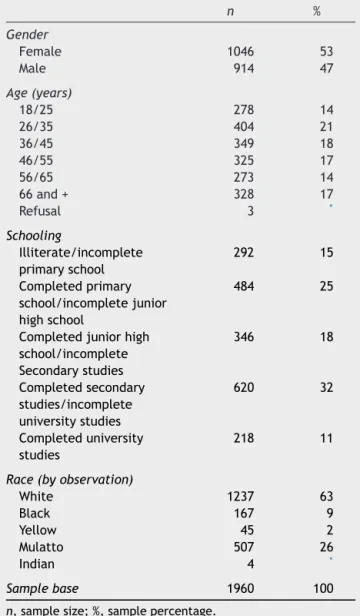
A descriptive analysis of the main predictor variables
evaluated(gender,age,schooling,race)isdiscriminatedin
Table2.
Table1 Samplesize(n)andpercentage(%)ofhouseholds visitedaccordingtocensussectorsinthecityofSãoPaulo.
Regions Total
n %
East 738 38
South 589 30
North 305 16
West 194 10
Center 134 7
Samplebase 1960 100
n,samplesize;%,samplepercentage.
Table 2 Descriptive analysis of the sample profile col-lectedforthecityofSãoPaulo.
n %
Gender
Female 1046 53
Male 914 47
Age(years)
18/25 278 14
26/35 404 21
36/45 349 18
46/55 325 17
56/65 273 14
66and+ 328 17
Refusal 3 *
Schooling
Illiterate/incomplete primaryschool
292 15
Completedprimary school/incompletejunior highschool
484 25
Completedjuniorhigh school/incomplete Secondarystudies
346 18
Completedsecondary studies/incomplete universitystudies
620 32
Completeduniversity studies
218 11
Race(byobservation)
White 1237 63
Black 167 9
Yellow 45 2
Mulatto 507 26
Indian 4 *
Samplebase 1960 100
n,samplesize;%,samplepercentage.
* Percentvalue<0.003%.
Prevalenceofsymptomsinthepopulationofthe cityofSãoPaulo
Presenceoftinnitus
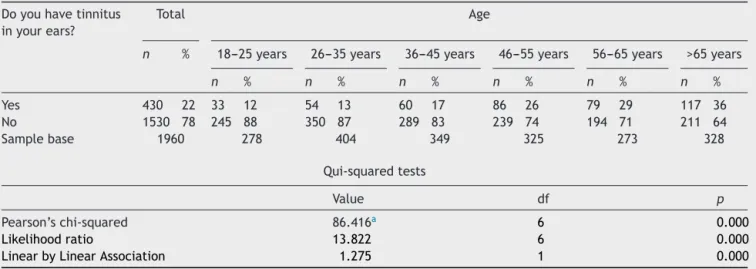
The prevalence of the reported symptom ‘‘tinnitus’’ in
Visual analogue scale - VAS
Figure1 VASforclassificationofannoyancecausedbytinnitus.
respondents), who responded affirmatively to the
ques-tion, ‘‘Do you have ringing in your ears?’’, versus 78%
(1530individuals)whodeniedthiscomplaint.Thesymptom
affectsa higherpercentage of women(26%) comparedto
men(17%),withastatisticallysignificantdifference
(Pear-son’schi-squaredtest,p=0.000).Aprogressivelyincreasing
prevalence with increasing age was also observed.
Appli-cation of Pearson’s chi-squared test revealed statistical
significance (p=0.000) in the evaluation of the presence
of tinnitusby agegroups. From thepoint of viewof age,
the peakof therespondents’ complaintoccursin
individ-ualsover 65yearsofage (36%),andis threetimes higher
than the prevalence (12%) observed among those 18---25
years of age (Table3).There was nodifferencebetween
smokers(23%)andnonsmokers(22%)(Pearson’schi-squared
test,p=0.581). However,havingor nothavingan
occupa-tionawayfromhomeprovedtobeakeydifferentiator;the
prevalence oftinnitusamongindividualswithout an
occu-pationwas29%,comparedwith18%ofthoseworkingaway
fromhome(Pearson’schi-squaredtest,p=0.000).
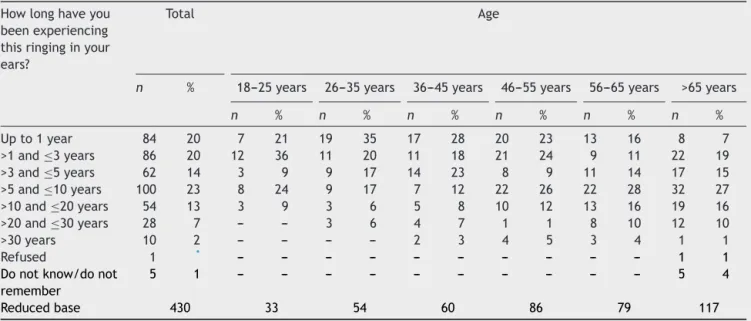
Durationoftinnitus
Therespondentswhoreportedhavingtinnitus(430
individ-uals,reducedbase),wereasked,‘‘Howlonghaveyoubeen
experiencingthisringinginyourears?’’.Weobservedawide
variationinresponses.Somepeoplelivedwiththesymptom
forashorttime(40%,uptothreeyears)andsomepeople
alongertime(27%,3---10years),whiletheremaininglived
withtinnitusforalmostalifetime(22%between10and30
years).Inoursample,nosignificantdifferenceswerefound
relativetothisparameter,asshowninTable4.
Characteristicsoftinnitus
Consideringtherespondentswhoreportedtinnitus(430
indi-viduals),theywereasked,‘‘Isyourringingconstant,i.e.,do
youperceiveitallthetimeeveryday?’’Approximatelyone
thirdofcases(32%)claimedtohaveaconstantringing,while
the vast majority related an intermittent tinnitus (68%).
Amongmen(38%)constanttinnituswasmoreprevalentthan
amongwomen(28%)(Pearson’schi-squaredtest,p=0.044).
With respect to age, the constant tinnitus increased in
prevalence about three times higher with advancing age
(Table5).
Thosewhoreportedthesymptom(430individuals)were
asked,‘‘Doesitbotheryou?’’Thevastmajority(64%)stated
that they felt uncomfortable, while others (36%) denied
anyannoyance.Amongwomen,thepercentagewas
signifi-cantlyhigher(73%)comparedtomen(50%).Withrespectto
theothervariables,nosignificantdifferencesinprevalence
werefoundinthesample.
Degreeoftinnitusannoyance
Aiming to better understand and measure the degree of
tinnitusannoyanceamongrespondentswhomentioned
hav-ing the symptom (430 individuals), the Visual Analogue
Scale(VAS)wasapplied.Theobservedpercentagesformild,
moderate,andseverediscomfortwere11%, 55%and34%,
Table3 Prevalenceofthereportedsymptom‘‘tinnitus’’accordingtothedifferentagegroupsinthepopulationofthecityof SãoPaulo.
Doyouhavetinnitus inyourears?
Total Age
n % 18---25years 26---35years 36---45years 46---55years 56---65years >65years
n % n % n % n % n % n %
Yes 430 22 33 12 54 13 60 17 86 26 79 29 117 36 No 1530 78 245 88 350 87 289 83 239 74 194 71 211 64 Samplebase 1960 278 404 349 325 273 328
Qui-squaredtests
Value df p
Pearson’schi-squared 86.416a 6 0.000
Likelihoodratio 13.822 6 0.000
LinearbyLinearAssociation 1.275 1 0.000
n,samplesize;%,samplepercentage;df,difference;p,statisticalsignificance(two-tailed).
Table4 Timeofdurationofreportedtinnitus,accordingtothedifferentagegroupsinthepopulationofthecityofSãoPaulo. Howlonghaveyou
beenexperiencing thisringinginyour ears?
Total Age
n % 18---25years 26---35years 36---45years 46---55years 56---65years >65years
n % n % n % n % n % n %
Upto1year 84 20 7 21 19 35 17 28 20 23 13 16 8 7 >1and≤3years 86 20 12 36 11 20 11 18 21 24 9 11 22 19 >3and≤5years 62 14 3 9 9 17 14 23 8 9 11 14 17 15 >5and≤10years 100 23 8 24 9 17 7 12 22 26 22 28 32 27 >10and≤20years 54 13 3 9 3 6 5 8 10 12 13 16 19 16 >20and≤30years 28 7 --- --- 3 6 4 7 1 1 8 10 12 10 >30years 10 2 --- --- --- --- 2 3 4 5 3 4 1 1 Refused 1 * --- --- --- --- --- --- --- --- --- --- 1 1
Donotknow/donot remember
5 1 --- --- --- --- --- --- --- --- --- --- 5 4
Reducedbase 430 33 54 60 86 79 117
n,samplesize;%,samplepercentage.
* Percentagevalue<0.003%.
respectively.Theirresponseswere:mean,6.3±2.3points,
andmedian,6points.
Interferenceoftinnitusindailyactivities
Despitethe high prevalence of respondentswho reported
annoyance with tinnitus when asked, ‘‘Does your ringing
interferewithyourdailyactivities?’’,82%answered‘‘no’’,
while18%answered‘‘yes.’’Withrespecttothose18%who
reportedthattinnitusinterfereswiththeirdailyactivities,
nodifferenceswereobservedbetweenthecategorical
varia-blessurveyed.
Discussion
Our field study wasintended to estimate the prevalence
of thesymptom ‘‘tinnitus’’in theadult populationof the
city ofSãoPaulo. This is thefirststudy ofthiskind tobe
heldinBrazil.Thisisanexpensiveproject,sincethe
inter-views were conductedin person in the households of the
interviewees;andtheexecutionofourstudywasonly
pos-sible becauseof the financialsupportof FAPESP.We used
the field research as a tool --- the investigator went to
theinvestigatedperson’shomeanddirectly addressedthe
questionnaire. Considering that tinnitus is subjective and
Table5 Prevalenceofconstant/intermittenttinnitus,accordingtothedifferentagegroupsinthepopulationofthecityof SãoPaulo.
Isthisringing constant,i.e.,do youperceiveit everyday?
Total Age
n % 18---25years 26---35years 36---45years 46---55years 56---65years >65years
n % n % n % n % n % n %
Yes 136 32 5 15 7 13 8 13 34 40 33 42 48 41 No 294 68 28 85 47 87 52 87 52 60 46 58 69 59
Reducedbase* 430 33 54 60 86 79 117
Qui-squaredtests
Value df p
Pearson’schi-squared 35.315a 6 0.000
Likelihoodratio 38.621 6 0.000
LinearbyLinearAssociation 25.957 1 0.000
n,samplesize;%,samplepercentage;*,mentionedtinnitusintheirears;df,difference;p,statisticalsignificance(two-tailed).
a difficult symptom to measure, we insisted onintensive
trainingofallinterviewersontheapplicationofthe
ques-tionnairesothatwecouldcharacterizeasbestaspossible
thesymptommentioned.Therefore,itmustbeconsidered
thatthesubjectivityoftherespondents’judgment,aswell
asthetemporalnatureofthereportedcomplaints,canbe
consideredaspotentialelementsofbias.
An affirmative answer to the question: Heading 3 was
given by 22% (430 individuals) versus 78% (1530
individ-uals) of respondents who denied the complaint. Despite
theclinicalrelevanceofthesymptom, noepidemiological
study determining the prevalence of tinnitus in the
pop-ulation was published in Brazil, and this prevalence was
estimatedbasedontheresultsfrompopulation-based
sur-veysinothercountries.Evenconsideringthesedata,studies
thatestimated theprevalenceof tinnitusin adult
popula-tions(over18yearsold)arelimited,sincetheydifferfrom
eachotherinmanyaspects,makingitdifficulttocompare
our results with those of other authors in the literature.
Ingeneral,theseepidemiologicalstudiesestimatethatthe
prevalenceoftinnitusisaround10---15%oftheadultgeneral
population.3,9,12,17,18
The percentage observed in our study is remarkable,
sincethisvalueiswellabovethatestimatedforthenational
population, andis stillhigh comparedtomostother
pub-lished surveys. Axelsson and Ringdahl observed in 1989 a
prevalenceof 14.2%,withtheoccurrencebeingmore
fre-quentinmenversuswomen).12In2.4%ofcases,tinnituswas
reportedasadisablingcondition.In1996,inan
epidemio-logical study of adult hearing problems in Italy, Quaranta
etal.foundthattheprevalenceofprolongedspontaneous
tinnituswas14.5%.18 Inan epidemiologicalstudy on
hear-inglossintheUnitedStatesassessingindividualsbetween
48and92yearsoldandpublishedin2002, Nondahletal.
notedaprevalenceoftinnitusof8.2%.9In2011,Fujii
con-ducteda Japanese population-basedstudy of adultsaged
45---79 years.3 The prevalence was11.9%, occurring more
frequentlyinmen(13.2%)thanwomen(10.8%);theauthor
also notedthat the frequency of this symptom increased
withage.
Inapopulation-basedfieldstudyconductedinAustralia
bySindhusakeetal.in2003,2015individualsagedbetween
55 and 99 years were included. Similar to our series, to
determine itsprevalence theauthors focused only onthe
presenceoftinnitusbytheirpatients,without focusingon
factors such astime, frequency and/or severity of
symp-toms. The prevalence oftinnitus was30.3%.11 This is one
of thefew publishedstudiesin theliterature indicating a
highprevalenceofthesymptom,andoneofthefewwhose
resultsresemble thoseofoursurvey. Themain difference
isthat,intheiranalysis,Sindhusake etal.consideredonly
elderlyindividuals,whereasinourstudywechosetoinclude
asamplewithanagegroup(18---80years)more
representa-tiveofthepopulation.
Theuseofdifferentcriteriaforthedefinitionoftinnitus
(ringinginthelastyear,persistenttinnitusforatleastthree
months,prolongedtinnitus,tinnitusoftenoralwayspresent,
tinnitusforafewyears,frequentandbothersometinnitusin
recentyears,atleastmoderatetinnitusthatinterfereswith
sleep). Thestudy ofdifferent agegroups (elderly,
adoles-cents), characteristics (workersand non-workers,workers
exposedandunexposedtonoise),andmethodsusedfordata
collection(mailedquestionnaires,a retrospectiveanalysis
ofdatafrompopulation-based studies)amongthevarious
existingstudiesintheliteraturecomplicates the
compari-sonofprevalenceamongpopulations.Thehigherprevalence
inourstudymayhavebeeninfluencedbythefactthatwe
didnotrestrictourquestion toa specifictime,frequency
andseveritypatternsoftinnitusduringtheinterview,when
wesimplyaskedaboutthepresenceofthesymptom.Among
respondents,tinnitusoccurredintermittentlyintwothirds
ofthesamplewhoreportedthesymptom.Thisfindingcanbe
supportedby apopulation-basedfieldresearchconducted
with14,178USadultsbetween1999and2004,withtheaim
todeterminetheprevalenceoftinnitusintheUnitedStates.
ThestudywaspublishedbyShargorodskyetal.in2010,after
ananalysisofthenationaldatabase,andincluded
individ-ualsaged30---80years.8TheprevalenceoftinnitusamongUS
adultswas25.3%forthepresenceoftinnitus,regardlessof
frequencyormeasureofoccurrence,afindingverysimilarto
ours;and7.9%whenconsideringonlythecasesoffrequent
tinnitusin the lastyear. That is, the prevalence changes
drasticallydepending onthecriteriausedtoconsiderthe
occurrenceoftinnitus.
With respect to gender, among those who answered
‘‘yes’’tothequestion:‘‘Doyouhaveringinginyourears?’’
(22%---430individuals),ahigherpercentageofwomen(26%)
versusmen(17%)wasobserved,whencomparedto
respon-dents who answered ‘‘no’’ to the same question (78%
---1530 individuals). Populationstudies are discrepant when
considering the gender among individuals who reported
tinnitus. Some studies show a higher prevalence among
menversuswomen,7,19---21butnotallstudies.9,11,12,22,23 Few
articlesintheliteratureweresimilartooursastothe
sam-plechosen (adult individuals in the population). In 2004,
Fujii et al., while investigating the prevalence of
tinni-tusintheJapanesepopulation,observedhigherprevalence
of thiscomplaint in men(13.2%) than in women (10.8%).
The authorsusedastheir study platform an olddatabase
from31,552 residentsover 35yearsofage inthetownof
Takayama,interviewed in 1992 ondemographicissues. In
2002, after excluding those deceased and those whohad
moved,theauthorssent questionnairesaskingabout
tinn-itus, so that one of three possible answers was marked:
(1)‘‘Ineverhadtinnitus,’’(2)‘‘Ihavetinnitus,’’(3)‘‘I’ve
hadtinnitus.’’Thebiasisthatnewresidentsorthosewho
have completed 35 years old during the gap of 10 years
ofthe studywere notincluded inthe sample.3 Andwhen
thosewhoresponded‘‘I’vehadtinnitus’’wereconsidered,
the prevalence was higher among females (5.1%) than in
males(3.1%).Baigietal.(2011)randomlyselected20,100
inhabitantsfromthenationalregistryoftheentireSwedish
population (6,891,560 inhabitants), limited to the age of
18---84years,amongwhich12,166individualsrespondedto
theproposed questionnaire. The question askedwas ‘‘Do
youhaveringinginyourears?’’Withthreepossibleanswers:
(1)‘‘No,’’(2)‘‘Yes,withamilddiscomfort,’’and(3)‘‘Yes,
withan intensediscomfort.’’ Logisticregression was
per-formed to estimate the probability of tinnitus related to
stress and noise level. According to the authors, women
have 40% less risk to develop tinnitus than men (Odds
Ratio=0.60);thischancewasobservedforallagegroups.2In
2010,intheUnitedStates,afterananalysisofthenational
Shargorod-skyetal.observedsimilarresults.Thepresenceoftinnitus
wasconsideredbasedonan answer‘‘Yes’’tothequestion
‘‘Inthelast12monthsdidyouhavetinnitusinyourears?’’,
followedbythe question‘‘How often?’’.The tinnituswas
consideredasbeingfrequentwhenthissymptom was
usu-allypresent,oroccurringatleastonceaday.Theprevalence
of tinnitus was higher among men (26.1%) versus women
(24.6%). However, as the national database intentionally
containedan overrepresentation of elderly peopleand of
Mexican-Americanandblacksubjects,thissimplycannotbe
consideredasampleoftheUSpopulation.Aftera
multivari-ateadjustmenttoturnthissampletoarepresentativebasis
forgeneralizingtheresultstothepopulation,itwasfound
thattheprevalenceoftinnituswashigherinwomen,when
onlythepresenceofthissymptomwasconsidered,
irrespec-tiveofwhetherornotthisbeafrequentsymptom(OR1.28).
Thus,afterthisadjustment,womenare28%morelikelyto
havetinnitus than men.8 In 2005, Hannafordetal., using
a questionnaire mailed to12,100 households in Scotland,
conductedasurveythatincluded15,788respondentsover
14years.Thepercentageofresponsetothequestionnaires
was64.2%.The prevalenceof tinnitus(lastinglongerthan
5min)was17%.Theauthorsfoundthat,inindividualsunder
45years,theprevalencewashigheramongwomen(13.3%),
reachingavalue almosttwicethatobserved amongmales
(7.1%);andthatagradualreversionofthissituationoccurs
forpeopleover45years.23
Similar to other systematic reports in the literature
describingage asawell-defined riskfactor for the
devel-opment of tinnitus,2,3,8,9 we also observed a progressive
increase in the prevalence of thissymptom with
increas-ingage. The peakof the complaint occursat 65 yearsof
age,andisthreetimeshigherthantheprevalenceobserved
in younger subjects. This can be easily explained by the
noise exposure over a lifetime andthe own auditory
sys-temagingprocess,withconsequentincreaseofcomplaints
relatedtotheinnerear.AccordingBaigietal.(2011),with
each additionalyear ofage, the riskof tinnitus increases
by3%,despitetheriskobservedinourstudyisalarmingly
higherthanthatreportedbytheseauthors.2
Anotherimportantfeatureobservedinourstudyrelated
toemployment.Theprevalence oftinnitusamong
individ-uals without an occupation was almost two times higher
thanthatobservedamongthosewithanoccupation.A
sim-ilar result was observed by Hasson et al. in 2010, when
describing the prevalence of communication disorders in
theSwedishgeneralpopulation(bothemployedand
unem-ployed);andcorrelationswithgender,age,socioeconomic
status(SES)andnoise.6Theauthorsdemonstrateda
signif-icant association between SES and prevalence of hearing
problems, including tinnitus. We can infer that
individ-uals withno occupation should be thosewith lower SES;
and,therefore, those moresusceptible tonoise exposure
(mechanical stress tothe inner ear), because these
peo-pleassumeunhealthyhabitsregardinghearingprotectionin
noisyenvironments,orexposethemselvestoexcessivenoise
forlongperiods.Thesepeoplearealsoclinicallymore
vul-nerable,thanks tothe highlevelofstress associatedwith
theircondition (emotional stress). Recently, it wasshown
thatpoorhealthisdirectlyrelatedtohigherprevalenceof
tinnitus;andthattheemotionalstatecanactasamodulator
oftheauditorysystem.5The processesofemotionalstress
involveboththeactivationofthesympatheticsystemwith
stimulation of ␣-adrenergic receptors in the cochlea,24,25
andtheprimaryneuroendocrine responseaimedat
estab-lishing the hypothalamic---pituitary---adrenal (HPA) axis.26
Current research suggests that acute stress protects the
cochlea,27---29 whilechronicstressisdamagingtohearing.30
TheimportanceofHPAaxisinhearingpreservationis
sup-portedbyclinicalstudiesshowingthatpatientswithtinnitus
showsignsofcommitmentassociatedwithahighdegreeof
perceivedstress,comparedtopatientswithouttinnitus.31---33
Onemustkeepinmindthattheelderlycomprisea
signifi-cantsegmentoftheunemployedpopulation,andtinnitusis
threetimesmorecommoninthisagegroup.
When asked about the characteristics of the symptom
mentioned, ‘‘Is this ringing constant,i.e.,is it perceived
every day?’’; one-third of individuals experienced steady
tinnitus, while the remaining two-thirds had intermittent
tinnitus.Surprisingly,theconstanttinnituswasmore
preva-lentamongmenthaninwomen.Thisfindingwasalsonoted
byShargorodskyetal.in20108whoobservedtheoccurrence
offrequenttinnitus(ringingusuallypresent,oratleastonce
aday)withahigherprevalenceinmenversuswomen(OR
0.92).
Whenasked about theannoyance causedby the
symp-tom, ‘‘Is this ringing bothersome to you?’’, we found
thattwo-thirdsof thepopulationwhomentionedtinnitus,
whetherconstantor not,werebotheredbythesymptom.
Until then, it wasestimated thatthis percentagewas far
lower, because according to Jastreboff, only 25% of
indi-vidualswhohavetinnitusdoseekmedicalattention10 and
assuch, the percentageobserved in our series(64%) was
totallyunexpected.Thispercentagewassignificantlyhigher
inwomencomparedtomen,indicatinggreatersensitivityin
thefemalegender.
To those who answered ‘‘Yes’’ to the above question,
wetookcaretoquantifythatlevelofdiscomfortusingVAS
(‘‘Pointonthecardhowmuchyourtinnitusisbothersome’’)
---arapidandeasilyunderstoodmethodforthelarge-scale
assessment of subjective symptoms.And it wassurprising
torealizethat thevast majority(89%)had amoderateto
severe degree of discomfort.The mean for the responses
obtained usingVASwas6.3.We arenotawareof another
fieldstudyintheliteraturethathasconductedthistypeof
measurementtocharacterizetinnitusinthepopulation,but
thisseemstousaveryhighvalue,basedonexpectationsand
estimatesforthelevelofdiscomfortofthesymptom.
We also asked, ‘‘Does this ringing interfere with your
daily activities?’’; and almost 20% of the population with
anannoyingtinnitusanswered‘‘Yes’’.Wefoundnostudies
intheliteraturethatsupportthesenumbers.In2011,when
consideringthissymptomintheJapanesepopulation,Fujii
etal.foundthat20---30%reportedtinnitusperception
dur-ingwakinghours,andthatapproximately0.4%ofthetotal
populationrefersthattinnitusseverelyaffectstheirability
toleadanormallife.3In2010,Gopinathreportedthatthe
incidenceoftinnitusduringa5-yearobservationperiodin
theAustralianpopulationwas18%.Tinnituswasmentioned
asslightlyuncomfortablein55.5%ofnewcases,as
moder-atelyuncomfortablein6.5%,andasseverelyuncomfortable
in 1.3%;five yearslater,this profile haschangedin those
individualswithpersistenttinnitus:39.6%mentioneda
Notwithstandingtheinabilitytodirectlycomparetheresults
ofGopinathin2010,sincethestudydesignsaredifferent,
thesefiguresarewellbelowthoseobservedinourstudy.
Thisstudyassessedtheprevalenceoftinnitusintheadult
population of the city of São Paulo. This is the first and
largeststudyofitskindever doneinBrazil,and
consider-ingthat mostother reports in theinternational literature
werebasedonmailedquestionnaires,webelievethatour
population-based sample is more reliable and
represen-tative. The high prevalence of tinnitus observed in our
patients,togetherwiththealarmingpredictionsofWHO34,35
withrespecttoanincreaseofhearingproblemsintheshort
term, signalsthe seriousness of the problem.Part of this
exponentialgrowthcanbeexplainedbytheaging
popula-tion,aswellasbytheincreasingnoiseexposureincountries
withmiddle and high income,35 asis the case of thecity
ofSãoPaulo. Inordertorevertthis negativetrendin our
community,itisnecessarythatpreventiveinterventionsare
implementedandadjusted,bothattheindividualand
orga-nizationallevel,makingmorepressingthedevelopmentof
strategiesandcampaignstoprevent,delayorminimizeits
currentandfutureimpactonthecommunity.
Conclusion
TinnitusinthepopulationofthecityofSãoPaulowasmore
prevalentthanpreviouslyestimated.Generally,this
symp-tommorefrequentlyaffectswomenandthoseunemployed,
andincreasessignificantlywithadvancingage.Most
respon-dentsmentionedannoyance withtinnitus,andthisfinding
is more prevalent in females. The degree of discomfort
measured by the Visual Analogue Scale showedmoderate
tinnitus,withanaverageof6.3fortheresponses.
Conflicts
of
interest
Theauthorsdeclarenoconflictsofinterest.
Acknowledgements
Associac¸ão Brasileira de Otorrinolaringologia e Cirurgia
Cérvico-Facial (ABORL-CCF), under Direction of Prof. Dr.
RicardoFerreiraBento---PublicNoticeforScholarship
Sup-porttoEpidemiologicalProjects;andFundac¸ãodeAmparoa
PesquisadoEstadodeSãoPaulo(FAPESP)/RegularResearch
Support/ProcessNo.2011/10343-7.
References
1.SanchezTG,Medeiros IR,LevyCP,RamalhoJdaR,BentoRF. Tinnitusinnormallyhearingpatients:clinicalaspectsand reper-cussions. Braz J Otorhinolaryngol. 2005;71:427---31. PubMed PMID:16446955.
2.BaigiA,OdenA,Almlid-LarsenV,BarrenasML,HolgersKM. Tinn-itusinthegeneralpopulationwithafocusonnoiseandstress: apublichealthstudy.EarHear.2011;32:787---9.PubMedPMID: 21716113.
3.FujiiK, NagataC,NakamuraK,KawachiT,Takatsuka N,Oba S,etal.Prevalenceoftinnitusincommunity-dwellingJapanese adults.JEpidemiol.2011;21:299---304.PubMedPMID:21646745.
4.GopinathB,McMahonCM,RochtchinaE,KarpaMJ,MitchellP. Incidence,persistence,andprogressionoftinnitussymptoms inolder adults:theBlue MountainsHearingStudy. Ear Hear. 2010;31:407---12.PubMedPMID:20124901.
5.Hasson D, Theorell T, Wallen MB, Leineweber C, Canlon B. StressandprevalenceofhearingproblemsintheSwedish work-ingpopulation.BMCPublicHealth.2011;11:130.PubMedPMID: 21345187,PubMedCentralPMCID:3056746.
6.Hasson D, Theorell T, Westerlund H, Canlon B. Prevalence andcharacteristicsofhearingproblemsinaworkingand non-workingSwedishpopulation.JEpidemiol CommunityHealth. 2010;64:453---60.PubMedPMID:19692714.
7.MichikawaT,NishiwakiY,KikuchiY,SaitoH,MizutariK,Okamoto M, et al. Prevalence and factors associated with tinnitus: a community-based study of Japanese elders. J Epidemiol. 2010;20:271---6.PubMedPMID:20501961.
8.Shargorodsky J, Curhan GC, Farwell WR. Prevalence and characteristics of tinnitus among US adults. Am J Med. 2010;123:711---8.PubMedPMID:20670725.
9.Nondahl DM, Cruickshanks KJ, Wiley TL, Klein R, Klein BE, TweedTS.Prevalenceand5-yearincidenceoftinnitusamong olderadults:theepidemiologyofhearinglossstudy.JAmAcad Audiol.2002;13:323---31.PubMedPMID:12141389.
10.JastreboffPJ,GrayWC,GoldSL.Neurophysiologicalapproach totinnituspatients.AmJOtol.1996;17:236---40.PubMedPMID: 8723954.
11.Sindhusake D, Mitchell P, Newall P, Golding M, Rochtchina E, Rubin G. Prevalence and characteristics of tinnitus in olderadults:theBlueMountainsHearingStudy. IntJAudiol. 2003;42:289---94.PubMedPMID:12916702.
12.AxelssonA, Ringdahl A. Tinnitus ---a studyof itsprevalence andcharacteristics.BrJAudiol.1989;23:53---62.PubMedPMID: 2784987.
13.IBGE. Censo Demográfico da Populac¸ão da Cidade de São Paulo; 2010. Available from: http://www.ibge.gov.br/home/ presidencia/noticias/noticiavisualiza.php?idnoticia=2204&id pagina=1
14.Havia M, Kentala E, Pyykko I. Prevalence of Meniere’s dis-easeingeneralpopulationofSouthernFinland.Otolaryngology. 2005;133:762---8.PubMedPMID:16274806.
15.Bittar RSM,Oiticica J, Bottino MA, Gananc¸aFF, Dimitrov R. Populationepidemiologicalstudyontheprevalence of dizzi-nessinthecityofSãoPaulo.BrazJOtorhinolaryngol.2013;79: 688---98.
16.FigueiredoRF,AzevedoAA,OliveiraPM.Análisedacorrelac¸ão entreaescalavisual-análogaeoTinnitusHandicapInventoryna avaliac¸ãodepacientescomzumbido.BrazJOtorhinolaryngol. 2009;75:76---9.
17.Anonymous.Populationstudyofhearingdisordersinadults: pre-liminarycommunication.JRSocMed.1981;74:819---27.PubMed PMID:7299784,PubMedCentralPMCID:1439358.
18.Quaranta A, AssennatoG, SallustioV.Epidemiology of hear-ing problems among adults in Italy. Scand Audiol Suppl. 1996;42:9---13.PubMedPMID:8668911.
19.Leske MC. Prevalence estimates of communicative disorders intheU.S.Language,hearingand vestibulardisorders.Asha. 1981;23:229---37.PubMedPMID:6972221.
20.Cooper JC Jr. Health and Nutrition Examination Survey of 1971---75: PartII.Tinnitus,subjective hearingloss,and well-being. J Am Acad Audiol. 1994;5:37---43. PubMed PMID: 8155893.
21.HoffmanHJ,ReedGW.Epidemiologyoftinnitus.In:SnowJBJr, editor.Tinnitus:theoryandmanagementNewYork:Lewiston; 2004.p.16---41.
23.HannafordPC, Simpson JA,Bisset AF,Davis A, McKerrow W, Mills R.The prevalence ofear, nose and throat problemsin thecommunity:resultsfromanationalcross-sectionalpostal survey in Scotland. Family Pract. 2005;22:227---33. PubMed PMID:15772117.
24.Bielefeld EC, Henderson D. Influence of sympathetic fibers on noise-induced hearing loss in the chinchilla. Hear Res. 2007;223:11---9.PubMedPMID:17092669.
25.HornerKC,GiraudetF,LuccianoM,CazalsY.Sympathectomy improvestheear’sresistancetoacoustictrauma---couldstress rendertheearmoresensitive?EurJNeurosci.2001;13:405---8. PubMedPMID:11168546.
26.CanlonB,MeltserI,JohanssonP,TaheraY.Glucocorticoid recep-torsmodulateauditorysensitivitytoacoustictrauma.HearRes. 2007;226:61---9.PubMedPMID:16843624.
27.Tahera Y, Meltser I, Johansson P, Salman H, Canlon B. Sound conditioning protects hearing by activating the hypothalamic---pituitary---adrenal axis. Neurobiol Dis. 2007;25:189---97.PubMedPMID:17056263.
28.Wang Y, Liberman MC. Restraint stress and protection from acousticinjury inmice. HearRes. 2002;165:96---102.PubMed PMID:12031519.
29.RareyKE,GerhardtKJ,CurtisLM,tenCateWJ.Effectofstress oncochlearglucocorticoidprotein:acousticstress.HearRes. 1995;82:135---8.PubMedPMID:7775279.
30.HornerKC.Theemotionalearinstress.NeurosciBiobehavRev. 2003;27:437---46.PubMedPMID:14505685.
31.HebertS,LupienSJ.Thesoundofstress:bluntedcortisol reac-tivitytopsychosocialstressintinnitussufferers.NeurosciLett. 2007;411:138---42.PubMedPMID:17084027.
32.HebertS,LupienSJ.Salivarycortisollevels,subjectivestress, andtinnitusintensityintinnitussufferersduringnoiseexposure inthelaboratory. IntJHygEnvironHealth. 2009;212:37---44. PubMedPMID:18243788.
33.HebertS,PaiementP,LupienSJ.Aphysiologicalcorrelatefor theintolerancetobothinternalandexternalsounds.HearRes. 2004;190:1---9.PubMedPMID:15051125.
34.MathersC,SmithA,ConchaM,editors.Globalburdenofhearing lossintheyear2000.Geneva:WorldHealthOrganisation;2000.