378 Radiol Bras. 2017 Nov/Dez;50(6):378–382
SPECT/CT with radiolabeled somatostatin analogues
in the evaluation of systemic granulomatous infections
SPECT/CT com análogos radiomarcados de somatostatina na avaliação de infecções granulomatosas sistêmicasPaulo Henrique Silva Monteiro1, Thiago Ferreira de Souza1, Maria Luiza Moretti2, Mariangela Ribeiro Resende2, Jair Mengatti3, Mariana da Cunha Lopes de Lima1, Allan Oliveira Santos1, Celso Darío Ramos1
Monteiro PHS, Souza TF, Moretti ML, Resende MR, Mengatti J, Lima MCL, Santos AO, Ramos CD. SPECT/CT with radiolabeled somatostatin analogues in the evaluation of systemic granulomatous infections. Radiol Bras. 2017 Nov/Dez;50(6):378–382.
Abstract
Resumo
Objective: To evaluate SPECT/CT with radiolabeled somatostatin analogues (RSAs) in systemic granulomatous infections in com-parison with gallium-67 (67Ga) citrate scintigraphy.
Materials and Methods: We studied 28 patients with active systemic granulomatous infections, including tuberculosis, paracoc-cidioidomycosis, pneumocystosis, cryptococcosis, aspergillosis, leishmaniasis, infectious vasculitis, and an unspeciied opportu -nistic infection. Of the 28 patients, 23 had started speciic treatment before the study outset. All patients underwent whole-body SPECT/CT imaging: 7 after injection of 99mTc-EDDA-HYNIC-TOC, and 21 after injection of 111In-DTPA-octreotide. All patients also
underwent 67Ga citrate imaging, except for one patient who died before the 67Ga was available.
Results: In 20 of the 27 patients who underwent imaging with both tracers, 27 sites of active disease were detected by 67Ga citrate
imaging and by SPECT/CT with an RSA. Both tracers had negative results in the other 7 patients. RSA uptake was visually lower than
67Ga uptake in 11 of the 20 patients with positive images and similar to 67Ga uptake in the other 9 patients. The only patient who
did not undergo 67Ga scintigraphy underwent 99mTc-EDDA-HYNIC-TOC SPECT/CT-guided biopsy of a lung cavity with focal RSA uptake,
which turned to be positive for aspergillosis.
Conclusion: SPECT/CT with 99mTc-EDDA-HYNIC-TOC or 111In-DTPA-octreotide seems to be a good alternative to 67Ga citrate imaging
for the evaluation of patients with systemic granulomatous disease.
Keywords: Single photon emission computed tomography; X-ray computed tomography; Octreotide; Gallium-67; Tuberculosis; Para-coccidioidomycosis.
Objetivo: Avaliar o estudo SPECT/CT com análogos de somatostatina radiomarcados (RSA) em infecções granulomatosas sistêmi-cas, em comparação com o estudo com gálio-67 (67Ga).
Materiais e Métodos: Vinte e oito paciente com infecção granulomatosa sistêmica ativa foram estudados, incluindo tuberculose, paracoccidioidomicose, pneumocistose, criptococose, aspergilose, leishmaniose, vasculite infecciosa e uma infecção oportunista inespecíica. Vinte e três tinham iniciado o tratamento previamente ao estudo. Todos izeram imagem de varredura e SPECT/CT, 7 deles pós-injeção de 99mTc-EDDA-HYNIC-TOC e os outros 21 pós-injeção de 111In-DTPA-octreotide. Todos os pacientes também izeram cintilograia com 67Ga, exceto um, que fez biópsia guiada por 99mTc-EDDA-HYNIC-TOC.
Resultados: Vinte e sete sítios de atividade foram detectados com 67Ga em 20 de 27 pacientes, também vistos nos estudos com
RSA. Ambos foram negativos nos outros 7 pacientes. A captação de RSA foi visualmente menor que a de 67Ga em 11 de 20 pa-cientes positivos e similar nos outros 9. Um paciente que não pôde fazer cintilograia com 67Ga, fez biópsia guiada por 99mTc-EDDA-
HYNIC-TOC SPECT/CT em uma cavidade pulmonar com captação desse traçador, que foi positiva para aspergilose.
Conclusão: SPECT/CT com 99mTc-EDDA-HYNIC-TOC ou 111In-DTPA-octreotide parece ser uma boa alternativa para o estudo com 67Ga
na avaliação de pacientes com doença granulomatosa sistêmica.
Unitermos: Tomograia computadorizada por emissão de fóton único; Tomograia computadorizada por raios X; Octreotide; Gálio-67; Tuberculose; Paracoccidioidomicose.
Study conducted in the Department of Radiology, School of Medical Sciences, State University of Campinas (Unicamp), Campinas, SP, Brazil.
1. Division of Nuclear Medicine, Department of Radiology, School of Medical Sci-ences, State University of Campinas (Unicamp), Campinas, SP, Brazil.
2. Division of Infectology, Department of Internal Medicine, School of Medical Sciences, State University of Campinas (Unicamp), Campinas, SP, Brazil.
3. Nuclear Energy and Research Institute (IPEN), São Paulo, SP, Brazil. Mailing address: Dr. Paulo Henrique Silva Monteiro. Avenida Moraes Salles, 1610, Centro. Campinas, SP, Brazil, 13010-002. E-mail: [email protected].
Received April 26, 2016. Accepted after revision November 3, 2016.
INTRODUCTION
Octreotide is a somatostatin analogue with several clinical applications, such as controlling upper gastroin-testinal bleeding and treating carcinoid syndrome(1). When
with metastable technetium-99 (99m Tc-EDDA-HYNIC-TOC) became available and was shown to have several advantages over 111In-DTPA-octreotide, including lower cost, ease of storage in a freeze-dried kit for labeling with 99mTc, better image quality, and a faster image acquisition
protocol(3,4).
When activated, monocytes and lymphocytes show strong membrane expression of somatostatin receptors(5,6).
Therefore, we expected to detect marked expression of those receptors, measurable by radiolabeled somatostatin analogue (RSA) scintigraphy, in granulomas and activated leukocytes that manifested as an immune response to sys-temic infectious diseases, such as tuberculosis, paracoc-cidioidomycosis, histoplasmosis, opportunist infections, pneumocystosis, and aspergillosis(7). Those diseases, as a
group, have a high prevalence in many developing coun-tries and a high number of new cases per year. Owing to the nature of their physiology, these diseases tend to spread throughout the whole body. The treatment is usu-ally slow and often empirical, especiusu-ally because there are only a few reliable methods to evaluate the disease activ-ity before, during, and after treatment(8–10).
Conventional computed tomography (CT) can pro-duce false-negative results for disease activity during and after treatment(11,12). Gallium-67 (67Ga) scintigraphy has long been used in order to detect and evaluate systemic granulomatous infections and is in fact considered as the gold standard for evaluating such infections(13,14). How-ever, it is dificult to use 67Ga in many situations, because it must be ordered days ahead of the moment of the
pro-cedure and, in many countries, only on speciic days of the week. In addition, in speciic situations, it is necessary
to acquire images at 48–72 h after injection, which limits its use in urgent and acute care.
The objectives of this study were to evaluate RSA up-take in patients with systemic granulomatous infections and to compare it with 67Ga citrate uptake, which was used as the reference method.
MATERIALS AND METHODS
This was an observational, prospective study. The
fol-lowing inclusion criteria were applied: having a conirmed
diagnosis, either clinically or according to laboratory test results, of a systemic infectious disease (such as tuber-culosis, paracoccidioidomycosis, histoplasmosis, oppor-tunistic infections, pneumocystosis, and aspergillosis); having been referred to our facility for 67Ga citrate scin-tigraphy; being under regular inpatient or outpatient fol-low-up of infectious diseases; and being 18 years of age or older. Patients who were pregnant or breastfeeding were excluded, as were those who declined to submit to or did not tolerate either of the imaging procedures at any time.
All procedures were performed in accordance with the ethical standards of the institutional and national research committees and with the 1964 Helsinki declaration and
its later amendments or comparable ethical standards. All participating patients gave written informed consent.
We studied 28 consecutive patients (11 females), with a mean age of 43.2 ± 14.9 years (range, 18–76 years), all of whom had active systemic granulomatous infec-tion: tuberculosis (in 13); paracoccidioidomycosis (in 8); pneumocystosis (in 2); cryptococcosis (in 1); angioinva-sive pulmonary aspergillosis (in 1); leishmaniasis (in 1); Bartonella henselae infection-associated vasculitis (in 1);
and an unspeciied opportunistic infection, treated em -pirically as tuberculosis (in 1). Of the 28 patients, 23 had
already started speciic treatment for the diverse infec -tious diseases an average of 19 ± 23 days before their inclusion in the study. The aspergillosis, cryptococcosis, and pneumocystosis patients were immunocompromised. Almost all of the patients had lung disease, except for the patient with B. henselae infection-associated vasculitis, who had diffuse large-vessel disease.
All patients were assessed through clinical interviews and examinations, as well as through imaging studies with 99mTc-EDDA-HYNIC-TOC or 111In-DTPA-octreotide,
de-pending on radiopharmaceutical availability. All patients were also submitted to 67Ga citrate imaging, except for one patient who died before the radiotracer became avail-able. In that patient, the 99mTc-EDDA-HYNIC-TOC
imaging indings were correlated with those of a guided
biopsy. The interval between imaging sessions did not ex-ceed 10 days (range, 4–10 days). For all patients, current diseases, known disease activity foci, disease duration, disease progress, disease severity, and responses to pre-vious therapies were evaluated in the clinical interviews and by reviewing patient charts.
Scintigraphy with 99mTc-EDDA-HYNIC-TOC was performed in a SPECT/CT system (Symbia T2; Siemens, Erlangen, Germany) with a low-energy, high-resolution collimator. The radiotracer dose was 249–370 MBq, cor-rected for patient body weight, with a mean dose of 300 MBq. In all patients, whole-body SPECT/CT scanning (table speed, 6 cm/min) was performed at 4 h after in-jection and was followed by additional SPECT/CT scans
(matrix, 64 × 64 pixels; 360° detector coniguration, with
a rotation of 180° for each detector; 6° per step; 30 s per view; and a 2-slice CT with voltage and current set at 130 kV and 35 mA, respectively) of regions of interest selected by an analysis of the whole-body scan. In some patients, additional planar images (1,000,000 counts per static im-age) were acquired 24 h after radiotracer injection, when it was deemed necessary in order to clarify inconclusive
imaging indings or to resolve discrepancies between the
clinical data and the images.
injection and was followed by additional SPECT/CT scans
(matrix, 64 × 64 pixels; 360° detector coniguration, with
a rotation of 180° for each detector; 6° per step; 35 s per view; and a 2-slice CT with voltage and current set at 130 kV and 35 mA, respectively) of regions of interest selected by an analysis of the whole-body scan.
As previously stated, all but one of the patients un-derwent 67Ga scintigraphy. The 67Ga scintigraphy was performed in the same SPECT/CT system described above, with a high-energy collimator and a radiotracer dose of 185 MBq. In all patients, whole-body SPECT/ CT scanning (table speed, 8 cm/min) was performed 48 h after injection and was followed by additional SPECT/CT
scans (matrix, 64 × 64 pixels; 360° detector conigura -tion, with a rotation of 180° for each detector; 6° per step; 30 s per view; and a 2-slice CT with voltage and current set at 130 kV and 35 mA, respectively) of regions of inter-est, selected by an analysis of the whole-body scan.
RESULTS
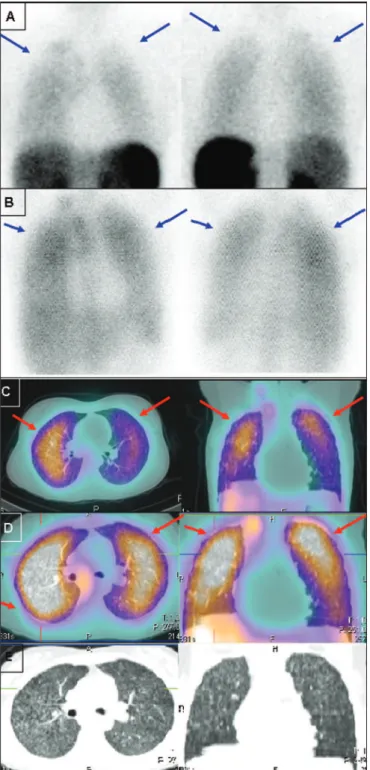
Twenty-seven sites of focal or diffuse active infectious disease were detected by 67Ga in 20 of the 27 patients submitted to 67Ga scintigraphy. All of those sites were also detected in RSA images (Figure 1). The images obtained with both tracers were negative in the other 7 patients. The intensity of 67Ga uptake was visually mild in 5 pa-tients, moderate in 11, and marked in 4. The intensities of 99mTc-EDDA-HYNIC-TOC and 111In-DTPA-octreotide uptake in the lesions were visually mild in 13 patients, moderate in 5, and marked in 2. The intensity of RSA up-take was visually lower than 67Ga uptake in 11 of the 20 patients with positive images (Figure 2), which was best visualized in SPECT/CT. In the 9 remaining patients, the RSA uptake in the sites of active disease was similar to 67Ga uptake. The only patient who did not undergo 67Ga
scintigraphy was submitted to 99mTc-EDDA-HYNIC-TOC SPECT/CT-guided biopsy of a right-lung cavity with mod-erate focal uptake. That patient had multiple lung cavities and was under suspicion of having an undiagnosed oppor-tunistic infection, dying before 67Ga was available for in-jection. The lung biopsy revealed aspergillosis (Figure 3).
DISCUSSION
For over 40 years, 67Ga citrate has been successfully used for the diagnosis and follow-up of diverse granulo-matous diseases. However, its high cost, limited avail-ability, and complicated imaging logistics limit its use at many nuclear medicine centers, especially centers in developing countries, which are precisely those at which the prevalence of infectious granulomatous diseases is highest. Therefore, there is a need for an alternative to 67Ga for the study of these diseases. In a pilot study, our
group determined the potential of using RSA in that con-text(15). The results of the present study demonstrate
con-cordance between RSA and 67Ga uptake sites in systemic
granulomatous infections, suggesting that RSA scintigra-phy could be used as an alternative method to detect dis-ease activity and guide biopsies in the setting of clinically suspected granulomatous disease.
Of particular interest is the case of the patient who did not manage to undergo 67Ga scintigraphy (Figure 3). That 51-year-old female patient presented a stage C3 HIV
infection (AIDS) and several previous episodes of tuber-culosis, which left her with multiple lung cavities. She was brought to our attention while suffering from a new, severe opportunistic infection, which did not respond to various empirical treatments, and her laboratory test re-sults had not revealed the etiology of the infection. She was scheduled to undergo an unguided lung biopsy as a
last-ditch effort to ind the cause of the disease. She was
included as part of our protocol, and her RSA imaging
revealed moderate focal uptake in one speciic cavity, in the
right lung. The SPECT/CT image was then used to guide
the lung biopsy, which identiied the etiology as Aspergillus sp. Although the patient, due to disease progression, did
Figure 3. Anterior (A) and posterior (B) whole-body imaging and transaxial SPECT/CT image (C) with 99mTc-EDDA-HYNIC-TOC of a 51-year-old patient with stage C3 HIV infection (AIDS) and an undiagnosed opportunistic respiratory in-fection. After all serology studies, cultures, and usual examinations were nega-tive for an etiology, it was decided to submit the patient to an unguided lung bi-opsy. On the day before the biopsy, she was brought to our attention, and 67Ga was unavailable in our service, prompting us to suggest 99mTc-EDDA-HYNIC-TOC imaging to guide the biopsy. Whole-body imaging, correlated with SPECT/CT, pointed to a single foci of more signiicant activity (red arrows), among several other inactive or barely active cavities, as seen on the SPECT/CT imaging. The biopsy was then guided to this cavity, and revealed Aspergillus sp., indicating angioinvasive pulmonary aspergillosis as the cause of the infection. However, due to the severity of the disease, the patient died before it was possible to perform 67Ga imaging.
not survive long enough for 67Ga to become available, we believe this case illustrates our intended purpose for this method: to quickly locate and direct the investigation of infectious granulomatous diseases. The method can
de-tect which lesions identiied by CT represent active infec -tion, as opposed to residual scar tissue. That seems to be especially useful in patients with multiple prior treat-ments and suspected active infection, as well as in guid-ing further biopsies to the most active lesions.
We also found limitations to the method investigated in the present study. The intensity of RSA uptake is less marked than is that of 67Ga and might require nuclear medicine practitioners who are more experienced in order to read the images. In addition, in our limited sample, RSA imaging did not reveal any additional lesions when compared with 67Ga, suggesting that the former is not su-perior in terms of sensitivity. On the contrary, RSA sensi-tivity is potentially inferior to that of 67Ga, because the le-sions tended to uptake less RSA than 67Ga. Furthermore, the aforementioned previous treatment might have low-ered the sensitivity of both imaging techniques, as might have the 4–10 day interval between the two procedures. However, because the treatment for granulomatous dis-eases usually takes weeks or months, we do not believe that this was a critical factor. The most severe limitation of our study is the small size of our sample, especially the limited number of patients with each individual dis-ease. Further studies, with larger samples, are needed in order to gather stronger evidence to support the use of RSA scintigraphy for diagnosing these diseases in clinical practice. That is a worthwhile pursuit, given the wider availability, reduced cost, and faster imaging of RSA scin-tigraphy when compared with 67Ga citrate scintigraphy, which is still the current gold standard for the functional imaging of these diseases in many countries.
CONCLUSIONS
SPECT/CT with 99mTc-EDDA-HYNIC-TOC or 111 In-DTPA-octreotide seems to be a good alternative to 67Ga citrate scintigraphy for the evaluation of patients with sys-temic granulomatous infections, especially for detecting which lesions found on CT represent active infection, as opposed to residual scar tissue. That seems to be especially useful in patients with multiple prior treatments and suspected active infection, as well as in guiding biopsies to the most active lesions. However, further studies are needed in order to gather more evidence to support its use in diagnosing such diseases in clinical practice.
Acknowledgment
We would like to acknowledge the Instituto de Pes-quisas Energéticas e Nucleares (IPEN) (Nuclear and En-ergy Research Institute) for providing us with the quan-tity of 111In-DTPA-octreotide required for our research.
REFERENCES
1. Dogliotti L, Tampellini M, Stivanello M, et al. The clinical manage-ment of neuroendocrine tumors with long-acting repeatable (LAR) octreotide: comparison with standard subcutaneous octreotide therapy. Ann Oncol. 2001;12 Suppl 2:S105–9.
2. Krenning EP, Kwekkeboom DJ, Bakker WH, et al. Somatostatin receptor scintigraphy with [111In-DTPA-D-Phe1]- and [123I-Tyr3]-octreotide: the Rotterdam experience with more than 1000 patients. Eur J Nucl Med. 1993;20:716–31.
3. Hubalewska-Dydejczyk A, Fröss-Baron K, Mikolajczak R, et al.
99mTc-EDDA/HYNIC-octreotate scintigraphy, an eficient method
for the detection and staging of carcinoid tumours: results of 3 years’ experience. Eur J Nucl Med Mol Imaging. 2006;33:1123–33. 4. Gabriel M, Decristoforo C, Donnemiller E, et al. An intrapatient
comparison of 99mTc-EDDA/HYNIC-TOC with 111In-DTPA-oc-treotide for diagnosis of somatostatin receptor-expressing tumors. J Nucl Med. 2003;44:708–16.
5. Marko J, Lamba R, Miller F, et al. OctreoScan positive Crohn’s disease mimicking an ileal carcinoid tumor. J Clin Gastroenterol. 2008;42:66–8.
6. Ferone D, Boschetti M, Resmini E, et al. Neuroendocrine-immune interactions: the role of cortistatin/somatostatin system. Ann N Y Acad Sci. 2006;1069:129–44.
7. Kwekkeboom DJ, Krenning EP, Kho GS, et al. Somatostatin recep-tor imaging in patients with sarcoidosis. Eur J Nucl Med. 1998; 25:1284–92.
8. Santín M, Podzamczer D, Ricart I, et al. Utility of the gallium-67 citrate scan for the early diagnosis of tuberculosis in patients
in-fected with the human immunodeiciency virus. Clin Infect Dis.
1995;20:652–6.
9. Ray S, Talukdar A, Kundu S, et al. Diagnosis and management of miliary tuberculosis: current state and future perspectives. Ther Clin Risk Manag. 2013;9:9–26.
10. Yamaga LY, Benard G, Hironaka FH, et al. The role of gallium-67
scan in deining the extent of disease in an endemic deep mycosis,
paracoccidioidomycosis: a predominantly multifocal disease. Eur J Nucl Med Mol Imaging. 2003;30:888–94.
11. Nardini S, Schiavon F, Zuin R, et al. Has the role of radiology
changed in the ight against pulmonary tuberculosis? Radiol Med.
1995;89:49–56.
12. Moon WK, Han MH, Chang KH, et al. CT and MR imaging of head and neck tuberculosis. Radiographics. 1997;17:391–402.
13. Palestro CJ, Goldsmith SJ. The role of gallium and labeled leukocyte scintigraphy in the AIDS patient. Q J Nucl Med. 1995;39:221–30.
14. Love C, Palestro CJ. Radionuclide imaging of inlammation and in -fection in the acute care setting. Semin Nucl Med. 2013;43:102–13. 15. Monteiro PHS, Souza TF, Stucchi RB, et al. SPECT/CT with
99mTc-EDDA-HYNIC-TOC and 111In-DTPA-octreotide for