Hospital Morbidity among
Guarani Indians in Southeastern
and Southern Brazil*
CARDOSO, Andrey Moreira
COIMBRA Jr., Carlos E. A.
TAVARES, Felipe Guimarães.
Escola Nacional de Saúde Pública, Fundação Oswaldo Cruz
* Research funded under Call for Projects MCT-CNPq/MS-SCTIE-DECIT, Grant 26/2006 (Case 409677/2006-0), MCT/CNPq 02/2006-Universal and FAPERJ-E-26 (Case 170.504/2007).
Abstract
Studies on hospital morbidity among Brazilian indigenous peoples are relatively recent, show limited coverage, and lack data sources capable of generating speciic indicators according to ethnic group. The current study describes hospital morbidity in the indigenous population living in 83 Guarani villages in Southern and Southe-astern Brazil (N=6,483), based on primary data obtained from a hospital admissions surveillance systemimplemented in 2007-2008, speciically for a case-control study on acute respiratory infections (ARI) in Guarani children. During the study period there were 666 hospitalizations in a total of 497 individuals, the majority under 5 years of age (71.9%). Respiratory illnesses were the main causes of hospitalization (64.6%), especially in children (<5 years: 77.6%; <1 year: 83.4%) and exceeded the proportions of hospital admissions from these causes in other indigenous groups. The overall hospi-talization rate (per 100 person-years) was 8.8, or 71.4 under 1 year and 21.0 from 1 to 4 years of age. The ARI hospitalization rate (5.3) was 6.5 and 2.0 times higher than for diarrhea and other causes, respectively, whi-le in children under 5 years of age (ARI=23.7) these differences were 7.4 and 5.4 times, respectively. The standardized Guarani hos-pitalization rate exceeded the standardized rates for the South and Southeast of Brazil by 40% and 210%, respectively. Hospitalization for primary care sensitive conditions and the high ARI rates indicate the need for studies to understand the epidemiology of ARI and investments to upgrade primary health care for the Guarani.
Key words: Hospitalization. Morbidity.
INTRODUCTION
Studies on hospital morbidity represent important tools for understanding the epi-demiological proile of population groups, since they contribute to the evaluation of the severity of diseases, surveillance and control of diseases, analysis of access to and utilization of health services, and health planning1-3. More recently, analysis of the
avoidable causes of hospitalization have backed the discussion on access and quality in primary health care3.
Studies on hospital morbidity in indige-nous peoples in Brazil are relatively recent and have limited coverage4-6. However, the
few available studies have shown morbidity and mortality patterns among indigenous peoples that are consistent with those observed among the country’s most vulne-rable social segments, generally with low schooling, inadequate housing and sani-tation, and dificulties in access to health services 4-9.
The analysis of hospital morbidity among indigenous peoples in Brazil en-tails additional dificulties besides those already documented1,2,10-12. It is not
pos-sible to retrieve information on ethnicity from the Hospital Information System of the Uniied National Health System (SIH/ SUS). Meanwhile, the Information System on Health Care for Indigenous Peoples (SIASI), managed by the National Health Foundation (FUNASA) under the Ministry of Health, presents limitations as to coverage and data quality13. It thus becomes obvious
that studies on hospital morbidity in indi-genous peoples lack adequate sources for description, and that adapted data collec-tion strategies are necessary to determine the proile of indigenous hospitalizations in each speciic case4-6.
This article describes hospital morbi-dity in the Guarani population living in 83 villages, based on primary data obtained from an indigenous hospital admissions surveillance system implemented specii-cally for a case-control study on etiologi-cal factors in acute respiratory infections
(ARI) in Guarani children hospitalized in Southern and Southeastern Brazil. Based on these indicators, the leading causes of hospitalization were identiied, as well as the segments of the Guarani population most vulnerable to hospitalization.
STUDY POPULATION AND
METHODS
A primary descriptive hospital morbi-dity study was conducted in the Guarani indigenous population served by FUNASA and living in 83 villages and camps in Sou-thern and Southeastern Brazil, distributed by State as follows: Rio Grande do Sul (32), Santa Catarina (16), Paraná (4), São Paulo (27), and Rio de Janeiro (5). This distribution represents the series of Guarani villages lo-cated on the coastal area extending from Rio de Janeiro to Rio Grande do Sul14, plus the 9
Guarani villages in the interior of Rio Grande do Sul State. In general, Guarani families are large and live in a situation of vulnerability marked by precarious environmental, so-cioeconomic, and housing conditions. A hospital admissions surveillance system among the Guarani people was implemen-ted, coordinated by one of the researchers and led by a team of nurses from FUNASA appropriately trained during two workshops held in Rio de Janeiro, with a pilot ield test in between. A routine surveillance system was established, aimed at monthly reporting of hospitalizations for all causes and ages. Systematic visits were made to the nurses in charge of reporting, the villages, and the hospitals serving the Guarani, in order to check the data and review patient charts. This process produced a primary databank of hospitalizations for the Guarani popula-tion in the study area.
the FUNASA health teams. The causes were classiied by one of the authors (Cardoso) according to the ICD-1015. When there was
more than one diagnosis, classiication of the principal cause was deined in light of the primary reason for hospitalization and ICD-10 guidelines. Patient transfers be-tween associated hospital units for a single disease episode were computed as a single hospitalization, as were re-hospitalizations of the same individual for the same event.
The population denominator needed to calculate the overall and sex, age, and cause-speciic rates was based on the total Guarani population living in the study area in mid-period, according to information provided by the local FUNASA health teams. Hospi-talizations were considered numerators for the rates and denominators for the global and age, sex, and cause-speciic proportions (ICD Chapters and Special Tabulation List for Morbidity - ICD 10). The rates were also calculated, considering as the numerator the individuals that underwent at least one hospitalization during the period. Given the seasonality of some illnesses, rates were calculated initially by eliminating the hospitalizations that occurred in the irst two or last two months (which were repe-ated during the 14-month study period). We inally elected to calculate the rates for the entire 14-month period, subsequently transformed into annual rates, since this was the approach that considered all the hospitalizations and that produced rates equivalent to the lowest rates, obtained by excluding the repeated months, in which the highest incidence of hospitalization was observed16.
The Guarani hospital morbidity indi-cators were produced by comparison of the proportions of hospitalizations and by rate ratios between the age, sex, and cause brackets. The indicators were also compa-red to those for the regions of Brazil (after rates standardization by the direct method, using the 2006 Brazilian population as the reference) and those produced in other studies focusing on indigenous and non-indigenous Brazilian populations.
ETHICAL APPROVAL
The research project was approved by the District Indigenous Health Council for the Southern Coast, the Institutional Review Board of the National School of Public Health (ENSP/FIOCRUZ, Review no. 130/05), and the National Research Ethics Commission (CONEP, Review no. 154/2006). The indigenous leaders of the villages were contacted in order to explain the research project to them and obtain properly signed Free and Informed Consent Forms. The project was also authorized by the National Foundation for Indian Affairs (Authorization no. 23/CGEP/07).
RESULTS
increased progressively in the subsequent hospitalizations (data not shown).
Ill-deined causes (Chapter XVIII) ac-counted for 4.2% of all hospitalizations, with a predominance of females (M: 1.9% and F: 6.3%; p=0.004) and individuals over 10 years of age (≤ 10 years: 1.7% and >10 years: 13.3%; p=0.000), and 1.3% of hospitalizations un-der 5 years of age. After excluding Chapter XVIII, the hospitalizations were ordered by decreasing frequency according to age bracket and causes (Table 2). Overall and under 5 years of age, there was a progressive reduction in the number of hospitalizations with increasing age. Diseases of the respira-tory tract were the most important causes of hospitalization, accounting for 64.6% of all hospitalizations and 77.6% under 5 years of age.
Hospitalizations were more frequent in females (M: 9.4%, F: 11.2%; p=0.02). The proportion of hospitalizations due to respiratory diseases was inversely related to age, appearing as the leading cause of hospitalization up to 9 years of age and over 50 years in both sexes. Endocrine, nutritional, and metabolic causes (Chapter IV ) were important under 1 year of age. External causes (Chapter XIX) appeared between 1 and 4 years and increased with
age, becoming the leading cause of hospita-lization in males starting at 10 years. Among females, causes related to pregnancy, chil-dbirth, and the puerperium (Chapter XV) assumed greater importance starting at 15 years. Among males over 20 years of age, mental and behavioral disorders (Chapter V) became more frequent and were the third leading cause in the over-50-year group. The latter age bracket also included diseases of the circulatory system (Chapter IX), while diseases of the digestive system were an important cause among women (Chapter XI) (data not shown).
In the analysis according to the Special Tabulation List for Morbidity15 for
chil-dren under 5 years (Table 2), pneumonia accounted for 56.7% of hospitalizations, followed by unspeciied acute lower respi-ratory infections (15.2%) and gastroenteritis (10.4%). Pneumonia accounted for at least half of the hospitalizations in all the age groups under 5 years. Among the respiratory causes of hospitalization under 5 years of age, pneumonias reached proportions of 70% or more; when unspeciied acute lower respiratory infections were added, the total reached 90% in practically all the age groups (data not shown).
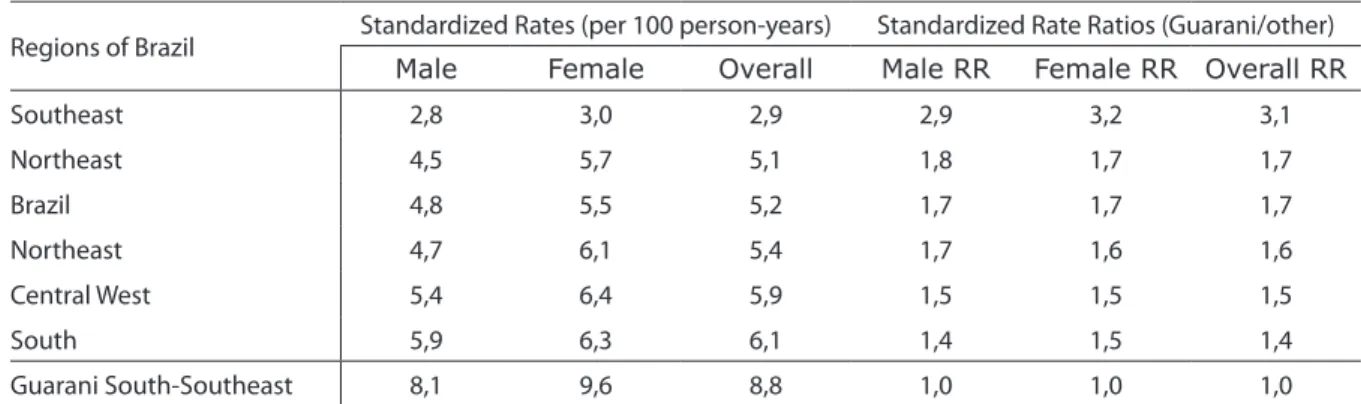
The Guarani show a higher standardized
Table 1 - Absolute number and proportions of hospitalizations by age groups, according to order of hospitalizations, Guarani Indians, Southeastern and Southern Brazil, 2007-2008.
AGE BRACKET
HOSPITALIZATIONS IN ORDER
TOTAL
1st 2nd 3rd 4th 5th 6th 7th 8th
n (%) n (%) n (%) n (%) n (%) n (%) n (%) n (%) n (%) % cum. < 1 year 151 (30,4) 41 (42,7) 20 (50,0) 9 (47,4) 3 (37,5) − − − 224 (33,6) 33,6 1 year 81 (16,3) 28 (29,2) 13 (32,5) 6 (31,6) 4 (50,0) 4 (100,0) 1 (100,0) 1 (100,0) 138 (20,7) 54,3
2 years 44 (8,9) 6 (6,3) 4 (10,0) 3 (15,8) 1 (12,5) − − − 58 (8,7) 63,0
3 years 35 (7,0) 4 (4,2) 1 (2,5) − − − − − 40 (6,0) 69,0
4 years 18 (3,6) 1 (1,0) − − − − − − 19 (2,9) 71,9
5-9 years 40 (8,0) 3 (3,1) − − − − − − 43 (6,5) 78,4
10-14 years 20 (4,0) 1 (1,0) − − − − − − 21 (3,2) 81,6
15-19 years 15 (3,0) 3 (3,1) − − − − − − 18 (2,7) 84,3
20-49 years 54 (10,9) 4 (4,2) 2 (5,0) 1 (5,3) − − − − 61 (9,2) 93,5
50 + years 39 (7,8) 5 (5,2) − − − − − − 44 (6,6) 100,0
hospitalization rates than all the regions of Brazil (Table 3). The overall annual hospi-talization rate was 8.8/100 persons (Table 4). The age-specific rates were 71.4/100 years under 1 year and 21.0/100 child-years from 1 to 4 child-years of age, dropping off drastically beginning at that age until rea-ching 50 years, when they increase again. The sex-speciic hospitalization rates were signiicantly higher among females for all hospitalizations (rate ratio: 1.2; 95%CI: 1.01-1.40) and for the 1 to 4-year group (rate ratio: 1.3; 95%CI: 1.02-1.73) and 15 to 19-year
group (rate ratio: 4.4; 96%CI: 1.46-13.55). The speciic hospitalization rates for ARI exceeded those due to diarrhea and other causes (Table 4). The rate ratios for speci-ic causes were higher in children under 5 years of age. The ARI rates were higher in girls from 1 to 4 years of age (rate ratio: 1.5; 95%CI: 1.08-2.03) and slightly higher in boys under 1 year (rate ratio: 1.1; 95%CI: 0.82-1.52), although without statistical sig-niicance. As for rates due to other causes, there was a signiicantly higher rate among females in the 15 to 19-year group (rate ratio:
Table 2 - Principal causes of hospitalization (ICD 10) according to age groups, Guarani Indians, Southeastern and Southern Brazil, 2007-2008.
CLASSIFIC
A
TION
CRITERIA
AGE GROUPS
CAUSES OF HOSPITALIZATION Proportion of
hospitalizations by
age bracket
1st cause 2nd cause 3rd cause Other
causes
Chap./
Category n %
Chap./
Category n %
Chap./
Category n % n % n % % cum.
ICD10 CHAPTERS
Overall X-Respiratory 412 64,6 I-Infectious 72 11,3 XIX-External 36 6,0 118 18,5 638 100,0 -< 5 years X-Respiratory 367 77,6 I-Infectious 52 11,0 XII-Skin 21 4,4 33 7,0 473 74,1 74,1
< 1 year X-Respiratory 186 83,0 I-Infectious 18 8,0
IV-Endocrine/
nutritional 4 1,8 15 6,7 223 47,1 47,1
12-23 month X-Respiratory 99 72,3 I-Infectious 22 16,1 XII-Skin 5 3,6 11 8,0 137 29,0 76,1
24-35 months X-Respiratory 43 76,8 I-Infectious 9 16,1
IV-Endocrine/
nutritional 2 3,6 2 3,6 56 11,8 87,9
36-47 months X-Respiratory 29 74,4 XII-Skin 6 15,4 I-Infectious 1 2,6 3 7,7 39 8,3 96,2
48-59 months X-Respiratory 10 55,6 XII-Skin 4 22,2 I-Infectious 2 11,1 2 11,1 18 3,8 100,0
1-4 years X-Respiratory 181 71,8 I-Infectious 34 13,5 XII-Skin 17 6,7 20 7,9 252 53,3
-5-9 years X-Respiratory 17 44,7 I-Infectious 6 15,8 XII-Skin 5 13,2 10 26,3 38 6,0 80,5
10-14 years XIX-External 7 36,8 I-Infectious 3 15,8 XI-Digestive 2 10,5 7 36,8 19 3,0 83,4
15-19 years X-Respiratory 3 25,0
XV-Childirth/
Postpartum 3 25,0 XIX-External 3 25,0 3 25,0 12 1,9 85,3
20-49 years XIX-External 13 24,1 X-Respiratory 7 13,0 I-Infectious 6 11,1 28 51,9 54 8,5 93,8
50 + years X-Respiratory 17 42,5 I-Infectious 4 10,0 IX-Circulatory 4 10,0 15 37,5 40 6,3 100,0
SPECIAL
TABULA
TION LIST OF
MORBIDIT
Y, ICD10
< 5 years PNM 268 56,7 UALRI 72 15,2 GE 49 10,4 84 17,8 473 100,0
-< 1 year PNM 131 58,7 UALRI 44 19,7 GE 17 7,6 31 13,9 223 47,1 47,1
12-23 months PNM 76 55,5 GE 21 15,3 UALRI 16 11,7 24 17,5 137 29,0 76,1
24-35 months PNM 32 57,1 GE 8 14,3 UALRI 7 12,5 9 16,1 56 11,8 87,9
36-47 months PNM 20 51,3 BR 5 12,8 I. SKIN 5 12,8 9 23,1 39 8,3 96,2
48-59 months PNM 9 50,0 I. SKIN 4 22,2 GE 2 11,1 3 16,7 18 3,8 100,0
5.7; 95%CI: 1.54-20.91) and 20 to 49-year group (rate ratio: 1.9; 95%CI: 1.03-3.64).
Considering individuals hospitalized at least once as the numerator, the annual hospitalization rate under 5 years of age drops to 21.5/100 child-years, with 48.1/100 child-years as the rate under 1 year (Table 4). The age-speciic rates are still higher under 5 years of age, but the differences between the sexes in all-cause hospitalization rates only persists in the 15 to 19-year age bracket (rate ratio: 5.7; 95%CI: 1.54-20.91).
Secondary diagnoses were recorded in 22.4% of the hospitalizations. Respira-tory causes (bronchospasm, bronchitis, bronchiolitis, and asthma) were the most frequent, while their proportions decreased with age, from 48.3% under 1 year to 6.7% starting at 5 years. Other important secon-dary diagnoses included iron deficiency anemia (Chapter III: 13.8%) under 1 year; malnutrition and dehydration (Chapter IV: 23.6%) and diarrhea and septicemia (Chap-ter I: 16.7%) from 1 to 4 years; as well as nonspeciic signs and symptoms (Chapter XVIII: 22.2%) and external causes (Chapter XX: 37.8%) in adults (data not shown).
DISCUSSION AND CONCLUSIONS
Given the relative lack of adequate data sources on indigenous peoples’ health in Brazil, various methodologies have been employed and great effort is necessary
to provide knowledge on this population segment’s hospital morbidity proile. Some recent studies4-6 have used manual searches
of hospitalizations in indigenous individu-als in the respective referral hospitindividu-als, by identifying the ethnic group (which in many Brazilian indigenous groups is combined with the individual’s irst name)4. Some of
these studies4,5 also used Hospital
Admis-sion Authorization Forms (AIH).
Among the Guarani, a manual search for hospital admissions through hospital records is basically unfeasible for various reasons: lack of various referral lows, inclu-ding clearly established referral procedures to higher levels of complexity in the National Health System (SUS) outside the villages; and the broad territorial distribution of the villages included in the study, resulting in a huge number of possible hospital units to be visited in the ive States of the South and Southeast. In addition, unlike some other indigenous groups in Brazil, the Guarani do not use their ethnic name added to their irst name, which greatly hinders any manual search for names in hospital records.
In addition to the well-known limita-tions of the Hospital Information System of the Uniied National Health System (SIH/ SUS) for describing hospital morbidity in the general population, utilization of the da-tabase also suffers from serious limitations for analyzing hospital morbidity in speciic ethnic groups, since its race/color
classii-Table 3 - Comparison of standardized hospitalization rates between Guarani Indians from Southeastern and Southern Brazil and the general Brazilian population, according to regions, 2007-2008.
Regions of Brazil Standardized Rates (per 100 person-years) Standardized Rate Ratios (Guarani/other)
Male Female Overall Male RR Female RR Overall RR
Southeast 2,8 3,0 2,9 2,9 3,2 3,1
Northeast 4,5 5,7 5,1 1,8 1,7 1,7
Brazil 4,8 5,5 5,2 1,7 1,7 1,7
Northeast 4,7 6,1 5,4 1,7 1,6 1,6
Central West 5,4 6,4 5,9 1,5 1,5 1,5
South 5,9 6,3 6,1 1,4 1,5 1,4
Guarani South-Southeast 8,1 9,6 8,8 1,0 1,0 1,0
cation lacks details on ethnic afiliation and is thus insuficient for distinguishing indivi-duals that belong to a speciic ethnic group4.
Notwithstanding the advantages and limitations of methodologies to describe hospital morbidity, the method used in this study has the advantage of allowing the potential retrieval of all hospital admissions
occurring in the study population, clearly identifying the population denominator for producing the hospitalization rates, not duplicating admissions, and minimizing distortions of diagnoses related to inancing procedures in the National Health System.
Hospital morbidity is considered an im-portant tool for health services evaluation
Table 4 - All-cause and speciic cause-related annual hospitalization rates and rate ratios according to sex and age groups, Guarani Indians, Southeastern and Southern Brazil, 2007-2008.
SEX AND AGE
BRACKET
POPULATION
HOSPITALIZATIONS HOSPITALIZED
PERSONS
OVERALL RATE
(100person-years)
SPECIFIC RATES
(100person-years) RATE RATIOS (95%CI)
OVERALL RATE
(100person-years)
N (%)
n Rate ARI Diarrhea Other Causes
ARI/
Diarrhea 95%CI
ARI/
Other
causes
95%CI n Rate
MALE
< 5 years 711 (21,0) 242 29,2 21,8 3,1 4,2 7,0 (4,85-10,20) 5,2 (3,52-7,66) 170 20,5
< 1 year 139 (4,1) 120 74,0 61,7 5,5 6,8 11,2 (5,44-23,14) 9,1 (4,69-17,55) 84 51,8
1-4 years 572 (16,9) 122 18,3 12,1 2,5 3,6 4,8 (2,76-8,49) 3,4 (2,06-5,47) 86 12,9
5-9 years 614 (18,2) 17 2,4 1,1 − 1,3 − − 0,8 (0,32-2,26) 15 2,1
10-14 years 449 (13,3) 8 1,5 − − 1,5 − − − − 7 1,3
15-19 years 403 (11,9) 4 0,9 0,2 − 0,6 − − 0,3 (0,04-2,74) 3 0,6
20-49 years 939 (27,8) 23 2,1 0,3 0,4 1,5 0,8 (0,18-3,11) 0,2 (0,06-0,67) 21 1,9
50 + years 262 (7,8) 24 7,9 1,3 0,7 5,9 1,9 (0,37-9,33) 0,2 (0,07-0,67) 21 6,9
TOTAL 3378 (100,0) 318 8,1 5,0 0,8 2,3 6,3 (4,18-9,36) 2,2 (1,66-2,84) 237 6,0
FEMALE
< 5 years 600 (19,3) 237 33,9 26,0 3,3 4,6 7,9 (4,96-12,52) 5,7 (3,78-8,45) 159 22,7
< 1 years 130 (4,2) 104 68,6 55,4 5,3 7,9 10,4 (4,87-22,42) 7,0 (3,69-13,33) 67 44,2
1-4 years 470 (15,1) 133 24,3 17,9 2,7 3,6 6,6 (3,70-11,86) 5,0 (2,97-8,33) 92 16,8
5-9 years 575 (18,5) 26 3,9 1,3 0,6 1,9 2,2 (0,65-7,21) 0,7 (0,28-1,68) 25 3,7
10-14 years 430 (13,8) 13 2,6 0,2 − 2,4 − − 0,1 (0,01-0,55) 13 2,6
15-19 years 303 (9,8) 14 4,0 0,6 − 3,4 − − 0,2 (0,04-0,75) 12 3,4
20-49 years 946 (30,5) 38 3,4 0,4 0,2 2,9 2,0 (0,41-9,68) 0,1 (0,05-0,39) 33 3,0
50 + years 251 (8,1) 20 6,8 2,7 0,3 3,8 9,0 (1,19-67,82) 0,7 (0,28-1,83) 18 6,1
TOTAL 3105 (100,0) 348 9,6 5,7 0,8 3,1 7,1 (4,70-10,81) 1,8 (1,44-2,36) 260 7,2
OVERALL
< 5 years 1311 (20,2) 479 31,3 23,7 3,2 4,4 7,4 (5,31-10,33) 5,4 (4,07-7,13) 329 21,5
< 1 year 269 (4,1) 224 71,4 58,6 5,4 7,3 10,8 (6,38-18,46) 8,0 (5,04-12,78) 151 48,1
1-4 years 1042 (16,1) 255 21,0 14,7 2,6 3,6 5,7 (3,77-8,48) 4,1 (2,86-5,82) 178 14,6
5-9 years 1189 (18,3) 43 3,1 1,2 0,3 1,6 4,0 (1,33-12,06) 0,7 (0,38-1,47) 40 2,9
10-14 years 879 (13,6) 21 2,0 0,1 − 2,0 − − 0,1 (0,01-0,32) 20 2,0
15-19 years 706 (10,9) 18 2,2 0,4 − 1,8 − − 0,2 (0,07-0,75) 15 1,8
20-49 years 1885 (29,1) 61 2,8 0,3 0,3 2,2 1,0 (0,33-3,03) 0,1 (0,06-0,32) 54 2,5
50 + years 513 (7,9) 44 7,4 2,0 0,5 4,8 4,0 (1,11-14,38) 0,4 (0,20-0,85) 39 6,5
and health planning and programming1,2,
even though it only partially represents a population’s morbidity pattern. In Brazil, the hospitalization pattern has changed rapidly, with a reduction in infectious, parasitic, and ill-deined causes and an increase in chro-nic non-commuchro-nicable causes and those related to accidents and violence17,18. These
changes result from social, environmental, demographic, epidemiological, inancial, and technological factors and those related to the health services structure17, and are
expressed unequally between the various regions of Brazil, between different social groups18, and nationally and internationally.
Diseases of the respiratory system were the principal causes of hospitalization among the Guarani, especially in children under 5 years, with more than 77% of ad-missions. Respiratory diseases exceed the second and third leading causes of hospita-lization by 6 and 11 times, and more than 7 and 17 times, respectively, among the overall Guarani population and Guarani children under 5 years of age.
A recent study among the Xavante in the State of Mato Grosso4 identiied the
follo-wing proportions of hospitalization due to respiratory diseases: 47.7% (overall), 55.1% (<5 years), and 57.5% (<1 years). Among indigenous people in the State of Rondonia, the overall proportion was lower (26.8%), but it was also concentrated in children under 5 years (43.4%)6. Also in Rondonia,
among the Suruí, 57.0% of hospitalizations in children under 5 years were due to dise-ases of the respiratory system5.
Interestingly, nutritional causes (Chap-ter IV) appear less frequently as the primary cause of hospitalization in Guarani children under 5 years, contrary to the situation among the Xavante4. Given the occurrence
of malnutrition among the secondary cau-ses of hospitalization in the Guarani, one can conjecture that even if malnutrition is underreported, it is not a direct cause of hospitalization among the Guarani. Rather, it is part of the secondary diagnoses, given the association between malnutrition and the principal causes of hospitalization in
the Guarani (ARI and diarrhea).
The analysis according to the ICD-10 Special Tabulation List of Morbidity highli-ghts the importance of pneumonia among the causes of hospitalization in Guarani children under 5 years of age. The sum of the proportions of pneumonia (56.7%), uns-peciied acute lower respiratory infections (15.2%), and bronchitis and bronchiolitis (4.4%), corresponding to all acute respira-tory infections, totals 76.3% of the causes of hospitalization in Guarani children under 5 years. Among Sururí children under 10 years of age, pneumonias accounted for 63.8% of the respiratory causes of hospitalization5.
The analysis of hospitalization propor-tions in Brazil according to ICD-10 Chapters (excluding Chapter XV) identiies diseases of the respiratory system as the principal causes of hospitalization in 2005 (17.8%), having shown a downward trend from 1995 to 200510. Although the relevance of
respira-tory diseases is similar among indigenous and non-indigenous populations, their magnitude among the Guarani is 3.6 times that of the overall Brazilian population.
If one applies to the under-5 Guarani population the estimates obtained for me-dian incidence of community pneumonia (0.29 case/child-year) and the proportion of hospitalizations due to this cause (7-13% of community pneumonias) obtained from a systematic review of studies in developing countries16, one would expect 381 new
cases of pneumonia per year, resulting in 27 to 50 hospitalizations of Guarani under 5 years. The worst-case scenario would be to apply the highest incidence (2.45 cases/ child-years) among the 28 studies in the review (Indonesia, 1995), which would lead to an expected 225 to 418 hospitalizations, similar to the number observed among the Guarani (268).
where higher ARI rates have been reported19,
and published in the late 1980s and early 90s, the current Guarani hospitalization pattern is comparable to that in children under 5 years of age in developing countries at least 15 years ago.
The standardized overall annual hospi-talization rate among the Guarani (8.8/100 persons) was 70% higher than the corres-ponding rate for Brazil (5.2/100 persons), and was 1.4 and 3.1 times higher than the standardized rates in the South (6.1/100 persons) and Southeast of Brazil (2.9/100 persons), respectively20, and at least 50%
higher than the other regions of the country for both sexes.
The overall annual Guarani hospitali-zation rate was similar to that among the Xavante4 (9.5/100 persons), although the
latter includes causes related to pregnancy, childbirth, and the puerperium, which if excluded would leave a lower rate for the Xavante (8.3/100 persons) than for the Guarani. The Guarani hospitalization rate for infants (< 1 years) was 3.4 and 23.0 ti-mes higher than for children 1 to 4 and 5 to 9 years of age, respectively, in the same ethnic group, and was higher than the cor-responding rates for the overall Brazilian population20 up to 9 years of age. From 10
years upward, the situation is reversed, whereby adults in the overall Brazilian po-pulation show a higher hospitalization rate than indigenous adults, while indigenous children are hospitalized more frequently than non-indigenous (although children are more heavily affected among both indige-nous and non-indigeindige-nous people).
The specific hospitalization rates for ARI were 3 to 11 times higher than those for diarrhea and other causes in children under 5 years, while in the overall Brazilian population the hospitalization rates due to other causes were higher than for ARI in all age brackets, including infants (<1 year)20.
Females showed higher hospitalization rates than males, both overall and in the 1-4-year and 15-19-year age brackets. Hospitaliza-tion rates due to ARI among the Guarani were much higher than for the Suruí5, in
whom hospitalizations due to respiratory diseases varied from 10.6 to 11.9/100 child-years. They were also higher than among non-indigenous children under 5 years (11.5%) in the municipality of Rio Grande, State of Rio Grande do Sul21.
Utilization of the number of hospitali-zations in a given period as the numerator for a rate results in an estimate of the mean number of hospitalizations per person, allowing one to calculate the number of hospitalizations that are expected to occur in the population in that time period. Me-anwhile, using the number of persons with at least one hospitalization during the pe-riod results in an estimate of the probability that a person will experience at least one hospitalization during the period1. Thus,
in addition to calculating the rates using the number of events (hospitalizations) as the numerator, we also used the number of persons with one or more hospitalizations as the numerator, which could estimate the individual risk of a Guarani undergoing at least one hospitalization per year. Using this method, the hospitalization rate in children under 5 dropped to 21.5/100 child-years, and the rate in children under 1 year to 48.1/100 child-years.
From 1 to 4 years of age, we observed a higher risk of hospitalization among girls for all causes and for ARI. Three birth co-horts in Southern Brazil2,22 showed a higher
risk of hospitalization among boys under 1 year, which was attributed to the lower median breastfeeding time in male infants. Differences between the sexes in exposure to environmental risk factors23 could explain
differential risks for hospitalization due to ARI in the 1 to 4-year group.
The risk of hospitalization among Guarani infants (< 1 year of age) was 2.5 times that described in three cohorts in Southern Brazil (1982: 19.6%; 1993: 18.1%; 2004: 19.2%)2,22. The risk of a Guarani infant
with a history of low birth weight (<2,000g in 1982: 40.9%). However, it was lower than the risk of hospitalization reported for the < 2,000g birth weight bracket in the cohorts from 1993 (71.6%) and 2004 (73.2%), which was attributed to the increasing prematurity among the newborns in these more recent cohorts.
The principal secondary causes rein-force the relevance of respiratory diseases among the Guarani. The frequency of re-hospitalizations due to pneumonia in children under 2 years, combined with the frequent occurrence of secondary diagno-ses of wheezing suggest limitations in the validity of speciic diagnoses of pneumonia, and that bronchial hyperreactivity is impli-cated in the pathogenesis of these repeat hospitalizations24.
The hospital morbidity proile among the Guarani is characterized by conditions that are sensitive to primary care, inclu-ding bacterial pneumonia, gastroenteritis, dehydration, iron deiciency anemia, skin and subcutaneous infections, bronchitis, and asthma3,11. These conditions can be
deined as diseases involving potentially avoidable hospitalization, given the existing health technologies and access to qualiied primary care3,25,26. No differences would be
expected between different social groups in the probability of hospitalization from these causes, as long as all the groups had univer-sal access to high-quality primary health care25. Thus, this set of diseases has been
used for monitoring and evaluating access to quality primary health care, especially in vulnerable groups.
Acute respiratory infections are among the leading causes of morbidity and mor-tality in developing countries, accounting for 30 to 50% of outpatient consultations and more than 50% of hospitalizations. There is a similarity in the incidence of ARI between wealthy and poor countries (4-7 cases/child-year), with a higher frequency in children under 5 years and in urban areas. More vulnerable social groups show a worse prognosis, given the severity of events and the preponderance of bacterial
pneumo-nia, which accounts for 19 to 21% of the 10 million deaths per year in children under 5 years of age worldwide, and 11 to 18% in Brazil19,27,28.
Recent data suggest that indigenous peoples are among the most marginalized population groups in Latin America9,29,
with higher morbidity and mortality rates than among the non-indigenous. Among the main points related to inequalities are access to and utilization of health servi-ces30,31, which in the case of the Guarani is
aggravated by social and environmental adversities that routinely characterize indi-genous peoples9,32. With the implementation
of the Subsystem for Indigenous Health Care in Brazil, it was expected that the principal barriers to access by indigenous peoples to the Uniied National Health System (SUS) would have been overcome, since there was a massive investment in structuring local health services on Indigenous Lands natio-nwide, with extensive expansion of primary care coverage. However, the increased heal-th care coverage appears not to have been accompanied by the elimination of techni-cal and health care limitations, caused by deicient support and technical supervision, or by substantial improvements in living conditions among indigenous peoples.
For example, according to a study in a county in the Ribeira Valley in the State of São Paulo to monitor child health indicators in response to work by Community Health Agents33 (considered essential for providing
universal primary care in rural areas), there was a reduction in hospitalizations after training for diagnosis and early treatment of ARI and diarrhea, encouragement for basic immunization, monitoring of child growth, and orientation for introducing specific foods in the diet. Flaws in the work by the Community Health Agents (in the present case, Indigenous Health Agents in the Indi-genous Health Subsystem) were attributed to inappropriate training, support, and supervision and multiple duties, resulting in low effectiveness in their work.
developing countries, like crowding, subs-tandard housing, and household pollution, malnutrition, and short breastfeeding, most of which are commonplace among the Guarani, various aspects have been highlighted that inluence the course and outcome of ARI: perception of the disease by families; patterns of care and habits during the illness; the decision to seek care outside the home; which kind of care is provided, and how; and compliance with treatment guidelines19. The latter two are particularly
related to the indiscriminate use of anti-biotics, resulting in additional risk of unfa-vorable evolution given the development of bacterial resistance to antimicrobials in the Americas.
The high hospitalization proportions and rates due to respiratory diseases among the Guarani emphasize the importance of overcoming access barriers to hospital care and suggest that such high igures could result from the increased probability of hospitalization among indigenous peoples in Brazil, considered more vulnerable to health problems, as occurs in populations with worse socioeconomic conditions26.
This fact is known as the hospitalization bias or Berkson paradox and results in potential distortion in hospital morbidity analyses21,34.
Based on the comparisons performed in this study, the situation of the Guarani allows raising two general hypotheses. First, that ARI incidence among the Guarani is higher than in other population groups. In this case, etiological factors are purportedly acting in a particular way in this group and leading to higher illness and hospitalization rates than reported in other indigenous and non-indigenous groups. Second, that ARI incidence in the Guarani is similar to that in other population groups. In this case, what differs is the severity or frequency of hospitalization. Local health services are not eficient in handling and treating cases locally. Additionally, the Guarani may be particularly subject to an hospitalization bias, resulting in higher than expected hos-pitalization rates and proportions.
Considering that primary care sensitive
conditions (PCSC) relect both the epide-miological proile and access and utilization of primary health care services11,26, the two
hypotheses appear to be acting in combi-nation. Thus, studies on the etiology and prognosis of ARI, frequency of diseases in the community, validity of outpatient and hospital diagnoses, technical and scientiic quality of the care provided, and access to and utilization of outpatient and hospital services would be useful for better unders-tanding the epidemiology of ARI among the Guarani and orienting intervention strategies.
In the short term, health surveillance and prevention of ARI and wheezing, with a focus on mother and child care, could contribute to better clinical evolution and a reduction in hospitalizations. Care could be strengthened by adequate composition of health teams, with improved work stabi-lity and training to conduct effective home visits, early and timely case identiication, adequate clinical management, and mo-nitoring of ARI treatment in the villages. These and other actions have been organi-zed in a set of strategies called Integrated Management of Childhood Illnesses (IMCI), widely recommended by the Pan-American Health Organization as the key alternative for controlling ARI and improving the health of children under 5 years19.
In addition, closer dialogue between local health teams and other referral units in the Uniied National Health System, as well as the use of protocols for the management of ARI, could lead to better application of indigenous health resources and a possible reduction in the unnecessary exposure of individuals to the hospital environment33,35.
he-alth inequalities.
These issues highlight the pressing need for better knowledge of ARI epidemiology among the Guarani and improved quality of training and care among local health teams and professionals working in the referral system outside the villages, including an-thropological aspects, in order to act com-prehensively and eficiently to control acute respiratory infections among indigenous groups in the South and Southeast of Brazil.
Acknowledgements
The authors wish to thank the Regional Ofices of FUNASA in the States of Southern and Southeastern Brazil, in particular the teams from the Indigenous Health Advisory Divisions; the Multidisciplinary Indigenous Health Teams, in particular the nurses and other nursing staff members; and above all the Guarani people, who supported and believed in this work as a potential contri-bution to their children’s health.
References
1. Kerr-Pontes LR, Rouquayrol, MZ. Medida da Saúde Coletiva. In: Rouquayrol MZ, Almeida Filho N (orgs.). Epidemiologia & Saúde. Rio de Janeiro: MEDSI; 2003. p.37-82.
2. César JA, Barros FC, Ramos FA, Albernaz EP, Oliveira LM, Halpern R, Breitenbach A, Stone MH & Fracalossi V. Hospitalizações em menores de um ano pertencentes a duas coortes de base populacional no Sul do Brasil: tendências e diferenciais. Cad Saúde Pública 1996; 12(S1): 67-71.
3. Alfradique ME, Bonolo PF, Dourado I, Lima-Costa MF, Macinko J, Mendonça CS et al. Internações por condições sensíveis à atenção primária: a construção da lista brasileira como ferramenta para medir o desempenho do sistema de saúde (Projeto ICSAP – Brasil). Cad Saúde Pública 2009; 25(6): 1337-49.
4. Lunardi R, Santos RV, Coimbra Jr. CEA. Morbidade hospitalar de indígenas Xavante, Mato Grosso, Brasil (2000-2002). Rev Bras Epidemiol 2007; 10: 441-52.
5. Orellana JDY, Basta PC, Santos RV & Coimbra Jr. CEA. Morbidade hospitalar em crianças indígenas Suruí menores de dez anos, Rondônia, Brasil: 2000 a 2004. Rev Bras Saúde Matern Infant 2007; 7: 281-7.
6. Escobar AL, Rodrigues AF, Alves CLM, Orellana JDY, Santos RV, Coimbra Jr. CEA. Causas de Internação Hospitalar Indígena em Rondônia. O Distrito Sanitário Especial Indígena Porto Velho (1998-2001). In: Coimbra Jr. CEA, Santos RV, Escobar AL (orgs.). Epidemiologia e Saúde dos Povos Indígenas no Brasil. Rio de Janeiro: Editora Fiocruz/ABRASCO; 2003. p. 127-47.
7. Cardoso AM, Santos RV, Coimbra Jr. CEA. Mortalidade infantil segundo raça/cor no Brasil: o que dizem os sistemas nacionais de informação?. Cad Saúde Pública 2005; 21: 1602-8.
8. Santos RV & Coimbra Jr. CEA. Cenários e Tendências da Saúde e da Epidemiologia dos Povos Indígenas no Brasil. In: Coimbra Jr. CEA, Santos RV, Escobar AL (orgs.). Epidemiologia e Saúde dos Povos Indígenas no Brasil. Rio de Janeiro: Editora Fiocruz/ABRASCO; 2003. p.13-47.
9. Garnelo L, Macedo G, Brandão LC. Os Povos Indígenas e a Construção das Políticas de Saúde no Brasil. Brasília: Organização Pan-Americana de Saúde; 2003.
10. Rede Interagencial de Informação para a Saúde – RIPSA. RIPSA. Indicadores Básicos para a saúde no Brasil: conceitos e aplicações. Organização Pan-Americana da Saúde; 2008.
11. Perpetuo IHO & Wong LR. Atenção hospitalar por condições sensíveis à atenção ambulatorial (CSAA) e as mudanças no seu padrão etário: uma análise exploratória dos dados de Minas Gerais. Anais do XII Seminário sobre Economia Mineira. 2006. Disponível em http://www.cedeplar.ufmg.br/seminarios/ seminario_diamantina/2006/ D06A043.pdf. [Acessado em 15 de agosto de 2009].
12. Victora CG. What`s a denominator?. Lancet 1993; 342: 97-9.
13. Sousa MC, Scatena, JHG & Santos, RV. O Sistema de Informação da Atenção à Saúde Indígena (SIASI): criação, estrutura e funcionamento. Cad Saúde Pública 2007; 23: 853-61.
14. Ladeira MI, Matta P (orgs.). Terras Guarani no Litoral: as matas que foram reveladas aos nossos antigos avós. São Paulo: Centro de Trabalho Indigenista, 2004. p. 113.
15. OMS. Classiicação Estatística Internacional de Doenças e Problemas Relacionados à Saúde – 10ª Revisão. São Paulo: Centro Colaborador da OMS para Classiicação de Doenças em Português, Faculdade de Saúde Pública, Universidade de São Paulo: São Paulo; 1995.
16. Rudan I. Tomaskovic L, Boschi-Pinto C, Campbell H. WHO Child Health Epidemiology Reference Group. Global estimate of the incidence of clinical pneumonia among children under ive years of age. Bull World Health Organ 2004; 82: 895-903.
18. Carmo EH, Barreto ML & Silva Jr. JB. Mudanças nos padrões de morbimortalidade da população brasileira: os desaios para um novo século. Epidemiol Serviços Saúde 2003; 12: 63-75.
19. Benguigui Y. Controle das infecções respiratórias agudas no contexto da estratégia AIDPI nas Américas. Rev Bras Saúde Matern Infant 2003; 3: 25-36
20. DATASUS. Informações em saúde, Assistência à Saúde, Internações hospitalares, Morbidade, Morbidade Hospitalar geral por local de residência – de 1995 a 2007. Disponível em: http://datasus.gov.br [Acessado em 12 de maio de 2009.]
21. Cesar JA, Horta BL, Gomes G, Shehadeh I, Chitolina J, Rangel L, Saraiva AO, Oliveira AK. Utilização de serviços de saúde por menores de cinco anos no extremo Sul do Brasil. Cad Saúde Pública 2002; 18: 299-305.
22. Matijasevich A, Cesar JA, Santos IS, Barros AJD, Dode MASO, Barros FC, Victora CG. Hospitalization during infancy in three population-based studies in Southern Brazil: trends and differentials. Cad Saúde Pública 2008; 24(S3): 437-43.
23. Victora, CG. Fatores de Risco nas IRA Baixas. In: Benguigui Y, Antuñano FJL, Schmunis G, Yunes J (orgs.). Infecções Respiratórias em Crianças. Washington DC: OPAS, 1998. p. 43-61.
24. Lasmar LMLBF, Calazans GC, Fontes MJF, Camargos PAM. Programa Criança que Chia – Belo Horizonte – MG – Experiência Mineira com um Programa Municipal de Atendimento à Criança Asmática. In: Cerci Neto A (org.). Asma em Saúde Publica. São Paulo: Manole; 2006. p. 93-101.
25. Casanova C & Starield B. Hospitalizations of children and access to primary care: a cross-national comparison. Int J Health Ser 1995; 25: 283-94.
26. Elias E, Magajevski F. A Atenção Primária à Saúde no sul de Santa Catarina: uma análise das internações por condições sensíveis à atenção ambulatorial, no período de 1999 a 2004. Rev Bras Epidemiol 2008; 11: 633-47.
27. Graham NMH. The Epidemiology of Acute Respiratory Infections. In: Nelson KE, Williams CM, Graham NMH (eds.). Infections Disease: Epidemiology and Practice. Gaithersburg: Aspen; 2001.
28. Chatkin JM, Machado, ARL. Infecção Respiratória Aguda na Criança. In: Duncan BB, Schmidth MI, Giugliani ERJ (orgs.). Medicina Ambulatorial: Condutas de Atenção Primária Baseadas em Evidências. 3ª ed. Porto Alegre: Artmed; 2004. p. 1335-41.
29. Montenegro RA, Stephens C. Indigenous health in Latin America and the Caribbean. Lancet 2006; 367: 1859-69.
30. Castro MSM, Travassos C, Carvalho MS. Fatores associados às internações hospitalares no Brasil. Ciência Saúde Coletiva 2002; 7(4): 795-811.
31. Travassos C, Martins M. Uma revisão sobre conceitos de acesso e utilização de serviços de saúde. Cad Saúde Pública 2004; 20(S2): 190-8.
32. Comissão Nacional sobre Determinantes Sociais da Saúde. As Causas Sociais das Iniquidades em Saúde no Brasil. Rio de Janeiro: Editora Fiocruz; 2008.
33. Cesar JA, Cavaleti MA, Holthausen RS, Lima LGS. Mudanças em indicadores de saúde infantil em um município com agentes comunitários: o caso de Itapirapuã Paulista, Vale do Ribeira, São Paulo, Brasil. Cad Saúde Pública 2002; 18: 1647-54.
34. Werneck GL, Almeida LM. Validade em Estudos Epidemiológicos. In: Medronho RA, Carvalho DM, Bloch KV, Luiz RR, Werneck GL (orgs.). Epidemiologia. Rio de Janeiro: Atheneu; 2003. p. 199-212.