A meta-analysis of cardiopulmonary exercise testing in
pre-pubertal healthy children produces new information
Aline Cristina Tavares I,II, Edimar Alcides BocchiI, Iram Soares Teixeira NetoI, Guilherme Veiga GuimarãesI
DOI: 10.5935/MedicalExpress.2016.01.02
I Universidade de São Paulo, Faculdade de Medicina, Hospital das Clınicas, Instituto do Coração (InCor), São Paulo, Brazil II Hospital Sírio-Libanês, São Paulo, Brazil
The objective of the paper was to analyze cardiopulmonary data and functional capacity in healthy children who have undergone ergospirometry. A systematic meta-analysis review of ergospirometry in children was performed based on reports indexed in PubMed, Bireme, and Embase. End points were age, sex, body mass index, maturation evaluation, the type of ergometer used for ergospirometry, and cardiopulmonary related values (peak heart rate and peak oxygen consumption [VO2]). Twenty articles were selected, which included 3,808 children, averaging 9.1years of age. A treadmill was used in 55% of the trials, and a cycle ergometer in the other 45% studies included in this analysis. The following statistically signiicant results were found: on subgroup analysis, peak VO2 values in boys on the treadmill was 20% higher than peak VO2 values in girls on the cycle ergometer; peak VO2 values in boys on the treadmill were 18% greater than that for girls on the same ergometer. BMI was inversely correlated with peak VO2 in the total analysis, and in female subjects on cycle ergometers. Peak heart rate during the ergospirometrical test was 5.6 BPM higher than the estimated 95% maximum heart rate. Most of the ergospirometrical parameters had not been reported in the original trials analyzed here. We conclude that peak VO2 value for pre-pubertal children are circa 18% higher in boys vs. girls and overall higher in treadmill vs. cycle ergometers.
KEYWORDS: Cardiopulmonary function, Cardiopulmonary exercise testing, Peak oxygen consumption.
Tavares AC, Bocchi EA, Teixeira-Neto IS, Guimarães GV. A meta-analysis of cardiopulmonary exercise testing in pre-pubertal healthy children produces new information. MedicalExpress (São Paulo, online). 2016;3(1):M160102
Received for Publication on October 11, 2015; First review on November 06, 2015; Accepted for publication on December 11, 2015; Online on January 04, 2016
E-mail: [email protected]
■
INTRODUCTIONCardiopulmonary exercise testing (CPX) is frequently used to appraise healthy, athletic children,1
but it is also performed to analyze several physiologic
variables that influence respiratory, cardiac, and
metabolic responses to progressive exercise and, therefore functional capacity.2-4
Peak oxygen consumption (peak VO2), a CPX measurement, is one of the indicators of a person’s cardiorespiratory condition. Peak VO2 deficits are associated with increased chances of developing other risk factors for cardiovascular disease in adulthood5,6 and
also helps screening ill pediatric patients,7-9 responses to
treatment10-14 and prognostic factors.15
Although pre-pubertal children are different from teens and adults, results from pediatric CPX have been
published together with those of teens and adults. These combined values do not accurately reflect specific values for children.16-17
This lack of specific data for children emphasizes the need for separating data according to age groups for pattern analysis.18Knowing the CPX patterns of
healthy children may be helpful for the development of clinical guidelines and better screening of ill pediatric populations in the future. Therefore, the aim of this study was to analyze cardiopulmonary data and functional capacity in healthy children who have undergone CPX.
■
METHODSLiterature search strategy
MedicalExpress (Sao Paulo, online) 2016 February;3(1):M160102
Cardiopulmonary exercise testing in healthy children Tavares AC
Statistical analyzes were performed with SPSS 12.0 for Windows (SPSS Inc., Chicago, IL, USA). The Kolmogorov-Smirnov test was used to check the normality of the population data. Parametric tests were used on the data with normal distribution.
The two-way ANOVA test was performed to determine the difference between sex-related values and between peak VO2 values measured on the cycle ergometer versus the treadmill. Pearson correlations were used to assess the relationship between two isolated variables. A p < 0.05 was considered statistically significant.
An approach for modeling the relationship between age and VO2 values was performed by a simple linear regression.
■
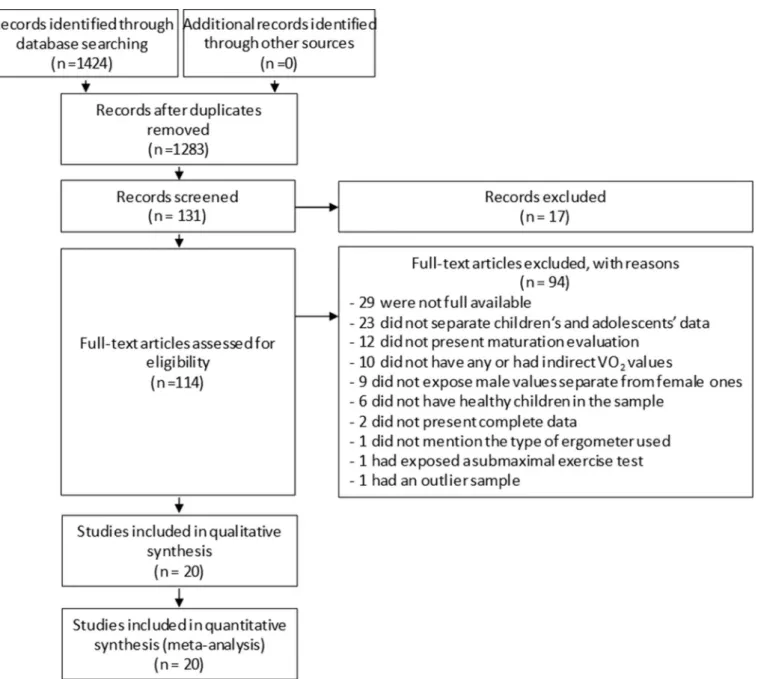
RESULTS AND DISCUSSIONFigure 1 illustrates the selection procedure. After a preliminary search, 1,283 articles were retrieved, and 131 were considered potentially relevant based on the title and abstract contents; only 114 were eligible for full text evaluation. Out of these, 94 trials were excluded for several reasons specified in the figure, leaving 20 reports which contained complete information relevant for this review; these were accordingly chosen for final analysis.
Included studies were published from 1985 to 2011, comprising a total of 3,808 children.
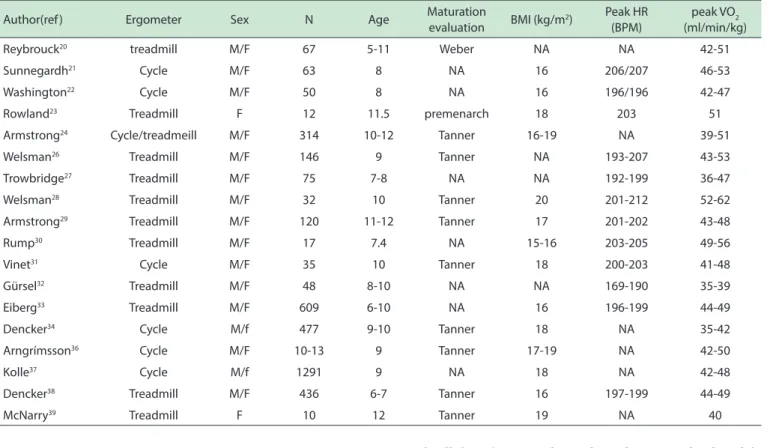
General study descriptions are shown in Table 1 indicating ergometer used, patients’ details, age and maturation evaluation (type of evaluation if there was any), BMI, peakHR and VO2 values.20-39
Among all included trials, 12 studies (60%) used the Tanner-Whitehouse evaluation scale to analyze children’s maturation.20 One study chose the Weber method,21 whereas one identified the sample as pre-menarchal and therefore this analysis considered the population as pre-pubertal.23 The remaining 7 trials provided no evaluation
of maturation, as shown in 1.
Overall, children were 9.1 ± 1.8 years old. Those children who were evaluated as pre-pubertal in their original trials were 9.6 ± 1.9 years old. Seven articles provided no pre-pubertal evaluation of the included children; these were significantly younger (8.4 ± 1.9) than children in the other studies. No correlation was found between age and VO2 values (Figure 2).
Most of the studies (12 trials, 60%) used a treadmill to perform the cardiopulmonary test. Seven studies (35%) used a cycle ergometer to perform the CPX. Only one trial compared cardiopulmonary values between both types of ergometers.24
All trials mentioned the criteria used to evaluate the maximal testing level. Sixteen trials21-25,38-39 chose
more than one of the following methods for maximal CPX consideration: (i): exhaustion in 17 trials (85%); (ii) very The search was performed using the following
keyword combinations: (1) child and VO2, and (2) child and VO2 peak. The results were limited to human studies published in English, Spanish, or Portuguese.
The selection was based first on the titles, second on the abstracts. Articles deemed relevant were retained for further analysis, which included a selection based on an analysis of the full text of the articles. The authors performed a double-check review of the list of possible trials.
Trials with cardiopulmonary test data in animals, child athletes, adolescents, or adults, and review articles were excluded. Trials that did not provide the number of patients included in the sample and the standard deviation value for the mean peak VO2 found during the CPX were also excluded from final data collection. Papers with estimated peak VO2
values by either formula or estimation, without complete data and without ergometer specification, were excluded as well.
Collected data
The following data were collected for final analysis from each study: a) number of children included; b) subjects’ sex; c) subjects’ age; d) subjects’ height and weight; e) subjects’ body mass index (BMI); if no BMI was provided, it was calculated as weight divided by height squared; f) whenever maturation was appraised, the respective scale was used in the evaluation as well; g) the ergometer used for cardiopulmonary testing (cycle ergometer or treadmill); and h) evaluation and cardiopulmonary related values (blood pressure, peak heart rate [HR], mean peak VO2, and peak VO2 standard deviation).
Peak VO2 values were converted into mL/min/kg for comparisons. Thus, the confidence interval of the peak VO2 values was calculated with μ ± Z*S/√n, where μ is the reported mean value of the peak VO2 in each trial; Z is the value related to the distribution reported in each trial; S is the reported standard deviation value of the peak VO2 in each trial; and n is the number of subjects included in the sample.
Collected data included in the tables are expressed according to the type of ergometer used for the cardiopul-monary testing, cycle ergometer (C) or treadmill (T) and according to sex.
Manuscripts are cited sequentially and chrono-logically based on year of publication to better clarify data presentation and their analysis.
Statistical analysis
Data are expressed as collected from the original trials, as absolute numbers, with the exception of peak VO2 values, for which confidence intervalswere calculated.
Figure 1 - Search Strategy. Results of search and selection of articles for inal analysis.
high respiratory exchange ratios equal to 1(11 trials), or to 0.99 (3 trials) in 14 studies (70%); (iii) estimated HR peak in 14 trials (70%); (iv) VO2 plateau when VO2 rise was less than 2 mL/kg/min despite continued increase in workload in three trials (15%).
In those reports in which CPX was executed on the cycle ergometer, the children were instructed to maintain a constant pedaling rate around 70/minute.
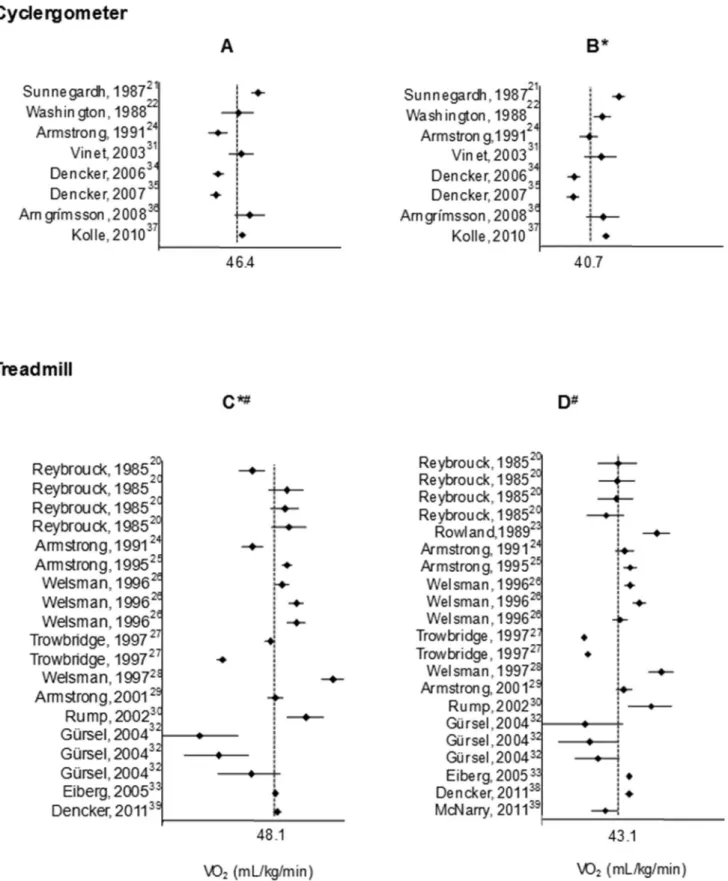
Confidence intervals and means of peak VO2 values are
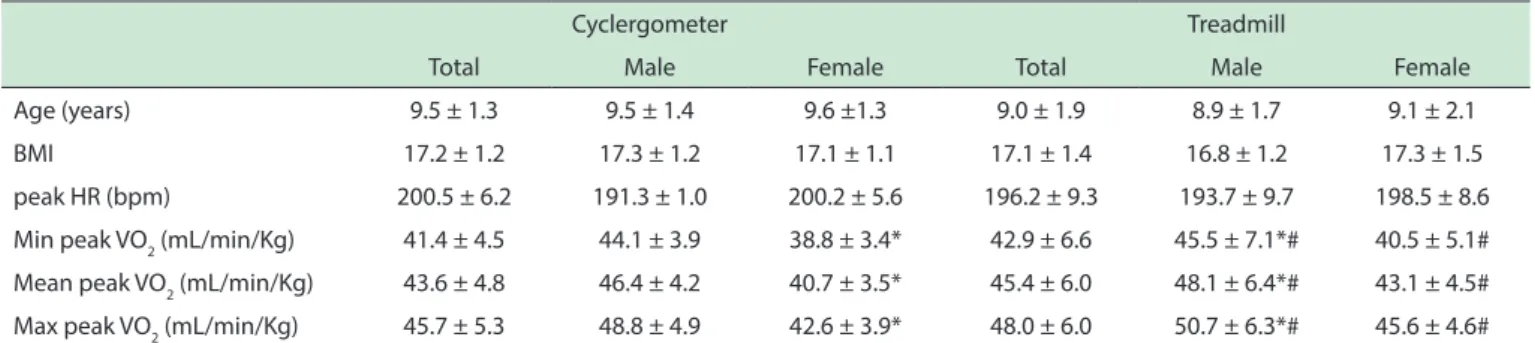
presented in Figure 3. Details from collected data according to each ergometer are shown in Table 2, which also contains age, BMI, peak RH, and peak VO2 confidence intervals from the trials according to sex. Table 3 shows the differing values from CPX cycle ergometer and treadmill data.
On subgroup analysis, there was a statistically significant difference of 13% in VO2values for male vs.
female, but no difference between ergometers).
Analyzing peak VO2 in mL/min, i.e., with no weight assumption, a similarity between female and male children was observed as well: females had 1.3 ± 0.2 mL/min and males1.4 ± 0.3 mL/min.
MedicalExpress (Sao Paulo, online) 2016 February;3(1):M160102
Cardiopulmonary exercise testing in healthy children Tavares AC
Table 1 - Overall characteristics of trials included in this review
Author(ref ) Ergometer Sex N Age Maturation
evaluation BMI (kg/m
2) Peak HR
(BPM)
peak VO2 (ml/min/kg)
Reybrouck20 treadmill M/F 67 5-11 Weber NA NA 42-51
Sunnegardh21 Cycle M/F 63 8 NA 16 206/207 46-53
Washington22 Cycle M/F 50 8 NA 16 196/196 42-47
Rowland23 Treadmill F 12 11.5 premenarch 18 203 51
Armstrong24 Cycle/treadmeill M/F 314 10-12 Tanner 16-19 NA 39-51
Welsman26 Treadmill M/F 146 9 Tanner NA 193-207 43-53
Trowbridge27 Treadmill M/F 75 7-8 NA NA 192-199 36-47
Welsman28 Treadmill M/F 32 10 Tanner 20 201-212 52-62
Armstrong29 Treadmill M/F 120 11-12 Tanner 17 201-202 43-48
Rump30 Treadmill M/F 17 7.4 NA 15-16 203-205 49-56
Vinet31 Cycle M/F 35 10 Tanner 18 200-203 41-48
Gürsel32 Treadmill M/F 48 8-10 NA NA 169-190 35-39
Eiberg33 Treadmill M/F 609 6-10 NA 16 196-199 44-49
Dencker34 Cycle M/f 477 9-10 Tanner 18 NA 35-42
Arngrímsson36 Cycle M/F 10-13 9 Tanner 17-19 NA 42-50
Kolle37 Cycle M/f 1291 9 NA 18 NA 42-48
Dencker38 Treadmill M/F 436 6-7 Tanner 16 197-199 44-49
McNarry39 Treadmill F 10 12 Tanner 19 NA 40
Figure 2 - A register of the linear regression of oxygen consumption (VO2: mL/min/Kg) over age in children 5 - 12 years old: The R2 regression coeicient (0.0006) indicates that VO2 is not a function of age.
mean, and maximum peak VO2 results: 38.7 ± 4.1; 40.8 ± 4.3; 42.8 ± 4.7, respectively, with no statistical differences.
BMI values correlated inversely to peak VO2 values for overall data (r = 0,4; p < 0.05). Female subjects on cycle ergometer also exhibited an inversed correlation of BMI with peak VO2 (r = -0.68; p < 0.05).
Peak HR values during CPX averaged 5.4 bpm above the estimated 95% maximal HR (196.9 ± 8 versus 191.5 ± 1.2, respectively), indicating that these were in fact maximal tests. Estimated maximal heart rates derive from the equation HRmax = 208 - [0.7 x age].22 Statistically significant,
this peak HR value correlated with peak VO2 value in the
treadmill data (r = 0.68 for male and r = 0.78 for female); the same correlation occurred for male children on the cycle ergometer (r = 0.53).
Systolic and diastolic blood pressure values were only reported in one study;22 thus, no analysis could be
made in this meta-analysis.
To the best of our knowledge, this is the first
meta-analysis of expected CPX values in pre-pubertal children with an age-homogenous sample; thus, many factors were taken into consideration for analysis: VO2 values similarities for sexes, maturation evaluation, criteria for test interruption, influence of body mass index upon VO2, and
the interaction between VO2 and ergometer type.
In all of the selected reports, CPX was never perfor-med to help in decision-making regarding therapeutics, be-cause only healthy children were involved. Reports relating to the use of the test date back to more than 4 decades;20
therefore, CPX has been shown to be a safe tool for evalu-ating physical performance and physiological limitations for this population.40
Figure 3 - Forest Plot of VO2 log odds ratio. A: Male VO2 value on cycle ergometer; B. Female VO2 value on cycle ergometer; C: Male VO2 value on treadmill; D: Female VO2 value on treadmill. * p < 0.05 comparing female cycle ergometer VO2 to male treadmill VO2;
# comparing male treadmill VO
MedicalExpress (Sao Paulo, online) 2016 February;3(1):M160102
Cardiopulmonary exercise testing in healthy children Tavares AC
Table 2 - Comparison of demographic and CPX parameters, regarding sex
Age (years) BMI peak HR (bpm) Min peak VO2
(mL/min/Kg)
Mean peak VO2 (mL/min/Kg)
Max peak VO2 (mL/min/Kg)
Total 9.1 ± 1.8 17.2 ± 1.3 196.9 ± 8.9 42.5 ± 6.0 44.9 ± 5.7 47.4 ± 5.8
Male 9.1 ± 1.7 17.1 ± 1.2 194.7 ± 9.3 45.1 ± 6.3 47.6 ± 5.8 50.1 ± 5.8
Female 9.2 ± 1.9 17.2 ± 1.4 191.5 ± 1.2 40.0 ± 4.7 42.4 ± 4.3 44.8 ± 4.6
BMI: Body mass index; CPX: Cardiopulmonary exercise testing; HR: Heart rate; min: minim; max:maximal; VO2: Oxygen consumption (mL/min/Kg).
Table 3 - Comparison of demographic and CPX parameters, regarding ergometers
Cyclergometer Treadmill
Total Male Female Total Male Female
Age (years) 9.5 ± 1.3 9.5 ± 1.4 9.6 ±1.3 9.0 ± 1.9 8.9 ± 1.7 9.1 ± 2.1
BMI 17.2 ± 1.2 17.3 ± 1.2 17.1 ± 1.1 17.1 ± 1.4 16.8 ± 1.2 17.3 ± 1.5
peak HR (bpm) 200.5 ± 6.2 191.3 ± 1.0 200.2 ± 5.6 196.2 ± 9.3 193.7 ± 9.7 198.5 ± 8.6
Min peak VO2 (mL/min/Kg) 41.4 ± 4.5 44.1 ± 3.9 38.8 ± 3.4* 42.9 ± 6.6 45.5 ± 7.1*# 40.5 ± 5.1#
Mean peak VO2 (mL/min/Kg) 43.6 ± 4.8 46.4 ± 4.2 40.7 ± 3.5* 45.4 ± 6.0 48.1 ± 6.4*# 43.1 ± 4.5#
Max peak VO2 (mL/min/Kg) 45.7 ± 5.3 48.8 ± 4.9 42.6 ± 3.9* 48.0 ± 6.0 50.7 ± 6.3*# 45.6 ± 4.6#
BMI: Body mass index; CPX: Cardiopulmonary exercise testing; HR: Heart rate; min: Minim; max: Maximal; NM: Nonmentioned; VO2: Oxygen consumption (mL/min/Kg). *p < 0.05 comparing female cycle ergometer VO2 to male treadmill VO2; # comparing male treadmill VO
2 to female treadmill VO2.
Many maturation-dependent traits respond in different ways to physiological stress induced by physical exercise and show differences in peak VO2 from pre-puberty and post-puberty.41-44
Firstly, the pubertal stage is associated with a period of insulin resistance.45 In fact, children have 50-60% of
the muscle glycogen found in adults. Children have lower lactate dehydrogenase activity with higher pH and higher adenosine triphosphate levels during muscle contraction.46
This is because children rely more heavily on aerobic metabolism as fuel when compared with adults. They also rely more heavily on lipid46-48 and less on carbohydrate
use for energy.46,49 Children also recover more rapidly
after exercise,47,50 which may favor activities that are more
aerobic in nature than those that are of a brief duration and/or of a higher intensity.49,50
Secondly, the total muscle mass of children compared with their total body mass is almost 10% less than that of adults,48,51 and their motor unit recruitment patterns differ
during exercise.46 Children also have lower ventilation, which is compensated by a significantly higher arterial-mixed venous O2 difference to achieve the same or similar VO2 rates.46,52
Because of all these differences in physiological responses, it is important to consider children separately from teens and adults.
The Tanner-Whitehouse scale is based on the development of secondary sexual characteristics, such as breast development and menarche in girls, standards for the penis in boys and pubic hair development in both sexes.41 This scale is the most common method of maturity
assessment; it is feasible and simple, meaning that trained
staff are apt to apply it and to have access to the data. The lack of a sexual maturity assessment is the reason why trials that combined information about children, adolescents, and adults were not included in this study.
Regarding differences in gender, this review showed that there were significant disparities between girls and boys on the treadmill. Although there are studies which also show that boys achieve greater distances on CPX52,53 and
higher VO2 values as a result of improved cardiorespiratory efficiency and a greater muscle-to-weight ratio,53-55 final
conclusions have not reached a consensus about these differences,38,52-54 because it has also been reported that girls
have approximately the same peak VO2 per kg of lean body mass as boys do;27,32,56 therefore, peak VO
2 was not correlated
to BMI itself.27,32 Our findings support this last conclusion.
Although female values of peak VO2 (in mL/min/Kg) on the cycle ergometer were the only ones that correlated with BMI, female values were the same when VO2 was analyzed as mL/ min (with no relation to weight mass). This lack of correlation might have happened because the analyzed sample was very homogenous according to BMI values.
In regard to the comparison between the treadmill and the cycle ergometer, the peak VO2 values difference on the cycle ergometer vs. treadmill was not supported by the research data from adults, whose anaerobic threshold, HR, and peak VO2are 10% higher on the treadmill vs. the cycle ergometer.56-60
Reports also point out that a cycle ergometer test may require an average of 10 additional minutes to achieve maximal effort than tests on treadmills,61 because (i)
large amounts of muscle mass occurs during a treadmill test;58,59,61 (iii) more discomfort in the thigh muscles occurs
during the cycle ergometer test; (iv) less intensity of effort and protocol duration to maximize aerobic energy transfer is achieved on the cycle ergometer.57,59,61
The 18-20% differences on peak VO2 values found in this analysis were similar to the 22% difference reported elsewhere;61 however, smaller differences have also been
reported: 7%,61 8%,24,64 or 12% higher on a treadmill.61,65 The best way to confirm differences between ergometers would be by pairing the sample and randomizing tests on different days. Although two trials studied both ergometers,24,64 only one of them had a paired evaluation,
showing no differences between ergometers.64
The reason for the discrepancies between findings in this analysis and the findings of the earlier studies is unclear because the collected tests had been analyzed as maximal tests. Although in published studies, 50% of the subjects achieved maximal CPX values,61 in this analysis we were unable to
guarantee that maximal CPX was indeed reached due to the lack of data for HR, BP, and time in more than 40%,95%, and 95% of the selected studies of this current meta-analysis, respectively. In spite of this lack of data, it is possible to state that the maximal observed heart rates were higher the the 95% of maximal expected rates, as previously noted.62
■
LIMITATIONSThis review would be richer if more CPX parameters (RER levels, time of the test, SBP, DBP, HR) had been presented in the original trial reports. The lack of values such as time and blood pressure, for example, limited the current analysis.
■
CLINICAL IMPLICATIONSThe parameters found in the CPX for healthy children
can be helpful in arriving at more precise diagnoses, in assessing the severity of impairment, in determining the response to treatment, and in predicting mortality for ill children.
■
CONCLUSIONGiven the present data, the mean peak VO2 value
for pre-pubertal children was considered to be 45.7±5.9 L/min/kg, also considering a 20% difference in peak VO2 value between boys and girls.
■
CONFLICT OF INTERESTAuthors have no conflicts of interest to disclose.
■
AUTHOR CONTRIBUTIONTavares, AC carried out the study concept, design, acquisition of data, analysis and interpretation of data, draft of initial manuscript, manuscript revision, submission and approval of final manuscript version to be published; Bocchi, EA reviewed and approved final manuscript version to be published; Teixeira Neto, IS carried out the acquisition of data, draft of the manuscript, manuscript review, and approved final manuscript version to be published; Guimarães GV supervised data collection and approved final manuscript version to be published.
■
ACKNOWLEDGMENTSThis study was supported by Fundação de Amparo à Pesquisa do Estado de São Paulo - FAPESP (2001/08985-0).Guilherme V Guimarães (CNPq # 304733/2008-3) was supported by Conselho Nacional de Pesquisa.
METANÁLISE DE TESTES DE EXERCÍCIOS CARDIOPULMONARES EM CRIANÇAS PRÉ-PÚBERES SAUDÁVEIS
MedicalExpress (Sao Paulo, online) 2016 February;3(1):M160102
Cardiopulmonary exercise testing in healthy children Tavares AC
PALAVRAS-CHAVE: função cardiopulmonar, teste
cardiopulmonar, consumo máximo de oxigênio
■
REFERENCES1. Eisenmann JC, Womack CJ, Reeves MJ, Pivarnik JM, Malina RM. Blood lipids of young distance runners: distribution and inter-relationships among training volume, peak oxygen consumption, and body fatness. Eur J Appl Physiol. 2001;85(1-2):104-12. http://dx.doi.org/10.1007/ s004210100445
2. The Criteria Committee of the New York Heart Association, Inc. Diseases of the heart and blood vessels: nomenclature and criteria for diagnosis, 6th ed. Boston: Little, Brown; 1964.
3. Rodgers GP, Ayanian JZ, Balady G, Beasley LW, Brown KA, Gervino EG, et
al. American College of Cardiology/American Heart Association Clinical Competence statement on stress testing: a report of the American College of Cardiology/American Heart Association/American College of Physicians-American Society of Internal Medicine Task Force on Clinical Competence. J Am Coll Cardiol. 2000;36(4):1441-53. http:// dx.doi.org/10.1016/S0735-1097(00)01029-9
4. Chang RKR, Gurvitz M, Rodrigues S, Hong E, Klitzner TS. Current practice of exercise stress testing among pediatric cardiology and pulmonology canters in the United States. Pediatr Cardiol. 2006;27(1):110-16. ttp://dx.doi.org/10.1007/s00246-005-1046-9
5. Hasselstrom H, Hansen SE, Froberg K, Andersen LB. Physical fitness and
physical activity during adolescence as predictors of cardiovascular disease risk in young adulthood. Danish Youth and Sports Study. An eight-year follow-up study. Int J Sports Med. 2002;23(Suppl. 1):S27-31. http://dx.doi.org/10.1055/s-2002-28458
6. Stelken AM, Younis LT, Jennison SH, Miller DD, Miller LW, Shaw LJ, et al. Prognostic value of cardiopulmonary exercise testing using percent achieved of predicted peak oxygen uptake for patients with ischemic and dilated cardiomyopathy. J Am Coll Cardiol. 1996;27(2):345-52. http://dx.doi.org/10.1016/0735-1097(95)00464-5
7. Milano GE, Neiva L. Implicações práticas no nível de condicionamento cardiorrespiratório em criança e adolescentes obesos/Practical implications of the level cardiorrespiratory conditioning in children and adolescents obese. Motriz Rev Educ Fís. 2009;15(2): 414-26. 8. Potter CR, Unnithan VB. Interpretation and implementation of
oxygen uptake kinetics studies in children with spastic cerebral palsy. Dev Med Child Neurol. 2005;47(5):353-7. http://dx.doi. org/10.1111/j.1469-8749.2005.tb01148.x
9. Pianosi P, LeBlanc J, Almudevar A. Relationship between FEV1 and
peak oxygen uptake in children with cystic fibrosis. Pediatr Pulmonol.
2005;40(4):324-9. http://dx.doi.org/10.1002/ppul.20277
10. Zugck C, Haunstetter A, Kruger C, Kell R, Schellberg D, Kübler W,
et al. Impact of beta-blocker treatment on the prognostic value of currently used risk predictors in congestive heart failure. J Am Coll Cardiol. 2002;39(10):1615-22. http://dx.doi.org/10.1016/S0735-1097(02)01840-5
11. Krasnoff JB, Mathias R, Rosenthal P, Painter PL. The comprehensive
assessment of physical fitness in children following kidney and liver
transplantation. Transplantation. 2006;2(2):211-217. http://dx.doi. org/10.1097/01.tp.0000226160.40527.5f
12. Mancini DM, Eisen H, Kussmaul W, Mull R, Edmunds LH Jr, Wilson JR. Value of peak exercise oxygen consumption for optimal timing of cardiac transplantation in ambulatory patients with heart failure. Circulation. 1991;83(3):778-86. http://dx.doi.org/10.1161/01.CIR.83.3.778 13. Richards DR, Mehra MR, Ventura HO, Lavie CJ, Smart FW, Stapleton DD,
et al. Usefulness of peak oxygen consumption in predicting outcome of heart failure in women versus men. Am J Cardiol. 1997;80(9):1236-8. http://dx.doi.org/10.1016/S0002-9149(97)00651-6
14. Lavie CJ, Osman AF, Milani RV, Mehra MR. Body composition and prognosis in chronic systolic heart failure: the obesity paradox. Am J Cardiol. 2003;91(7):891-4. http://dx.doi.org/10.1016/S0002-9149(03)00031-6
15. Guimarães GV, D’Avila VM, Camargo PR, Moreira LFP, Luces JRL, Bocchi EA. Prognostic value of cardiopulmonary exercise testing in children with heart failure secondary to idiopathic dilated cardiomyopathy in a
non-β-blocker therapy setting. Eur J Heart Failure. 2008;10(6):560-5.
http://dx.doi.org/10.1016/j.ejheart.2008.04.009
16. Marinov B, Mandadzhieva S, Kostianev S. Oxygen-uptake efficiency
slope in healthy 7- to 18-year-old children. Pediatr Exerc Sci. 2007;19(2):159-70.
17. Pettersen SA, Fredriksen PM, Ingjer F. The correlation between peak oxygen uptake (VO2peak) and running performance in children and adolescents. Aspects of different units. Scand J Med Sci Sports. 2001;11(4):223-8. http://dx.doi.org/10.1034/j.1600-0838.2001.110405.x
18. Tavares AC, Bocchi EA, Guimarães GV. Endothelial function in pre-pubertal children at risk of developing cardiomyopathy: a new frontier. Clinics. 2012;67(3):273-8. http://dx.doi.org/10.6061/ clinics/2012(03)12
19. Moher D, Liberati A, Tetzlaff J, Altman DG et al. Preferred Reporting Items for Systematic Reviews and Meta-Analyses: The PRISMA Statement. Ann Intern Med. 2009;151(4):264-269. http://dx.doi. org/10.7326/0003-4819-151-4-200908180-00135
20. Reybrouck T, Weymans M, Stijns H, Knops J, Hauwaert L. Ventilatory anaerobic threshold in healthy children. Age and sex differences. Eur J Appl Physiol. 1985;54(3):278-84. http://dx.doi.org/10.1007/ BF00426145
21. Sunnegardh J, Bratteby LE. Maximal oxygen uptake, anthropometry and physical activity in a randomly selected sample of 8 and 13 year old children in Sweden. Eur J Appl Physiol. 1987;56(3):266-72. http:// dx.doi.org/10.1007/BF00690891.
22. Washington RL, Gundy JC, Cohen C, Sondheimer HM, Wolfe RR. Normal aerobic and anaerobic exercise data for North American school-age children. J Pediatr. 1988;12(2):223-32. http://dx.doi.org/10.1016/ S0022-3476(88)80059-3
23. Rowland TW, Green GM. Anaerobic threshold and the determination of training target heart rates in premenarchal girls. Pediatr Cardiol. 1989;10(2):75-9. http://dx.doi.org/10.1007/BF02309918
24. Armstrong N, Williams J, Balding J, Gentle P, Kirby B. The peak oxygen uptake of British children with reference to age, sex and sexual maturity. Eur J Appl Physiol. 1991;62(5):369-75. http://dx.doi. org/1007/BF00634975
25. Armstrong N, Kirby BJ, McManus AM, Welsman JR. Aerobic fitness of
prepubescent children. Ann Hum Biol. 1995;22(5):427-41. http:// dx.doi.org/10.1080/03014469500004102
26. Welsman JR, Armstrong N, Nevill AM, Winter EM, Kirby BJ. Scaling peak VO2 for differences in body size. Med Sci Sports Exerc. 1996;28(2):259-65. http://dx.doi.org/10.1097/00005768-199602000-00016 27. Trowbridge CA, Gower BA, Nagy TR, Hunter GR, Treuth MS,
Goran MI. Maximal aerobic capacity in African-American and Caucasian prepubertal children. Am J Physiol Endocrinol Metab. 1997;273(36):E809-14.
28. Welsman JR, Armstrong N, Kirby BJ, Winsley RJ, Parsons G, Sharpe P. Exercise performance and magnetic resonance imaging-determined thigh muscle volume in children. Eur J Appl Physiol. 1997;76(1):92-7. http://dx.doi.org/10.1007s004210050218.
29. Armstrong N, Welsman JR. Peak oxygen uptake in relation to growth and maturation in 11- to 17-year-old humans. Eur J Appl Physiol. 2001;85(6):546-51. http://dx.doi.org/10.1007/ s004210100485.
30. Rump P, Verstappen F, Gerver WJM, Hornstra G. Body composition and
cardiorespiratory fitness indicators in prepubescent boys and girls. Int
J Sports Med. 2002;23(1);50-4. DOI: 10.1055/s-2002-19274 31. Vinet A, Mandigout S, Nottin S, Nguyen L, Lecoq AM, Curteix D, et al.
Influence of body composition, hemoglobin concentration, and cardiac
size and function of gender. Chest. 2003;124(4):1494-9. doi:10.1378/ chest.124.4.1494.
33. Eiberg S, Hasselstrom H, Grønfeldt V, Froberg K, Svensson J, Andersen LB. Maximum oxygen uptake and objectively measured physical activity in Danish children 6-7 years of age: the Copenhagen school child intervention study. Br J Sports Med. 2005;39(10):725-30. http:// dx.doi.org/10.1136/bjsm.2004.015230
34. Dencker M, Thorsson EA, Karlsson MK, Linden EC, Svensson J, Wollmer
P, et al. Daily physical activity and its relation to aerobic fitness in
children aged 8-11 years. Eur J Appl Physiol. 2006;96(5):587-92. http://dx.doi.org/10.1007/s00421-005-0117-1.
35. Dencker M, Thorsson O, Karlsson MK, Lindén C, Eiberg S, Wollmer P, et
al. Gender differences and determinants of aerobic fitness in children
aged 8-11 years. Eur J Appl Physiol. 2007;99(1):19-26. http://dx.doi. org/10.1007/s00421-006-0310-x
36. Arngrimsson SA, Sveinsson T, Jóhannsson E. Peak oxygen uptake in children: evaluation of an older prediction method and development of a new one. Pediatr Exerc Sci. 2008;20(1):62-73.
37. Kolle E, Steene-Johannessen J, Andersen LB, Anderssen SA. Objectively
assessed physical activity and aerobic fitness in a
population-based sample of Norwegian 9- and 15-year-olds. Scand J Med Sci Sports. 2010;20(1):e41-7. http://dx.doi.org/10.1111/j.1600-0838.2009.00892.x.
38. Dencker M, Hermansen M, Bugge A, Froberg K, Andersen LB. Predictors of VO2 peak in children age 6- to 7-years-old. Pediatric Exercise Science. 2011;23(1):87-96.
39. McNarry MA, Welsman JR, Jones AM. Influence of training and maturity
status on the cardiopulmonary responses to ramp incremental cycle and upper body exercise in girls. J Appl Physiol. 2011;110(2):375-81. http://dx.doi.org/10.1152/japplphysiol.00988.2010
40. Guimarães GV, Carvalho VO. Cardiorespiratory test in healthy and cardiopathic children. Arq Bras Cardiol. 2011;96(4):340. http://dx.doi. org/10.1590/S0066-782X2011000400013
41. Tanner JM, Whitehouse RH. Clinical longitudinal standards for height, weight, height velocity, weight velocity, and stages of puberty. Arch Dis Childhood. 1976;51(3):170-9. http://dx.doi.org/10.1136/ adc.51.3.170
42. Weber G, Kartodihardjo W, Klissouras V. Growth and physical training with reference to heredity. J Appl Physiol 1976;40(2):211-5. 43. Mahon AD, Marjerrison AD, Lee JD, Woodruff ME, Hanna LE. Evaluating
the Prediction of Maximal Heart Rate in Children and Adolescents. Research Quarterly for Exercise and Sport. 2010;81(4):466-71.http:// dx.doi.org/10.1080/02701367.2010.10599707
44. Machado FA, Guglielmo LGA, Denadai BS. Velocidade de corrida associada ao consumo máximo de oxigênio em meninos de 10 a 15 anos. [Running speed associated with maximal oxygen uptake in boys aged 10 to 15 years.] Rev Bras Med Esporte. 2002;8(1)1-6. http:// dx.doi.org/10.1590/S1517-86922002000100001.
45. Riddell MC. The endocrine response and substrate utilization during exercise in children and adolescents. J Appl Physiol. 2008;105(2):725-33. http://dx.doi.org/10.1152/japplphysiol.00031.2008
46. Taylor DJ, Kemp GJ, Thompson CH, Radda GK. Ageing: effects on oxida-tive function of skeletal muscle in vivo. Mol Cell Biochem. 1997;174(1-2):321-4. http://dx.doi.org/10.1023/A:1006802602497
47. Morse M, Schlutz FW, Cassels DE. Relation of age to physiological responses of the older boy (10-17 years) to exercise. J Appl Physiol. 1949;1(10):683-709.
48. Timmons BW, Bar-Or O, Riddell MC. Oxidation rate of exogenous carbohydrate during exercise is higher in boys than in men. J Appl Physiol. 2003;94(1):278-84. http://dx.doi.org/10.1152/ japplphysiol.00140.2002
49. Martinez LR, Haymes EM. Substrate utilization during treadmill running in prepubertal girls and women. Med Sci Sports Exerc. 1992;24(9):975-83.
50. Silva OB, Saraiva LCR, Sobral-Filho DC. Treadmill stress test in children and adolescents: higher tolerance on exertion with ramp protocol Arq Bras Cardiol. 2007;89(6):391-7. http://dx.doi.org/10.1590/S0066-782X2007001800007.
51. Malina RM, Bouchard C. Growth, maturation, and physical activity. Champaign, IL: Human Kinetics. 1991:p.151-67.
52. Ricardo DR, Almeida MB, Frankli BA, Arauoj CGS. Initial and final exercise heart rate transients. Influence of gender, aerobic fitness, and clinical status.
Chest. 2005;127(1):318-27. http://dx.doi.org/10.1378/chest.127.1.318 53. Fraine DES, De-Oliveira FR, Abad CCC, Kiss MAPDM. Evidências de
validade do t20 como aproximação do limiar anaeróbio em jovens jogadores de futebol. R da Educação Física/UEM. 2004;5(2):33-7.
http://dx.doi.org/10.4025/reveducfisv15n2p33-37
54. Woynarowska B. The validity of indirect estimations of maximal oxygen uptake in children 11-12 years of age. Eur J Appl Physiol. 1980;43(1):19-23. http://dx.doi.org/10.1007/BF00421351. 55. Bianba B, Berntsen S, Andersen LB, Stigum H, Bjertness E. Estimation of
peak oxygen uptake from maximal power output among 9-10 year-old children in Lhasa, Tibet. J Sports Med Phys Fitness. 2010;50(3):274-80. 56. Hosick PA, McMurray RG, Cooper DM. The relationships between leptin
and measures of fitness and fatness are dependent upon obesity status
in youth. Pediatr Exerc Sci. 2010,22(2):195-204.
57. Fairshter RD, Walters J, Salness K, Fox M, Minh VD, et al. A comparison of incremental exercise tests during cycle and treadmill ergometry. Med Sci Sports Exerc. 1983,5(6):549-54.
58. Mays RJ, Boer NF, Mealey LM, Kim KH, Goss FL. A comparison of practical assessment methods to determine treadmill, cycle, and elliptical ergometer Vo2 peak. J Strength Cond Res. 2010,24(5):1325-31. http://dx.doi.org/10.1519/JSC.0b013e3181c7c677
59. Carvalho VO, Bocchi EA, Pascoalino LN, Guimarães GV. The relationship between heart rate and oxygen consumption in heart transplant recipients during a cardiopulmonary exercise test: heart rate dynamic during exercise test. Int J Cardiol. 2010,145(1):158-60. http://dx.doi. org/10.1016/j.ijcard.2009.07.035
60. Hermansen L, Saltin B. Oxygen uptake during maximal treadmill and bicycle exercise. J Appl Physiol. 1969,26(1):31-7.
61. Gardenghi G, Dias FD. Reabilitação cardiovascular em pacientes cardiopatas. Rev Integração. 2007;51(4):387-92.
62. Armstrong N, Davies B. The metabolic and physiological responses of children to exercise and training. Phys Educ Rev. 1984;7(2):90-105. 63. Wick JR. The use of multistage exercise testing with wheelchair
ergometry and arm cranking in subjects with spinal cord injury. Paraplegia. 1978,15(3):252-61. http://dx.doi.org/10.1038/sc.1977.38 64. Mácek M, Vávra J, Novosadová J. Prolonged exercise in prepubertal
boys. I. Cardiovascular and metabolic adjustment. Eur J Appl Physiol. 1976;35(4):291-8. http://dx.doi.org/10.1007/BF0043289