Studying on Burning Rate of Propellant under
Diverse Parameters
Hung-Ta Chu
Abstract - An experimental investigation on the burning
rates and mechanical properties of HTPB propellants
with Fe2O3 and AP is carried out at pressure in the
range from 10 to 14 MPa and universal tester. The
content of Fe2O3 and the oxidizer particle size
distribution have a considerable effect on the burning
rate of the propellant.
Keywords: AP, burning rate.
I. INTRODUCTION
With the rising of operating pressure of solid propellant grain, it is necessary to study the burning characteristics of solid propellant grain under different pressure [1-3]. Ammonium Perchlorate (AP) used in composite propellants consists of diverse particle sizes for the high loading density and steady combustion procedure. Three particle sizes of Ammonium Perchlorate are used in this article.
II. Experimental Process
Materials and Specimens Fabrication
Ammonium Perchlorate (AP), hydroxyl terminated polybutadiene (HTPB), aluminum (metal fuel), and isophorone diisocyanated (IPDI, curing agent) were used as the propellant ingredients for formulation experimental fabrication. A small vertical mixer was used for mixing the propellant slurry and the slurry were casted in the vacuum desiccators and cured at 75Ԩ in the oven for five days. The testing specimens used were known as JANNAF Class C as
Hung-Ta Chu is with Chung Shan Institute of Science and Technology, P.O.Box 90008-21-4, Manzhou, Pingtung, 947, Taiwan
shown in Fig.1, developed by the JANNAF committee, and are particularly suited for highly loaded materials [4]. Uniaxial tensile loading tests were performed with the Cometech QC-506LWC extensimeter at 50mm/min crosshead speed. The JANNAF specimens were tested using grips applying the displacement through the shoulders of the specimens as shown in Fig 2 and 3.
Fig.1 Uniaxial tensile JANNAF testing specimen. (all dimensions: mm)
Fig.2 JANNAF specimen with load cell grip.
Proceedings of the World Congress on Engineering and Computer Science 2012 Vol II WCECS 2012, October 24-26, 2012, San Francisco, USA
ISBN: 978-988-19252-4-4
ISSN: 2078-0958 (Print); ISSN: 2078-0966 (Online)
Fig. 3 JANNAF specimen with Cometech QC-506LWC extensimeter
The effect of diverse AP particle sizes and content of Fe2O3 on propellant burning rates were studied. The mass
average diameter of AP were stated as 225μ, 90μ, and 20μ respectively. The proportions of Fe2O3 and diverse AP
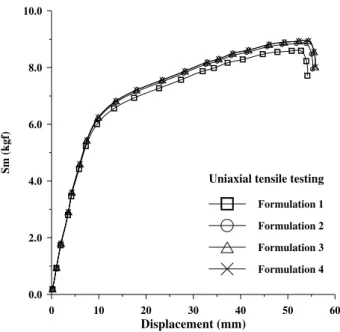
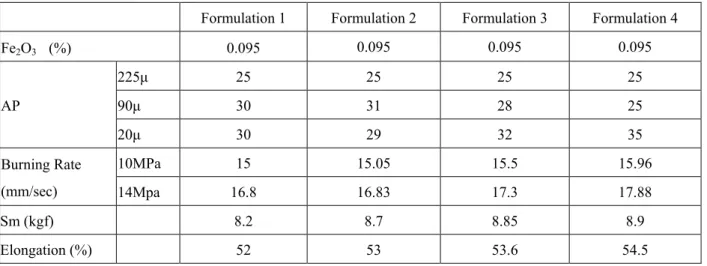
particle sizes with burning rate at 10MPa and 14MPa and mechanical properties were given in table 1, 2 and Fig. 4.
0 10 20 30 40 50 60
Displacement (mm)
0.0 2.0 4.0 6.0 8.0 10.0
Sm
(kgf)
Uniaxial tensile testing
Formulation 1
Formulation 2
Formulation 3
Formulation 4
Fig. 4 Uniaxial tensile testing of loading-displacement curve
The burning rate increases noticeably with the percentage of 20μAP increasing, but the influence of 90μAP is not so obvious as shown in Fig. 5 and 6.
28 30 32 34 36
20 μ AP (%) 14.00
16.00 18.00 20.00
rb
(
m
m
/se
c)
burning rate (mm/sec) 10Mpa 14Mpa
Fig. 5 Variation in propellant burning rate with diverse proportion AP
0.090 0.100 0.110 0.120
Fe2O3 (%) 14.00
16.00 18.00 20.00
rb (
mm
/se
c)
burning rate (mm/sec)
10Mpa 14Mpa
Fig. 5 Variation in propellant burning rate with diverse proportion Fe2O3
III. Results and discussions
According to the relevant measurement results from HTPB/AP propellants, the propellant burning rate is able to appropriately controlled by means of AP and Fe2O3
proportion, at the same time, the smaller particle size of AP is, the greater effect to burning rate could be; furthermore, the influence to burning rate from proportion of Fe2O3 is
bigger than AP.
Proceedings of the World Congress on Engineering and Computer Science 2012 Vol II WCECS 2012, October 24-26, 2012, San Francisco, USA
ISBN: 978-988-19252-4-4
ISSN: 2078-0958 (Print); ISSN: 2078-0966 (Online)
Table 1 Diverse formulation with burning rate and mechanical properties
Formulation 1 Formulation 2 Formulation 3 Formulation 4
Fe2O3 (%) 0.095 0.095 0.095 0.095
AP
225μ 25 25 25 25
90μ 30 31 28 25
20μ 30 29 32 35
Burning Rate (mm/sec)
10MPa 15 15.05 15.5 15.96
14Mpa 16.8 16.83 17.3 17.88
Sm (kgf) 8.2 8.7 8.85 8.9
Elongation (%) 52 53 53.6 54.5
Table 2 Diverse formulation with burning rate
Formulation 1 Formulation 2 Formulation 3 Formulation 4
Fe2O3 (%) 0.095 0.1 0.105 0.11
AP
225μ 25 25 25 25
90μ 30 30 30 30
20μ 30 30 30 30
Burning Rate (mm/sec)
10MPa 15.3 15.45 15.75 16.1
14Mpa 16.9 17.11 17.45 18.06
REFERENCES
[1] M.M. Li, Y. Wang, X.D.Guo, ”Numerical simulation for burning rate of GAP high-energy propellant,” JOURNAL OF SOLID ROCKET TECHNOLOGY, Vol.32, No.5,2009, pp.535-538.
[2] Z.B.,Liu, L.Wang, and C.B.,Hu, “Prediction of burning rate of solid motor by static burning rate of strands,” JOURNAL OF SOLID ROCKET TECHNOLOGY, Vol.3, No.2, 2008, pp.149-167.
[3] M.M., Iqbal, L.Wang, “Propellant burning rate calculation with improved predictions,” JOURNAL OF SOLID ROCKET TECHNOLOGY, Vol.25, No.1, 2002, pp.51-54.
[4] Biggs, G.L., ”Solid Propellant Aging kinetics,” 45th AIAA/ASME/SAE/ASEE Joint Propulsion Conference & Exhibit, 2-5 August 2009, AIAA 2009-5423.
Proceedings of the World Congress on Engineering and Computer Science 2012 Vol II WCECS 2012, October 24-26, 2012, San Francisco, USA
ISBN: 978-988-19252-4-4
ISSN: 2078-0958 (Print); ISSN: 2078-0966 (Online)