THE INFLUENCE OF THE PROCESSING CONDITIONS ON
THE PROPERTIES OF HYDROTHERMAL PROCESSED
BARIUM TITANIUM OXIDE POWDERS
F.G.S. Arau´jo*, A.A. Mendes Filho** and L.C.B. Pinto**
*Associate Professor, Physics Department/REDEMAT, Federal University of Ouro Preto, Campus da UFOP, Ouro Preto, 30.240-000, MG, Brazil **Senior Researchers, Technological Center of
Minas Gerais, CETEC, Belo Horizonte, MG, Brazil
(Received September 22, 1999) (Accepted in revised form February 17, 2000)
Keywords:Powder processing; Hydrothermal
Introduction
Among the ferroelectric materials, barium titanium oxide, BaTiO3, is the most widely employed by the industry, because of its ease of production and extremely high permittivities (1–3). Most of the BaTiO3 available on the market is produced by calcination, but the need of miniaturization for the production of advanced devices demands supplies of higher quality starting powders.
Calcination usually produces powders with particle sizes in the range of a few micrometers (4), while the coprecipitation (5), the alkoxide (6,7) and the hydrothermal (8 –12) processes usually yield particles in the range of a few nanometers to about 0.5mm. The average particle size of titanate powders
determines which phase of the material will be stable at room temperature, i.e., the Curie temperature depends on the particle size (13–16).
Barium titanium oxide conventional ceramics are usually tetragonal perovskites, with high dielectric constants, from approximately 0°C to 130°C, the Curie temperature. Above 130°C the material passes from the tetragonal phase to the cubic phase, accompanied by a sharp decrease in its permittivity (1). Single crystals of BaTiO3present a relative permittivity of 400 along the tetragonal c axis and of 4000 along the axes perpendicular to it (14). This leads to a calculated relative permittivity of 950-1200 for polycrystalline ceramics (14). However, values for the relative permittivity of barium titanium oxide ceramics are commonly between 1500 and 2000, and values as high as 6000 have already been encountered (13). Buessem et al. (13) explained the anomalously high permittivity values of barium titanium oxide ceramics in terms of internal stresses developed during sintering.
The permittivity has been determined to increase with a decreasing grain size until approximately 1mm, and to decrease with further refinement (14). A critical grain size was related to the stability of
the tetragonal phase and to the ferroelectric domain sizes (13,14). Therefore, economic methods for producing tetragonal BaTiO3with small particle sizes may allow higher dielectric constants.
Calcining usually results in wide ranges of particle sizes, contributing to the heterogeneity of the dielectric properties. Alkoxide routes may produce fine and chemically pure powders, but their high costs and initial amorphous structures are serious obstacles (3). The oxalate process is already commercial (3), but there are still problems to be solved on the preparation of stoichiometric barium titanyl oxalate tetrahydrate (5). The hydrothermal process shows commercial promise, because of the
a powder with 300nm particles. Begg et al. (15) prepared 300nm tetragonal hydrothermal barium titanium oxide powders by mixing a hydrolyzed titanium alkoxide precursor and barium hydroxide in an autoclave at 300°C for 5 days. No references concerning the influence of the Ba ions concentration in the mixture could be found.
This paper reports the production of BaTiO3 powders using only TiO2, Ba(OH)2 and water as starting materials, at relatively low temperatures, following the procedures employed by Araujo et al. (20). Low temperature hydrothermal processing proved to be capable of producing tetragonal powders, with sharp particle size distributions, without the calcination step. Two Ba/Ti ratios in the mixture, namely 1.02 and 2.00, were applied, to study the influence of excess Ba ions in the autoclave.
Experimental
The barium titanium oxide powders were prepared from mixtures of titanium oxide, TiO2, barium hydroxide octahydrate, Ba(OH)2z8 H2O, with Ba/Ti ratios of 1.02 and 2.00, and distilled water. The reactions were carried out in autoclaves at 140 and 180°C for 20 hours and at 220°C for 4, 8 and 20 hours. The excess barium ions were eliminated in a two step process, consisting of a reaction with acetic acid (2%) followed by filtering. The powders were analyzed for their densities by He pycnometry (a series of 10 measurements to determine each data on the plot). X-ray diffractometry analyses were performed in all powders, using a RIGAKU X-ray Diffractometer System, to determine their compo-sitions, the phases present and the degree of tetragonality of the titanate phases. The diffraction patterns were obtained at 1°/min, from 20° to 110°. The average particle sizes were measured by TEM. In all plots, the error bars are smaller than the markers.
Results and Discussion
Density Measurements
Figure 1 shows the evolution with time of the structural density of the powders processed at 220°C. For both Ba/Ti ratios in the mixture, the density increases with time. The powders processed with the higher Ba/Ti ratio do not achieve the theoretical density for BaTiO3 (6.017g/cm3), while the powders processed with Ba/Ti5 1.02 reach it after 20 hours of processing. This may be related to the higher
Transmission Electron Microscopy (TEM)
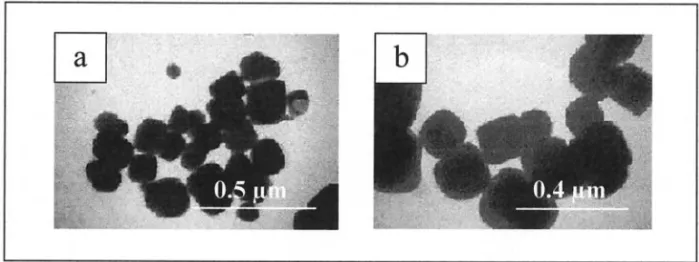
Transmission electron micrographs of some of the powders processed at 220°C for 8h are shown in Figure 2.a and 2.b for the Ba/Ti ratios of 1.02 and 2.00, respectively. The sharp edges of the particles, together with their rectangular projections, suggest the crystallization of the barium titanium oxide powders during hydrothermal processing.
TEM analysis was performed on the powders produced with the Ba/Ti ratios of 1.02 and 2.00, at 220 °C and processing times of 4, 8 and 20 h. The average particle sizes of the powders were calculated from gaussian fitting of histograms for each series of samples, and Figure 3 shows its evolution with processing time. Sharp particle size distributions on the histograms revealed the homogeneity of the powders. It can be observed that the average particle size,d, of the powders tend to increase with the Ba/Ti ratio and with time, as could be expected from the Ostwald ripenning mechanism. The decrease indbetween 4 and 8h processing, for the Ba/Ti52,00 powder, is probably related to the presence of large unreacted particles of barium hydroxide in the sample. Average particle sizes of up to approxi-mately 200 nm could be produced from the hydrothermal synthesis alone, without calcination.
Figure 1. Evolution with time of the structural density of hydrothermal barium titanium oxide powders, processed at 220°C. The lines are intended as guides for the eyes.
Figure 2. TEM micrographs of BaTiO3powders produced by hydrothermal synthesis at 220°C for 8 hours. a) Ba/Ti ratio of 1.02
X-Ray Diffraction Analysis (XRD)
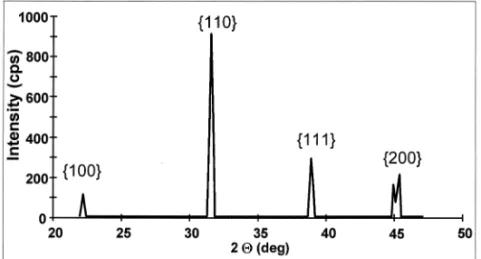
A typical diffraction pattern of the produced powders is shown in Figure 4. The diffraction patterns confirmed the formation of crystalline barium titanium oxide for all of the processing conditions, even for times as short as 4h.
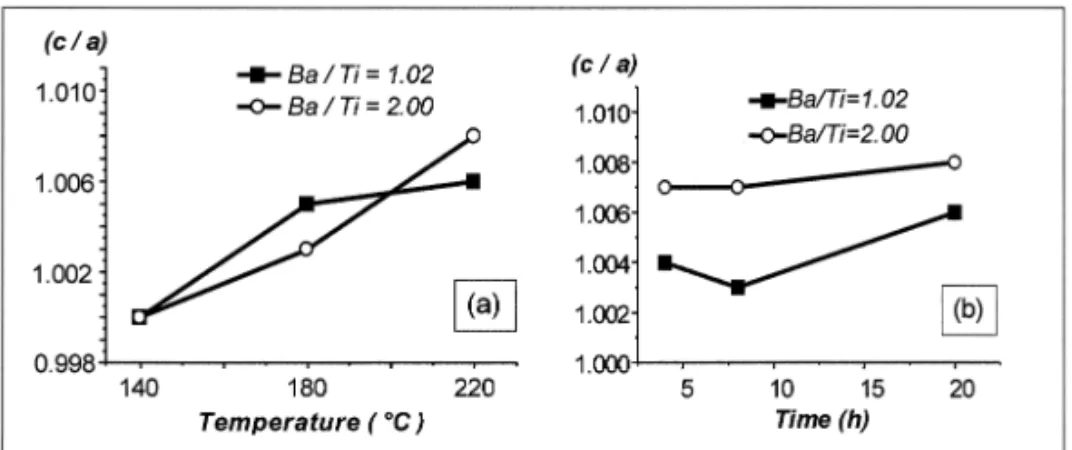
In Figure 4, the peak corresponding to the {200} family is split, confirming the tetragonal perovskite structure. Such pronounced splittings only occurred for the Ba/Ti ratio of 2.00, at the processing temperature of 220°C. For the powders synthesized at lower temperatures with the Ba/Ti ratio of 2.00, and for all the powders synthesized with the Ba/Ti ratio of 1.02, no total splitting could be observed. Instead, a line broadening, which increased with processing time and temperature was present. Upon deconvolution of the [200] lines in such spectra, a variable degree of splitting was revealed, corre-sponding to a degree of tetragonality increasing with time and temperature. Plots of the tetragonality factor (the ratio between the crystal parameters, c/a) are shown in Figure 5.a and 5.b.
Figure 5.a shows an increasing c/a ratio with temperature, for a fixed time of 20 hours, and Fig. 5.b shows higher c/a ratios for the powders processed with a Ba/Ti ratio of 2.00, compared to the powders processed at 220°C with a Ba/Ti ratio of 1.02. Comparing Figures 3 and 5.b, it can be observed that only
Figure 3. Average particle sizes of barium titanium oxide powders produced by hydrothermal synthesis at 220°C. The lines are intended as guides for the eyes.
powders with average particle sizes above approximately 130nm exhibited relatively high c/a ratios, indicating that this particle size can be taken as critical for the stabilization of the tetragonal phase.
Conclusions
Crystalline, tetragonal barium titanium oxide powders, homogeneous in particle size distribution and with average particle sizes of up to 200nm, can be produced directly by hydrothermal synthesis at temperatures as low as 220°C for 20h. The properties of the powders produced under these conditions enable one to skip calcination before sintering. Higher Ba/Ti ratios during processing increase the powders average particle sizes and hence the tetragonality factor, c/a, but decrease the final skeletal density. A critical average particle size for the stabilization of the tetragonal phase was found to be around 130nm.
Acknowledgements
The authors acknowledge REDEMAT and FAPEMIG for their support.
References
1. M. Kahn, et al., in Electronic Ceramics, ed. L. M., Levinson, M. Dekker, New York (1988). 2. A. K. Maurice and R. C. Buchanan, Ferroelectrics. 74, 61 (1987).
3. P. P. Phule and S. H. Risbud, J. Mater. Sci. 25, 1169 (1990). 4. G. A. Hutchins, et al., Am. Ceram. Soc. Bull. 66(4), 681 (1987). 5. F. S. Yen, et al., J. Am. Ceram. Soc. 73(11), 3422 (1990). 6. P. P. Phule and S. H. Risbud, Adv. Ceram. Mater. 3(2), 183 (1985). 7. Y. Suyama and M. Nagasawa, J. Am. Ceram. Soc. 77(2), 603 (1994). 8. R. Vivekanandan, et al., Mater. Res. Bull. 22, 99 (1986).
9. M. A. Delfrate, et al., J. Mater. Sci. 5, 153 (1994). 10. W. Hertl, J. Am. Ceram. Soc. 71(10), 879 (1988).
11. T. Kutty and P. Murugaraj, J. Mater. Sci. Lett. 7, 601 (1988). 12. D. Hennings, et al., J. Eur. Ceram. Soc. 8, 107 (1991). 13. W. R. Buessem, et al., J. Am. Ceram. Soc. 75(10), 2923 (1992). 14. G. Arlt, et al., J. Appl. Phys. 58(4), 1619 (1985).
Figure 5. (a) Tetragonality factor (c/a) as a function of temperature for hydrothermal BaTiO3powders, processed for 20 hours,
with Ba/Ti ratios of 1.02 and 2.00. (b) Tetragonality factor (c/a) as a function of time for hydrothermal BaTiO3powders,