Effectiveness of a web-based intervention
in reducing binge drinking among
nightclub patrons
Yago C BaldinI, Adriana SanudoI, Zila M SanchezI
I Universidade Federal de São Paulo. Escola Paulista de Medicina. Departamento de Medicina Preventiva. São Paulo, SP, Brasil
ABSTRACT
OBJECTIVE: To evaluate the efectiveness of a web-based intervention in reducing binge drinking among nightclub patrons after six months.
METHODS: We carried out a website survey with probabilistic sample in 31 nightclubs in the city of São Paulo, Brazil, which originated a randomized controlled trial with 1,057 participants. hose classiied as problem drinkers (n = 465) using the Alcohol Use Disorders Identiication Test were randomized into two study groups – intervention and control. he web-based intervention consisted of exposing the participants to a normative feedback screen about their alcohol consumption, characterizing the risks associated with amount consumed, money spent on drinks, drinking and driving, risk classiication of Alcohol Use Disorders Identiication Test, and tips to reduce damage.
RESULTS: here was a signiicant reduction in the practice of binge drinking in the week estimated at 38% among participants in the intervention group after six months (p < 0.05). However, there was no signiicant reduction in the outcomes when we analyzed the intervention and control groups and at baseline and after sixth months, simultaneously.
CONCLUSIONS: We cannot conclude that digital tools reduce the pattern of binge drinking among party goers in São Paulo. More studies are needed with this methodology because of its attractiveness to this type of group, given the privacy and speed that personalized information is transmitted.
DESCRIPTORS: Binge Drinking, prevention & control. Internet. Evaluation of the Eicacy-Efectiveness of Interventions. Randomized Controlled Trial.
Correspondence: Zila M Sanchez
Departamento de Medicina Preventiva – UNIFESP Rua Botucatu, 740 4º andar 04023-900 São Paulo, SP, Brasil E-mail: [email protected]
Received: Sep 20, 2016 Approved: Dec 20, 2016
How to cite: Baldin YC, Sanudo A, Sanchez ZM. Effectiveness of a web-based intervention in reducing binge drinking among nightclub patrons. Rev Saude Publica. 2018;52:2.
Copyright: This is an open-access article distributed under the terms of the Creative Commons Attribution License, which permits unrestricted use, distribution, and reproduction in any medium, provided that the original author and source are credited.
INTRODUCTION
Nightclubs are an important place for leisure and entertainment for young persons1.
hey are an environment where changes in social patterns are tolerated and pleasure is stimulated2 and, together with the abusive alcohol consumption, they contribute with
the increased risk exposure of nightclub patrons, such as physical or sexual violence3,
aggressions, and conduct violations4. Binge drinking (BD)5 is common in nightclubs, which
can be deined as the consumption of at least four doses of alcohol in a single occasion
for women and ive doses for men6. his practice can increase the chance of harmful
consequences from alcohol abuse7, as it is associated with higher chances of sexual abuse,
suicide attempts, unprotected sex, unwanted pregnancies, drunkenness, falls, accidents, and inlammatory diseases8.
In order to reduce the consumption of alcohol and other drugs, recent web-based interventions (i.e., ofered over the Internet) have been tested in developed countries, especially among young persons or students9,10, using personalized normative feedback
messages11,12. Personalized messages address educational information about alcohol use,
personal messages about the drinking proile of participants, risk factors and harmful consequences, costs associated with consumption, comparisons with other proiles, and tips for harm reduction13,14, by confronting individual consumption with population consumption
or by providing ways on how to change behavior15. he advantage of this type of tool is
that it can be used on a large scale because it is easy to access and has a low cost16, besides
respecting the privacy of participants17.
International studies have shown a signiicant reduction in the practice of BD in university students after six months of personalized normative feedback via the Internet18,19. Kypri et al.
have observed a signiicant reduction of 11% in the total volume of alcohol consumed after six months, reducing personal, sexual, and legal problems related to alcohol, and a signiicant reduction of 19% in relation to academic problems, such as failure to perform tasks because of alcohol consumption20,21.
Although Brazil has broad Internet access22, web-based interventions aimed at reducing
alcohol abuse in the population have been used only recently23, even though it is clear that
this type of tool must be implemented in the country following adaptations that take into account cultural diferences24. herefore, the introduction of interventions among party goers
to reduce problems related to BD is a necessary and promising ield of activity25, which makes
this an innovative study. hus, the objective of this study was to evaluate the efectiveness of a web-based intervention in reducing the practice of BD and its lack of control among nightclub patrons after six months.
METHODS
Sample of the Website Survey
he data used in this study originated from a website survey26 carried out to diagnose drug
use and other risk behaviors among party goers in the city of São Paulo, Brazil, in 201327–29.
In this study, nightclubs were deined as any establishment that presented control of entry and exit, sale of alcoholic beverages, and dance loor. Details of the cross-sectional study are found in Sanchez et al.28
Data Collection, Instruments, and Variables
2) answering an online questionnaire the next day, and 3) participating in the randomized controlled trial (RCT).
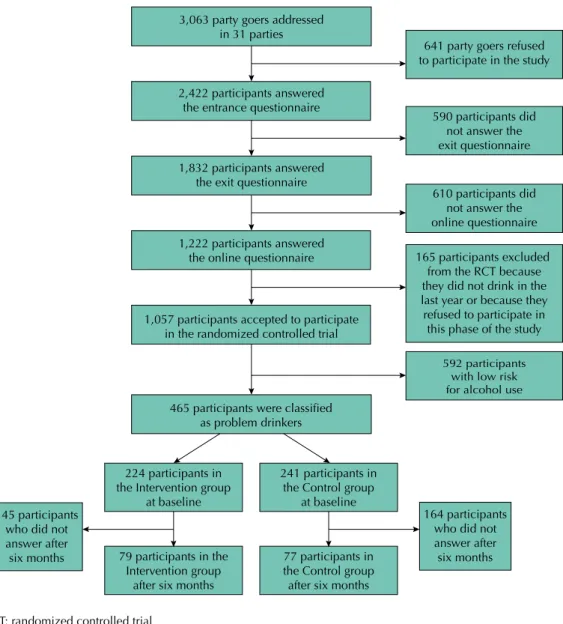
We systematically approached 3,063 subjects in the queues to enter 31 parties, so that the last one of every three individuals was invited to participate in the project. he inclusion criteria were: intention to enter the party and being at least 18 years old. In the case of refusal, data on age and sex were recorded and the next person was approached. A total of 2,422 subjects agreed to participate in the study (acceptance of 79%), who answered an interview about sociodemographic variables, patterns of alcohol consumption, and risk behaviors in parties in the 12 months before the interview; we also measured the alcohol concentration in the exhaled air at the time of the interview using a breathalyzer.
At the exit of the nightclub, those who had been interviewed at the entrance (identiied via a bracelet with a unique numerical code) were asked to answer a new interview. hen, we gave them a folder with information about participation in an online research.
On the day after recruitment, we sent the link of a post-party questionnaire, subdivided into two modules, by e-mail to the 1,833 participants of the exit interview. Of these, 1,222 accessed the questionnaire (acceptance of 67%). he questionnaire included questions regarding the risk behaviors of participants after leaving the nightclub, alcohol expenses, higher amount of
3,063 party goers addressed in 31 parties
2,422 participants answered the entrance questionnaire
1,832 participants answered the exit questionnaire
1,222 participants answered the online questionnaire
1,057 participants accepted to participate in the randomized controlled trial
465 participants were classified as problem drinkers
592 participants with low risk for alcohol use
610 participants did not answer the online questionnaire 590 participants did
not answer the exit questionnaire 641 party goers refused to participate in the study
165 participants excluded from the RCT because they did not drink in the last year or because they refused to participate in this phase of the study
224 participants in the Intervention group
at baseline
241 participants in the Control group
at baseline
79 participants in the Intervention group
after six months
77 participants in the Control group after six months
164 participants who did not answer after six months 145 participants
who did not answer after six months
RCT: randomized controlled trial
doses consumed, time of consumption, type of drink, and the evaluation of the Alcohol Use Disorders Identiication Test (AUDIT), which has 10 questions producing a score ranging from zero to 40 that classiies the pattern of alcohol consumption into four risk levels (low risk use, risk use, harmful use, dependence).
he AUDIT has been developed by the World Health Organization (WHO) to identify the frequency, amount, and consequences of alcohol abuse30. As an evaluation tool, the AUDIT
has shown an increasing number of evidence of being a rapid and successful methodology to identify these standards31. In this study, we used AUDIT to identify patterns of alcohol
consumption among party goers and to select them for an RCT for a web-based intervention with personalized normative feedback.
In this study, we analyzed the following outcome variables: binge drinking in the month (BDmonth), binge drinking in the week (BDweek), and lack of control over drinking behavior (lack of control); the last two come from the AUDIT and the irst one is an extra question.
he BDmonth refers to the following question (extra-AUDIT): “In the last four weeks, what was the highest amount of standard doses of alcohol you consumed on a single occasion?” his was an open question and we categorized the response of ive or more doses as “yes” and the response of less than ive as “no”.
he BDweek refers to question three of the AUDIT: “How often do you have ive or more drinks on one occasion?”. We categorized as “yes” the response “Weekly” and “Daily or almost daily” and as “no” the response “Never”, “Less than monthly”, and “Monthly”. We highlight that we chose to use the option of ive doses based on an average concentration of 12 g of ethanol per dose, following the original guidance of the AUDIT which presupposes 60 g of ethanol or more for this question. hus, the dose options presented to the participant were 330 ml of beer (1 can; 4.7% ethanol / 130 ml wine; 12% ethanol / 40 ml distillate; 39% ethanol).
Lack of control over drinking behavior refers to question four of the AUDIT “How often during the last year have you found that you were not able to stop drinking once you had started?” We categorized as “yes” the responses “Less than monthly”, “Monthly”, “Weekly”, and “Daily or almost daily”, and as “no” the responses “Never”.
he sociodemographic data were taken from the initial database, that is, the one from the face-to-face interviews at the entrance of the nightclubs, as described in Santos et al.32 he
sociodemographic adjustment variables used were: sex (male, female), age, and socioeconomic status, obtained from the Brazilian Association of Population Studies (ABEP, 2012)33 (A = high,
B = medium-high, C = average, D = medium-low, E = low; the C , D, and E classes were grouped because of the small amount of sample).
Randomized Controlled Trial Procedures
Of the 1,222 nightclub patrons who accessed the online questionnaire, a total of 1,057 had consumed alcohol in the last year and agreed to participate (acceptance of 86.5%) in the RCT. Allocation in the groups was randomized and stratiied, performed on the website itself, using a stratiied permuted block randomization algorithm, considering the following categories for each of the three randomization strata: 1) sex ( female, male), 2) age group (18–24, 25–34, 35+), and 3) pattern of alcohol consumption (AUDIT classiication in four categories, that is, 0–7, 8–14, 15–19, 20–40 points). At the end of the randomization, we obtained an intervention group with 515 (48.7%) participants and a control group with 542 (51.3%) participants.
After the initial evaluation, we applied the web-based intervention of personalized normative feedback, which followed the model adopted by Kypri et al.19 For the subjects of
each risk level (organic and mental health, as well as social complications), 2) information on social norms with bar graphs of the percentage of Brazilians, in the same age group and sex, who reported drinking less alcohol, emphasizing how this behavior is atypical for the general population (data from the general population of the household survey on alcohol of 200634), 3) personalized estimate of inancial expenses with alcohol per month and year,
and 4) general information with data to minimize the adverse consequences of alcohol consumption. Participants of the control group received no intervention and only answered the questionnaire.
In this study, we included participants with scores greater than or equal to eight in the AUDIT, that is, those classiied by the AUDIT as problem drinkers (AUDIT score ≥ 8). Of the 1,057 participants randomized in both groups, 465 (44.0%) met the inclusion criteria.
Six months after the initial response, all 465 participants were contacted by e-mail containing the link to a new questionnaire to be completed for a new evaluation. If they did not respond to the questionnaire within three days, we sent a new link, in addition to a SMS, informing them about the e-mail. After three e-mails sent without an answer, the participant was contacted by telephone and informed about the link sent. he logistics of sending e-mails, SMS, and later telephone calls was the same used in the diferent times of the study.
Statistical Analysis
Qualitative variables were described as number (n) and percentage (%), while quantitative variables were described as mean and standard deviation. We evaluated the association between qualitative variables using Pearson’s chi-square test or Fisher’s exact test when one or more expected values were less than ive. he comparison of the quantitative variables according to a dichotomous qualitative variable was performed using Student’s t-test.
We analyzed the outcome variables using generalized linear models with panel data using the “xtlogit” procedure (Stata/SE 13.1 for Windows – StataCorp). All models included group efect (intervention or control), time (baseline or six months of follow-up), and group-time interaction. he interaction term allowed us to evaluate the efect of the intervention between the two evaluations. he results were presented as crude odds ratio (ORc) and respective 95% conidence interval (95%CI). In addition to this model, a new model was adjusted for each of the outcome variables, taking into account sex, age, and socioeconomic class, as well as the parameters already described. hese results were expressed as adjusted odds ratios (ORadj) and respective 95%CI. he predictors were considered as ixed factors in the models.
We compared the data on sex, age, socioeconomic class, AUDIT score at baseline, and allocation group among the participants who answered the six-month follow-up versus those
who did not. his was done to verify if the data of the respondents remained homogeneous regarding the initial sample and to show whether the non-response to the follow-up was diferent according to the randomization group.
Participants were analyzed in the group for which they were randomized at baseline, in the so-called intention-to-treat (ITT) analysis. We also performed a reanalysis of the data using the Last Observation Carried Forward (LOCF) method; that is, for the participants who did not respond the six-month follow-up, we considered the response at baseline.
hroughout the statistical analysis, we adopted a signiicance level of 5%.
Ethics
RESULTS
Of the 1,832 nightclub patrons invited to respond to the online questionnaire sent by e-mail, 610 (33.3%) did not respond (Figure 1). Of this total, 1,057 (86.5%) accepted to participate in the RCT, of which 465 (44.0%) had an AUDIT score greater than or equal to eight – “problem drinkers” – and were then randomized into two groups: intervention (n = 224) and control (n = 241).
hus, 465 patrons (44.0%, 95%CI 41.0–47.0) were classiied as “problem drinkers”. Of these, 344 (74.0%, 95%CI 69.7–77.9) and 256 (55.2%, 95%CI 50.5–59.7) individuals responded “yes” for BDmonth and BDweek, respectively. Approximately 50% of these problem drinkers reported a lack of control over drinking behavior (n = 231, 95%CI 45.1–54.4).
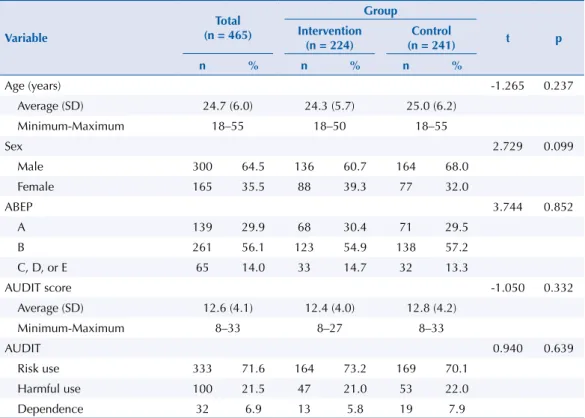
According to Table 1, the intervention and control groups were homogeneous regarding the variables of age (p = 0.237), sex (p = 0.099), ABEP socioeconomic status (p = 0.852), and AUDIT score (p = 0.332).
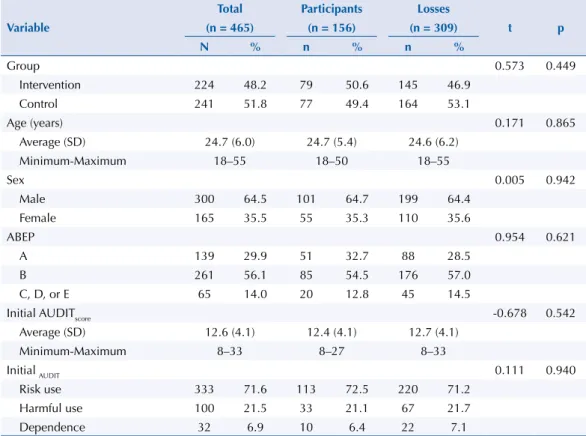
At the six-month follow-up, we obtained the response of 79 (50.6%) participants from the intervention group and 77 (49.4%) participants from the control group. Table 2 shows the attrition results of the sociodemographic data, AUDIT score at baseline, and allocation group among these 156 respondents versus nonresponders. here was no statistically signiicant
diference between participants who answered the questionnaire after six months versus
nonresponders.
Table 3 presents the summary measures for the outcomes evaluated at baseline and after six months of follow-up, according to group. We can observe that there was no signiicant diference between the two groups in either of the two moments of evaluation. We also observed no signiicant efect of the intervention after six months of follow-up in any of the evaluated outcomes. However, the OR of the intervention efect at six months for the outcomes evaluated are less than 1, showing that the intervention group presented a decrease in BDmonth, BDweek, and lack of control when compared to the control group.
Table 1. Distribution of the 465 participants according to group, sociodemographic data, and AUDIT score at baseline.
Variable
Total (n = 465)
Group
t p
Intervention (n = 224)
Control (n = 241)
n % n % n %
Age (years) -1.265 0.237
Average (SD) 24.7 (6.0) 24.3 (5.7) 25.0 (6.2)
Minimum-Maximum 18–55 18–50 18–55
Sex 2.729 0.099
Male 300 64.5 136 60.7 164 68.0
Female 165 35.5 88 39.3 77 32.0
ABEP 3.744 0.852
A 139 29.9 68 30.4 71 29.5
B 261 56.1 123 54.9 138 57.2
C, D, or E 65 14.0 33 14.7 32 13.3
AUDIT score -1.050 0.332
Average (SD) 12.6 (4.1) 12.4 (4.0) 12.8 (4.2)
Minimum-Maximum 8–33 8–27 8–33
AUDIT 0.940 0.639
Risk use 333 71.6 164 73.2 169 70.1
Harmful use 100 21.5 47 21.0 53 22.0
Dependence 32 6.9 13 5.8 19 7.9
Table 3. Comparisons between groups in both times and intervention effect in six months (group and time interaction) for ITT and LOCF analysis.
Variable
Groups
Comparison between groupsa Intervention effect in six monthsb
Intervention (n = 224)
Control (n = 241)
n % 95%CI n % 95%CI ORca 95%CI OR
adj
b 95%CI ORc
a
(95%CI) p
ORadjb
(95%CI) p
Intention-to-treat – ITT BDmonth
Baseline 161 71.9 66.0–77.8 183 75.9 70.5–81.3 0.81 0.53–1.23 0.79 0.52–1.20 0.97
(0.48–1.94) 0.930
0.98
(0.49–1.98) 0.959 Six months 51 63.9 53.3–73.8 54 69 59.0–79.0 0.78 0.41–1.49 0.77 0.40–1.48
BDweek
Baseline 119 53.4 46.5–59.9 137 56.8 50.6–63.1 0.87 0.60–1.25 0.91 0.63–1.31 0.92
(0.52–1.66) 0.795
0.92
(0.51–1.67) 0.794 Six months 32 41.8 31.8–51.8 34 47.2 37.0–57.4 0.80 0.45–1.44 0.84 0.46–1.51
Lack of control
Baseline 111 49.8 43.2–56.3 120 49.8 43.5–56.1 0.99 0.69–1.44 1.01 0.69–1.45 0.56
(0.30–1.03) 0.062
0.55
(0.30–1.02) 0.058 Six months 35 43.9 33.6–54.2 49 58.4 48.1–68.7 0.56 0.30–1.01 0.55 0.30–1.01
Last Observation Carried Forward – LOCF BDmonth
Baseline 161 71.9 66.0–77.8 183 75.9 70.5–81.3 0.81 0.53–1.23 0.79 0.52–1.20 0.98
(0.75–1.29) 0.901
0.99
(0.74–1.31) 0.928 Six months 161 68.3 62.2–74.4 183 73 67.4–78.6 0.80 0.53–1.19 0.78 0.52–1.16
BDweek
Baseline 119 53.4 46.8–59.9 137 56.8 50.6–63.1 0.87 0.60–1.25 0.91 0.62–1.31 0.94
(0.76–1.17) 0.591
0.94
(0.75–1.17) 0.580 Six months 111 49.8 43.2–56.3 132 54.8 48.5–61.0 0.82 0.57–1.18 0.85 0.59–1.23
Lack of control
Baseline 111 49.8 43.2–56.3 120 49.8 43.5–56.1 0.99 0.69–1.44 1.00 0.69–1.45 0.90
(0.72–1.12) 0.352
0.90
(0.71–1.13) 0.352 Six months 106 47.5 41.0–54.1 121 50.2 43.9–56.5 0.90 0.62–1.29 0.90 0.62–1,30
ITT: intention-to-treat analysis; LOCF: last observation carried forward; BDmonth: binge drinking in the month; BDweek: binge drinking in the week a Reference: control group.
b Generalized linear model with Stata xtlogit procedure adjusted by group effect, time, group*time, sex, age, and ABEP. Reference: control group.
Table 2. Distribution of 465 party goers according to the response to the six months of follow-up.
Variable
Total Participants Losses
t p
(n = 465) (n = 156) (n = 309)
N % n % n %
Group 0.573 0.449
Intervention 224 48.2 79 50.6 145 46.9
Control 241 51.8 77 49.4 164 53.1
Age (years) 0.171 0.865
Average (SD) 24.7 (6.0) 24.7 (5.4) 24.6 (6.2)
Minimum-Maximum 18–55 18–50 18–55
Sex 0.005 0.942
Male 300 64.5 101 64.7 199 64.4
Female 165 35.5 55 35.3 110 35.6
ABEP 0.954 0.621
A 139 29.9 51 32.7 88 28.5
B 261 56.1 85 54.5 176 57.0
C, D, or E 65 14.0 20 12.8 45 14.5
Initial AUDITscore -0.678 0.542
Average (SD) 12.6 (4.1) 12.4 (4.1) 12.7 (4.1)
Minimum-Maximum 8–33 8–27 8–33
Initial AUDIT 0.111 0.940
Risk use 333 71.6 113 72.5 220 71.2
Harmful use 100 21.5 33 21.1 67 21.7
Dependence 32 6.9 10 6.4 22 7.1
In addition, we can note a marginally signiicant result (p = 0.058) for the intervention efect in reducing the prevalence of lack of control over drinking behavior (ORadj = 0.55, 95%CI 0.30–1.02). However, when data are imputed via LOCF, there is no trend of signiicance for the intervention efect on lack of control over drinking.
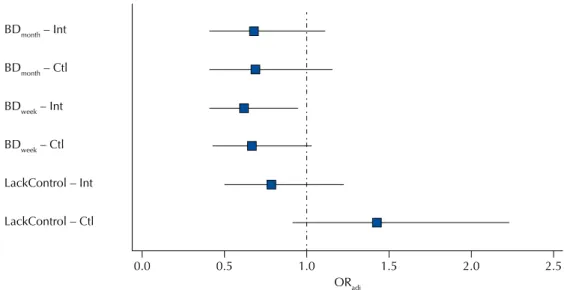
Figure 2 shows the comparison of the time outcomes for each group evaluated. here was a signiicant efect of the intervention group for BDweek, that is, we observed a reduction of 38% (p = 0.026) in the sixth month of follow-up in the practice of binge drinking in the week, after adjusting for sex, age, and socioeconomic class, when compared to baseline; for the control group, no signiicant efect was observed (p = 0.062) for this same outcome.
DISCUSSION
he results presented here are part of the irst epidemiologic research in Brazil on risk behavior in parties in the city of São Paulo, Brazil. he study investigated the efect of an online intervention after six months to reduce the practice of BD among nightclub patrons. he main inding was the reduction in 38% of the report of BDweek after six months of exposure to the intervention. he group of problem drinkers accounted for 44% of the respondents in the parties of the city and, therefore, require immediate intervention or treatment30. he results
also showed that most subjects who chose to participate in the RCT were male (64.5%) and belonged to the socioeconomic classes A or B (86%). Average age was 24.7 years.
he sociodemographic data of the participants of the intervention corroborate the data of Siliquini et al.7, who have found a proportion of 67.9% of men, aged between 20 and 24 years,
and with high education level, suggesting good socioeconomic class, in nightclubs in six European countries. Another Brazilian study, conducted in Belo Horizonte, State of Minas Gerais, with 913 persons who had left leisure environments such as bars and parties, has found a population of 80% of males, aged between 18 and 30 years, and with a family income greater than eight minimum wages35.
Web-based interventions based on custom normative feedback are most commonly applied to college students13. Kypri et al.19, in a study with 2,435 New Zealand university students who
were problem drinkers according to the AUDIT classiication, have found a reduction of 9% 0.0
BDmonth – Int
BDmonth – Ctl
BDweek – Int
BDweek – Ctl
LackControl – Int
LackControl – Ctl
0.5 1.0 1.5
ORadj
2.0 2.5
BDmonth: episode of binge drinking in the last thirty days (month); BDweek: episode of binge drinking in the last seven days (week); Int: Intervention; Ctl: Control; LackControl: Lack of control over drinking behavior (lack of control); ORadj: odds ratio obtained by generalized linear model with Stat xtlogit procedure adjusted by group, time, group*time, sex, age, and socioeconomic class. The OR values represented have as reference the baseline (moment 0)
in the frequency of drinking, 6% in the drinking amount, and 14% in the volume consumed after six months of exposure to a web-based intervention of personalized normative feedback. On the other hand, in a systematic review, Foxcroft et al.36 have evaluated 66 studies seeking
to determine the reduction of the harmful consequences of alcohol abuse in students from normative feedback. here were no signiicant beneits associated with interventions with social norms in this population, but the authors emphasize the diiculty of comparing these studies given the heterogeneity of design36.
In the city of Curitiba, in State of Paraná, a study with a university population comparing web-based interventions with non-computerized interventions (based on motivational interviews) has found more positive results in web-based interventions in the reduction of alcohol use, recommending this alternative to personal interviews, since they are easily accessed by students and cover a greater number of participants24.
his type of tool seems to have positive efects when analyzing the general population. In a systematic review, Tait and Christensen9 have analyzed fourteen studies (n = 7,082)
regarding online interventions for young persons with problem drinking and they have found a reduction of 12% in the amount of alcohol consumed, 35% in the frequency of BD, and 57% in the negative consequences of alcohol use in the diferent studies. In Brazil, Andrade et al.23 have also analyzed digital tools in the general population in a study with
929 participants. he authors emphasize that, despite the relatively low adherence to the study, alcohol consumption can be reduced after six weeks in 62.5% of the users with harmful alcohol consumption, emphasizing the advantage of the tools being available to remote populations and at any time of the day.
he main advantage of the use of digital tools is their accessibility, especially among young university students16, a population that largely makes up the scenario of parties in São Paulo32,
besides their cost-efectiveness and practicality15. For Simon-Arndt et al., who have applied
the same type of intervention in US seamen, another great advantage of the method was the privacy provided by the Internet when compared to face-to-face actions17.
In this study, there was a signiicant reduction in the practice of BD in the week estimated at 38% among participants in the intervention group after six months, not observed in the control group. However, when evaluating the efect of the program (group-time interaction), the results for BD are not signiicant and the reduction in the lack of control is marginally signiicant, even though all odds ratios show a protective trend for the intervention. he more severe option, from a statistical point of view, of using the LOCF approach, considering that the losses maintained their baseline consumption pattern, suggests that there is no intervention efect in any of the evaluated outcomes. hus, we cannot categorically state that said intervention is efective in this scenario, since we had a complete loss of signiicance when we included the losses in the analyses from the worst possible scenario (no change).
Among the limitations of this study, we can mention the rate of loss of subjects at the diferent stages, the diiculty of access to the Internet of some party goers, limiting the amplitude of the RCT, and the impossibility of comparing our results with other studies, given the unprecedented nature of the use of web-based interventions among nightclub patrons. Another limitation is related to the adaptation of the criterion of BD for women, since in this study, we considered as BD ive or more doses for both sexes, while several studies choose to reduce the amount to four doses for women. Even with these limitations, the innovative nature of this study is reinforced in Brazil, a country marked by great damages from the abuse of alcohol by the population.
REFERENCES
1. Calafat A, Koller M; Comisión de las Comunidades Europeas. Enjoying the nightlife in Europe: the role of moderation. Palma de Mallorca: IREFREA; 2003.
2. Graham K, Bernards S, Osgood DW, Wells S. Bad nights or bad bars? Multi-level analysis of environmental predictors of aggression in late-night large-capacity bars and clubs. Addiction. 2006;101(11):1569-80. https://doi.org/10.1111/j.1360-0443.2006.01608.x
3. Reingle J, Thombs DL, Weiler RM, Dodd VJ, O’Mara R, Pokorny SB. An exploratory study of bar and nightclub expectancies. J Am Coll Health. 2009;57(6):629-38. https://doi.org/10.3200/JACH.57.6.629-638
4. Demant J, Heinskou MB. Taking a chance: sex, alcohol and acquaintance rape. Young. 2011;19(4):397-415. https:/doi.org/10.1177/110330881101900403
5. Calafat A, Blay NT, Hughes K, Bellis M, Juan M, Duch M, Kokkevi A. Nightlife young risk behaviours in Mediterranean versus other European cities: are stereotypes true? Eur J Public
Health. 2011;21(3):311-5. https://doi.org/10.1093/eurpub/ckq141
6. National Institute of Alcohol Abuse and Alcoholism. NIAAA Council approves definition of binge drinking. NIAAA Newslett. 2004 Winter [cited 2017 Jul 3];(3):3. Available from: https:// pubs.niaaa.nih.gov/publications/Newsletter/winter2004/Newsletter_Number3.pdf
7. Siliquini R, Colombo A, Berchialla P, Bert F, TEND-D Group. Binge drinking and
psychoactive drug use in a cohort of European youths. J Public Health Res. 2012;1(1):83-8. https://doi.org/10.4081/jphr.2012.e15
8. Naimi TS, Brewer RD, Mokdad A, Denny C, Serdula MK, Marks JS. Binge drinking among US adults. JAMA. 2003;289(1):70-5. https://doi.org/10.1001/jama.289.1.70
9. Tait RJ, Christensen H. Internet-based interventions for young people with problematic substance use: a systematic review. Med J Aust. 2010 [cited 2017 Jul 3];192(11 Suppl):S15-21. Available from: https://www.mja.com.au/system/files/issues/192_11_070610/tai10832_fm.pdf
10. Rooke S, Thorsteinsson E, Karpin A, Copeland J, Allsop D. Computer-delivered interventions for alcohol and tobacco use: a meta-analysis. Addiction. 2010;105(8):1381-90.
https://doi.org/10.1111/j.1360-0443.2010.02975.x
11. Kypri K, Langley JD. Perceived social norms and their relation to university student drinking.
J Stud Alcohol. 2003;64(6):829-34. https://doi.org/10.15288/jsa.2003.64.829
12. McAlaney J, Bewick B, Hughes C. The international development of the ‘Social Norms’ approach to drug education and prevention. Drugs (Abingdon Engl). 2011;18(2):81-9. https://doi.org/10.3109/0968787631003610977
13. Walters ST, Neighbors C. Feedback interventions for college alcohol misuse: what, why and for whom? Addict Behav. 2005;30(6):1168-82. https://doi.org/10.1016/j.addbeh.2004.12.005
14. Palfai TP, Winter M, Lu J, Rosenbloom D, Saitz R. Personalized feedback as a universal prevention approach for college drinking: a randomized trial of an e-mail linked universal web-based alcohol intervention. J Prim Prev. 2014;35(2):75-84. https://doi.org/10.1007/s10935-013-0337-9
15. Riper H, Straten A, Keuken M, Smit F, Schippers G, Cuijpers P. Curbing problem drinking with personalized-feedback interventions: a meta-analysis. Am J Prev Med. 2009;36(3):247-55. https://doi.org/10.1016/j.amepre.2008.10.016
16. White A, Kavanagh D, Stallman H, Klein B, Kay-Lambkin F, Proudfoot J, et al. Online alcohol interventions: a systematic review. J Med Internet Res. 2010;12(5):e62. https://doi.org/10.2196/jmir.1479
17. Simon-Arndt CM, Hurtado SL, Patriarca-Troyk LA. Acceptance of web-based personalized feedback: user ratings of an alcohol misuse prevention program targeting U.S. Marines. Health
Commun. 2006;20(1):13-22. https://doi.org/10.1207/s15327027hc2001_2
18. Lewis MA, Patrick ME, Litt DM, Atkins DC, Kim T, Blayney JA, et al. Randomized controlled trial of a web-delivered personalized normative feedback intervention to reduce alcohol-related risky sexual behavior among college students. J Consult Clin Psychol. 2014;82(3):429-40. https://doi.org/10.1037/a0035550
19. Kypri K, Hallett J, Howat P, McManus A, Maycock B, Bowe S, Horton NJ. Randomized controlled trial of proactive web-based alcohol screening and brief intervention for university students.
20. Kypri K, Langley JD, Saunders JB, Cashell-Smith ML, Herbison P. Randomized controlled trial of web-based alcohol screening and brief intervention in primary care. Arch Intern Med. 2008;168(5):530-6. https://doi.org/10.1001/archinternmed.2007.109
21. Kypri K, Saunders JB, Williams SM, McGee RO, Langley JD, Cashell-Smith ML, et al. Web-based screening and brief intervention for hazardous drinking: a double-blind randomized controlled trial. Addiction. 2004;99(11):1410-7. https://doi.org/10.1111/j.1360-0443.2004.00847.x
22. Instituto Brasileiro de Geografia e Estatística. Pesquisa Nacional por Amostra de Domicílios 2014. Rio de Janeiro: IBGE; 2014 [cited 2017 Jul 3]. Available from: http://www.ibge.gov.br/ home/estatistica/populacao/trabalhoerendimento/pnad2014/default.shtm
23. Andrade AL, Lacerda RB, Gomide HP, Ronzani TM, Sartes LM, Martins LF, et al. Web-based self-help intervention reduces alcohol consumption in both heavy-drinking and dependent alcohol users: a pilot study. Addict Behav. 2016;63:63-71. https://doi.org/10.1016/j.addbeh.2016.06.027
24. Christoff AO, Boerngen-Lacerda R. Reducing substance involvement in college students: a three-arm parallel-group randomized controlled trial of a computer-based intervention. Addict
Behav. 2015;45:164-71. https://doi.org/10.1016/j.addbeh.2015.01.019
25. Warpenius K, Holmila M, Mustonen H. Effects of a community intervention to reduce the serving of alcohol to intoxicated patrons. Addiction. 2010;105(6):1032-40. https://doi.org/10.1111/j.1360-0443.2009.02873.x
26. Voas RB, Furr-Holden D, Lauer E, Bright K, Johnson MB, Miller B. Portal surveys of time-out drinking locations: a tool for studying binge drinking and AOD use. Eval Rev. 2006;30(1):44-65. https://doi.org/10.1177/0193841X05277285.
27. Carlini C, Andreoni S, Martins SS, Benjamin M, Sanudo A, Sanchez ZM. Environmental
characteristics associated with alcohol intoxication among patrons in Brazilian nightclubs. Drug
Alcohol Rev. 2014;33(4):358-66. https://doi.org/10.1111/dar.12155
28. Sanchez ZM, Ribeiro KJ, Wagner GA. Binge drinking associations with patrons’ risk behaviors and aAlcohol effects after leaving a nightclub: sex differences in the “Balada com Ciência” Portal Survey Study in Brazil. PLoS One. 2015;10(8):e0133646. https://doi.org/10.1371/journal.pone.0133646
29. Santos R, Baldin Y, Carlini CM, Sanchez ZM. Classification of alcohol use disorders among nightclub patrons: associations between high-risk groups, sociodemographic factors and illicit drug use. Am J
Drug Alcohol Abuse. 2015;41(5):433-41. https://doi.org/10.3109/00952990.2015.1050497
30. Babor TF, Higgins-Biddle JC, Saunders JB, Monteiro MG. AUDIT: The Alcohol Use Disorders Identification Test: Guidelines for Use in Primary Care. 2.ed. Geneva: WHO Department of Mental Health and Substance Dependence; 2001 [cited 2017 Jul 14]. Available from: http:// apps.who.int/iris/bitstream/10665/67205/1/WHO_MSD_MSB_01.6a.pdf
31. Reinert DF, Allen JP. The alcohol use disorders identification test: an update of research findings.
AlcoholClin Exp Res. 2007;31(2):185-99. https://doi.org/10.1111/j.1530-0277.2006.00295.x
32. Santos MGR, Paes AT, Sanudo A, Sanchez ZM. Factors associated with pre-drinking among nightclub patrons in the city of São Paulo. Alcohol Alcohol. 2015;50(1):95-102. https://doi.org/10.1093/alcalc/agu055
33. Associação Brasileira de Empresas de Pesquisa. Critério de Classificação Econômica no Brasil. Rio de Janeiro: ABEP; 2012.
34. Laranjeira R, Pinsky I, Sanches M, Zaleski M, Caetano R. Alcohol use patterns among Brazilian adults. Rev Bras Psiquiatr. 2010;32(3):231-41. https://doi.org/10.1590/S1516-44462009005000012
35. Campos VR, Salgado R, Rocha MC, Duailibi S, Laranjeira R. Prevalência do beber e dirigir em Belo Horizonte, Minas Gerais, Brasil. Cad Saude Publica. 2008;24(4):829-34. https://doi.org/10.1590/S0102-311X2008000400013
36. Foxcroft DR, Moreira MT, Almeida Santimano NM, Smith LA. Social norms information for alcohol misuse in university and college students. Cochrane Database Syst Rev. 2015;(12):CD006748. https://doi.org/10.1002/14651858.CD006748.pub4
Funding: São Paulo Research Foundation (FAPESP – Processes 11/51658-0 and 14/18602-0).
Authors’ Contribution: YCB: analysis and interpretation of the data and preparation and revision of the study. AS: design and planning of the analysis, interpretation of the data, and revision of the study. ZMS: design and planning of the study, data collection, analysis, and interpretation, revision of the manuscript, approval of the inal version, public responsibility for the content of the article.