Purificatio n and binding analysis o f the
nitro ge n fixatio n re gulato ry NifA pro te in
fro m
Az osp irillum b rasilense
Departamentos de 1Biotecnologia and 2Genética, Centro de Biotecnologia,
Universidade Federal do Rio Grande do Sul, Porto Alegre, RS, Brasil
3F.A. Janssens Laboratory of Genetics, Katholieke Universiteit Leuven,
Heverlee, Belgium L.M.P. Passaglia2,
C. Van Soom3,
A. Schrank1 and
I.S. Schrank1
Abstract
NifA protein activates transcription of nitrogen fixation operons by the alternative σ54 holoenzyme form of RNA polymerase. This protein
binds to a well-defined upstream activator sequence (UAS) located at the -200/-100 position of nif promoters with the consensus motif TGT-N10-ACA. NifA of Azospirillum brasilense was purified in the form of
a glutathione-S-transferase (GST)-NifA fusion protein and proteolytic release of GST yielded inactive and partially soluble NifA. However, the purified NifA was able to induce the production of specific anti-A. brasilense NifA-antiserum that recognized NifA from A. brasilense
but not from K. pneumoniae. Both GST-NifA and NifA expressed from the E. colitac promoter are able to activate transcription from the
nifHDK promoter but only in an A. brasilense background. In order to investigate the mechanism that regulates NifA binding capacity we have used E. coli total protein extracts expressing A. brasilensenifA in mobility shift assays. DNA fragments carrying the two overlapping, wild-type or mutated UAS motifs present in the nifH promoter region revealed a retarded band of related size. These data show that the binding activity present in the C-terminal domain of A. brasilense
NifA protein is still functional even in the presence of oxygen. Co rre spo nde nce
I.S. Schrank
Centro de Biotecnologia, Bloco IV Av. Bento Gonçalves, 9500 Caixa Postal 15005 91501-970 Porto Alegre, RS Brasil
Fax: + 55-51-319-1079 E-mail: irene@ dna.cbiot.ufrgs.br
Research supported by CNPq, FAPERGS and the Geconcerteerde O nderzoeksactie (to J. Vanderleyden).
Received September 26, 1997 Accepted July 21, 1998
Ke y words
•NifA protein
•NifA antibodies
•Azospirillum brasilense
•Gel shift assay
•NifA activity
•Upstream activator sequence
Intro ductio n
In many diazotroph organisms, the
nitro-gen fixation nitro-genes (nif) are transcribed by an
alternative holoenzyme form of RNA poly-merase and require an activator protein, NifA. Both activity and synthesis of NifA are regu-lated in response to environmental effectors. Two major signals regulate nitrogen fixa-tion, oxygen and ammonia, and this
regula-tion occurs mainly at the level of nif gene
transcription mediated by NifA. NifA acts as a DNA-binding protein which recognizes
typical upstream promoter sequences
(TGT-N10-ACA) showing many enhancer element
properties located upstream of promoters of the -24/-12 type (1). The integration host
factor protein (IHF) stimulates K.
pneumo-niae NifA-mediated activation of nif
pro-moters by facilitating DNA loop formation (2).
NifA activates nif transcription under
senses changes in the oxygen and/or
nitro-gen status of the cell in Klebsiella
pneumo-niae and Azotobacter vinelandii (4-7). In A.
brasilense and members of the Rhizobiaceae family, where NifL has not been found, the NifA protein itself is inactivated by oxygen. The NifA protein contains a conserved motif
of cysteine residues, which is absent in K.
pneumoniae and A. vinelandii, involved in
sensitivity to oxygen in Bradyrhizobium
japonicum and possibly in A. brasilense (8,9). NifA proteins are structurally similar to each other, and three independent domains, separated by two inter-linker-domains (IDL), were defined (8,10,11). The C-terminal do-main contains a helix-turn-helix DNA bind-ing motif (12,13); the central domain, in-volved in catalysis, contains the nucleotide binding site (10,14) and the N-terminal
do-main is not essential for K. pneumoniae NifA
activity. In K. pneumoniae this latter
do-main, that has no homologue, appears to decrease the sensitivity to NifL (10,12,15). In A. brasilense, NifA is synthesized in an inactive form under conditions not compat-ible with nitrogen fixation (16). Moreover, its regulation differs considerably from that found in other free living diazotrophs. It has
been proposed that, in A. brasilense, the
N-terminal domain plays an inhibitory role which leads to the inactivation of NifA in the
absence of PII protein (17,18). PII protein
plays an essential role in the regulation of
nitrogen metabolism in E. coli by controlling
the activity of GS (19,20) and it appears that
glnB is essential for nitrogen fixation in A.
brasilense (18). Another important feature of A. brasilense is the regulation of nitroge-nase activity at the post-translational level by a switch-off mechanism in response to environmental changes in ammonia concen-tration (21). Therefore, the plant
growth-promoting A. brasilense, which associates
with roots of economically important grasses, has some characteristic features at the level of nitrogen fixation regulation.
In this paper, we report the production of
NifA from A. brasilense in E. coli cells, its
purification, the production of specific anti-serum and the analysis of the activity of the recombinant NifA protein. We also show that the recombinant NifA proteins were
active only in A. brasilense cells and were
able to induce transcription from the nifH
promoter. The ability of A. brasilense NifA
to bind to upstream activator sequences
pres-ent on nif genes even in its inactive form in
response to oxygen is also demonstrated.
Mate rial and Me thods
Bacte rial strains, plasmids and growth
co nditio ns
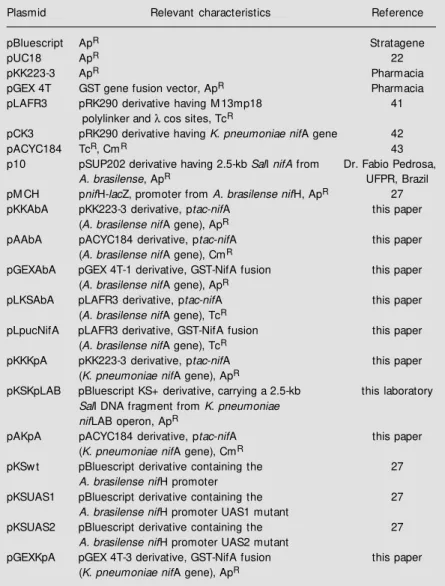
The bacterial strains and plasmids used in the present study are listed in Tables 1 and
2. LB medium (22) was used for growing E.
coli strains at 37o
C. YT medium (22) was used to induce the glutathione-S-transferase
(GST)-NifA fusion protein on E. coli BL21
strains at 30o
C. A. brasilense strains were
grown at 30oC in either LB medium or MMAb
minimal medium (23) using 0.5% malate as carbon source. MMAb without ammonium chloride was used when nitrogen-free medi-um was required. The medimedi-um was supple-mented with the antibiotics tetracycline (Tc), ampicillin (Ap) or kanamycin (Km) when necessary, at concentrations of 10, 100 or 30 µg/ml, respectively.
Conjugation experiments were performed on D-plates (8 g/l Bacto nutrient broth, 0.25 g/l magnesium sulfate, 1 g/l potassium chlo-ride, 0.01 g/l manganese chloride). MMAb medium supplemented with Tc and Km was
used to select A. brasilense transconjugants.
DNA manipulations, nitroge nase assays,
ß-galactosidase assays and conjugation
enzymes were purchased from Pharmacia (Uppsala, Sweden), Gibco/BRL (Gaithers-burg, MD) or Promega (Madison, WI) and used according to the manufacturers in-structions.
Nitrogenase activity was measured by the acetylene reduction method described by Burris (24). Ethylene production was quan-tified on a Plot fused silica column (50 m x
0.32 nm, 5 µm Al2O3/KCl, Chrompack)
in-stalled in a Hewlett Packard 5890A gas chro-matograph. Propane was used as internal standard.
Determination of ß-galactosidase
activ-ity of the nif-lacZ promoter fusions was
car-ried out according to the standard procedure of Miller (as described in reference 22) at 25o
C.
Plasmid mobilization from E. coli S17.1 to
A. brasilense Sp7 by biparental conjugation was performed as previously described (25).
Plasmid constructions
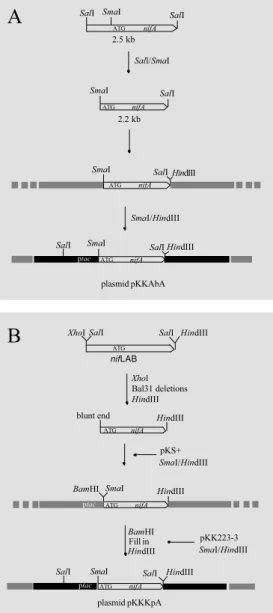
The strategy used to obtain the pKKAbA plasmid is shown in Figure 1A. DNA from plasmid p10 was digested to generate the
2.2-kb SmaI/SalI DNA fragment carrying
the coding region for NifA from A. brasilense.
The SmaI site is located at 91 bp from the
ATG start codon. In the pKKAbA
(pKK233-3 vector) construct the A. brasilense nifA
gene is under the control of the tac promoter.
The nifA gene from A. brasilense was
also cloned into three other plasmid vectors.
Plasmid pKKAbA was digested with SalI
and the entire construction, ptac-nifA, was
cloned into the SalI site of the pACYC184
vector (pAAbA plasmid). The pGEX 4T-1 vector was used to generate a GST-NifA
fusion protein. The SmaI/SalI 2.2-kb DNA
fragment from plasmid p10 was also cloned
into the pGEX 4T-1 SmaI/SalI digested
vec-tor. In this way the nifA gene was cloned in
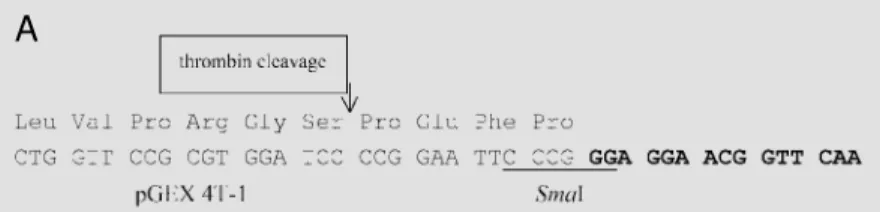
frame with GST and the recombinant plas-mid, pGEXAbA, was able to produce a GST-NifA fusion protein (Figure 2A).
Table 1 - Bacterial strains used in the present study.
Bacteria Strain Relevant characteristics Reference
A. brasilense Sp7 w ild-type strain, ATCC 29145 37 Sp7067 Sp7 mutant Nif -, nifA::Tn5 31 Sp7077 Sp7 mutant Nif -, nifA::Tn5 31
E. coli M C1061 hsdR mcrB araD 139∆(araABC-leu) 38 7679 ∆lacX74 galU galK rpsL thi
BL21 hsdS gal (λcIts857 ind1 Sam7 nin5 39
lacUV5-T7 gene1)
DH5α hsdR17 endA1 thi-1 gyrA96 relA1 22
recA1 supE44 ∆lacU169 (φ80lacZ∆M 15)
S17.1 thiendA recA hsdR RP4-2-Tc::M u-Kan::Tn7 40
Table 2 - Plasmids used in the present study.
Plasmid Relevant characteristics Reference
pBluescript ApR Stratagene
pUC18 ApR 22
pKK223-3 ApR Pharmacia
pGEX 4T GST gene fusion vector, ApR Pharmacia
pLAFR3 pRK290 derivative having M 13mp18 41
polylinker and λ cos sites, TcR
pCK3 pRK290 derivative having K. pneumoniae nifA gene 42
pACYC184 TcR, CmR 43
p10 pSUP202 derivative having 2.5-kb SalI nifA from Dr. Fabio Pedrosa,
A. brasilense, ApR UFPR, Brazil pM CH pnifH-lacZ, promoter from A. brasilense nifH, ApR 27
pKKAbA pKK223-3 derivative, ptac-nifA this paper
(A. brasilensenifA gene), ApR
pAAbA pACYC184 derivative, ptac-nifA this paper
(A. brasilensenifA gene), CmR
pGEXAbA pGEX 4T-1 derivative, GST-NifA fusion this paper (A. brasilensenifA gene), ApR
pLKSAbA pLAFR3 derivative, ptac-nifA this paper
(A. brasilensenifA gene), TcR
pLpucNifA pLAFR3 derivative, GST-NifA fusion this paper (A. brasilensenifA gene), TcR
pKKKpA pKK223-3 derivative, ptac-nifA this paper
(K. pneumoniaenifA gene), ApR
pKSKpLAB pBluescript KS+ derivative, carrying a 2.5-kb this laboratory
SalI DNA fragment from K. pneumoniae nifLAB operon, ApR
pAKpA pACYC184 derivative, ptac-nifA this paper
(K. pneumoniaenifA gene), CmR
pKSw t pBluescript derivative containing the 27
A. brasilensenifH promoter
pKSUAS1 pBluescript derivative containing the 27
A. brasilensenifH promoter UAS1 mutant
pKSUAS2 pBluescript derivative containing the 27
A. brasilensenifH promoter UAS2 mutant
For the complementation experiments,
the nifA gene was cloned into the pLAFR3
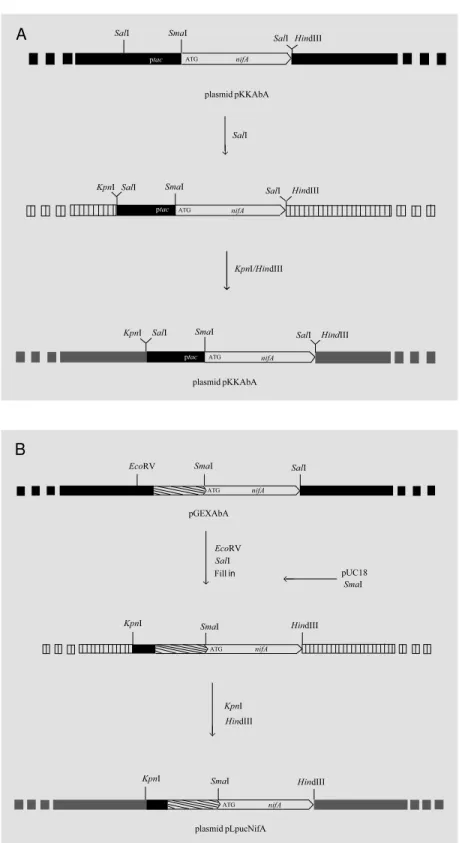
cosmid. Figure 3A depicts the steps used to generate plasmid pLKSAbA carrying the ptac-nifA construction and Figure 3B shows the pLpucNifA derivative containing the GST-NifA fusion construction.
The nifA gene of K. pneumoniae was also
cloned into the transcriptional vector pKK223-3 and into the translational fusion vector pGEX 4T-3. Plasmid pCRA37 (26)
was digested with SalI, yielding a 2.9-kb
DNA fragment carrying the K. pneumoniae
nifLAB region. This fragment was cloned
into the pBluescript KS+ vector generating
the pKSKpLAB plasmid. To remove the nifL
gene, pKSKpLAB was digested with XhoI
and Bal 31 deletions were carried out. Two different deleted DNA fragments have been selected and confirmed by DNA sequenc-ing. The first one, shown in Figure 1B, has
only 91 bp upstream from the nifA ATG start
codon and was cloned into the pKK223-3
vector under the control of the tac promoter
to produce the recombinant plasmid pKKKpA. To construct plasmid pAKpA, the ptac-nifA region from pKKKpA was
re-moved by SalI digestion and cloned into the
pACYC184 SalI digested vector. The
sec-ond Bal 31 deleted fragment was cloned into the pBluescript vector, named pKS3.1(5.1), and completely sequenced. Figure 2B shows the strategy used to clone the NifA as a fusion protein with GST into the pGEX 4T-3 vector to produce the plasmid pGEXKpA.
Ce ll e xtracts and de te ction of NifA by
We ste rn blot
Coupled transcription/translation in S30 extracts (Promega), using either pKKAbA or pKKKpA plasmids, were prepared fol-lowing the instructions provided by the manu-facturers.
E. coli BL 21 extracts, carrying
pGEXAbA or pGEXKpA plasmids, and
DH5α, carrying plasmids pKKAbA or
pAAbA, were prepared after growing the
cells for 2 h at 30o
C in YT medium supple-mented with ampicillin. The fusion protein was induced in aerobically grown cultures by the addition of 0.1 mM IPTG and the cells were harvested after growing for another 3 h at the same temperature. Proteins (1/4 of the culture) were separated on 10% SDS/poly-acrylamide gels and visualized by Coomassie blue staining. Western blotting was per-formed as described in reference 22. Detec-tion was carried out using monoclonal
anti-bodies against GST or A. brasilense NifA
antiserum. The reaction was incubated with
A
SalI SmaI SalIATG
2.5 kb
nifA
Sall/SmaI
SmaI SalI
ATG
2.2 kb
nifA
SmaI SalIHindIII
SmaI/HindIII
ATG nifA SmaI
SalI SalIHindIII
plasmid pKKAbA
ptac
ATG nifA
Figure 1 - Cloning strategy for the insertion of nifA, from A. brasilense (A) and from K. pneu-moniae (B), into the pKK223-3 vector. The figure also show s the restriction map of plasmid p10 containing the nifA gene from A. brasilense (A) and plas-m id pCRA37 cont aining t he
nifLAB genes from K. pneumo-niae (B). The black boxes repre-sent the pKK223-3 vector and the gray boxes represent the pUC18 vect or in A and t he pBluescript vector in B.
B
XhoISalI SalI HindIIIATG
nifA ATG
ATG nifA HindIII
SalI
HindIII
SmaI
HindIII
BamHI Fill in
BamHISmaI blunt end
nifLAB
HindIII
Xhol Bal31 deletions
pKS+
SmaI/HindIII
pKK223-3
SmaI/HindIII
HindIII
SalI
ATG nifA
plasmid pKKKpA
ptac
anti-mouse antibody labeled with alkaline phosphatase and developed with a goat anti-mouse (IgG) secondary antibody using the substrate B-CIP/NBT detection system (Sigma, St. Louis, MO).
Purification of NifA prote in and
immunological procedures
A. brasilense NifA protein was purified
from E. coli harboring the pGEXAbA
plas-mid as described in the GST Gene Fusion System (Pharmacia 2nd edn.). The purified NifA protein was used as immunogen for the generation of mouse antiserum as follows. Five female BALB/c white mice were im-munized by intradermal injection with NifA. The purified protein (10 mg) was mixed with an equal volume of Freunds complete adju-vant for the first injection, or with Freunds incomplete adjuvant for the second injection 12 days later. One week after the second injection, NifA antiserum was collected, di-luted 1:100 and used for Western immuno-blot experiments.
Ge l shift motility assays
DNA-binding assays were performed as described before (27).
The oligonucleotides used in the PCR re-actions were 5TGCATCCCCCGTGCCA GTTCGCG3 and 5CCTGACGCTGGCTCT GACGCTGG 3. The first oligonucleotide was labeled with digoxigenin (DIG) and the detec-tion system was that described in the DIG gel shift kit (Boehringer, Mannheim, Germany).
Re sults and D iscussion
De te ction of NifA activity on transcriptional
fusio ns
To demonstrate the activity of A.
brasi-lense NifA protein in vitro (binding assays), we directed the synthesis of this protein from an expression vector (pKK223-3) in a
A
B
coupled transcription-translation system (S30 extracts). Two plasmids, pKKAbA and pKKKpA, carrying transcriptional fusions of A. brasilense and K. pneumoniae nifA
genes with tac promoter were constructed
(Figure 1) and tested. Induction of the
ex-pression from tac promoter in strains
carry-ing the plasmids resulted in no detectable
production of the 35
S-labeled proteins on 10% SDS-polyacrylamide gels.
To analyze the capability of the nifA
protein to activate the nifH promoter two
other plasmid constructions were made. Plas-mids pAAbA and pAKp6 carry the same transcriptional fusion present in pKKAbA and pKKKpA, but were cloned into a vector (pACYC184) compatible with pMCH (27),
containing the A. brasilense nifH promoter
fused to lacZ. Cell cultures were prepared
from strain MC1061 carrying the pMCH plasmid and from the two different
con-structs which produced NifA either from A.
brasilense or from K. pneumoniae.
Tran-scriptional activation of the A. brasilense
nifH promoter in vivo by K. pneumoniae
NifA protein is shown in Table 3. The
tran-scriptional fusion of A. brasilense nifA
pro-tein failed to activate the nifH promoter.
The transcription/translation coupled sys-tem was used previously to analyze the
ac-tivity of NifA protein from R. meliloti (28)
and K. pneumoniae (29,30). The activity
present in the control construction (tac-nifA
from K. pneumoniae) is in agreement with
previous results which have shown that this
protein is able to activate the nifH promoter
from A. brasilense (27; Table 3). The failure
of the A. brasilensetac-nifA fusion protein
to activate the nifH promoter is probably due
to its inactive form in the presence of oxygen (31).
D e te ction of NifA activity on translational
fusio ns
In order to purify A. brasilense NifA and
to induce the production of antibodies we
Figure 3 - Strategy for cloning the nifA gene from A. brasilense into cosmid pLAFR3. A
show s the steps for cloning the transcriptional tac-nifA fusion construct, and B show s the steps for cloning the translational fusion GST-NifA. Black boxes indicate the pKK223-3 vector in A and the pGEX 4T-1 vector in B; striped boxes indicate the pBluescript vector in A and the pUC18 vector in B; gray boxes indicate the pLAFR3 vector. The stippled arrow indicates the sequence of the GST protein from vector pGEX 4T-1.
ATG nifA
HindIII
SalI
plasmid pKKAbA
SalI
SalI
KpnI SalI HindIII
KpnI/HindIII
ATG nifA
SmaI
SalI
ptac
plasmid pKKAbA
HindIII
HindIII
ATG nifA
ATG nifA
plasmid pLpucNifA
Fill in pUC18
SmaI
SmaI
SmaI
KpnI
KpnI
KpnI
HindIII
↓
B
↓↓
↓ ↓
A
↓
HindIII
SalI
SmaI
SalI
KpnI
ATG nifA
EcoRV SmaI SalI
ATG nifA
pGEXAbA
EcoRV
SalI
SmaI
ptac
cloned the coding region as a translational fusion with GST (pGEX vector). NifA
pro-tein from K. pneumoniae has been
previ-ously purified as active fusion protein with MBP using the whole sequence (13), only the catalytic domain (15), only the N-termi-nal domain or only the C-termiN-termi-nal domain (32). In the present study two plasmids were
constructed, pGEXAbA carrying the A.
brasilense NifA protein fused with GST and pGEXKpA carrying the GST-NifA fused
protein from K. pneumoniae (Figure 2).
Af-ter digestion with thrombin, the A. brasilense
NifA protein has an addition of 31 amino
acids from the NifA noncoding region of A.
brasilense in the N-terminal domain. The
GST-NifA fusion protein from K.
pneumo-niae has a NifA deleted for the 32 first amino
acids and an insertion of 9 extra amino acids from the pUC18 polylinker (Figure 2).
To verify the constructions,
ß-galactosi-dase activity was determined in E. coli cells
carrying the pMCH plasmid and the activity
of the truncated NifA from K. pneumoniae is
shown in Table 3. The transcriptional activa-tion shows low values due to the incompat-ibility between plasmids pMCH and pGEXKpA resulting in transient expression
only. We demonstrated that the K.
pneumo-niae NifA fused with GST, partially deleted
at the N-terminal domain, is in its active form. Similar results were reported by Berger et al. (32) using NifA fusion with MBP,
showing the activity of NifA both in vivo and
in vitro. However, the A. brasilense NifA fusion protein was unable to induce
ß-galac-tosidase activity from the nifH promoter in
E. coli extracts.
Immunological de te ction of A. brasilense
NifA prote in
A. brasilense NifA protein was purified
from E. coli extracts as a GST-NifA fusion
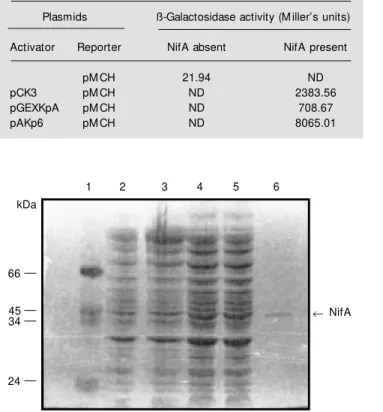
protein (plasmid pGEXAbA). NifA was re-leased from GST by cleavage with thrombin (Figure 4, lanes 4 and 5). Approximately
Table 3 - Activation of nifH promoter by K. pneumoniae NifA in an E. coli background.
All plasmids w ere transformed to E. coli and, after grow th at 37oC for 18 h, ß-gal activity w as measured. Results are reported as the means of three representative experiments. ND = Not determined.
Plasmids ß-Galactosidase activity (M iller’s units)
Activator Reporter NifA absent NifA present
pM CH 21.94 ND
pCK3 pM CH ND 2383.56
pGEXKpA pM CH ND 708.67
pAKp6 pM CH ND 8065.01
kDa
66
45 34
24
1 2 3 4 5 6
NifA
Figure 4 - Purification of NifA from E. coli BL21 (pGEXAbA). SDS-PAGE of denatured samples. Total E. coli extracts containing the GST-NifA fusion protein present in the supernatant (lane 2) and pellet (lane 3). Total E. coli
extracts containing the A. brasilense NifA protein, after cleavage w ith thrombin, present in the supernatant (lane 4) and pellet (lane 5). Lane 6, 1 µg of purified NifA preparation and lane 1, molecular mass standards (Pharmacia). The position of NifA is indicated by the arrow .
50% of the NifA protein remained in the supernatant (Figure 4, lane 5) and was puri-fied by standard procedures (Figure 4, lane 6). NifA polypeptide has an apparent molec-ular mass of 51 kDa (Figure 5), whereas the predicted NifA protein size, deduced from the nucleotide sequence, was 77 kDa (31). This discrepancy was also found by Arsène et al. (33) and they suggested that it could be due to the presence of a high proline residue content. Proteins rich in proline can cause anomalous migration in SDS-PAGE.
The purified NifA protein was used to
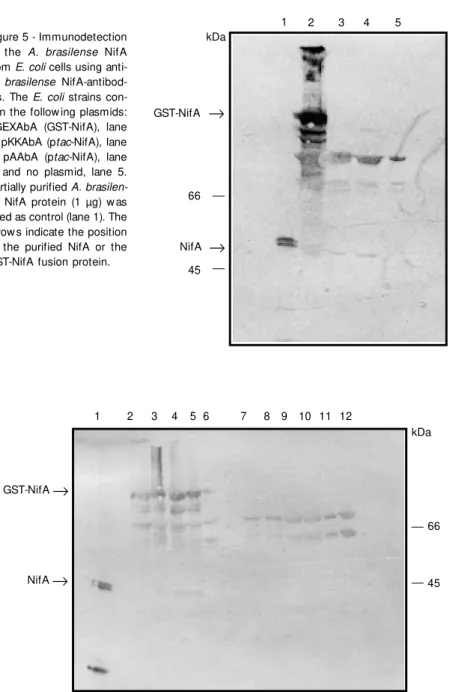
pKKAbA or pAAbA plasmids (ptac-nifA) (Figure 5, lanes 3 and 4). The fusion GST-NifA protein was also detected with antise-rum (Figure 5, lane 2). The extra bands present in all extracts are cross-reactive
non-specific E. coli antibodies.
Immunodetection allowed us to verify the A. brasilense NifA constructs. We were
able to demonstrate the expression of A.
brasilense NifA from the tac promoter and also as a fusion GST-NifA protein (Figure
5). The antiserum is specific for A. brasilense
NifA since it does not recognize NifA from K. pneumoniae (Figure 6, lanes 7-12). It is
known that K. pneumoniae NifA protein
shows an intrinsic tendency to aggregate and can only be purified as a fusion MBP-NifA protein (13,15,30,32). Although the NifA
proteins from A. brasilense and K.
pneumo-niae have a high level of amino acid
se-quence identity (31), they differ in nifA
ex-pression patterns. We demonstrate here that A. brasilense NifA protein can be easily
purified from aerobically grown E. coli cells,
but is inactive. The present results also show
that A. brasilense NifA can be synthesized in
E. coli driven by the tac promoter and, al-though the protein is unable to activate the
nifH promoter in E. coli cells, it is able to
bind to the UAS present in this promoter (see
Binding activity of the A. brasilense NifA
protein).
Activity of the A. brasilense NifA prote in
The activity of the NifA protein was de-termined by its ability to restore nitrogen
fixation to A. brasilense nifA-Tn5 mutant
strains, under nitrogen fixation conditions. For this reason, we constructed the pLAFR3 derivative plasmids pLpucNifA and pLKSAbA (Figure 3). In this way, we were able to analyze both NifA constructs, the
GST-NifA fused protein and the ptac-NifA
expression system. Table 4 shows the nitro-genase activity of the wild type and mutant A. brasilense strains. The two constructs
kDa
GST-NifA →
66
45 → NifA
1 2 3 4 5
Figure 5 - Immunodetection of the A. brasilense NifA from E. coli cells using
anti-A. brasilense NifA-antibod-ies. The E. coli strains con-tain the follow ing plasmids: pGEXAbA (GST-NifA), lane 2; pKKAbA (ptac-NifA), lane 3; pAAbA (ptac-NifA), lane 4, and no plasmid, lane 5. Partially purified A. brasilen-se NifA protein (1 µg) w as used as control (lane 1). The arrow s indicate the position of the purified NifA or the GST-NifA fusion protein.
GST-NifA→
45 →
NifA
66 kDa
1 2 3 4 5 6 7 8 9 10 11 12
Figure 6 - Immunodetection of the A. brasilense NifA from E. coli cells harboring the pGEXAbA plasmid. Lane 1, partially purified A. brasilense NifA protein; lanes 2-6, E. coli
extracts carrying the pGEXAbA plasmid, and lanes 7-12, E. coli extracts carrying pGEXKpA plasmid (K. pneumoniae GST-NifA fusion protein).
elicit antibodies. To detect the presence of NifA protein, Western blot analysis was
per-formed using the anti-A. brasilense NifA
antiserum. The antibodies reacted with the
purified A. brasilense NifA protein (Figure
5, lane 1) and also with a related polypeptide
were able to restore a Nif+ phenotype to the
nifA-Tn5 mutant strains. The reduced
activ-ity, as compared to the wild-type strain, could be due to the structure of the NifA protein found in these constructions containing the extra amino acids or even the GST protein. Transcriptional regulation should be ruled
out because no nifA promoter was present.
Binding activity of the A. brasilense NifA
pro te in
The A. brasilense nifH promoter presents two overlapping UASs and their role was examined by introducing base substitutions in both UAS sites, generating plasmids pKSUAS1 and pKSUAS2 (27). A 630-bp
Sau3A DNA fragment from plasmids pKSwt,
pKSUAS1 and pKSUAS2 (27) was used as target sequence to amplify by PCR a 200-bp fragment containing the two overlapping wild-type UASs, the UAS1 mutant and the
UAS2 mutant, respectively. To assay the A.
brasilense NifA binding capacity, total
pro-tein extracts isolated from E. coli MC1061
carrying plasmids p10, pAAbA or pGEXAbA were incubated with the DIG-labeled 200-bp
DNA fragment (Figure 7A). Total protein
extracts carrying K. pneumoniae NifA
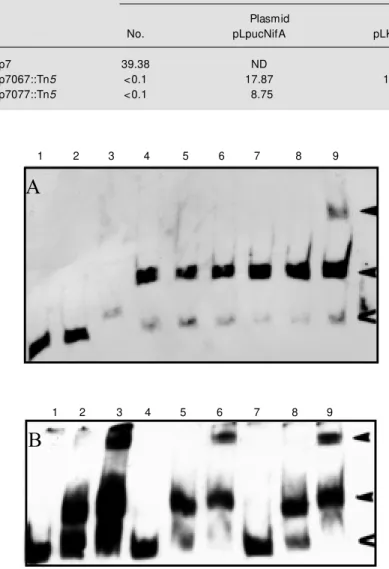
pro-tein provided by plasmids pCK3, pAKpA or pGEXKpA were used as positive control. The binding reactions were carried out at 30°C for 20 min in order to maintain the NifA protein in an active form (13). A re-tarded band was visualized when extracts from MC1061/pCK3, MC1061/pAKpA, MC1061/pGEXKpA, MC1061/p10 and MC1061/pAAbA were incubated with the UAS-carrying fragments (Figure 7A, lanes 4-8). No shift was detected when an extract from MC1061 was used (Figure 7A, lane 2) or when an extract from MC1061/pCK3 was incubated with a 230-bp DNA fragment, with no UAS motif (Figure 7A, lane 3). Two retarded bands appeared when an extract from MC1061/pGEXAbA was used (Figure 7A, lane 9). The upper new extra band was
Table 4 - Nitrogenase activity of A. brasilense.
Complementation w as measured in overnight cultures. The data are the average of three independent assays. ND = Not determined.
Strain Nitrogenase activity (nmol C2H4 min-1 mg protein-1)
Plasmid
No. pLpucNifA pLKSAbA
Sp7 39.38 ND ND
Sp7067::Tn5 <0.1 17.87 16.85
Sp7077::Tn5 <0.1 8.75 8.66
1 2 3 4 5 6 7 8 9
1 2 3 4 5 6 7 8 9
Figure 7 - Binding of NifA protein to the nifH UAS promoter region by gel-mobility shift assay. A, The 200-bp DIG labeled DNA fragment w as incubated w ith crude cell superna-tant from E. coli strains (20 µg total extract/reaction) containing the K. pneumoniae NifA protein synthesized by plasmids pCK3 (lane 4), pAKpA (lane 5) and pGEXKpA (lane 6) or
A. brasilense NifA protein synthesized by plasmids p10 (lane 7), pAAbA (lane 8) and pGEXAbA (lane 9), alone or fused w ith GST protein. Lane 1, control of DNA fragment; lane 2, the control of the DNA fragment w as incubated w ith M C1061 total extract, and lane 3, a 230-bp DNA fragment w ith no UAS motif, used as a probe, w as incubated w ith M C1061/pCK3 total extract (negative controls). B, Lanes 1, 4 and 7 correspond to the added w ild-type UAS region, UAS1 mutant and UAS2 mutant fragments, respectively. Lanes 2 and 3, w ild-type fragment incubated w ith crude cell supernatant from E. coli
strains (20 µg total extract/reaction): M C1061/pAAbA (lane 2) and M C1061/pGEXAbA (lane 3). Lanes 5 and 6, UAS1 mutant fragment incubated w ith total extracts from M C1061/pAAbA (lane 5) and from M C1061/pGEXAbA (lane 6). Lanes 8 and 9, UAS2 mutant fragment incubated w ith total extracts from M C1061/pAAbA (lane 8) and M C1061/pGEXAbA (lane 9). The full arrow heads represent the retarded bands and the open arrow head represents the free-labeled fragment.
A
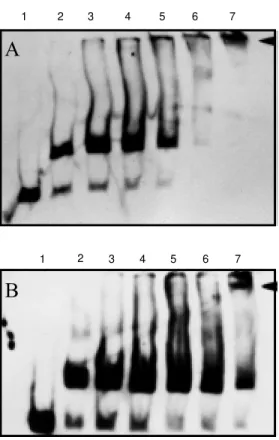
ment, and incubated with anti-A. brasilense NifA-antibody (Figure 8). Increasing a-mounts of antibody led to the formation of a high molecular weight complex which was not visible in the control reaction (Figure 8, lane 2). Since this antibody was shown to be
specific for A. brasilense NifA protein, the
supershift effect detected when both extracts were used should be due to the formation of the DNA-NifA-antiNifA complex. A similar result was also reported by Zimmer et al. (34) using extracts enriched for HoxA pro-tein in the presence of purified HoxA anti-bodies.
Up to now, only NifA from K.
pneumo-niae and A. vinelandii have been purified.
The K. pneumoniae NifA protein has been purified as a fusion protein with MBP, pro-viding a large N-terminal extension (13). The A. vinelandii NifA protein was purified
as a soluble active protein and showed in
vitro control functions predicted from in
vivo functions (7). In these two bacteria the
activity of NifA is modulated by the negative regulatory protein NifL in response to envi-ronmental oxygen and fixed nitrogen (6,7). The A. brasilense NifA protein belongs to a class of proteins that are not active in the presence of oxygen, based on the model of regulation proposed by Fischer et al. (8,9) that involves the cysteine residues found in the inter-linker domain. Another feature of A. brasilense NifA is that the N-terminal domain inhibits its own activity in the pres-ence of ammonia (33). This was explained
by the presence of two closely related PII
proteins found in A. brasilense (18) that are
involved in different regulatory steps of
ni-trogen metabolism. The PII protein, a
prod-uct of the glnB gene, is required for
modulat-ing NifA activity in response to changes in cellular nitrogen levels (18,33).
Our work demonstrates that the NifA
from A. brasilense can be expressed in E.
coli extracts both as a fusion protein or as
NifA itself but is still inactive in aerobically grown cells. This inactivation could be due
visualized only with E. coli harboring this
plasmid and was probably due to the high molecular weight GST-NifA fusion protein. When the 200-bp DNA fragments carry-ing the mutated UAS motifs were used as a probe a gel shift band was also visualized (Figure 7B). The extra band in gel shift assays was also detected when the UAS
mutant DNA fragments were mixed with A.
brasilense NifA fused with GST (MC1061/
pGEXAbA). Previously, we have demon-strated that the two overlapping UAS
se-quences have differential effects on nifH
promoter activity using K. pneumoniae NifA
protein (27). However, the binding affinity of A. brasilense NifA protein, fused or not with GST, revealed no specificity when we compared wild-type or mutant UAS DNA fragments.
To further analyze the binding of NifA protein, mobility gel shift assays were car-ried out with NifA preparations (total ex-tracts from MC1061/pAAbA and MC1061/ pGEXAbA), wild-type UAS-carrying
frag-1 2 3 4 5 6 7
Figure 8 - M obility shift assay of
E. coli extracts carrying plasmids pAAbA (A) or pGEXAbA (B) in t he presence of increasing amount of purified NifA anti-body. Standard binding reactions w ere carried out w ith the total extracts previously incubated overnight w ith different antibody concentrations. Lane 1, Wtype fragment only; lane 2, w ild-type fragment and 20 µg of pro-tein. Lanes 3 to 7, different a-mounts of antibody reacting w ith fragment/protein as in lane 2. Lane 3, 2 µl of anti-NifA; lane 4, 4 µl of anti-NifA; lane 5, 8 µl of NifA; lane 6, 16 µl of NifA and lane 7, 32 µl of anti-NifA. The supershift band is indi-cated by the full arrow head.
1 2 3 4 5 6 7
A
to the lack of A. brasilense PII-like protein in
E. coli cells. However, NifA activity was
obtained in A. brasilensenifA mutants. Thus,
even if a different mechanism is involved in the regulation of nitrogen fixation in the presence of ammonia, it is possible that one mechanism of control occurs at the level of NifA inactivation through its N-terminal
domain, mediated by PII protein (18).
The modular structure of transcriptional activators suggests that inactive NifA would be able to bind to its target sequences (35). It
has been shown, in the case of K.
pneumo-niae NifA, that DNA binding activity can be
separated from the transcriptional activation capacity (32). The oxygen sensitivity of the A. brasilense NifA is attributed to the con-served motif of cysteine residues which is present in the interdomain linker between the central and carboxy-terminal domains (8,9). Upon oxygen inactivation, it can be hypothesized that the conformation of the central domain is altered in such a way that transcriptional activation capacity is lost,
without affecting the DNA-binding capacity of the carboxy-terminal domain. In the case of NtrC-like transcriptional activators, where transcriptional activation capacity is regu-lated by phosphorylation, the inactive, unphosphorylated activator is still able to bind to its UAS (36). In this study we show
that, although A. brasilense NifA protein is
unable to activate nif promoters in
aerobio-sis due to its sensitivity to oxygen, the pro-tein retains the ability to bind UAS sequences.
Ackno wle dgm e nts
The authors thank F. Pedrosa for the gift of plasmid p10 and H.B. Ferreira and S.S. Farias for the gift of plasmid pGEX and for help during the immunological experiments. We are indebted to J. Vanderleyden for pro-viding the opportunity for L.M.P. Passaglia to develop part of the experiments in his laboratory and for helpful discussions.
Re fe re nce s
1. Buck M , M iller S, Drummond M H & Dixon RA (1986). Upstream activator sequences are present in the promoters of nitrogen fixation genes. Nature, 320: 374-378. 2. Hoover TR, Santero E, Porter SC & Kustu
S (1990). The integration host factor stimulates interaction of RNA polymerase w ith NIFA, the transcriptional activator for nitrogen fixation operons. Cell, 63: 11-22. 3. Buchanan-W ollaston AV, Cannon M C, Beynon JL & Cannon FC (1981). Role of the nifA gene product in the regulation of
nif expression in Klebsiella pneumoniae.
Nature, 294: 776-778.
4. Hill S, Kennedy C, Kavanagh EP, Goldberg R & Hanan R (1981). Nitrogen fixation gene (nifL) involved in oxygen regulation of nitrogenase synthesis in Klebsiella pneumoniae. Nature, 290: 424-426. 5. M errick M , Hill S, Hennecke H, Hahn M ,
Dixon R & Kennedy C (1982). Repressor properties of the nifL gene product in
Klebsiella pneumoniae. M olecular and General Genetics, 185: 75-81.
6. Lee H, Narberhaus F & Kustu S (1993). In vitro activity of NifL, a signal transduction
protein for biological nitrogen fixation.
Journal of Bacteriology, 175: 7683-7688. 7. Austin S, Buck M , Cannon W, Eydmann T
& Dixon RA (1994). Purification and in vitro activities of the native nitrogen fixa-tion control proteins NifA and NifL. Jour-nal of Bacteriology, 176: 3460-3465. 8. Fischer HM , Bruderer T & Hennecke H
(1988). Essential and non-essential do-mains in the Bradyrhizobium japonicum
NifA protein: identification of indispen-sible cysteine residues potentially in-volved in redox reactivity and/or metal binding. Nucleic Acids Research, 16: 2207-2224.
9. Fischer HM , Fritsche S, Herzog B & Hennecke H (1989). Critical spacing be-tw een be-tw o essential cysteine residues in the interdomain linker of the Bradyrhizo-bium japonicum NifA protein. FEBS Let-ters, 255: 167-171.
10. Drummond M H, Whitty P & Wootton JC (1986). Sequence and domain relation-ships of ntrC and nifA from Klebsiella pneumoniae: homologies to other regula-tory proteins. EM BO Journal, 5: 441-447.
11. Drummond M H, Contreras A & M itchenall LA (1990). The function of isolated do-mains and chimaeric proteins constructed from the transcriptional activators NifA and NtrC of Klebsiella pneumoniae. M o-lecular M icrobiology, 4: 29-37.
12. M orett E, Cannon W & Buck M (1988). The DNA-binding domain of the transcrip-tional activator protein NifA resides in its carboxy terminus, recognises the up-stream activator sequences of nif promot-ers and can be separated from the posi-tive control function of NifA. Nucleic Ac-ids Research, 16: 11469-11488. 13. Lee H, Berger DK & Kustu S (1993).
Activ-ity of purified NifA, a transcriptional acti-vator of nitrogen fixation genes. Proceed-ings of the National Academy of Sciences, USA, 90: 2266-2270.
14. Cannon W & Buck M (1992). Central do-main of the positive control protein NifA and its role in transcriptional activation.
Journal of M olecular Biology, 225: 271-286.
NIFA, a bacterial-binding protein, activates transcription in vitro: Activation is inhib-ited by NIFL. Proceedings of the National Academy of Sciences, USA, 91: 103-107. 16. Liang YY, de Zamaroczy M , Arsène F, Paquelin A & Elmerich C (1992). Regula-tion of nitrogen fixaRegula-tion genes in Azospi-rillum brasilense Sp7: Involvement of the
nifA, glnB and glnA gene products. FEM S M icrobiology Letters, 100: 113-120. 17. de Zamaroczy M , Paquelin A & Elmerich
C (1993). Functional organization of the
glnB/glnA cluster of Azospirillum brasilen-se. Journal of Bacteriology, 175: 2507-2515.
18. de Zamaroczy M , Paquelin A, Peltre G, Forchhammer K & Elmerich C (1996). Co-existence of tw o structurally similar but functionally different PII proteins in Azos-pirillum brasilense. Journal of Bacteriol-ogy, 178: 4143-4149.
19. M agasanik B (1988). Reversible phospho-rylation of an enhancer binding protein regulates the transcription of bacterial ni-trogen fixation genes. Trends in Biochemi-cal Sciences, 13: 475-479.
20. Stock JB, Ninfa AJ & Stock AM (1989). Protein phosphorylation and regulation of adaptative responses in bacteria. M icro-biological Review s, 53: 450-490. 21. Zhang Y, Burris RH, Ludden PW &
Rob-erts GP (1994). Posttranslational regula-tion of nitrogenase activity in Azospirillum brasilense ntrBC mutants: Ammonium and anaerobic sw itch-off occurs through independent signal transduction path-w ays. Journal of Bacteriology, 176: 5780-5787.
22. Sambrook J, Fritsch EF & M aniatis T (1989). M olecular Cloning: A Laboratory M anual. Cold Spring Harbor Laboratory Press, New York.
23. Vanst ockem M , M ichiels K & Vanderleyden J (1987). Transposon mu-tagenesis of Azospirillum brasilense and
Azospirillum lipoferum: physical analysis of Tn5 and Tn5-mob insertion mutants.
Applied and Environmental M icrobiology,
53: 410-415.
24. Burris RH (1972). Nitrogen fixation - assay methods and techniques. M ethods in En-zymology, 248: 415-431.
25. Galim and M , Perroud B, Delorm e F, Paquelin A, Vieille C, Bozouklian H &
Elmerich C (1989). Identification of DNA regions homologous to nitrogen fixation genes nifE, nifUS and fixABC in Azospiril-lum brasilense Sp7. Journal of General M icrobiology, 135: 1-13.
26. Cannon FC, Riedel GE & Ausubel FM (1979). Overlapping sequences of Kleb-siella pneumoniae nif DNA cloned and characterised. M olecular and General Ge-netics, 174: 59-66.
27. Passaglia LM P, Schrank A & Schrank IS (1995). The tw o overlapping Azospirillum brasilense upstream activator sequences have differential effects on nifH promoter activity. Canadian Journal of M icrobiology,
41: 849-854.
28. Beynon JL, Williams M K & Cannon FC (1988). Expression and functional analysis of the Rhizobium m eliloti nifA gene.
EM BO Journal, 7: 7-14.
29. Santero E, Hoover TR, Keener J & Kustu S (1989). In vitro activity of the nitrogen fixa-tion regulatory protein NifA. Proceedings of the National Academy of Sciences, USA, 86: 7346-7350.
30. Austin S, Henderson NC & Dixon RA (1990). Characterization of the Klebsiella pneumoniae nitrogen-fixation regulatory proteins NifA and NifL in vitro. European Journal of Biochemistry, 187: 353-360. 31. Liang YY, Kaminski PA & Elmerich C
(1991). Identification of a nifA-like regula-tory gene of Azospirillum brasilense Sp7 expressed under conditions of nitrogen fixation and in the presence of air and am m onia. M olecular M icrobiology, 5: 2735-2744.
32. Berger DK, Narberhaus F, Lee H & Kustu S (1995). In vitro studies of the domains of the nitrogen fixation regulatory protein NIFA. Journal of Bacteriology, 177: 191-199.
33. Arsène F, Kaminski PA & Elmerich C (1996). M odulation of NifA activity by PII in Azospirillum brasilense: evidence for a regulatory role of the NifA N-terminal do-main. Journal of Bacteriology, 178: 4830-4838.
34. Zimmer D, Schw artz E, Tran-Betcke A, Gew inner P & Friedrich B (1995). Temper-ature tolerance of hydrogenase expres-sion in Alcaligenes eutrophus is conferred by a single amino acid exchange in the transcriptional activator HoxA. Journal of
Bacteriology, 177: 2373-2380.
35. North AK, Klose KE, Stedman KM & Kustu S (1993). Prokaryotic enhancer binding proteins reflect eukaryotic-like modular-ity: the puzzle of nitrogen regulatory pro-tein C. Journal of Bacteriology, 175: 4267-4273.
36. Van Soom C, de Wilde P & Vanderleyden J (1997). HoxA is a transcriptional regula-tor for expression of the hup structural genes in free-living Bradyrhizobium japo-nicum. M olecular M icrobiology, 23: 967-977.
37. Tarrand JJ & Krieg NR (1978). A taxo-nomic study of the Spirillum lipoferum
group w ith descriptions of a new genus,
Azospirillum gen. nov. and tw o species, Azospirillum lipoferum (Beijerinck) comb. nov. and Azospirillum brasilense sp. nov.
Canadian Journal of M icrobiology, 24: 967-980.
38. Casadaban M J, Chou J & Cohen SN (1980). In vitro gene fusions that join an enzymatically active beta-galactosidase segment to amino-terminal fragments of exogenous proteins: Escherichia coli plas-mid vectors for the detection and cloning of translational initiation signals. Journal of Bacteriology, 143: 971-980.
39. Studier FW & M offatt BA (1986). Use of bacteriophage T7 RNA polymerase to di-rect selective high-level expression of cloned genes. Journal of M olecular Biol-ogy, 189: 113.
40. Simon R, Priefer U & Pühler A (1983). A broad host range mobilization system for
in vivo genetic engineering: transposon mutagenesis in Gram negative bacteria.
Bio/Technology, 1: 784-790.
41. Staskaw icz B, Dahlbeck D, Keen N & Napoli C (1987). M olecular characteriza-tion of cloned avirulence genes from O and race 1 of Pseudomonas syringe p.v.
glycinea. Journal of Bacteriology, 169: 5789-5794.
42. Kennedy C & Drummond M H (1985). Use of cloned nif regulatory elements from
Klebsiella pneumoniae to examine nif
regulation in Azotobacter vinelandii. Jour-nal of General M icrobiology, 131: 1787-1795.
43. Rose RE (1988). The nucleotide sequence of pACYC184. Nucleic Acids Research,