The change in the motions of the Earth and spacecraft launching
-a college physics level -an-alysis
(As mudan¸cas no movimento da terra e o lan¸camento de ve´ıculos espaciais - uma an´alise no n´ıvel da gradua¸c˜ao em f´ısica)
Gengmin Zhang
1Key Laboratory for the Physics and Chemistry of Nanodevices and Department of Electronics, Peking University, Beijing, China
Recebido em 25/1/2013; Aceito em 14/3/2013; Publicado em 26/9/2013
Both the translational velocity and the angular velocity of the Earth change during a spacecraft launch-ing process, in which a spacecraft is accelerated from the ground and eventually sent into space. This article presents a systematic study of the role played by the changes in the translation and rotation of the Earth in spacecraft launching. Neglecting these changes, which inevitably arise in the interaction between the Earth and the spacecraft, there is an obvious conflict with the conservation laws of momentum and angular momentum. Nevertheless, this flaw in principle is not accompanied by any technically erroneous answers when college stu-dents solve the often-encountered exercise problems, thanks to the special reference frames stustu-dents use. It is pointed out that the technical validity of the Earth-in-constant-motion approximation cannot be generalized to arbitrary reference frames. For example, the correct values of the second and third cosmic velocities cannot be found in an arbitrary reference frame if the velocity of the Earth is treated as a constant. In an arbitrary reference frame, the increase in the translational kinetic energy of the Earth, which is caused by the work done by the gravitational pull by the spacecraft, is not negligible if compared with the increase in the kinetic energy of the spacecraft. It is also demonstrated that the disparity in the energy consumed in launching a spacecraft from the ground along different directions cannot be well interpreted if the angular velocity of the Earth is treated as a constant. When the spacecraft is launched eastwards, the increase in its kinetic energy is partly gained, either directly or indirectly, at the expense of a decrease in the rotational kinetic energy of the Earth.
Keywords: second cosmic velocity, third cosmic velocity, Earth motion, conservation of momentum, conserva-tion of angular momentum, kinetic energy of the Earth.
Tanto a velocidade de transla¸c˜ao quanto a velocidade angular de rota¸c˜ao da Terra mudam durante o pro-cesso de um lan¸camento espacial, em que o ve´ıculo ´e acelerada a partir do solo e, finalmente, enviado para o espa¸co. Este artigo apresenta um estudo sistem´atico da influˆencia das mudan¸cas na transla¸c˜ao e na rota¸c˜ao da Terra sobre o processo de lan¸camento de um ve´ıculo espacial. Negligenciando essas mudan¸cas, h´a um conflito evidente com as leis de conserva¸c˜ao de momento e momento angular. No entanto, esta falha, em princ´ıpio, n˜ao ´e acompanhada por respostas tecnicamente erradas quando os estudantes universit´arios resolvem esse tipo comum de exerc´ıcio, devido `a utiliza¸c˜ao de sistemas de referˆencia muito particulares. ´E importante observar que a validade t´ecnica da aproxima¸c˜ao da ”Terra em movimento constante” n˜ao pode ser generalizada para sistemas de referˆencia arbitr´arios. Por exemplo, os valores corretos da segunda e da terceira velocidades c´osmicas n˜ao podem ser encontrados em um sistema de referˆencia arbitr´ario se a velocidade da Terra for tratada como uma constante. Em um sistema de referˆencia arbitr´ario o aumento da energia cin´etica de transla¸c˜ao da Terra, cau-sado pelo trabalho realizado pela for¸ca gravitacional da ve´ıculo espacial, n˜ao ´e insignificante quando comparado com o aumento da energia cin´etica do pr´oprio ve´ıculo. Tamb´em fica demonstrado que a disparidade na energia consumida no lan¸camento de um ve´ıculo espacial a partir do solo ao longo de dire¸c˜oes diferentes n˜ao pode ser explicada se a velocidade angular da Terra for tratada como uma constante. Quando o ve´ıculo ´e lan¸cado para leste, o aumento da sua energia cin´etica ´e parcialmente ganho, quer direta ou indiretamente, `as custas de uma diminui¸c˜ao da energia cin´etica de rota¸c˜ao da Terra.
Palavras-chave: segunda velocidade c´osmica, terceira velocidade c´osmica, movimento da Terra, conserva¸c˜ao do momento, conserva¸c˜ao do momento angular, energia cin´etica da Terra.
1E-mail: [email protected].
1. Introduction
As is well known, neglecting the motion of the Earth in studying the motions of particles in the vicinity of the Earth leads to contradictions in principle. The most cited example seems to be that the momentum of the particle-Earth system is not conserved when the par-ticle is supposed to fall to a “motionless” ground [1]. Generally, however, this conceptual deficiency is not accompanied by technically detectable mistakes. This article systematically re-examines this topic from the perspective of spacecraft launching. The changes in the motion of the Earth are studied during both the accelerating process and escaping process of a space-craft. To maintain a rigorous application of Newton’s second law, inertial reference frames, in which the cen-ter of mass of the spacecraft-Earth system is either at rest or in a uniform rectilinear motion, are employed. Changes in the motion of the Earth play arguably an indispensable role in the process of spacecraft launch-ing. Omitting these changes could lead to erroneous results.
For clarity, the well-known definitions of the sec-ond and third cosmic velocities are repeated here. The minimum velocity (or more unambiguously, speed) re-quired for a spacecraft at the surface of the Earth to escape the gravitational pull of the Earth is defined as the second cosmic velocity (or the “escape velocity”). The minimum velocity for a spacecraft at the surface of the Earth to escape the gravitational pull of the Sun is defined as the third cosmic velocity. In these defini-tions, it has to be emphasized, the two cosmic velocities are both measured with respect to the Earth center.
2.
Some ambiguities in determining the
second cosmic velocity and their
clar-ifications
2.1. Possible ambiguities
The mass of the spacecraft, the mass and radius of the Earth are denoted by m,Me andRe, respectively. As
is usually taught in textbooks, the second cosmic veloc-ity (denoted here byv2) can be found by invoking the theorem of kinetic energy:
0−12mv22=−
GMem
Re
. (1)
Despite the extreme simplicity of this problem, sev-eral ambiguities could arise, including: (i) the reference frame in which the problem is treated; (ii) the precise meaning of the term “−GMem
Re ”; and (iii) the
reason-ableness in neglecting the kinetic energy of the Earth.
2.2. The appropriate reference frames
Newton’s second law is valid only in an inertial refer-ence frame. With all the external forces, e.g. those
from the Sun and the Moon, omitted, a reference frame in which the center of mass of the spacecraft-Earth system is either at rest or in uniform rectilinear mo-tion should be rigorously speaking an inertial reference frame. Hereafter, a frame in which the center of mass of the spacecraft-Earth system is at rest is termed the “S frame” and a frame in which the center of mass un-dergoes uniform rectilinear motion is termed the “S’ frame”.
Of course, one can also opt to use a reference frame in which the center of the Earth is either at rest or in uniform rectilinear motion. In this case, the refer-ence frame is non-inertial because of the gravitational pull received by the Earth from the spacecraft and iner-tia forces should be introduced to guarantee conceptual rigor [2]. The discussion in this article is restricted to inertial frames only.
2.3. The exact meaning of the term “−GMem
Re ”
In some textbooks, it is explicitly stated and even em-phasized that the gravitational potential energy is as-sociated with the particle-Earth system instead of the particle alone [3]. Nonetheless, a student might still be dimly impressed that a particle alone has a gravi-tational potential energy near the Earth. For example, according to Eq. (1), during the escape of the space-craft from the Earth, the gravitational potential energy increases from−GMem
Re to zero at the expense of a loss
in the kinetic energy of the spacecraft alone. That is, the increase in the kinetic energy of the Earth does not appear to play any role in the increase in the potential energy. (Hereafter, the word “increase” means the dif-ference between the kinetic energies at two states, with the kinetic energy of the final state as the minuend and that of the initial state as the subtrahend. An “in-crease” can be either positive or negative.) Therefore, it is quite natural for a student to relate the potential energy−GMem
Re solely to the spacecraft.
As common knowledge, the introduction of poten-tial energy arises from the work done by conservative forces. It should be emphasized that work is actually done by a pair of forces in the above example. That is, the gravitational pull exerted on the Earth by the spacecraft also plays an indispensable role. The follow-ing discussion is restricted to the assumption that the force and counter force between two arbitrary particles lie along the straight line that joins the two particles. The work done by such a pair of force and counter force between two particles is
LetF12=|F12|,ρ= r1−r2, andρ=|ρ|. Then [4]
dW =±F12dρ. (3)
Importantly, dρis actually the increase in the dis-tance between particles 1 and 2 and is independent of the choice of reference frame in Newtonian mechanics. Therefore, the work done by this force pair is indepen-dent of reference frame and consequently, can be calcu-lated in any reference frame. Generally, the most con-venient frame for the calculation is the frame in which one of the two particles, e.g. particle 2, is at rest. In this case,dr2= 0 and
dW =F12·dr1+F21·dr2=F12·dr1. (4) That is, calculating the work done by the force on particle 1 only in this particle-2-at-rest frame is equiv-alent to calculating the work done by the force pair in an arbitrary reference frame.
As commonly practiced in most textbooks, in the reference frame in which the Earth’s center is at rest, the work done by the Earth’s gravitational pull on the spacecraft is easily calculated to be “−GMem
Re ”. From
the above discussion, it is readily known that in the S frame the sum of the work done by the gravitational pull exerted on the spacecraft and that on the Earth is also “−GMem
Re ”. Equivalently, the term “−
GMem
Re ” can
be understood as the potential energy of the spacecraft-Earth system instead of that of the spacecraft alone.
Consequently, in the S frame, the term −GMem
Re
should be equal to the increase in the kinetic energy of the spacecraft-Earth system instead of the kinetic en-ergy of the spacecraft alone. According to K¨onig’s the-orem, the kinetic energy of the Earth, which is treated as a rigid body here, is the sum of two parts, namely, its “translational kinetic energy” and its “rotational kinetic energy”. During the escape of the spacecraft, the rotational kinetic energy of the Earth remains un-changed and is not taken into consideration when the theorem of kinetic energy is used.
The escape of the spacecraft from the Earth is reached if its relative velocity with respect to the Earth is at least zero at infinity. Because the center of mass of the spacecraft-Earth system is motionless in the S frame, after escape both the spacecraft and the Earth have (at least) zero velocity in the S frame. Thus Eq. (1) should be replaced by
−GMRem
e
= 0−
[1
2m(Ve+v2) 2
+1 2MeV
2
e
] , (5)
whereVedenotes the initial velocity of the Earth in the
S frame when escape has just commenced. (It might be necessary to remind possible freshman readers again that both the second and the third cosmic velocities are measured with respect to the Earth center. Therefore,
when measured in the S frame, the velocity of a space-craft with the second cosmic velocity is Ve+v2, not v2.)
Moreover, another equation derived from the con-servation of momentum should be added
m(Ve+v2) +MeVe= 0. (6)
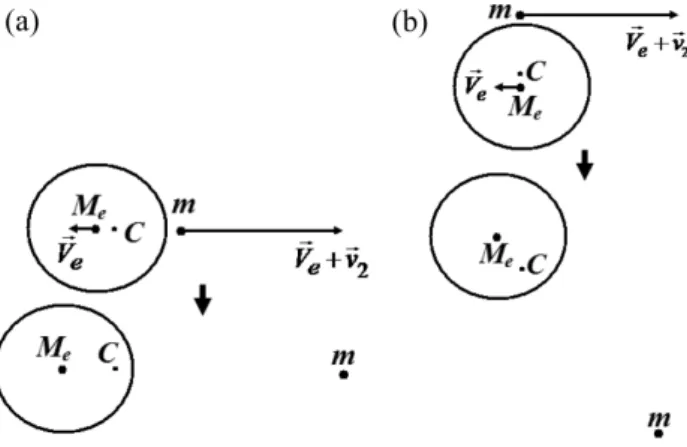
The process involving a spacecraft escaping the Earth, as observed in the S frame, is illustrated in Fig. 1. Two cases are described. In Fig. 1(a), both the initial velocity of the spacecraft and that of the Earth are along the straight line that joins the craft and the Earth’s center. In Fig. 1(b), the space-craft is launched along a tangent to the Earth’s surface. Fig. 1(a) provides the most direct visualization of this problem whereas Fig. 1(b) illustrates the use of the Earth’s rotation in the actual launch, as will be dis-cussed in section 4.
Figure 1 - Launching a spacecraft with the second cosmic veloc-ity as observed in the S frame. (The initial velocveloc-ity of the Earth and the distance from the center of mass of the spacecraft-Earth system to the Earth’s center are both greatly exaggerated.) (a) The spacecraft is launched along the straight line that joins the spacecraft and the Earth’s center; (b) The spacecraft is launched along a tangent to the Earth’s surface.
2.4. On the technical validity of omitting the increase in the Earth’s translational ki-netic energy
Using Eqs. (5) and (6), the second cosmic velocity can be found
v2=
√
2G(Me+m)
Re
, (7)
from which the often-used approximate result can be comfortably obtained after droppingm
v2=
√ 2GMe
Re
. (8)
In fact, after eliminating Ve using Eq. (6), Eq. (5) is
rewritten as
−GMem
Re
= [
0−12m (
Me
m+Me
v2
)2] +
[
0−1 2Me
(
− mv2
m+Me
)2]
. (9)
Now, Eq. (1) can be obtained from Eqs. (5) and (6) using two approximations. First, the initial speed of the spacecraft in the S frame, Mev2
m+Me, is approximated by
v2. Second, and more importantly, the increase in the Earth’s kinetic energy, 0− 1
2Me
(
− mv2 m+Me
)2
, is omit-ted directly. Both approximations can be well justified when the condition m << Me is taken into
considera-tion.
However, the situation is different when a reference frame in which the spacecraft-Earth system is in motion is used. Letucdenote the constant non-zero velocity of
the center of mass of this system in the S′ frame. The velocity of the Earth at the beginning of the escape in the S’ frame is denoted byUe. Apparently, the
defini-tion of v2 demands both the velocity of the spacecraft and that of the Earth should beuc after the escape of
the spacecraft. The process of escape is illustrated in Fig. 2. Accordingly, Eqs. (5) and (6) should be revised to state
−GMem
Re
=1
2(m+Me)u 2
c−
[1
2m(Ue+v2) 2
+1 2MeU
2
e
]
, (10)
and
m(Ue+v2) +MeUe= (m+Me)uc. (11)
Figure 2 - Launching a spacecraft with the second cosmic veloc-ity as observed in the S’ frame. (For simplicveloc-ity,uc andUe are
assumed to be along the same direction.) (a) The spacecraft is launched along the straight line joining the spacecraft and the Earth’s center; (b) The spacecraft is launched along a special tangent to the Earth’s surface.
Equation (7), and thus Eq. (8), can still be obtained from Eqs. (10) and (11). That uc does not appear in
the final result is expected because v2 is the relative
speed of the spacecraft with respect to the Earth and is independent of the reference frame.
The right side of Eq. (10) separates into two parts: the increase in the kinetic energy of the spacecraft, de-noted by ∆Ekm, and that of the Earth, denoted by
∆Eke. Taking into considerationm << Me, their
ex-pressions reduce to
∆Ekm=
1 2m
[
u2c−(Ue+v2)2
] =
−1 2m
[
2uc·v2+v22
]
, (12)
and
∆Eke=
1 2Me
(
u2c−Ue2
)
=muc·v2. (13) Apparently, ∆Ekeis generally not negligible in
com-parison with ∆Ekm unless |uc·v2| << v22. Conse-quently, when solving the problem in the S’ frame, ne-glecting the increase in the Earth’s kinetic energy dur-ing the escape of the spacecraft, i.e. treatdur-ing the veloc-ity of the Earth as constant, generally leads to a wrong result.
The physical origin of this disparity in treating the Earth’s kinetic energy in the two frames can be read-ily understood by comparing the power applied to the Earth by the gravitational field with that applied to the spacecraft, here denoted by Pe and Pm,
respec-tively. The two gravitational forces here are identical in magnitude but opposite in direction. Furthermore, the velocity of the Earth in the S frame at a certain moment is denoted byVand that of the spacecraft by
v. Obviously,V =|V|<< v=|v|and
Pe
Pm
= V
v <<1. (14)
Therefore, the increase of the kinetic energy of the Earth is negligible. However, when one moves to the S’ frame, the corresponding ratio becomes:
P′
e
P′
m
=γ|uc+V|
|uc+v|
, (15)
whereγis a factor determined by the velocity directions of the spacecraft and the Earth. Although
Vv << 1,
|uc+V|
|uc+v| is not necessarily a small quantity. That is, the
increase in the kinetic energy of the Earth is not gen-erally negligible in comparison with the increase in the kinetic energy of the spacecraft.
3.
Calculating the third cosmic velocity
directly in the Solar System
The velocity and speed of the Earth in the reference frame fixed to the Sun are:
Ue=|Ue|=
√ GMs
Rse
, (16)
where Ms and Rse are the mass of the Sun and the
radius of the orbit of the Earth around the Sun, re-spectively. (The orbit is approximated by a circle.)
The third cosmic velocity is denoted byv3here. One ostensibly plausible approach to determine v3 directly in the fixed-to-the-Sun reference frame is to resort to the theorem of kinetic energy for the spacecraft
−GMRem
e −
GMsm
Rse
= 0−12m(Ue+v3)2, (17)
from which the wrong result
v3= 1.38×10⁴ m/s (18)
is obtained.
The introduction of a critical speed,ξ=|ξ|, defined as the minimal speed required for the spacecraft in the Earth’s orbit to escape the Solar System, can establish a connection between Eq. (17) and the discussion in the previous section: given that
1 2mξ
2
−GMsm
Rse
= 0, (19)
Eq. (17) can be re-written as
−GMem
Re
= 1 2mξ
2
−12m(Ue+v3)2. (20) In this treatment, the left side of Eq. (20) is un-derstood as the work done by the Earth’s gravitation field on the spacecraft during the escape process. The right side is the increase in the kinetic energy of the spacecraft during this process. Right after the space-craft escapes from the Earth, i.e., when it is sufficiently far away from the Earth but still near the Earth’s or-bit around the Sun, the residual speed needs to be at least “ξ” for the spacecraft to further escape the Sun’s gravitational pull. From the discussion in the preceding section, the reason behind the mistake can be readily seen: −GMem
Re should be understood as the total work
done by the gravitational pull between the Earth and the spacecraft and is equal to the increase in the kinetic energy of the spacecraft-Earth system instead of that of the spacecraft alone. That is, the erroneous omission of the increase in the Earth’s kinetic energy leads to the wrong answer [5].
Denoting the velocity of the Earth after the escape of the spacecraft byUe1, Eq. (20) is revised as
−GMem
Re
= (
1 2mξ
2 +1
2MeU 2
e1
)
−
[ 1
2m(Ue+v3) 2
+1 2MeU
2
e
]
. (21)
Assuming the spacecraft escape time from the Earth is very short, the impulse due to the gravitational pull from the Sun during this time is negligible. Therefore, the momentum of the spacecraft-Earth system is ap-proximately conserved
MeUe1+mξ=MeUe+m(Ue+v3). (22)
Taking m << Me and using Eqs. (16), (19), (21),
and (22),v3is found to be
v3=
√ ξ2+U2
e −2Ueξ+
2GMe
Re
=
√ (
3−2√2)GMs Rse
+2GMe Re
= 1.66×10⁴m/s. (23)
4.
The change in Earth’s rotation in
ac-celerating a spacecraft
So far, the S frame has proved to be an appropriate reference frame in studying the spacecraft escape pro-cess from the Earthafter attaining the necessary high speed, e.g. v2, because the omission of the increase in the Earth’s translational kinetic energy in this refer-ence frame makes no technical differrefer-ence to the final result. However, if the S frame is further used in de-termining the energy required to accelerate an initially grounded spacecraft to the same high speed, caution must be taken again not to neglect the change in the motion of the Earth.
4.1. Verne’s gun
Verne envisaged a powerful gun that could send a space-craft to the Moon. Impractical as this approach is, it is nonetheless interesting to study the process where a spacecraft is accelerated to the second cosmic veloc-ity by such a gun on the surface of the Earth in the S frame. For simplicity, it is assumed that the gun is in rigid joint with the Earth. That is, the relative motion between the gun and the Earth caused by the spacecraft launching is neglected. Instead, it is imagined that the Earth and the gun jointly receives the recoil.
Letvi=vieˆ(vi=|vi|) andVi=−Viˆe(Vi=|Vi|),
where ˆeis the eastward unit vector, denote the respec-tive velocities of the spacecraft grounded at point “A” on the Earth surface and the center of the Earth “O” in the S frame before the launching. In the S frame, the center of mass of the spacecraft-Earth system “C” is at rest, thus
mvi+MeVi= 0. (24)
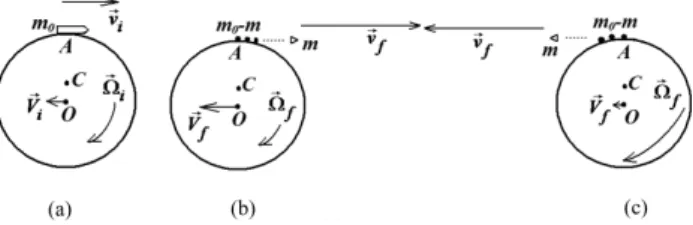
Before launching, as depicted in Fig. 3, the space-craft is motionless with respect to the surface of the Earth and its velocity in the S frame is purely the “ve-locity of following”. For simplicity, the spacecraft is assumed to be on the equator.
vi=Vi+Ωi×OA, vi=−Vi+ ΩiRe, (25)
where Ωi is the angular velocity of the Earth before
launch, and Ωi=|Ωi|. Thus,
Vi =
mΩiRe
Me+m
and vi =
MeΩiRe
Me+m
. (26)
Figure 3 - Launch of an initially grounded spacecraft using Verne’s gun, as observed in the S frame. (a) Before launch; (b) after an eastward launch; (c) after a westward launch.
When the accelerating process concludes, the space-craft gains a relative velocity v2 with respect to the Earth’s center. That is,
vf−Vf=v2=±v2ˆe, (27) where the upper sign corresponds to an eastward launch and the lower sign to a westward launch. Again, us-ing momentum conservation, the final velocities of the spacecraft and the Earth’s center can be calculated
vf =±
Mev2
Me+m
ˆ
e and Vf =∓
mv2
Me+m
ˆ
e. (28)
For both eastward and westward launches, the in-crease in the spacecraft’s kinetic energy is
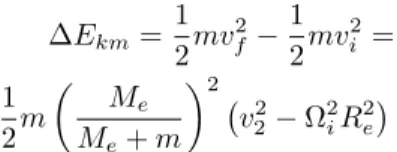
∆Ekm=
1 2mv
2
f −
1 2mv
2
i =
1 2m
( Me
Me+m
)2 (
v22−Ω2iR2e
)
. (29)
Similarly, in both eastward and westward launch-ings, the increase in the Earth’s translational kinetic energy is
∆Ekt=
1 2MeV
2
f −
1 2MeV
2
i =
1 2Me
( m Me+m
)2 (
v22−Ω2iR
2
e
)
<<∆Ekm. (30)
Furthermore, the recoil of the powerful gun in-evitably changes not only the velocity of the Earth’s center, but also, more importantly, the angular veloc-ity of the Earth. Neglecting external forces, the angu-lar momentum of the spacecraft-Earth system is con-served. Also, the period of acceleration is approximated as being very short, so that the change in the space-craft’s position during acceleration can be neglected. The most straightforward reference point (not neces-sarily the most convenient one) for calculating angular momenta is the center of mass, i.e. point C. The axis that passes the Earth’s center O and is perpendicular to the equator plane is approximated as a principal axis of inertia and the corresponding moment of inertia is denoted byI. Then,
CA×mvi+CO×MeVi+IΩi=
CA×mvf+CO×MeVf+IΩf, (31)
whereΩf is the angular velocity of the Earth after the
accelerating process.
Using conservation of momentum, Eq. (31) can be rewritten as
Re·mvi+IΩi=±Re·mvf+IΩf. (32)
Equation (32) demonstrates that the most conve-nient reference point to calculate the angular momen-tum of the spacecraft-Earth system is actually the spa-tial point in the S frame that momentarily coincides with the Earth’s center O during the accelerating of the spacecraft. Rearrangement of Eq. (32) yields
Ωf = Ωi+
Rem
∆Ekr=
1 2IΩ
2
f−
1 2IΩ
2
i =
Rem(vi∓vf)·
[ Rem
2I (vi∓vf) + Ωi ]
. (34)
As a good approximation, it is assumed that I = kMeR2e. Obviously, in Eq. (34),
R2eIm(vi∓vf)
=
m
2kMe
(vi∓vf)
Re
<<Ωi. Hence, by using Eqs. (26), (28), (29), (30), (34) and approximating Me
Me+mand
m Me+mby
1 and 0, respectively, the increase in the kinetic energy of the spacecraft-Earth system is calculated to be
∆Ek= ∆Ekm+ ∆Ekt+ ∆Ekr=
∆Ekm+ ∆Ekr =
1
2m(v2∓ΩiRe) 2
. (35)
This result is in agreement with that obtained in the reference frame fixed to the ground. Irrespective of whether observed in the S frame or the frame fixed to the ground, the conclusion is the same: launching the spacecraft eastwards consumes less energy than launch-ing westwards. Nonetheless, the interpretations in the two frames differ. In the frame fixed to the ground, the initial spacecraft speed is zero. The final spacecraft speed in an eastwards launch,v2−ΩiRe, is smaller than
that in a westwards launch,v2+ ΩiRe. In the S frame,
when the spacecraft is launched eastwards, the gun’s re-coil slows the rotation of the Earth and ∆Ekr <0. That
is, a certain amount of the Earth’s rotational kinetic en-ergy is converted into kinetic enen-ergy of the spacecraft; thus less chemical energy from the gunpowder is con-sumed. When the spacecraft is launched westwards, the recoil pushes the Earth to rotate faster and ∆Ekr>0.
In this case, the expended chemical energy from the gunpowder is used to increase both the kinetic energy of the spacecraft and the rotational kinetic energy of the Earth.
4.2. Tsiolkovsky’s rocket
The derivation of Tsiolkovsky’s ideal rocket equation can be routinely found in college textbooks. It is re-peated here with all velocities written in vector form.
The total mass of the rocket before launching ism0. The mass of the spacecraft, which is the payload of the rocket, ism. The initial velocity of the grounded rocket observed in the S frame isvi=vieˆ, where ˆeis still the
eastward-pointing unit vector, and the final velocity of the spacecraft after depletion of all fuel is vf =±vfeˆ.
The effective exhaust velocity of the fuel is η = ∓ηeˆ. Here vf = |vf| > 0 and η = |η| > 0. Again, upper
signs refer to eastward launchings and lower signs to westward launchings. The velocity of the rocket at a given moment is v. The mass of the rocket at this mo-ment is denoted also bym. The increase in the rocket’s
mass due to the expended fuel over an infinitesimal time interval isdm <0. Correspondingly, the increase in the velocity of the rocket isdv.
The conservation of the momentum of the rocket system requires:
mv= (m+dm) (v+dv) + (−dm) (v+dv∓ηeˆ). (36) Therefore,
∫ ±vfˆe
viˆe
dv=∓ηeˆ ∫ m
m0
dm
m , (37)
from which the relation between the mass of the space-craft and the initial mass of the rocket can be estab-lished:
m0=me
vf∓vi
η . (38)
That is, for identical final speed vf(> vi), a rocket
can have a smaller mass when launched eastwards than launched westwards. Unlike Verne’s gun, here the ad-vantage in launching eastwards is apparent without the need to consider the increase in the rotational kinetic energy of the Earth. The reason is very simple. In obtaining the ideal rocket equation, the rocket, includ-ing payload and fuel, is approximated as an isolated system. For Verne’s gun, the accelerating of the space-craft requires accelerating the ground in the opposite direction. For Tsiolkovsky’s rocket, the accelerating of the spacecraft is negated by expelling spent fuel in the opposite direction.
Figure 4 - Launching of an initially grounded spacecraft using Tsiolkovsky’s rocket as observed in the S frame. (a) Before the launching; (b) after an eastward launching; (c) after a westward launching.
For an eastward launching, the rocket’s velocity be-fore launching is vi = (−Vi+ReΩi) ˆe, and the
veloc-ity of the fuel after the launching, which is first ex-pelled from the rocket and eventually falls to ground, is [−(Vi+ ∆V) +Re(Ωi+ ∆Ω)] ˆe, where ∆V and ∆Ω
are the increase in the speed and angular velocity of the Earth caused by the adhesion of the fuel. Momen-tum conservation of the spacecraft-fuel-Earth system expressed in the S frame requires
m0(−Vi+ReΩi)−MeVi=mvf+ (m0−m)× [−Vi−∆V +Re(Ωi+ ∆Ω)]−Me(Vi+ ∆V) = 0.(39)
The angular momentum of the system is also con-served. Here the spatial point that coincides with the Earth’s center at the moment of launch (not the Earth’s center itself) is taken as the reference point. Therefore,
Rem0(−Vi+ReΩi) +kMeR2eΩi=
Remvf+Re(m0−m) [−(Vi+ ∆V) +Re(Ωi+ ∆Ω)] +
kMeR2e(Ωi+ ∆Ω). (40)
As in the preceding section, it is easy to verify that the increase in the Earth’s translational kinetic energy is negligible in comparison with the increase in the spacecraft’s kinetic energy.
From Eqs. (39) and (40), ∆Ω can be found
∆Ω = −m(Vi+vf−ReΩi) Re[kMe+ (k+ 1) (m0−m)]
=
−m(vkMf−ReΩi)
eRe
<0. (41)
The increase in the rotational kinetic energy of the Earth is thus calculated to be
∆Ekr=
1 2kMeR
2
e
[
(Ωi+ ∆Ω)2−Ω2i
] =
−mReΩi(vf−ReΩi)<0. (42)
The spacecraft’s accelerating eventually slows down the Earth’s rotation when the spent fuel falls to the
ground. In this sense, it is still reasonable to argue that the spacecraft gains its kinetic energy at the expense of the rotational kinetic energy of the Earth.
In a westward launch, the corresponding results are
∆Ω = m(vf+ReΩi)−mVi Re[kMe+ (k+ 1) (m0−m)]
=
m(vf+ReΩi)
kMeRe
>0, (43)
and
∆Ekr=
1 2kMeR
2
e
[
(Ωi+ ∆Ω)2−Ω2i
] =
mReΩi(vf+ReΩi)>0. (44)
5.
Conclusion
When one tries to solve an astronautics problem, such as finding the second and third cosmic velocities, in an inertial reference frame in which the spacecraft-Earth system is moving, the increase in the kinetic energy of the Earth should be considered, because the power of the gravitational pull from the spacecraft doing work on the Earth is not negligible in comparison with the power of the gravitational pull from the Earth doing work on the spacecraft.
The launching of an initially grounded spacecraft into space inevitably changes the Earth’s rotation. Launching the spacecraft eastwards is more economi-cal in terms of energy consumption because part of the rotational kinetic energy of the Earth is converted into kinetic energy of the spacecraft. For Verne’s gun, the conversion is direct; for Tsiolkovsky’s rocket, the con-version is indirect.
References
[1] T. Moore,Six Ideas that Shaped Physics, Unit C: Con-servation Laws Constrain Interaction(WCB McGram-Hill, New York, 2003), 2nd
ed, p. 60.
[2] B.K. Gao and T.Z. Xie, College Physics11, 46 (1991) (in Chinese).
[3] R.A. Serway and J.W. Jewett, Principle of Physics (Qinghua University Press, Beijing, 2004), 3rd
ed., p. 211.
[4] A.S. Qi and C.Y. Du, Mechanics (Higher Education Press, Beijing, 2005) 2nd
ed., p. 127 (in Chinese).
[5] Z.H. Hu, College Physics7, 26 (1984) (in Chinese).
[6] R.A. Serway and J.W. Jewett, Principle of Physics (Qinghua University Press, Beijing, 2004), 3rd