Vol. 32 n. esp., pp. 1-10 doi: http://dx.doi.org/10.1590/0102-3772e32ne219 ORIGINAL ARTICLE
The relationship between context, attitudes and well-being in organizational change
Kettyplyn Sanches Franco1
Elaine Rabelo Neiva Vanessa de Fátima Nery
Gisela Demo
Universidade de Brasília
ABSTRACT - A model was proposed to assess whether attitudes mediate the relationship between the context of organizational change and well-being. A quantitative study was conducted to test the model in three Brazilian public organizations that underwent organizational change processes. Seven hundred, ninety-ive employees answered the organizational change context attributes scale, attitudes toward organizational change scale and scale of well-being in the workplace. Analyses of validity and reliability were carried out for all measures using three diferent samples, while Path Analysis were performed to test the mediation model. The model was partially corroborated suggesting the inluence of attitudes and attributes of change on the well-being. In addition, the study provides mediation as a methodological strategy that can be used in further research.
Keywords: organizational change, organizational environment, attitude, well-being.
A relação entre atributos, atitudes e bem-estar na mudança organizacional
RESUMO - Um modelo para avaliar se atitudes medeiam a relação entre os atributos de mudança organizacional e o bem-estar foi testado com uma amostra de 795 trabalhadores oriundos de três diferentes organizações públicas que passaram por processos de mudança organizacional. Três instrumentos foram aplicados pela internet, a saber: Escala dos atributos da mudança organizacional, escalas de atitudes frente a mudança organizacional e de bem-estar no trabalho. Diferentes amostras foram utilizadas para análises fatoriais conirmatórias das escalas e os resultados indicaram bons índices de validade das estruturas originais das escalas. Análises de trajetória -Path Analysis- foram realizadas para testar o modelo de mediação. O modelo foi parcialmente corroborado apontando a inluência das atitudes e dos atributos de mudança no bem-estar.
Palavras-chave: mudança organizacional, contexto organizacional, atitude, bem-estar.
1 Contact: [email protected].
The study of behavioral and afective aspects is a hi -ghlight in the topic of organizational change, because of the increasingly recognition of the importance of employees’ reactions for successful interventions (Bordia, Restubog,
Jimmieson & Irmer, 2011; Fugate, Prussia & Kinicki, 2012;
Oreg, Vakola & Armenakis, 2011). Therefore, the capacity of the organization to understand and implement changes
emerges as a crucial diferential (Van de Ven & Sun, 2011).
The successful corporations are those capable of predicting change and developing their strategies in advance (Neiva &
Paz, 2012, Van de Ven & Sun, 2011).
The exclusive use of productivity and results indicators does not comprise the human aspects contained in the process
of organizational change (Neiva & Paz, 2012, Oreg, Vakola &
Armenakis, 2011, Van de Ven & Sun, 2011), because the im-plementation of organizational changes demands employees to adopt the new practices and behaviors required to the process. Organizational change could be conceptualized as a set of events occurring in the internal context of the organiza-tion and that, regarding individuals, typically brings about
reactions against the process (Neiva & Paz, 2012). Studies show that negative efects on the well-being resulting from
organizational changes are associated with the generation
of uncertainties and losses of job posts (Green, 2011), workers’ overload and stress (Dahl, 2011) and increased anxiety (Bryson, Barth & Dale-Olsen, 2013). Context characteristics are an important antecedent of explicit
re-actions to organizational change (Neiva & Paz, 2012, Nery
& Neiva, 2015, Oreg, Vakola & Armenakis, 2011) that can be expressed in positive or negative terms. These reactions
have cognitive, afective and behavioral components. As -suming that attitudes regarding changes are considered to
be evaluative and afective, positive or negative reactions
towards the events and processes taking place in the orga-nization, and that attitudes have impact on the other human
afections (Lazarus & Folkman, 1984), one can suggest a relationship with the well-being of individuals in speciic
contexts of organizational change (Bryson, Barth & Dale--Olsen, 2013, Dahl, 2011).
The objective of this study is to test the relationship between the attributes of the organizational change context (planning/preparation and degree of risk of the change), the individuals’ attitudes in face of changes (acceptance, fear and opposition) and well-being at work. Although attitudes have been pointed out as mediators of the relationships between
attributes of change and individuals’ behavior (Neiva & Paz,
2012, Nery & Neiva, 2015), these have never been tested
as well-being antecedents (Neiva & Paz, 2012). To identify
variable in this study. Therefore, it intends to test a mediation model that has never been investigated in previous studies.
The context of organizational change
There is a need to identify the pertinent characteristics to
deine the organizational change context, and how these afect behavior, afects and cognitions of individuals (Kalimo, Taris & Schaufeli, 2003, Maes & Van Hootegem, 2011, Raferty & Restubog, 2010, Raferty & Griin, 2006). Eight attributes
that dynamically describe organizational change were listed (Maes & Van Hootegem, 2011):
- Control: refers to the emergent or planned change; - Scope: refers to the continuum of adaptation to change; - Frequency: refers to the number of organizational changes
taking place;
- Progress: is the number of stages to implement a change;
- Time: is how long change implementation will last; - Speed: refers to the pace of succession of actions of
change;
- Objectives: refer tothe inal status, when change is made;
- Leadership style and decision-making: deined by the
degree of participation that can range according to the degrees of cooperation and participation.
Some factors of the context of change have deserved at-tention (Oreg, Vakola & Armenakis, 2011), notably studies on to which extent interventions for change are planned (Nery & Neiva, 2015, Kalimo, Taris & Schaufeli, 2003), the organization background regarding change, future perspectives with new
change processes (Cunningham, 2006; Devos, Buelens & Bou -ckenooghe, 2007; Kalimo, Taris & Schaufeli, 2003), intensity of
the change process (Cunningham, 2006), frequency of occurren -ce of interventions, degree of risk of the organizational change (Nery & Neiva, 2015, Devos, Buelens & Bouckenooghe, 2007), degree of imposition of changes by senior management, and support provided to workers (Neiva, Odelius & Ramos, 2015). In the international setting, studies point out that context
attributes related to planning and eforts towards organization
change have great impact on the communication and reaction of workers (Self, Armenakis & Schraeder, 2007, Van de Ven & Sun, 2011). That is so because when an organization plans in advance the change-related actions, workers tend to
perceive these as less threatening (Cunningham, 2006, Dahl,
2011, Devos, Buelens & Bouckenooghe, 2007).
The context of change analyzed as antecedent variable herein is structured on two dimensions: planning, preparation
and previous experiences (PPEAM) and the degree of risk
of the change. It is also suggested that actions on change planning addressed to increase involvement in the process are associated with positive attitudes towards the organizational
change (Nery & Neiva, 2015, Raferty & Restubog, 2010)
and supportive behaviors (Kim, Hornung & Rosseau, 2011). The risk degree of the change could be associated with the individuals’ openness towards accepting the change process and emitting the expected behaviors during the process (Oreg, Vakola & Armenakis, 2011, Devos, Buelens &
Bouckenoo-ghe, 2007). Finally, the identiication of context attributes that inluence on organizational changes is an advantage
to the change agents, since that knowledge facilitates the
implementation and management of the process of change (Self, Armenakis & Schraeder, 2007).
Attitude towards organizational changes
At the start of a process of changes in an organization, the
irst experiences and information about change are enough to
bring about several cognitions and feeling such as frustration,
enthusiasm or fear (Choi, 2011, Bouckenooghe, 2010, Lines, 2005). Individual may have emotional reactions in the irst
contacts with a change, causing feelings such as frustration,
enthusiasm or fear (Choi, 2011; Bouckenooghe, 2010; Lines,
2005). On the other hand, changes can be positively perceived when these eliminate rework and unnecessary routines, and also maximize opportunities of growth and development to workers (Kruglanski, Higgins & Capozza, 2007).
There is an increasing need for surveys on the efects that
attitudes towards organizational change have on employees (Choi, 2011; Dahl, 2011), considering that workers’ attitude towards organizational change are critical aspects to the success of any organizational change. That is so because these attitudes predispose individuals to act in a given way in relation to an object (Oreg, Vakola & Armenakis, 2011).
The eforts to plan change in advance make change more
predictable, provide more information to people on the im-minence of changes and the likely duration of the process of change (Nery & Neiva, 2015, Neiva, Odelius & Ramos, 2015). Moreover, planning change implementation helps workers to
perceive the change as less threatening (Cunningham, 2006,
Devos, Buelens & Bouckenooghe, 2007), which shapes people’s feelings and viewpoints on the change (Vakola,
Tsa-ousis & Nikolaou, 2004). The occurrence of positive attitudes
- attitudes of acceptance - during the process of change enables
the occurrence of behaviors to it individuals into changes,
increasing the possibility of successful initiatives (Nery &
Neiva, 2015, Neiva & Paz, 2012). On the other hand, negative
attitudes in relation to changes, like fear and skepticism, could
have the opposite efect, reducing the probability of supportive behavior among employees (Neiva & Paz, 2012).
Hypotheses 1 and 2 herein assume that the planning of organizational changes and the degree of risk perceived by
employees can inluence their evaluations about the change
process (Nery & Neiva, 2015, Neiva, Odelius & Ramos, 2015,
Devos, Buelens & Bouckenooghe, 2007). Planning as attribute of the context can afect the cognitive evaluation and afect that
individuals address to this objective (Weinner, 2009). H1: The planning and preparation of organizational chan-ges are positively associated with attitudes of acceptance, and negatively associated with attitudes of fear and opposition during the process of change.
2011, Kruglanski, Higgins & Capozza, 2007). Therefore, the highest the impact of restructuring, more negative responses to change such as anger, cynism and feeling of uncertainty at work (Greenglass & Burke, 2000). This relationship gives rise to the following hypothesis:
H2: The degree of risk and uncertainties about the orga-nizational changes are negatively associated with attitudes of acceptance, and positively associated with attitudes of fear and opposition during the process of change.
Well-being at work
Well-being corresponds to afective and cognitive as -pects suchas evaluation of the organizational environment
(Dessen & Paz, 2010). Some authors describe well-being as the fulillment of the individuals’ needs and desires when performing their duties in the organization (Dessen & Paz, 2010). The well-being of collaborators may be inluenced by
the organizational change, and the implementation of organi-zational changes is related with the context wherein changes take place, the cognitive traits employed by the individual to construe them, and the opinion of other individuals about the process (Dahl, 2011; Green, 2011).
Literature emphasizes the inluence of factors of the con -text of change both on attitudes (Bordia et al., 2011, Nery &
Neiva, 2015) and on well-being (Cunningham, 2006; Raferty & Griin, 2006; Raferty & Restubog, 2010). During the im -plementation of changes, individual may be required to pre-sent new behaviors demanded by changes. However, changes
can bring out unplanned efects like denial, resistance, stress,
cynism, reduced commitment or illness among employees.
These efects are potential indicators of the (lack of) success
of the actions for change (Fugate et al., 2012; Oreg et al.,
2011; Self et al., 2007). Downsizing inluence the well-being
of employers with increased turnover (Fugate et al., 2012,
Raferty & Restubog, 2010), high levels of burnout, Cortisol
and testosterone (Dahl, 2011), low indexes of well-being, stress, cardiovascular symptoms (Dahl, 2011), absenteeism
(Burke & Greenglass, 2000; Cunningham, 2006), psycho -somatic symptoms (Burke & Greenglass, 2000), and other
forms of diseasing (Harenstam et al., 2004).
Employees can be more prone to support organizational changes if there is a feeling of trust and attachment to the organization, or when the organization is concerned about
quality of life at the workplace (Fugate et al., 2012; Raferty
& Restubog, 2010, Cunningham, 2006). Planning and dife
-rentiated communication strategies to the diferent phases of
organizational change could have an important impact on to which degree employees accept the change (Bryson, Barth &
Dale-Olsen, 2013) and efects on other afects and cognitions
of employees, according to evaluative models of emotions
and afects (Lazarus & Folkman, 1984). Therefore, when
an organization plans the process of change ensuring trust through information, transparency in process and care to the quality of life of workers, it can ensure positive impacts on their well-being. This brings about other hypotheses:
H3: The planning and preparation of organizational changes are positively associated with the well-being of employees during the process of change.
Other studies report that processes of change with high degree of risk reduce the feeling of well-being, increase the levels of dissatisfaction and stress at work, and reduce trust in the organization (Bryson, Barth & Dale-Olsen, 2013;
Noblet & Rodwell, 2008). Studies show that negative efects
on the well-being resulting from organizational changes are associated with the generation of uncertainties and losses of job posts (Green, 2011), workers’ overload and stress (Dahl, 2011) and increased anxiety (Bryson, Barth & Dale-Olsen, 2013). Moreover, the evaluations of threat are positively related to absenteeism, inertia and voluntary separations
(Fugate, Prussia & Kinicki, 2012).
H4: The degree of risk and uncertainties of organizational
changes are negatively associated with the well-being of employees during the process of change.
The context characteristics are an important antecedent of
explicit reactions to the organizational change (Neiva & Paz,
2012, Nery & Neiva, 2015) that, in turn, can be expressed
in positive or negative terms, and have cognitive, afective and behavioral components as attitudes (Neiva & Paz, 2012;
Oreg, Vakola & Armenakis, 2011). Assuming that attitudes towards changes also have impact on the remainder human
afects, according to the evaluative models of emotions and afects Lazarus & Folkman, 1984), so we can suggest a relationship with the well-being of individuals in speciic
contexts of organizational change (Bryson, Barth & Dale--Olsen, 2013; Dahl, 2011).
H5: Attitudes of acceptance, opposition and fear mediate the link between planning and preparation of organizational changes and the well-being of employees during the process of change.
H6: Attitudes of acceptance, opposition and fear mediate
the link between degree of risk and uncertainties of organi-zational changes and the well-being of employees during the process of change.
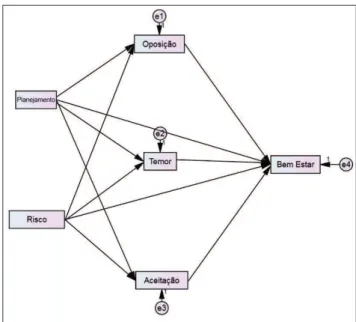
Figure 1 illustrates the relationships hypothesized in the text.
Method
Description of organizations and contexts of changes
The survey comprised employees and service providers
of three public organizations in the ield of electric power services in Brazil, and in the ield of delivering professional
selection and public contest services. Organization 1 is a public-private partnership in the segment of electric power generation and transmission. Organization 2 is a company
working in the ield of electric power distribution and sale. Finally, Organization 3 is a social organization in the ield
of evaluation, selection and promotion of events. After the bibliographic and documentary survey, we found that the three organizations had undergone strategic repositioning due to governmental pressure and the new regulatory process, including changes on their mission, new brand,
implemen-tation of new oices, stricter rules for career development,
implementation of performance assessment program, and structural changes on leadership.
Sample
Organization 1 had 3,800 employees and 164 service providers. Altogether, 1,600 employees were invited to parti -cipate in the survey. Of these, only 575 employees completed
the survey, with a return rate of 47%. Organization 2 has 298 employees, of which 130 have been selected, but only 55 responded to the scales, with return rate of 42%. Orga
-nization 3 has 392 employees, and 165 participated in the research, with a return rate of 41%. Total sample comprised
795 employees participating.
Data were demographically analyzed by sex and oice
held in the organizations. Most of the participants are men
(75%). Most of the employees hold university (38%) and post-graduate (21%) degree. Regarding oices held, 46.5% work in the ore area, 39.2% in the intermediary area of operations, and 14.3% in other areas of the organizations.
Instruments
Scale of Attributes of the context of organizational change. Three instruments were used to this survey to eva-luate: the attributes of the context of change; attitudes in face of the organizational change; and, well-being of employees. The instruments were subject to confirmatory factorial
analyses using samples that comprised ive organizations in the Federal District. The irst instrument used was the Scale
of Attributes of Organizational Change - previously named context (Nery & Neiva, 2015). The scale has to factors. The
irst one refers to planning, preparation and experiences prior to change (PPEAM) and evaluates the employees’ percep -tions about the prepara-tions that preceded the changes. The factor of degree of risk and impact of changes is related to the employees’ perceptions about aspects resulting from the
implementation of change and that could afect the individual
and the organization. The Scale of Attributes of
Organizatio-nal Change has 21 items with factor loadings above 0.45 and Cronbach’s alphas higher than 0.74. All items are evaluated
according to the scale, ranging from 0 (fully disagree) to 10 (fully agree). Example of item: “The organization underwent many changes in the last few years”. A second sample with
475 respondents was used to the conirmatory factorial
analysis. The assumptions of normality, linearity and homo-geneity of variances were previously analyzed, in addition to problems related to multicollinearity and singularity. All analyses considered the matrix of covariance, and the
esti-mation method adopted was that of Maximum Likelihood. The irst conirmatory factorial analysis comprised all
items part of the scale factors. However, the model was not
speciied. Therefore, we decided for a leaner solution that included only items with load higher than 0.60. The test of models itting proposed considered the following indexes: ratio between chi-square (χ²) and degrees of freedom (gl), NFI, TLI, CFI, GFI, AGFI and RMSEA (Hox, 2010). In this study the itting indexes found in the conirmatory factorial
analysis to the scale of Attributes of Organizational Change,
the following were considered acceptable: [χ² (31, N = 475) = 113.24, p < 0.005; χ²/gl = 3.53; NFI = 0.95; TLI = 0.97; CFI = 0.97; GFI = 0.95; AGFI = 0.92; RMSEA (IC) = 0.07 (0.06-0.08)].
Attitudes in face of the organizational change. The attitudes in face of organizational change were measured through the Scale of Attitude in face of Organizational Change (EAMO) of three factors (acceptance, fear and
skepticism) made up by 46 items with weights above 0.45 and Cronbach’s alpha higher than 0.85, with evidences of validity in the study by Neiva, Ros and Paz (2005). Example
of item: “Changes oxygenate the organization”. The
con-irmatory factorial analysis of the scale of attitudes in face of organizational change comprised 419 subjects from ive diferent organizations in the Federal District. Only the items
with factor loading above 0.50 were selected, and results
showed Goodness-of-Fit for the three factors: χ² (38, N = 419) = 108.24. p < 0.005; χ²/gl = 2.84; TLI = 0.96, CFI = 0.96, GFI = 0.95; NFI = 0.95, RMSEA (IC) = 0.06 (0.04-0.08)].
Well-being in organizations. Finally, the individual well-being in organizations was measured using the Well--being Scale. This is a one-factor instrument made up by 15
items with factor loading above 0.45 and Cronbach’s alpha.
The evidences of validity for this instrument were provided in
a previous study (Dessen & Paz, 2010). Example of item: “I
feel good working here”. The original well-being instrument
has 15 items; however, due to a system error, only 14 items were registered on the database. The conirmatory factorial analysis comprises a sample of 367 cases from ive organi -zations in the Federal District. The results of the unifactorial
structure of the 14 items showed good Goodness-of-it: χ² (34, N = 367) = 129.49, p < 0.005; χ²/gl = 3.81; TLI = 0.95, CFI = 0.96, GFI = 0.93; NFI = 0.95, RMSEA (IC) = 0.09 (0.74-0.11)].
Procedures
collaborators, explaining the survey objectives, procedures and the online survey address. For data collection,
instru-ments were inputted in the online software LimeSurvey.
When the research instruments were accessed, instructions
were displayed and the assurance of anonymity and coni -dentiality was reinforced to participants.
The assumptions of the multivariate statistical analyses
were analyzed to the data analysis. Conirmatory factorial
analyses were performed using structural equations to verify the factorial structure of all instruments applied. The model and mediation relationships were tested through structural equations and bootstrapping.
To test the inluence of the common method variance,
a model of a factor that showed no acceptable
Goodness--of-it (NFI = 0,46; CFI = 0,39 e NNFI = 0,49) was used.
The model with one single factor was used to evaluate any
potential efect of the common method variance (Podsakof, MacKenzie, Lee & Podsakof, 2003). When this model has no itting, we conclude that variance of the common method is not enough to explain the results found.
To the tests of hypotheses and general evaluation of the
model, it was considered the goodness-of-it of models with
relationship between the research variables, as prescribed
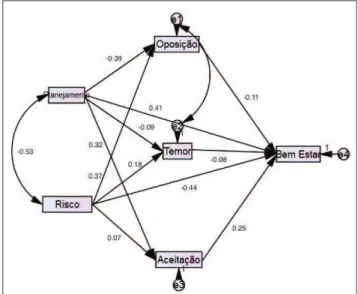
by Kline (2010), MacKinnon & Fairchild (2007), Preacher, Zyphur & Zhang (2010) and Preacher & Selig (2012). Fi -gure 2 presents the model testes through structural equation modeling.
Results
To test the hypotheses present and to the overall
evalua-tion of itting, the model indicated in Figure 2 was submitted
to evaluation using structural equations. The initial model
presented good goodness-of-it indexes, although the relation
between the chi-square and degrees of freedom - CMIN/
DF - was 34.92, very far from 2.0, as recommended by Kline (2010). The remainder goodness-of-it indexes were adjusted (GFI = 0.93; CFI = 0.95; NFI = 0.93; TLI = 0.73), but residues were considered high (RMSEA = 0.16; IC 95% [0.11; 0.18]). Based on suggestions by the AMOS software, the model was re-speciied - the goodness-of-it indexes for
these models are presented in table 1.
Figure 2. Re-speciied model testes by the survey
Based on the goodness-of-it indexes suggested by
the AMOS software, we added a correlation between exogenous variables, change planning and degree of risk of changes, in addition to a correlation between errors of
the fear and opposition attitudes. This led to a signiicant
reduction of the residue presented by the model and the relation between chi-square and degrees of freedom. According with Kline (2010), few correlations between
errors can be accepted to improve the goodness-of-it of
the model.
The altered model presented good goodness-of-it in -dexes, despite the 15.92 CMIN/DF which is very far from 2.0, as recommended by Kline (2010). Considering this is a large sample of observations (795 cases), Hair, Black, Babin, Anderson & Tatham (2009) accept a high chi-square value and a CMIM/DF value higher than 2. The remainder
goodness-of-it indexes that consider the sample size were responsive (GFI = 0.97; CFI = 0.98; NFI = 0.97; TLI = 0.89), although the residue was considered high (RMR = 0.06; RMSEA = 0.09. IC[0.06; 0.11]). Therefore the results of the inal model itting were considered highly acceptable. Table 1 shows the comparison between the goodness-of-it
indexes of the models.
Table 1. Comparison between models
Models GFI CFI NFI TLI RMSEA CI 95%
Initial model 0,93 0,95 0,95 0,83 0,12 0,08 – 0,12
Final model adjusted (Amos) 0,97 0,98 0,97 0,89 0,09 0,06 – 0,11
The second stage of analysis comprised the evaluation
of the hypothesized relationships and the mediating efects.
The mediation model in this study is considered complex,
because it has more than one mediating variable (Preacher, Zyphur & Zhang, 2010). Here, mediation was veriied
using structural equations, observing the magnitude and
signiicance of the indirect efects through bootstrapping.
Indirect efects are estimated based on a population sample, and are results of the estimates on regression coeicients. Signiicant indirect efects are a measure analogous to the use of other methods that suggest the signiicances of the regression interaction efects (Preacher & Selig, 2012). To
that, several analyses were performed with sub-models to
Table 2 shows the results of the mediation analyses. The results of the test on attitudes mediation in face of orga-nizational change to the well-being variable corroborate the hypothesis that attitudes of acceptance and skepticism mediate the relationship between planning and well-being.
Table 2. Result of the mediation test to the variable criterion
Dependent variable: well-being
Variables □ Indirect efct Comment
Well-being planning 0.41** 0.41** Partial mediation
Risk - well-being -0.55** -0.44** Partial mediation
Planning →
Acceptance 0.32** 0.32** Partial mediation
Planning →
Fear -0.09 -0.07 No mediation
Planning →
Skepticism -0.39** -0.35** Partial mediation
Risk→
acceptance -0.07 ns -0,003 ns No mediation
Risk→
Fear 0.18** 0,04 ns No mediation
Risk→
Skepticism 0.37** -0,01 ns No mediation
Fear - Well-being -0.09 0,02 ns No mediation
Skepticism - Well-being -0.11** -0.11** Partial mediation
Acceptance - Well-being 0.25* 0.25* Partial mediation
*p ≤ 0.001; **p ≤ 0.05 ; ns = nonsigniicant
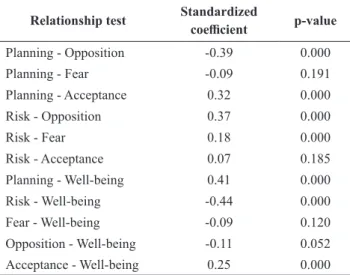
In Table 3, the hypothesis H1 was partially corroborated, because the attitudes of acceptance were positively associated
with planning (β = 0.32; p = 0.000), while the opposition atti
-tudes were negatively associated with planning (β = -0.39; p = 0.000). However, the attitudes of fear were not predicted by the planning and previous preparation of changes (β = -0.09; p = 0.191). The hypothesis H2 was also partially corroborated,
considering that the degree of risk of changes was positively
associated with the attitudes of opposition (β = 0.37; p = 0.021) and of fear of organizational changes (β = 0.18; p = 0.015). Nonetheless, no inluence of the degree of risk on attitudes of acceptance (β = 0.07; p = 0.185) was identiied.
The study results also supported the hypothesis H3, because planning and preparation of organizational changes had positive
inluence on the well-being of employees during the process of changes (β = 0.41; p = 0.000). Regarding the relation between risk and well-being, hypothesis H4 was also supported, since the risk of organizational changes negatively inluences the well
--being of employees during the process of change (β = -0.44; p = 0.000). Results point out that the more threatening the change,
higher the negative impact on the employee’s well-being.
Table 3. Coeicient of the relationships tested by structural equations
Relationship test Standardized
coeicient p-value
Planning - Opposition -0.39 0.000
Planning - Fear -0.09 0.191
Planning - Acceptance 0.32 0.000
Risk - Opposition 0.37 0.000
Risk - Fear 0.18 0.000
Risk - Acceptance 0.07 0.185
Planning - Well-being 0.41 0.000
Risk - Well-being -0.44 0.000
Fear - Well-being -0.09 0.120
Opposition - Well-being -0.11 0.052
Acceptance - Well-being 0.25 0.000
According to the bootstrapping evaluation of indirect
efects presented in Table 2, there is empirical support to
the relationship of mediation of acceptance and skepticism attitudes between planning and preparation of change and the well-being of employees. However, there is no empirical support to the mediation of attitudes of fear, skepticism and acceptance in the relation between grade of risk and well-being of employees during the organizational
change process. We conclude for the efect of mediation
that, however, does not extinguish the direct relationship
on indirect efects conirmed by bootstrapping, suggesting
partial mediation.
Discussion
This study was designed with the general objective of investigating the relations among attributes of the context of change, attitudes (fear, acceptance and opposition) and well-being of employees during the organizational change
process. These relationships were identiied based on the
results of this research.
The irst and second hypotheses advocate that plan -ning and preparation of changes, as well as the degree of risk, are predictors of attitudes towards the change. The results point out that attitudes of acceptance to change
are signiicantly higher when employees perceive that
the organization has planned and prepared the change. These data corroborate the literature that advocates for the importance of planning organizational change, because the perception on planning shapes the viewpoints on the
change (Vakola, Tsaousis & Nikolaou, 2004) and tends to
reduce unfavorable attitudes, and minimize the perception
on uncertainty degree (Raferty & Griin, 2006; Devos,
Buelens & Bouckenooghe, 2007).
Therefore, the occurrence of positive attitudes promote
attitudes to it individuals to changes, and increase the pos -sibility of success, since large-scale organizational change is only possible if based on changes on the behavior of the organization members (Santos, Neiva & Andrade-Melo, 2013). On the other hand, negative attitudes can have the
opposite efect (Neiva & Paz, 2012).
The variable of degree of risk and impact of changes was more relevant to explain the variables of attitudes of opposi-tion and fear to changes. One can infer that as more perceived the change is as a risk to employees, more attitudinal variables of opposition and fear. This result is in line with the literature
that postulates the inluence of negative attitudes in relation
to the organizational change on the occurrence of behaviors
that hinder individuals from itting into changes (Neiva & Brito, 2008). According to these results, one could say that
hypothesis H2 was partially corroborated, contradicting Devos, Buelens and Bouckenooghe (2007), according to
whom the risk of changes inluences both the individuals’
openness towards accepting the process of change and the emission of new behaviors to be incorporated. Therefore,
additional studies are required to identify the inluences of
the degree of risks on the attitudes of acceptance, analyzing
the efects that attitudes in face of organizational changes
have on workers (Choi, 2011).
The third hypothesis assumes that planning and pre-paration of organizational changes are associated with the
well-being of employees during the process of change. The results shown in Table 3 corroborate the hypothesis that perception on the change planning and preparation result
in well-being. Eforts to plan change make it more pre -dictable and result in positive attitudes before the change. Studies point out that when context is characterized by intensive or frequent changes, without the due planning, some undesired consequences could come about such
as negative feelings, uncertainty, anxiety and diferent feelings to workers (Vakola, Tsaousis & Nikolaou, 2004;
Devos, Buelens & Bouckenooghe, 2007). Another study shows the importance of planning to the success of the change (Devos et al.,2007), suggesting the likelihood of
supportive behaviors to changes signiicantly higher when
employees perceive that the organization has planned and prepared the change.
The fourth hypothesis suggests that the degree of risk and uncertainties of organizational changes are negatively asso-ciated with the well-being of employees during the process of change. Data here corroborate this hypothesis showing that higher risk of uncertainty of the process of change, hi-gher the negative impact on the employees’ well-being. This reinforces studies on the harmful impacts of organizational change on the employees’ well-being (Greenglass & Burke, 2000a; Kivimaki et al., 2000).
The analysis of mediation relationships is becoming increasingly important to understand social and
psycholo-gical phenomena. The ifth and sixth hypotheses (H5 and H6) suggest that attitudes in face of change mediate the
relationships between the attributes of context and well--being. This way, is evidenced that context of change (VI) is a predictor of well-being (VD) with data presented in Figure 2 and Table 2. Attitudes in face of changes (VMe) are predictors of well-being (VD) and mediate the rela-tionship between planning and preparation and well-being
of workers in the process of change. The indirect efects
of attitudes of fear, skepticism and acceptance were not corroborated in the use of bootstrapping procedures to test the relationship of mediation of attitudes I the relation between degree of risk and well-being of workers in the organizational change.
Despite these results, it is worth emphasizing that the variable of acceptance was not present as a mediator to the relation between degree of risk and well-being. This is evidence that the degree of risk of change has not
sig-niicantly inluenced the attitudes in face of change in the
organizations surveyed. This result could be attributed to the characteristics of the public organizations approached herein, since in public organizations employees have a
di-ferent perception of risk. That is so because the separation
process, or the downsizing, passes by bureaucratic criteria with legal support that minimize the perceptions of degree of risk and uncertainty about the organizational change. This way, this survey should be replicated in private orga-nizations to observe if this relationship persists in a context of more competitive market.
The mediation model in this study is considered com-plex, because it has more than two mediating variables
-nitude and signiicance of the indirect efects through bootstrapping. The indirect efects are estimated based on
a population sample, and are results of the estimates on
regression coeicients. Signiicant indirect efects are a
measure analogous to the use of other methods that
sug-gest the signiicances of the regression interaction efects (Preacher & Selig, 2012). Several analyses with sub --models were performed to investigate the sign, magnitude
and signiicance of coeicients, as well as the mediation relationship (Preacher, Zyphur & Zhang, 2010; Preacher
& Selig, 2012). The bootstrapping analysis corroborated
these efect.
Theoretical and Practical Implications
Considering the few studies in the literature approaching
aspects of change that inluence the individuals’ attitudes and behaviors (Vakola, Tsaousis & Nikolaou, 2004; Raferty & Griin, 2006; Oreg, Vakola & Armenakis, 2011), and that
attributes of the context of change are neglected in many studies, the theoretical contribution of this study is that it subsidizes research that study the variable of organizational
context and it inluences on the individuals’ responses to
the change.
The large-scale organizational changes can only suc-ceed based on the change of behaviors of the organization members (Santos, Neiva & Andrade-Melo, 2013).
There-fore, understanding how attitudes inluence the supportive behavior to change is a diferential of success. Finally, this
study can provide subsidies to the personnel management area to think on elaborated actions, mainly strategic planning action oriented to organizational change, internal events to disseminate the stages of the process of changes, and improve communication and transparency of the processes of change, fostering positive attitudes and promoting engagement to the proposed process of change.
The negative attitudes, in turn, could be minimized with programs on quality of life and well-being during the implementation of changes, to reduce the negative impacts on the employees’ well-being. According to literature, when resistance is well management, it tends to facilitate the process of change. Otherwise it could lead to unbea-rable anguish and discomfort (Bortolotti, Souza Junior & Andrade, 2009).
Another important contribution refers to the mediating nature of the variable of attitude in face of changes regarding the context and well-being at the workplace. The mediating
role partially conirmed here is relevant to studies in the ield of organizational change, considering that this is a
complex and multifaceted phenomenon. Moreover, it
rein-forces the inluence of individuals’ attitudes as facilitators
to the success of organizational change processes (Neiva
& Paz, 2012).
The existence of the mediating efect, even if partial in
attitudes in face of organization changes in the relationship between attributes (planning and preparation, and degree of risk of change) and the employee well-being point out consistency of the proposed predictive model. It also rein-forces that idea that, in face of an organizational change,
the attitude of acceptance positively mediates the relation between planning and well-being, while the attitudes of fear and opposition mediate the relation between risk and well-being. Therefore, we can conclude that change plan-ning and preparation increase the likelihood of positive attitudes towards the organizational change process, while the perception of risk and uncertainties bring about attitu-des of fear and opposition to the process, thus hindering its implementation.
Limitations and Future agenda
The research was limited to a cross-sectional study; howe-ver, studies on organizational changes are typically performed when the process is underway. Despite this methodological
diiculty, longitudinal surveys in the initial phase of change
are needed, because these could enable the analysis of the whole process of organizational change, as well as its con-sequences. Results allow the comparison of the process and better estimate impacts of change on employees.
The sample of this survey can also be considering as a limiting factor. Considering that organizations belong to the public sector, the internal context of changes may have
diferent characteristics on other sectors, where the market pressure is more constant and boosts changes in a diferent
way. Further studies should try to expand results to other
sectors to ind conclusions that allow for generalization.
This survey analyzed only two variables of the context of organizational change. Therefore, other variables could interfere on the employees’ attitudes towards the organiza-tional change We suggest carrying out studies to evaluate other variables of the context, such as employees’
engage-ment, inluence of the leadership on the process of change;
restructuring and change through legal order, which could
afect attitudes towards organizational change, to show paths
to new surveys.
Final Remarks
This document is an invitation to organizations to rethink the approach of their interventions, considering planning in the processes of change as a way to achieve success in their initiatives, without neglecting the employees’ well-being. Therefore, this study reinforces that change agents should be more focused on understanding the role played by the attributes of the context on attitudes in face of organizational changes, as well as on the employees’ perception about the well-being. Moreover, despite the unavoidable reactions and behaviors inherent to the organizational change processes,
the organizations should plan it in an efective way, mini -mizing the degree of uncertainty and risks arising out of these changes, reducing negative attitudes and maximizing positive attitudes.
Conlict of interests
References
Bordia, P. Restubog, S. L. D., Jimmieson, N., & Irmer, B. (2011). Haunted by the past: Efects of poor change management history on employee attitudes and turnover. Group & Organization Management, 36(2) 191-222.
Bouckenooghe, D. (2010). Positioning change recipients’ attitudes toward change in the organizational change literature. The Journal of Applied Behavioral Science, 46(4), 500– 531.
Bryson, A., Barth E. & Dale - Olsen, H. (2013). The Efects of Organizational Change on Worker Well-Being and the Moderating Role of Trade Unions. Industrial and Labor Relations Review.66 (4), 989-1011.
Choi, M. (2011). Employees’ attitudes toward organizational change: A literature review. Human Resource Management, 50(4), 479-500.
Cunningham, G. B. (2006). The relationships among commitment to change, coping with change, and turnover intentions. European Journal of work and Organizational Psychology, 15(1), 29-45. Dahl, M.S. (2011). Organizational Change and Employee Stress.
Management Science, 57 (2), 240 – 256.
Dessen, M. C., & Paz, M. G. T. (2010). Bem-estar pessoal nas organizações: o impacto de conigurações de poder e características de personalidade. Psicologia: Teoria e Pesquisa, 26(3),549-556.
Devos, G., Buelens, M., & Bouckenooghe, D. (2007). The contribution of content, context, and process in understanding openness to organizational change: two experimental simulation studies. Journal of Social Psychology, 147(6), 607-629.
Fugate. M., Prussia G. & Kinicki A.J. (2012). Managing employee withdrawal during organizational change: The role of threat appraisal. Journal of Management, 38(3).890-914
Green, F. (2011). Unpacking the misery multiplier: How employability modiies the impacts of unemployment and job insecurity on life satisfaction and mental health. Journal of Health Economics. 30(2) .265–76.
Greenglass, E. & Burke, R.J. (2000). The relationship between hospital restructuring, anger, hostility and psychosomatics in nurses. Journal of Community and Applied Social Psychology, 10, 155-161.
Kalimo, R., Taris, T. W., & Schaufeli, W. B. (2003). The efects of past and anticipated future downsizing on survivor wellbeing: an equity perspective. Journal of Occupational Health Psychology, 8(2), 91-109.
Kim, T.G., Hornung, S. & Rosseau (2011). Change-supportive employee behavior: Antecedents and the moderating role of time. Journal of Management, 37(6), 1664-1693.
Kivimaki, M., Vahtera, J., Griiths, A., Cox, T., & Thomson, L. (2000). Sickness absence and organizational downsizing. In R. J. Burke & C. L. Cooper (Eds.), The organization in crisis: Downsizing, restructuring, and privatization (78–94). Oxford, England: Blackwell.
Kline, R.B. (2010). Principles and Practice of Structural Equation Modeling. New York: Guilford Press.
Kruglanski, A. P., A; Higgins, E; Capozza, D. (2007). “On the move” or “staying put”: Locomotion, need for closure, and reactions to organizational change. Journal of Applied Social Psychology, 37(6), 1305-1340.
Lazarus, R. S., & Folkman, S. (1984). Stress, appraisal, and coping. New York: Springer
Lines, R. (2005). The Structure and Function of Attitudes toward Organizational Change. Human Resource Development Review, 4, 8-32. doi: 10.1177/1534484304273818
Maes, G., & Van Hootegem, G. (2011). Toward a dynamic description of the attributes of organizational change. Research in Organizational Change and Development, 19, 191-231. doi:10.1108/S0897-3016(2011)0000019009
MacKinnon, D. P., Fairchild, A. J., and Fritz, M. S. (2007). Mediation analysis. Annual Review Psychology, 58, 593-614.
McDonald, R. P., & Ho, M.-H. R. (2002).Principles and practice in reporting structural equation analyses. Psychological Methods, 7(1), 64–82.
McFarlin, D. & Sweeney, P. (1992). ‘Distributive and procedural justice as predictors of satisfaction with personal and organizational outcomes.’, Academy of Management Journal, 35, 3, 626 - 637.
Neiva, E. R. (2012). Mudança organizacional e seus efeitos colaterais: Estresse, adoecimento e bem-estar nas organizações. In M. C. Ferreira & H. Mendonça (Orgs.), Saúde e bem-estar no trabalho: Dimensões individuais e culturais (pp. 268-345).
São Paulo, SP:Casa do Psicólogo.
Neiva, E.R., Odelius, C.C. & Ramos, L.D. (2015). The Organizational Change Process: Its Inluence on Competences Learned on the Job. BAR, Brazilian Administration Review, 12 (4), 324-347.
Neiva, E. R., Ros, M., & Paz, M. G. T. (2005). Attitudes towards organizational change: validation of a scale. Psychology in Spain, 9(1), 81-90.
Neiva, E. R., & Paz, M. G. T. (2012).Percepção de mudança individual e organizacional: o papel das atitudes, dos valores, do poder e da capacidade organizacional. Revista de Administração (São Paulo), 47, 22-37.
Nery, E. R., & Neiva, V. F (2015). Variáveis de Contexto e Respostas à Mudança Organizacional: Testando o Papel Mediador das Atitudes. Psicologia: Teoria e Pesquisa, 31(2), 259-268.
Noblet, A. J., & Rodwell, J. J. (2008). Integrating job stress and social exchange theories to predict employee strain in reformed public sector contexts. Journal of Public Administration Research and Theory, 19, 555-578.
Oreg, S., Vakola, M., & Armenakis, A. (2011). Change Recipients’ Reactions to Organizational Change: A 60-Year Review of Quantitative Studies. The Journal of Applied Behavioral Science. 47(4), 461-524.
Preacher, K. J., & Selig, J. P. (2012). Advantages of Monte Carlo confidence intervals for indirect effects. Communication Methods and Measures, 6, 77-98.
Preacher, K. J., Zyphur, M. J., & Zhang, Z. (2010). A general multilevel SEM framework for assessing multilevel mediation. Psychological Methods,15, 209-233.
Podsakof, P. M., MacKenzie, S. B., Lee, J.-Y., & Podsakof, N. P. (2003). Common method biases in behavioral research: A critical review of the literature and recommended remedies. Journal of Applied Psychology, 88(5), 879-903.
doi:10.1037/0021-9010.88.5.879
Raferty, A. E., & Griin, M. A. (2006). Perceptions of Organizational Change: A Stress and Coping Perspective. Journal of Applied Psychology, 91(5), 1154-1162.
Santos, J. N., Neiva, E. R., & Andrade-Melo, E. A. (2013). Relação entre clima organizacional, percepção de mudança organizacional e satisfação do cliente. Psicologia: Teoria e Pesquisa, 29 (1), 31-39.
Self, D., Armenakis, A., & Schraeder, M. (2007). Organizational change content, process and context: A simultaneous analysis of employee reactions. Journal of Change Management, 7(2), 211-229. Vakola, M., Tsaousis, L., & Nikolaou, L. (2004). The role of
emotional intelligence and personality variables on attitudes toward organizational change. Journal of Managerial Psychology, 19(2), 88-110.
Van de Ven, A. H., & Sun, K. (2011). Breakdowns in implementing models of organization change. The Academy of Management Perspectives, 25(3), 58-74. DOI: 10.5465/AMP.2011.63886530. Weinner, B, J. (2009). A theory of organizational readiness for
change. Implement SCI, 4: 67. Published online 2009 Oct 19. doi: 10.1186/1748-5908-4-67.