6&+22/1(7:25.6.12:/('*(&,5&8/$7,21$1'6&+22/,03529(0(17
7+((6&;(/352-(&7˹65(6($5&+$*(1'$
Susana Batista16, Eva Gonçalves17, Rui Santos18
$EVWUDFW
ESCXEL Project – School Network for Excellence is a network of public schools in eight Portuguese municipal-ities, the respective local authorities and a research team in CICS.NOVA, an interdisciplinary centre of social sciences at Nova University of Lisbon. This paper presents ESCXEL’s activities in order to illustrate the roles of knowledge within a school network. Three main axes of ESCXEL’s activities are explored: a) benchmarking
of results in national exams; b) collaborative learning in seminars and training; c) data collection, analysis and dissemination for local planning. All of them illustrate new ways in which knowledge circulates among different actors involved in the political process, pointing not only to regulation mechanisms of school practices but
DOVRWRWKHSRWHQWLDOXVHRINQRZOHGJHDVDUHVRXUFHWRGHͤQHSUREOHPVDQGDFWLRQSODQVDWWKHORFDOOHYHO
.H\ZRUGVschool networks; knowledge circulation; regulation; benchmarking; collaborative learning
7KH(6&;(/3URMHFWDQHPSLULFDOUHDOLW\WRVWXG\QHZPRGHVRIUHJXODWLRQLQHGXFDWLRQ
For the last three decades, education systems worldwide have known normative transformations on their or-ganization and management, in a context of decentralization and school autonomy policies. These changes
IDYRXUWKHHPHUJHQFHRIGHFHQWUDOL]HGKRUL]RQWDODQGQHWZRUNHGIRUPVRIUHJXODWLRQDQGFRQͤJXUHDFRPSOH[
regulation system of education, promoted by different scales and actors (Barroso, 2005).
School networks are being conceptualized as a new school administration and organization tool based on hor-izontal relationships in order to achieve common goals. They constitute a form of voluntary regulation of a col-laborative nature (Justino & Batista, 2014): they derive from the organizations’ or the actors’ own will, and their
MRLQWDFWLRQJXLGHVFRQGLWLRQVRULQͥXHQFHVWKHDOORFDWLRQDQGPDQDJHPHQWRIUHVRXUFHVDQGWKHJRDOVDQG
results of educational action. Within this framework, some salient questions arise, such as: How are networks in education built and by whom? How do they work and for what purpose(s)? Do they constitute a regulatory instance in education systems?
In Portugal, projects involving networks or partnerships between schools and other educational actors are becoming more common nowadays, trying to address issues such as the promotion of educational success and the reduction of school-leaving, or to draw attention to questions like the environment or volunteering. A certain number of these projects emerged from the initiative of schools, university researchers, local actors or civil society organizations.
This paper aims to present a Portuguese school network, the ESCXEL Project – School Network for Excellence. Through the description of its main activities, it is possible to raise questions about the role of producing and
VKDULQJNQRZOHGJHLQDVFKRROQHWZRUN2QWKHRQHKDQGWKHUHDUHVSHFLͤFNQRZOHGJHEDVHGPHFKDQLVPVLQ
this school network which can be seen as tools for regulating school practices. On the other hand, the circula-tion of knowledge in this school network constitutes a resource for local accircula-tion.
The ESCXEL Project is a network based on a partnership between public schools of eight municipalities (which count 38 school units totalling 166 schools19, in which are enrolled around 59.500 students), their local author-ities, and CICS.NOVA, an interdisciplinary research centre20. This project was born in 2008 from the initiative of some researchers and their interpretation of the Portuguese educational system’s trends and challenges. Its main goal is to foster a continuing endeavor to improve quality and performance in its schools. “Excellence” does not mean a state of top quality: ESCXEL network and its schools do not claim to be the best, but rather
16 CICS.NOVA, Faculdade de Ciências Sociais e Humanas da Universidade Nova de Lisboa (FCSH-NOVA), Portugal. Email: [email protected] 17 CICS.NOVA, FCSH-NOVA, Portugal. Email: [email protected]
18 CICS.NOVA, FCSH-NOVA, Portugal. Email: [email protected]
19 6JG2QTVWIWGUGUEJQQNU[UVGOJCUDGGPTGCTTCPIGFFWTKPIVJGNCUV[GCTUD[ITQWRKPIKPFKXKFWCNUEJQQNUKPVQūUEJQQNENWUVGTUŬ*GTGūUEJQQNWPKVUŬTGHGTU
either to those clusters, or to individual schools as yet unclustered, which remain as discrete establishments. For commodity’s sake, we will henceforth use
VJGVGTOūUEJQQNUŬHQTDQVJUKVWCVKQPU
that they are working each day to improve, following Aristotle thoughts suggestively summarized by Durant (2006 [1926], p. 98) that “We are what we repeatedly do. Excellence, then, is not an act, but a habit”.
7KHVSHFLͤFDLPVGHULYHGIURPWKLVJHQHUDOJRDOFRQVLVWRQFDSDFLWDWLQJVFKRROVDQGFRPPXQLWLHVFRPSULVLQJ
students, teachers, parents, policy agents and citizens) to promote educational excellence; support municipal-ities in the adoption of local educational development plans; identify, disseminate and monitor “good practice”;
GHYHORSVHOIHYDOXDWLRQSURFHVVHVDQGSURGXFHVFLHQWLͤFNQRZOHGJHDERXWHGXFDWLRQ7RDFKLHYHWKRVHDLPV UHVHDUFKHUVPRELOL]HVFLHQWLͤFFRPSHWHQFLHVORFDODXWKRULWLHVFRQWULEXWHZLWKPRELOL]DWLRQDQGFRRUGLQDWLRQRI
resources, and schools offer their experience and innovation capacities (see Gonçalves, Cunha & Batista, 2011). In the next section, we present ESCXEL’s activities along three main axes: a) benchmarking of results in nation-al exams; b) collaborative learning in seminars and training; c) data collection, annation-alysis and dissemination for local planning. In each of those axes, we will illustrate our purposes with examples and some quotations from principals’ interviews and a focus-group of department coordinators, which were conducted in an exploratory study on the use of ESCXEL activities in three schools with diverse academic and socioeconomic realities and results (Batista & Gonçalves, 2015).
(6&;(/˹VDFWLYLWLHV
6\VWHPDWLFDQDO\VLVRIUHVXOWVLQQDWLRQDOH[DPVbenchmarking
Since the beginning of the ESCXEL Project, researchers have drawn and disseminated annual reports analys-ing schools’ and municipalities’ results in national exams. Those reports contain several statistical indicators, which were improved throughout the years according to the users’ feedback.
Results on national exams are always analysed in relation to the national average marks, using an index in
RUGHUWRHOLPLQDWHVSXULRXVYDULDWLRQGXHWRGLIIHUHQFHVLQWKHH[DPV̵GLͦFXOW\RYHUWKH\HDUV$QQXDOLQGH[HV
are obtained dividing the average marks in each school and municipality by the national average, multiplied by 100. The national value therefore corresponds to the constant index basis of 100.
0RVWͤJXUHVDQGWDEOHVWUDFNVFKRRORUPXQLFLSDOLW\DYHUDJHLQGH[HVDQGWKHLUSURJUHVVLRQWUHQGRYHUD\HDU
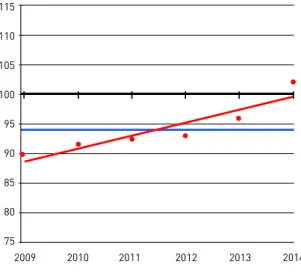
series21. As we can see in Figure 1, the results of School A are compared to the national average (which equals 100). Each point represents that year’s index; the blue line is the index average in the analysed period; the red line represents the progression of results. In this case, although the school average in the six-years period was
EHORZWKHQDWLRQDODYHUDJHLQGH[DYHUDJHWKHSURJUHVVLRQRIUHVXOWVZDVSRVLWLYHDQGLQWKHͤQDO
year the average of School A in national exams was above the national average.
Figure 1. Average marks index in national lower secondary education exams in Mathematics in School A, 2009-2014, national average marks = 100
115
110
105
100
95
90
85
80
75
2009 2010 2011 2012 2013 2014
21 +VOKIJVDGCUMGFYJ[VJGTGUGCTEJGTUFGƒPGFC[GCTRGTKQFVQCPCN[\GUEJQQNCPFOWPKEKRCNKV[TGUWNVUKPPCVKQPCNGZCOU6JKUYCUPQVCYJQNN[CTDKVTCT[
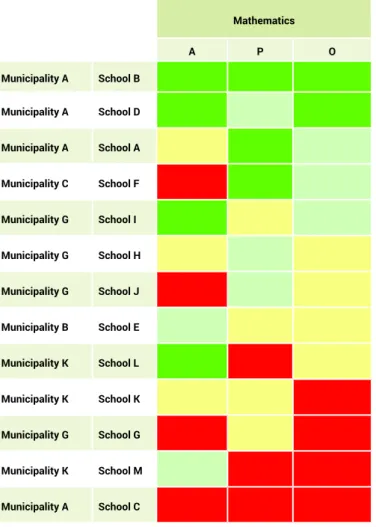
These indicators are then related and summarized in an easy-to-read benchmarking tool called scoreboard, which compares all ESCXEL schools and municipalities. The scoreboardsare tables encoded according to a
̸WUDͦFOLJKWVV\VWHP̹IURPJUHHQ JRRGWRUHG EDGDVLQWKHH[DPSOHLQ)LJXUH
These tables present three summary indicators for each education stage and discipline:
i) the 6-year average in relation to the national average (A, equivalent to the blue line in Figure 1, where a value of 100 or more is denoted in bright green; a value between 95 and 100 in light green; a value between 95 and
LQ\HOORZDQGͤQDOO\DYDOXHRIRUOHVVLQUHG
ii) the 6-year progression trend22 (P, equivalent to slope of the red line in Figure 1), where improvement is co-loured green (2 or superior bright green; higher than 0 and below 2 light green), stable or slightly negative yellow, and decreases of 2% or more a year red;
LLLWKHRXWORRN2DTXDOLWDWLYHPHDVXUHZKLFKFRPELQHVWKHWZRSUHYLRXVLQGLFDWRUVDFFRUGLQJWRSUHGHͤQHG
criteria.
Figure 2. Scoreboard for lower secondary education exams in Mathematics, 2009-2014 (example)
0DWKHPDWLFV
A P O
0XQLFLSDOLW\$ 6FKRRO%
0XQLFLSDOLW\$ 6FKRRO'
0XQLFLSDOLW\$ 6FKRRO$
0XQLFLSDOLW\& 6FKRRO)
0XQLFLSDOLW\* 6FKRRO,
0XQLFLSDOLW\* 6FKRRO+
0XQLFLSDOLW\*
6FKRRO-0XQLFLSDOLW\% 6FKRRO(
0XQLFLSDOLW\. 6FKRRO/
0XQLFLSDOLW\. 6FKRRO.
0XQLFLSDOLW\* 6FKRRO*
0XQLFLSDOLW\. 6FKRRO0
0XQLFLSDOLW\$ 6FKRRO&
Schools and municipalities are ranked primarily according to outlook, which is consistent with ESCXEL’s main focus on improvement. This means that even if a school has obtained an average equal or superior to the na-tional average (A = bright green), if the progression is negative and inferior to 2% (P = red), the outlook will be negative (O= yellow) and the school will not appear in the top positions (as is the case of School L in Figure 2).
Conversely, in the cases of Schools A and F in Figure 2 their good progressions (P = bright green) compensated for their average results being below national average (A = yellow and red, respectively), and the resulting pos-itive outlook (O= light green) positioned these schools at the top area of the table.
The elaboration and dissemination of these reports and indicators became one of the key activities of the researchers’ team. This activity contributes to the creation of a benchmarking culture among schools, in the sense that principals and teachers are now able to compare performances in relation to common references, particularly to the national average and to comparable ESCXEL schools. This feature is particularly evident in the following statement:
We never had another referential [before ESCXEL]. […] It is good to have references and to know how very far or close to the norm we are (Principal 2).
The scoreboards are not elaborated to be used merely as school or municipality rankings. They are compar-ative maps in which each school can locate itself and, more importantly, identify other schools with which to compare itself. Schools are then able to use this network as a benchmark platform and learn from practices in comparable schools. In this sense, as argued by Barroso and Afonso (2011), the indicators can generate new circuits of knowledge and diffusion of good practice:
When we look at the comparative results, we identify municipalities with some […] similarity in terms of size and in terms of type of students and we ask why they have better results […]. If there is a form of organization that we can replicate which will better prepare our kids in terms of learning, we are receptive (Principal 1).
More recently, indicators of the socioeconomic context of school results at the municipal level were built upon multiple linear regression models of average exam marks at each education stage on municipal-level socio-economic variables, such as sociodemographic, sociosocio-economic or educational variables (Batista, Franco & Santos, 2014). Since the regression models displayed a considerable weight of socioeconomic contexts on exam results, the derived indicators are a reliable measure of socioeconomic underpinnings of results at the aggregate municipal level23.
It is possible, then, to contextualize the municipalities’ results and measure the deviation of observed results to regression estimates. As shown in Table 1, the reports state whether municipalities’ results are above, sim-ilar or below to those estimated according to socioeconomic indicators. Deviations provide a different kind of benchmark from which local actors can evaluate education performances, and compare to similar socioeco-nomic contexts.
Table 1. Socioeconomic indicators, observed results, estimated results and deviations, lower secondary education, in three selected municipalities (Indexes average, 2009-2014)
6RFLRHFRQRPLF
LQGLFDWRU ,QGH[HVDYHUDJH1DWLRQDO
(VWLPDWHGLQGH[HV DYHUDJH
1DWLRQDO 'HYLDWLRQ
0XQLFLSDOLW\$ 14,3 97,1 103,9 -6,8
0XQLFLSDOLW\% 5,7 96,2 95,3 0,9
0XQLFLSDOLW\& 12,3 105,5 101,9 3,6
3HQGLQJRQVXͦFLHQWGDWDDYDLODELOLW\WKHUDQJHRIVRFLRHFRQRPLFLQGLFDWRUVDQGHVWLPDWHVZLOOEHH[WHQGHG
to earlier schooling stages, as well as to different units of analysis, namely the schools.
6HPLQDUVDQGWUDLQLQJcollaborative learning
Learning in school networks happens precisely by “sharing experiences […], and examining different views, perspectives and experiences” (Veugelers & O’Hair, 2005: 5). Therefore, another main activity in ESCXEL is the organization of seminars in its municipalities in order to provide a common space for school principals,
WHDFKHUVDQGPXQLFLSDOLWLHV̵UHSUHVHQWDWLYHVWRVKDUHSUDFWLFHVGHEDWHVSHFLͤFTXHVWLRQVDQGWKLQNRISRVVL -ble solutions. Each of these seminars has a general topic that framing the discussions, like “information and communication technologies in schools”, “school and commun ity in the elaboration of education plans”, “ped-agogical organization strategies”, and “ped“ped-agogical articulation between educational levels”, among others.
7KHWRSLFVDUHGHͤQHGDQGDJUHHGXSRQLQWKH(;&(/FRRUGLQDWLRQERDUGPHHWLQJVLQZKLFKDUHUHSUHVHQWHGDOO
network participants. In seminars, schools shared their own experiences and listen to others:
Seminars are moments to exchange experiences with other schools, and that is very useful to us (Principal 3).
Those seminars were initially called “good practice seminars”: some schools presented to the plenary of at-tendants their internal projects or practices that stood out for their good results or effects. More recently, the seminar format was changed, responding to the schools’ needs for more structured information. The sharing of good practice remains at the heart of the seminars, albeit in a more framed way. Morning lectures on the selected topic are given to the plenary by experts or researchers, followed by a questions and answers period.
,QWKHDIWHUQRRQWKHSDUWLFLSDQWVDUHGLYLGHGLQWRWKUHHRUIRXUVPDOOHUJURXSVWRGLVFXVVVSHFLͤFVXEWKHPHV ZKLFKFDQEHLQWURGXFHGE\VKRUWSUHVHQWDWLRQVRUE\DVHWRITXHVWLRQVWRDGGUHVVDQGRUVKDUHVSHFLͤF
tools and experiences related to those subthemes. In the end of the day, a summary of each of these discus-sions is shared with all the participants.
All seminars take place on Fridays and include a lunch gathering, besides which there is always a small and informal work meeting and a dinner the day before. Such convivial moments have been crucial to develop trust among all the network members from different schools and municipalities, which favours the establishment of a background for collaborative learning.
Training courses are another way in which collaborative learning is fostered in the ESCXEL Project. For in-stance, following an analysis of schools’ Educational Projects, a strategic institutional document that presents each school’s identity and main goals for a 3-year period, a team of researchers wrote down and distributed a template which schools could use to build their Educational Projects in order to overcome some critical issues
LGHQWLͤHGLQWKHDQDO\VLVQDPHO\WKRVHRIXQFOHDUDLPVDQGVWUDWHJLHV)ROORZLQJDUHTXHVWIURPVFKRROVD SURIHVVLRQDOWUDLQLQJFRXUVHRQ(GXFDWLRQDO3URMHFWVZDVRUJDQL]HGDQGFHUWLͤHGE\WKHVFLHQWLͤFFRPPLWWHH
for teacher’s continuing training. Besides the training course contents themselves, this experience also proved to be an important way to create and strengthen the ties of the school network, through the discussion of ideas and sharing of experiences between teachers and/ or principals, as illustrated in the following statements (quoted from the training course evaluation reports):
Share of experiences/ knowledge of other schools’ reality. Professional enrichment.
It also allowed us to see which Educational Projects existed in other schools.
$VHFRQGWUDLQLQJFRXUVHUHTXHVWHGE\WHDFKHUVDIWHUWKHͤUVWH[SHULHQFHLVFXUUHQWO\LQSODFHDGGUHVVLQJ
tools for data collection and systematization in school context.
In seminars and training courses, principals, teachers, municipalities’ representatives and researchers meet
IDFHWRIDFHDQGHQJDJHLQDFWLYLWLHVWKDWIRVWHUFROODERUDWLYHOHDUQLQJ+RZHYHUDVLGHQWLͤHGLQDQLQTXLU\
conducted in 2010 to all network members as part of the network self-assessment report, there is a need to create more possibilities for teachers to exchange ideas and resources, and follow up the discussions initiated
'DWDFROOHFWLRQDQDO\VLVDQGGLVVHPLQDWLRQIRUlocal planning
The third core activity consists in data collection, analysis and dissemination for local education planning. This is as yet the least developed activity, and also the one in which researchers have been more involved during the last few months. This takes place at three different levels: municipalities, schools and classrooms.
At the municipal level, the research team is assisting local authorities in promoting an integrated territorial de-velopment. This work is based on a proposal to help design Municipal Educational Development Plans and to support their implementation, through the collection/ dissemination of data and the production of diagnostic and monitoring reports, in a pioneering approach on local education planning in Portugal.
7KHDIRUHPHQWLRQHGVXUYH\DSSOLHGWR(6&;(/PHPEHUVDOVRLGHQWLͤHGWKHFRPPXQLFDWLRQEHWZHHQWKHUH
-search team and municipalities’ representatives as a crucial area for improvement. In order to tackle this issue,
WZRH[SHULHQFHGUHVHDUFKHUVIURPWKHJHRJUDSK\DQGWHUULWRULDOSODQQLQJͤHOGMRLQHGWKHWHDPDQGGDWDEDVHV
are being organized with patterned information on partner municipalities.
At the school level, the research team is also organizing and presenting tables with relevant information on school variables. This information is based on a national database provided by the Ministry of Education, which integrates data on all public education establishments. Tables contain values for all ESCXEL schools and municipalities, as well as the national averages. They cover information on the size and distribution of the student population across the school offer (for instance, the number of students per class according to levels and modalities of education), demographic and socioeconomic characteristics of the student population (gen-der, nationality, type of social support, parental education), information about the teaching staff (size, age and time of service average, students to teacher ratio) and results (retention and leaving rates according to level and modality of education).
The availability of this information allows schools to compare some of their socioeconomic and organizational
FKDUDFWHULVWLFVLWLVDOVRLPSRUWDQWDVDGLDJQRVWLFIRUWKHGHͤQLWLRQRIJRDOVDQGVFKRROVWUDWHJLFSODQQLQJ 7KHVHDUHVRPHRIWKHLVVXHVSRLQWHGE\WHDFKHUVLQDIHHGEDFNRIDͤUVWGUDIWRIWKHVHWDEOHV
=6JGFQEWOGPV?EQPVCKPUKPVGTGUVKPICPFKORQTVCPVFCVCVQFGƒPGCPFEJCTCEVGTK\GQWTUEJQQNCPFKVCNNQYU
at the same time, a comparison with other schools of this municipality and of the network […]. Anyway this data will be taken as a starting point for a further analysis of the evolution on the improvement of the school’s results.
Data on organizational variables, schools and results characterization […] [are] a working basis for the devel-opment of school’s strategic documents, namely the Educational Plan and Annual Activities Plan.
)LQDOO\DWWKHFODVVOHYHOWKHUHLVDSLORWSURMHFWXQGHUZD\LQRQH(6&;(/VFKRROFDOOHG̸SURͤOHFODVVHV̹ZKLFK
aims at experimenting a different way to group students in classes in order to improve their achievement in the core disciplines of Mathematics and Portuguese, which may avoid the problems inherent to full “level” or “track
FODVVHV̹ZKLOHVWLOOKHOSLQJWHDFKHUVWRSODQOHVVRQVDFFRUGLQJWRWKHUHTXLUHPHQWVRIHDFKFKLOGSURͤOH̸3URͤOH FODVVHV̹LVDPRGHOIRURUJDQL]LQJFODVVHVDQGSODQQLQJOHVVRQVLQYROYLQJͤYHVWDJHVLLGHQWLI\LQJVWXGHQWV̵ SURͤOHVLLRUJDQL]LQJFODVVHVLLLVHOHFWLQJKXPDQUHVRXUFHVLYLPSOHPHQWLQJDGHTXDWHWHDFKLQJVWUDWHJLHVY
monitoring students’ performance and adapt teaching strategies.
(6&;(/UHVHDUFKHUVZHUHUHVSRQVLEOHIRUWKHͤUVWVWDJHE\DQDO\VLQJVWXGHQWV̵SHUIRUPDQFHGXULQJWKHSUHYL -ous school year. Each student performance in Portuguese and Mathematics was analysed in comparison to
WKHVWXGHQW̵VDYHUDJHͤQDOJUDGHVREWDLQHGLQERWKGLVFLSOLQHVLQWKHSUHYLRXVVFKRRO\HDU:KHQHYHUDVWXGHQW
had either a negative grade in both disciplines, or a lower grade in one discipline as compared to his/her aver-age, regardless of whether the grade was negative or positive, this was interpreted as displaying a performance
GHͤFLWLQWKRVHGLVFLSOLQHV
7KLVDQDO\VLVSURGXFHGIRXUJURXSVRIVWXGHQWVZLWKVLPLODUSHUIRUPDQFHSURͤOHV̰*URXSGHͤFLWLQ3RUWX
in Portuguese, and problem solving, mathematical thinking, mathematical communication and mental calcula-tion in Mathematics, which were assessed through an analysis of the scores obtained by each student in each competency within each discipline.
Stages 2 and 3 were the responsibility of the principal’s team within the school. First they organized
class-HVDFFRUGLQJWRWKHJURXSVLGHQWLͤHGLQVWDJHPL[LQJVWXGHQWVZLWKSRVLWLYHDQGQHJDWLYHJUDGHVEXWZLWK GHͤFLWVLQWKHVDPHGLVFLSOLQH6HFRQGO\WRHDFK3RUWXJXHVHFODVVDQGHDFK0DWKHPDWLFVFODVVWKHSULQFLSDO DOORFDWHGWKHPRVWDGHTXDWHWHDFKHUVDFFRUGLQJWRWKHUHVSHFWLYHSURͤOHUHTXLUHPHQWV,WZDVDOVRQHFHVVDU\
to organize a weekly schedule that would guarantee that all Portuguese classes in the same educational level took place at the same time, as well as all Mathematics classes.
Next stage, number 4, is the design and implementation of teaching strategies by teachers of Portuguese and Mathematics, as well as by all teachers of the main classes. For example, in a main class with students of a
3RUWXJXHVHSURͤOHVKRZLQJGHͤFLWVLQUHDGLQJWHDFKHUVIURPDOOGLVFLSOLQHVPD\LPSOHPHQWDVWUDWHJ\WRKDYH
those students reading out loud a text or a problem more often.
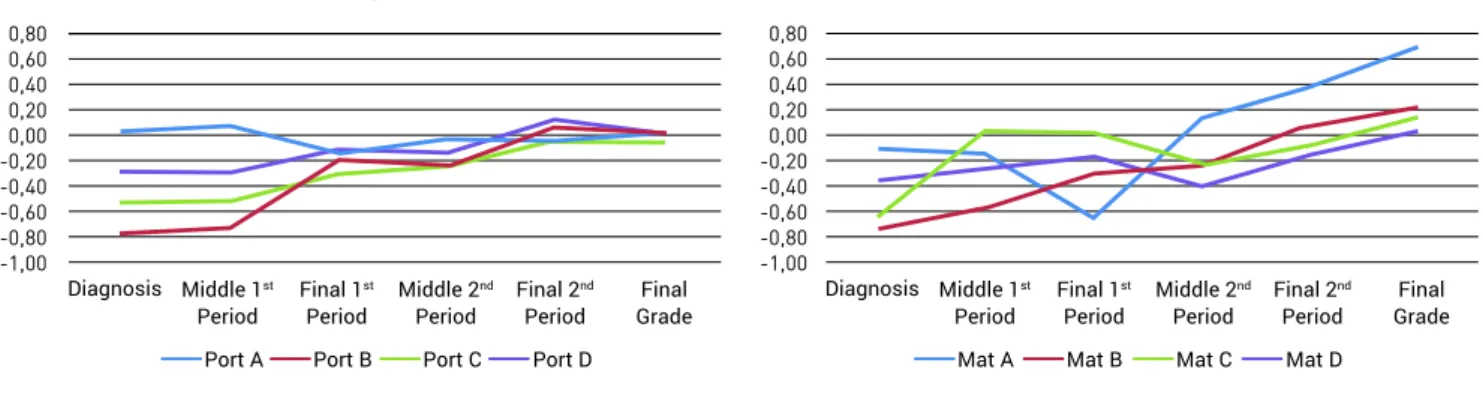
During stage 4, teachers experimented with the new model of class organization for the main disciplines (See Figure 3). Students attend lessons in most disciplines (History, Geography, Physical education, etc.) in their main class (A, B or C). In Portuguese and Mathematics, students from all main classes with grades 1 and 224 in the discipline were dislocated to the “Rehabilitate” class to recover the competencies they needed to improve. Students with grades “3” were placed in the “Consolidate” class to consolidate their competencies, and the ones with better grades went to the “Boost” class where the assigned teacher was able to work on strategies to boost their performances.
Figure 3. An LOOXVWUDWLRQRIWKHRUJDQL]DWLRQRISUŖOHFODVVHVLQDJLYHQGLVFLSOLQH3RUWXJXHVHRU0DWKHPDWLFV
&/$66$ &/$66% &/$66&
Grades 1, 2 Grades 3 Grades 4, 5
Rehabilitate Consolidate Boost
Finally, ESCXEL researchers are responsible for implementing the last stage of the model, which is to monitor students’ performance.The team is currently working on the analysis of data collected since the beginning of this pilot project, in order to present stable monitoring reports on students’ and class progress. For instance,
)LJXUHGLVSOD\VWKHHYROXWLRQRIWKHGLVFLSOLQHV̵PDUNVLQIRXUͤIWKJUDGHPDLQFODVVHV$%&'WKURXJKRXW
the school year, as deviations from the reference mark 325.
24 Marks are scored from 1 to 5.
)LJXUH(YROXWLRQRIGLVFLSOLQHVJUDGHVDVGLIIHUHQFHVWRWKHUHIHUHQFHPDUN LQ̧IWKJUDGHVFKRRO\HDU 0,80 0,60 0,40 0,20 0,00 -0,20 -0,40 -0,60 -0,80 -1,00 0,80 0,60 0,40 0,20 0,00 -0,20 -0,40 -0,60 -0,80 -1,00 Portuguese Mathematics
Diagnosis Middle 1st Diagnosis
Period
Middle 1st Period Final 1st
Period
Final 1st Period Middle 2nd
Period
Middle 2nd Period Final 2nd
Period
Final 2nd Period Final
Grade
Final Grade
Port A Port B Port C Port D Mat A Mat B Mat C Mat D
,QWKLVVFKRROFODVVHV$DQG'ZHUHLGHQWLͤHGDV0DWKHPDWLFV3URͤOHDQG%DQG&DV3RUWXJXHVH0DWKHPDWLFV
3URͤOH)LJXUHVKRZVFRQVLGHUDEOHLPSURYHPHQWLQWKHSHUIRUPDQFHRIFODVVHV$DQG'HVSHFLDOO\WKHIRU
-PHULQVWXGHQWV̵SHUIRUPDQFHLQWKHUHVSHFWLYHSURͤOHGLVFLSOLQHRI0DWKHPDWLFV7KHRWKHUWZRFODVVHVDOVR
improved over the school year, in both Mathematics and Portuguese.
The monitoring reports also provide information about each students’ performance in each discipline according
WRWKHVSHFLͤFFRPSHWHQFLHV7RFRPSOHWHWKHVHWRIGDWDZKLFKWKHWHDFKHUVPD\XVHWRLPSOHPHQWWKHDGHTXDWH
strategies, researchers added information about each class’s performance in key competencies (Figure 5).
Figure 5. Evolution of the average marks (as differences to the reference mark = 3) LQWKHNH\FRPSHWHQFLHVRI̧IWKJUDGH 0DWKHPDWLFVLQ&ODVV$VFKRRO\HDU 0,3 0,2 0,1 0 -0,1 -0,2 -0,3 -0,4 -0,5 -0,6 -0,7 -0,8 -0,9 -1
Diagnosis 1st evaluation 2nd evaluation 3rd evaluation 4th evaluation 5th evaluation Prob. Solving
Mat. Communication Mental Calculation Mat. Thinking
)RUH[DPSOHFODVV$LQ)LJXUHVKRZVRQHPDLQGHͤFLWWKDWRISUREOHPVROYLQJZKLFKDOOWHDFKHUVDQGPRUH VSHFLͤFDOO\WKH0DWKHPDWLFVWHDFKHUVKRXOGFRQVLGHUDGGUHVVLQJEHWWHULQWKHLUVWUDWHJLHV7HDFKHUVLQSURͤOH
classes are working on how to use monitoring reports to set and adapt strategies according to each class
VSHFLͤFGHͤFLWV
.QRZOHGJHFLUFXODWLRQLQVFKRROQHWZRUNVUHJXODWLRQDQGUHVRXUFHIRUVFKRROLPSURYHPHQW
The ESCXEL school network, which has the particularity of having a research centre as a partner, illustrates
WKHQHZUHODWLRQEHWZHHQNQRZOHGJHDQGSROLF\UHͥHFWLQJWKHZLGHUPRYHPHQWWRZDUGVFRJQLWLYHDQGUHͥH[LYH
societies in which knowledge is at the centre of social action (Pons &Van Zanten, 2007).
First of all, the relation between knowledge and policy means that knowledge is used to create regulation tools, or becomes a regulation tool itself (Barroso & Afonso, 2011; Pons & Van Zanten, 2007). Knowledge-based regulation tools represent new ways in which public action is coordinated, based in knowledge production,
dis-VHPLQDWLRQDQGH[FKDQJHDPRQJDFWRUVLQWKHͤHOGRINQRZOHGJHDQGSROLWLFDODFWRUV$IRQVR &RVWD
Through these types of tools, the actors’ behaviour is regulated by knowledge circulation mechanisms rather than constraint. Benchmarking in ESCXEL Project can be seen as a knowledge-based regulation tool and in its own way, it promotes a regulation of practices within a school network. The same can be said about the sharing of good practice, which is a potential source for regulated actions, as they show what could be done and how (Barroso & Afonso, 2011). This constitutes a soft regulation, which effect depends on the reception, interpretation and use by local actors. In fact, the meaning of knowledge is built during its interpretation and not inscribed in the tool itself (Freeman & Sturdy, 2007 in Mangez, 2011).
The relation between knowledge and policy points, secondly, to an understanding of knowledge as a resource for action and decision making (Mangez, 2011), which depends on the local mobilization of knowledge. Some activities in ESCXEL network, like training courses or dissemination of data analysis for local planning, are
spe-FLͤFDOO\GHGLFDWHGWRFDSDFLWDWHDFWRUVIRUDFWLRQ0DUR\2WKHUDFWLYLWLHVLQFOXGLQJWKHRQHVSUHVHQWHG
as knowledge-based regulation tools (cf benchmarking and good practices), can also be seen as resource for action, simultaneously based upon knowledge, knowledge producers and knowledge users, without rigidly set roles: at different stages in the process, all actors in the network reciprocally become producers and users drawing on each others’ knowledge. In this sense, we follow Delvaux’s (2009) approach, which breaks with the
IRUPDODQGVFLHQWLͤFFRQFHSWRINQRZOHGJHDQGZLWKSUHYLRXVOLQHDUSHUVSHFWLYHVRIWKHWUDͦFEHWZHHQNQRZO
-HGJHSURGXFHUVXVXDOO\DFWRUVIURPWKHVFLHQWLͤFͤHOGDQGUHFHLYHUVSROLWLFDODFWRUV7KHQHZDSSURDFK FRQVLGHUVDZLGHUGHͤQLWLRQRINQRZOHGJHDQGVWXGLHVKRZGLIIHUHQWDFWRUVVHOHFWDQGFRPELQHYDULRXVNLQGV
of knowledge in the political process.
5HJXODWLRQDQGUHͥH[LYLW\LQDFROODERUDWLYHHQYLURQPHQWDUHSUHVHQWLQWKHWKUHHXQGHUO\LQJJRDOVRIWKHFRQ
-VWUXFWLRQDQGGLVVHPLQDWLRQRILQGLFDWRUVLQ(6&;(/QHWZRUNLGHQWLͤHGE\6DQWRVLWRDGGQHZZD\VWR
analyse and present the results on national exams and their evolution, in order to “inform the perception, prob-lematization, discussion and action orientations” of educational local actors (pp. 152-153 [our emphasis]); ii) to contribute to a collaborative and benchmarking culture among network members; iii) to stimulate a self-evalua-tion culture and the presentation of results to external evaluations.
In fact, knowledge produced and disseminated in ESCXEL network activities can induce self-evaluation and
UHͥH[LYLW\ SURFHVVHV DPRQJ ORFDO DFWRUV RQ WKHLU HGXFDWLRQDO SUDFWLFHV DQG UHVXOWV VLPLODUO\ WR ZKDW KDS
-SHQVZLWKVRPHH[WHUQDOHYDOXDWLRQWRROV$IRQVR &RVWD2]JD7KHUHͥHFWLRQVWLPXODWHGZLWKLQ
schools and municipal agencies by reports or by presentations in seminars contributes to the creation of new
NQRZOHGJHFRPELQLQJFRGLͤHGNQRZOHGJHGUDZQIURP(6&;(/DFWLYLWLHVZLWKWDFLWORFDONQRZOHGJH0DQJH]
2011). Thereby, knowledge is contextualized in social interactions within schools, which are crucial for the reconstruction of meanings and production of new meanings (Afonso & Costa, 2011).
Most of the persons interviewed in an exploratory work (Batista & Gonçalves, 2015) mentioned the use of
ES-&;(/UHSRUWVDQGSUHVHQWDWLRQVLQVHPLQDUVWRGLVFXVVUHVXOWVDQGLQVWLJDWHUHͥHFWLRQZLWKLQVFKRROV%DVHG XSRQQHZNQRZOHGJHWKHVHUHͥHFWLRQVFRQWULEXWHWRWKHGHͤQLWLRQRISUREOHPVRUDFWLRQSODQV7KHVHDUHWZR FUXFLDOPRPHQWVLQWKHSROLWLFDOSURFHVVZKHUHNQRZOHGJHLVXVHGDVUHVRXUFHGHͤQHGE\'HOYDX[DV ̸SUREOHPDWL]DWLRQ̹DQG̸SUHFRQL]DWLRQ̹,QWKHIROORZLQJVWDWHPHQWVZHFDQVHHKRZUHͥHFWLRQVLQGXFHGE\ (6&;(/QHWZRUN̵VDFWLYLWLHVFDQOHDGWRWKHGHͤQLWLRQRIQHZSUREOHPVJHQHUDOO\LQWKHIRUPRILVVXHVWREH
ESCXEL report […] is one of the tools which also serve to set goals and guidelines (Principal School 1).
[ESCXEL results reports] give a widening perspective because they inform us of our school’s outlook. And that is important to debate the future, to make a plan and establish strategies and benchmarks for the future (Principal School 2).
We have been changing the structure of our Educational Project to ensure that all strategies and bench-marks can be evaluated with the proper indicators according to what we learned in the ESCXEL training course (Department Coordinator School 1).
All our teachers that attended [Municipality X] Seminar brought a considerable amount of ideas that were debated and some of them implemented in our school (Principal School 3).
I should tell you that we also have been improving the information we put on MISI [the digital platform which stores data on students’ socioeconomic characterization]. Until two years ago, the school’s administrative services uploaded data on MISI. End of story. I never bothered to go and check. And then [when ESCXEL distributed analyses based on MISI data] I noticed that there was a lot of wrong data […]. In this issue too, it forced us to have a better look at our data […] and now I insert the data into MISI myself (Principal School 1).
School networks are important structures that can bring about changes in education: they create the con-ditions for knowledge creation and sharing by and among schools (Veugelers & O’Hair, 2005) and also other
DFWRUVDVLWLVWKHFDVHLQWKH(6&;(/QHWZRUN7KURXJKRQJRLQJGLVFXVVLRQDQGUHͥH[LRQERWKDFURVVDQG
within schools in networks, new ideas, tools and practices are created, in a process where the initial knowledge is substantially transformed (Veugelers & O’Hair, 2005), combining different sources and types of knowledge (Delvaux, 2009).
+RZHYHUDVVWDWHGE\.DW](DUODQG-DDIDUVLPSOHFRQQHFWLRQVDUHQRWHQRXJKWRFUHDWHVLJQLͤFDQW
change in practice: effective networks are learning communities, “groups of schools working together in in-tentional ways to enhance the quality of professional learning and to strengthen capacity for continuous im-provement, in the service of enhanced student learning” (p.9). Upon ideas, practices and information from the
QHWZRUNDFWRUVLQVFKRROVDUHDZDUHRIQHZFKDOOHQJHVDQGLQLWLDWHVHOIUHͥH[LRQZKLFKDOVRFDQFRQWULEXWHWR
the development of a shared vision of education (Veugelers & O’Hair, 2005) – especially if the new knowledge produced locally is based on a professional learning community, where it is shared and helps to elaborate col-lective know-how in order to improve students’ performance (Normand & Derouet, 2011). According to Katz, Earl and Jaafar (2009), participation in school networks fosters the development of professional learning
com-PXQLWLHVLQVFKRROVE\OLQNLQJWKHPWRRWKHUVFKRROEDVHGJURXSVDQGDOORZLQJQHZDQGGLYHUVLͤHGFLUFXLWVRI
knowledge creation and sharing to emerge; once new knowledge is created and shared within the school, it is
OLNHO\WRLQͥXHQFHHGXFDWLRQDOSUDFWLFHV
Our description of ESCXEL’s main activities raises some important questions on the role of knowledge in edu-cation policy, in the context of new modes of regulation in eduedu-cational systems. We were able to identify how, in a school network, knowledge can be used simultaneously as a regulation tool and as a resource for action in schools. However, mobilization of knowledge may differ according to schools (Batista & Gonçalves, 2015) and
WKHUHLVDQHHGWRH[SORUHIXUWKHUZKHWKHUDQGKRZVHOIHYDOXDWLRQDQGUHͥH[LYLW\SURFHVVHVLQ(6&;(/QHWZRUN
5HIHUHQFHV
Afonso, N., & Costa, E. (2011). A avaliação externa das escolas: Um instrumento de regulação baseado no conhecimento. In J. Barroso & N. Afonso (Eds.), Políticas educativas: Mobilização de conhecimento e modos de regulação (pp.155-189). Vila Nova de Gaia: Fundação Manuel Leão.
Barroso, J. (2005). O Estado, a educação e a regulação das políticas públicas. Educação & Sociedade, 26(92), 725-751.
Barroso, J., & Afonso, N. (2011). Introdução. In J. Barroso & N. Afonso (Eds.), Políticas educativas: Mobilização de conhecimento e modos de regulação (pp. 11-25). Vila Nova de Gaia: Fundação Manuel Leão.
Batista, S., Franco, L., & Santos, R. (2014). Indicadores sintéticos de contexto socioeconómico dos resultados escolares em exames nacionais nos concelhos de Portugal Continental (2009-2014), Working Papers CES-NOVA, 1. Retrieved from
KWWSFHVQRYDIFVKXQOSWFPVͤOHVSXEOLFDFRHV38%FGFHSGI
Batista, S., & Gonçalves, E. (2015, September). School Networks and Knowledge Mobilisation: exploratory study in ESCXEL Project. Paper presented at ECER 2015, Budapest. Abstract retrieved from
http://www.eera-ecer.de/ecer-programmes/conference/20/contribution/34798/
Delvaux, B. (2009). Qual é o papel do conhecimento na acção pública? Educação & Sociedade, 30(109), 959-985. http://dx.doi.org/10.1590/S0101-73302009000400003
Durant, W. (2006 [1926]). The story of Philosophy. The lives and opinions of the world’s greatest philosophers from Plato to John Dewey (2nd ed.). New York, NY: Simon&Schuster.
Gonçalves, E. (2015, October). A democracia participada das famílias no interior das escolas. In Sá, V., Torres, L., Silva, G., & Silva, D. (Eds.), II Colóquio Internacional de Ciências Sociais de Educação.O governo das esco-las: Atores, Políticas e Práticas, Braga: Universidade do Minho, De Facto Editores. Retrieved from
KWWSZHEVLHXPLQKRSWLLFLFVHͤOHV$7$6,,&,&6(B&6SGI
Gonçalves, E. Cunha, S., & Batista, S. (2011, November). ESCXEL Project – Schools of Excellence Network. A pioneer educational project from Portugal. Proceedings from ICERI2011: 4th International Conference of Education, Research and Innovation. Madrid: IATED. Retrieved from
http://library.iated.org/publications/ICERI2011
Justino, D., & Batista, S. (2013). Redes de escolas e modos de regulação do sistema educativo. Educação, Te mas e Problemas. [A escola em análise: olhares sociopolíticos e organizacionais], 6(12-13), 41-60. Katz, S., Earl, L., & Jaafar, S. B. (2009). Building and connecting learning communities. The power of networks for
school improvement. Thousand Oaks, CA: Corwin Press.
Mangez, É. (2011). Economia, política e regimes do conhecimento. In Barroso, J. & Afonso, N. (Eds.), Políticas educativas: Mobilização de conhecimento e modos de regulação (pp.191-222). Vila Nova de Gaia: Fundação Manuel Leão.
0DUR\&3ROLWLTXHVHWRXWLOVGHmO̵«FROHGHODSHUIRUPDQFH}DFFRXQWDELOLW\U«JXODWLRQSDUOHVU«VXOWDWV
et pilotage. In C. Maroy (Ed.), .ŨȌEQNGȃNŨȌRTGWXGFGNCRGTHQTOCPEG (pp. 13-31). Brussels: De Boeck.
Normand, R., & Derouet, J.-L. (2011). Évaluation, développement professionnel et organisation scolaire. Revue Française de Pédagogie, 174. Retrieved from
http://rfp.revues.org/2899
Ozga, J. (2009). Governing education through data in England: from regulation to self-evaluation. Journal of Education Policy, 24(2), 149-162.
http://dx.doi.org/10.1080/02680930902733121
Pons, X., & Van Zanten, A. (2007, June). Knowledge circulation, regulation and governance. Research Report Know&Pol. Retrieved from
http://knowandpol.eu/IMG/pdf/lr.tr.pons_vanzanten.eng.pdf
Santos, R. (2014). Monitorização e benchmarking de resultados escolares (exames e provas de aferição) na Rede ESCXEL. In CNE (Ed.), Avaliação externa e qualidade das aprendizagens (pp. 152-166). Lisbon: Conse-lho Nacional de Educação. Retrieved from
http://www.cnedu.pt/pt/publicacoes/seminarios-e-coloquios/1074-avaliacao-externa-das-escolas Veugelers, W., & O’Hair, M. J. (Eds.). (2005). Network Learning for Educational Change. Maidenhead: Open University
![Figure 3. An LOOXVWUDWLRQRIWKHRUJDQL]DWLRQRISUŖOHFODVVHVLQDJLYHQGLVFLSOLQH3RUWXJXHVHRU0DWKHPDWLFV](https://thumb-eu.123doks.com/thumbv2/123dok_br/15843676.658683/7.892.86.394.637.847/figure-an-looxvwudwlrqriwkhrujdql-dwlrqrisur-ohfodvvhvlqdjlyhqglvflsolqh-ruwxjxhvhru-dwkhpdwlfv.webp)