Brazilian Journal of Physics, vol. 37, no. 1, March, 2007 71
The NJL Interaction from
q
-Deformed Inspired Transformations
∗V. S. Tim´oteo1 and C. L. Lima2
1Centro Superior de Educac¸˜ao Tecnol´ogica, Universidade Estadual de Campinas, 13484-370, Limeira, SP, Brazil
2Instituto de F´ısica, Universidade de S˜ao Paulo, CP 66318, 05315-970, S˜ao Paulo, SP, Brazil
Received on 29 September, 2006
From the mass term forq-deformed quark fields, we obtain effective contact interactions of the NJL type. The parameters of the model that maps a system of non-interacting deformed fields into quarks interacting via NJL contact terms is discussed.
Keywords: Quantum Algebras; Hadronic Physics; Effective Models
In hadron physics, the NJL model [1, 2] is a very simple effective model for strong interactions that describes impor-tant features like the dynamical mass generation, spontaneous chiral symmetry breaking, and chiral symmetry restoration at finite temperature.
q-Deformed algebras provide a nice framework to incorpo-rate, in an effective way, interactions not originally contained in the Lagrangian of a particular system [3–5].
In recent works [6–9], we have been investigating possible applications of quantum algebras in hadronic physics. In gen-eral, we observed that when we deform the underlying alge-bra, the system is affected with correlations between its con-stituents. We have studied in detail the NJL model under the influence of a quantumsu(2)algebra.
In this work we approach the following question: is it pos-sible to obtain an art of ”canonical transformation” connecting the NJL model to a simpler non-interacting system? We veri-fied that we can indeed obtain the same dynamics of the NJL interaction with non-interactingq-deformed quark fields.
We start by writing a mass term for theq-deformed quark fields
L
massq = −MΨΨ
= −M ¡
Ψ1Ψ1+Ψ2Ψ2¢
= −M ¡
UU+DD¢ (1)
whereΨ1,2=U,Dare the components ofΨ.
Theq-deformed quark fields can be written in terms of the standard fields as
Ψ1 = ψ1+ (q−1−1)ψ1ψ2γ0ψ2, (2)
Ψ2 = ψ2+ (q−1−1)ψ2ψ1γ0ψ1, (3)
or
U = u+ (q−1−1)udγ0d, (4) D = d+ (q−1−1)duγ0u, (5) andψ1,2=u,d. Here both components are modified in the same way, so that the above expressions are different from he
∗Talk given at RETINHA 18, IFUSP, S˜ao Paulo, May 2006.
Dedicated to Prof. Yogiro Hama in honor of his 70th birth.
ones used in [4, 5], where only one component is affected. Extending the deformation to the two components is required to obtain a set of terms that will form an interaction of the NJL type. This implies that the anti-commutation relations for the deformed fieldsΨwill also be different from the ones in [4, 5]. Since obtaining the new anti-commutation relations is not in the scope of this work, we focus on the effective interactions contained in the non-interacting Lagrangian.
Using Eqs. (4) and (5), we can re-write the Lagragian Eq.(1) in terms of the non-deformed quark fields
UU = uu+Q uud†d+Q d†duu+Q2dduudd, (6) DD = dd+Q ddu†u+Q u†udd+Q2uudduu, (7) whereQ= (q−1−1).
We can re-write the above equations as follows
UU = ³1+2Qd†d´uu+Q
2 2
¡
dduudd+dduudd¢, DD = ³1+2Qu†u´dd+Q
2 2
¡
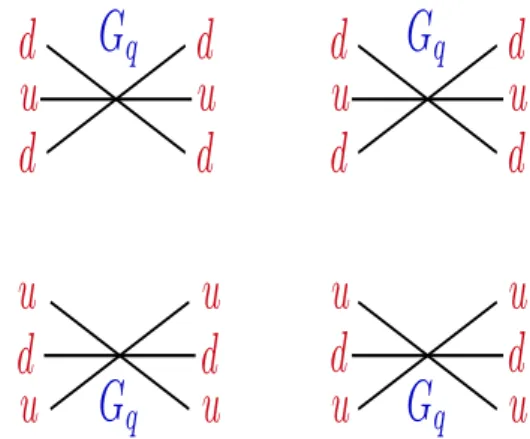
uudduu+uudduu¢, so that we identify the contact interactions between the quarks contained in the non-interacting deformed fields Lagrangian. The six-point contact terms are depicted in Fig. 1.
d
d
d
d
u
u
u
u
u
u
d
d
d
d
u
u
d
d
d
d
u
u
u
u
G
q
G
q
G
q
G
q
FIG. 1: Contact interactions generated by the mass term for theq -deformed fermion fields.
72 V. S. Tim´oteo and C. L. Lima
have
¡
UU+DD¢ =
à 1+2Q
ψ†ψ®
A !
¡
uu+dd¢
+ Q
2 2
hψψi A2 × ¡
dduu+dddd+uudd+uuuu¢, (8) wherehψ†ψi=hu†ui=hd†di=ρv,hψψi=huui=
dd®
=
ρs, andA=A(T;q)has the same dimension of the conden-sate and will be determined later in this work. This procedure corresponds to have one fermion line closed and can be repre-sented by the diagrams of Fig. 2.
u
u
d
d
d
d
u
u
!
uu
"
!
dd
"
u
u
u
u
d
d
d
d
!
dd
"
!
uu
"
G
q
G
q
G
q
G
q
FIG. 2: Reduction of the six-point interactions of Fig. 1 to four-point interactions by closing one fernion line.
Now we can write the mass term for theq-deformed quark fields
L
qmass = −MΨΨ= −M³1+2Dψ†ψEΓ´ψψ
− M 2 hψψiΓ
2ψψψψ,
(9)
withΓ=Q/A
Accordingly, the kinetic energy term for the deformed fields,Ψγµ∂
µΨ, can be written in terms of the non-deformed ones as
Ψγµ∂
µΨ = Uγµ∂µU+Dγµ∂µD
= uγµ∂
µu+Q¡dγ0duγµ∂µu+uγµ∂µudγ0d¢
+ dγµ∂µd+Q
¡
uγ0udγµ∂µd+dγµ∂µduγ0u ¢
+ Q2¡
dγ0duγµ∂ µudγ0d¢
+ Q2¡
uγ0udγµ∂
µduγ0u¢ (10)
By using an extreme mean field approximation, namely, substituting everywhere in the kinetic energy contribution hψ†ψi=hu†ui=hd†di →ρv, andhψψi=huui=
dd® →ρs,
we obtain
Ψγµ∂µΨ = uγµ∂µu(1+2Γρv)
+ dγµ∂
µd(1+2Γρv)
+ (uγµ∂µu)Γ2ρv+¡dγµ∂µd¢Γ2ρv
= ¡
uγµ∂
µu+dγµ∂µd¢(1+Γρv)2 (11) This corresponds to a usual kinetic energy with a shifted mo-mentump→p(1+Γρv)2.
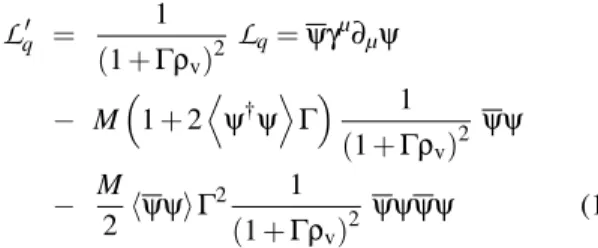
The treatment of the density dependence of the kinetic en-ergy term is rather cumbersome and will be postponed to a further contribution. We will consider the influence of this momentum dependent kinetic energy term in an effective way. Therefore, we will study a class of Lagrangians of the type
L
q′ = 1(1+Γρv)2
L
q=ψγµ∂µψ− M³1+2Dψ†ψEΓ´ 1
(1+Γρv)2 ψψ
− M 2 hψψiΓ
2 1
(1+Γρv)2 ψψψψ (12)
This representative of the full Lagrangian
L
q=Ψγµ∂µΨ+L
qmass, when written in terms of the standard quark fields, can be identified with the NJL LagrangianL
NJL=ψγµ∂µψ−m0ψψ+Gψψψψ. (13) The conditions for both Lagrangians,L
NJL andL
′q, to be equivalent for any values ofT andqare
M=(1+Γρv)
2
(1+2Γρv)m0, (14)
and
G=−M 2
ρsΓ2
(1+Γρv)2 . (15)
If we insert Eq. (14) in Eq. (15), we obtain an equation forΓ
Γ2−2αρvΓ−α=0, (16)
where
α=− 2G
m0ρs >0. (17)
This equation has two solutions
Γ±=αρv
à 1±
s
1+ 1
αρ2 v
!
. (18)
Brazilian Journal of Physics, vol. 37, no. 1, March, 2007 73
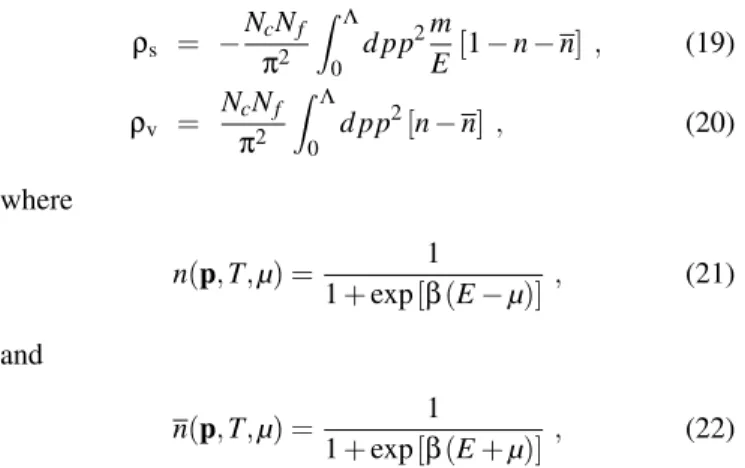
The scalar (ρs) and vector (ρv) densities were calculated from the NJL model at finite temperature:
ρs = −NcNf
π2
Z Λ
0
d pp2m
E[1−n−n] , (19)
ρv = NcNf
π2
Z Λ
0
d pp2[n−n] , (20) where
n(p,T,µ) = 1
1+exp[β(E−µ)], (21)
and
n(p,T,µ) = 1
1+exp[β(E+µ)], (22)
are the fermions and anti-fermions distribution functions re-spectively withE=pp2+m2.
First solve the set of coupled gap equations form,µ, and ρv(Eqs. 23 and 20, respectively) in the NJL model at finite temperature and chemical potential
½
m=m0−2Gρs,
µ=µ0−NGcρv. (23) The next step is to calculate the scalar and vector densities entering in the equation forΓfor a given value of the defor-mation parameterq. In this way we obtainA(T;q), which in turn is used to obtainM. The numerical results are displayed in Figures 3 and 4, where we show the quantityA, in units of the condensate at zero temperature, as a function of both temperature and deformation for theq>1 andq<1 regimes.
0 0.05
0.1 0.15
0.2 1 1.1 1.2 1.3
1.4 1.5 0
0.01 0.02 0.03 0.04 0.05
q T (GeV)
A/
ρ0
FIG. 3: The quantityA, in units of the chiral condensate at zero tem-peratureρ0=ρs(T =0) =−1.42×10⁻² GeV3, as a function of
temperature andq-deformation for theq>1 regime.
It is worth to note that the mass of theq-deformed fermion fields,M, does not depend on the deformation of the algebra while its temperature dependence is shown in 5.
The quantity A(T;q) maps the simple non-interacting model into the NJL model. It represents, in an effective way,
the correlations introduced by the quantum algebra, when we write the non-interacting Lagrangian in terms of the standard
0 0.05 0.1 0.15
0.2 0.4
0.5 0.6 0.7 0.8 0.9 1 0
0.2 0.4 0.6 0.8
q T (GeV)
A/
ρ0
FIG. 4: The quantityA, in units of the chiral condensate at zero tem-peratureρ0=ρs(T =0) =−1.42×10⁻² GeV3, as a function of
temperature andq-deformation for theq<1 regime.
0 0.02 0.04 0.06 0.08 0.1 0.12 0.14 0.16 0.18 0.2 0
20 40 60 80 100 120 140
T (GeV)
M / m
0
FIG. 5: The mass of theq-deformed quark fields, in units of the current quark massm0=5 MeV, as a function ofT for bothq>1
andq<1 regimes. For small temperatures,M=m0.
quark fields. These correlations, in a mean field approxima-tion, are effectively represented by contact interactions of the NJL type. It is also important to mention that it inherits the phase transition. When the condensate and the dynamical mass vanishes with increasingT, the quantityAalso experi-ences the phase transition. This is an expected behavior, since it depends on the dynamical mass. For a given temperature, T, and deformation,q, there is a value of the mapping func-tion,A(T;q), that makes the Lagrangians Eq.(12) and Eq.(13) equivalent.
Summarizing, we have shown that it is possible to describe the dynamics of an interacting system of the NJL type with a simple non-interacting system by using a set of quantum algebra transformations and a mapping function.
Acknowledgments
74 V. S. Tim´oteo and C. L. Lima
[1] Y. Nambu and G. Jona-Lasinio, Phys. Rev.122, 345 (1961). [2] U. Vogl and W. Weise, Prog. Part. Nucl. Phys.27, 195 (1991). [3] D. Galetti and B. M. Pimentel, An. Acad. Bras. Ci.67, 7 (1995);
S. S. Avancini, A. Eiras, D. Galetti, B. M. Pimentel, and C. L. Lima, J. Phys. A: Math. Gen.28, 4915 (1995); D. Galetti, J. T. Lunardi, B. M. Pimentel, and C. L. Lima, Physica A242, 501 (1997).
[4] M. Ubriaco, Phys. Lett. A 219, 205 (1996).