1232 Brazilian Journal of Physics, vol. 37, no. 4, December, 2007
Improvement of Mass Calculations for the Neutron Rich
A
∼
32
Nuclei
S. Khaled and M. Ramdhane
Department of Physics, Mentouri Constantine University-25000 Constantine, Algeria
Received on 20 August, 2007
In previous works anomalies were observed in binding energies for the island of inversion nuclei centered at Z=11, N=21 by the comparison of theoretical calculations and experiment. An attempt was made in this work using an improved term of shell corrections to observe the evolution of these anomalies. This term was added to the macroscopic part of the previous mass formula and binding energy calculations have been carried out. A distribution of these latter on a (N,Z) chart has indicated that the calculated values increase with the increase of N for all values studied as for those of experiment except the value of Z=10. This result shows the presence of these anomalies only in the line Z=10 and their absence in the lines Z=11 and 12. Although this shell correction includes a term representing an interaction between protons and neutrons of valence shells, but it is insufficient to study this deformed mass region.
Keywords: Mass calculations; Anomalies; Island of inversion
I. INTRODUCTION
In previous works, a mass formula was developed by taking the Weizs¨acker mass formula as a starting point and basing on the relative neutron excessI [1]. This formula composed of a macroscopic part and shell correction term was applied to calculate binding energies of the A∼32 nuclei. In this deformed mass region, anomalies were observed for the first time by Thibault et al. [2].
This work is an attempt to improve the macroscopic calcu-lations made in the previous work [1] by improving the shell correction term of the mass formula. The improved term con-tains the effect of magic numbers and an interaction term be-tween protons and neutrons [3]. The mass formula deduced was employed to calculate binding energies of theA∼32 nu-clei. The calculations show the absence of the anomalies only in the linesZ=11 and 12 of the(N,Z)chart.
II. MASS FORMULA
The mass formula employed is given by
E=Emac+Eshell (1) WhereEmacis a macroscopic term given by [1]
Emac=av¡1−kvI2¢A−as¡1−ksI2¢A2/3−ac1
Z2 A1/3+ac2
Z2 A ±δ (2) And av,kv,as,ks,ac1,ac2 are parameters to be determined
by a fit of experimental binding energies of nuclei [4]. The pairing energy is given by [1]
δ=
+³√12 A−
10 A ´
−30¯¯N−AZ ¯
¯ , Z and N even
−10A −30 ¯ ¯N−AZ
¯
¯ , Z or N odd
−
³ 12 √
A− 10
A ´
−30¯¯N−AZ ¯
¯ , Z and N odd
−
³ 12 √
A+ 20
A ´
−30¯¯N−AZ ¯
¯ , Z and N odd, Z=N (3)
The new shell correction is given by [3]
Eshell=¡Esel f+Eint¢G (4) The termEsel f is a sum of shell effects for each kind of nucleons; it is given by [3]
Esel f=Es "
∑
à z2i D2i +
n2j D2j
!
+
∑
(ziεi+njεj) #(5)
Where
Di=Mi+1−MiandD j=Mj+1−Mj, Mi,Mi+1,MjandMj+1are magic numbers.
εi,εjare slopes of the difference(Eexp−Emac)in function ofziandnjrespectively.
Esis a universal factor for all shell effects, its value is:Es= 26.004MeV [3].
Gis an erosion factor; its value is determined in our work by a fit of experimental binding energies.
Eint corresponds to the interaction effects between protons and neutrons of valence shells. To deduce its form, we define: * The concerned region, Zm ≤ Z ≤ ZM,Nm ≤ N ≤ NM,Zµand Nµ.
* The number of valence particles,p′andn′. * The function f(p′,n′)corresponding to this effect. It has the following form:
Eint=
∑
Eηfη(ρi,ρj) (6) WithEη=Es
min(Zµ−Zm,ZM−Zµ) Di
min(Nµ−Nm,NM−Nµ) Dj
(7) Where
ρi= p′/p′max, ρj=n′/n′max
p′max andn′max are the maximal values of p′ andn′ in the region concerned.
Zm=12(Mi−1+Mi), Zµ=Mi, ZM=12(Mi+Mi+1),
S. Khaled and M. Ramdhane 1233
NM=12(Mj+Mj+1).
For magic nuclei,Eintis given by: Esph=Eηρ2iρj¡1−ρ2i+1
¢
(1−ρj+1) (8)
For neutron rich nuclei, it is given by:
Ern=Eηρiρj (9)
Wheren′=N−Nm, p
′
=ZM−Z. For proton rich nuclei, it is given by:
Er p=Eη(ρi−ρj)2 ¡
1−ρ2i+1 ¢
(1−ρj+1) (10)
III. DETERMINATION OF PARAMETERS
To deduce the parameters of this formula, a fit of exper-imental binding energies of neutron richA∼32 nuclei was carried out [1,3,4].
IV. RESULTS
The parameters deduced are: av=14.3507MeV, kv=1.9001, as=13.3655MeV,ks=2.4522, ac1 =0.6834MeV, ac2=0.4896MeV,
εi=−3.1209,εj=−1.6325,
G=0.4159,Es=26.004MeV.
In Fig. 1, we represent the experimental and calculated binding energies of the neutron richA∼32 nuclei versus the number of neutronsN.
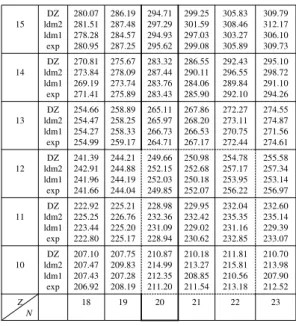
The results of binding energies are distributed with those of experiment [4] and those reported in references [1,5] in the (N,Z)chart of Fig. 2.
In Fig. 1, the first observation made on the new calculations (ldm2) is that they follow the same behavior as those of ex-periment for the three values ofZ. They are also situated on the upper side of the three curves but they are very close to experiment in the case ofZ=12.
In Fig. 2, the results of binding energies obtained are in agreement with those of experiment [4]. The distribution of these results on a(N,Z)chart shows that the anomalies ob-served in reference [1] are present only in the lineZ=10, and are absent in the linesZ=11 andZ=12 of the(N,Z)chart.
The reason for occurring these anomalies only in the line ofZ =10 is probably the great spacing between proton and neutron shells for the isotopes of these nuclei and mainly the Ne isotopes. Another reason is the form of the interaction between protons and neutrons depending only on magic num-bers and valence particles, so its application is not important for these nuclei. Adding also the great number of proton holes for the Ne isotopes than for Na and Mg isotopes, so there is a probable interaction between proton holes in the same shell. It is interesting to compare our results with those of Duflo and Zuker [5], where they have developed and employed a purely microscopic mass formula. The results obtained using their formula showed also the presence of anomalies only in the
18 20 22
204 206 208 210 212 214
216 Z=10
exp ldm2 ldm1
EL
(Me
V
)
N a
18 20 22 24
220 222 224 226 228 230 232 234
236 Z=11 exp ldm2 ldm1
EL
(Me
V
)
N b
18 20 22 24
240 242 244 246 248 250 252 254 256
258 Z=12
exp ldm2 ldm1
EL
(MeV)
N c
1234 Brazilian Journal of Physics, vol. 37, no. 4, December, 2007
15 DZ ldm2 ldm1 exp
280.07 281.51 278.28 280.95
286.19 287.48 284.57 287.25
294.71 297.29 294.93 295.62
299.25 301.59 297.03 299.08
305.83 308.46 303.27 305.89
309.79 312.17 306.10 309.73
14 DZ ldm2 ldm1 exp
270.81 273.84 269.19 271.41
275.67 278.09 273.74 275.89
283.32 287.44 283.76 283.43
286.55 290.11 284.06 285.90
292.43 296.55 289.84 292.10
295.10 298.72 291.10 294.26
13 DZ ldm2 ldm1 exp
254.66 254.47 254.27 254.99
258.89 258.25 258.33 259.17
265.11 265.97 266.73 264.71
267.86 268.20 266.53 267.17
272.27 273.11 270.75 272.44
274.55 274.87 271.56 274.61
12 DZ ldm2 ldm1 exp
241.39 242.91 241.96 241.66
244.21 244.88 244.19 244.04
249.66 252.15 252.03 249.85
250.98 252.68 250.18 252.07
254.78 257.17 253.95 256.22
255.58 257.34 253.14 256.97
11 DZ ldm2 ldm1 exp
222.92 225.25 223.44 222.80
225.21 226.76 225.20 225.17
228.98 232.36 231.09 228.94
229.95 232.42 229.02 230.62
232.04 235.35 231.16 232.85
232.60 235.14 229.39 233.07
10 DZ ldm2 ldm1 exp
207.10 207.47 207.43 206.92
207.75 209.83 207.28 208.19
210.87 214.99 212.35 211.20
210.18 213.27 208.85 211.54
211.81 215.81 210.56 213.18
210.70 213.98 207.90 212.52
Z N
18 19 20 21 22 23
FIG. 2: Distribution of experimental and calculated binding energy values on a (N,Z)chart. exp: experimental values, ldm1: values reported in reference [1], ldm2: values of this work, DZ: values re-ported in reference [5]. The dashed lines surround the island of in-version; the magic number 20 is selected by thick lines.
lineZ=10, and their absence in the linesZ=11 andZ=12 of the (N,Z)chart. So the mass formula developed in this work has improved well the binding energies for nuclei with Z=11 and 12 and there is not much improvement for the Z=10 nuclei.
V. CONCLUSION
In previous works and using a mass formula, anomalies have been observed following the linesZ=10,11 and 12 of the(N,Z)chart [1]. In this work we have replaced the shell correction term of the mass formula by a deeper term, contain-ing the effect of magic numbers and a term of interaction be-tween nucleons. The application of this formula has resolved the anomalies problem following only the linesZ=11,12 of the island of inversion. The fact of these anomalies is that in these nuclei the last neutrons shell is far from that of protons and the Ne isotopes contain more holes than the Na and Mg isotopes. Consequently the interaction between protons and neutrons is neglected. The weak coupling model discussed in [1] remains the good approximation to study this deformed mass region.
[1] S. Khaled, M. Ramdhane, and F. Benrachi, Eur. Phys. J. A22, 17 (2004).
[2] C. Thibault, R. Klapisch, C. Rigaud, A. M. Poskanzer, R. Prieels, L. Lessard, and W. Reusdorf, Phys. Rev. C12, 644 (1975). [3] J. Duflo, Nucl. Phys. A576, 29 (1994).
[4] G. Audi, A. H. Wapstra, and C. Thibault, Nucl. Phys. A729, 337 (2003).
![FIG. 1: Representation of experimental and calculated binding ener- ener-gies using the two liquid-drop models (ldm1 [1] and ldm2) versus N.](https://thumb-eu.123doks.com/thumbv2/123dok_br/18982276.457483/2.892.485.817.79.934/representation-experimental-calculated-binding-using-liquid-models-versus.webp)