Article
J. Braz. Chem. Soc., Vol. 22, No. 3, 422-427, 2011. Printed in Brazil - ©2011 Sociedade Brasileira de Química 0103 - 5053 $6.00+0.00
A
*e-mail: [email protected]
Electropolymerization of Brilliant Cresyl Blue on Carbon Ionic Liquid Electrode and
Electrocatalytic Application for the Voltammetric Determination of Ascorbic Acid
Xia Li, Qingjuan Niu, Guangjiu Li, Tianrong Zhan and Wei Sun*
Shandong Provincial Key Laboratory of Biochemical Analysis, College of Chemistry and Molecular Engineering, Qingdao University of Science and Technology, Qingdao 266042, P. R. China
Azul de cresil brilhante (BCB) foi eletropolimerizado sobre a superfície de um eletrodo de carbono líquido iônico (CILE) por voltametria cíclica de varredura na faixa de potencial de –0,5 a
1,0 V. CILE foi preparado usando o 1-etil-3-metil-imidazólio tetraluoroborato ([EMIM]BF4) como
modiicador. Um ilme polimerico estável de BCB foi obtido no CILE com aparecimento de um par de picos redox. As características do ilme PBCB foram estudadas por diversos métodos tais como, microscopia eletrônica de varredura (SEM), espectroscopia de impedância eletroquímica (EIS) e voltametria cíclica. O eletrodo modiicado apresentou excelente resposta eletrocatalítica para ácido ascórbico com o aumento das respostas eletroquímicas. Sob condições ótimas, uma
boa resposta voltamétrica linear foi obtida no intervalo 2,0 × 10⁻⁵-3,0 × 10⁻³ mol L-1 , com limite
de detecção de 6,5 μmol L-1 (3σ).
Brilliant cresyl blue (BCB) was electropolymerized on the surface of a carbon ionic liquid electrode (CILE) by cyclic voltammetric sweep in the potential range from –0.5 to 1.0 V. CILE
was prepared by using 1-ethyl-3-methyl- imidazolium tetraluoroborate ([EMIM]BF4) as modiier.
The stable polymer ilm of BCB was obtained on the CILE and a pair of redox peaks appeared. The characteristics of PBCB ilm was studied by different methods such as scanning electron microscopy (SEM), electrochemical impedance spectroscopy (EIS) and cyclic voltammetry. This modiied electrode showed excellent electrocatalytic response to ascorbic acid with the increase of the electrochemical responses. Under the optimal conditions a good linear voltammetric response
could be obtained over the range of 2.0×10 -5-3.0×10⁻³ mol L-1 and the detection limit was got as
6.5 μmol L-1 (3σ).
Keywords:brilliant cresyl blue, ascorbic acid, carbon ionic liquid electrode,
electro-polymerization
Introduction
In recent years ionic liquids (ILs) have been widely used in the ields of electrochemistry and electroanalysis due to the speciic characteristics including negligible vapor pressure, wide potential windows, good ionic conductivity, extraction and catalytic ability.1 Wei et al.2 reviewed the
recent progresses of ILs in the ield of electrochemical sensors.ILs have been proved to be an eficient modiier and binder in place of the traditional non-conductive organic binders in the preparation of carbon paste electrode (CPE). Carbon ionic liquid electrode (CILE) has exhibited many speciic advantages including low cost, easy fabrication, simple preparation procedure, wide potential windows,
high rates of electron transfer, good anti-fouling ability and inherent catalytic activity.3 Electrochemical detection
based on CILE as working electrode has been widely investigated in recent years. Zheng and co-workers4,5
investigated the electrochemical behaviors of calcium dobesilate and rutin on the CILE. Li et al.6 constructed a
prussian blue modiied CILE for the nonenzyme hydrogen peroxide sensor. A hydroxylapatite modiied CILE was also prepared for the simultaneous determination of ultra-trace lead and cadmium.7 Our group also applied different
kinds of CILEs for the investigation on the electrochemical behaviors of some electroactive substances including DNA and proteins.8-11
conditions, a layer of polymer can be in situ formed on the electrode surface with controllable thickness, high conductivity and good stability. Many electroactive dyes have been electropolymerized on the working electrode. For example, Yang et al.12 prepared poly(safranine T) ilms on the
graphite electrode and investigated the electrocatalytic effect to dopamine. Balamurugan et al.13 prepared poly(brilliant
cresyl blue) and poly(5-amino-2-napthalenesulfonic) composite modified electrode by the electrochemical polymerization. Vostiar et al.14 electropolymerized toluidine
blue on glassy carbon electrode for the construction of an amperometric urea biosensor. Karyakin et al.15
prepared poly(methylene blue) modiied electrode for the electrocatalytic oxidation of NADH.
Ascorbic acid (AA) is an important molecule with many applications in the fields of medicine, veterinary science, food and drink industry. Various methods have been proposed for AA determination such as HPLC, capillary zone electrophoresis (CZE), spectrophotometry and electroanalysis.16-18 Due to its large overpotential and
electrode fouling, AA can not be directly determined by the electrochemical method on conventional bare electrode.19, 20 So
the chemically modiied electrode has been widely constructed to accelerate the electrochemical reaction and decrease the overpotential. Various kinds of modiiers such as chloranil,21
isetin22 and C
60-[dimethyl-(β-cyclodextrin)]2/Naion 23 etc,
were reported for the electrode modiication in the literature. In this paper a poly(brilliant cresyl blue) (PBCB) ilm was synthesized on the surface of CILE by cyclic voltammetry. Brilliant cresyl blue (BCB) is a cationic quinine-imide dye with a planar and rigid structure, and it has been proven to possess promising properties as a redox catalyst. BCB has been used as a luorescent indicator for measurements across biological membranes.24 A sensor for hemoglobin
based on PBCB electrodeposited on platinum electrode has also been reported.25 By electropolymerization of BCB on
the CILE surface, a layer of conducting ilm was formed, which exhibited improved electrochemical performance. The electrocatalytic behaviors of PBCB/CILE to the oxidation of AA were carefully investigated, which provided a sensitive method for AA and its drug formulation detection.
Experimental
Reagents
Brilliant cresyl blue (BCB, Shanghai Reagent Company), 1-ethyl-3-methyl- imidazolium tetraluoroborate ([EMIM] BF4, Hangzhou Chemer Chemical Limited Company),
ascorbic acid (AA, Shanghai Kangjiu Chemical Reagent Limited Company) and graphite powder (average particle
size 30 μm, Shanghai Colloid Chemical Plant) were used as received. A 0.1 mol L-1 phosphate buffer solution (PBS) was
used as the supporting electrolyte. All the other chemicals were of analytical reagent grade and double-distilled water was used in all the experiments.
Apparatus
A CHI 750B electrochemical analyzer (Shanghai CH Instrument, China) was used for all the electrochemical experiments with a traditional three-electrode system composed of a CILE or PBCB/CILE as working electrode, a platinum wire as auxiliary electrode and a saturated calomel electrode (SCE) as reference electrode. Scanning electron microscopy (SEM) was obtained on a JSM-6700F scanning electron microscope (Japan Electron Company).
Preparation of polymer modiied electrode
CILE was prepared by mixing 1.6 g of graphite powder, 100 μL of [EMIM]BF4 and 400 μL of liquid parafin in an
agate mortar by hand. The prepared homogeneous carbon paste was tightly packed into a glass tube (Φ = 4 mm) and a copper wire was introduced into the other end for the electrical contact. The surface of CILE was smoothed on a weighing paper prior to use. For BCB polymerization, the CILE was immersed into a 0.1 mol L-1 pH 7.0 PBS
contained 3.0 mmol L-1 BCB and 0.1 mol L-1 KCl. Then
cyclic voltammetry was performed between the potential range from –0.5 to 1.0 V for 50 cycles with the scan rate of 100 mV s-1. Electrode with electropolymerized layers
was rinsed with PBS and distilled water for three times, and dried at room temperature for further usage.
Results and Discussion
Electropolymerization of brilliant cresyl blue on CILE
Figure 1 showed the cyclic voltammograms of polymer ilm growth in electrolytic solution, which was consisted of 3.0 mmol L-1 BCB, 0.1 mol L-1 pH 7.0 PBS and 0.1 mol L-1
indicated by Maleki et al.,26 the presence of IL in the carbon
paste electrode exhibited not only high adherence of the graphite particles, but also the π-electron interaction of the IL layers with the π-electron system of graphite. CILE had been demonstrated to have the advantages such as wide potential windows, high electron transfer rates and good anti-fouling ability. A layer of IL was also formed on the surface of CILE, which had the inherent catalytic ability. So the presence of IL as modiier in the carbon paste electrode provided an inherent catalytic interface for BCB polymerization to take place. According to the former reports about the polymerization of azine monomer,27,28 the electro-oxidation of BCB monomer
proceeds and yields some highly reactive species like cation radicals, which initiate the electropolymerization of the monomer. The gradually increase of the redox peaks in the cyclic voltammogram indicated the gradually conversion of BCB into its polymeric product, and a thin blue colored ilm was formed on the surface of CILE.
The optimal conditions for the growth of PBCB ilm were investigated. Electropolymerization of BCB requires a high potential for the irreversible oxidation of the monomer. If the potential is too high, over-oxidation of the polymer will take place. So the potential range was optimized and the redox peak currents of PBCB reached the maximum in the potential range from –0.5 V to 1.0 V. The redox peak currents of PBCB increased with the increase number of the potential cycles. However, when the number of potential cycles was up to 50, there were no obvious increase of the redox peak currents. From the experiments it was found that the redox peak currents of PBCB increased with the increase of scan rate in the range from 30 mV s-1 to 200 mV s-1. After
considering the time factor in the experiments, the number of potential cycles and scan rate were selected as 50 and 100 mV s-1, respectively. By controlling the experimental
conditions, a series of PBCB modiied CILE were fabricated in parallel for further use.
Surface morphology
Scanning electron microscopy (SEM) was used to characterize and compare the morphology of different modiied electrodes with the results shown in Figure 2. It can be seen that an uneven and discontinuous fault appeared on the surface of CPE (Figure 2a). While a uniform and no separated carbon layers could be observed on the CILE surface (Figure 2b). Since [EMIM]BF4 was a hydrophilic
ionic liquid with high viscosity, it could ill into the layer of graphite powder and bridge the isolated carbon lask, so a lat surface could be obtained. Figure 2c showed the SEM image of PBCB/CILE where a layer of compact ilms appeared, which indicated that BCB was successfully electropolymerized on the surface of CILE with a polymer ilm formed.
Electrochemical characteristics of the modiied electrode
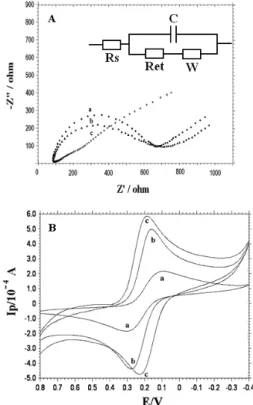
Electrochemical impedance spectroscopy (EIS) is a useful technique to monitor the impedance changes of the electrode surface during the modification process. The semicircle diameters of Nyquist plot reflects the electron transfer resistance (Ret), from the electron transfer of the redox probe [Fe(CN)6]3–/4–. The semicircular part at higher frequencies
corresponds to the electron transfer limited process and the linear part at lower frequencies corresponds to the diffusion process. The interfacial characteristic of the PBCB/CILE was studied by EIS in a 0.1 mol L-1 KCl solution contained
the redox couples of 1.0 mmol L-1 [Fe(CN) 6]
3–/4–. Figure 3A
showed the EIS of different electrodes with the frequencies swept from 104 to 0.1 Hz. Here Z′ and Z″ are the real and
imaginary parts of experimental data. Then the Randles circuit is used to it the impedance spectra. The Ret value of CPE was estimated as 308.1 Ω (curve a) and that of CILE decreased to 203.13 Ω (curve b), which was due to the presence of high ionic conductive IL in the CPE. The Ret value of PBCB/CILE decreased further and a straight line appeared (curve c), which indicated that the presence of PBCB ilm exhibited good conductivity and the electron transfer rate at the electrode/ solution interface was greatly increased.
Figure 3B showed typical cyclic voltammograms of the modiied electrodes in a K3[Fe(CN)6] and KCl solution.
Figure 1. Cyclic voltammograms of 3.0 mmol L-1 BCB electropolymerized
on the CILE with the sweep cycles from 1 to 50. Inset is cyclic voltammogram of the irst circle with the scan rate of 100 mV s-1.
On the CILE a pair of well-deined redox peaks appeared (curve b) with peak-to-peak separation (∆Ep) at 0.102 V (vs. SCE), which was much smaller than the ∆Ep value (0.161 V) of the CPE (curve a), and the redox peak currents also increased greatly, which may be due to the high ionic conductive IL present in the CPE. On the PBCB/CILE, the redox peak current further increased when more reversible electrochemical responses appeared (curve c), due to the presence of high conductive polymer ilm on the CILE surface that further accelerated the electron transfer rate of the redox probe.
Electrochemical behaviors of AA on the PBCB/CILE
Figure 4 shows cyclic voltammograms of 3.0 mmol L-1
AA in 0.1 mol L-1 PBS pH 6.5 on different electrodes. On
the CPE, AA exhibited an oxidation peak located at 432 mV (vs. SCE) with the oxidation peak current at 15.28 μA (curve a). On the CILE the oxidation potential appeared at 338 mV (vs. SCE) with the oxidation peak current at 36.1 μA (curve b). The overpotential decreased 94 mV and the oxidation peak potential increased 1.5 times, indicating the superiority of CILE to CPE. The presence of IL in the CPE showed the inherent catalytic ability due to the speciic
characteristics of IL. While on the PBCB/CILE the oxidation peak potential reached 286 mV (vs. SCE) with a peak current of 73.2 μA (curve c). Compared with that of CPE and CILE, a decrease of overpotential of 146 and 52 mV (vs. SCE) towards more negatively direction was observed when the peak current increased for about 4.7 and 2.03 times, respectively. It is well-known that the increase of peak current and the decrease of overpotential are the characteristics of the electrocatalytic reaction. The experimental results further testified the superiority of PBCB/CILE to CPE and CILE, indicating that PBCB ilm on the electrode surface increased the ability of electron transfer at the interface of electrode/solution and catalyzed the electro-oxidation reaction of AA.
Cyclic voltammograms of AA with different scan rates were further investigated. With the increase of scan rate the oxidation peak current increased with the positively movement of the oxidation peak potential. A linear relationship of oxidation peak currents (Ipa) of AA with scan rate was constructed with the linear regression equation as Ipa(μA) = 0.940 + 9.073 ν (V s-1) (γ = 0.996), indicating an
adsorption-controlled electrode process. As for an adsorption-adsorption-controlled irreversible electrode process, the electrochemical parameters such as charge transfer coeficient (α) and the electrode reaction rate constant(ks)can be calculated by exploring the relationship of oxidation peak potential with scan rate.29 The
relationship of Epa with lnυ was constructed with the linear regression equation Epa(V) = 0.256 + 0.122 lnν (γ = 0.997). From the slope and the intercept, the values of α and ks were calculated as 0.53 and 0.875 s-1, respectively.
Optimal of experimental conditions
The optimal pH for AA oxidation was carefully investigated and the results were shown in Figure 5A. It can be seen that the maximum value of oxidation peak current appeared at pH 6.5, so this value was selected throughout
Figure 3. (A) Electrochemical impedance spectroscopy of CPE (a),
CILE (b) and PBCB/CILE (c) in a 0.1 mol L-1 KCl solution containning 1.0 mmol L-1 [Fe(CN)
6]3-/4-with frequencies swept from 104 to 0.1 Hz. Inset is the Randles circuit model in the cell. (B) Cyclic voltammograms of CPE (a), CILE (b) and PBCB/CILE (c) in solution of 5.0×10⁻⁴ mol L-1 K3[Fe(CN)6] + 0.5 mol L-1 KCl at scan rate of 100 mV s-1.
the experiments. Since the electrode process was adsorption-controlled, the accumulation time for AA was investigated. It can be seen that the peak current reached its maximum at 30 s (Figure 5B). So 30 s of accumulate time was used in the following procedure.
Calibration curve
Under the optimal conditions differential pulse voltammetry (DPV) was used for the sensitive determination of AA. Figure 6 showed the DPV curves of different concentrations of AA on PBCB/CILE in PBS pH 6.5. The DPV oxidation peak currents increased linearly with AA concentration in the range from 2.0×10⁻⁵ to 3.0×10⁻³ mol L-1
with the linear regression equation as Ipa(μA) = 0.318 + 0.522C (mol L-1) (γ=0.999), with a detection limit of
6.5 μmol L-1 (3σ).
The reproducibility and stability of PBCB/CILE were further investigated. A relative standard deviation (RSD) of 1.96% was obtained for seven successive determinations of 2.0×10⁻⁵ mol L-1 AA in PBS pH 6.5, which indicated that
PBCB/CILE showed good reproducibility. The modiied electrode was stored at 4 ºC when not in use and 98.1% of the initial current response was retained after 2 weeks storage. After one month storage, the peak current response decreased about 7.9%. Moreover, ive PBCB modiied electrodes were prepared by the same procedure independently and the relative standard deviation (RSD) for the determination of 2.0×10⁻⁵ mol L-1 AA was calculated as 3.5%, which indicated
the modiied electrode had good repeatability.
Interference study
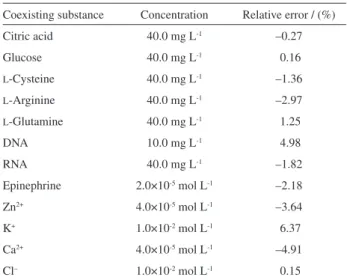
The inluences of some coexisting substances such as inorganic ions and organic compounds on the determination of 3.0 mmol L-1 AA were investigated with the results listed
in Table 1. These substances may be commonly existed in the biological samples. It can be seen that few of them had inluence on the determination and the PBCB/CILE showed good selectivity.
Analytical application and recovery test
To assess the analytical application of the proposed method, a Vitamin C tablet, which was purchased from Shandong Luoxin Pharmaceutical Co. Ltd. (060221) with the speciied amount of 0.1 g AA per tablet, was determined Figure 5. (A) Effect of pH buffer on the oxidation peak current of
3.0×10⁻³ mol L-1 AA. (B) Effect of accumulation time on the peak current of 3.0×10⁻³ mol L-1 AA in PBS pH 6.5 with the scan rate of 100 mV s-1.
Figure 6. Differential pulse voltammograms of PBCB/CILE at different
AA concentrations (from a to g are 5.0×10⁻⁵, 8.0×10⁻⁵, 1.0×10⁻⁴, 5.0×10⁻⁴, 8.0×10⁻⁴, 1.0×10⁻³, 3.0×10⁻³ mol L-1, respectively). Inset is the linear relationship of anodic peak currents and AA concentrations.
Table 1. Inluences of coexisting substances on the determination of 3.0×10⁻³ mol L-1 AA
Coexisting substance Concentration Relative error / (%)
Citric acid 40.0 mg L-1 –0.27
Glucose 40.0 mg L-1 0.16
L-Cysteine 40.0 mg L-1 –1.36
L-Arginine 40.0 mg L-1 –2.97
L-Glutamine 40.0 mg L-1 1.25
DNA 10.0 mg L-1 4.98
RNA 40.0 mg L-1 –1.82
Epinephrine 2.0×10⁻⁵ mol L-1 –2.18
Zn2+ 4.0×10⁻⁵ mol L-1 –3.64
K+ 1.0×10⁻² mol L-1 6.37
Ca2+ 4.0×10⁻⁵ mol L-1 –4.91
Cl– 1.0×10⁻² mol L-1 0.15
Table 2. Determination of AA in Vitamin C tablet (n = 5)*
Sample Speciied / g Detected / g Added /
(10-4 mol L-1)
Detected /
(10-4 mol L-1) RSD / (%) Recovery / (%)
1 0.1 0.096 5.00 4.89 1.63 97.8
2 0.1 0.092 5.00 5.06 2.01 101.2
3 0.1 0.094 5.00 4.82 1.47 96.4
*average of 5 parallels detection.
by standard addition method. The determination results were shown in Table 2. It can be seen that the proposed method was sensitive with a recovery range of 96.4%-101.2%, indicating the practical application of this modiied electrode.
Conclusions
Electrochemical polymerization of BCB on the surface of carbon ionic liquid electrode was performed and the properties of the resulted polymer ilms modiied electrode were investigated. Experimental results exhibited that BCB had been polymerized on the electrode surface with excellent electrochemical performances. The polymer ilm on the electrode showed good electrocatalytic ability to the oxidation of AA and the electrochemical behaviors of AA on PBCB/CILE was carefully investigated. Under the optimal conditions, a linear relationship of the oxidation peak current and the AA concentration was obtained within the range from 2.0×10⁻⁵ to 3.0×10⁻³ mol L-1 by
differential pulse voltammetry, and the method was further applied to AA drug sample detection with satisfactory results.
Acknowledgments
We are grateful to the inancial support of the Shandong Province Natural Science Foundation (ZR2009BL017).
References
1. Musameh, M.; Wang, J.; Anal. Chim. Acta 2008,606, 45. 2. Wei, D.; Ivaska, A.; Anal. Chim. Acta 2008,607, 126. 3. Maleki, N.; Safavi, A.; Sedaghati, F.; Tajabadi, F.; Anal.
Biochem. 2007, 369, 149.
4. Zheng, J. B.; Zhang, Y.; Yang, P. P.; Talanta2007, 73,920. 5. Zhang, Y.; Zheng, J. B.; Talanta2008, 77,325.
6. Li, Y. H.; Liu, X. Y.; Zeng, X. D.; Liu, Y.; Liu, X. S.; Wei, W. Z.; Luo, S. L.; Microchim. Acta2009, 165, 393.
7. Li, Y. H.; Liu, X. Y.; Zeng, X.D.; Liu, Y.; Liu, X. T.; Wei, W. Z.; Luo, S. L.; Sens. Actuators, B 2009, 139, 604.
8. Sun, W.; Yang, M. X.; Jiao, K.; Anal. Bioanal. Chem. 2007,
389, 1283.
9. Sun, W.; Li, Y. Z.; Duan, Y. Y.; Jiao, K.; Biosens. Bioelectron.
2008, 24, 994.
10. Sun, W.; Li, Y. Z.; Yang, M. X.; Liu, S. F.; Jiao, K.; Electrochem. Commun. 2008, 10, 298.
11. Sun, W.; Li, Y. Z.; Gao, H. W.; Jiao, K.; Microchim. Acta 2009,
165, 313.
12. Yang, Q. X.; Zhang, M. F.; Li, G. B.; Zhang, Y.; Chin. J. Anal. Lab.2007, 26, 72.
13. Balamurugan, A.; Chen, S. M.; J. Solid State Electrochem. 2010,
14, 35.
14. Vostiar, I.; Tkac, J.; Sturdik, E.; Gemeiner, P; Bioelectrochemistry
2002, 56, 113.
15. Karyakin, A. A.; Karyakina, E. E.; Schuhmann, W.; Varfolomeyev, S. D.; Electroanalysis 1994,6, 821.
16. Albrecht, J. A.; Schafer, H. W.; J. Liq. Chromatogr.1990, 13, 2623.
17. Chiari, M.; Nesi, M.; Carrea, G.; Righetti, P. G.; J. Chromatogr.
1993, 645, 197.
18. Fei, J. J.; Luo, L. M.; Hu, S. S.; Gao, Z. Q.; Electroanalysis
2004,16, 319.
19. Raoof, J. B.; Ojani, R.; Kiani, A.; J. Electroanal. Chem.2001,
515,45.
20. Zen, J. M.; Tsai, D. M.; Kumar, A. S.; Electroanalysis2002,
15, 1171.
21. Ojani, R.; Raoof, J. B.; Zamani, S.; Electroanalysis 2005,17, 1740.
22. Golabi, S. M.; Irannejad, L.; Electroanalysis 2005,17, 985. 23. Wei, M.; Li, M. X.; Li, N. Q.; Gu, Z. N.; Zhou, X. H.;
Electroanalysis2002,14, 135.
24. Teuber, M.; Rogner, M.; Berry, S.; Biochim. Biophys. Acta 2001,
1506, 31.
25. Dong, S. J.; Zhu, Y. M.; Song, S. H.; J. Electroanal. Chem.
1989,275, 233.
26. Maleki, N.; Safavi, A.; Tajabadi, F. Anal. Chem. 2006,78, 3820. 27. Chen, X. X.; Wang, Y.; Hu, S. S.; Microchim. Acta2008,161,
255.
28. Malinauskas, A.; Niaura, G.; Bloxham, S.; Ruzgas, T.; Gortony, L.;
J. Colloid Interface Sci. 2000, 230,122. 29. Laviron, E.; J. Electroanal. Chem.1979,101, 19.
![Figure 3B showed typical cyclic voltammograms of the modiied electrodes in a K 3 [Fe(CN) 6 ] and KCl solution](https://thumb-eu.123doks.com/thumbv2/123dok_br/18995566.462083/3.892.458.799.425.545/figure-showed-typical-cyclic-voltammograms-modiied-electrodes-solution.webp)