Short Report
Further Diterpenoids Isolated from
Pterodon polygalaeflorus
Angela M. C. Arriagaa, Maria Augusta B. de Castroa, Edilberto R. Silveiraa and Raimundo Braz-Filhob a
Departamento de Química Orgânica e Inorgânica, Centro de Ciências, Universidade Federal do Ceará, CP 12200, 60451-970, Fortaleza, Ceará, Brazil
b
Setor Química de Produtos Naturais-LCQUI-CCT, Universidade Estadual do Norte Fluminense, 28015-620, Campos, Rio de Janeiro, Brazil
Dos frutos de Pterodon polygalaeflorus (Leguminosae) foram isolados o novo diterpeno 6α -hidroxivouacapano e os conhecidos diterpenóides 6α,7β,14β,19-tetraidroxivouacapano, 6α,7β -diidroxivouacapan-17β-oato de metila e o flavonóide taxifolina. As estruturas foram determinadas com base em análise espectroscópica, inclusive RMN bidimensional, transformação química do novo diterpeno e comparação com dados da literatura.
From fruits of Pterodon polygalaeflorus (Leguminosae) the new diterpene 6a-hydroxyvoua-capane, the known diterpenoids vouacapane-6α,7β,14β,19-tetraol and methyl 6α,7β -dihydrox-yvouacapan-17β-oate and the flavonoid taxifolin were isolated. Structural determinations were accomplished by spectroscopic analysis, including two-dimensional NMR, chemical transforma-tion of the new diterpene and comparison with literature data.
Keywords: Pterodon polygalaeflorus, Leguminosae, diterpenoids, flavonoid
J. Braz. Chem. Soc., Vol. 11, No. 2, 187-190, 2000. Printed in Brazil
c 2000 Soc. Bras. Química 0103 - 5053 $6.00+0.00
Introduction
In continuation of our systematic studies of the Brazil-ian northeast medicinal plants, we have undertaken a study of Pterodon polygalaeflorus Benth. (Leguminosae), which is used in folk medicine against bronchytis, amigdalytis and as tonic. We have already reported diterpenoids1 and the
volatile constituents2 from this plant. In continuation to this
phytochemical investigation, we now report the isolation and structure determination of a new diterpene 6α -hydroxyvoua-capane (1) and of the known compounds vouacapane-6α,7β,14β,19-tetraol (2)3, methyl 6α,7β
-dihydroxyvouaca-pan-17β-oate (3)4 and the flavonoid taxifolin (4,
5,7,3’,4’-tetrahydroxydihydroflavonol)5 , isolated from the fruits. The
structures of these compounds were deduced by spectral analysis, mainly 1H and 13C NMR, including 2D-NMR
ex-periments [1H-1H-COSY, 13Cx1H-COSY-1JCH (HETCOR)
and 13Cx1H-COSY-nJ
CH (n=2 and 3, COLOC)], chemical
transformation of the new diterpene (1) and comparison with literature data.
Results and Discussion
The hot hexane extract of coarsely ground fruits of P. polygalaeflorus was submitted to aqueous ethanol alkaline hydrolysis. After usual work-up, the insaponifiable fraction
obtained was chromatographed on silica gel column to fur-nish a newditerpene 6α-hydroxyvouacapane(1), methyl 6α,7β-dihydroxyvouacapan-17β-oate (2), previously isolated from Pterodon emarginatus4, vouacapane-6α,7β,14β
,19-tetraol(3), which was also isolated fromthe seedsof a speci-men of P. polygalaeflorus collected in Minas Gerais-Bra-zil6,and the flavonoid 4, known as taxifolin (5,7,3’,4’,
tetrahydroxydihydroflavonol)5. Compound 1 was not
pre-viously obtainedas a natural product, although it was pre-pared from its acetylated derivative 1a, which had been iso-lated from Dipterix lacynifera7.
4 O O O H HO OH O H OH 1b O
1 R=H
1a R=Ac
3 20 19 18 17 16 15 14 13 12 11 10 9 8 7 6 5 4 3 2 1 O H H H O R CO2R1
OH O H H H OH HO OH OH 1 2
3 4 5
6 7 8 9 10 11 12 13 14 15 16 17 18 19 20 20 19 18 17 16 15 14 13 12 11 10 9 8 7 6 5 4 3 2 1 O H H H OR
2 R=H, R1=Me
2a R=Ac, R1=M e
188 Arriaga et.al J. Braz. Chem. Soc
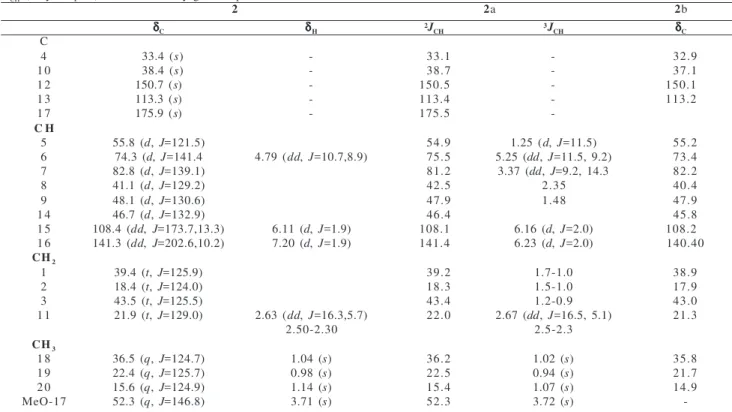
The identification of the known compounds 2-4 in-volved the analysis of 1H NMR (1D and 2D 1H-1H-COSY)
and 13C NMR (HBBD and DEPT) spectral data (Table 1)
and comparison with literature values1,5,6. The
compara-tive analysis of the chemical shifts of the hydrogen and carbon atoms of 2 and methyl 6α-acetoxy-7β -hydroxyvoua-capan-17β-oate (2a) and 6α,7β-dihydroxyvouacapan-17β -oic acid (2b), which were also isolated from Pterodon polygalaeflorus1, revealed, as anticipated, the
modifica-tions in the chemical shifts of the hydrogen H-6 [2: δH 4.79
(dd, J=10.7, 8.9 Hz); 2a: δH 5.25 (dd, J=11.5, 9.2 Hz)] and carbons C-5 [∆δC = 55.8 (2) - 54.9 (2a) = 0.9 ppm], C-6
[∆δC = 74.3 (2) - 75.5 (2a) = - 1.2 ppm] and C-7 [∆δC = 82.8 (2) - 81.2 (2a) = 1.6 ppm] as a consequence of the absence of the γ-effect (C-5 and C-7) and β-effect (C-6) of the carbo-nyl carbon of the 6a-acetoxy group in 2 (Table 1).
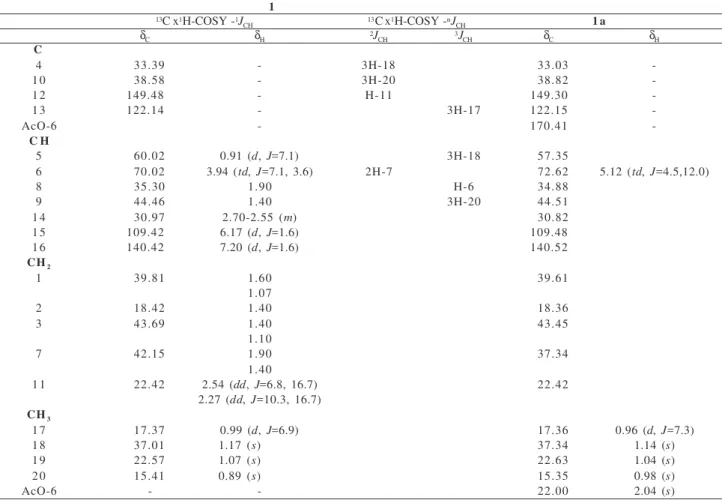
Compound 1 was obtained as colorless needles after crystallization from methanol. The HREIMS spectrum showed the molecular ion at m/z 302.2126 corresponding to the molecular formula C20H30O2 (m/z 302.2238, ∆m/z =
0.0112 daltons). This data together with the presence of signals for three quaternary [δH 0.89 (s,3H-20), 1.07(s,
3H-19) and 1.17 (s, 3H-18)] and one tertiary [δH 0.99 (d, J=6.9 Hz, 3H-17)] methyl groups, one carbinolic hydrogen at
δH 3.94 (td, J=7.1, 3.6 Hz, H-6) and two hydrogens at δH 6.17 (d, J=1.6 Hz, H-15) and 7.20 (d, J=1.6 Hz, H-16) of a
2,3-disubstituted furan observed in the 1H NMR spectrum
allowed us to classify this diterpene as a vouacapanoid, the same class of diterpenoids which was reported previ-ously1. This deduction was confirmed by comparative
analysis of the HBBD- and DEPT-13C NMR, which revealed
the presence of signals corresponding to four quaternary (δC 149.48, 122.14, 38.58 and 33.39), seven methine (δC 140.42, 109.42, 70.02, 60.02, 44.46, 35.30 and 30.97), five
methylene (δC 43.69, 42.15, 39.81, 22.42 and 18.42) and four methyl (δC 37.01, 22.57, 17.36 and 15.41) carbon atoms. The
presence of one secondary hydroxyl group was indicated by 1H NMR of the monoacetate derivative (1a), which
re-vealed downfield shift for carbinolic hydrogen H-6 [∆δH 5.12 (1a) - 3.93 (1) = 1.19 ppm].
The localization of the hydroxyl group at C-6 was de-duced by the spin-spin interaction of hydrogen H-6 [δH
3.94 (td, J=7.1, 3.6 Hz)] with H-5 [δH 0.91 (d, J=7.1 Hz)] and 2H-7 (δH 1.90 and 1.40) revealed by homonuclear 2D 1H -1H-COSY spectrum and the chemical shift of C-5 (δC 60.02)
that was assigned on the basis of heteronuclear 2D direct CH [13Cx1H-COSY1JCH: δC 60.02 (C-5) correlated with H-5
(δH 0.91)] and via long range coupling CH [13Cx1 H-COSY-nJCH (n = 2 and 3) COLOC]: δC 60.02 (C-5) correlated with
3H-18 (δH 1.17)] spectra. Additional confirmation of the
presence of a hydroxyl group at C-6 was obtained from the
13C NMR spectrum of the acetyl derivative of 1a: i) the
Table 1. 1H (200 MHz) and 13C (50.3 MHz) NMR spectral data for diterpenes 2, 2a and 2b in CDCl
3 and TMS as internal standard, including 1J
CH (fully coupled) of 2 obtained by gated experiment.*
2 2a 2b
δδδδδC δδδδδH 2JCH 3JCH δδδδδC
C
4 033.4 (s) - 033.1 - 032.9
1 0 038.4 (s) - 038.7 - 037.1
1 2 150.7 (s) - 150.5 - 150.1
1 3 113.3 (s) - 113.4 - 113.2
1 7 175.9 (s) - 175.5
-C H
5 55.8 (d, J=121.5) 054.9 1.25 (d, J=11.5) 055.2 6 74.3 (d, J=141.4 4.79 (dd, J=10.7,8.9) 075.5 5.25 (dd, J=11.5, 9.2) 073.4 7 82.8 (d, J=139.1) 081.2 3.37 (dd, J=9.2, 14.3 082.2
8 41.1 (d, J=129.2) 042.5 2.35 040.4
9 48.1 (d, J=130.6) 047.9 1.48 047.9
1 4 46.7 (d, J=132.9) 046.4 045.8
1 5 108.4 (dd, J=173.7,13.3) 6.11 (d, J=1.9) 108.1 6.16 (d, J=2.0) 108.2 1 6 141.3 (dd, J=202.6,10.2) 7.20 (d, J=1.9) 141.4 6.23 (d, J=2.0) 0140.40 CH2
1 39.4 (t, J=125.9) 039.2 1.7-1.0 038.9
2 18.4 (t, J=124.0) 018.3 1.5-1.0 017.9
3 43.5 (t, J=125.5) 043.4 1.2-0.9 043.0
1 1 21.9 (t, J=129.0) 2.63 (dd, J=16.3,5.7) 022.0 2.67 (dd, J=16.5, 5.1) 021.3
2.50-2.30 2.5-2.3
CH3
1 8 36.5 (q, J=124.7) 1.04 (s) 036.2 1.02 (s) 035.8 1 9 22.4 (q, J=125.7) 0.98 (s) 022.5 0.94 (s) 021.7 2 0 15.6 (q, J=124.9) 1.14 (s) 015.4 1.07 (s) 014.9 MeO-17 52.3 (q, J=146.8) 3.71 (s) 052.3 3.72 (s) 0
-*Multiplicity of signals of carbon atoms deduced by comparative analysis of HBBD- and DEPT-13C NMR. Chemical shifts and coupling
Vol. 11 No. 2, 2000 Further Diterpenoids 189
signals of the carbon atoms C-5 (δC 57.35) and C-7 (δC 37.34) revealed, as anticipated, the γ-effects of the carbonyl car-bon of the acetoxyl group [C-5: ∆δC = 57.35 (1a) - 60,02 (1) = - 2.67 ppm; C-7: ∆δC = 37.34 (1a) - 42.15 (1) = - 4.81
ppm]; ii). The C-6 signal showed the downfield shift =
∆δC = 72.62 (1a) - 70,02 (1) = 2.6 ppm as a consequence of
the β-effect of the carbonyl carbon atom (Table 2). The presence of a tertiary methyl group at C-14 [δH 0.99 (d,
J=6.9 Hz) and δC 17.37] was confirmed by 2D carbon-hy-drogen correlation (3JCH) of the 3H-17 (δH 0.99) with the
carbon atom C-13 (δC 122.14) observed in the 13Cx1 H-COSY-nJCH (n = 2 and 3) spectrum.
The 2D carbon-hydrogen correlation experiments modu-lated with 1JCH established the hydrogen chemical shift
correlations with those of the carbon atoms and also 2JCH
and 3JCH couplings to detect hydrogen resonance
corre-lated with not directly bound carbon signals, along with the application of the usual shift parameters and multiplic-ity of signals, were used to complete the assignment of the
1H and 13C NMR spectra of 1 (Table 2).
The location of the hydroxyl group at chiral carbon C-6
Table 2. 1H (200 MHz) and 13C (50.3 MHz) NMR data for diterpene 1 and acetyl derivative 1a, in CDCl
3 and TMS as internal standard. The
chemical shifts are in δ (ppm) and coupling constants (J) in Hz are described in parentheses.* 1
13Cx1H-COSY -1J
CH 13Cx1H-COSY -nJCH 1 a
δC δH 2JCH 3JCH δC δH
C
4 033.39 - 3H-18 033.03
-1 0 038.58 - 3H-20 038.82
-1 2 149.48 - H-11 149.30
-1 3 122.14 - 3H-17 122.15
-AcO-6 - 170.41
-C H
5 060.02 0.91 (d, J=7.1) 3H-18 057.35
6 070.02 3.94 (td, J=7.1, 3.6) 2H-7 072.62 5.12 (td, J=4.5,12.0)
8 035.30 1.90 H-6 034.88
9 044.46 1.40 3H-20 044.51
1 4 030.97 2.70-2.55 (m) 030.82
1 5 109.42 6.17 (d, J=1.6) 109.48
1 6 140.42 7.20 (d, J=1.6) 140.52
CH2
1 039.81 1.60 039.61
1.07
2 018.42 1.40 018.36
3 043.69 1.40 043.45
1.10
7 042.15 1.90 037.34
1.40
1 1 022.42 2.54 (dd, J=6.8, 16.7) 022.42 2.27 (dd, J=10.3, 16.7)
CH3
1 7 017.37 0.99 (d, J=6.9) 017.36 0.96 (d, J=7.3)
1 8 037.01 1.17 (s)0 0 0 0 0 037.34 1.14 (s)
1 9 022.57 1.07 (s)0 0 0 0 0 022.63 1.04 (s)
2 0 015.41 0.89 (s)0 0 0 0 0 015.35 0.98 (s)
AcO-6 0- - 022.00 2.04 (s)
*Multiplicity of signals of carbon atoms deduced by comparative analysis of HBBD- and DEPT-13C NMR. Chemical shifts and coupling
constants of hydrogen atoms obtained from 1H NMR.
in the equatorial position was deduced on the basis of the J-value (7.1 Hz) observed for the signal of the H-6 [δH 3.94
(dd, J=7.1, 3.6 Hz)], downfield shift [∆δH = 5.12 (1a) - 3.94 (1) = 1.18 ppm] observed in the 1H NMR spectrum of the
monoacetate 1a (Table 2). The monoacetate 1a,obtained by acetylation of 1 with Ac2O/Py, was identified by a
com-parative study of the 1H and 13C NMR spectra with the
natural product isolated from Dipteryx lacunifera7.
Confirmation of 1 as a natural product (and not as a hydrolysis product) was obtained by preparation of a new hexane extract from fruits (1.5 kg) collected from the same specimen. The residue (16 g) was submitted to col-umn chromatography on silica gel eluted with hexane, CHCl3 and EtOAc. The residue (5.3 g) from the CHCl3
elution was submitted to a preparative TLC affording 1
(12.7 mg).
The relative configuration of 1 was also deduced on the basis of the [α]D= + 26.6 ± 0.05 (c 1.0, CHCl3)
190 Arriaga et.al J. Braz. Chem. Soc
Experimental
General experimental procedures
Mps: uncorr. Optical rotation was obtained on a Perkin-Elmer 341 digital polarimeter; NMR: 1H(200 MHz) and 13C
(50.3 MHz) in CDCl3 (1 and 2), CDCl3 + acetone-d6 (3 and
4) and TMS as int. standard; EIMS: 70 eV.; CC: silica gel (Merck 0.05-0.20 mm); TLC: silica gel H or G (Merck) and spots were visualized by exposure to iodine vapour.
Plant material
Pterodon polygalaeflorus Benth. was collected in May 1993 in Joaquim Pires, Piauí State, Brazil. A voucher speci-men (No 8808) representing the collection was identified by
Dr Afranio G. Fernandes (Botanist, Departamento de Biologia, UFC) and has been deposited at Herbario Prisco Bezerra of the Departamento de Biologia, Universidade Federal do Ceará, Brazil.
Extraction and isolation of the constituents
The powdered fruits (5 kg) were extracted with hexane in a Sohxlet apparatus to yield 500 g of a yellowish oil that was designated EH. The yellowish oil EH (100 g) was submitted to alkaline hydrolysis according to usual procedure, KOH-H2O-EtOH (1:1) under reflux for 30 min. Column chromatog-raphy of the ppt (60 g) obtained after addition H2O yielded 4
fractions designated EHH (8.6 g) eluted with hexane, EHC (17.6 g) eluted with CHCl3, EHAE (21.3 g) eluted with EtOAc
and EHM (10.0 g) eluted with methanol. Fraction EHAE (21.3 g) was chromatographed on a silica gel column: the fraction eluted with CHCl3 yielded 6α-hydroxyvouacapane 1 (380 mg) after recrystallization from MeOH; the fraction eluted with CHCl3-EtOAc (9:1) furnishedmethyl 6α,7β -dihydrox-yvouacapan-17β-oate (2, 150 mg) after recrystallization from MeOH; the fraction eluted with CHCl3-EtOAc (2:8) afforded vouacapane-6α,7β,14β,19-tetraol (3, 80 mg) after
recrystalli-zation from MeOH; and the fraction eluted with EtOAc yielded taxifolin (4, 5,7,3’,4’-tetrahydroxydihydroflavonol, 100 mg) after recrystallization from MeOH.
6α-Hidroxyvouacapane (1)
M. p. 147.6-148.3 °C, needles from MeOH. [α]D= + 26.6
± 0.05 (c 1.0, CHCl3). 1H NMR (200 MHz, CDCl3) and 3C
NMR (50 MHz, CDCl3): Table 2. HREIMS m/z (rel. int.):
302.2126 (C20H30O2, m/z 302.2246, [M].+, 30); 284.2024
(C20H28O, m/z 284.2140, [M - H2O].+, 89); 108.0550 (C7H8O,
m/z 108.0575, 1b, 100).
Acetylation of 1
6α-Acetoxyvouacapane (1a) was obtained by treatment of 1 (105 mg) with Ac2O (5 mL) and pyridine (1.5 mL). The
usual work-up followed by CC on silica gel [hexane:CHCl3 1:1 as eluent] of the crude product furnished 1a (100 mg) as an oil fr. homogeneous by TLC. 1H NMR (200 MHz, CDCl3)
and 13C NMR (50 MHz, CDCl3): Table 2. HREIMS m/z (rel.
int.): 344.2794 (C22H32O3, m/z 344.2396, [M].+, 31); 316.2465
(C21H32O2, m/z 316.2404, [M-CO].+, 10.5), 285.2315
(C20H29O, m/z 285.2220, [M-AcO.], 20), (C7H8O, m/z.
108.0575, 1b, 47.5).
Acknowledgments
The authors are grateful to Brazilian agencies FINEP, CAPES, CNPq and FUNCAP for financial support and to Prof. Afrânio Gomes Fernandes (Universidade Federal do Ceará) for collection and identification of the plant material.
References
1. Campos, A. M.; Silveira, E. R.; Braz-Filho, R.; Teixeira, T.C. Phytochemistry1994, 36, 403.
2. Campos, A. M.; Alencar, J. W., Matos, F. J. A.; Craveiro, A. A.; Machado, M. I. L.; Teixeira, T.C. J. Essent. Oil Res. 1994, 517.
3. Arriaga, A. M. C.; Silveira, E. R.; Braz-Filho, R.; Castro, M. A. B.; Dourado, R. C. M.; Andrade, I. C. M. Abstracts of the 17th Annual Meeting of the Brazilian
Chemical Society, 1995, PN-065.
4. Marajan, J. R.; Monteiro, M. B. J. Chem. Soc. PerkinI 1973, 520.
5. Markan, K.R.; Ternai, B. Tetrahedron 1976, 32, 2608. 6. Demuner, A. J.; Barbosa, L. C. A.; Veloso, D. P.; Alves, D. L. F.; Howart, O. W. J. Nat. Prod.1996, 59, 770. 7. Mendes, F. N. P.; Silveira, E. R. Phytochemistry 1994,
35, 1499.