ORIGINAL ARTICLE
Two systems for empathy in obsessive-compulsive
disorder: mentalizing and experience sharing
Maria C. Pino,
1Domenico De Berardis,
2,3Melania Mariano,
4Federica Vellante,
3Nicola Serroni,
2Alessandro Valchera,
5Marco Valenti,
4,6Monica Mazza
41Dipartimento di Medicina Clinica, Sanita` Pubblica, Scienze della Vita e dell’Ambiente, Universita` degli studi dell’Aquila, L’Aquila, Italy. 2Dipartimento di Salute Mentale, U.O.S. Servizio di Diagnosi e Cura, Teramo, Italy.3Dipartimento di Neuroscienze, Imaging e Scienze Cliniche,
Chieti, Italy.4Dipartimento di Scienze Cliniche Applicate e Biotecnologiche, Universita` degli studi dell’Aquila, L’Aquila, Italy.5Casa di Cura villa San Giuseppe, Ascoli Piceno, Italy.6Centro di Riferimento Regionale per l’Autismo, ASL 1, L’Aquila, Italy.
Objective: To investigate empathic abilities in patients with obsessive-compulsive disorder (OCD) compared to control subjects. OCD is characterized by persistent obsessions and compulsions. Previous studies have proposed specific emotion recognition deficits in patients with OCD. The ability to recognize emotion is part of the broad construct of empathy that incorporates mentalizing and experience-sharing dimensions.
Methods:Twenty-four subjects with a diagnosis of OCD and 23 control subjects underwent empathic measures.
Results:Patients with OCD compared to control subjects showed deficits in all mentalizing measures. They were incapable of understanding the mental and emotional states of other people. On the other hand, in the sharing experience measures, the OCD group was able to empathize with the emotional experience of other people when they expressed emotions with positive valence, but were not able to do when the emotional valence was negative.
Conclusion: Our results suggest that patients with OCD show a difficulty in mentalizing ability, whereas the deficit in sharing ability is specific for the negative emotional valence.
Keywords: Obsessive-compulsive disorder; empathy; mentalizing; experience sharing
Introduction
Obsessive-compulsive disorder (OCD) is a frequent and debilitating anxiety disorder with a fluctuating course, characterized by obsessions or compulsions that cause severe distress and interfere with the cognitive functioning of patients.1,2
A growing body of research has implicated emotion recognition proneness in the etiology and maintenance of OCD.3-5 However, results from these studies are incon-sistent with the findings of other studies,6-8which showed that patients with OCD were not impaired in the perception of emotion. Recently, Daros et al.4 showed that patients with OCD have deficits in recognizing facial displays of emotion. Emotional recognition capacity is part of the complex construct called social cognition.9-11Social
cog-nition refers to a relatively large number of psychological constructs that range from complex concepts, such as theory of mind (ToM), to more elementary concepts, such as emotion perception, processing of social cues or social perception, and empathic ability.9 The latter capacity allows one to understand and share the emotional states
of others in reference to oneself and plays a critical role in social interaction, from bonding between mother and child to understanding others’ feelings and subjective psycho-logical states.12-15 Empathy is a fundamental component of human nature across cultures.14 The ability to empathize
reflects an innate ability to perceive and be sensitive to the emotional states of other people.14 Several definitions of empathy have been proposed, but only two are consistent across numerous conceptualizations15: cognitive ability to take the perspective of the other people and affective response to emotions of others.15For this reason, empathy has recently been considered a multifaceted concept that includes at least two dimensions: explicitly considering others’ internal states (mentalizing) and sharing those states (experience sharing).11,16-19 According to the recent literature,11,16 mentalizing ability examines ToM capacity by asking subjects to draw explicit inferences about the mental states of others and their ability to represent those states outside of the ‘‘here and now’’ including the future, past, counterfactuals, and targets’ perspectives. Experience sharing is the tendency to take on, resonate with, or ‘‘share’’ the emotions of others, and it is often tied to a mechanism known as ‘‘neural resonance.’’10 Several neuropsychiatric disorders, including schizophre-nia,13,20,21autism spectrum disorders,11,22-25psychopathy,26 brain injury,27and frontotemporal lobe degeneration,28 feature different subprocesses of empathy deficits.13 Accordingly, assessment of the recognition and processing Correspondence: Maria Chiara Pino, Department of Life, Health and
Environmental Sciences, University of L’Aquila, Via Vetoio, Localita` Coppito, 67100, L’Aquila.
E-mail: [email protected] Submitted Feb 19 2015, accepted Jul 04 2015.
of emotion in individuals with OCD would provide a more comprehensive evaluation of these subjects and could explain many social and interpersonal aspects of their disease.29
Only two studies have researched the relationship between OCD and empathy.13,30In these studies,13,30the authors found that patients with OCD exhibited signifi-cantly higher levels of affective empathy (i.e., empathic concern and personal discomfort), as evaluated with the interpersonal reactivity index (IRI) as a measure of empathic ability. Jolliffe & Farrington31,32 highlighted at least two serious limitations of the IRI: the first is that empathy is confused with sympathy, a distinct, albeit closely linked construct.33-35Second, using the IRI to assess the cognitive components of empathy mostly focuses on the respondent’s ability to take another person’s perspective, and overlooks ability to recognize and understand the emotions felt by another. Given that the emotional aspect of empathy has consistently been considered a fundamental component of empathy since its earliest theorizations, this oversight is puzzling.36-39
For this reason, in this study, we investigated the empa-thic ability of subjects with OCD by dividing the tests into mentalizing and experience-sharing abilities. Our goals were: (1) to compare patients with OCD and healthy indi-viduals in terms of empathic abilities; and (2) to evaluate the relationship between OCD symptoms and empathic dimensions (mentalizing and sharing). The study of social skills in patients with OCD is also crucial for the con-struction of rehabilitation paradigms to improve empathic capacities and, consequently, social interactions.
Materials and methods
Participants
The study included 47 participants. Twenty-four subjects with a diagnosis of OCD (mean age, 39.05612.85 years) were recruited from the Psychiatric Diagnosis and Treat-ment Service at Hospital G. Mazzini, ASL 4, Teramo, Italy.
The remaining 23 subjects (control group; mean age, 38.65611.88 years) were recruited to match the OCD group with respect to age, sex, and education.
Diagnoses were made by clinical assessment following the Structured Clinical Interviews for DSM-IV Axis I Disorders (SCID-I).40All participants enrolled in the OCD group had a Yale-Brown Obsessive Compulsive Scale (Y-BOCS)41total score of at least 16 within the first 10 items. The exclusion criteria were any concomitant axis I disorder or organic mental disorder, intelligence quotient (IQ)p70 as measured by the Wechsler Adult Intelligence Scale-Revised (WAIS-R), and past or current substance abuse.
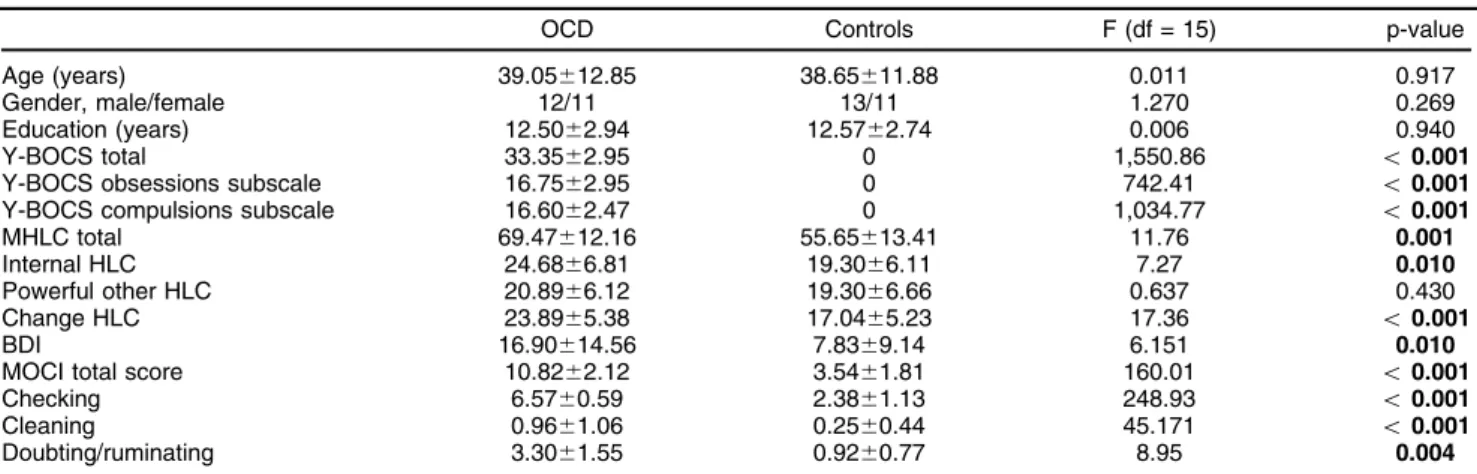
Each patient had to understand the nature of the study and sign an informed consent form prior to administration of rating scales. Sociodemographic and clinical informa-tion for all participants is summarized in Table 1.
Instruments
Clinical measures
All rating scales were administered by psychiatrists with at least 5 years’ clinical experience and who were supervised by senior psychiatrists.
Yale-Brown Obsessive Compulsive Scale (Y-BOCS).
Severity of OCD was assessed with the first 10 items of the Y-BOCS,41a clinician-administered scale developed to assess the severity of obsessions and compulsions, independent of the number and type of obsessions or compulsions present. In general, the items depend on the patient’s report; however, the final rating is based on the clinical judgment of the interviewer.
Multidimensional health locus of control (MHLC).42
Health locus of control (HLC) refers to individual beliefs regarding potential causes of health outcomes. It is an adaptation of the locus of control concept that stems from Rotter’s social learning theory, where it was introduced as a personality construct. Applied to health and health
Table 1 Sociodemographic and clinical profile of patients with OCD and controls
OCD Controls F (df = 15) p-value
Age (years) 39.05612.85 38.65611.88 0.011 0.917
Gender, male/female 12/11 13/11 1.270 0.269
Education (years) 12.5062.94 12.5762.74 0.006 0.940
Y-BOCS total 33.3562.95 0 1,550.86 o0.001
Y-BOCS obsessions subscale 16.7562.95 0 742.41 o0.001
Y-BOCS compulsions subscale 16.6062.47 0 1,034.77 o0.001
MHLC total 69.47612.16 55.65613.41 11.76 0.001
Internal HLC 24.6866.81 19.3066.11 7.27 0.010
Powerful other HLC 20.8966.12 19.3066.66 0.637 0.430
Change HLC 23.8965.38 17.0465.23 17.36 o0.001
BDI 16.90614.56 7.8369.14 6.151 0.010
MOCI total score 10.8262.12 3.5461.81 160.01 o0.001
Checking 6.5760.59 2.3861.13 248.93 o0.001
Cleaning 0.9661.06 0.2560.44 45.171 o0.001
Doubting/ruminating 3.3061.55 0.9260.77 8.95 0.004
Data presented as mean6standard deviation, unless otherwise specified.
behavior, the locus of control means that individuals attribute particular health outcomes to either internal or external sources. Internally oriented individuals generally hold the belief that events are a consequence of their own actions, whereas externally oriented persons believe events occur due to factors beyond their control. The MHLC contains three subscales43: internal HLC (IHLC), powerful other HLC (PHLC), and change HLC (CHLC). Each subscale measures an individual’s tendency to believe that health outcomes are due mainly to one’s own behavior (IHLC), to powerful others such as medical professionals or family (PHLC), or to change (CHLC). PHLC and/or CHLC are classified as external beliefs, and IHLC, as internal belief.42
Beck Depression Inventory (BDI).44 The BDI is a measure of severity of self-reported depression in adults. In the Italian adaptation of the BDI was used in this study,45it is scored by adding the ratings for each of the 24 symptoms. Each symptom is rated dichotomously and the total score can range from 0 to 24. The scale has shown good psychometric qualities (Cronbach’sa: 0.87).
Maudsley Obsessional-Compulsive Inventory (MOCI).46,47
The MOCI-R is a self-report questionnaire contained in the Cognitive Behavioral Assessment (CBA-2.0) battery.47 This version is a 21-item questionnaire that evaluates OCD. It employs a dichotomous response format, and total scores range from 0 to 21. The 21 items are classified into three subscales: 1) checking (nine items); 2) cleaning (nine items); and 3) doubting/ruminating (four items).
Empathy measures
The measures of empathic ability were divided into mentalizing and sharing measures, as described below.
1) Mentalizing measures
Basic Empathy Scale (BES), cognitive subscale.32,33,38
The BES comprises 20 items, which are scored by participants on a five-point Likert-type scale (1 = strongly disagree, 2 = disagree, 3 = neither agree nor disagree, 4 = agree, 5 = strongly agree). In the two-factor model,32 nine items assess cognitive empathy (items 3, 6, 9, 10, 12, 14, 16, 19, 20), and 11 items assess affective empathy (items 1, 2, 4, 5, 7, 8, 11, 13, 15, 17, and 18). In the two-factor conceptualization, the BES included seven reversed items, and scores could range from 20 (empathy deficit) to 100 (high level of empathy).
The BES has demonstrated good validity.32,33,38 Cronbach’s a coefficient was calculated to examine the
internal consistency of the scale, considered globally and in its two dimensions, as yielded by the confirmatory factor.
Empathy Quotient (EQ).48,49The EQ is a questionnaire that largely focuses on cognitive empathy and is com-posed of 60 questions, split into two types: 40 questions tapping empathy and 20 filler items, which were included to distract the participant from a relentless focus on empathy. Each item scores one point if the respondent
records the empathic behavior mildly, or two points if the respondent records the behavior strongly. Approximately half of the items were formulated to produce a disagree-ment response, and the other half to produce an agreement response for the empathic feeling, in order to avoid a response bias either way. The EQ has a forced choice format, so it can be self-administered.
2) Experience-sharing measures
Eyes Task.50 In brief, in this revised version of the Reading the Mind in the Eyes Test, participants are given 36 photographs depicting the ocular area in an equal number of different actors and actresses. At each corner of every photo, four emotional descriptors, e.g., dispirited, bored, playful, or comforting, are printed, only one of which (the target word) correctly identifies the depicted person’s mental state, while the others are included as foils. The test is scored by adding the number of items (photographs) correctly identified by the participant; therefore, the maximum total score is 36.
Emotion Attribution Task.51 This task assesses ability to represent the emotions of others. In this task, the participant is presented with 58 short stories describing an emotional situation and is required to provide an emotion describing how the main character might feel in that situation. The sentences were designed to elicit attribu-tions of positive and negative emoattribu-tions.
This task assesses ability to identify and represent seven emotions: happiness, anger, disgust, sadness, embarrassment, envy, and fearfulness. The task is scored according to the number of correct attributions.
BES, affective subscale.32,33,38 The affective subscale of the BES comprises 11 items designed to measure emotional congruence with another person’s emotions. Example items include ‘‘I get caught up in other people’s feelings easily.’’ Each item asks participants to express their own degree of agreement on a five-point, Likert-type scale, ranging from 1 (strongly disagree) to 5 (strongly agree). Theacoefficient was 0.86.33
Statistical analysis
SPSS version 22 was used. One-way ANOVA was conducted to identify significant differences among the two groups (OCD and control) in sociodemographic, mentalizing (EQ, BES cognitive subscale), and experi-ence-sharing measures (Eyes task, Emotion Attribution Task, BES affective subscale). Moreover, Pearson correlation coefficients were calculated between clinical measures and mentalizing and sharing measures.
Results
Clinical results
The OCD sample scored higher on several clinical measures as compared to controls: Y-BOCS total score (F1,45 =
1,550.86; po0.001), obsessions subscale (F1,45= 742.41;
po0.001). In the MHLC scale, OCD patients scored higher only on the CHLC subscale (mean scores: 21.6567.66 vs. 17.0465.23; F1,45= 5.66; p = 0.020). These analyses are
reported in detail in Table 1.
Mentalizing measures
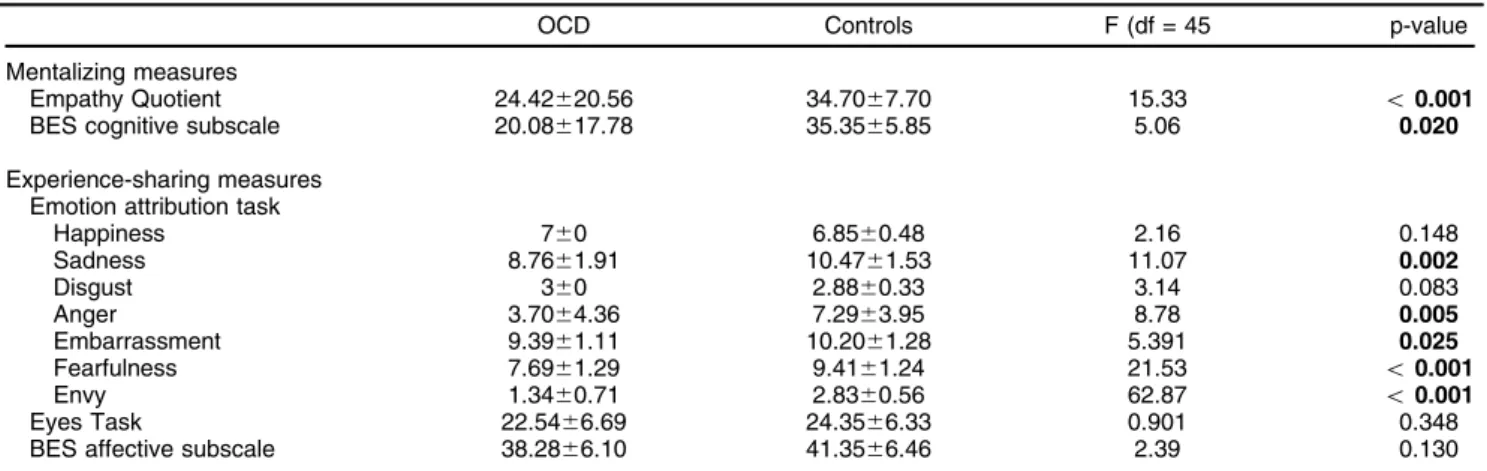
The OCD sample scored lower than controls both in the EQ (F1,45= 15.33; po0.001) and BES cognitive (F1,45=
5.03; p = 0.020) measures. Mentalizing performance scores (means and standard deviation) are reported in Table 2.
Experience-sharing measures
In the experience-sharing measures, the OCD group scored lower on emotion recognition compared to the control group in all negative emotions, except disgust. There were no differences in happiness scores (Table 2). The OCD group did not show significant differences compared to the control group in the BES affective sub-scale (F1,45= 2.39; p = 0.130) or the eyes task (F1,45= 0.901;
p = 0.348).
Correlation analysis
We performed a Pearson correlation analysis in the OCD group between clinical measures (Y-BOCS and BDI) and mentalizing and experience-sharing measures. The ana-lysis showed a significant negative correlation between the BES cognitive subscale and two Y-BOCS sub-scales: obsessions (r = -0.462; p = 0.001) and compulsions (r = -0.392; p = 0.005).
Moreover, experience-sharing ability for sadness also correlated negatively with the Y-BOCS subscales obses-sions (r = -0.423; p = 0.002) and compulobses-sions (r = -0.420; p = 0.003). Sharing ability for the disgust emotion correlated positively with BDI. Other correlations did not show significant effects (Table 3).
Discussion
In the present study, we explored the ability to represent one’s own and others’ mental states (mentalizing ability) and to share in the internal states of others (experience sharing) in OCD subjects compared to a control group.
We found that patients with OCD exhibited a deficit in mentalizing ability (cognitive empathy) compared to the Table 2 Mentalizing and experience-sharing measures for patients with OCD and controls
OCD Controls F (df = 45 p-value
Mentalizing measures
Empathy Quotient 24.42620.56 34.7067.70 15.33 o0.001
BES cognitive subscale 20.08617.78 35.3565.85 5.06 0.020
Experience-sharing measures Emotion attribution task
Happiness 760 6.8560.48 2.16 0.148
Sadness 8.7661.91 10.4761.53 11.07 0.002
Disgust 360 2.8860.33 3.14 0.083
Anger 3.7064.36 7.2963.95 8.78 0.005
Embarrassment 9.3961.11 10.2061.28 5.391 0.025
Fearfulness 7.6961.29 9.4161.24 21.53 o0.001
Envy 1.3460.71 2.8360.56 62.87 o0.001
Eyes Task 22.5466.69 24.3566.33 0.901 0.348
BES affective subscale 38.2866.10 41.3566.46 2.39 0.130
Data presented as mean ± standard deviation, unless otherwise specified. Values in bold are statistically significant. BES = Basic Empathy Scale; df = degrees of freedom; OCD = obsessive-compulsive disorder.
Table 3 Correlation analysis (Pearson coefficient) between clinical measures (Y-BOCS, BDI and MOCI-R) and mentalizing and sharing measures in the OCD group
Y-BOCS obsessions Y-BOCS compulsions BDI Checking Cleaning Doubting/ ruminating
Mentalizing measures
BES cognitive subscale -0.462* -0.392* 0.184 0.079 -0.281 0.219
Empathy Quotient -0.215 -0.225 0.346 0.101 -0.213 0.168
Sharing measures
Sadness -0.423* -0.420* -0.194 0.006 -0.169 0.217
Happiness 0.233 0.235 -0.112 0.280 -0.003 0.027
Disgust 0.079 0.347 0.415* -0.010 -0.194 0.123
Anger -0.057 0.140 -0.634 0.118 0.089 -0.020
Embarrassment -0.220 -0.294 -0.231 -0.161 0.008 -0.006
Fearfulness 0.087 -0.043 -0.052 -0.065 -0.061 -0.004
Envy -0.161 -0.04 0.176 -0.002 0.02 0.019
Eyes task -0.176 -0.164 -0.108 0.250 0.211 -0.101
BES affective subscale -0.284 -0.226 -0.242 0.101 -0.213 0.165
BDI = Beck Depression Inventory; BES = Basic Empathy Scale; MOCI = Maudsley Obsessional-Compulsive Inventory; OCD = obsessive-compulsive disorder; Y-BOCS = Yale-Brown Obsessive Compulsive Scale.
control subjects. Interestingly, our results for mentalizing abilities reveal that persons with OCD have trouble under-standing the meaning of what others are saying and doing, and typically struggle to take the other person’s perspective (BES cognitive subscale and EQ). An impaired capacity to understand mental states and to comprehend interpersonal relations could affect self-appraisal and adaptation capa-cities in subjects with OCD.51In agreement with a study by Giovagnoli et al.,52 we support the idea that mentalizing ability deficits predict self-rated cognitive functioning, strategies for coping with stressful events, and overall quality of life perception. The mentalizing ability deficit in OCD may have psycho-behavioral implications. In particu-lar, impairment in mentalizing ability jeopardizes correct estimation of one’s own social and behavioral functioning. Indeed, an important characteristic of intact mentalizing ability is the comprehension that minds can take different perspectives of the world. A correct solution for ToM tasks requires participants to distinguish between mental repre-sentations held by the self and by others.53Moreover, an individual who understands real mental states should also maintain good self-awareness.53Adequate comprehension of real mental states and interpersonal dynamics could help one avoid redundant thoughts or actions, make behavior fluid, or enhance feelings of belonging to a social group.52 Several studies have shown that the association between ToM and psycho-behavioral alterations may reflect damage to common neural substrates that underlie ToM and emotional-behavioral control.53,54 Regarding experience-sharing measures, OCD subjects did not differ from controls in the experience-sharing dimension (affective empathy) when other people expressed emotions with positive valence. Fontenelle et al.13 note that their OCD sample displayed greater levels of affective empathy. With the exception of the disgust emotion, in our study, the difficulty of these patients to empathize with the emotional experience of others was linked to sharing of emotions with negative valence. A robust association between disgust and OCD has not been consistently observed in the literature.55 In fact, individuals with OCD have been reported to be more prone to disgust.56Isolation of affect30 (disconnecting feelings from thoughts) for negative emotion could be a defense in OCD. The isolation mechanism can help OCD patients control intolerable and negative emo-tions by detaching affective elements from the situa-tion.30,57 In addition, previous neuroimaging studies of
empathy have also suggested associations between OCD and emotional processing.56 The neural correlates of empathy involve temporal and frontal lobe regions including the cingulate, insula, medial prefrontal cortex,18,58,59 and orbitofrontal cortex.60 Interestingly, these regions are related to the pathophysiology of OCD.61We hypothesize that difficulty in negative emotion processing could affect quality of life in persons with OCD. Indeed, Calkins et al.62 showed that engaging in compulsions (e.g., saying a prayer) or avoidance behaviors (e.g., refusing to pick up one’s baby) may serve to assuage negative emotions and, in the long term, these rituals serve to maintain the vicious cycle of OCD. The results of our correlation analysis showed that, in the OCD group, Y-BOCS scores (on both the obsessive and the compulsive subscales) correlated
negatively with the BES cognitive subscale, a mentalizing measure that demonstrated impairment in the OCD group. Both the obsessive and compulsive subscales of the Y-BOCS also correlated negatively with ability to recognize the emotion of sadness. This means that the higher the Y-BOCS score, the lower the performance of individuals with OCD on the BES cognitive subscale and the lower their ability to recognize negative emotions.
Interestingly, the disgust emotion correlated positively with BDI. Zahn et al.63 hypothesized that disgust is of particular relevance to major depressive disorder because it entails the devaluation of one’s character,64such as shame,
but is related to violations of internalized moral duties,65 such as guilt. These characteristics are also present in subjects with OCD. In fact, OCD has been found to have a profound impact on mood, with feelings of depression and overwhelming anxiety states being a common phenomenon among those with OCD.66
This result confirms a relationship of difficulty in the cognitive dimension of empathy and recognition of negative emotions with symptom severity in OCD. A negative influence of mentalizing ability deficit in patients with OCD causes bad mood, stigma, low self-esteem, and poor social integration. These difficulties compound the symptoms typically found in this patient population.
Given the recent literature on empathy as a multi-dimensional process and new paradigms of evaluation of empathic abilities, the development of a clinical profile based on cognitive and social processes may be more informative for treatment than an OCD diagnosis alone. Moreover, social and empathic features may provide an important perspective for research to redraw the diag-nostic frontiers of different neuropsychiatric disorders.
The small sample size is an important limitation of our study. Another potential limitation is the lack of measures to evaluate the prosocial concern, according to the empathy model of Zaki & Ochsner.19Recently, empathy
was suggested to have three facets, but we assessed only two (mentalizing and experience sharing), as the majority of neuroscience research in empathy has focused on these two empathic processes. The proposed third aspect of empathy (prosocial concern) has only begun to receive increasing neuroscientific attention in the last few years.19Neuroscientific data concerning other
Acknowledgements
We are extremely grateful to the Psychiatric Diagnosis and Treatment Service, Department of Mental Health, G. Mazzini Hospital, NHS, ASL 4,Teramo, Italy, for their help in recruiting patients. We wish to thank Marta Baroni for her assistance with data collection.
Disclosure
The authors report no conflicts of interest.
References
1 Abramowitz JS, Taylor S, McKay D. Obsessive-compulsive disorder. Lancet. 2009;374:491-9.
2 De Berardis D, Serroni N, Marini S, Rapini G, Carano A, Valchera A, et al. Alexithymia, suicidal ideation, and serum lipid levels among drug-naı¨ve outpatients with obsessive-compulsive disorder. Rev Bras Psiquiatr. 2014;36:125-30.
3 Ozkiris A, Essizoglu A, Gulec G, Aksaray G. The relationship between insight and the level of expressed emotion in patients with obsessive-compulsive disorder. Nord J Psychiatry. 2015;69:204-9. 4 Daros AR, Zakzanis KK, Rector NA. A quantitative analysis of facial
emotion recognition in obsessive- compulsive disorder. Psychiatry Res. 2014;215:514-21.
5 Schienle A, Scha¨fer A, Stark R, Walter B, Franz M, Vaitl D. Disgust sensitivity in psychiatric disorders: a questionnaire study. J Nerv Ment Dis. 2003;191:831-4.
6 Kornreich C, Blairy S, Philippot P, Dan B, Foisy M, Hess U, et al. Impaired emotional facial expression recognition in alcoholism com-pared with obsessive-compulsive disorder and normal controls. Psychiatry Res. 2001;102:235-48.
7 Montagne B, de Geus F, Kessels RP, Denys D, de Haan EH, Westenberg HG. Perception of facial expressions in obsessive-compulsive disorder: a dimensional approach. Eur Psychiatry. 2008;23:26-8.
8 Parker HA, McNally RJ, Nakayama K, Wilhelm S. No disgust recognition deficit in obsessive-compulsive disorder. J Behav Ther Exp Psychiatry. 2004;35:183-92.
9 Mazza M, Giusti L, Albanese A, Mariano M, Pino MC, Roncone R. Social cognition disorders in military police officers affected by post-traumatic stress disorder after the attack of An-Nasiriyah in Iraq 2006. Psychiatry Res. 2012;198:248-52.
10 Mazza M, Tempesta D, Pino MC, Catalucci A, Gallucci M, Ferrara M. Regional cerebral changes and functional connectivity during the observation of negative emotional stimuli in subjects with post-traumatic stress disorder. Eur Arch Psychiatry Clin Neurosci. 2013;263:575-83. 11 Mazza M, Pino MC, Mariano M, Tempesta D, Ferrara M, De Berardis
D, et al. Affective and cognitive empathy in adolescents with autism spectrum disorder. Front Hum Neurosci. 2014;8:791-791.
12 Decety J, Moriguchi Y. The empathic brain and its dysfunction in psychiatric populations: implications for intervention across different clinical conditions. Biopsychosoc Med. 2007;1:22-22.
13 Fontenelle LF, Soares ID, Miele F, Borges MC, Prazeres AM, Range´ BP, et al. Empathy and symptoms dimensions of patients with obsessive-compulsive disorder. J Psychiatr Res. 2009;43:455-63. 14 Decety J, Cowell JM. The complex relation between morality and
empathy. Trends Cogn Sci. 2014;18:337-9.
15 Jackson PL, Meltzoff AN, Decety J. How do we perceive the pain of others? A window into the neural processes involved in empathy. Neuroimage. 2005;24:771-9.
16 Shamay-Tsoory SG. The neural bases for empathy. Neuroscientist. 2011;17:18-24.
17 Dziobek I, Rogers K, Fleck S, Bahnemann M, Heekeren HR, Wolf O, et al. Dissociation of cognitive and emotional empathy in adults with Asperger syndrome using the Multifaceted Empathy Test (MET) J Autism Dev Disord. 2008;38:464-73.
18 Mazza M, Tempesta D, Pino MC, Nigri A, Catalucci A, Guadagni V, et al. Neural activity related to cognitive and emotional empathy in post-traumatic stress disorder. Behav Brain Res. 2015;282:37-45. 19 Zaki J, Ochsner KN. The neuroscience of empathy: progress, pitfalls
and promise. Nat Neurosci. 2012;15:675-80.
20 Hu K, Lijffijt M, Beauchaine TP, Fan Z, Shi H, He S. Influence of empathetic pain processing on cognition in schizophrenia. Eur Arch Psychiatry Clin Neurosci. 2015;265:623-31.
21 Montag C, Heinz A, Kunz D, Gallinat J. Self reported empathic abil-ities in schizophrenia. Schizophr Res. 2007;92:85-9.
22 Jones CR, Pickles A, Falcaro M, Marsden AJ, Happe´ F, Scott SK, et al. A multimodal approach to emotion recognition ability in autism spectrum disorders. J Child Psychol Psychiatry. 2011;52: 275-85.
23 Schwenck C, Mergenthaler J, Keller K, Zech J, Salehi S, Taurines R, et al. Empathy in children with autism and conduct disorder: group-specific profiles and developmental aspects. J Child Psychol Psychiatry. 2012;53:651-9.
24 Anholt GE, Cath DC, van Oppen P, Eikelenboom M, Smit JH, van Megen H, et al. Autism and ADHD symptoms in patients with OCD: are they associated with specific OC symptom dimensions or OC symptom severity? J Autism Dev Disord. 2010;40:580-9.
25 Russell G, Rodgers LR, Ford T. The strengths and difficulties ques-tionnaire as a predictor of parent-reported diagnosis of autism spectrum disorder and attention deficit hyperactivity disorder. PLoS One. 2013;8:e80247.
26 de Oliveira-Souza R, Hare RD, Bramati IE, Garrido GJ, Azevedo Igna´cio F, Tovar-Moll F, et al. Psychopathy as a disorder of the moral brain: fronto-temporo-limbic grey matter reductions demonstrated by voxelbased morphometry. Neuroimage. 2008;40:1202-13.
27 Shamay-Tsoory SG, Tomer R, Goldsher D, Berger BD, Aharon-Peretz J. Impairment in cognitive and affective empathy in patients with brain lesions: anatomical and cognitive correlates. J Clin Exp Neuropsychol. 2004;26:1113-27.
28 Rankin KP, Kramer JH, Miller BL. Patterns of cognitive and emotional empathy in frontotemporal lobar degeneration. Cogn Behav Neurol. 2005;18:28-36.
29 Bozikas VP, Kosmidis MH, Giannakou M, Saitis M, Fokas K, Garyfallos G. Emotion perception in obsessive-compulsive disorder. J Int Neuro-psychol Soc. 2009;15:148-53.
30 Kang JI, Namkoong K, Yoo SW, Jhung K, Kim SJ. Abnormalities of emotional awareness and perception in patients with obsessive-compulsive disorder. J Affect Disord. 2012;141:286-93.
31 Jolliffe D, Farrington DP. Empathy and offending: a systematic review and meta-analysis. Aggress Violent Behav. 2004;9:441-76. 32 Jolliffe D, Farrington DP. Development and validation of the Basic
Empathy Scale. J Adolesc. 2006;29:589-611.
33 Albiero P, Matricardi G, Speltri D, Toso D. The assessment of empathy in adolescence: a contribution to the Italian validation of the ‘‘Basic Empathy Scale’’. J Adolesc. 2009;32:393-408.
34 Eisenberg N, Fabes RA, Carlo G, Speer AL, Switzer G, Karbon M, et al. The relations of empathy-related emotions and maternal prac-tices to children’s comforting behavior. J Exp Child Psychol. 1993; 55:131-50.
35 Hoffman ML. Toward a comprehensive empathy-based theory of prosocial moral development. In: Bohart AC, Stipek JD, editors. Constructive and destructive behavior implications for family, school and society. Washington: American Psychological Association; 2001. p. 61-86.
36 Feshbach N. Parental empathy and children adjustment/maladjust-ment In: Eisenberg N, Strayer J editors. Empathy and its develop-ment. New York: Cambridge University Press; 1987. p. 271-91. 37 Feshbach N, Roe K. Empathy in six- and seven-year-olds. Child Dev.
1968;39:133-45.
38 Carre´ A, Stefaniak N, D’Ambrosio F, Bensalah L, Besche-Richard C. The Basic Empathy Scale in adults (BES-A): factor structure of a revised form. Psychol Assess. 2013;25:679-91.
39 Davis MH. Measuring individual differences in empathy: evidence for a multidimensional approach. J Pers Soc Psychol. 1983;44:113-26. 40 First MB, Spitzer RL, Gibbon M, Williams JBW. Structured clinical
interview for DSM-IV-TR axis I disorders, research version, patient edition. (SCID-I/P) New York: biometrics research. New York: New York State Psychiatric Institute; 2002.
41 Goodman WK, Price LH, Rasmussen SA, Mazure C, Fleischmann RL, Hill CL, et al. The Yale-Brown Obsessive Compulsive Scale. I. Devel-opment, use, and reliability. Arch Gen Psychiatry. 1989;46:1006-11. 42 Wallston KA, Wallston BS, DeVellis R. Development of the
43 Kuwahara A, Nishino Y, Ohkubo T, Tsuji I, Hisamichi S, Hosokawa T. Reliability and validity of the Multidimensional Health Locus of Control Scale in Japan: relationship with demographic factors and health-related behaviour. Tohoku J Exp Med. 2004;203:37-45.
44 Beck JG, Grant DM, Clapp JD, Palyo SA. Understanding the inter-personal impact of trauma: contributions of PTSD and depression J Anxiety Disord. 2009;23:443-50.
45 Vidotto G, Moroni L, Burro R, Filipponi L, Balestroni G, Bettinardi O, et al. A revised short version of the depression questionnaire. Eur J Cardiovasc Prev Rehabil. 2010;17:187-97.
46 Min BB, Won HT. Reliability and validity of the Korean translations of Maudsley Obsessional-Compulsive Inventory and Pauda Inventory. Korean J Clin Psychol. 1999;18:163-82.
47 Sanavio E, Vidotto G. The components of the Maudsley Obsessional-Compulsive Questionnaire. Behav Res Ther. 1985;23:659-62. 48 Baron-Cohen S, Wheelwright S. The empathy quotient: an
investi-gation of adults with Asperger syndrome or high functioning autism, and normal sex differences. J Autism Dev Disord. 2004;34: 163-75.
49 Preti A, Vellante M, Baron-Cohen S, Zucca G, Petretto DR, Masala C. The Empathy Quotient: a cross-cultural comparison of the Italian version. Cogn Neuropsychiatry. 2011;16:50-70.
50 Baron-Cohen S, Wheelwright S, Hill J, Raste Y, Plumb I. The ‘‘Reading the Mind in the Eyes’’ Test revised version: a study with normal adults, and adults with Asperger syndrome or high-functioning autism. J Child Psychol Psychiatry. 2001;42:241-51.
51 Blair RJ, Cipolotti L. Impaired social response reversal. A case of ‘acquired sociopathy’. Brain. 2000;123:1122-41.
52 Giovagnoli AR, Parente A, Villani F, Franceschetti S, Spreafico R. Theory of mind and epilepsy: what clinical implications? Epilepsia. 2013;54:1639-46.
53 Baron-Cohen S, Ring H, Moriarty J, Schmitz B, Costa D, Ell P. Recognition of mental state terms. Clinical findings in children with autism and a functional neuroimaging study of normal adults. Br J Psychiatry. 1994;165:640-9.
54 Shamay-Tsoory SG, Aharon-Peretz J. Dissociable prefrontal net-works for cognitive and affective theory of mind: a lesion study. Neuropsychologia. 2007;45:3054-67.
55 Olatunji BO, Ebesutani C, Haidt J, Sawchuk CN. Specificity of disgust domains in the prediction of contamination anxiety and avoidance: a multimodal examination. Behav Ther. 2014;45:469-81.
56 Whitton AE, Henry JD, Grisham JR. Cognitive and psychophysiolo-gical correlates of disgust in obsessive-compulsive disorder. Br J Clin Psychol. 2015;54:16-33.
57 Fenichel O. The psychoanalytic theory of neurosis. New York: WW Norton Company; 1945.
58 Lamm C, Decety J, Singer T. Meta-analytic evidence for common and distinct neural networks associated with directly experienced pain and empathy for pain. NeuroImage. 2011;54:2492-502.
59 Vo¨llm BA, Taylor AN, Richardson P, Corcoran R, Stirling J, McKie S, et al. Neuronal correlates of theory of mind and empathy: a functional magnetic resonance imaging study in a nonverbal task. Neuroimage. 2006;29:90-8.
60 Brink TT, Urton K, Held D, Kirilina E, Hofmann MJ, Klann-Delius G, et al. The role of orbitofrontal cortex in processing empathy stories in 4- to 8-year-old children. Front Psychol. 2011;2:80-80.
61 Kwon JS, Jang JH, Choi JS, Kang DH. Neuroimaging in obsessive-compulsive disorder. Expert Rev Neurother. 2009;9:255-69. 62 Calkins AW, Berman NC, Wilhelm S. Recent advances in research
on cognition and emotion in OCD: a review. Curr Psychiatry Rep. 2013;15:357.
63 Zahn R, Lythe KE, Gethin JA, Green S, Deakin JF, Workman C, et al. Negative emotions towards others are diminished in remitted major depression. Eur Psychiatry. 2015;30:448-53.
64 Fischer AH, Roseman IJ. Beat them or ban them: the characteristics and social functions of anger and contempt. J Pers Soc Psychol. 2007;93:103-15.
65 Higgins ET. Self-discrepancy - a theory relating self and affect. Psychol Rev. 1987;94:319-40.
66 Angelakis I, Gooding P, Tarrier N, Panagioti M. Suicidality in obsessive compulsive disorder (OCD): a systematic review and meta-analysis. Clin Psychol Rev. 2015;39:1-15.
67 Cialdini RB, Brown SL, Lewis BP, Luce C, Neuberg SL. Reinter-preting the empathy-altruism relationship: when one into one equals oneness. J Pers Soc Psychol. 1997;73:481-94.