A R T I C L E
Humanism and Solidarity in Brazilian
Foreign Policy Under Lula (2003-2010):
Theory and Practice
1
Carlos Aurélio Pimenta de Faria
Pontiical Catholic University of Minas Gerais (PUC-Minas), Brazil
Clarisse Goulart Paradis
Ph.D Candidate in Political Science, Federal University of Minas Gerais (UFMG), Brazil
The “humanistic” or “solidarity-based” trend in the Brazilian strategy of international insertion, adopted after the rise to power of President Lula and con-sidered innovative, consolidated the objective of prioritizing the South-South axis and can be explained by domestic, regional, and systemic reasons. This strategy was put into practice by increasing the international aid granted by Brazil, by transferring resources and technology and by the emphasis placed on conveying to partner countries some of the domestic social policies and programmes devel-oped successfully by the Brazilian government. The aims of this paper are: (a) to look at how this “humanism” and “solidarity” appeared in the discourse of the Brazilian authorities; (b) to discuss the reasons for them and their logic in the na-tional, regional, and systemic dimensions; and (c) to map the initiatives adopted, the preferred partners and areas, the resources used and the intragovernmental connections necessary for their implementation.
Keywords: Foreign policy; Brazil; humanistic; solidarity
B
y the end of the first decade of the 20th century, Brazil had attainedunprece-dented visibility and prestige in international affairs (Dauvergne and Farias, 2012; Hurrell, 2008; Rouquié, 2008), a position long aspired by the Brazilian elite (Lima, 2005a). Evidence of this is so plentiful that examples are unnecessary. Such a shift was made possible by both international and domestic factors.
(engajada) (Almeida, 2004); that it sought a “sovereign presence” in the world system
(Souto Maior, 2004); that it was based on a search for a new “diplomatic architecture” (Almeida, 2005); that it followed a strategy of attaining “autonomy through diversifica-tion” [of partners] (Vigevani and Cepaluni, 2007) and that it was based on a “charismatic diplomacy” that was “impossible to transfer” (Ricupero, 2010), among many other labels and adjectives.2 Celso Amorim, Minister of Foreign Affairs during Lula’s two terms in
of-fice, said in an interview immediately after his appointment to lead Itamaraty once again3
that the country’s foreign policy would be “lofty and active” (altiva e ativa). In another
interview, towards the end of his eight years as Lula’s foreign affairs minister, Amorim stated that he preferred to label it as “fearless and solidarity-based” (desassombrada e
solidária) (Amorim, 2010).
Until quite recently, few Brazilian foreign policy analysts had stressed the impor-tance that this emphasis on “humanism” and “solidarity” had on Lula’s strategy of inter-national insertion, even if, as we will see, it was strongly present in public speeches given both by Lula and Amorim since the very beginning, and even if it was almost immediately translated into practice. Lima and Hirst (2006: 22), however, state that the “inclusion of the social agenda as a major topic of foreign affairs was one of the first and most important innovations”.
This new tendency of the country’s foreign policy, regarded as innovative, consoli-dated the objective of prioritizing the South-South axis. With this objective, Brazil estab-lished closer ties to countries on the periphery of capitalism, which can be explained by domestic, regional, and systemic reasons. This strategy was put into practice, inter alia, by
the increase in international aid granted, the transfer of resources and technology, and the emphasis placed on conveying to partner countries some of the domestic social policies and programmes developed successfully by the Brazilian government.
The Rhetoric of Solidarity and Humanism in Lula’s Foreign Policy
The activism of Brazilian foreign policy under Lula may be gauged by the intensity of the so-called presidential diplomacy during his time in office. Table 1 compares the official presidential trips to foreign countries made by Cardoso (1995-2002) and by Lula (2003-2010).
Table 1. Official Presidential Trips Abroad: Cardoso and Lula
Cardoso (1995-2002) Lula (2003-2010)
Total trips abroad 94 146
Number of countries visited 44 85
Number of visits 135 254
Number of countries visited and number of visits by region
Countries Number of visits Countries Number of visits
Africa 3 5 21 32
Antarctica 0 0 1 1
Asia 8 8 10 19
Europe 14 44 18 57
Central America & Caribbean 4 6 11 21
Middle East 1 1 10 12
North America 3 15 2 20
South America 11 56 12 92
TOTAL 44 135 85 254
Source: Adapted from Ribas and Faria (2011).
Whereas Cardoso’s presidential diplomacy had been widely praised in Brazil (Danese, 1999), the intensity of Lula’s personal engagement in international affairs initially sur-prised many of his fellow citizens, largely due to prejudice, since the former industrial worker did not have a university degree and spoke only Portuguese.4 As a matter of fact,
the comparison presented above not only illustrates the priority Lula gave to foreign af-fairs, but also shows that the South-South axis really became of particular concern during his administration.
few passages in order to show that such a strategy was conceived since the very beginning of the Lula administration, to illustrate that it was clearly and frequently presented and to highlight how powerful this rhetoric was at times. As we will see, the fact that the presi-dent could claim, as he did on several occasions, that he himself had experienced poverty, hunger, exclusion and migration motivated by economic reasons was not the only reason for which it was so powerful.5
In his inauguration speech on January 1, 2003, Lula made it clear that the link be-tween domestic and foreign policies in his government would not just be “developmental”. It must be borne in mind that in Brazil, foreign policy has traditionally been regarded as an instrument to promote economic development at home. Lima and Hirst (2006: 21) have also stressed this point: “the government’s fight against poverty and unequal income dis-tribution at home and its assertive and activist foreign policy can be viewed as two sides of the same coin”.
In the aforementioned inaugural speech, Lula called upon the nation to make the “end of hunger a great national cause”, a “crusade”. He said, “Our foreign policy will also reflect the desires that were expressed in the streets. In my government, Brazilian diplomatic action will be oriented by a humanistic perspective and will be, above all, an instrument for national development”. The main priority was to build “a continent that is politically stable, prosperous and united, on the basis of the ideals of democracy and social justice”. The country would back the efforts to make the United Nations and its agencies efficient instruments for promoting “social and economic development, to fight poverty and inequality”.
We are starting a new chapter in Brazilian History today, not as a submis-sive nation, (…) not as an unjust nation, passubmis-sively watching the suffering of the poorest, but as a lofty (altiva) and noble nation that will affirm itself courageously
in the world as a nation for all, free from class, ethnic, gender or belief distinc-tions.6
that hunger and poverty are usually [part of] the cultural environment (caldo de cultura)
where fanaticism and intolerance arise”. The speech at Davos was thus concluded: “We urgently need to unite around a world pact for peace and against hunger. And rest assured that Brazil will do its part”.
Lula regarded the task of convincing leaders, sensitizing audiences and setting the in-ternational agenda as part of his responsibility. This is clear when one looks at his agenda and reads his speeches. But Lula had more than a moral discourse, personal charm, cha-risma and his own life story to support his “crusade”. He also insistently presented Brazil-ian social policies created or improved by his government, such as Fome Zero (Zero
Hun-ger) and the conditional cash transfer programme called Bolsa Família, which became the
world’s greatest programme of that sort, as best practices to be emulated. In 2011, Lula’s former minister, José Graziano da Silva, was elected Director-General of the UN Food and Agriculture Organization (FAO). Lula once said that “Brazil wants to be proud to be the first country to accomplish all the Millennium Goals established in Rome”.7 In fact, Brazil
managed to accomplish the first goal (“to eradicate extreme poverty and hunger”) well before the deadline. But it was not only the domestic policies that were praised and sold as examples to other developing countries. The social programmes financed by the IBSA (India, Brazil and South Africa) Forum Fund in non-member countries, for example, re-ceived an award from the UN.
Both Lula and Amorim stressed the “humanistic” spirit that characterized Brazil’s mobilization in the domestic and international spheres on many occasions. According to the rationale that was being disseminated, “the fight against exclusion and inequality is not a mere consequence of growth, but its mainspring” (mola mestra). As Lula had
strong-ly condemned the invasion of Iraq, which took place on March 20, 2003, he said repeatedstrong-ly that “our war is against hunger and poverty, and that is the only war that interests us”. But perhaps the most striking argument used by him on countless occasions in his speeches around the world was that hunger can be considered the most lethal weapon of mass de-struction, since it killed “twenty thousand people a day and eleven children per minute”, affecting nearly one quarter of humanity. The goal of “transforming hunger into a political issue” became clear and was easily recognizable. “We will not be successful in the fight against hunger if we do not radically change the standards of international cooperation. It is necessary to turn the page on the models imposed from abroad”.8 “With the IBSA
Fund we are proving that it is not necessary to be rich in order to show solidarity, that it is possible to help without interfering in other nations’ internal affairs”.9
in multilateral institutions – particularly in the World Trade Organization (WTO), where the country led the articulation of the G20 in 2003 – were also linked to the search not only for a more equitable international system, but also for social justice. As Lula men-tioned several times, “there will be no peace and security [in the world] without economic development and social justice”.10 Targeting the heavy subsidies for agriculture practised
by the USA and Europe, both Lula and Amorim emphasised many times that “it cannot be possible that cows in some developed countries earn more than two dollars a day in subsidies, while half of the world’s population has to survive on less than that”.11 In
an-other speech, Lula said that “the sum of resources spent on subsidies for agriculture is equivalent to six times the yearly additional value necessary to make the achievement of the Millennium Goals possible. Such a situation must change”.12 According to Amorim,
(...) for the first time in the history of trading diplomacy we have managed to put together [through the G20] two seemingly antagonistic objectives: trade liberalization and social justice. This has only been possible with this background which, in a way, President Lula created with his crusade against hunger.13
Lastly, but no less important, we must mention the relevance and opportuneness of a term/concept coined by Minister Amorim: “non-indifference”. Whereas non-intervention and the defence of self-determination have been traditional hallmarks of Brazilian diplo-macy, as several analysts have stressed, the new concept “non-indifference” was first used to justify the Brazilian leadership of MINUSTAH in Haiti, the UN mission established in 2004 under Chapter 7 of the UN Charter. The term was later used by Brazilian diplomatic authorities to try to legitimize not only humanitarian assistance, but also debt relief and technical cooperation with the official goal of promoting social development in other third world countries. Just as “the right to intervene” was largely used by the USA in their War against Terror after the Iraq War, “non-indifference” also legitimized a sort of interven-tion, but for the sake of social justice (Lima, 2005b). And in Haiti, Amorim believed that Brazil was “creating a new paradigm in international cooperation to solve conflicts. (…) What we desire is that our action in Haiti turns out to be a model, at this moment in which the UN is undergoing profound transformations”.14
It is therefore possible to say that Lula worked hard in his “crusade” (or “aposto-late”, as Amorim once said) to set the international agenda and to disseminate Brazilian policies, becoming a kind of international policy entrepreneur. And a very successful one, according to many observers and analysts.15 But how can one explain such a “crusade”?
Domestic, Regional and Systemic Reasons that guided Lula’s
Humanistic Foreign Policy
Although the individual, psychological motivations for launching this innovation in Brazilian foreign policy could be employed in our search for an explanation, as we saw in the previous section, in the following discussion we will emphasise the domestic, regional, and systemic variables.16
It must be initially said that, although the Workers’ Party’s (PT) rule in Brazil and “Lulismo” have been viewed as “pragmatic” – at least in comparison to other Latin
Amer-ican left-wing governments that rose to power, in what has been labelled as a “pink wave” that swept the region in this century’s first decade (Panizza, 2006) –, it is hard to distin-guish the political/ideological reasons behind the emergence of that humanistic trend in Brazilian foreign policy from the more pragmatic ones. Be that as it may, we should always ask ourselves if there really are politics without ideology.
Lula won the presidential elections in 2002 after also having disputed the three pre-vious ones. His victory was possible not only due to a nationwide mass mobilization led by his party and his charismatic personality. His appeals to social justice during the cam-paign were combined with a promise to preserve the orthodoxy of the country’s economic policies in order to calm down the markets and to gain the confidence of the middle class-es. The neoliberal policies of Lula’s predecessor, Cardoso, of the Brazilian Social Democ-racy Party (PSDB), would not be undone at the cost of instability. Economic orthodoxy may have marked Lula’s first term in office, but as well as departing from the privatiza-tions that took place during the government of the Social Democrats, the administration also immediately started putting into practice the long aspired foreign and social policies preached by the PT.
inequalities produced during the previous government and the diplomatic fidelity to the United States, with no visible domestic impact, which was the guideline of the Social Democrats.
Thus, the strategy of solidarity-based international insertion, stressing the South-South axis, was domestically produced, legitimized and reinforced by the character of the Brazilian political leader, by political competition and by the need to produce economic improvements. The Brazilian economy was among the world’s first to recover after the 2008 Wall Street Crash, which took place during Lula’s second term. Such a performance was attributed, to a large extent, to both foreign and social policies, as domestic demand kept the machine working and Brazilian exports were no longer dependent mainly on de-veloped countries (China became Brazil’s main commercial partner in 2009).
Regional factors also played an important role, as the new Brazilian foreign policy sought to reinforce the traditional priority given to South America, treating it as a renewed priority. However, it quickly became evident that the kind of bold regional leadership ini-tially preached by Lula and the PT would not work out. As if the huge regional asymme-tries were not enough to make most of the Brazilian initiatives suspicious, Venezuelan president Hugo Chávez had also begun expanding his regional ambitions through the ALBA (Bolivarian Alternative for the Americas) and his petro-diplomacy (Burges, 2007).
Brazil’s regional leadership had several interconnected purposes: to transform the open regionalism of the 1990s into a post-liberal one, which would supposedly promote common political, strategic and social objectives; to reduce or prevent US hegemony over the continent; to promote regional trade and the interests of Brazilian companies (and the Lula government strongly backed the internationalization of the country’s companies); to support, both directly and indirectly, like-minded political leaders in neighbouring coun-tries; and last but by no means least – on the contrary –, to make the region a platform for consolidating Brazil as a global player (Spektor, 2011). According to that rationale, the Brazilian leadership then had to be based on solidarity and humanism, which also demanded a willingness on Brazil’s part to act as a regional integration paymaster.17
the domestic and international spheres, helped to revive the North-South divide. The War on Terror was contrasted with the war against poverty, and the selfish objectives of trade liberalization and the hegemony of the few developed nations started to be forcefully de-nounced in the streets and by dozens of leaders of developing countries.
Traditional Brazilian ambitions of reforming the institutional structure of the inter-national system, particularly the UN, where Brazil demands a seat in the Security Coun-cil, are also said by many to be an important motivation for the priority given to the South-South axis. This is so because the new partners and beneficiaries of the cooperation Brazil is implementing could lead to greater political support and possibly new votes in its favour. The 2008 outbreak of the profound financial crisis that still limits the international impetus and influence of the developed nations has been interpreted in the periphery as a sign and an opportunity. The transformation of BRIC (Brazil, Russia, India, China) from an acronym into a group of emerging countries that endeavour to coordinate their international positions, and the subsequent expansion to include South Africa, should be regarded as one of the many manifestations of this perception.
Having analysed the rhetoric of solidarity and humanism in Lula’s foreign policy and very briefly presented the domestic, regional, and systemic reasons that drove such an innovation, our task in the next section is to discuss how it was translated into practice.
Humanistic and Solidarity–based Brazilian Foreign Policy
in Lula’s Government: Priorities, Projects and Intragovernmental
Coordination
The “humanistic” and “solidarity-based” trend in Brazilian foreign policy was brought to life by a series of projects, activities and programmes implemented through a network of governmental and nongovernmental organizations. These projects and ac-tions included: Brazil’s methodological transfer of some of its main policies through the provision of South-South technical cooperation, debt relief for poorer countries and Bra-zil’s commitment to help countries affected by natural disasters or conflict by means of international humanitarian assistance. The purpose of this section is to map these initia-tives, the key partners, resources, and intragovernmental connections necessary for their implementation.18
government’s involvement in actions that sought to alleviate people’s poverty, hunger and misery. The next subsections will briefly touch on the priorities, policies, and programmes of the following three areas: (1) South-South technical cooperation; (2) humanitarian as-sistance; and (3) financial cooperation. We will then conclude by presenting the intragov-ernmental coordination efforts and structures necessary for implementing these policies and programmes.
Before examining the practice of international solidarity in Lula’s foreign policy, how-ever, another comparative exercise may be useful in order to make the administration’s priorities even clearer. The great emphasis placed by the Lula government on the “social question” in its international agenda may also be attested by a content analysis of the bilat-eral “international acts” signed by Brazil during 2003-2010. Such research is greatly facil-itated by the fact that the Itamaraty’s Department of International Acts (Divisão de Atos Internacionais) has a database on its website that enables access to all the acts signed and a search for specific key words. In this regard, a comparison between the Cardoso (1995-2002) and Lula (2003-2010) governments is revealing. The aforementioned site has a reg-ister of 845 bilateral acts signed during Cardoso’s years in office, a figure that more than doubled during the following government (1,896 bilateral acts signed). This difference proves the great international activism of the Lula administration. For the purposes of this article, however, it is more important to compare the results of the search for the keyword “social development” in the text of those agreements. This expression appears in 576 of the bilateral acts signed during the Cardoso administration (68.2% of the total), whereas it appears in 1,546 of the 1,896 bilateral acts signed during Lula’s government (81.6%).19
South-South Technical Cooperation during Lula’s Government
The South-South cooperation is not a new phenomenon, but it has been deeply refor-mulated and enhanced in the last decade or so. According to Silva (2010), the motivation for undertaking this cooperation is to share interests and mutual benefits. In this sense, the South-South cooperation had an important role during the Cold War, after the ar-ticulation of the Non-Aligned Movement at the Bandung Conference in 1955, and in the operation of the G77, created in 1964. The oil crisis, the international recession and the debt crisis in peripheral countries during the 1970s and 1980s caused a significant reduc-tion in development cooperareduc-tion, which affected both North-South and South-South co-operation. Only in the 21st century have we been able to see the South-South cooperation
cooperation. The creation of the Millennium Goals in 2000 added urgency to the prob-lems of the South. Finally, the crisis and the disappointment with the cooperation initia-tives came from the North, which have frequently ended up with not very encouraging results for the recipient countries, making the asymmetries of power even more evident and strengthening the dependence of peripheral countries (Silva, 2010).
The South-South Technical Cooperation, also known as technical cooperation for development, or horizontal cooperation, is one of the cooperation modalities delivered by Brazil.20 It was “reinvigorated” from the beginning of the Lula government, as pointed out
by Puente (2010). This was due to the expansion of relations and to an approximation with the countries of the periphery, as well as to the growing human and financial resources allocated to the Brazilian Agency for Cooperation (ABC).21
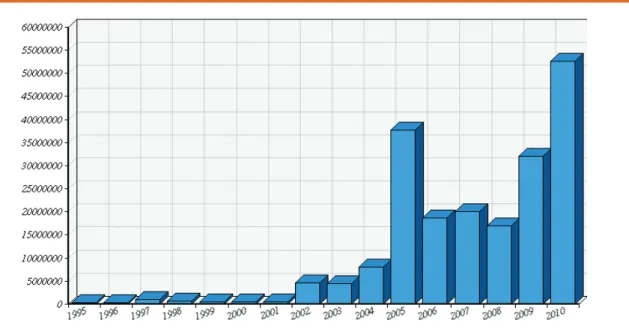
The following figure shows the evolution of the ABC’s budget from 1995 to 2010. One can see that from 2004 to 2005 there was a significant budget increase, from nearly US$ 8 million to US$ 37 million (Puente, 2010: 294). One explanation for this sudden increase was the fact that Brazil has been carrying out cooperation projects in Haiti, where it leads the UN peacekeeping mission, MINUSTAH, which began in 2004. In the following years the budget fell in relation to 2005 and increased again in 2009. Nevertheless, from the last year of Cardoso’s presidency (2002)22 and during the Lula administration, the amount of
resources allocated to the ABC increased significantly. Notice, however, that a study con-ducted by the ECOSOC and the OECD showed that in 2008 Brazil was only the eighth donor among developing countries, responsible for just 2.6% of the resources mobilized (apud Souza, 2012: 90).
Figure 1. ABC Budget (1995 – 2010), in R$
According to the ABC, from 2004, the Brazilian technical cooperation for develop-ment sought to strengthen Brazil’s relations with developing countries, supporting proj-ects that were national development priorities of recipient countries and those that had the involvement of local institutions, thus producing a greater impact and a multiplying effect on those countries (ABC, 2010, n.d.).
According to a report presented by the Ministry of Foreign Affairs (MRE), the num-ber of projects implemented by the ABC greatly increased during the Lula government. In 2003, the ABC had started 34 projects. In 2009, 96 projects were started (MRE, 2011, n.d.). Regarding the recipient countries, in 2009, 50% of the projects were implemented in African countries, 39% in countries of South and Central America and the Caribbean, and 11% in Asia and the Middle East. The main areas covered by these projects and activities were: agriculture (21.86%), health (16.28%), education (12.12%), environment (7.43%), and public safety (6.28%). The projects in the area of social development made up 5.31% of the initiatives (MRE, 2011, n.d.).23
Humanitarian Assistance in Lula’s Government
The Brazilian Ministry of Foreign Affairs defines international humanitarian assis-tance as:
Any action that contributes, in an immediate and effective way, to prevent, protect from, prepare for, reduce or alleviate suffering and to provide assistance to other countries or regions that are – temporarily or otherwise – in situations of emergency, public calamity, imminent or serious threat to life, to health, to the protection of human rights or the humanitarian rights of its population (MRE, 2010).
In Lula’s government, Brazilian humanitarian assistance went through a growing process of institutionalization and there was great concern for its operation. This took place after the creation of the General Coordination for International Action Against Hunger (CGFOME), linked to the Office of the General Secretary of the Ministry of For-eign Affairs by Decree No. 4759, of June 21, 2003. According to the General Coordinator of CGFOME, Minister Milton Rondó Filho, CGFOME was created to be the “external interface” of the Zero Hunger Programme24, providing humanitarian assistance and
emer-gency actions on food security.25
Moreover, the Inter-Ministerial Working Group on Humanitarian Assistance (GTIA-HI) was created by a decree published on June 21, 2006 in order to coordinate the efforts of Brazilian international humanitarian aid and to formulate a bill that would permanently authorize the donation of food, medicine and other items from Brazilian public stocks to international humanitarian actions. Thus, on April 17, 2007 bill nº 73726 was presented
for this purpose, as these donations were being sent by means of Provisory Measures27,
which authorized the shipments. In addition, in 2009, the first humanitarian warehouse in Brazil, at the International Airport of Rio de Janeiro, was set up with the aim of expediting humanitarian assistance.
Humanitarian assistance, as well as other actions comprising the “humanistic” and “solidarity-based” trend of Brazilian foreign policy, divides opinion within the country. The Observatory of the Metropolises, in partnership with other national and international organizations, conducted a survey in major metropolitan areas of Brazil to understand the exercise of citizenship in these regions. The survey was also conducted in six other countries: Canada, the United States, France, Sweden, Spain and Portugal. In it, respond-ents were asked about the importance of “helping people around the world who live in precarious situations”. The indicator varies from zero to seven (seven = Very important; zero = Not important at all) and Brazil came first in the ranking, with an average of 6.23, followed by Spain, Portugal, Canada and Sweden (Azevedo; Santos; Ribeiro, 2009: 353). Since only 43% of the Brazilian population lives in metropolitan areas, the results cannot be extrapolated to the whole population. Nevertheless, they suggest strong internal sup-port for the “humanistic” and “solidarity-based” foreign policy actions. On the other hand, according to Milton Rondó Filho, coordinator of CGFOME, the opposition parties have been against the approval of Bill 737/2007. This controversy is illustrated by the declara-tion of separate voting by Deputy Fernando Coruja (PPS – Socialist Popular Party):
The initiative was also subject to pressure from other leftist parties. Heloísa Helena, then Senator for the Socialism and Freedom Party (PSOL), made a speech in 2004 criti-cizing giving humanitarian assistance to other countries instead of providing aid to needy states in Brazil:
I appeal once again to humanitarian aid for the Brazilian states that suf-fer emergencies and floods. Of course, I have much sympathy for the people of Africa, the Arab World and Latin America. There is no problem with that. I just want humanitarian aid to also be provided to Brazil. A government that throws in the mud of speculation 70% of the public budget, that chooses to fill bankers’ bellies while emptying the plates, jobs and dignity of the Brazilian people has no moral authority to demand humanitarian aid, saying that someone in this House was against it. No one is against it. Lies! [...]. Solidarity with others, yes, but also solidarity with the Brazilian people!” (Senado Federal, 2004).
The humanitarian assistance provided by Brazil during the Lula administration con-sisted of donations in kind (food, medicine and general items), sending in Brazilian profes-sionals to help28, cash donations29 and participation in multilateral dialogues on
humani-tarian assistance.30 The funds for international humanitarian assistance are authorized by
the Annual Budget Law (LOA), under the responsibility of the Ministry of Foreign Affairs (MRE). In 2010, the international humanitarian assistance budget was R$50 million. Ac-cording to a study by the Institute for Applied Economic Research (IPEA) and the ABC, Latin American and Caribbean countries received 76.27% of Brazilian humanitarian aid between 2005 and 2009. The Asian continent received 16.44% and Africa received 7.26% of these resources. Oceania received 0.02% of the Brazilian aid during that period (IPEA and ABC, 2010).
Financial Cooperation
This policy has also generated controversy. There are many questions regarding whether or not Brazil should have cancelled some of these countries’ debts. In September 2004, Deputy Antonio Carlos Mendes Thame, from the Brazilian Social Democracy Party, presented Bill No. 4128, which required the Executive to obtain specific and express per-mission from Congress to relieve debt. As justification, the deputy argued:
Despite the merits of the announced motivation for such international acts (solidarity), we agree with the chairman of the Federal Bar Association of Brazil, who has publicly declared that he did not find any device in the Federal Consti-tution that gives powers to the Brazilian President to unilaterally forgive debts or make donations with public money to other countries (Thame, 2004).
The bill was in process until 2010, when it was declared unconstitutional by means of a report by the Committee on Constitution, Justice and Citizenship (CCJC) of the National Congress (Congresso Nacional, 2010).
In addition to debt relief, Lula proposed the creation of the “Action against Hunger and Poverty” programme in 2004, an attempt to diversify the international agenda. This action was supported by Heads of Government such as Jacques Chirac (France), Ricardo Lagos (Chile) and José Luís Zapatero (Spain), as well as UN Secretary-General Kofi An-nan. The unprecedented nature of this initiative was the fact that it proposed to create and implement innovative financing mechanisms able to finance actions to eradicate hunger and poverty. In 2006, the proposal evolved into a pilot project and UNITAID, a central medicine purchasing facility at the headquarters of the World Health Organization, fund-ed by a solidarity tax on airline tickets, was creatfund-ed.
In the next section we will present the intragovernmental coordination efforts put into practice for implementing technical cooperation and international humanitarian as-sistance, highlighting the most relevant actors involved at the domestic level.
Intragovernmental Coordination for the implementation
of South-South Technical Cooperation and International
Humanitarian Assistance
dominance of the Executive in Brazilian foreign policy; the fact that Brazilian legislators delegated responsibility for its formulation to the Executive;31 the country’s international
isolation, which was also an outcome of adopting the development model through import substitution; and the traditional “non-conflictive” practice of Brazilian diplomacy (Faria, 2008: 81).
However, the Itamaraty’s insulation has become less pronounced since the country’s redemocratization in 1985 and after the economic liberalization that took place in the be-ginning of the 1990s, which led to the appearance of new stakeholders who tend to achieve greater influence on foreign policy decisions, in a context of the emergence of new internal distributional conflicts (LIMA, 2000). This trend highlights the increasing politicization of foreign policy in Brazil, reducing the monopoly of foreign policy production by the Min-istry of Foreign Affairs (Faria, 2012), which also reflects the expansion and diversification of the country’s international agenda. In this sense, new governmental actors have also come into play, and the participation of other ministries besides the MRE has become re-current. Silva et al. (2010) have pointed out that this process of “public fragmentation of diplomacy” provides an increase in the bureaucratic spaces of foreign policy formulation and a greater dialogue with society.
The study of the current institutional arrangement of Brazilian foreign policy under-taken by the aforementioned authors demonstrated that today’s competence regarding the production of foreign policy in Brazil is shared by the entire structure of the federal ex-ecutive branch. Almost all ministries have a structure for international affairs. Moreover, this “horizontal decentralization” can be observed both during the decision/formulation and the implementation phases (Silva et al., 2010). In the next subsection, the activities undertaken by the various ministries and governmental agencies mobilized to put the solidarity-based foreign policy into practice will be analysed in the context of technical cooperation and international humanitarian assistance. Financial cooperation with less developed countries involves a much smaller number of governmental agencies, demand-ing an implementation structure that is not so complex, this bedemand-ing the reason for which it will not be further discussed in this paper.
Intragovernmental Coordination for the implementation
of South-South Technical Cooperation
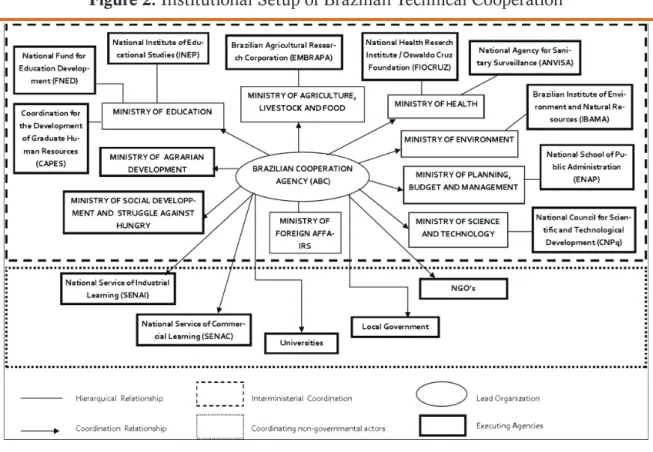
institutions, which, in most cases, act as executors and are fundamental to implementing many of the actions.
It is estimated that more than 120 national institutions are involved in delivering technical cooperation. These include ministries, departments, foundations, universities, private companies, NGOs, and various sub-national entities (Ayllón and Leite, 2010).
The network of agencies and organizations that deliver Brazil’s technical cooper-ation is coordinated by the ABC. According to Decree nº 7304 of September 22, 2010, the Agency has the primary function of coordinating cooperation activities, but it is also responsible for negotiating, monitoring, evaluating, planning etc. However, it seldom acts as a direct executor of cooperation projects (BRASIL, 2010b).
Figure 2 shows the institutional design of the Brazilian technical cooperation, as well as the intragovernmental network mobilized for its implementation. It depicts the main ministries and executing agencies of technical cooperation. Among them, the Brazilian Agricultural Research Corporation (EMBRAPA) stands out. Its expertise in the area of tropical agriculture enables the transfer of its technology to developing countries. Accord-ing to Ayllón and Leite (2010), the company has technical cooperation agreements with more than 50 countries and runs 65% of the ABC projects in the area of tropical agricul-ture. An EMBRAPA regional office was recently opened in Ghana.
In the area of public health, the Ministry of Health (MS) plays a central role. In 2010, through Ordinance nº 2356, the MS created the Working Group on International Cooperation on Health to strengthen and expand the connection and coordination of the Ministry’s partnerships with others actors. Projects to support the structuring of nation-al programmes to prevent and cure diseases like HIV/Aids are worthy of note, as is the implementation of human milk banks and support for the production of medicines in col-laboration with the Oswaldo Cruz Foundation (FIOCRUZ), which recently established a branch in Mozambique (Farani, 2009).32
Another form of Brazilian technical cooperation is the transfer of methodology of some of the social policies considered most successful in the Lula government. The Minis-try of Social Development and Fight against Hunger (MDS) is significantly involved in de-veloping technical cooperation with dede-veloping countries, as some of these social policies fall under its responsibility.33 Until 2010, the MDS had signed 62 international cooperation
Figure 2: Institutional Setup of Brazilian Technical Cooperation
Source: Author’s elaboration
In the area of professional qualification, there is the involvement of institutions such as the National Service for Commercial Learning (SENAC) and the National Service for Indus-trial Learning (SENAI). The latter has projects for restructuring education systems and for creating professional training centres in Portuguese-speaking countries (Angola, Cape Verde, Guinea-Bissau, East Timor) and Latin America (Paraguay and Colombia) (SENAI, n.d.).
In the area of education, Brazil transfers the methodology from the National School Food Programme (PNAE), which operates under the control of the National Fund for Ed-ucational Development (FNDE). In 2010, thirteen countries kept cooperative agreements with the Fund (FNDE, 2010). Furthermore, in this same area, there is the project the NGO Solidarity in Literacy (Alfasol) has with the ABC, providing training for teachers and technical staff in basic literacy and education for young people and adults in Cape Verde (Alfabetização Solidária, 2009).
Intragovernmental Coordination for the Implementation of
Brazilian International Humanitarian Assistance
Assistance (GTIAHI). The Brazilian system of international humanitarian assistance in-cludes a set of activities developed by a series of ministries and federal government agen-cies.34 Figure 3 shows the actors involved in the provision of humanitarian assistance, as
well as their mode of participation.
Figure 3: Institutional Setup of Brazilian International Humanitarian Aid
Source: author’s elaboration
The National Supply Company (CONAB) – linked to the Ministry of Agriculture, Livestock and Supply – has an important role in international humanitarian assistance. Its general function is to manage the outflow of the national harvest, to build public stocks and to sell them according to market movements (CONAB, 2010). The role of the CONAB in international humanitarian aid is to act in the purchase of food, storage and distribu-tion logistics. Between 2004 and March 2007, it allocated nearly 220 tonnes of food for humanitarian assistance (CONAB, 2007: 5).
coordination and technical supervision of the National System of Civil Defence (SIN-DEC), and seeks to build preventative rescue, and recuperative care; to prevent disasters; and to minimize their impacts on the population. It is responsible for the humanitarian as-sistance provided by Brazil (BRASIL, 2010a) and operates internationally, donating items to countries affected by conflict or natural disasters; sending in trained professionals; and representing Brazil in multilateral dialogue forums dedicated to humanitarian assistance, such as the Global Platform for Disaster Reduction in 2009.
In addition, we should mention the Cabinet of Institutional Security (GSI), linked to the Presidency. Its function, among others, is to prevent the occurrence of crises and coordinate their management (GSI, n.d.). In international humanitarian assistance, its role is to liaise with other agencies to provide the logistics of assistance. In January 2010, the Office gave support to victims of the earthquakes in Chile and Haiti (Aguilar, 2012).
The role of the Ministry of Agrarian Development (MDA) and the Ministry of Social Development and Fight against Hunger (MDS) in international humanitarian assistance manifests mainly through the Food Acquisition Programme (PAA).35 They carry out the
donation of food coming from government stocks and bought from family farmers.
This brief mapping of programmes, projects, activities and priorities that make the “humanistic” and “solidarity-based” foreign policy of the Lula administration concrete al-lows us to understand its domestic operation. The creation of the General Coordination of International Actions Against Hunger (CGFOME), linked to the Itamaraty, the significant increase in both the number of projects and budget of the Brazilian Cooperation Agen-cy (ABC) and the greater institutionalization of international humanitarian assistance, through the creation of the Interministerial Working Group for International Humani-tarian Assistance (GTIAHI), are some of the ways in which the rhetoric of international solidarity has been translated into practice.
Additionally, improving the accountability of these policies is essential, as it helps to ensure transparency and legitimacy. The importance of accountability becomes even greater as these actions are not free from controversy. As we have seen, assistance provid-ed to other countries from the South, in the form of technical or humanitarian assistance, can and has in fact been regarded as incompatible with the social obstacles Brazil still faces.
Concluding Remarks
In order to discuss the theory and practice of the humanistic trend in Brazilian for-eign policy under Lula (2003-2010), we have used different sorts of arguments (related to three levels of analysis – the individual, the state and the international, both regionally and globally) and stressed the relevance of various actors (politicians, bureaucrats, political parties and domestic and international institutions). In order to provide more than the panoramic view that we have given here, it would be necessary to touch not only on Inter-national Relations Theory, but also on Political Science, History, Public Administration, Political Psychology and Sociology of Organizations. After all, foreign policy analysis is a multidisciplinary field almost by definition.36
So, what has been the actual impact of this innovation in Brazilian foreign policy, also considering that its scope was not restricted to the national level? One could say that new institutions and social programmes were created and that old ones were strength-ened; that it helped to give Brazil a special place on the world stage, an outstanding one, according to many; that it mobilized actors and institutions at home and abroad; that it helped change the international agenda; and that it promoted social improvement. Its sole impact on poverty and hunger alleviation is certainly very difficult to measure. It is there-fore not absurd to say that its most visible impact, at least from the viewpoint of 2013, has been essentially political.
In a recent seminar promoted by Perseu Abramo Foundation, an official PT think
tank, Garcia said that Latin American integration “needs to be different”, that “we need
a solidarity-based integration”. “We Brazilians do not want to be Latin American
Germa-ny.”37 And there are several other indications of policy continuity.
Dilma Rousseff’s government seems to preserve the foreign policy innovation it
in-herited from the previous president, a policy orientation that does not reflect international
altruism, but an international posture of “enlightened self-interest”, according to Lima’s
(2005b) sympathetic suggestion. However, if such a standing results in Brazil becoming a
“post-imperial power”, as Brazilian leftist media has suggested, it is a possibility that will
probably make entrenched realists smile and change the subject. An “offensive realist”
might not react so politely… Be that as it may, Brazil has already been labelled “the soft
power great power” (Dauvergne and Farias, 2012: 913).
Revised by Priscila Moura
Submitted in August 2012
Accepted in June 2013
References
AGÊNCIA BRASILEIRA DE COOPERAÇÃO. CGPD - Coordenação Geral de Cooperação Técnica entre Países em Desenvolvimento. <http://www.abc.gov.br/abc/coordenacoesCGPDIntroducao. asp> (accessed November 10, 2010).
AGÊNCIA BRASILEIRA DE COOPERAÇÃO. (n.d.), Projetos de Cooperação Sul-Sul. <http:// www.abc.gov.br/projetos/cooperacaoPrestada.asp> (accessed September 12, 2010).
AGUILAR, Sérgio. (2012), Emerging powers, humanitarian assistance and foreign policy: the case of Brazil during earthquake crisis in Haiti. International Journal of Humanities and Social Science, vol.2, nº 16, pp. 93-101.
ALEXANDRE, Cristina Vieira Machado. (2006), O Congresso Brasileiro e a Política Externa: 1985-2005. (Master Dissertation, International Relations Institute, Pontifical Catholic University of Rio de Janeiro,PUC-Rio.
ALFABETIZAÇÃO SOLIDÁRIA. (2009), Alfabetização Solidária, 13 anos: percursos e parcerias. <http://www.alfabetizacao.org.br/aapas_site/adm/file/publicacao/201001281628_
ALMEIDA, Paulo Roberto de. (2004), Uma política externa engajada: a diplomacia do governo Lula. Revista Brasileira de Política Internacional, vol.47, nº 1, pp.162-184.
ALMEIDA, Paulo Roberto de. (2005), Uma nova arquitetura diplomática? Interpretações divergentes sobre a política externa do governo Lula (2003-2006). Revista Brasileira de Política Internacional, vol. 49, nº 1, pp. 95-116.
ALMEIDA, Helga do Nascimento de. (2013), O Congresso e a política externa: um estudo sobre a Câmara dos Deputados brasileira no governo Lula. (Master Dissertation, Political Science, Federal University of Minas Gerais, UFMG.
AMORIM, Celso. (2010), Sempre digo que Pelé só teve um; igual a Lula não vai ter. Folha de São
Paulo –online version. 15/11/2010. Entrevista concedida a Eliane Cantanhêde. <http://www1. folha.uol.com.br/poder/830614-celso-amorim-sempre-digo-que-pele-so-teve-um-igual-a-lula-nao-vai-ter.shtml> (accessed November 19, 2010).
ANDERSON, Perry. (2011), Lula’s Brazil. London Review of Books, vol.33, nº 7, pp. 3-12.
AYLLÓN, Bruno and LEITE, Iara Costa. (2010), La cooperación Sur-Sur de Brasil: ¿Instrumento de política exterior y/o manifestación de solidaridad internacional? Mural Internacional, ano
1, nº 1.
AZEVEDO, Sérgio de; SANTOS Jr., Orlando Alves; RIBEIRO, Luiz César de Queiroz. (2009), Metrópoles, cultura política e cidadania no Brasil. Cadernos Metrópole, vol.11, nº 22, pp.
347-366.
BRASIL. (2003), Decreto nº 4.759 de 21 de junho de 2003. Aprova a Estrutura Regimental e o Quadro Demonstrativo dos Cargos em Comissão e das Funções Gratificadas do Ministério das Relações Exteriores, e dá outras providências. <http://www.planalto.gov.br/ccivil_03/ decreto/2003/D4759.htm>
BRASIL. (2010a), Decreto nº 7.257 de 04 de agosto de 2010. Regulamenta a Medida Provisória no
494 de 2 de julho de 2010, para dispor sobre o Sistema Nacional de Defesa Civil - SINDEC, sobre o reconhecimento de situação de emergência e estado de calamidade pública, sobre as transferências de recursos para ações de socorro, assistência às vítimas, restabelecimento de serviços essenciais e reconstrução nas áreas atingidas por desastre, e dá outras providências. < http://www.planalto.gov.br/ccivil_03/_Ato2007-2010/2010/Decreto/D7257.htm> .
BRASIL. (2010b), Decreto nº 7.304 de 22 de setembro de 2010. Aprova a Estrutura Regimental e o Quadro Demonstrativo dos Cargos em Comissão e das Funções Gratificadas do Ministério das Relações Exteriores, e dá outras providências. <http://www.planalto.gov.br/ccivil_03/_ Ato2007-2010/2010/Decreto/D7304.htm#art6>.
BURGES, Sean W. (2005), Auto-estima in Brazil. The logic of Lula’s south-south foreign policy.
International Journal, Autumn, pp.1133-1151.
BURGES, Sean W. (2007), Building a Global Southern Coalition: the competing approaches of Brazil´s Lula and Venezuela’s Chávez. Third World Quarterly, vol.28, nº7, pp.1343-1358.
CHEIBUB, Zairo B. (1985), Diplomacia e Construção Institucional: o Itamaraty em uma perspectiva histórica. Dados, vol. 28, nº1, pp. 113-131.
COMPANHIA NACIONAL DE ABASTECIMENTO. A CONAB e a Assistência Humanitária Internacional. Mar. 2007. <http://www.assistenciahumanitaria.mre.gov.br/documentos/ CONAB.pdf> (accessed February 19, 2010).
COMPANHIA NACIONAL DE ABASTECIMENTO (2010), Quem Somos. <http://www.conab. gov.br/conteudos.php?a=11&t=>
DANESE, Sérgio França. (1999), Diplomacia Presidencial: História e Crítica. Rio de Janeiro:
Topbooks.
DAUVERGNE, Peter and FARIAS, Déborah B. (2012), The rise of Brazil as a global development power. Third World Quarterly, vol. 33, nº5, pp. 903-917.
DINIZ, Simone and RIBEIRO, Cláudio Oliveira. (2008), The role of the Brazilian Congress in foreign policy: an empirical contribution to the debate. Brazilian Political Science Review,
vol.2, nº2, pp.10-38.
FARANI, Marco (2010). Agência Brasileira de Cooperação. In: Seminário Brasil e China na África: Desafios da Cooperação para o Desenvolvimento. Brasília, Jun. 9, 2010. 27 slides: PowerPoint. <http://www.cebri.com.br/midia/documentos/minmarcofaranichinanaafrica972003.pdf> (accessed November 10, 2010).
FARANI, Marco. (2009), Cooperação Sul-Sul. Boletim da Atuação Internacional Brasileira em Saúde, Ministério da Saúde, nº1, outubro, pp. 6-6.
FARIA, Carlos Aurélio Pimenta de. (2008), Opinião pública e política externa: insulamento, politização e reforma na produção da política exterior do Brasil. Revista Brasileira de Política Internacional, vol.51, nº 2, pp. 80-97.
FARIA, Carlos Aurélio Pimenta de. (2012), O Itamaraty e a política externa brasileira: do insulamento à busca de coordenação dos atores governamentais e de cooperação com os agentes societários. Contexto Internacional, vol. 34, nº 1, pp.311-355.
FUNDO NACIONAL DE DESENVOLVIMENTO DA EDUCAÇÃO. (2010), Nações Unidas conhece alimentação escolar brasileira. <http://www.fnde.gov.br/fnde/sala-de-imprensa/ noticias/item/1926-nações-unidas-conhece-alimentação-escolar-brasileira>. (Accessed June 5, 2011).
GABINETE DE SEGURANÇA INSTITUCIONAL DA PRESIDÊNCIA DA REPÚBLICA. (n.d.), Sobre o Gabinete de Segurança Institucional. <http://www.gsi.gov.br/sobre>. (Accessed November16, 2010).
HUDSON, Valerie M. (2007), Foreign policy analysis: classic and contemporary theory. Maryland,
Rowman & Littlefield Publishers.
HURRELL, Andrew (2008), Lula’s Brazil: a Rising Power, but Going Where? Current History,
February, pp. 51-57.
LIMA, Maria Regina Soares (2000), Instituições democráticas e política exterior. Contexto Internacional, vol. 22, nº 2, pp. 265-303.
LIMA, Maria Regina Soares. (2005a), Aspiração internacional e política externa. Revista Brasileira de Comércio Exterior, vol.19, nº 82, 2005, pp. 4-19.
LIMA, Maria Regina Soares. (2005b), Autonomia, não-indiferença e pragmatismo: vetores conceituais da política exterior. Revista Brasileira de Comércio Exterior, nº 83, pp. 16-20.
LIMA, Maria Regina Soares de and HIRST, Mônica. (2006), Brazil as an intermediate state and regional power: action, choice and responsibilities. International Affairs, vol. 82, nº 1, pp. 21-40.
LIMA, Maria Regina Soares de and SANTOS, Fabiano. (2001), O Congresso e a política de comércio exterior. Lua Nova, nº 52, pp. 121-149.
MINISTÉRIO DAS RELAÇÕES EXTERIORES (2010). Assistência humanitária. <http:// www.itamaraty.gov.br/temas/acao-contra-a-fome-e-assistenciahumanitaria/assistencia-humanitaria/view> (accessed November10, 2010).
MINISTÉRIO DAS RELAÇÕES EXTERIORES. (n.d.), Balanço de Política Externa 2003/2010. 7.1.1 Anexo – Cooperação Internacional. Cooperação bilateral prestada. <http://www. itamaraty.gov.br/temas/balanco-de-politica-externa-2003-2010/7.1.1-anexo-cooperacao-internacional.-cooperacao-bilateral-prestada/view>. (accessed May 28, 2011).
MINISTÉRIO DO DESENVOLVIMENTO AGRÁRIO. (n.d.), Secretaria da Agricultura Familiar. Programas – Programa de Aquisição de Alimentos (PAA). < http://portal.mda.gov.br/portal/ saf/programas/paa>. (Accessed November10, 2010)
MINISTÉRIO DO DESENVOLVIMENTO SOCIAL E COMBATE À FOME. (n.d.), Fome Zero – O que é. < http://www.fomezero.gov.br/o-que-e>. (Accessed June 5, 2011).
MINISTÉRIO DO DESENVOLVIMENTO SOCIAL E COMBATE Á FOME (2010). Sobre o Ministério. Relações Internacionais. <http://www.mds.gov.br/sobreoministerio/ relacoesinternacionais>. (Accessed December 2, 2010).
OBJETIVOS DE DESENVOLVIMENTO DO MILÊNIO. Relatório Nacional de Acompanhamento. Brasília, Ipea, 2010. <http://agencia.ipea.gov.br/images/stories/PDFs/100408_relatorioodm. pdf> (Accessed June 14, 2010).
PANIZZA, Francisco. (2006), La marea rosa. Análise de Conjuntura OPSA, nº8.
PINHEIRO, Letícia. (2009), Autores y Actores de la Política Exterior Brasileña. Foreign Affairs Latinoamérica, vol. 9, nº 2, pp.14-24.
PINHEIRO, Letícia and VEDOVELI, Paula. (2012), Caminhos Cruzados: Diplomatas e Acadêmicos na Construção do Campo de Estudos de Política Externa Brasileira. Revista Política Hoje, vol.
21, nº 1, pp. 211-254.
PUENTE, Carlos Alfonso Iglesias. (2010), A cooperação técnica horizontal brasileira como instrumento de política externa: a evolução da cooperação técnica com países em desenvolvimento (CTPD) no período 1995-2005. Brasília: FUNAG.
Simpósio de Pós-Graduação em Relações Internacionais do Programa Santiago Dantas. São Paulo, November 2011. <http://www.santiagodantassp.locaweb.com.br/br/simp/artigos2011/ leticia_ribas_carlos_faria.pdf> .
RICUPERO, Rubens. (2010), À sombra de Charles De Gaulle: uma diplomacia carismática e intransferível - A política externa do governo Luís Inácio Lula da Silva (2003-2010). Novos Estudos, nº 87, pp.35-58.
RIPLEY, Brian. (1993), Psychology, Foreign Policy, and International Relations Theory. Political Psychology, vol. 14, nº 3, pp. 403-416.
ROUQUIÉ, Alain (2008). “Brazil, a South American state among the key players”. Global insights.
<http://www.ciaonet.org/book/cup/0016215/f_0016215_13994.pdf. (Accessed April 10, 2012).
SENADO FEDERAL. (2004), Pronunciamento da Senadora Heloísa Helena. 30/11/2004. Portal Atividade Legislativa. <http://www.senado.gov.br/atividade/pronunciamento/detTexto. asp?t=350593>.
SENAI (2011). Cooperação Internacional. <http://www.senai.br/br/institucional/snai_coo. aspx>. (Accessed June 5, 2011).
SERVIÇO NACIONAL DE APRENDIZAGEM INDUSTRIAL. (n.d.), Cooperação Internacional. <http://www.senai.br/portal/br/institucional/snai_coo.aspx>.
SILVA, Michelle Morais de Sá. (2010), How did we get here? The Pathways of South-South Cooperation. Poverty in Focus, International Policy Centre for Inclusive Growth, nº 20. SILVA, Elaini Cristina Gonzaga da; SPÈCIE, Priscila; VITALE, Denise. (2010), Atual Arranjo
Institucional da Política Externa Brasileira. Texto para Discussão, Instituto de Pesquisa
Econômica Aplicada, nº 1489.
SPEKTOR, Matias. (2011), O regionalismo do Brasil. Plataforma democrática, Working Paper nº 16.
SOUTO MAIOR, Luiz A.P. (2004), Dois anos de presença soberana: uma reflexão sobre a política externa do governo Lula. Revista Cena Internacional, vol. 6, nº 2, pp. 53-72.
SOUZA, André de Mello e. (2012), A cooperação para o desenvolvimento Sul-Sul: os casos do Brasil, da Índia e da China. Boletim de Economia e Política Internacional, nº 9, pp. 89-99.
VIGEVANI, Tullo and CEPALUNI, Gabriel. (2007), A política externa de Lula da Silva: a estratégia da autonomia pela diversificação. Contexto Internacional, vol. 29, nº 2, pp. 273-335.
VILAS, Carlos M. (2005), La izquierda latinoamericana y el surgimento de regímenes nacional-populares. Nueva Sociedad, nº 197, pp. 84-99.
Notes
2 Notice that the labels and qualifications just quoted were formulated by diplomats, both retired and active (Almeida, Souto Maior and Ricupero), and by academic analysts (Vigevani and Cepaluni). Their contribution to the constitution of foreign policy as a field of study in Brazil was recently discussed by Pinheiro and Vedoveli, 2012.
3 Celso Amorim was also Minister of Foreign Affairs from June 1993 to December 1994, during Itamar Franco’s presidency.
4 This was the perception one may have had from reading the editorials of leading Brazilian newspapers during the presidential race of 2002 and during the first months of Lula’s presidency. 5 The pieces of discourse presented and discussed below were selected from public speeches
that focused on the country’s foreign policy made by both Lula and Amorim during their eight years in office (2003-2010). They can be found in the Brazilian Ministry of Foreign Affairs website, which attempts to make all official pronouncements available. They were all read and the quotations analysed in this paper were selected in order to achieve the objectives previously mentioned.
6 All speeches quoted in this section were retrieved from the Brazilian Ministry of Foreign Affairs website (http://www.itamaraty.gov.br/sala-de-imprensa). Downloaded on February 3, 2011. Authors’ translations.
7 30th FAO Regional Conference for Latin America and the Caribbean. Brasília, 04/16/2008. 8 Lula, World Summit on Food Security. Rome, 16/11/2009.
9 Lula, 4th IBSA Summit. Brasília, 15/04/2010.
10 Lula, Press conference on the Global Fund to Fight Poverty. Geneva, 30/01/2004. 11 Lula, World Bank Conference on the Fight against Poverty. Shanghai, 26/05/2004. 12 FAO 60th anniversary celebration. Rome, 17/10/2005.
13 National Conference on Food Security. Brasília, 26/10/2004.
14 Amorim, High-Level Seminar on Peacekeeping Operations. Brasília, 02/05/2007.
15 In May, 2010 Lula won the World Food Day Medal from the FAO and was declared “Global Champion in the Fight Against Hunger”. In the following year, he won the 2011 World Food Prize.
16 In the “Colloquy Brazil: Global Actor”, held in Paris on July 13, 2005, Lula said: “Given my own life story and political experience, it [the fight against hunger and poverty] is a personal priority”. The importance of political psychology to the development of Foreign Policy Analysis as a subfield of International Relations is discussed by Ripley (1993) and Hudson (2007). 17 It is important to note that Brazil’s real willingness to act as a regional paymaster is still a
controversial question among Brazilian foreign policy analysts, as evidence is contradictory. 18 It must be emphasised that the mapping that follows does not include all of the initiatives
involve many actors. As pointed out by Puente (2010), the cooperation activities developed by the ABC are poorly publicized, even within the Ministry of Foreign Affairs (MRE).
19 Source: Sistema Consular Integrado, Ministry of Foreign Affairs website, <http://dai-mre. serpro.gov.br/pesquisa_ato_bil>. Accessed April, 25 2012.
20 Technical cooperation is understood as a “[...] multidimensional process, which can be bilateral or multilateral in scope, regional or interregional in character. It should be held by and between governments and may count on the participation of public and private organizations. Although it is an initiative among developing countries, it should not dismiss the support of developed countries and international organizations in their implementation” (United Nations apud Puente, 2010: 78).
21 Brazilian agency responsible for international cooperation, linked to the Ministry of Foreign Affairs.
22 According to Puente, the recovery process of the ABC budget began in 2002, after the inclusion of ordinary resources for financing activities of horizontal cooperation. From 1998 to 2001, the agency’s budget came from unused resources in projects of other government agencies with the UNDP. These funds were very low and from 1999 to 2001, served only to cover the administrative costs and the conditionalities of received cooperation (Puente, 2010: 145-146). 23 For a very interesting comparison between Brazilian, Chinese and Indian South-South
development cooperation showing the distinctiveness of the Brazilian cooperation, see Souza, 2012.
24 The Zero Hunger Programme is a strategy driven by the federal government to ensure the right to adequate food to people with little access to it. It was the main social policy during Lula’s first term in office.
25 Interview recorded at CGFOME, in Brasília, on Oct. 7, 2010. 26 This Bill of Law is still pending at the Chamber of Deputies.
27 A “provisory measure” is a legal act in Brazil through which the president can enact “laws” without previous approval by the National Congress. There are two requirements for a “provisory measure” to be issued: the urgency and the relevance of the matter to be regulated. 28 For example, doctors, psychologists, coroners, military personnel and civil defence professionals,
among others.
29 These funds are used to pay for flights transporting items of humanitarian assistance, for the purchase of items in recipient countries and for voluntary contributions to UN offices and organizations involved in humanitarian assistance.
31 This argument of a supposed legislative delegation was originally developed by Lima and Santos (2001). More recently, the literature has emphasised the contribution made by the Brazilian legislative to the production of the country’s foreign policy (e.g: Alexandre, 2006; Diniz and Ribeiro, 2008; and Almeida, 2013).
32 Oswaldo Cruz Foundation is a Brazilian scientific institution for research and development in biomedicine.
33 E.g. the Zero Hunger Programme (promoting food security and nutrition), the “Bolsa Família” (a programme of income transfer, which benefits families in extreme poverty), the construction of cisterns (a receptacle for water, built to catch and store rainwater) etc.
34 The GTIAHI is coordinated by the CGFOME, linked to the MRE, and composed of the following agencies: Civil House; Ministry of Defence; Ministry of Justice, represented by the National Department of Public Security; Ministry of Finance, represented by the Internal Revenue Service; Ministry of Agriculture, Livestock and Supply, represented by the National Supply Company (CONAB); Ministry of Health, Ministry of Social Development and Fight against Hunger; Ministry of National Integration, represented by the National Civil Defence Agency; General Secretariat of the Presidency of Republic; Institutional Security Cabinet of the Presidency; Ministry of Education; Ministry of Agrarian Development; Ministry of Communications; and Special Secretariat for Human Rights.
35 “Created in 2003, the Food Acquisition Programme (PAA) is one of the actions of the Zero Hunger Programme and aims to ensure access to food in the necessary quantity and regularity for populations in situations of food and nutrition insecurity. It also aims to contribute to forming strategic stocks, allows family farmers to store their produce to be sold at fair prices and promotes social inclusion in rural areas. It is run by the Ministries of Agrarian Development (MDA) and Social Development and Fight against Hunger (MDS) with state and local governments and civil society organizations”(MDA, n.d.).
36 According to Valerie Hudson, “Explanatory variables from all levels of analysis, from the most micro to the most macro, are of interest to the analyst to the extent that they affect the decision making process. As a result, insights from many intellectual disciplines, such as Psychology, Sociology, Organizational Behaviour, Anthropology, Economics and so forth, will be useful for the foreign policy analyst in efforts to explain foreign policy decision making, making multi-/ interdisciplinarity a third hallmark of FPA [Foreign Policy Analysis]”. (2007, p.6).