Introduction
Compounds containing a chain with three nitrogen atoms, the triazenes, are largely described on the literature [1,2]. Among other uses, they were studied as chemotherapeutic agents. Triazenes and anionic triazenide ligands can show different types of coordination in metal complexes [1-5]. They can be monodentate, (N1,N3)-chelating towards one metal atom or (N1,N3)-bridging over two metal atoms.
Compounds containing two chains of three nitrogen atoms, the bistriazenes, are also known [6-14]. The possibilities of coordination are enhanced when two nitrogen chains are pres-ent on the ligand. Complexes of ortho-, meta- and
para-bis(phenyltriazene)benzenes ligands were synthesized and characterized. As expected, sev-eral different coordination types were observed. Bistriazenes show the coordination properties of triazenes and also the capacity to force close con-tacts between metal atoms.
Although the structure of complexes with bistriazene ligands have been described, no reports were found in the literature related to electrochemical properties of these compounds. These studies are important for characterization and to a better understanding of their reactivity, stability and possible applications.
The 1,2-bis(phenyltriazene)benzene ligand, C6H5NNN(H)C6H4NNN(H)C6H5, was used to syn-thesize the complex bis-(µ2
-oxo)-tetrakis{[1-43 Ecl. Quím., São Paulo, 33(3): 43-46, 2008
www.scielo.br/eq www.ecletica.iq.unesp.br
Volume 33, número 3, 2008
Electrochemical properties of Cu
4[PhN
3C
6H
4N
3(H)Ph]
4(
µ
-O)
2, a tetranuclear Copper(II) complex with
1-phenyltri-azenido-2-phenyltriazene-benzene as ligand
A. Hermann1, L. S. Silva1, C. R. M. Peixoto1*, A. B. de Oliveira2, J. Bordinhão3and M. Hörner2
1Departamento de Biologia e Química, Universidade Regional do Noroeste do Estado do Rio Grande do Sul (UNIJUI), Rua
do Comércio, 3000, Bairro Universitário, 98.700-000 Ijui, RS, Brazil
2Departamento de Química, Universidade Federal de Santa Maria (UFSM), Campus Universitário, 97.105-900 Santa
Maria, RS, Brazil
3Instituto de Química, Universidade Federal do Rio de Janeiro (UFRJ), Cidade Universitária CT Bloco A-641, 21945-970
Rio de Janeiro, RJ, Brazil
Abstract: Bis-(µ2-oxo)-tetrakis{[1-feniltriazene-1,3-diil)-2-(phenyltriazenil)benzene copper(II) is a tetranuclear complex which shows four Cu(II) ions coordinated by four 1,2-bis(phenyltriazene)ben-zene bridged ligands, with one diazoaminic deprotonated chain, and two O2-ligands. The complex reduces at E1/2= -0.95 V vs Fc+/Fc, a two electrons process. Cyclic voltammetric and spectroelectro-chemical studies showed a reversible process. When immobilized on carbon paste electrode, the com-plex electrocatalyses the reduction of O2dissolved on aqueous solution at –0.3 VvsSCE potential. The obtained current shows linearity with O2concentration.
Keywords: copper(II) complex; 1,2-bis(phenyltriazene)benzene ligand; spectroelectrochemical charac-terization; electrochemical sensor, oxygen reduction.
L-1. Ferrocene (Merck) 1 mmol L-1was added to the Cu4L4solution in the final of the experiment of cyclic voltammetry in tetrahydrofuran medium to use its potential of oxidation as an internal poten-tial standard.
For oxygen reduction reaction studies, a carbon paste electrode was constructed by mixing 20 mg of graphite powder (Merck), 5 mg of Cu4L4 complex and one drop of mineral oil (Nujol). For electrochemical measurements, aqueous solution, at pH 4.5, containing potassium chloride (Reagen) 1 mol L-1 as supporting electrolyte, was used. Dissolved oxygen concentration was controlled by bubbling N2or atmospheric air. Oxygen concentra-tions were determined by Winkler method [15].
Results and discussion
Electrochemical characterization
The cyclic voltammogram of Cu4L4 com-plex is represented in Fig. 1a. It was observed a reversible reduction process at E1/2= –0.95 Vvs
Fc+/Fc. In the cyclic voltammogram of the free ligand 1,2-bis(phenyltriazene)benzene no redox process occurs at this potential, indicating that this is due to copper(II) ions (Figure 1b).
Two electrons transfer was determined by controlled potential electrolyses. As there are four copper(II) ions, it may occur the process Cu(II)4 Cu(II)2Cu(I)2, with localization of the two electrons in two copper ions, or delocalization of them around the copper tetramer.
phenyltriazene-1,3-diil)-2-(phenyltriazenil)benzene copper(II), Cu4[PhN3C6H4N3(H)Ph]4(µ2-O)2, (which will be represented by Cu4L4). This mole-cule is formed by a tetramer of four copper(II) ions and four 1-phenyltriazenido-2-phenyltriazene ben-zene anions, [C6H5NNNC6H4NNN(H)C6H5]-. Each ligand chelates one metal ion by the deproto-nated N3chain and coordinates monodentate to the neighboring one, using the protonated N3 chain. The p-oxo ligands occupy the twofold axis and bridge two opposite edges of the Cu4tetrahedron. The crystal structure of this complex was deter-mined by X-Ray crystallography and was described elsewhere [12].
The objective of this work was the char-acterization of the electrochemical, spectroelec-trochemical and electrocatalytic properties of the Cu4L4 complex. For electrocatalytic studies the complex was incorporated on a carbon paste electrode, and used as electrocatalyst for the O2 reduction reaction in aqueous solution.
Experimental Synthesis
The ligand 1,2-bis(phenyltriazene)ben-zene and the complex Cu4L4 were prepared as described on the literature [12].
Electrochemical measurements
Cyclic voltammetry was carried out with a Microquímica instrument, consisting of a MQPG-01 potentiostat. A platinum disc and saturated calomel (SCE) were used as working and reference electrodes. A platinum sheet was used as the auxil-iary electrode. For controlled potential electroly-ses, cylindrical Pt grids were used as working and auxiliary electrodes and the potential was fixed at -0.4 Vvs SCE. For spectroelectrochemical meas-urements the Microquímica potentiostat was used in parallel with a Pharmacya Biotech, Ultrospec 2000 spectrophotometer. A three-electrode system was designed for a rectangular quartz cell of 0.03 cm internal path-length. A gold minigrid was used as a transparent working electrode, in the presence of a small saturated calomel reference and a plat-inum auxiliary electrode. Tetrahydrofuran P.A. (Vetec) was used as solvent and 0.1 mol L-1 tetra-butylammonium hexafluorophosphate (Sigma), as supporting electrolyte, in nitrogen atmosphere. The concentration of the Cu4L4 complex was 1 mmol
44 Ecl. Quím., São Paulo, 33(3): 43-46, 2008
Figure 1.Cyclic voltammogram of the 1 mmol L-1
Cu4L4complex (a) and 1 mmol L-11,2-
bis(phenyl-triazene)benzene ligand (b), in tetrahydrofuran, containing tetrabutylammonium hexafluorphos-phate 0.1 mol L-1at a scan rate of 100 mV s-1.
45 Ecl. Quím., São Paulo, 33(3): 43-46, 2008
Figure 2. Electronic spectra of 1 mmol L-1Cu 4L4at
0.5 V (a) and –1.0 V vs SCE (b) applied potentials, and of the ligand 1,2-bis(phenyltriazene)benzene (c) in tetrahydrofuran, containing tetrabutylammo-nium hexafluorphosphate 0.1 mol L-1.
Spectroelectrochemistry
The reversibility of the Cu4L4redox process was also observed by spectroelectrochemistry. The electronic spectrum of the ligand 1,2-bis(phenyltri-azene)benzene shows an intense band at 378 nm (ε=32120 mol-1L cm-1) (Fig. 2c) due to transitions in the triazene group [2,13,14]. In the complex this band appears at 388 nm (ε=33860 mol-1L cm-1) (Fig. 2a). The spectrum of the complex also shows a broad and low intense band in the 600-800 nm region, due to d-d transitions in the copper(II) ion [16]. The intensity of this band decreases and the band at 388 nm is shifted to 395 nm when the com-plex is reduced at –1.0 VvsSCE (Fig. 2b). When the complex is oxidized again at 0.5 VvsSCE the initial spectrum is observed (Fig. 2a), indicating that there was no decomposition of the reduced form.
Figure 3. Cyclic voltammogram of the Cu4L4 com-plex incorporated on a carbon paste electrode in aque-ous solution at N2atmosphere (a) and saturated with O2 (b), and of the carbon paste electrode without Cu4L4incorporated in O2saturated solution (c), con-taining KCl 1 mol L-1at a scan rate of 25 mV s-1.
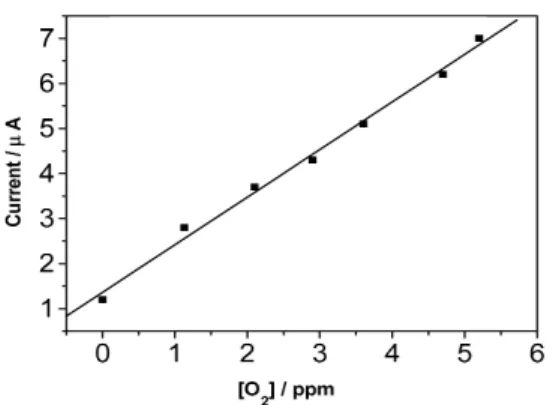
The current, obtained by chronoamper-ometry, for oxygen reduction at a fixed potential (-0.30 V vs SCE), is shown in Fig. 5. It was obtained a linear relationship with the concentra-tion of dissolved oxygen in aqueous soluconcentra-tion, represented by the equation I = 1.056[O2] + 1.365, with a linear correlation coefficient of 0.9967, for oxygen concentrations between 1.1 and 5.2 ppm. In accord with this result, it is pos-sible the use of this electrode as a sensor for O2 in aqueous solution. Due to the insolubility of Cu4L4in aqueous medium the electrode achieved high stability. It was used continuously and main-tained the response for at least 180 hours.
Oxygen reduction reaction
The Cu4L4complex incorporated on carbon paste electrode shows the reduction process at E1/2 = -0.17 VvsSCE (Fig. 3a). When oxygen was dis-solved in the aqueous solution, it was observed an increase in the cathodic and decrease in the anodic peak current (Fig. 3b), indicating electron transfer from reduced immobilized Cu4L4to dissolved O2.
In the Fig. 4 it is shown the intensity of the current observed for O2 reduction by Cu4L4 as a function of the applied potential, obtained by chronoamperometry. It is observed that the elec-trocatalytic process begins at -0.1 V, and the cur-rent increases until -0.3 VvsSCE. In the carbon paste electrode with no Cu4L4complex incorpo-rated the oxygen reduction begins only at -0.4 V.
Figure 4. Current for O2reduction by Cu4L4 com-plex incorporated in a carbon paste electrode as a function of the applied potential, obtained by chronoamperometry, in O2saturated aqueous solu-tion, containing KCl 1 mol L-1.
References
[1] D. S. Moore, S. D. Robinson, Adv. Inorg. Chem. Radiochem. 30 (1998) 1.
[2] T. Giraldi, T. A. Connors, G. Cartei, Triazenes. Chemical, Biological, and Clinical Aspects, Plenum Press, New York, 1990. [3] M. Hörner, G. M. Oliveira, L. C. Visentim, R. S. Cezar, Inorg. Chim. Acta 359 (2006) 4667.
[4] G. Ríos-Moreno, G. Aguirre, M. Parra-Hake, P. J. Walsh, Polyhedron 22 (2003) 563.
[5] J. G. Rodrıguez, M. Parra-Hake, G. Aguirre, F. Ortega, P. J. Walsh, Polyhedron 18 (1999) 3051.
[6] M. Hörner, G. M. Oliveira, J. S. Bonini, H. Fenner, J. Organomet. Chem. 691 (2006) 655.
[7] M. Hörner, G. M. Oliveira, J. S. Oliveira, W. M. Teles, C. A. L. Filgueiras, J. Beck, J. Organomet. Chem. 691 (2006) 251. [8] M. Horner, G. M. Oliveira, A. J. Bortoluzzi, Z. Anorg. Allg. Chem. 632 (2006) 537.
[9] M. Horner, D. M. Borchhardt, J. Daniels, J. Beck, Anal. Sci. 22 (2006) 129.
[10] M. Horner, J. Beck and A. B. Oliveira, Z. Anorg. Allg. Chem. 623 (1997) 65.
[11] M. Horner, A. G. Pedroso, C. R. M. Peixoto, J. Beck, Z. Naturforsch. B 45b (1990) 689.
[12] M. Hörner, J. Bordinhão, J. Beck, J. Strähle, Z. Anorg. All. Chem. 620 (1994) 107.
[13] X. L. He, Y. Q. Wang, K. Q. Ling, Talanta 72 (2007) 747. [14] E. C. Buruiana, V. Melinte, T. Buruiana, B. C. Simionescu, T. Lippert, L. Urech, Journal of Photochem. Photobiol. A: Chem. 186 (2007) 270.
[15] J. Mendham, R. C. Denney, J. D. Barnes, and M. J. K. Thomas, Vogel, Análise Química Quantitativa, Livros Técnicos e Científicos, Rio de Janeiro, RJ, Brazil, sixth ed., 2002, p. 243. [16] F. A. Cotton, G. Wilkinson, C. A. Murillo and M. Bochmann, Advanced Inorganic Chemistry, John Willey & Sons, Inc., New York, sixth. ed., 1999, p. 869.
46 Ecl. Quím., São Paulo, 33(3): 43-46, 2008
Figure 5. Current, obtained by chronoamperometry, at -0.3 V vs SCE, by the carbon paste electrode with Cu4L4complex incorporated as a function of oxygen concentration dissolved in aqueous solution, contain-ing KCl 1 mol L-1.
cal properties of a bistriazene complex. It was demonstrated the high capacity of the ligand to coordinate and to bridge metallic ions. The sta-bility of the tetramer formed by four copper(II) ions in the bis-(µ2 -oxo)-tetrakis{[1-phenyltri-azene-1,3-diil)-2-(phenyltriazenil)benzene cop-per(II) complex was not affected even after the reduction process, and this permitted the use of the complex as an electrocatalyst.
Acknowledgements
C.R.M.P. is indebted to FAPERGS. A. H. and L. S. S. are indebted to CNPq and to FAPERGS, respectively, for a fellowship. We apol-ogize to Prof. Dr Ademir Neves and Msc. Ademir dos Anjos of the UFSC for use of his laboratory and help in the coulometric measurements.
Received June 02 2008 Accepted August 14 2008
A. Hermann, L. S. Silva, C. R. M. Peixoto, A. B. de Oliveira, J. Bordinhão e M. Hörner. Propriedades eletroquímicas do Cu4[PhN3C6H4N3(H)Ph]4(µ-O)2, um complexo tetranuclear de Cobre (II) com o ligante 1-feniltriazenido-2-feniltriazeno-benzeno.
Resumo: Bis-(µ2-oxo)-tetrakis{[1-feniltriazeno-1,3-diil)-2-(feniltriazenil)benzeno cobre(II) é um complexo tetranuclear que apresenta quatro íons Cu(II) coordenados por quatro ligantes 1,2-bis(fenil-triazeno)benzeno em ponte, com uma cadeia diazoamínica desprotonada, e dois ligantes O2-. O com-plexo apresenta um processo de redução por dois elétrons a E1/2= -0,95 V vs Fc+/Fc. Voltametria cícli-ca e espectroeletroquímicícli-ca demonstraram um processo reversível. Quando imobilizado em eletrodo de pasta de carbono, o complexo eletrocatalisa a redução de O2dissolvido em solução aquosa a –0,3 Vvs
SCE. A corrente obtida apresenta linearidade com a concentração de O2.
Palavras-chave: complexo de cobre (II); ligante 1,2-bis(feniltriazeno)benzeno; espectroeletroquímica; redução de oxigênio.
Conclusions