DOI: http://dx.doi.org/10.1590/S1414-40772016000200007
Communication policies of Spanish universities targeting
prospective students: an evaluation by secondary schools
Marta Barandiaran Galdós Miren Barrenetxea Ayesta Antonio Cardona Rodríguez Ana Mª Martín Arroyuelos Juan José Mijangos del Campo Jon Olaskoaga Larrauri
Abstract: This paper presents an evaluation of the communication policies through which Spanish universities help to facilitate young people’s passage from secondary to higher education. The underlying data have been gathered through a survey conducted with guidance providers at a sample of Spanish secondary schools, as well as through a series of in-depth interviews involving these same teachers. The research has led to the conclusion that the career guidance tendered by secondary schools is provided within a setting of relative precariousness in terms of information: the teachers surveyed consider that the importance of the brieing content they receive always exceeds the quality of the manner in which this information is forthcoming. The developments in the design of new uni-versity qualiications and the criteria applied by Spain’s National Agency for Quality Assessment and Accreditation (ANECA) constitute a magniicent opportunity for improvement in this ield.
Key words: Communication policies. Higher education institutions.
Políticas de comunicação de universidades espanholas visando os futuros alunos: uma avaliação pelas escolas secundárias
Resumo:Este artigo apresenta uma avaliação das políticas de comunicação através do qual as universidades espanholas ajudam a facilitar a passagem dos jovens do secundário para o ensino superior. Os dados subjacentes foram recolhidos através de uma pesquisa realizada com os prestadores de orientação em uma amostra de escolas secundárias espanholas, bem como através de uma série de entrevistas em profundidade envolvendo esses mesmos professores. A investigação levou à conclusão de que a orientação de carreira oferecidas pelas escolas secundárias é fornecido dentro de um cenário de precariedade relativa em termos de informações: os professores inquiridos consideram que a importância do conteúdo instrução que recebem sempre excede a qualidade da maneira pela qual esta informação está próxima. Os desenvolvimentos na concepção de novos diplomas universitários e os critérios aplicados pela Agência Nacional da Espanha de Avaliação da Qualidade e Acreditação (ANECA) constituem uma magníica oportunidade para melhorias neste campo.
1 Introduction
The nature, structure and importance of the communication policies that Spanish universities use when addressing prospective students can be unders-tood only when these policies are interpreted as part of a broader and more complex mechanism: the guidance young people receive when passing from secondary to higher education.
Those of us who have studied at university know that the transition from
school to university or college is dificult and challenging, albeit ultimately rewarding. The clearest proof of this is the rate of irst-year drop-outs in hi -gher education, even in the most advanced and best funded university systems (GUERRA;RUEDA, 2005; RAUSCH; HAMILTON, 2006), and the means that certain universities are employing to unravel the reasons for this phenomenon (BRINKWORTH; MCCANN;NORDSTRÖM, 2008; EMBO, 2006;
RAUS-CH;HAMILTON, 2006) and reduce its impact (PEAT;DALZIEL;GRANT,
2000; TAYLOR, 2008).
A large slice of the literature on this matter, including that mentioned in the preceding paragraph, has detected or proven the relationship between early leaving amongst undergraduates and the scant guidance students have received (WILLCOXSON, 2010), which is the best justiication for the development of a holistic guidance system that is set in motion even before a young person goes to university in order to develop a general competence: the ability to decide upon an academic or professional career (GONZÁLEZ, 2009). In fact, the bulk of drop-outs occur amongst undergraduates who had unrealistic expectations
about work and life at university that would not be later fulilled (EMBO, 2006; RAUSCH;HAMILTON, 2006), or they made up their mind on which course to study excessively inluenced by family and friends, instead of reaching a
mature decision based on their own interests, skills and possibilities (GUERRA;
RUEDA, 2005; RAUSCH;HAMILTON, 2006). It is at this point that universi -ties’ communication policy has a vital role to play, helping university entrants to form a sound and measured opinion not only on what university can do for
them, but also on the sacriices they will have to make before they graduate,
thereby helping them to reach a decision on their academic and professional future that is conscious, rational and mature (GONZÁLEZ, 2009).
2 Background to the research and its objectives
In Spain, scholarly interest in guidance for university entrants is a recent
papers on the topic have delved into an explanation of the guidance role and
a description of the doctrinal options in the ield of guidance (RODRÍGUEZ; ÁLVAREZ; ECHEVERRÍA; MARÍN, 1993; RODRÍGUEZ, 1997); others have
sought to describe the functions and structures of university guidance services (ECHEVERRÍA, 1997; SALMERÓN, 2001; SÁNCHEZ; GUILLAMÓN,
2008; VIDAL; DÍEZ;VIEIRA, 2001); inally, other authors have focused on an evaluation of these services, either by providing speciic assessment crite -ria (VIEIRA, 2008) or by gathering opinions on university guidance services (SÁNCHEZ, 1998).
The research whose results are summarised in this paper embarks upon a
two-pronged line of approach: a) its aim is to assess, yet the evaluation is based on a highly speciic aspect of the part universities play in providing guidance,
namely, the communication policy targeting prospective students in order to
facilitate the transition from secondary to higher education; and b) this asses -sment is based on the opinions of one of the groups affected by this policy: the body of guidance providers or counselling teachers working at Spanish secondary schools.
This approach is explained by the fact that in Spain, the onus for providing guidance on the passage to university does not basically fall upon institutions of higher education, but instead on the schools themselves. There are various reasons for this situation, yet a prime conditioning factor is that, generally speaking, university guidance in Spain is relatively underdeveloped when compared to all the echelons of education (VIDAL et al., 2001). It is likely that,
in the future, the creation of the European Higher Education Area will help to develop guidance in higher education, and it may already be doing so. Never -theless, the current reality of guidance in Spain means that pupils in secondary
education receive the bulk of the information and guidance they require at the
schools where they are studying (GUERRA; RUEDA, 2005). However, these schools need to draw upon a wide range of information in order to perform this task, and as we have been able to verify during the course of this research, most of this information comes directly from the universities. This is the point that reveals the transcendence of universities’ communication policy: the part
they play in the passage of prospective students involves providing the brieing
material and the structural support to enable secondary schools to effectively undertake their advisory role.
3 Research design and methods
The data used to achieve the paper’s aims have been gathered directly from
has involved two complementary instruments, a questionnaire and a personal
interview, which have been applied to those teachers responsible for providing guidance.
The exploratory nature of the research means there is no ready-made ques -tionnaire applicable to this case that has been endorsed by previous research.
This has therefore required the preparation of an ad hoc questionnaire whose
design and content is the result of merging several sources. The main one is to
be found within the legal context: Spain’s Royal Decree 1393/2007, regulating oficial studies in higher education, which lays down that once the curricula have been drawn up, they are to be veriied, and for this purpose Spain’s National Agency for Quality Assessment and Accreditation (ANECA) has introduced
a number of protocols based on a series of criteria, some of which specify the information that Spanish universities are to provide to their present and future
students. Apart from the legal precepts, the questionnaire’s inal design is inde
-bted to the researchers’ expertise and background in the ield of communication
policy, backed by the opinions of an array of experts in teaching and guidance that were called upon to validate the draft.
The main body of the questionnaire, in its deinitive version, asks respondents
to use a scale ranging from “very low” to “very high” to rate the importance of
thirty brieing items classiied into six blocks.
The rest of the questionnaire requires the respondent to indicate the main source of the information on these brieing items, list the channels commonly
used accordingly, select the three deemed to be most effective and name the university that is considered to stand out from the rest in terms of
communica-tion policy. The quescommunica-tionnaire also includes several quescommunica-tions for identifying
the respondent.
The questionnaire was circulated between November 2008 and May 2009
via the internet, with this being the option of choice given its low cost, the speed in which the results were forthcoming and the facilities of the platform used regarding the tabulation of data. Use was made of a motivational letter, sent by
e-mail, from where a link provided access to the questionnaire.
The sample used consisted of 876 schools chosen from a database of 5,089
schools and colleges teaching formal secondary education (Bachillerato), upper
level occupational training (Formación Profesional de grado superior), plastic
arts and design (Artes Plásticas y Diseño) y and sports education (Enseñanzas Deportivas). The database was built up by combining the information on schools
and colleges from each one of Spain’s regions, the Autonomous Communities.
goal was set of a 95% conidence level with an error margin of no more than 5%, which meant the sample could not have fewer than 358 schools. Nonethe -less, the decision was taken to double the sample size in order to compensate for a foreseeably high rate of non-responses. Finally, the sample was extended
to include 876 schools so that certain Autonomous Communities would be
properly represented.
In the end, the number of answers in the ield work amounted to 275. The
high rate of non-responses means that no claim can be made for statistical
ac-curacy in the strictest sense. Nonetheless, the number of answers is suficiently
high for serious consideration to be given to the data gathered.
In addition to the questionnaire, the research used a complementary instru -ment: a personal interview with the teachers in 142 secondary schools, with 82 of these being face-to-face and the remainder held over the phone. The purpose of these interviews was to collect the views and opinions of the guidance provi-ders working at the schools, single out the most important items on their agenda and identify the underlying discourses at the schools. Accordingly, the sample’s
representativeness was not considered signiicant for this part of the ield work. Ultimately, the information gathered through these two methods, question -naire and interview, proved to be fully compatible.
4 Evaluation of university communication policies from the
perspective of secondary schools
Secondary schools are the preferred target for the brieing policies that uni -versities use for facilitating the transition from secondary to higher education,
as conirmed by prior research both into the design and operation of university services (SÁNCHEZ; GUILLAMÓN, 2008) and into the passage to higher education (GUERRA; RUEDA, 2005). Accordingly, the opinion secondary schools have on the quality and pertinence of the information they receive from
universities is deemed to be essential.
This section gathers the opinions of guidance providers in secondary edu-cation regarding the usual content of universities’ communiedu-cations policies
and on the quality of the manner in which that information is conveyed. The
section likewise reports on the channels through which the guidance providers
receive the information they require, and its serves to qualify their preferences
on this matter.
The interest of the results presented under this heading is twofold. On the one hand, the information it contains allows a diagnosis to be made of the
be of use to those universities seeking to adapt the content of their policies and the instruments they use in their application to the needs and preferences of their target audiences.
4.1 Perception of the relative importance to prospective students of universities’ communication policy
The irst conclusion that can be drawn from the answers provided by guidan
-ce providers on the relative importan-ce of the brieing content is that there is an
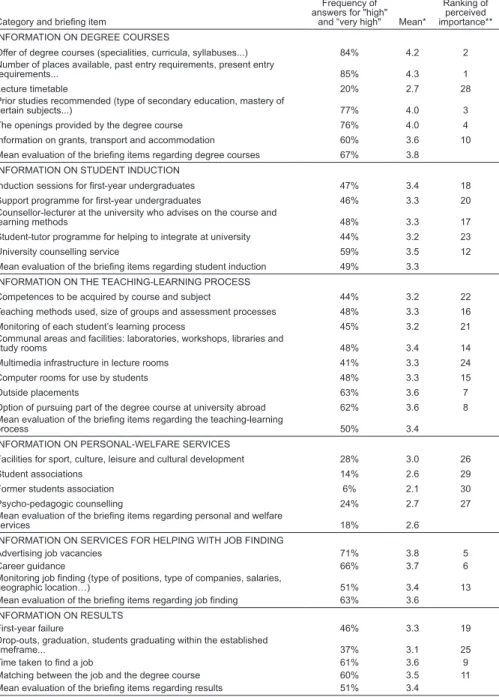
order of priority that ultimately places certain issues above others in terms of their importance to pupils. Those items linked to the offer of available courses are, for the guidance providers in the survey, the ones of greatest importance
to their pupils. In the ranking based on the relative frequencies of “high” and “very high” responses (table I), these items appear on ive occasions in the
top ten positions and receive an average evaluation that is clearly higher than the other categories. On a second level of importance there is the information
on the availability of mechanisms for helping graduates to ind a job. In third
place, secondary schools rate the information on results, although within this category the items given the greatest importance involve the job potential of each degree course, clearly of greater importance than academic results. The categories teaching-learning process and student induction generally receive
a similar evaluation from the guidance providers. Nonetheless, in both these categories the aspects that stand out from all the other brieing items are those
related to the openings universities provide for studying abroad or for
under-taking job placements. This issue will be addressed again in due course. Well
below all the other categories are “personal and welfare services”, to which only a minority of schools rate with a “high” or “very high” response.
The range of courses on offer is, as noted earlier, the star category, at least from the standpoint of the guidance providers and heads of study surveyed.
With the exception of information on lecture timetables, all the other brieing
content in this category is deemed to be important by a majority of those sur-veyed and is ranked in the top ten of content. This does not mean there are no
differences between the brieing items that make up this category. In general, it may be afirmed that, according to those surveyed, the conditions of access
to undergraduate courses and the actual range of courses available are the sine
qua non data that all universities should provide. This concern for the content of each university course (syllabus, nature, focus and dificulty of the sub
-jects) is understandable amongst those responsible for providing guidance in
the queries they receive from pupils and their parents refer precisely to such matters. Meanwhile, the entrance requirements (advised subjects of study) and graduation prospects (what the degree can be used for) are slightly down the
list in the order of preference for those surveyed. The personal interviews held with the guidance providers suggest they are not familiar with these concepts at secondary schools, or with the design of competency-based teaching.
The extent to which higher education opens the doors to employment for
graduates is, for those surveyed, the second brieing item in order of importance. This inding coincides with the opinions expressed by the guidance providers
and heads of study interviewed personally, who agree in pointing out that both pupils and their parents are concerned about the openings provided by degree
courses. According to these data, pupils are more interested in inding out about the mechanisms the university will use in the future to help them ind a job than
those used to monitor its graduates.
The importance given to the brieing items on the teaching-learning process
also follows a pattern: greater importance is given to those aspects peripheral to new teaching methodologies than to the actual methods themselves. The possibility of studying abroad and job placements are accessory considerations in the methodological overhaul that is taking place in Spanish higher education. From this it is deduced that, if they are valued, it is more because they generate immediate possibilities that are attractive to prospective students, associated either with their academic experience or with their access to the labour market, than for the role they play in the actual learning process.
All the brieing content on student induction is considered important by around half of the schools surveyed. This category does not record signiicant
differences between the various induction mechanisms, although it may be of interest to note that the schools consider the information on the existence and operations of the university guidance service (Servicio de Orientación
Uni-versitaria) to be more important than any other in this category (59% of those surveyed coincide in stating that this information is important or very important),
probably because the guidance providers at secondary schools perceive that the
counselling services at universities are a good interlocutor for their inquiries,
as revealed by the interviews held with these teachers.
Finally, the guidance providers in secondary education coincide in sho-wing relatively little interest in the information on a university’s approach to
personal and welfare services. Within this category, more importance is given
Table I - Opinion of secondary schools on the
relative importance of brieing content
* Mean for the answers when restated in quantitative terms (“very low” = 1; “low” = 2, “average” = 3, “high” = 4, “very high alto” = 5). ** Ordered by frequency in terms of the answers "high" and "very high".
Source: Compiled by author.
Category and brieing item
Frequency of answers for "high"
and “very high" Mean*
Ranking of perceived importance** INFORMATION ON DEGREE COURSES
Offer of degree courses (specialities, curricula, syllabuses...) 84% 4.2 2 Number of places available, past entry requirements, present entry
requirements... 85% 4.3 1
Lecture timetable 20% 2.7 28
Prior studies recommended (type of secondary education, mastery of
certain subjects...) 77% 4.0 3
The openings provided by the degree course 76% 4.0 4
Information on grants, transport and accommodation 60% 3.6 10
Mean evaluation of the brieing items regarding degree courses 67% 3.8 INFORMATION ON STUDENT INDUCTION
Induction sessions for irst-year undergraduates 47% 3.4 18
Support programme for irst-year undergraduates 46% 3.3 20 Counsellor-lecturer at the university who advises on the course and
learning methods 48% 3.3 17
Student-tutor programme for helping to integrate at university 44% 3.2 23
University counselling service 59% 3.5 12
Mean evaluation of the brieing items regarding student induction 49% 3.3 INFORMATION ON THE TEACHING-LEARNING PROCESS
Competences to be acquired by course and subject 44% 3.2 22 Teaching methods used, size of groups and assessment processes 48% 3.3 16 Monitoring of each student’s learning process 45% 3.2 21 Communal areas and facilities: laboratories, workshops, libraries and
study rooms 48% 3.4 14
Multimedia infrastructure in lecture rooms 41% 3.3 24
Computer rooms for use by students 48% 3.3 15
Outside placements 63% 3.6 7
Option of pursuing part of the degree course at university abroad 62% 3.6 8
Mean evaluation of the brieing items regarding the teaching-learning
process 50% 3.4
INFORMATION ON PERSONAL-WELFARE SERVICES
Facilities for sport, culture, leisure and cultural development 28% 3.0 26
Student associations 14% 2.6 29
Former students association 6% 2.1 30
Psycho-pedagogic counselling 24% 2.7 27
Mean evaluation of the brieing items regarding personal and welfare
services 18% 2.6
INFORMATION ON SERVICES FOR HELPING WITH JOB FINDING
Advertising job vacancies 71% 3.8 5
Career guidance 66% 3.7 6
Monitoring job inding (type of positions, type of companies, salaries,
geographic location…) 51% 3.4 13
Mean evaluation of the brieing items regarding job inding 63% 3.6 INFORMATION ON RESULTS
First-year failure 46% 3.3 19
Drop-outs, graduation, students graduating within the established
timeframe... 37% 3.1 25
Time taken to ind a job 61% 3.6 9
Matching between the job and the degree course 60% 3.5 11
4.2 Perception of the quality of universities’ communication policy regarding prospective students
The part they play as the interface mechanism in the communication process between universities and their prospective students places secondary schools in
an advantageous position to evaluate the appropriateness of the brieing content universities provide, the eficacy of the means they employ and, in general, the quality of the communication process.
Indeed, it would not be too bold to afirm that guidance providers at se -condary schools are more aware than universities themselves of the interests,
concerns and dificulties their pupils face when deciding upon their academic
future. This standpoint contains, nonetheless, a major speculative ingredient,
which is the reason that the instigators of this research have opted for reques -ting those responsible for guidance at secondary schools to make an explicit
assessment of the quality of the information they receive from universities and
which they use during the course of their duties.
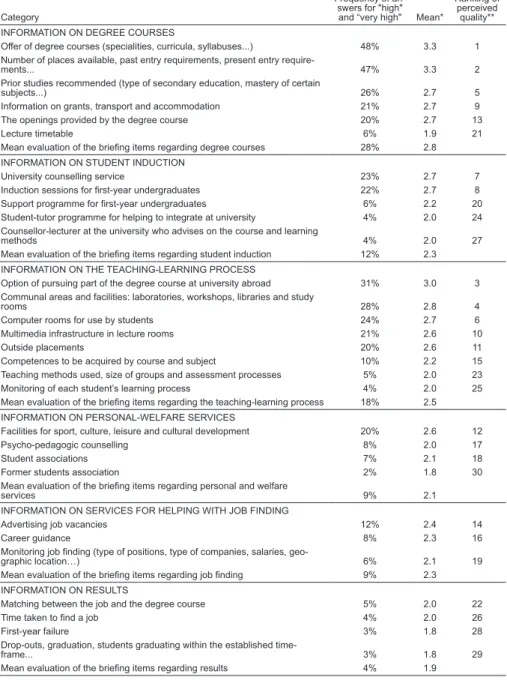
Table II shows the content of the communication policies whose quality has
been rated as “high” or “very high” by a greater number of schools. Standing out from all the other contents that have traditionally occupied the channels of communication between universities and secondary schools are “offer of degree
courses” and “terms of access”, for which the current brieing mechanisms
appear to satisfy the majority of secondary schools. This group also features the content on universities’ technical facilities and communal areas.
These data reveal, in short, that there are certain aspects of universities’
communication policy with which the schools are reasonably satisied; however,
and given that the schools are being asked to carry out an evaluation exercise, it is perhaps more interesting to focus on the content regarding which the schools
afirm they do not receive quality information.
Those surveyed stress the almost non-existent quality of the information on academic results and access to the labour market. For example, the quality of
the information on drop-out rates, graduation or the average time each student takes to complete the degree course is rated as “low” or “very low” by 81% of
the schools questioned1. The feeling that Spanish universities are not particularly concerned about informing prospective students on these matters is readily
apparent when analysing their websites. The cases in which comprehensive information is provided on these issues are few and far between and, further-more, the universities that do provide such data rarely do so through the links designed for prospective students.
The guidance providers are also critical about the information on the teaching methods used at universities, and about the provision of personal and welfare
services. Nonetheless, it should be remembered that this information was not
considered overly important by the schools, which tempers the seriousness of
its scant quality.
Indeed, the relationship between the importance attributed and the quality
perceived may be a good measure of the precariousness of the information with which guidance providers at secondary schools undertake their duties. This
precariousness is all the greater the higher the importance of a speciic issue and the lower the quality of the information they have on it. Graph I provides
an initial appreciation of the precariousness of this information: there is not a
single brieing item in which the schools consider there is an excess of informa
-tion; or to put it another way, schools give a far higher rating to the importance of any one of the items than to the quality of the information they have on it.
Graph I - Importance given to brieing content vs. perceived quality
Table II - Opinion of secondary schools on the quality
of the information received by brieing item
* Mean for the answers when restated in quantitative terms (“very low” = 1; “low” = 2, “average” = 3, “high” = 4, “very high” = 5). ** Ordered by frequency in terms of the answers "high" and "very high".
Source: Compiled by author.
Category
Frequency of an-swers for "high" and “very high" Mean*
Ranking of perceived quality** INFORMATION ON DEGREE COURSES
Offer of degree courses (specialities, curricula, syllabuses...) 48% 3.3 1 Number of places available, past entry requirements, present entry
require-ments... 47% 3.3 2
Prior studies recommended (type of secondary education, mastery of certain
subjects...) 26% 2.7 5
Information on grants, transport and accommodation 21% 2.7 9
The openings provided by the degree course 20% 2.7 13
Lecture timetable 6% 1.9 21
Mean evaluation of the brieing items regarding degree courses 28% 2.8 INFORMATION ON STUDENT INDUCTION
University counselling service 23% 2.7 7
Induction sessions for irst-year undergraduates 22% 2.7 8
Support programme for irst-year undergraduates 6% 2.2 20 Student-tutor programme for helping to integrate at university 4% 2.0 24 Counsellor-lecturer at the university who advises on the course and learning
methods 4% 2.0 27
Mean evaluation of the brieing items regarding student induction 12% 2.3 INFORMATION ON THE TEACHING-LEARNING PROCESS
Option of pursuing part of the degree course at university abroad 31% 3.0 3 Communal areas and facilities: laboratories, workshops, libraries and study
rooms 28% 2.8 4
Computer rooms for use by students 24% 2.7 6
Multimedia infrastructure in lecture rooms 21% 2.6 10
Outside placements 20% 2.6 11
Competences to be acquired by course and subject 10% 2.2 15 Teaching methods used, size of groups and assessment processes 5% 2.0 23 Monitoring of each student’s learning process 4% 2.0 25
Mean evaluation of the brieing items regarding the teaching-learning process 18% 2.5 INFORMATION ON PERSONAL-WELFARE SERVICES
Facilities for sport, culture, leisure and cultural development 20% 2.6 12
Psycho-pedagogic counselling 8% 2.0 17
Student associations 7% 2.1 18
Former students association 2% 1.8 30
Mean evaluation of the brieing items regarding personal and welfare
services 9% 2.1
INFORMATION ON SERVICES FOR HELPING WITH JOB FINDING
Advertising job vacancies 12% 2.4 14
Career guidance 8% 2.3 16
Monitoring job inding (type of positions, type of companies, salaries, geo
-graphic location…) 6% 2.1 19
Mean evaluation of the brieing items regarding job inding 9% 2.3 INFORMATION ON RESULTS
Matching between the job and the degree course 5% 2.0 22
Time taken to ind a job 4% 2.0 26
First-year failure 3% 1.8 28
Drop-outs, graduation, students graduating within the established
time-frame... 3% 1.8 29
5 Conclusions
A large part of the evaluation of universities’ communication policy pre-sented in this paper is based on the answers provided by school counsellors in
the questionnaires they were asked to complete. Yet beyond the actual content
of these answers, the emphatic nature, manner and feeling of the opinions they give reveals a markedly critical viewpoint.
Most of the school counsellors surveyed have said that, generally speaking,
they are not satisied with the information and support they receive from
their reference universities. These guidance providers complain that they are forced to track down basic information on access and syllabuses for each individual university, and then compile it in a way that provides their pupils
with a comprehensive understanding of their options; in their view, the content of the different degree courses is expressed in a way that the pupils ind hard to understand, and the teachers themselves admit they also ind it somewhat obtuse; they express the challenges they face when dealing with the chaotic structure of certain university websites; they are disgruntled by the fact that a
fair proportion of the information they receive by post is of little use for pro-viding serious guidance.
The obviously critical tone with which secondary schools evaluate the
brieing policies of Spanish universities is yet another facet of the scant com -munication that has traditionally existed between these echelons of education
(GUERRA; RUEDA, 2005), and which has been conirmed by the answers pro -vided when schools have been asked about the degree of coordination between
schools preparing for university entrance and the universities themselves. 63%
of those surveyed declared that the coordination is low or very low, whereas only 8% considered it to be high or very high. Meanwhile, the universities
themselves see things quite differently; that is, most university guidance ser -vices seem to be unaware of the problems of coordination between these two echelons of Spain’s education system.
The negative feedback forthcoming in the personal interviews held with
the guidance providers in secondary education has been conirmed by their answers to the questions they have been asked regarding the quality of certain aspects of the brieing content they receive. The survey was based on 30 di -fferent content items, ranging from the information on a university’s offer of
degree courses or the number of places available and entry grades required,
through to the information on the university’s facilities regarding computer rooms, psycho-pedagogical support, or the advertising of job vacancies. The
the group of secondary-school guidance providers gave a higher rating to the
importance of the information on the item in question than to the quality with
which it is received. The diagnosis is clear and should be stated emphatically:
the guidance providers at the schools surveyed are dissatisied with universi -ties’ communication policy and they are forced to undertake their counselling role facing a lack of information that can only compromise the effectiveness of their task.
There are in all probability numerous reasons for this situation, and their
solution requires Spanish universities to become mindful of the importance of
these policies and allocate more means for their implementation, furnish them
with more appropriate structures or ine-tune the operations of those already in place. Nevertheless, there is something that the research summarised in this
paper can do to improve the situation. The dissatisfaction schools manifest regarding the information supplied may be due in part to the fact that
univer-sities and schools differ in the way they look upon the brieing priorities of undergraduates about to embark upon a degree course. If this is true – and the answers provided by the questionnaires submitted to universities and schools seem to ratify it – the irst thing institutions of higher education should do is
introduce mechanisms of dialogue with secondary education, and thereby en-sure that their efforts are focused on those matters that the recipients of their policies deem to be most important.
In short, the evaluation of the communication between universities and
secondary schools with a view to paving the way for young people as they pass from one echelon to another shows that there are still aspects that need
to be improved. It is likely that these shortcomings are no more than the local relection of a more general problem in the scant coordination between these two echelons of education. If this is true, we should welcome the proposals of the European Higher Education Area in the way it will lend consistency to
References
BRINKWORTH, Russel; MCCANN, Bem; NORDSTRÖM, Karin. First
year expectations and experience: student and teacher perspectives. Higher
Education, Netherlands, v. 58, p. 157-173, 2008.
ECHEVERRÍA, Benito Samanés. Los servicios universitarios de
orientación. In APODACA, Pedro; LOBATO, Clemente. (Eds.). Calidad en
la Universidad: orientación y evaluación. Barcelona: Laertes, 1997.
EMBO. From School to University – a report on the transition from
secundary school biology education to university in Europe, 2006. Available in: <http://www.embo.org/documents/report.pdf>. Access: june 22, 2012. GONZÁLEZ, Viviana Maura. Autodeterminación y conducta exploratoria. Elementos esenciales en la competencia para la elección profesional
responsable. Revista Iberoamericana de Educación, Madrid, v. 51, p. 201-220, 2009.
GUERRA, Carlos Rodríguez; RUEDA, Eva M. Domínguez. Estudio longitudinal de los jóvenes en el tránsito de la enseñanza secundaria a la
universidad: orientación, expectativas, toma de decisiones y acogida de los
nuevos estudiantes en la universidad. Informe para el Programa de Estudios y Análisis del Ministerio de Educación y Ciencia (convocatoria 2005) de la Secretaría de Estado de Universidades e Investigación, 2005. Available in: <http://www.mec.es/univ/proyectos2005/EA2005-0266.pdf.>. Access: june
22, 2012.
PEAT, Mary; DALZIEL, James; GRANT, Anthony M. Enhancing the
transition to university by facilitating social and study networks: results
of a One-day Workshop. Innovations in Education and Training
International, New York, v. 37, n. 4, p. 293-303, 2000.
RAUSCH, John L.; HAMILTON, Matthew W. Goals and distractions:
explanations of early attrition from traditional university freshmen”. The
Qualitative Report, Flórida, v. 11, n. 2, p. 317-334, June, 2006
RODRÍGUEZ, Sebastián Espinar. Orientación universitaria y evaluación de la calidad. In APODACA, Pedro & LOBATO, Clemente. (Eds.). Calidad en
RODRÍGUEZ, Sebastián Espinar; ÁLVAREZ, Manuel; ECHEVERRÍA, Benito; MARÍN, María A. Teoría y práctica en la orientación educativa.
Barcelona: PPU, 1993
SALMERÓN, Honorio Pérez. Los servicios de orientación en la
Universidad. Procesos de creación y desarrollo. Ágora Digital, Valladolid,
n. 2, 2001. Available in: <http://www.uhu.es/agora/version01/digital/
numeros/02/02articulos/monograico/salmeron.PDF>. Access: june 22, 2012. SÁNCHEZ, María F. García. Las funciones y necesidades de orientación en
la Universidad: un estudio comparativo sobre las opiniones de universitarios y profesionales. Revista de Orientación Psicopedagógica, Madrid, v. 9, n. 5, p. 87-107, 1998.
SÁNCHEZ, María F. García; GUILLAMÓN, José R. Fernández. (Coords.).
Situación actual de los servicios de orientación universitaria: estudio
descriptivo. Revista de Educación, Madrid, n. 345, p. 329-352, enero-abril, 2008.
TAYLOR, Janet A. Assessment in irst year university: a model to manage
transition. Journal of University Teaching and Learning Practice,
Wollongong, NSW, Australia, v. 5, n. 1, article 3, 2008.
VIDAL, Javier; DÍEZ, Gloria; VIEIRA, María J. La oferta de los servicios de orientación en las universidades españolas: innovación y
ajuste a las necesidades de la comunidad universitaria. Informe para
el Programa de Estudios y Análisis del Ministerio de Educación Cultura y Deporte (convocatoria 2001) de la Secretaría de Estado de Educación y Universidades, 2001. Available in: < http://www3.unileon.es/dp/amide/inves/ publi/Servori.pdf>. Access: june 22, 2012.
VIEIRA, María J. Criterios para la evaluación del sistema de apoyo y
orientación al estudiante universitario: revisión y propuesta. Revista de
Educación, Madrid, n. 345, p. 399-423, enero-abril, 2008.
WILLCOXSON, Lesley. Factors affecting intention to leave in the irst, second and third year of university studies: a
semester-by-semester investigation. Higher Education Research & Development,
Marta Barandiaran Galdós – Universidad del País Vasco UPV/EHU Bilbao | España. Contato: [email protected]
Miren Barrenetxea Ayesta – Universidad del País Vasco UPV/EHU Bilbao | España. Contato: [email protected]
Antonio Cardona Rodríguez – Universidad del País Vasco UPV/EHU Bilbao | España. Contato: [email protected]
Ana Ma Martín Arroyuelos – Universidad del País Vasco UPV/EHU
Bilbao | España. Contato: [email protected]
Juan José Mijangos del Campo – Universidad del País Vasco UPV/EHU Bilbao | España. Contato:[email protected]
Jon Olaskoaga Larrauri – Universidad del País Vasco UPV/EHU Bilbao | España. Contato: [email protected]