Inefficient commuting in a city with spillovers
1
Jo˜ao Filipe
2NOVA School of Business and Economics
Advisor: Susana Peralta
August 2011
1I am grateful to Susana Peralta for precious comments and suggestions. I also
express my gratitude to Jos´e Tavares, Antonieta Cunha e S´a, Sofia Franco, Ana Balc˜ao Reis, S´onia F´elix, Pedro Chaves, Nuno Paix˜ao, Miguel Faria e Castro, Vasco Botelho, Cl´audia Alves, Ernesto Freitas and Tiago Botelho, and to all participants in the Research Group meetings. Financial support from Funda¸c˜ao para a Ciˆencia e a Tecnologia, Portugal, is gratefully acknowledged.
2Address: NOVA School of Business and Economics, Campus de Campolide,
Abstract
This paper presents a model of a duo-centric linear city where agents choose in which jurisdiction they want to work. Jurisdictions are unequally productive and local governments use a head tax and, possibly, a source-based wage tax, to finance a local public good. Each agent derives utility from both the local public good of the jurisdiction where he works and where he lives; thus, interjurisdictional commuting generates endogenous spillovers. We analyze the tax competition equilibrium when local governments use both the head and the wage tax and compare it to the utilitarian benchmark. We show that local public goods are underprovided in the most productive ju-risdiction, and overprovided in the least productive one. We also show that distortive source-based wage taxation may improve upon the equilibrium with residence taxes alone, as it allows to charge commuters with part of the cost of the public good they enjoy.
Keywords: Tax competition, Commuting, Local Public Good Spillover, Median Voter Equilibria.
1
Introduction
In this paper we look at the impact of local level fiscal decentralization on the provision of public goods in a framework where agents commute and local governments provide public goods (or publicly provided private goods) with an endogenous spillover effect. We have in mind the world described by Fisher (1996) who writes “Many individuals live in one city, work in another, and do most of their shopping at stores or a shopping mall in still another locality”. The spillovers we want to analyze are due to the fact that agents reside in one place but can work in a different one, and therefore can be subject to two different local governments.
This framework encompasses a large variety of possible forms of local governments, from different jurisdictions in one metropolitan area to neigh-boring cities or even states with common borders as long as it makes sense to have agents commuting from one to the other. As stated in Peralta (2007) “there is extensive evidence of the increasing importance of interjurisdictional commuting, possibly fostered by the improvement in transportation technolo-gies”. Such increasing importance is documented for example in Shields and Swenson (2000), Glaeser et al. (2001) and Renkow (2003) using US data, by Van Ommeren et al. (1999) for The Netherlands or Cameron and Muell-bauer (1998) for Great Britain. In all these papers we can find clear evidence that both the number of commuters and the commuting distance has been increasing in the last 40 or 50 years.
Since individuals spend most of their time in the place where they live and where they work, it is natural to consider that they consume the public goods provided in both. However, among the several types of local public goods some are more used by the inhabitants of the municipality (such as garbage collection, gas supply, parks or monuments with free entrance for locals, etc.), while others are used by both the inhabitants and the commuters that work there (road construction and maintenance, free parks, public transportation, street lighting, etc.).1 Our purpose is precisely to find a way that better
1
reflects these facts.
The literature usually treats spillovers as exogenous, i.e., agents “auto-matically” get utility from the public goods provided in other jurisdictions.2
However, most local public goods are only consumed by the people who ac-tually go to that municipality. If a nearby town now offers, for example, a better garbage collection service, its residents will enjoy higher utility due to cleaner streets, but it is difficult to argue that someone with little contact with that city will benefit from that improved service.
In a commuting setup spillovers actually arise in a quite natural and endogenous way: when individuals spend part of their working day away from their residence jurisdiction, they enjoy public goods in both the municipality where they live and in that where they work.
Local public goods are usually financed with a combination of local taxes and transfers from central governments. Local governments worldwide have different levels of tax collection autonomy, and access to different kinds of taxes.3 Such taxes include residence-based wealth taxes, pure residence-based
income taxes, pure source-based income taxes, or “hybrid” ones.
Examples of residence-based wealth taxes are mostly residential and busi-ness property taxes which, in the United States, “are the most important source of local government tax revenue” (Braid, 2005). Pure residence-based income taxes charged by local governments can be found in Baltimore (Braid, 2009) or in Portugal. Pure source-based wage taxes or payroll taxes that apply uniformly to citizens depending only on their workplace can also be found in the U.S., in cities like San Francisco, Los Angeles, Newark (New Jersey) and Birmingham (Alabama), where “a central-city’s wage tax applies at the same rate to central-city and suburban residents working in the central city, but not to central-city and suburban residents working in the suburbs” (Braid, 2009).
goods or publicly provided private goods.
2
This is the Oates’s tradition spillover that we can find for example in Besley and Coate (2003).
3
Examples of cities using “hybrid” income taxes are also presented in Braid (2009). In these cases all central city residents are taxed at a rate, irrespective of where they work, while residents in the suburbs who work in the central city can be taxed at a different rate. Kansas City, St. Louis, Wilmington, Detroit, New York City and Philadelphia are the provided examples. But the use of wage or income taxes by local governments is not confined to the United States. Mexico, Australia, Austria, France and Greece also have payroll taxes at state or local level (Peralta, 2007). Korea has source based income taxes (Chu and Norregaard, 1997). Besides these, Braid (2005) points the use of such taxes also on Sweden, Denmark, France, Germany, Japan and Spain.
When we think about the fiscal autonomy of local governments the prob-lem of centralized vs. decentralized decision immediately arises. We traveled a long way since the pioneering work of Oates (1972) who formalized the standard approach for this question and reached the Oates’s Decentraliza-tion Theorem that states that decentralization is preferred in the absence of spillover effects while otherwise there is a trade-off due to the incapabil-ity of the central government to follow different public policies in different regions. This assumption of uniformity of the centralized policy is used in many other papers on fiscal federalism to impose a cost on centralization.4
The arguments in favor of local governments are usually justified by some kind of informational advantage on the features of their regions (they are “closer to the people”, which allows to better respond to the agents’ needs) but the decentralization comes to a cost due to the failure to internalize tax and expenditure spillover effects (Oates, 1999).
Our purpose is to analyze the majority voting decentralized equilibrium against the benchmark of a first-best benevolent social planner solution.5
Our model introduces public goods with an endogenous spillover effect
4
For example in Alesina and Spolaore (1997) when studying the size of nations or in Bolton and Roland (1997) analysing the threat of secession.
5
in the framework of a linear city used by, e.g., Peralta (2007) and Braid (2000) to tackle interjurisdictional tax spillovers. The city is divided into two jurisdictions and agents choose where they want to work. Productivity, and thus wages, differ across regions and individuals trade-off the advantages (i.e., wage and working conditions) of a given job against travel costs (distance, time, and money) when choosing their work place. Our main contribution is to allow individuals to enjoy public goods in the work place. We do not, however, model the residence choice of agents, assuming that residence and working choices are independent, as argued by Wildasin (1986) and supported by empirical evidence provided by Rouwendal and Meijer (2001), Glaeser et al. (2001) and Zax (1991 and 1994). For a recent analysis of the residence decision refer to Wrede (2009) where land is included and agents can choose their residence location according to a bid-rent function.6
The contribution of this paper is twofold. On the one hand, it introduces public good spillovers in a linear city tax competition model with commuting in the line of Peralta (2007). On the other hand, it introduces a distortive wage tax on a model with spillovers.
In our setup agents only get utility from the public good supplied in the other jurisdiction if they choose to work there. Otherwise they only get utility from the one provided in their own jurisdiction. Therefore, the spillover effect is endogenous instead of the traditional exogenous one. One may argue that agents enjoy the public goods in other jurisdictions if they go there for leisure or shopping and therefore use the public goods provided even without working there. However, such use is occasional and most of the goods and services from which individual get utility in those cases are privately provided ones (hotels, restaurants, leisure facilities, shopping malls, theaters, etc.). As such, we chose to disregard these situations and concentrate on the commuters for work case.
We prove that in the tax competition equilibrium the public good of the most productive region is underprovided, while that of the least productive
6
region is overprovided. We also show that tax competition leads to a less than efficient number of commuters. Interestingly, we show that the introduction of a distortive wage tax tends to improve the provision of the public goods, when compared to a situation where local governments only use a lump sum residence tax. The use of the distortive wage tax is therefore, a second-best result, as it partially offsets the distortion generated by the endogenous spillover of the public goods.
The remainder of the paper is organized as follows. In Section 2 we present the model. Section 3 computes the first best, which is then used as a benchmark to compare the results obtained in Section 4, i.e., the tax competition equilibrium where both a lump sum and a distortive tax are used. Section 5 compares the tax competition equilibrium found before with the one attained when only the lump sum tax is used. Section 6 concludes.
2
The Model
We consider a linear city divided into two jurisdictions with the same size. Each jurisdiction has an employment center where agents can work. The total number of residents of the city is normalized to 1, as well as the city size, with extreme points of the segment -1/2 and 1/2. Inhabitants are uniformly distributed across the city and cannot choose their residence location. Each agent is indexed by his residence place, x.
Letn(x) and N(x) denote the density and distribution function, respec-tively, so that
n(x) = 1 and N(x) =x+ 12
Since the two jurisdictions have the same size and residents are uniformly distributed, both have the same number of inhabitants, ¯N = 1/2. The median resident of each jurisdiction coincides with the geographic center of the jurisdiction, i.e., mH = −1/4 and mL = 1/4. The employment centers
from the median resident (γ > 1/4). This opens up the possibility for a majority of residents of one jurisdiction to commute to the other one.
Firms located at the employment centers produce an homogeneous good according to a linear technology Yi =αiNi, where Yi is the output and Ni is
the number of workers in jurisdiction i.7 The two jurisdictions have unequal
productivities. We use H to denote the high-productivity jurisdiction and L for the low-productivity one, with αH > αL.
H L
H L
‐1/2 ECH 0 ECL 1/2
Figure 1: The City
The government of each jurisdiction collects a head tax (Ti) paid by all
its residents and, possibly, an ad-valorem source-based tax on wages (τi) paid
by all workers in the employment center of jurisdiction i to finance a public good budget Gi.8
The local government budget constraint is therefore
Gi =TiN¯ +αiτiNi
where αi is the gross wage earned by workers in the employment center of
jurisdiction iand Ni is the number of workers in that jurisdiction.
Agents support a per-mile commuting cost c and can choose to which employment center they want to commute (i.e., where they want to work). Commuting to the jurisdiction where they do not live is, therefore, more costly than commuting to the one where they live since the distance they must travel is higher. Each individual provides one unit of labor and pays a wage tax at the source so that the net wage earned by an individual working
7
As stated in Peralta (2007) the assumption of a linear technology is not essential and the obtained results would remain unchanged if we introduce perfectly mobile capital in the model with a constant returns to scale production function.
8
Note that in our setup the head taxTican be seen as land or residential property tax
inj isωj =αj(1−τj). All agents have a revenueW from other sources which
is assumed to be high enough such that everyone can always pay his tax bill. Agents get utility both from private consumption and from the public good. We follow Peralta (2007) and Braid (2000) and assume a quasi-linear util-ity function; however, differently from that author, we allow the individuals to enjoy both the public goods of their residence and work places. The utility enjoyed by individual x, who lives ini and works inj is given by:
uij(x;τ;Gi;Gj) = ωj−Ti+W −c|x−ECj|+ (1−k)υ(Gi) +kυ(Gj) (1)
i, j =H, L
whereECj is the location of the employment center where the agent chooses
to work (γ or−γ),Gi is the public good provided in the jurisdiction where he
lives, Gj is the public good provided in the jurisdiction where he works and
υ(G) is an increasing concave function. In the subsequent we will assume
υ(G) = √G.9 The intensity of the spillover effect due to having
individu-als deriving utility from the public goods provided in both jurisdictions is measured by the constant k, where 0 ≤ k ≤ 1. When k ≤ 1/2, Gi is more
important than Gj, i.e., agents care more for the public good provided in
the jurisdiction where they live than for the one provided in the jurisdiction where they work.10
Again, notice that this is not the standard spillover effect we can find in the literature. In our case agents only get utility from the public good pro-vided in the other jurisdiction if they decide to work there, i.e., the spillover is endogenous. When they decide the working location they are also choosing the public good mix they want to consume.
9
Though this assumption is not essential to obtain most of our results, it allows for closed form expressions and more clear-cut conclusions.
10
This is what is considered, for example, in Besley and Coate (2003) and would fit our model since we argue that agents are able to get utility from a wider variety of public goods provided in their residence place. However, the assumption of these boundaries for
kis not necessary to reach the results of this paper so we choose not to impose them and
2.1
The choice of the workplace
An agent will work in the jurisdiction where he lives if uii(x;τ;Gi;GH)−
uij(x;τ;Gi;GL)≥0 and will commute to the other jurisdiction otherwise.
Looking at this utility difference we can calculate the marginal interjuris-dictional commuter, denoted ˆx. From (1) we can see that the difference between the utility obtained working in H and the one obtained by working in L is:
uiH −uiL=
ωH −ωL+ 2γc+k
√
GH −√GL
if x≤ −γ
ωH −ωL+ 2xc+k
√
GH −√GL
if −γ < x < γ
ωH −ωL−2γc+k
√
GH −√GL
if x≥γ
IfuiH(x;τ)−uiL(x;τ) is positive the agent chooses to work in H,
other-wise he chooses to work in L. Note that for |x| > γ the utility difference is independent from x which means that if one agents that lives between the employment center of a jurisdiction and its outer limit wants to commute to the other one, every agent will want to do the same. We assume away such non-interesting cases and focus on the situation where −γ < x < γˆ . The marginal ij-commuter ˆx will be the one indifferent between working in H or L, therefore
ˆ
x= ωH −ωL+k
√
GH −
√
GL
2c (2)
This marginal interjurisdictional commuter ˆx defines a commuting equi-librium where all x <xˆ work in H and allx >xˆ work in L.
3
First Best
planner that chooses the wage taxes, the residence taxes, the level of public good provided in each jurisdiction and allocates workers to an employment center so that overall utility is maximized.
The planner thus faces an overall budget constraint such that the provi-sion of public goods must be fully paid by the wage and head taxes, i.e.,
GH +GL=τHαH N¯ + ˆx
+τLαL N¯ −xˆ
+ ¯N(TH +tL) (3)
The problem faced by the social planner is therefore
max
ˆ
x,GH,GL,τH,τL,TH,TL
U =UH +UL
s.t. GH +GL=τHαH N¯ + ˆx
+τLαL N¯ −xˆ
+ ¯N(TH +tL)
whereU is the overall utility of the population, equal to the sum of the utility of all inhabitants of jurisdiction H (UH) and of all inhabitants of jurisdiction
L (UL). Note that it will never be optimal to have H-residents commuting
to L since their commuting cost will be higher than if they work in H and their productivity will be lower. Therefore, we can only have L residents commuting to H, i.e., ˆx≥0, which allow us to calculate UH and UL as:
UH =
Z 0 −12
uHHdx (4)
UL=
Z xˆ
0
uLHdx+
Z 12
ˆ
x
uLLdx (5)
Denoting byCi the total commuting costs of all the residents of
jurisdic-tion i, we have
CH =c
" Z −γ
−12
(−γ−x)dx+
Z 0 −γ
(x+γ)dx
#
=c
1 8 +γ
2
−γ2
CL=c
" Z −ˆx
0
(x+γ)dx+
Z γ
ˆ
x
(γ−x)dx+
Z 12
γ
(x−γ)dx
#
=CH+c xˆ2
(7)
where the last term in CL is the increase in commuting costs due to the
interjurisdictional commuters which must travel a longer distance. Total utility in each jurisdiction is therefore given by:
UH = ¯N
h
ωH −TH +W +
p
GH
i
−CH (8)
UL = ¯N
h
ωL−TL+W +
p
GL
i
−CH + ˆx[ωH −ωL+k∆υ]−c xˆ2
(9)
where ∆υ =
√
GH−
√
GLandk∆υis the impact on utility of the consumption
of the public good provided in jurisdiction H rather the one provided in L to interjurisdictional commuters.
Note that the two last terms of UL are the gain to L of having
interjuris-dictional commuters. The novelty of our analysis is reflected on the term ∆υ
generated by the spillover effect of the public goods: agents near the border of jurisdiction L now have two effects on utility when commuting to H: the difference in wage and the difference in the level of public goods provided (weighted byk since they always get utility (1−k) fromGL, the public good
provided in the jurisdiction where they live).
Solving the social planner problem formalized previously we can easily see that the planner is indifferent between using the wage or the head tax, since he can allocate the workers to any of the employment centers. Therefore the choice ofτH,τL,TH andTL is irrelevant for our analysis. The only thing that
must be ensured is that the budget constraint is satisfied with these taxes. We can then assume τi = 0 and finance the public goods exclusively with
implicitly performing any type of interjurisdictional transfers.11
Solving the first order conditions of the problem we reach the first best solution:
ˆ
xo = αH −αL
2c−k2 (10)
GoH =
1 4+
k(αH −αL)
4c−2k2
2
(11)
GoL =
1 4 −
k(αH −αL)
4c−2k2
2
(12)
The first order conditions can be found in the appendix and clearly show that the optimal interjurisdictional commuter ˆxo results from the trade-off
between commuting costs and productivity gains and the public good level. Notice that given what we stated above, for this solution to make sense ˆxo
must be positive so that we have some individuals commuting from L to H
and not the other way around. Therefore, 2c−k2 >0, or k2 <2c.
Regarding the local public goods, the first order conditions express the Samuelson condition for the optimal provision of public goods. Since GH
provides k-weighted utility also to ˆx residents of L, the marginal benefit of
GH is higher than without the spillover while the inverse applies toGL. This
fact also results in a higher optimal level of local public good in H than in
L, as we can see comparing equations (11) and (12).
Looking at the impact of the intensity of the spillover effect, k, on the first best solution we can see that it positively affects ˆxo and Go
H, but has a
negative impact onGo
L.12 The intuition is straight-forward: if the spillover is
higher, the interjurisdictional commuters enjoy higher utility from GH and
lower from GL. This results in lower optimal provision of the former and
higher optimal provision of the the latter, thus leading to an increase in the
11
As pointed in Peralta (2007). Remember that the purpose of the calculation of the first best is to use it as a benchmark to compare with the tax competition equilibrium and so we want to keep it as neutral as possible.
12
optimal number of commuters from L to H (i.e., higher ˆxo).
4
Tax Competition Equilibrium
Having calculated the conditions that define the first best, we can now com-pute the tax competition equilibrium and compare it to the utilitarian opti-mum. In this section we will assume that a government elected by majority rule in each jurisdiction decides the taxes and public goods levels. The elected policy will then be the one preferred by the median voter of each jurisdiction which in our model coincide with the median resident, i.e., mH =−1/4 and
mL = 1/4. Notice that all agents agree on the residence tax Ti and,
there-fore, we have the same median voter in all directions. We are thus facing an unidimensional problem and can apply the median voter theorem.
Since we are looking at the tax competition equilibrium attained when local governments can use both the residence (lump-sum) and the wage (dis-tortive) tax, agents are now concerned with the net wage they earn in each employment center rather than the gross wage dictated by their productivity. This means that local governments, when deciding the wage tax level, face a trade-off between financing the public good and changing the number of interjurisdictional commuters due to the reduction of the net wage in the jurisdiction.
Each local government maximizes the utility of the median voter sub-ject to the commuting equilibrium ˆx and to the budget constraint of the jurisdiction:
max
Gi,τi,Ti
umi
s.t.xˆ= (1−τH)αH −(1−τL)αL+k∆υ 2c
Gi = ¯N Ti+τiαiNi
Remember that Ni is the number of agents working in the employment
For the utility of the median voter we must separate the case where he commutes to the other jurisdiction from the case where he commutes to the employment center of his own jurisdiction. For the median voter of H, we prove that in this framework it is never the case that he commutes to jurisdiction L.13 This is an expectable result: since both the gross wage and
the public good are lower in the latter, and the traveled distance is much higher than if he decides to work in the employment center of H, it does not pay to commute to L. However, for the median voter of L it can make sense to commute to H thanks to the increase in productivity. Therefore, the median voter of H enjoys an utility of:
umH = (1−τH)αH +W −TH −c
−1
4+γ
+pGH
For the median voter of L, his utility when he works in his own jurisdiction is given by:
umL = (1−τL)αL+W −TL−c
γ− 1
4
+pGL
If he decides to work in H he will get utility both fromGL (weighted by
1−k) and GH (weighted by k) and his utility is, therefore, given by:
umL = (1−τH)αH +W −TL−c
1 4+γ
+ (1−k)pGL+k
p
GH
4.1
Median voter of L works in L
Let us first assume that the median voter of L works in the employment center of L, which happens when ˆx <1/4. Solving the utility maximization problem for mH and mL we have the equilibrium solution given by:
τ∗
H =
2c αH(6c−k2)
(αH −αL)
13
τ∗
L =−
2c αL(6c−k2)
(αH −αL)
G∗
H =
1 4 +
k(αH −αL)
12c−2k2
2
G∗
L=
1 4−
k(αH −αL)
12c−2k2
2
ˆ
x∗ = αH −αL
6c−k2
The first order conditions on the local public goods express the usual equality between marginal benefit and marginal cost, taking into account the impact of the level of public good on the government budget due to interjurisdictional commuters, whose choice of working place is driven by local public good provision. This means that increasing the provision of the public good increases the number of workers subject to the wage tax, affecting the cost borne by the median voter.
The characterization of the tax competition equilibrium is provided in the following proposition:
Proposition 1: In the tax competition equilibrium where both the residence and the wage taxes are available and both median voters work in their own jurisdictions:
(i) The wage is taxed in H and subsidized in L;
(ii) The local public good in jurisdiction H is underprovided while the one in jurisdiction L is overprovided;
(iii) There is undercommuting of agents. Proof. See appendix.
burden to the interjurisdictional commuters from region L using the wage tax and since the median voter of L works in L, he uses the head tax to impose a higher tax burden to the interjurisdictional commuters, which will not receive the wage subsidy. What we are seeing is a transfer of income from the interjurisdictional commuters to everyone else.
As for the provision of public goods, agents in H have a marginal cost of
GH lower than those in L. Since both the median voters of H and L are
ex-porting part of the tax burden to the L interjurisdictional commuters we have two effects: for H residents, GH is less expensive due to the tax export and
due to the fact that by increasingGH the number of such commuters increase,
which makes it even less expensive; for the median voter of L increasing GL
decreases the number of commuters, which increases the marginal cost. Comparing the levels of public good provided in each jurisdiction with the first-best solution, we reach an intuitive underprovision of the public good of jurisdiction H and overprovision of the one of jurisdiction L. The median voter of H does not take into account the spillover effect of the public good provided in H on the L-residents that commute to his jurisdiction and, therefore, considers a lower marginal benefit of GH when compared to the
first-best. This leads to a situation of underprovision of this public good. Similarly, the median voter of L does not consider that a fringe ˆx of the residents of L commute to H and, thus, get utility from GL weighted by k,
leading to overprovision of GL.
All these distortions lead to undercommuting. This is easily explained by the fact that jurisdiction H is less attractive, while jurisdiction L is more attractive than in the first best case. A lower net wage earned in the em-ployment center of H (due to the positive wage tax τH) and a lower level of
GH make jurisdiction H not so appealing while the opposite happens for L
(with subsidized wages and higher provision of GL).
i.e., taking the partial derivatives of the equilibrium expressions.14 We find
that k has a positive impact on the local public good of H, on the number of commuters (measured by ˆx) and on the wage tax charged in H. The wage tax and the local public good in L depend negatively on k. The intuition for the wage taxes is based on the tax exporting idea: when k increases the incentives to commute fromLtoHalso increase and, therefore, both median voters have more room to charge the interjurisdictional commuters. For the remaining variables, the intuition is basically the same as in the first best case.
Finally, we check that the equilibrium obtained respects the condition ˆ
x <1/4, i.e., the median voter of L works in L.
ˆ
x∗ = αH −αL
6c−k2 <
1
4 ⇔αH −αL<
6c−k2
4 ⇔k
2 <6c
−4(αH −αL)
Remember that we are also assuming that ˆx < γ, therefore we must also ensure this condition is satisfied. However, γ ∈(1/4; 1/2) and, therefore, the combination of the two conditions is ˆx < 1/4. The plot below shows the space of parameters for which this equilibrium exists.
k2
(αH−αL)
❈ ❈
❈ ❈
❈ ❈
❈ ❈
❈ ❈
❈ ❈
❈
3 2c
6c
ˆ
x∗<1 4
✠ ✠
Figure 2: Space of parameters when median voter of L works in L
14
4.2
Median voter of L works in H
We shall now analyse the Nash equilibrium where the median voter of L works in the employment center of H, i.e., he ij-commutes. Note that the problem for the median voter of H remains unchanged, and GH is implicitly
defined by (16). However, for mL his utility is now given by:
umL = (1−τH)αH +W −TL−c
1 4+γ
+ (1−k)pGL+k
p
GH
Recall that the difference to the previous case is that the median voter of L gets (1−k)-weighted utility from GL and k-weighted utility from GH,
the public good provided where he works. Deriving the first order conditions and solving all the equations we get the following equilibrium levels:15
τ∗
H =
2c(c+αH −αL)
αH(6c−k2)
τ∗
L=
c(4c−k2−2(α
H −αL))
αL(6c−k2)
G∗
H =
1 4 +
ck+k(αH −αL)
12c−2k2
2
G∗
L =
1 4 −
ck+k(αH −αL)
12c−2k2
2
ˆ
x∗ = αH −αL+c
6c−k2
On the first order conditions we can notice that the marginal benefit of
GL for the median voter of L is weighted by (1−k) instead of 1, since he
works in H and therefore gets k-weighted utility from GH. The expression
for the marginal cost is the same as before.
The next proposition characterizes the tax competition equilibrium:
15
Proposition 2: In the tax competition equilibrium where both the residence and the wage taxes are available and both median voters work in the high-productivity jurisdiction:
(i) The wages are taxed in H and in L;
(ii) The public good in jurisdiction H is underprovided while the one in jurisdiction L is overprovided;
(iii) There is undercommuting of agents. Proof. See appendix.
In this situation no jurisdiction is willing to subsidize wages. The median voter of L is not willing to subsidize the wage in L due to the fact that he is not working in that jurisdiction. Since he is now one of the interjurisdictional commuters he wants to use τL to finance the budget of L because he is not
subject to such tax.
As for the provision of public goods, the intuition is basically the same as in the previous case, with the additional fact that on the choice of GL
the marginal benefit for mL is now smaller since it is weighted by (1 −
k). Nevertheless, we can still show that GH is underprovided, and GL is
overprovided.
Let us now analyse the impact ofkon the equilibrium solution.16 We find
that k has a positive impact on the local public good of H, on the number of commuters (measured by ˆx) and on the wage tax charged in H. The wage tax and the local public good in L depend negatively on k. The arguments exposed on the previous sections apply to this case as well.
We must now check that the equilibrium obtained respects the condition ˆ
x >1/4, i.e., the median voter of L is an interjurisdictional commuter.
ˆ
x∗ = αH −αL+c
6c−k2 >
1
4 ⇔αH −αL+c >
6c−k2
4 ⇔k
2 >2c
−4(αH −αL)
We must also check that ˆx < γ, knowing that γ ∈(1/4; 1/2):
16
ˆ
x∗ = αH −αL+c
6c−k2 < γ⇔αH−αL+c < γ(6c−k 2)
⇔k2 <6c−c+αH −αL γ
The plots below show the space of parameters for which this equilibrium exists considering the two extreme values of γ: 1/2 and 1/4.
k2
(αH−αL)
❈ ❈
❈ ❈❈ ❆
❆ ❆
❆ ❆
❆ ❆
❆❆
2c
2c
4c
ˆ
x∗>1 4 ˆ
x∗< γ
✒ ✠
k2
(αH−αL)
❈ ❈
❈ ❈❈ ❈
❈ ❈
❈❈
1 2c
2c ˆ
x∗>1 4 ˆ
x∗ < γ
Figure 3: Figure 4:
Space of parameters ifγ = 12 Space of parameters if γ = 14
Checking for the extreme value γ = 1/4 is useful to see how the space of possibilities changes with γ: the area between the lines gets smaller until it vanishes when γ = 1/4.
Notice that the condition ensuring the existence of the equilibrium of the previous section was k2 < 6c−4(α
H −αL), which means that the two
k2
(αH−αL)
❈ ❈
❈ ❈❈ ❆
❆ ❆
❆ ❆
❆ ❆
❆❆
2c
4c ❈
❈ ❈
❈ ❈
❈ ❈
❈ ❈
❈ ❈
❈ ❈
3 2c
6c
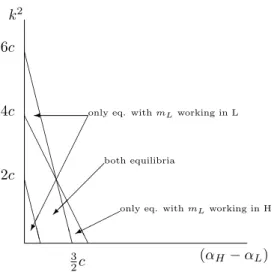
only eq. withmLworking in L
only eq. withmLworking in H both equilibria
✁ ✁ ✁ ✁ ✁ ✁ ✁ ✁☛
✛
✟ ✟ ✟ ✙ ✠
Figure 5: The two spaces of parameters
The space of parameters that allows for existence of an equilibrium where the median voter of L is an interjurisdictional commuter is partially contained within the one that allows for the existence of equilibrium with both median voters working in their own jurisdiction. Therefore, in this area, we can find both equilibria. Outside this range, no equilibrium exists.
5
Eliminating the Distortive Wage Tax
In this section we compare the tax competition equilibrium obtained when local governments only use the lump-sum head tax to the one when both the lump-sum head tax and the distortive wage tax are used.
Following the structure of the previous sections, we first focus on the case where the median voter of L works in L. If only the head tax is used, the equilibrium levels of local public goods will be given by:17
G∗∗
H =G∗∗L =
1 4
2
Comparing the two tax competition equilibria we achieve a second-best result induced by the use of the distortive tax:
17
Proposition 3: When both median voters work in their own jurisdictions, the use of the distortive tax enhances the provision of the public goods vis-a-vis the case where only the lump-sum tax is used.
Proof. See appendix.
As a matter of fact, the proof shows that:
GoH > G∗H > G∗∗H
Go
L< G∗L< G∗∗L
The distortion introduced by the wage tax partially offsets the inefficiency created by the tax competition equilibrium due to the spillover effect of the public goods to the interjurisdictional commuters. This is a typical second-best result where the introduction of two distortions (the wage tax and the inter-jurisdictional externalities) improves upon the case where only one dis-tortion is present. The tax export generated by the wage tax on H reduces the marginal cost to the policy-maker in H, thus leading him to provide a higher level of GH, thus getting closer to the optimal provision. The reverse
applies to L where the overprovision is reduced by the introduction of the wage subsidy that increases the cost of provision to mL.
If we consider the case where the median voter of L commutes to H the equilibrium levels of local public goods is:
G∗∗
H =
1 4
2
G∗∗
L =
1 4−
k
4
2
The result achieved in this case is not so strong as before:
increases the level of public goods provided in both jurisdictions vis-a-vis the case where only the lump-sum tax is used.
Proof. See appendix.
We can only say that eliminating the distortive wage tax we get an in-crease in the provision of both local public goods as the proof shows that:
GoH > G∗H > G∗∗H
G∗
L> G o
H > G∗∗L
Note that we can no longer say that the provision of both public goods is enhanced with the introduction of the distortive wage tax. We can be sure of such enhancement regarding GH, but when we look atGL what we find is
that it changes a situation of underprovision into one of overprovision.
6
Conclusion
This paper introduces commuting-related spillovers in a duo-centric linear city where local governments provide public goods and agents choose in which region they want to work. We assume agents get utility√Gi from the public
goods provided in the jurisdiction where they live and where they work, thus generating an endogenous spillover effect. The utility derived from the public good supplied in the residence jurisdiction is weighted by (1−k) while the one derived from the public good provided in the work place is weighted by
k.
sum tax in terms of the provision of the public goods as it partially offsets the distortion introduced by the endogenous spillover effect.
Appendix
Proof of Proposition 1.
(i) τ∗
H =
αH−αL+k[√G∗H−
√G∗ L] 3αH
Since αH > αL and G∗H > G∗L ⇒τH∗ >0
τ∗∗
L =
−(αH−αL)−k[√G∗H−
√G∗
L] 3αL
Since αH > αL and G∗H > G∗∗L ⇒τL∗ <0
(ii) p
G∗
H −
p
Go
H = 14 +
k(αH−αL)
12c−2k2 − 14 −
k(αH−αL) 4c−2k2 =
k(αH−αL) 12c−2k2 −
k(αH−αL) 4c−2k2 Since 12c−2k2 >4c−2k2 ⇔p
G∗
H −
p
Go
H <0⇔G∗H < GoH
p
G∗
L−
p
Go
L= 14 −
k(αH−αL) 12c−2k2 −
1 4 +
(αH−αL) 4c−2k2 =−
k(αH−αL) 12c−2k2 +
(αH−αL) 4c−2k2 Since 12c−2k2 >4c−2k2 ⇔p
G∗
L−
p
Go
L>0⇔G∗L> GoL
(iii) ˆx∗−xˆo = αH−αL 6c−k2 −
αH−αL 2c−k2
Since 6c−k2 >2c−k2 ⇔xˆ∗−xˆo <0⇔xˆ∗ <xˆo
Proof of Proposition 2.
(i) τ∗
HαH = 3c + 2c xˆ∗ −16
Since ˆx∗ ∈ 1 4;
1 2
⇒τ∗
H >0
τ∗
LαL= 23c−2c xˆ∗− 16
Since ˆx∗ ∈ 1 4;
1 2
⇒τ∗
LαL∈ 0;12
⇒τ∗
L>0
(ii) For GH please check the proof of proposition 1 as the problem is the
same. p G∗ L− p Go
L= 14 −
k
2xˆ∗− 1 4 −
k
2xˆ
o
= k2xˆo
−k2xˆ∗
Since there is undercommuting, ˆx∗ <xˆo
⇔p
G∗
L−
p
Go
L >0⇔
⇔G∗
L> GoL
(iii) ˆx∗−xˆo = αH−αL+c 6c−k2 −
αH−αL 2c−k2 =
2c−k2−4(α
H−αL) (6c−k2)(2c−k2) Since k2 > 4(α
H −αL) + 2c and both denominators were positive so
that ˆx >0⇔2c−k2−4(α
H −αL)<−8(αH −αL)<0⇔xˆ∗ <xˆo
Proof of Proposition 3. p G∗∗ H − p G∗
H = 14 − 1 4 +
k
2xˆ∗
=−k2xˆ∗ <0⇔G∗
H > G∗∗H
p G∗∗ L − p G∗ L = 1 4 − 1 4 − k
2xˆ∗
= k
2xˆ∗ >0⇔G∗L < G∗∗L
Proof of Proposition 4.
p
G∗∗
H −
p
G∗
H = 14 − 1 4 +
k
2xˆ∗
=−k
2xˆ∗ <0⇔G∗H > G∗∗H
p
G∗∗
L −
p
G∗
L = 14 −
k
4 − 1 4 −
k
2xˆ∗
= k
4(2ˆx∗−1)
Since 2ˆx∗ <1⇒p
G∗∗
L −
p
G∗
L <0⇔G∗L> G∗∗L
p
G∗∗
L −
p
Go
L = 14 −
k
4 − 1 4 −
k
2xˆ
o
= k
4(2ˆx
o
−1) Since 2ˆxo <1
⇒p
G∗∗
L −
p
Go
L<0⇔G o
L> G∗∗L
FOC of the first best utility maximization problem in section 3.
∂()
∂xˆ = 0 ⇔xˆ
o = αH−αL+k[ √
GH−√GL] 2c
∂()
∂GH = 0⇔ 1 2√Go
H 1 2 + ˆxk
= 1
∂()
∂GL = 0⇔ 1 2√Go
L 1 2 −xkˆ
= 1
Comparing the condition regarding ˆxwith the one obtained in Peralta (2007) we can see that the difference lies exactly on the presence of the term
k√
GH −
√
GL
. The spillover makes agents consider the difference in pub-lic goods provision when deciding the work place since their utility depend on Gj.
Partial derivatives in order to k of the first best solution
∂ˆxo
∂k =
2k(αH−αL) (2c−k2)2 >0
Since we only care for the sign of the derivatives, we can check the sign of the partial derivative of √Gi instead of Gi:
∂√Go H
∂k =
4k2(α
H−αL) (4c−2k2)2 +
4k2(α
H−αL) (4c−2k2)2 >0
∂√Go L
∂k =−
Proof that there is no equilibrium with mH commuting to L
If mH commutes to L the maximization problems are to maximize:
umH = (1−τL)αL+W −TH −c 1 4 +γ
+ (1−k)√GH +k
√
GL
and
umL = (1−τL)αL+W −TL−c γ− 1 4
+√GL
The relevant first order conditions are, therefore,
∂UmH
∂GH = 0⇔ −2 h
1−τHαH∂G∂xˆ
H i
+ 1−k
2√GH = 0
∂UmH
∂τH = 0⇔αH 1 2 + ˆx
+τHαH∂τ∂xˆ
H = 0
∂UmL
∂GL = 0⇔ −2 h
1 +τLαL∂G∂xˆ
L i
+ 1
2√GL = 0
∂UmL
∂τL = 0⇔ −αL+ 2αL 1 2 −xˆ
−2τLαL∂τ∂xˆ
L = 0
Solving all the equations we reach the equilibrium marginal interjurisdic-tional commuter:
ˆ
x∗ = αH−αL−c 6c−k2
For mH to commute to L, ˆx∗ <−14 ⇔ αH6−c−αkL2−c <−14 ⇔
⇔αH −αL<−12c+14k2 ⇔αH −αL<−14 (2c−k2)
Since 2c−k2 >0, the right hand side is negative, while the left hand side is
positive, which is impossible.
FOC of the utility maximization problems is section 4.1.
The equilibrium levels of local public goods are implicitly defined by:
∂UmH
∂GH = 0⇔ 1 2√G∗
H
= 2−τHαHkc 1
2√G∗ H
∂UmL
∂GL = 0⇔ 1 2√G∗
L
= 2−τLαLkc 1
2√G∗ L
Note that the marginal cost is affected by the term τiαi(k/c)υ′(Gi), which is
the impact of the of the level of public good on the government budget due to interjurisdictional commuters.
Regarding the wage taxes, the reaction functions are given by: ∂UmH
∂τH = 0⇔
−αH −2
h
−αH 12 + ˆx
+τHαH∂τ∂xˆ
H i
= 0⇔
⇔ −αH −2
−αH
1 2 +
(1−τH)αH−(1−τL)αL+k[√G∗H−
√G∗ L]
2c +
τHα2H 2c
⇔τ∗
H =
αH−(1−τL)αL+k[√G∗H−
√G∗ L] 2αH
∂UmL
∂τL = 0⇔ −αL−2 h
−αL 12 −xˆ
−τLαL∂τ∂xˆ
L i
= 0⇔
⇔ −αL−2
−αL
1 2 −
(1−τH)αH−(1−τL)αL+k[√G∗H−
√G∗ L] 2c
− τLα2L 2c
= 0⇔
⇔τ∗
L=
αL−(1−τH)αH+k[√G∗H−
√G∗
L] 2αL
Combining the two reaction functions on the wage taxes we get:
τ∗
H =
αH−αL+k[√G∗H−
√G∗ L] 3αH
τ∗
L=
−(αH−αL)−k[√G∗H−
√G∗ L] 3αL
These equations result on the equilibrium marginal interjurisdictional com-muter:
ˆ
x∗ = αH−αL+k[
√G∗ H−
√G∗ L] 6c
Partial derivatives in order to k of the equilibrium in section 4.1.
∂ˆx∗
∂k =
2k(αH−αL) (6c−k2)2 >0
∂τ∗ H
∂k =
4kc(αH−αL)
αH(6c−k2)2 >0
∂τ∗ L
∂k =−
4kc(αH−αL)
αL(6c−k2)2 <0
Since we only care for the sign of the derivatives, we can check the sign of the partial derivative of √Gi instead of Gi:
∂√G∗ H
∂k =
4k2(α
H−αL) (12c−2k2)2 >0
∂√G∗ L
∂k =−
4k2(α
H−αL) (12c−2k2)2 <0
FOC of the utility maximization problems in section 4.2.
The FOC on UmH are the same as in section 4.1.
1 2√GH =
2c τHαHk+c
τ∗
H =
αH−(1−τL)αL+k[√G∗H−
√G∗ L] 2αH
For umL we have: ∂UmL
∂GL = 0⇔(1−k) 1
2√GL = 2−τLαL
k c
1 2√GL
∂UmL
∂τL = 0⇔2 h
αL 12 −xˆ
+τLαL∂τ∂xˆ
L i
⇔2 αL 1 2 −
(1−τH)αH−(1−τL)αL+k[√G∗H−
√G∗ L] 2c
+τLα2L 2c
= 0⇔
⇔τ∗
L=
c+αL−(1−τH)αH−k[√G∗H−
√G∗ L] 2αL
Combining the two reaction functions on the wage tax we get:
τ∗
H =
c+(αH−αL)+k[√G∗H−√G∗ L] 3αH
τ∗
L=
2c−(αH−αL)−k[√G∗ H−
√G∗ L] 3αL
These equations result on the equilibrium marginal interjurisdictional com-muter:
ˆ
x∗ = αH−αL+k[ √
GH− √
GL]
6c +
1 6
Partial derivatives in order to k of the equilibrium in section 4.2.
∂ˆx∗
∂k =
2k(αH−αL+c) (6c−k2)2 >0
∂τ∗ H
∂k =
4kc(αH−αL+c)
αH(6c−k2)2 >0
∂τ∗ L
∂k =
−2kc(6c−k2)+2k(4c
−ck2
−(αH−αL)
αL(6c−k2)2 <0
Since we only care for the sign of the derivatives, we can check the sign of the partial derivative of √Gi instead of Gi:
∂√G∗ H
∂k =
c+(αH−αL)(12c−2k2)+4k(ck+k(α
H−αL)) (12c−2k2)2 >0
∂√G∗ L
∂k =−
c+(αH−αL)(12c−2k2)+4k(ck+k(α
H−αL)) (12c−2k2)2 <0
FOC of the utility maximization problems in section 5.
The median voter of H enjoys an utility of:
umH =αH +W −TH −c −
1 4 +γ
+√GH
If the median voter of L works in L his utility is given by:
umL =αL+W −TL−c γ−
1 4
+√GL
The first order conditions are therefore:
∂umH
∂GH = 0⇔ 1 2√G∗∗
H
= 2⇔p
G∗
H = 14
∂umL
∂GL = 0⇔ 1 2√G∗∗
L
= 2⇔p
G∗
H = 14
If the median voter of L works is an interjurisdictional commuter, his utility is given by:
umL =αH +W −TL−c 1 4 +γ
The first order conditions are therefore:
∂umH
∂GH = 0⇔ 1 2√G∗∗
H
= 2⇔p
G∗
H =
1 4
∂umL
∂GL = 0⇔ 1−k
2√G∗∗ L
= 2⇔p
G∗
L=
1−k
References
Alesina, A. and E. Spolaore, 1997, On the number and size of nations, The Quarterly Journal of Economics 112(4), 1027-1056.
Besley, T. and S. Coate, 2003, Centralized versus decentralized provision of local public goods: a political economy approach, Journal of Public Eco-nomics 87(12), 2611-2637.
Bolton, P. and G. Roland, The breakup of nations: a political economy anal-ysis, The Quarterly Journal of Economics 112(4), 1057-1090.
Braid, R., 2000, A spatial model of tax competition with multiple tax instru-ments, Journal of Urban Economics 47, 88-114.
Braid, R., 2005, Tax competition, tax exporting and higher-government choice of tax instruments for local governments, Journal of Public Economics 89, 1789-1821.
Braid, R., 2009, The employment effects of a central city’s source-based wage tax or hybrid wage tax, Regional Science and Urban Economics 39, 512521.
Cameron, G. and J. Muelbauer, 1998, The housing market and regional com-muting and migration choices, Scottish Journal of Political Economy 45(4), 420-446.
Chu, K. and J. Norregaard, 1997, Korea, in Ter-Minassian, Teresa (ed.), Fiscal Federalism in Theory and Practice, IMF.
Fernandez, G., 2004, Tax increment financing: interaction between two over-lapping jurisdictions, Journal of Urban Economics 55, 151164.
Fisher, R.S., 1996, State and local public finance, 2nd. ed., Irwin.
Glaeser, E., J. Kolko and A. Saiz, 2001, The consumer city, Journal of Eco-nomic Geography 1(1), 27-50.
Grazzini, L. and T. van Ypersele, 2003, Fiscal coordination and political competition, Journal of Public Economic Theory 5(2), 305-325.
Oates, W., 1972, Fiscal Federalism, Harcourt Brace Jovanovich.
Oates, W., 1999, An Essay on Fiscal Federalism, Journal of Economic Liter-ature 37(3), 1120-1149.
OECD, 2009, The fiscal autonomy of sub-central governments: an update.
Peralta, S., 2007, Political support for tax decentralization, Journal of Public Economic Theory 9, 1013-1030.
Renkow, M., 2003, Employment growth, worker mobility and rural economic development, American Journal of Agricultural Economics 85(2), 503-513.
Rouwendal, J. and E. Meijer, 2001, Preferences for housing, jobs and com-muting: a mixed logit analysis, Journal of Regional Science 41(3), 475-505.
Shields, M. and D. Swenson, 2000, Regional labour markets: the relation-ship between industry level employment and in-commuting in pennsylvania counties, The Journal of Regional Analysis and Policy 30(2), 81-94.
Van Ommeren, J., P. Rietveld and P. Nijkamp, 1999, Job moving, residential moving and commuting: a search perspective, Journal of Urban Economics 46, 230-253.
Wheaton, M.C., 1977, A bid-rent approach to housing demand, Journal of Urban Economics 4, 200217.
Wildasin, D.E., 1986, Spatial variations of the marginal utility of income and unequal treatment of equals, Journal of Urban Economics 19, 125-129.
Zax, J., 1991, The substitution between quits and moves, The Economic Journal 101(409), 1510 - 1521.