Abstract
Objective: To investigate the prevalence of overweight and its association with socioeconomic, biological, and maternal factors in children under 5 years of age in the semiarid region of the state of Alagoas.
Methods: This was a cross-sectional study with a representative sample. We evaluated child variables (excess weight, sex, birth weight, prematurity, duration of breastfeeding, and origin) and mother variables (excess weight, central obesity, income, education, and smoking during pregnancy). Excess weight in children was deined based on the weight-for-height ≥ 1 z score; in mothers, overweight and central obesity were identiied by mass body index ≥ 30 kg/m2 and waist circumference ≥ 80 cm, respectively. We conducted logistic regression, adopting overweight as an outcome, considering as signiicant p < 0.05.
Results: The sample comprised 963 children, with a mean age of 27.7 months (SD ±17.3). The prevalence of overweight children was 28.5%, directly associated with central obesity in the mother (odds ratio = 1.46; 95%CI 1.07-1.98) and duration of non-exclusive breastfeeding for a period of less than 6 months (odds ratio = 1.82, 95%CI 1.31-2.51).
Conclusions: This study showed a high prevalence of overweight children under 5 years of age associated with central obesity in the mother and non-exclusive breastfeeding for a period less than 6 months. These indings suggest that breastfeeding may protect children against overweight and point to the need for primary and secondary prevention of maternal central obesity.
J Pediatr (Rio J). 2012;88(4):347-52: Overweight, obesity, anthropometry, childhood.
O
riginala
rticle Jornal de PediatriaCopyright © by Sociedade Brasileira de Pediatria
347
Introduction
Excess weight is considered one of the major public health problems of modern society, and its prevalence has acquired epidemic proportions. In the last 30 years, the prevalence of obesity in child population has increased in all the Brazilian regions and social classes,1 with numbers ranging between 5 and 18%.2 In Brazil, while watching a major decline in the prevalence of child malnutrition has been observed, an alarming increase in the occurrence of overweight children has been registered, including those belonging to families of lower acquisitive power.3
The increased prevalence of overweight children is alarming due to the high risk that these children have of becoming obese adults, and more susceptible to various morbid conditions such as respiratory diseases, cardiovascular, endocrine, orthopedic, psychosocial, among others. Thus, obesity affects the health and quality of life of individuals, both in short and long terms.4 Studies have sought to identify the factors that are associated with the occurrence of overweight in childhood, and among them are the socioeconomic, demographic,
Overweight and associated factors
in children from northeasten Brazil
Marcella de A. Moreira,1 Poliana C. Cabral,2 Haroldo da S. Ferreira,3 Pedro I. C. de Lira4
1. PhD candidate, Nutrição em Saúde Pública, Universidade Federal de Pernambuco (UFPE), Recife, PE, Brazil. 2. Adjunct professor, Departamento de Nutrição, UFPE, Recife, PE, Brazil.
3. Associate professor, Faculdade de Nutrição, Universidade Federal de Alagoas (UFAL), Maceió, AL, Brazil. 4. Full professor, Departamento de Nutrição, UFPE, Recife, PE, Brazil.
No conflicts of interest declared concerning the publication of this article.
Financial support: Conselho Nacional de Desenvolvimento Científico e Tecnológico (CNPq no. 401925/2005-6) and Fundação de Apoio à Pesquisa em Alagoas (FAPEAL no. 01/2006, protocol PROJ_168_11387759).
Suggested citation: Moreira MA, Cabral PC, Ferreira HS, de Lira PI. Overweight and associated factors in children from northeasten Brazil. J Pediatr (Rio J). 2012;88(4):347-52.
environmental, and biological factors, thus, allowing an outline of the environment in which the child lives,4,5 favoring the planning and evaluation of actions for health promotion and prevention of illnesses.
As for the direct association between parental obesity and the obesity of children, according to investigations there seems to be no doubt of it.6,7 However, the same level of evidence does not exist for other variables, such as the child’s sex, birth weight, duration of breastfeeding, and maternal level of education.7
In a scenario of changes within the patterns of nutritional problems, with increasing prevalence of overweight children and the effects on their health: this study aimed to identify the frequency of excess weight and its association with the socioeconomic, biological, and maternal factors in children under 5 years of age from the semiarid region of the state of Alagoas.
Methods
This study was conducted from the project entitled “Nutrition and health of the mother and child population of the semiarid region of the state of Alagoas,” an analytical cross-sectional study involving representative probability sample of mothers and children under 5 years of age.
The Brazilian semiarid region, characterized by poor infrastructure, public services, and social indicators, is 1,142,000 km2 and comprises approximately 1,500 municipalities distributed in 11 states. Its population is 26.4 million, which represents 15.5% of the population in Brazil.8 In the state of Alagoas, the semiarid region comprises 38 municipalities and a population estimated at 884,668 inhabitants,9 about one third of the state population (3,037,103 inhabitants).
The sampling procedure adopted was multistage three steps, consisting, respectively, in drawing of 15 among the 38 municipalities that comprise the semiarid region, drawing four census tracts in each county, and inally drawing a starting point within each sector, from which 24 households, that had children eligible for the study, were visited in a row.
The selection of municipalities was made by means of systematic sampling with probability proportional to size (number of inhabitants). In drawing the census tracts, we took into account the proportionality of urban-rural designation as contained in spreadsheets and maps provided by the Brazilian Institute of Geography and Statistics. The census tracts were deined as the territorial unit of collection of census operations, with physical limits identiied in contiguous areas and respecting the local political-administrative division, which consisted of 200 to 300 households.
The ieldwork took place between January and March 2007. The team consisted of two supervisors and 10 nutrition students, divided into two groups. Students, appropriately trained, interviewed the biological mothers and collected data on the family, mother, and her child.
For the study of association between explanatory variables in relation to the excess weight, a signiicant level of 95% (1-
α
), a power study of 80% (1-β), with a minimum of 221 children, in 1:1 ratio in each stratum of explanatory variables was considered. To do so, the sample totaled 963 children.Data on rural or urban origin; mother’s schooling in complete years; family income; birth weight; duration of not exclusive breastfeeding (< 6 and ≥ 6 months); duration of exclusive breastfeeding (< 4 and ≥ 4 months); gestational age (< 37 weeks = preterm and 37 to 42 weeks = to term), smoking during pregnancy; weight and height of the child and his mother; and maternal waist circumference were collected.
The anthropometric measurements of weight and height were performed according to the recommendations of Frisancho.10 We used a portable electronic scale with a capacity of 180 kg and 100 g of subdivisions. Children and their mothers were barefoot and with minimal clothing for obtaining weight. For children under 24 months, initially, the mother was weighed, and then holding the child in her arms, the weight of the mother/child was obtained, and the difference between these two measurements was noted. The weight of children above 24 months was observed with the child in the standing position and in the center of the base of the scale. The length of children aged less than 24 months was measured in a wooden stadiometer it with a tape measure of 100 cm and subdivisions in mm, while the height of children above 24 months and their mothers was obtained in a portable stadiometer, built of anodized aluminum, with a platform, 216 cm tall and sensitive to 1 mm.
The readings of weight and height were said aloud by an anthropometrist, and registered in a questionnaire by his assistant, who repeated the values, also aloud, before registering them, in order to avoid transcription errors.
The standards used for comparison of anthropometric measurements of weight and height were the new curves for assessing the growth of children 0-5 years from the World Health Organization (WHO).11 Nutritional status was classiied according to weight-for-height, establishing the diagnosis of an overweight child with the cutoff ≥ 1 z score.11
Nutritional diagnosis n = 963 % 95%CI
Thinness (< -2 z score) 22 2.3 1.5-3.4
Eutrophy (≤ -2 and < 1 z score) 666 69.2 66.2-72.0
Risk of overweight (≥ 1 and < 2 z score) 192 19.9 17.5-22.5
Overweight (≥ 2 and < 3 z score) 63 6.5 5.1-8.2
Obesity (> 3 z score) 20 2.1 1.3-3.1
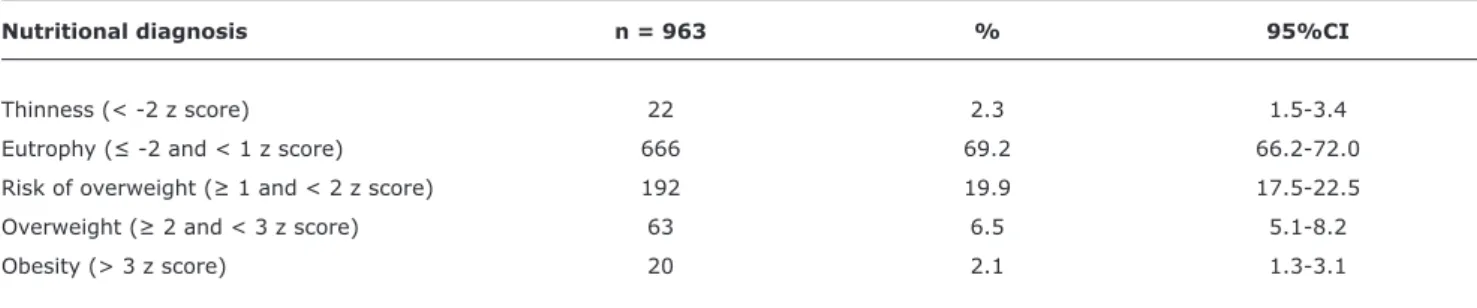
Table 1 - Nutritional status of children under 5 according to the index weight for height is expressed as z score (semiarid region of the state of Alagoas, 2007)
95%CI = 95% confidence interval.
Central obesity was deined as waist circumference value greater than or equal to 80 cm.13
Statistical analysis was performed using the Epi-Info, version 6.04, and Statistical Package for Social Sciences – SPSS, version 13.0, verifying the association between exposure variables and the presence of excess weight. Univariate analysis was performed using the chi-square test to calculate the value of p and 95% conidence interval (95%CI). To identify the variables associated with excess weight, we performed logistic regression analysis. The explanatory variables with p < 0.20 in univariate analysis (chi-square) went into the construction of the model. The base category to estimate the odds ratio (OR), adjusted and unadjusted, was deined as “the one with the lowest risk for excess weight.” We used the 95%CI of OR and the signiicance level of 5%.
The mothers of the children were informed about the aims of the study and invited to sign the consent form. This project was submitted to the Ethics Committee in Research of Universidade Federal de Alagoas (CEP / UFAL Opinion No 011375/2005-69).
Result
In total, 963 minors under 5 years were evaluated, with a homogeneous distribution in relation to gender. Of these, 51.4% were male and at mean age of 27.7 months (SD ± 17.3).
Table 1 shows that 192 children (19.9%) are at risk of overweight, 63 (6.5%) overweight and 20 (2.1%) were obese. The results on the association of overweight with maternal and child variables are shown in Tables 2 and 3.
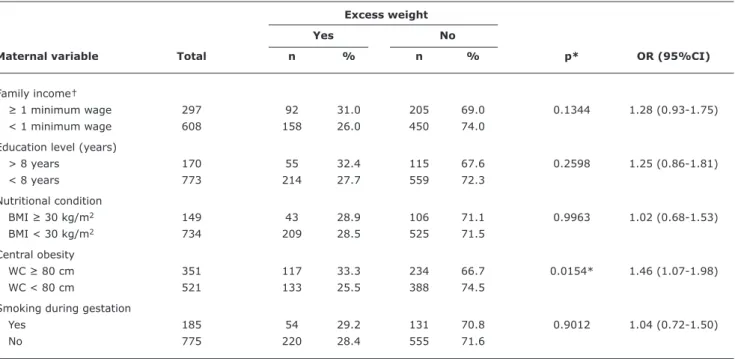
As for maternal variables (Table 2), only central obesity was associated (positively) with overweight in children (OR = 1.46, 95%CI 1.07 to 1.98).
The results presented in Table 3 show that among the variables related to the child, only the duration of exclusive breastfeeding was not associated with the outcome. That is, the risk of overweight was 1.8 times higher among children who were breastfed for a period of less than 6 months (OR = 1.82, 95%CI 1.31 to 2.51).
The adjusted OR for potential confounding factors showed that overweight remained signiicantly associated with central obesity of the mother (OR = 1.11, 95%CI 1.06 to 1.27) and duration of non-exclusive breastfeeding for a period less than 6 months (OR = 1.54, 95%CI 1.19 to 2.22).
Discussion
The results of this research show some speciicity because they have been obtained from a homogeneous sample of individuals of low socioeconomic status, from the semiarid region of the state of Alagoas, which is one of the states with the worst socioeconomic conditions of the Northeast Region of Brazil.14
Excess weight
Yes No
Maternal variable Total n % n % p* OR (95%CI)
Family income†
≥ 1 minimum wage 297 92 31.0 205 69.0 0.1344 1.28 (0.93-1.75)
< 1 minimum wage 608 158 26.0 450 74.0
Education level (years)
> 8 years 170 55 32.4 115 67.6 0.2598 1.25 (0.86-1.81)
< 8 years 773 214 27.7 559 72.3
Nutritional condition
BMI ≥ 30 kg/m2 149 43 28.9 106 71.1 0.9963 1.02 (0.68-1.53)
BMI < 30 kg/m2 734 209 28.5 525 71.5
Central obesity
WC ≥ 80 cm 351 117 33.3 234 66.7 0.0154* 1.46 (1.07-1.98)
WC < 80 cm 521 133 25.5 388 74.5
Smoking during gestation
Yes 185 54 29.2 131 70.8 0.9012 1.04 (0.72-1.50)
No 775 220 28.4 555 71.6
Table 2 - Odds ratio and 95% conidence interval of overweight in children under 5 years according to maternal variables (semiarid region of the state of Alagoas, 2007)
95%CI = 95% confidence interval; BMI = body mass index; OR = odds ratio; WC = waist circumference. * p (error probability) < 0.05.
† Minimum wage of reference at time of study (2007) = R$ 350.00.
Overweight
Yes No
Children variables Total n % n % p* OR (95%CI)
Gender
Female 479 134 28.0 345 72.0 0.8008 0.95 (0.71-1.28)
Male 484 140 28.9 344 71.1
Birth weight
≥ 4,000 g 63 23 36.5 40 63.5 0.2231 1.44 (0.82-2.54)
< 4,000 g 843 240 28.5 603 71.5
Premature
Yes 94 27 28.7 67 71.3 0.9423 1.01 (0.61-1.66)
No 860 245 28.5 615 71.5
Duration of non-exclusive breastfeeding (months)
< 6 months 373 132 35.4 241 64.6 0.0002* 1.82 (1.31-2.51)
≥ 6 months 410 95 23.2 315 76.8
Duration of exclusive breastfeeding (months)
< 4 months 776 222 28.6 554 71.4 0.9725 1.03 (0.66-1.63)
≥ 4 months 118 33 28.0 85 72.0
Origin
Urban area 408 111 27.2 297 72.8 0.5065 0.90 (0.67-1.21)
Rural area 548 161 29.4 387 70.6
Table 3 - Odds ratio and 95% conidence interval of overweight in children under 5 years according to children variables (semiarid region of the state of Alagoas, 2007)
The review study conducted by Ferrari16 indicates that, regardless of gender and the criteria used, the values of overweight and obesity in preschool children vary from 3.3 to 36.0%. This demonstrates the absence of a consensus among the methods and cutoff points established between them. The cutoff point for classifying overweight in children in this study (z score ≥ 1) was chosen in order to be able to alert policymakers about the risk of childhood overweight in the population studied and, thus try take preventive action against overweight and obesity in this age group. It is worth highlighting that, in comparison to previous studies, the same cutoff point and index in question were taken into account.
In the present study, no signiicant association was observed in overweight with any socioeconomic variable studied, similar to the research of Smith et al.17 The association between excess weight and socioeconomic factors seem to largely vary depending on country and age group evaluated. In developed countries, it was shown that the prevalence of overweight among children is higher among those belonging to less privileged18 different socioeconomic levels. In contrast, in developing countries, the overweight in children tends to be more prevalent in families with better socioeconomic level.4 However, in recent years, it is observed in Brazil, the increase in the occurrence of overweight children in all socioeconomic strata, including those belonging to families of low income, and at the same time, the decline in the prevalence of malnutrition, which characterizes the nutritional transition process.3
The lack of association of total maternal obesity, diagnosed by BMI, with the overweight children reported here was controversial when compared to other studies.7,19 On the other hand, the diagnosis of central obesity, performed by measuring the waist circumference, resulted in a risk factor. This result demonstrates the lack of sensitivity of BMI and, thus, enhances the use of the waist as a strong indicator of body fat.
Based on the data presented, there was no signiicant association between maternal smoking during pregnancy and overweight in children, in contrast to studies performed in the same região.19,20 Likewise, there was no difference in incidence of overweight in relation to gender, resembling other studies.6,7,21 However, studies by Deckelbaum et al.4 and Bussato et al.22 found a higher incidence of overweight in female children under 5 years.
In the present study, there was no association between high birth weight and overweight in children, a relationship which has proved as very controversial in literature. According to the study of Ferreira et al.,14 high birth weight would be a predictive factor for obesity, whereas a systematic review indicates that low birth weight is what increases susceptibility to this outcome.23 There still are studies that refer to appropriate birth weight as being protective against
future obesity,24 while research by Araujo et al.25 found no association, a inding similar to the present investigation.
The results of this study reveal the existence of an inverse association between the duration of non-exclusive breastfeeding and overweight, i.e., children breastfed for a period of less than 6 months are more likely to be overweight when compared to those breastfed for higher periods, thus, relecting the protective role of breastfeeding against overweight, regardless of not being unique, this resembles population-based and meta-analyzes studies,18,24 while Bussato et al.22 found no association . The difference observed in the prevalence of obesity among breastfed and non-breastfed children is small and probably inluenced by publication bias and confounding factors.
There was no association between duration of exclusive breastfeeding and overweight children in this study, in controversy with the study of Balaban & Silva,7 in which children who were exclusively breastfed for less than 4 months had a prevalence of excessive higher weight (22.5%) than those who were exclusively breastfed for 4 months or more (13.5%). The data presented by Ferreira et al.14 showed that breastfeeding for a minimum period of 30 days or more may protect against overweight in children 1-5 years, this study was conducted in the same region of the present investigation. Breast milk in the irst weeks or months of life is extremely important, because it may be a critical period for the expression of the protective effect of breastfeeding against excessive weight.23
The existence of contradictory results in studies evaluating the association between breastfeeding and overweight in childhood may be due to methodological differences between surveys. These may be related to outlining, sample size, and adjustment or non-adjustment of potential confounding variables, specially birth weight, maternal obesity, and socioeconomic status.26
We conclude that in the present study, a high prevalence of overweight in children under 5 years was demonstrated, verifying that the duration of exclusive breastfeeding for a period of less than 6 months and maternal central obesity were associated with overweight children. Therefore, our data suggest that breastfeeding may protect children against overweight and point to the need for primary and secondary prevention of maternal central obesity.
Acknowledgements
Correspondence:
Marcella de Arruda Moreira
Av. Visconde de Albuquerque, 185/402, Edf. Piazza Venezia, Madalena
CEP 50610-090 - Recife, PE - Brazil
Tel.: +55 (81) 8744.8406, +55 (81) 9930.0992 E-mail: [email protected]
References
1. Instituto Brasileiro de Geograia e Estatística (IBGE). Pesquisa de Orçamentos Familiares (POF) 2002-2003: antropometria e análise do estado nutricional de crianças e adolescentes no Brasil. Rio de Janeiro: IBGE; 2006.
2. Taddei JA, Colugnati FA, Rodrigues EM. Transição nutricional em menores de cinco anos: evidências dos inquéritos antropométricos brasileiros. In: Cardoso AL, Lopes LA, Taddei JA, eds. Tópicos em nutrição pediátrica. São Paulo: Atheneu; 2004. p.11-43. 3. Batista Filho M, Rissin A. Nutritional transition in Brazil: geographic
and temporal trends. Cad Saude Publica. 2003;19:S181-91. 4. Deckelbaum RJ, Williams CL. Childhood obesity: the health issue.
Obes Res. 2001;9:239S-43S.
5. Ribeiro IC, Taddei JA, Colugnatti F. Obesity among children attending
elementary public schools in São Paulo, Brazil: a case-control
study. Public Health Nutr. 2003;6:659-63.
6. Dias LC, Navarro AM, Cintra RM, Silveira LV. Overweight and obesity prevalence among preschool children of ive schools in Botucatu in the state of São Paulo. Rev Cienc Ext. 2008;4:105-12. 7. Balaban G, Silva GA. Protective effect of breastfeeding against
childhood obesity. J Pediatr (Rio J). 2004;80:7-16.
8. United Nations Children’s Fund (UNICEF). O semi-árido brasileiro e a segurança alimentar e nutricional de crianças e adolescentes. Brasília (DF): UNICEF; 2005. http://www.unicef.org/brazil/pt/
caderno_completo.pdf. Access: 12/03/2012.
9. Instituto Brasileiro de Geograia e Estatística (IBGE). Estados@: Alagoas; 2007. http://www.ibge.gov.br/estadosat/perfil. php?sigla=al. Access: 12/03/2012.
10. Frisancho AR. Anthropometric standards for the assessment of growth and nutritional status. Ann Arbor, USA: The University of Michigan Press; 1990.
11. World Health Organization (WHO). Multicentre Growth Reference Study Group. Child Growth Standards: length/height-for-age, weight-for-age, weight-for-length, weight-for-height and body mass index-for-age: methods and development. Geneva: World Health Organization; 2006.
12. World Health Organization (WHO). Physical status: the use and interpretation of anthropometry. Technical Report Series 854. Geneva: World Health Organization; 1995.
13. Expert Panel on Detection, Evaluation, and Treatment of High Blood Cholesterol in Adults. Executive Summary of The Third Report of The National Cholesterol Education Program (NCEP) Expert Panel on Detection, Evaluation, And Treatment of High Blood Cholesterol In Adults (Adult Treatment Panel III). JAMA. 2001;285:2486-97.
14. Ferreira HS, Luciano SC. Prevalence of extreme anthropometric measurements in children from Alagoas, Northeastern Brazil. Rev Saude Publica. 2010;44:377-80.
15. Motta ME, Silva GA. Obesity and malnutrition in children: proile
of a low-income community. J Pediatr (Rio J). 2001;77:288-93.
16. Ferrari HG. The obesity panorama in Brazilian children and adolescents: review of the last 10 years. Pediatria (São Paulo). 2009;31:58-70.
17. Silva GA, Balaban G, Motta ME. Prevalence of overweight and obesity in children and adolescents of different socioeconomic conditions. Rev Bras Saúde Matern Infant. 2005;5:53-9. 18. von Kries R, Koletzko B, Sauerwald T, von Mutius E, Barnert D,
Grunert V, et al. Breast feeding and obesity: cross sectional study. BMJ. 1999;319:147-50.
19. Ferreira HS, Assunção ML, Florêncio TM, Lima MA. Estado nutricional de pré-escolares da região semi-árida do estado de Alagoas. Cad Estud Desenv Soc Debate. 2006;4:37-42.
20. Ferreira HS, Vieira ED, Cabral Junior CR, Queiroz MD. Breastfeeding for at least thirty days is a protective factor against overweight in preschool children from the semiarid region of Alagoas. Rev Assoc Med Bras. 2010;56:74-80.
21. Menezes RC, Lira PI, Oliveira JS, Leal VS, Santana SC, Andrade SL, et al. Prevalence and determinants of overweight in preschool children. J Pediatr (Rio J). 2011;87:231-7.
22. Bussato AR, Oliveira AF, Carvalho HS. The inluence of breastfeeding on the nutritional status of children and adolescents. Rev Paul Pediatr. 2006;24:249-54.
23. Parsons TJ, Power C, Logan S, Summerbell CD. Childhood predictors of adult obesity: a systematic review. Int J Obes Relat Metab Disord. 1999;23:S1-107.
24. Harder T, Bergmann R, Kallischnigg G, Plagemann A. Duration
of breastfeeding and risk of overweight: a meta-analysis. Am J Epidemiol. 2005;162:397-403.
25. Araújo CL, Victora CG, Hallal PC, Gigante DP. Breastfeeding and
overweight in childhood: evidence from the Pelotas 1993 birth
cohort study. Int J Obes (Lond). 2006;30:500-6.