On a correct diet: exploration of the orthorexia construct from the
essential nuclei of experimental discourse
Sobre uma alimentação correta: exploração do constructo ortorexia desde os núcleos essenciais do
discurso experimental
En torno del apetito correcto: exploración del constructo ortorexia desde los núcleos esenciales del
discurso experiencial
Ginés Mateo-Marínez1 Maria Carmen Sellán-Soto1
1. Universidad Autónoma de Madrid.
Madrid, España.
Corresponding author:
Ginés Mateo-Marínez.
E-mail: [email protected]
Submited on 12/01/2016. Accepted on 02/13/2017.
DOI: 10.1590/2177-9465-EAN-2016-0350
A
bstrActObjectives: To explore the experience lived by some women who are concerned with following a natural and organic diet. Method: The qualitative analysis of the discourse was done as a bricolage (thematic content analysis and phenomenological
interpretative analysis, using diferent ad hoc techniques). Results: The subjective experience of women consists of a
phenomenological ield that deines their historicity: past, represented by the theme "Why did you choose to eat like this"; present, "An optimism recreated"; and imagined future, "Absence of disease as object of ideal consciousness". This phenomenological ield evolves, in experience and discourse, as an intermittent dilation of the theme "The expansion of consciousness in the right appetite". Conclusions: The orthorexia construct and the correct appetite discourses should be explored in greater depth by the
scientiic community in order to investigate: social stigmatization of people concerned with healthy eating and, in an associated way, pathologization of condition.
Keywords: Orthorexia; Women; Eating Habits; Qualitative Research; Healthy Eating.
r
esumenObjetivos: Explorar la experiencia vivida por parte de mujeres preocupadas por seguir una alimentación natural y ecológica. Método: Se realizó el análisis cualitativo del discurso a modo de bricolaje (análisis de contenido temático y análisis interpretativo
fenomenológico, utilizando diferentes técnicas ad hoc). Resultados: La experiencia subjetiva de las mujeres está constituida
por un campo fenomenológico que deine su historicidad: pasado, representado por el tema "Por qué ha decido comer así"; presente, "Un optimismo recreado"; y futuro imaginado,"Ausencia de enfermedad como objeto de consciencia ideal". Dicho campo fenomenológico evoluciona, en experiencia y discurso, a modo de dilatación intermitente en el tema "La expansión de la consciencia en el apetito correcto". Conclusiones: El constructo ortorexia y los discursos del apetito correcto han de ser
explorados más en profundidad por la comunidad cientíica para investigar: estigmatización social de las personas preocupadas de la alimentación sana y, de modo asociado, patologización de la condición.
Palabras clave: Ortorexia; Mujeres; Hábitos Alimenticios; Investigación Cualitativa; Alimentación Saludable.
r
esumoObjetivos: Explorar a experiência vivida por algumas mulheres preocupadas em seguir uma alimentação natural e orgânica. Método: Foi realizada a análise qualitativa do discurso a modo de bricolagem (análise de conteúdo temático e análise interpretativa
fenomenológica, utilizando diferentes técnicas ad hoc). Resultados: A experiência subjetiva das mulheres consiste em um campo
fenomenológico que deine sua historicidade: passado, representado pelo tema "Por que escolheu comer assim"; presente, "Um otimismo recriado"; e futuro imaginado, "Ausência de doença como objeto de consciência ideal". Dito campo fenomenológico evolui, na experiência e no discurso, como uma dilatação intermitente do tema "A expansão da consciência no apetite correto".
Conclusões: O constructo ortorexia e os discursos do apetite correto devem ser explorados em maior profundidade pela
comunidade cientíica, a im de investigar as ressonâncias do fenômeno em diferentes contextos: estigmatização social das pessoas preocupadas com uma alimentação saudável e, de modo associado, patologização da condição.
INTRODUCTION
At present, observable realities that condition the human being's life at an organic, psychological, social and cultural level are established. Some of these are the overproduction of communication devices; the hyperbolic distribution of images and advertisements,1,2 which foster concern and increase interest in body image;3-5 the incidence, increasingly, of cancer, anxiety and stressful environments;6,7 and the interest overwhelmed by aesthetic factors such as facial and body perfectionism, muscle hypertrophy and deinition, and non-healthful antiaging.8,9
These realities, insofar as they manifest a certain social and health situation relatively emergent and expansive, form a nest disturbed by the celerity of sociocultural processes, globalization and virtual worlds;10 for example, the quantitative and qualitative increase of chronic diseases, and the indiscriminate cult of the body, somehow justify some of the dietary behaviors and ideologies.11 It makes sense, therefore, to consider such provisions for food as reactive and/or coercive processes to multicultural inluence, the virulent multiplication of food-related images and their commercialization, and the huge increase in seemingly unlimited virtual spaces in which "everything is possible".12
Focusing on the issue in question (human provisions for food), there are two that seem to be established as epidemiological oppositional conditions: on the one hand, frequent consumption of fast-food and, on the other extreme, avoidance of food that does not come from natural or reliable sources, and interest in functional foods (antioxidants, anticancer, depurative, etc.).13 Here, the human disposition for food and healthy food comes into play, since, among other reasons, it is a less researched subject and, in principle, it is given less risk to health.
That disproportionate interest in healthy food, viewed from the perspective of translating that inclination into the terms of concern or obsession, is deined by the American doctor Steven Bratman. The term deined by the author in the year 1997 is orthorexia; the word comes etymologically from the Greek ortos (correct) and from orexis (appetite), that is, literally, correct appetite. Bratman argues that it is a disorder characterized by an obsession with food considered healthy by the suferer, which sometimes leads to a state of malnutrition and even death.14 In short, this deinition is the irst conceptualization and the theoretical embryo on which the orthorexic panorama develops as a health problem.
Although the epidemiological evidence of orthorexia is quite small, there are studies that report, with more or less success, on the magnitude of the problem. On the one hand, there are studies that indicate the prevalence in the general population, although most show calculations of orthorexic proportion in small samples and of greatly deined proiles. The prevalence in the general population is estimated to be 6.9%, and in high-risk groups (health professionals and artists) between 35% and
57.8%.15 On the other hand, in Spain, some specialists assure that, among their consulted, the 0.5-1% presents orthorexia.16
The social impact delineates in some way the proile of the most vulnerable subjects. In the reviewed literature, there are studies focusing on environmental and contextual aspects (virtual social networks, information and communication technologies, television, shops, etc.), as well as internal aspects (values, religions, ideologies, etc.). The main characteristics of the orthorexic proile are the socio-economic level, the profession and the higher educational level and/or linked to health, and social ideals (ecology, environmentalism, salutes', etc.).17 A study shows the relationship of choice of a university career in terms of food behavior. In sporting and dietetic students, the orthorexic condition is related to body dysmorphic disorder.18 In a multivariate regression analysis in athletes, diet, age, number of concerns, and rituals were predictors.19 And as data concerning gender and age, although the orthorexic disposition occurs more in men and in diferent age groups, it continues to be proportionally superior in women,20,21 being, in short, a risk factor of mental and physical health.22
In a similar way, there is bibliographic testimony that supports the condition of orthorexia as a lifestyle in which its the appearance (esthetics), and the cultivation and processing of food (nature or essence); the purchase of non-toxic food (organic, ecologic, pure, without pesticides or other artiicial products) and a thorough examination of its components;23 food and ritual practices according to a logic of care that also engages the family;24 illusory sense of security (belief in preventing disease), a need for absolute control over oneself, "a hidden conformism" to achieve a culturally accepted model as beautiful; perfectionism towards oneself and oriented to others, fruit of self-demand and social constructions;25 the search for spirituality and identity, and desire for self-aspiration; and the loss of social networks and afective dissatisfaction that favors in unison the obsessive preoccupation with food, in principle to treat or improve health, and then to become the diet the center of life.26
body and various orientations in eating behavior are evident in current Western society. Good physical appearance and health are synonymous with happiness and, therefore, people are attracted to healthy products and activities.16 All this contextual drawing of the orthorexia phenomenon comprises, more or less simultaneously, several processes that converge to the same path: the culture of health and, moreover, the culture of healthism (conception of health as individual responsibility, understood as an end in itself, as a virtue that must be valid for each and every human being, instead of being considered as mean to achieve life projects).28
With the purpose of exploring in depth and from a sociocultural perspective the construct orthorexia, with holistic approach and from the sense that has been pronounced in this introductory text, it is proposed to carry out a qualitative study in the Comunidad Autónoma de Madrid, attending to the presence and collaboration of organizations, social movements and/or human proiles in favor of the culture of the healthy and ecological. It is proposed, as an initial general objective, to explore the experience of people with orthorexia (concern or obsession with healthy eating).
The objective initially proposed, from the dynamism and relexivity of the qualitative research approach, has evolved to deinitively establish itself as a general objective, to explore the experience lived in women concerned about a natural and ecological diet. The speciic objectives are to identify concepts and ideas that describe the experience and to know strategies of constitution of the experience.
METHOD
To make an approximation to the lived experience, that is, to know the subjectivity in relation to the phenomenon of study here called (concern to follow a natural and ecological diet), the qualitative tradition in research attends to the words of the people, spoken and/or written, and observable behavior, for the production of descriptive data. As well, phenomenological orientation is essential for the conception of qualitative methodology, insofar as the researcher's disposition is, ultimately, to see things from the point of view of other people, inquiring into the subjective world of human experience for their comprehension.29,30
Symbolic Interactionism would rest on three main premises: people act on things and on other people, based on the meanings that such things have for them, being the meanings, deinitely, those that are determining human actions for others and for themselves; meanings are social products fruit of interaction; and social actors attribute meanings to situations, people, things and themselves through a process of interpretation.29
From the initial methodological proposal generated by the philosopher Husserl, that is, without abandoning the phenomenological precept of "to the proper things", of the approach to the essences, of the description of the essences manifested in the consciousness, the Phenomenological
Reduction is proposed as a process of categorization, of the essentialization of the experience and, inally, of access to the
experience of the participating subjects.31,32 Also, maintaining the premise of Phenomenological Reduction in the ield of sociological analysis, it is necessary to dispense with the conception of Transcendental reduction (as a process of absolute disconnection from the reality of the world) and to consider the use of eidetic reduction as a psychological method capable of interpretation, that is, as a process of objectiication of consciousness through eidetic variation,33,34 in which it also interferes or interacts, to inally be described the phenomenon as a structure possible to conceptualize and comprehend, the hermeneutic disposition of the researcher as a subject of interpretation of what, already interpreted by the participants in the process of eidetic variation of objectiications in the consciousness for access to the constitutive essences of the experience, manifests itself through language and the intersubjective process of reciprocal communication between the symbolic worlds of the researcher and of the subjects participating in the study.29
This research work has been carried out in the Comunidad Autónoma de Madrid. M. F. CÁTERING ECOLÓGICO, S.L. has been the social domicile where the researcher was allowed to introduce himself, to become gradually involved and to participate in the phenomenon of study.
In the irst instance, the inclusion criteria that have been established for the study population have been as follows: a. Men or women diagnosed with orthorexia. b. Men or women with an obsession for healthy eating.
These inclusion criteria have been remodeled, to inally be established as: a. Women worried about a natural and ecological diet. B. Women who, without having to be diagnosed, maintain a lifestyle around healthy food.
As sampling strategies in the course of the research work, the irst step has been to access the ield of study by means of purpose-based sampling (selection of informants in terms of accessibility, that is, easy access and location).35 Limitations of access to comparable fields of study (other spaces and organizations for natural and ecological food) have led to the methodological decision to snowball sampling (access to new informants opportunistically through other contacts).36
Based on analytical inferences and the emergence of hypotheses, the data collection has been redirected in a more focused way (theoretical sampling), allowing a more congruent and structured understanding of the phenomenon.35 Moreover, in later phases of the analysis, the sampling by extreme cases, with the in-depth analysis of informants with powerful and explicit discourses, have helped in the understanding of the phenomenon also from a theoretical proposal.37
Characteristics of the sample
INFORMANT
AGE
ACADEMIC LEVEL
LABOR PERFORMANCE
CONDITIONING DISEASE OF
FOOD
ML (most relevant social actor
in paricipant observaion)
50/55
University studies
Administraion and
Nutriion
Cancer (in the past)
E
42
Primary studies
Monitors sports center
Son with chronic metabolic
disease
M (elite informant)
42
University studies
Agricultural engineering
Cancer (in the past)
MA
40/45
University studies
Medicine
Not referred
Data collection techniques
In the process of collecting data for the generation of research work, diferent techniques have been used according to field needs and the demands of the analytical process, opting for the triangulation of observational technique and conversational techniques. As an observational technique, participant observation has enabled the irst entry into the ield of information of the phenomenon, giving access and allowing the progressive knowledge of the operation of women concerned about a natural and ecological diet, by identifying their modes of interaction, activities, values and beliefs, common discourses, among others. Conversational techniques (open interviews and in-depth interviews) have facilitated access to the lived experience, through a process of deepening the search for knowledge about the phenomenon.29,31
Data analysis
In the qualitative research tradition, working with data is a process in continuous progress, so that the collection and analysis of the same is carried out simultaneously or at least within a dynamic of feedback and lexibility Collection techniques, analytical approaches, and even research objectives.29,38
This article details the phases of reduction and organization,39 as well as the domains of discovery and codiication;29,38 the rest is constituted, by its extension, in an independent but complementary paper of the study.
Strategy 1: Discovery
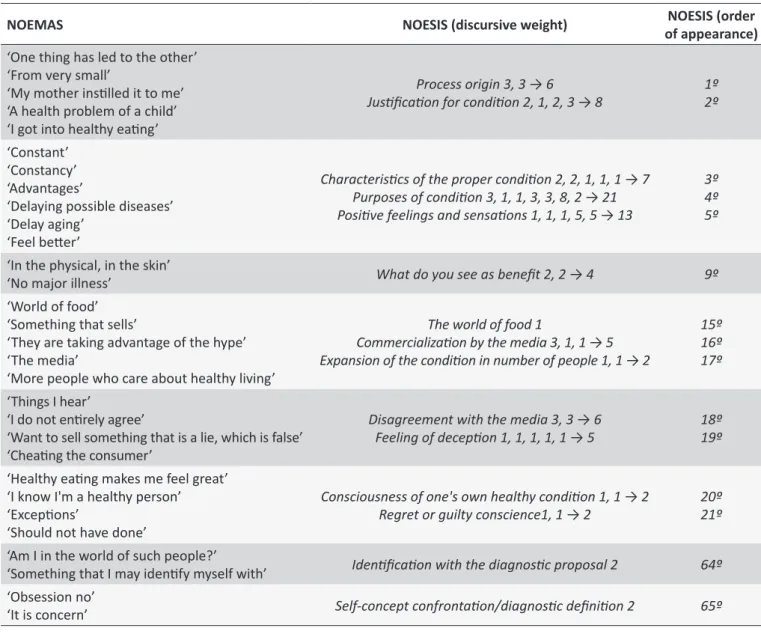
In the discovery strategy the following memorandum has been made, which has proved especially useful for identifying emerging issues, as well as their hypothetical trend in the evolution of data analysis. The memorandum has consisted of a classiication closely related to the informants' discourse, according to their words, phrases and modes of expression, for the elaboration of a noetic-noematic syntax table or correlation of noesis (forms) and noemas (contents); Establishing thematic labels for the first impressions of meaning and descriptive meanings of the phenomenon. Thus, from the initial proposal as bricolage, a series of ad hoc analytical techniques have been used, in the irst instance to facilitate to the investigator "what is
there" and "what goes with what" in the data: (I) warning patterns and themes; (II) counting; and (III) grouping the content according to the discursive weight and modes of representation (looking for underlying guidelines for the irst hypothetical associations), understanding noemas as natural discourse (natural linguistic units), and noesis (syntactic structurants) as the weight of the speech and the order of appearance based on spontaneous self-relection (repetition or return of the same subject) and fruit of the interaction between informant and researcher.38
Strategy 2: Codiication
With the coding strategy, the vague ideas and intuitions of the beginning of the research process are being polished, expanded, discarded or further developed in depth. The suggested steps for the development of this strategy, according to Taylor and Bogdan, are:29 development of coding categories, making a list with all the themes, concepts, interpretations, typologies and propositions, identiied or produced in the initial phase of discovery analysis; Coding all the data, assuming the negative and positive incidents linked to each category and, in unison, reining the coding scheme by adding, expanding, deleting and redeining the categories, making the codes plausibly it the data; separate the data belonging to each coding category; discard the remaining data after a thorough review of the data not entered in the analysis; reine the analysis taking into account the probability that some ideas and concepts will not it the data, and that some propositions lose validity, having to eliminate them and develop others more appropriate.
RESULTS
In each of the representations, the most relevant are recorded, with a process of reduction and additional selective disposal so that the results can be communicated, for extension purposes, without afecting the congruence and the amplitude of the phenomenon.
DISCUSSION
The results represented in the present study with respect to the correct appetite are in tune with some studies in which the characteristics of people with orthorexia or with a pathological inclination are indicated for the food considered healthy;23,27 that is, their ideology (what and how they think) is in line with the themes expressed in this paper "The World of Healthy Eating", "Why I Choose to Eat It" and "Absence of Inirmity as an Object of Ideal Consciousness". The set of strategies and constitutive
mechanisms of experience (what do they do), are related with the theme "A recreated optimism", as an exercise of feedback of the condition between knowledge, manipulation and consumption of natural and organic food.
With respect to the results represented by the expansion of the healthy condition in the right appetite, there is a study in which the orthorexic proile is deined as a person of high socioeconomic level and higher academic level, informed and researcher of everything in terms of food and natural and ecological food.15 This aspect tunes in with the topic "Investigating and informing", "My purchase" and "Qualifying the reliability of food".
On the other hand, there are no qualitative studies of discourse analysis, or of approximation or understanding of the experience lived by people worried about healthy eating; so that the present work contributes, as a novelty, to the subjective experience of these people.
Table 1.
Noeic-noemaic correlaion (natural linguisic units, discursive weight and order of appearance).
NOEMAS
NOESIS (discursive weight)
NOESIS (order
of appearance)
‘One thing has led to the other’
‘From very small’
‘My mother insilled it to me’
‘A health problem of a child’
‘I got into healthy eaing’
Process origin 3, 3 → 6
Jusiicaion for condiion 2, 1, 2, 3 → 8
1º
2º
‘Constant’
‘Constancy’
‘Advantages’
‘Delaying possible diseases’
‘Delay aging’
‘Feel beter’
Characterisics of the proper condiion 2, 2, 1, 1, 1 → 7
Purposes of condiion 3, 1, 1, 3, 3, 8, 2 → 21
Posiive feelings and sensaions 1, 1, 1, 5, 5 → 13
3º
4º
5º
‘In the physical, in the skin’
‘No major illness’
What do you see as beneit 2, 2 → 4
9º
‘World of food’
‘Something that sells’
‘They are taking advantage of the hype’
‘The media’
‘More people who care about healthy living’
The world of food 1
Commercializaion by the media 3, 1, 1 → 5
Expansion of the condiion in number of people 1, 1 → 2
15º
16º
17º
‘Things I hear’
‘I do not enirely agree’
‘Want to sell something that is a lie, which is false’
‘Cheaing the consumer’
Disagreement with the media 3, 3 → 6
Feeling of decepion 1, 1, 1, 1, 1 → 5
18º
19º
‘Healthy eaing makes me feel great’
‘I know I'm a healthy person’
‘Excepions’
‘Should not have done’
Consciousness of one's own healthy condiion 1, 1 → 2
Regret or guilty conscience1, 1 → 2
20º
21º
‘Am I in the world of such people?’
‘Something that I may idenify myself with’
Ideniicaion with the diagnosic proposal 2
64º
‘Obsession no’
Table 2.
Essenial nuclei of feedback/narraive memos. The geometric representaions consitute the essenial nuclei,
fed by the themes “verices”, expanding according to their discursive weight in the process of manifestaion of the
discourse.
The theme of Non-inirmity as an object of ideal consciousness seems to refer, more or less consistently, to a thought and
an ideaion in which the disease is constructed as something to be eliminated (also, due to the reiteraion and emphasis
of the informants in this idea, seems to be established primarily as basis of the condiion of concern for healthy eaing),
through a strict and complexly designed self-control: design of self-control; of which one is absolutely conscious, blurring in
the speeches a certain alliance/symbiosis between food and the mind (I feed myself mentally).
On a more collecive level, women who are concerned about healthy eaing seem to strengthen the condiion in the
community where the experience of healthy is bet and lived in the irst person (The circle of health).
These women also seem to be deined as opposites to the products and ideas sold by the media (Disagreements with
the media), generaing, in unison, A recreated opimism, reconstructed by manifesing itself through feedback of posiive
thoughts and disposiions, whether born from inside, or arising from the external world, although seemingly contrary to the
environment.
The modes of socializaion in the contexts of the healthy, in the informant women, seem to obey two more or less
contradictory aspects: on the one hand, a rich discourse appears around the ield of the experience of the healthy, in which
the experience seems to have a strong sense and desire to be expressed, informed and expanded (The circle of health); this
theme is posiively nourished by the theme Beneit to the light, which refers to aspects (physical and psychological, and
even spiritual), which are favored by the provision of healthy food.
A result of this apparent phenotypic and mental beneit, the disposiion of the informants is of communicaion, of
informaion to others, of infecing their own condiion, although not in the way that the media do (The expansion of the
healthy condiion).
This essenial theme is covered by other themes to lead and redirect the deiniion of the condiion of concern for natural
and ecological food (How are those of healthy food).
Within the Circle of healthy, the theme of A opimism recreated, by The beneit to the light and Eaing Healthy Arms seems
to be poteniated as a compendium of extensions generated from the own disposiion towards other spheres and contexts,
as conqueror of other territories, as an exit from the subjecive to the external and to the objecive; in spite of obstacles
and people who do not support or do not idenify with the phenomenon (The others who do not take care of themselves).
Around the non-inirmity seems to blur the sense (also the basis and purpose) of the condiion of these women (why the
later?). By means of a recreated opimism, fully self-produced and conscious (conscious that I eat healthy), women seem
to be described, as well as jusiied repeatedly (How are those of healthy food), to then allow to see - and be seen - as a
reward (self-validaion, self-recogniion of its good/proper performance), the result of non-inirmity, as an intermitent or
later reality (Why I choose to eat like this).
This essenial theme is consituted around a body of knowledge (ideas and concepts) about the quality, the presentaion,
the genesis and the processing of the foods, seeming to adjudicate to each type of food a surname or disincive qualiier,
represening diferent funcions and applicaions (Quality Foods, Genuine Foods and Natural Foods). The genuine food
seems to be the one culivated by oneself, knowing its enire process, to be directly consumed. The natural is the food
raised in clean contexts, without manipulaions or prosecuions; and quality food is nevertheless seen as a food that,
despite being part of a merchandising network, complies with the quality ceriicaion protocols required by the ecological
community.
The reliability raing seems to occur, in paricular, at the ime of purchase (My purchase), a circumstance in which the
decisions regarding the reliability of the products ofered seem to be taken (That food is not reliable), new generaing An
opimism recreated in that the decision making is according to some precepts and ideals of naturalness and ecologism.
The purchase is apparently deined as a moment, rather than as a recurring fact. That is to say, each purchase made is lived
as a ime in which the exhausive checking of the quality of the food (Qualifying the reliability of the food) is merged, while
censorship decisions are made (That food is not reliable), and one lives in unison a sense of deceit projected on those who
sell (supermarkets, shops, adverisements); even seems to live a feeling of decepion or betrayal by the food properly, as
long as it is not shown as the expected way (They are cheaing on you). In this sense, we choose, as far as possible, Quality
Foods and Natural Foods.
These purchasing and decision-making moments in terms of food reliability and quality seem to be condiioned and fed by
a transverse search and informaion gathering and even thorough invesigaion of ingredients, food combinaions, cooking
methods, ecological companies, among others (Invesigaing and informing).
This essenial theme seeks its links through three diferent manifestaions, apparently establishing itself as a foundaion,
and why the condiion of living concerned about natural and ecological food: on the one hand, The cradle of healthy eaing
as a nest of generaion, irst decision-making, genuine experience of the condiion within a family or a close environment
structured around healthy and ecological feeding, making the iniial world of the person The world of healthy eaing. On
the other hand, opimism is recreated as a set of mechanisms (experienial consituional strategies) that lead and are led
to more expression, to strengthen belief in the condiion, making it irmer and more visible (more ethical?) (Beneit of the
light) in common sense of The circle of health as a chronotope of reproducion and expansion of the condiion, in which
also emerge contradictory provisions that invite the rethinking of ideas, as well as the appearance of gestures of frustraion
or more efort and emphasis on food control (Disagreements with the media) to achieve the situaion of non-disease (Non
inirmity as an object of ideal consciousness).
The core of research and informaion seems to emerge transversally in the discourse of women, resorted to arguing the
provision of the purchase, while being prepared and while decepion is lighter and security at the ime to decide what to
buy is more pronounced (My purchase). Adequate and suicient informaion seems to favor the link with other people
interested in/in the world of healthy eaing (The socializaion in the healthy), favoring in unison the feedback of the healthy
circle, spaces where experiences are also shared, advices are give and recommendaions to each other made, increasing the
body of knowledge and ideas around the experience.
The fact of having an ambiious disposiion to recognize and know about the condiion and of the food itself seems to
generate, when expectaions are not fulilled, Conscience charge, which is appeased by a more demanding modiicaion in
diet or physical exercise (Compensaion as channeling diversion), thus becoming clearer A recreated opimism.
At the ime that is available the search for informaion and invesigaion on the part of these women, emerges a subject
which, although it is not feedbacked the most, manifests itself in a diverse way, that is, in many subjects. Having an
awareness of a well-rooted healthy condiion (Being aware that I eat healthy) seems to lead to a gradual and irregular
dilaion of the condiion in the immediate environment, making the woman in quesion a focus of atenion and
protagonism (The family clinic eye); as well as more or less ofensive consideraions and opinions within the socializaion
itself (Socializaion in health, sigmaizing opinion?); and other more construcive comments, although it is not clear
whether with a certain disposiion of envy of the others towards the women (The beneit to the light).
The world of healthy food seems to evolve, as an expression and manifestaion of the experience of women, as an
expansion: embracing the environment; waning to compromise and convince morally and poliically the environment
(Arms of healthy eaing), placing it as a vicim of convenional mercanilizaion of health (Markeing as a pandemic resource
of ideals).
Opimism (expressed through strategies and gestures of self-control, food correcion, irm beliefs in the condiion, etc.), is
shown above all associated with a remarkable mental disposiion in which one is conscious and one assumes the condiion
despite of the limits and criicisms of the environment (family or society) (Being aware that I eat healthy). This feeling
of opimism (which can also be termed as a non-surrender, a reairmaion (an obsession?), emerges more stable in the
circle of health, allowing also, more expansively and reciprocally to describe similar people or of the same condiion (How
are those of healthy food), in order to aspire (delaying, avoiding, evading, not waning the real situaion of illness - in the
present or in the past, of some close person or even of the world in general), to an idealized situaion more or less lax in
ime, although projected in a rather distant future, of non-disease (non inirmity as an object of ideal consciousness).
Coninued Table 2.
The limitation that arises when comparing studies on the same phenomenon (orthorexia) must be assumed, based on the fact that the studies published until the present are of a quantitative nature and not elaborated from a constructivist paradigm. Thus, on the one hand, there is a gradual and, in the last years, more drastic growth of epidemiological studies that expose the prevalence of the orthorexic condition through the application of the Bratman test, with a diagnostic orientation;18,40-42 while analyzing subjective experience, there is a clear instability, which generates ambiguity, which invites us to think of the inadequacy of the construct, as a term and as a meaning whose attributes are "social stigmatization" and "obsession as a deining
characteristic of the condition". In this sense, from the present study, consideration of the correct appetite as pathology leaves breach for questioning.
On the other hand, orthorexia, either as a preoccupation or as an extreme obsession with healthy eating, is bordering on obsessive-compulsive disorder, anorexia and selective food disorders.24,43,44 The present study can help to clear those limits and know more deeply the condition of living concerned about healthy eating.
The consumption of organic food evolves increasingly, tending to normalization in certain social groups involved in ecological movements and ideologies. This data can intervene in the standardization of the condition of concern for an ecological diet; despite the struggle in its expansion, for being minority groups but increasingly visible and distributed. This argument tunes in with the theme manifested in this work "The expansion of the healthy condition".
As for the limitations of the present study, comparisons cannot be made with similar studies, since they are not available. As far as access to the ield of work is concerned, the establishment of conidence and necessary rapport has taken a long time, having to bypass data sources, Having to bypass sources of data that, being through the ield, have not been accessible again; and also assuming laborious analytical work simultaneously to the collection of the data. This has meant that the sampling done was more by purpose than theoretical.
Finally, some of the themes represented in the results ("Being aware that I eat healthy", "Arms of healthy eating/Marketing as a pandemic resource of ideals" and "Absence of disease as an object of ideal consciousness") although described, still invite to be perfected and more deeply understood, ofering a ield of inquiry in the experience of women informants: to penetrate in the sense of "conventional" ideals, in the "conscious" disposition of the condition and in "non-inirmity" as complex conceptions attributable to correct appetite. The theoretical point that should be studied with more depth in the future would be the expansion of the healthy condition, located in the midst of the turbulence of conventional society, a victim of health as a commercialized product and as a violated right.
CONCLUSIONS
The experience of women who are preoccupied with a natural and ecological diet is constituted by a thematic experiential ield or subjective/interior experience that traverses their historicity (past, present and future imagined): "Why I choose to eat like this", "Optimism Recreated" and "No illness as an object of ideal consciousness", respectively. "The expansion of the healthy condition" is the exercise that identifies and progresses irregularly, dilating and retracting the condition of the right appetite in the environment, through "Arms of healthy eating/Marketing as a pandemic resource of ideals", "Beneit in the light" and "The family clinic eye: stigmatizing opinion?".
Consideration of orthorexia as a pathology is associated, apart from established biomedical criteria, with social stigma-tization and diiculties of socialization, because it possesses ideologies and idiosyncratic ways of living alimentation. As a term, orthorexia is relatively ofensive in producing resonances of other food conditions such as anorexia or vigorexia.
The constitutive strategies of the experience are concen-trated in "a recreated optimism", in an introspective exercise and self-relection ("How are those of the healthy food") and also within "The circle of health", with the provision/predisposi -tion of "Being aware that I eat healthy". The global and holistic perspective of understanding, from nursing to the phenom-enon of right appetite, allows for a deeper approximation, and to contemplate the meanings attributed by women to the subjective experience of their condition. Thus, the qualitative evidence makes possible an approximation to the afectivity and to the psychosocial processes, to the culture of care in the right appetite, from the deep and extensive analysis of their experiential discourses.
REFERENCES
1. Cuevas J. La imagen como mercancía: promoción y negación de la imagen técnica. [Internet]. 2nd ed. Actas IV CILCS; 2014 [cited 2016 Apr 13]. Available from: http://www.revistalatinacs.org/14SLCS/2014_ actas/056_Cuevas.pdf
2. González Ibáñez E. Ruido visual: la saturación de imágenes en la contemporaneidad. AusArt Journal for Research in Art [Internet]. 2015 [cited 2016 Feb 14]; 3(2): 230-231. Available from: http://www.ehu.eus/
ojs/index.php/ausart/article/view/15964/14190
3. Martínez Fernández VA, Juanatey Boga O y Costa Sánchez C. Agenda Setting y crisis económica: inluencia de la prensa en el comportamiento de consumo y ahorro. Estudios sobre el Mensaje Periodístico [Internet]. 2012 [cited 2016 Jun 23]; 18(1): 147-149. Available from: http://revistas. ucm.es/index.php/ESMP/article/view/39362/37908
4. Vaquero-Cristóbal R, Alacid F, Muyor JM y López-Miñarro PA. Imagen corporal; revisión bibliográica. Nutrición Hospitalaria [Internet]. 2013 [cited 2016 Jan 23]; 28(1): 27-35. Available from: http://scielo.isciii.es/
pdf/nh/v28n1/04revision04.pdf
5. Ortíz Sánchez LM. Cuerpos e identidades on line: construcción de identidades corporales en el chat. Colombian Applied Linguistics Journal [Internet]. 2013 [cited 2016 Jan 23]; 15(2): 302-309. Available from: http://revistas.udistrital.edu.co/ojs/index.php/calj/article/
view/5136/6746
6. Cortes JMM, Sanz NA, Godoy P, Moros MJS, Portero RC, Moran FG, et al. Las enfermedades crónicas como prioridad de la vigilancia de la salud pública en España. Gaceta Sanitaria [Internet]. 2016 [cited 2016 Jul 22]; 30(2): 154-157. Available from: http://www.sciencedirect.com/
science/article/pii/S021391111500254X
7. Sánchez Martínez S, Rico Cano A y Ferrer Moreno CM. El estilo de vida nos deine: dieta y cáncer. Salud y Cuidados en el Envejecimiento: Alimentación y Envejecimiento [Internet]. 2015 [cited 2016 Feb 28]; 3: 25-32. Available from: http://formacionasunivep.com/documents/ publicaciones/salud-y-cuidadores-en-el-envejecimiento-volumenIII.
pdf#page=26
8. Martínez Guirao JE. Construyendo los cuerpos "perfectos". Implicaciones culturales del culto al cuerpo y la alimentación en la vigorexia. Universitas [Internet]. 2014 [cited 2016 Jan 23]; 21: 77-99. 9. Romero Croce J. El malestar actual de la cultura y la martirización
del cuerpo. Psicología y Salud [Internet]. 2012 [cited 2016 Apr 15]; 22(2): 205-214. Available from: http://www.uv.mx/psicysalud/ psicysalud-22-2/22-2/Jes%FAs%20Romero%20Croce.pdf
10. Martín M y Torres M. Imágenes e imaginarios en el espacio público virtual: apuntes para una agenda de investigación. Razón y Palabra [Internet]. 2013 [cited 2016 Mar 16]; 18(82). Available from: http://www.
11. De Vogli R, Kouvonen A y Gimeno D. La inluencia de la desregulación del mercado en el consumo de comida rápida y el índice de masa corporal: un análisis de series temporales entre países. Boletín de la Organización Mundial de la Salud [Internet]. 2014 [cited 2015 Cec 30]; 92(2): 77-152. Available from: http://www.who.int/bulletin/
volumes/92/2/13-120287-ab/es/
12. Peñaiel C, Camacho I y Pastor J. Estudio de las Webs de información de salud en español y euskera dirigidas a jóvenes y adolescentes. Actas V Congreso Internacional Latina de Comunicación Social [Internet]. 2013 [cited 2016 Jan 12]. Available from: http://www.revistalatinacs. org/13SLCS/2013_actas/082_Penaiel.pdf
13. CFK. Caracterización de la tipología y peril sociodemográico del consumidor de alimentos ecológicos en España. Ministerio de Agricultura, Alimentación y Medio Ambiente. Peril del Consumidor de Alimentos Ecológicos en España [Internet]. 2014. Available from http://
www.magrama.gob.es/es/alimentacion/temas/laagriculturaecologica/
estudioperilconsumidorecologico2014_tcm7-346684.pdf
14. Bratman S y Knight D. Health Food Junkies. Ortorexia nervosa: overcoming the obsession with healthful eating. Estados Unidos: Broadway Books; 2000. p. 25-38.
15. Varga M, Dukay-Szabó S, Túry F y van Furth EF. Evidence and gaps in the literature on orthorexia nervosa. Eat Weight Disord [Internet]. 2013 [cited 2016 Apr 14]; 18(2): 103-11. Available from: https://www.ncbi.
nlm.nih.gov/pubmed/23760837
16. Cabanach Mané C y López Medina MD. Ortorexia: de sana inquietud a patología. Metas de Enfermería [Internet]. 2009 [cited 2016 Feb 14]; 12(6): 14-19. Available from: https://dialnet.unirioja.es/servlet/ articulo?codigo=3007849
17. Varga M, Dukay-Szabo S y Túry F. Orthorexia nervosa and it's background factors. Ideggyogy Sz [Internet]. 2013 [cited 2016 Marc 21]; 66(7-8): 220-227. Available from: https://www.ncbi.nlm.nih.gov/
pubmed/23971352
18. Bo S, Zoccali R, Ponzo V, Soldati L, De Carli L, Benso A, et al. University courses, eating problems and muscle dysmorphia: are there any associations? J Transl Med [Internet]. 2014 [cited 2016 Apr 13]; 12: 221. Available from: https://www.ncbi.nlm.nih.gov/pmc/articles/ PMC4256707/
19. Segura-García C, Papaianni MC, Caglioti F, Procopio L, Nisticò CG, Bombardiere L, et al. Orthorexia nervosa: a frequent eating disordered behavior in athletes. Eat Weight Disord [Internet]. 2012 [cited 2016 Apr 18]; 17(4): 226-33. Available from: https://www.ncbi.nlm.nih.gov/
pubmed/22361450
20. Hepworth K. Eating disorders today-not just a girl thing. J Christ Nurs [Internet]. 2010 [cited 2016 Feb 15]; 27(3): 236-241. Available from: https://www.ncbi.nlm.nih.gov/pubmed/20632480
21. Arusoğlu G, Kabakçi E, Köksal G y Merdol TK. Orthorexia nervosa and adaptation of ORTO-11 into Turkish. Turk Psikiyatri Derg [Internet]. 2008 [cited 2016 Jan 24]; 19(3): 283-291. Available from: https://www.ncbi. nlm.nih.gov/pubmed/?term=Orthorexia+nervosa+and+adaptation+of +ORTO-11+into+Turkish
22. Ramacciotti CE, Perrone P, Coli E, Burgalassi A, Conversano C, Massimetti G, et al. Orthorexia nervosa in the general population: a preliminary screening using a selfadministered questionnaire (ORTO-15). Eat Weight Disord [Internet]. 2011 [cited 2016 Mar 25]; 16(2): 127-130. Available from: https://www.ncbi.nlm.nih.gov/pubmed/21989097 23. Håman L, Barker-Ruchti N, Patriksson G y Lindgren EC. Orthorexia
nervosa: An integrative literature review of a lifestyle syndrome. Int J Qual Stud Health Well-being [Internet]. 2015 [cited 2016 Jun 16]; 10 (2): 67-99. Available from: https://www.ncbi.nlm.nih.gov/pmc/articles/ PMC4539385/
24. Musolino C, Warin M, Wade T y Gilchrist P. Healthy anorexia: The complexity of care in disordered eating. Soc Sci Med [Internet]. 2015 [cited 27 Jan 2016]; 139: 18-25. Available from: https://www.ncbi.nlm.
nih.gov/pubmed/26150064
25. Barnes MA y Caltabiano ML. The interrelationship between orthorexia nervosa, perfectionism, body image and attachment style. Eat Weight Disord [Internet]. 2016 [cited 2016 Jun 28]; 11. Available from:
https://www.ncbi.nlm.nih.gov/pubmed/?term=The+interrelationship+ between+orthorexia+nervosa
26. Janas-Kozik M, Zejda J, Stochel M, Brozek G, Janas A y Jelonek I. Orthorexia: a new diagnosis? Psychiatr Pol [Internet]. 2012 [cited 2016 May 22]; 46(3): 441-450. Available from: https://www.ncbi.nlm.nih.gov/
pubmed/23045897
27. Koven NS y Abry AW. The clinical basis of orthorexia nervosa: emerging perspectives. Neuropsychiatr Dis Treat [Internet]. 2015 [cited 2016 Jan 30]; 11: 385-394. Available from: https://www.ncbi.nlm.nih.gov/pmc/ articles/PMC4340368/
28. Ferrer Lues M. Relexiones sobre la concepción de la salud como responsabilidad individual. Construyendo bioética en salud pública. Bioética y Sociedad en Latinoamérica. Fundación Interamericana Ciencia y Vida. 2012; 1: 111-115.
29. Taylor SJ y Bogdan R. Introducción a los métodos cualitativos de investigación. Barcelona: Paidós; 1987. p. 11-15.
30. Pedraz Marcos A, Zarco Colón J, Ramasco Gutiérrez M y Palmar Santos AM. Investigación Cualitativa. Colección Cuidados de Salud Avanzados. Madrid: Elsevier; 2014. p. 12-20.
31. León OG y Montero I. Métodos de investigación en Psicología y Educación. Las tradiciones cuantitativa y cualitativa. Madrid: McGraw Hill; 2015. p. 430-580.
32. Husserl E. Meditaciones cartesianas. México: FCE; 1996. p. 48-63. 33. Husserl E. Investigaciones Lógicas, 2. Madrid: Alianza editorial; 2002.
p. 28-54.
34. Schütz A. Fenomenología del mundo social. Buenos Aires: Paidós;
1972. p. 12-19.
35. Morse JM y Richards L. Readme irst for a user´s guide to qualitative methods. Thousand Oaks: Sage Publications; 2002. p. 49-55. 36. Field PA y Morse JM. Nursing Research. The application of Qualitative
Approaches. London: Chapman & Hall; 1994. p. 23-41.
37. Polit DF y Tanato Beck C. Nursing Research. Principles and methods. Philadelphia: Lippincott Williams & Wilkins; 1995. p. 9-14.
38. Kvale S. Las entrevistas en Investigación Cualitativa. Madrid: Morata;
2011.
39. Miles MB y Huberman AM. An expanded sourrcebook. Qualitative data analysis. Thousand Oaks: Sage Publications; 1994. p. 29-44. 40. Alvarenga MS, Martins MC, Sato KS, Vargas SV, Philippi ST y Scagliusi
FB. Orthorexia nervosa behavior in a sample of Brazilian dietitians assessed by the Portuguese version of ORTO-15. Eat Weight Disord [Internet]. 2012 [cited 2016 Jan 14]; 17(1): 29-35. Available from: https://
www.ncbi.nlm.nih.gov/pubmed/22751269
41. Varga M, Thege BK, Dukay-Szabó S, Túry F y van Furth EF. When eating healthy is not healthy: orthorexia nervosa and its measurement with the ORTO-15 in Hungary. BMC Psychiatry [Internet]. 2014 [cited 2016 Jan 18]; 28(14): 59. Available from: https://www.ncbi.nlm.nih.gov/ pmc/articles/PMC3943279/
42. Asil E y Sürücüoğlu MS. Orthorexia Nervosa in Turkish Dietitians. Ecol Food Nutr [Internet]. 2015 [cited 2016 Mar 22]; 54(4): 303-313. Available from: https://www.ncbi.nlm.nih.gov/pubmed/25602930
43. Kummer A, Dias FM y Teixeira AL. On the concept of orthorexia nervosa. Scand J Med Sci Sports [Internet]; 2008 [cited 2015 Dec 27]; 18(3): 395-396. Available from: https://www.ncbi.nlm.nih.gov/pubmed/18435688 44. Dell'Osso L, Abelli M, Carpita B, Pini S, Castellini G, Carmassi C
y Ricca V. Historical evolution of the concept of anorexia nervosa
and relationships with orthorexia nervosa, autism, and
obsessive-compulsive spectrum. Neuropsychiatric Disease and Treatment [Internet]. 2016 [cited 2016 Jul 11]; 12:1651-1660. Available from: http:// www.ncbi.nlm.nih.gov/pmc/articles/PMC4939998/pdf/ndt-12-1651.pdf 45. Alonso LE, Fernández Rodríguez CJ e Ibáñez Rojo R. Crisis y nuevos
patrones de consumo: discursos sociales acerca del consumo ecológico en el ámbito de las grandes ciudades españolas. Empiria: Revista de Metodología de Ciencias Sociales [Internet]. 2014 [cited 2016 Jul 25]; 29: 13-38. Available from: http://revistas.uned.es/index.