SURGICAL TECHNIQUE
423
Fournier’s gangrene - delayed pedicle flap based upon the
anterior abdominal wall
_______________________________________________
Ania Sliwinski
1, Liam E. Kavanagh
1, Damien Bolton
1, Nathan Lawrentschuk
1, John G. Crock
21Department of Urology, University of Melbourne, Austin Hospital and 2Department of Surgery, Monash University, Melbourne, Victoria, Australia
ABSTRACT
ARTICLE
INFO
______________________________________________________________ ______________________
Introduction: Fournier’s gangrene is a poly-microbial necrotizing fasciitis that involves the perineum and/or external genitalia. Urgent surgical debridement is well recognized as essential acute treatment yet unique challenges arise for plastic surgical reconstruc-tion to obtain a complete funcreconstruc-tional recovery. This case describes a successful delayed pedicle flap repair based upon the anterior abdominal wall.
Case description: A 24 year old man was admitted to ICU ten days after elective circu-mcision with Fournier’s gangrene. He underwent a number of surgical debridements, and was referred for plastic surgical management. He had penile reconstruction using a random pattern abdominal flap, which was performed as a three stage procedure including flap vascular delay technique.
Discussion: Perineal and penile skin loss can be significant and is difficult to repair. Various techniques have been used to reconstruct lost tissue: skin grafts, transposition of the testes and spermatic cords to the thigh, flaps, and other types of pediculated myocutaneous flaps. Muscle flap reconstruction provides an environment that allows for complete regeneration of the urethral epithelium but is bulky and unsightly. Skin grafts contract and may produce painful and dysfunctional reconstructions. This novel technique produces a functional, and aesthetic reconstruction.
Conclusion: Penile skin recovery following Fournier’s gangrene recovery is problema-tic. This case demonstrates the functionality of a delayed flap repair using the anterior abdominal wall.
Key words:
Fournier Gangrene; Surgical Flaps; Abdominal Wall
Int Braz J Urol. 2014; 40: 423-6
_____________________
Submitted for publication: July 12, 2013
_____________________
Accepted after revision: October 09, 2013
INTRODUCTION
Fournier’s gangrene is a poly-microbial ne-crotizing fasciitis that involves the perineum and/ or external genitalia. Management involves urgent surgical debridement, which will usually need to be repeated, and may extend to total scrotectomy, and less commonly penectomy and colostomy. This case describes a successful delayed pedicle flap repair based upon the anterior abdominal wall.
Case presentation
A 24 year old man underwent a circum-cision for “prophylactic hygiene reasons”. Several days after surgery he developed pain and swelling, then became unwell and was admitted with sepsis at ICU with a fulminating infection and suppurative tissue necrosis. He underwent a series of emergency debridement. Three weeks after his acute infection he was referred for plastic surgical intervention.
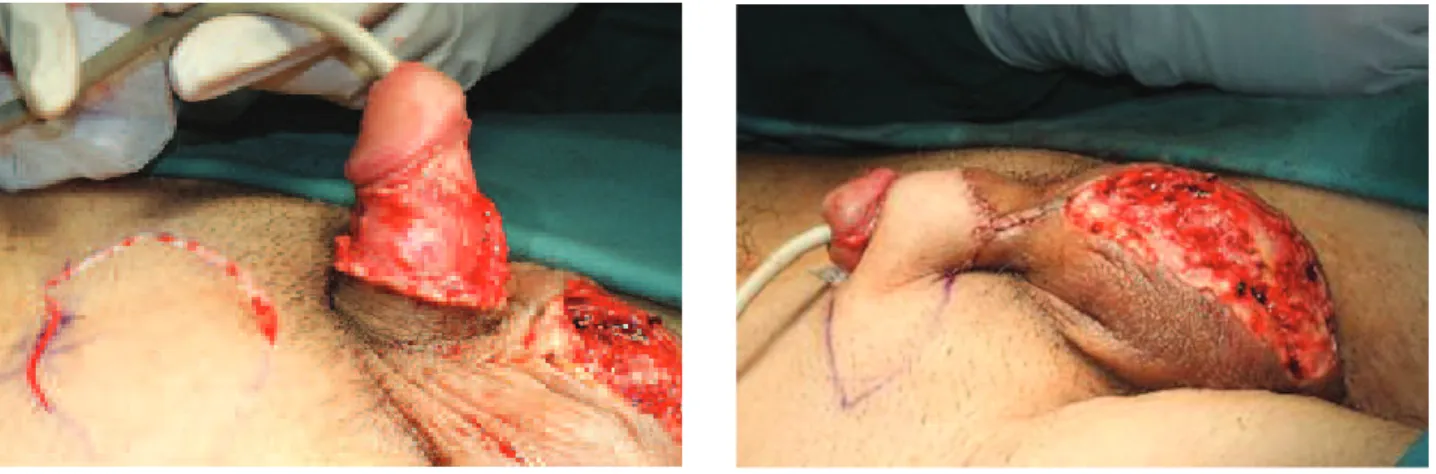
Under general anaesthesia the penile skin and scrotum were further debrided (Figure-1). The
Vol. 40 (3): 423-426, May - June, 2014
IBJU| FOURNIER’S GANGRENE - SUCCESSFUL DELAYED PEDICLE FLAP REPAIR
424
flap was patterned on an imprint of the penile defect, and the template marked on the abdomen with surgical ink (Figures 2 and 3). The penile shaft was exposed, and then it was buried under a large random pattern flap centred over the mi-dline raphe of the abdomen (Figure-4). Once half the flap had been raised and inset onto the penis using 5/0 vicryl rapide sutures, the operation was terminated.One week later the patient was taken back to theatre and the second half of the flap was de-layed. A well established and well described plas-tic surgical procedure, the flap is raised and inset back into its own donor site without transposition or thinning; this is achieved by making an inci-sion around the surgical ink marked lines and le-aving the flap in situ, hle-aving been islanded.
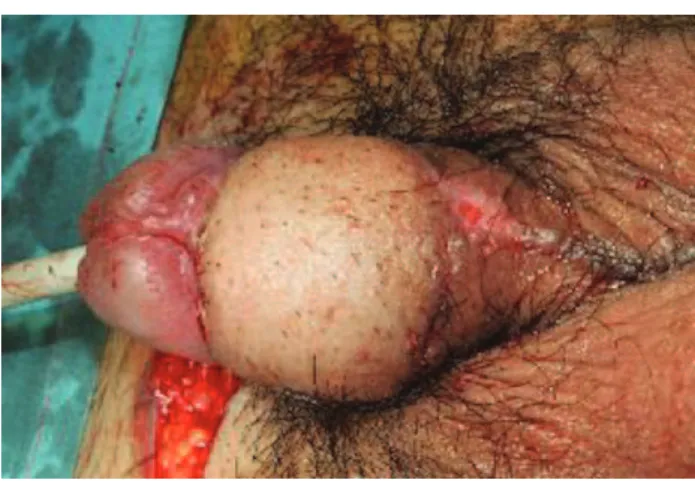
Over the ensuing 7 to 10 days, neovas-cularisation occurs which renders the flap more robust and it can then be formally raised and inset around the penile (Figure-5) shaft and the reconstruction dressed with a soft silicone prima-ry wound dressing(Mepitel®, Molnlycke, Gothen-burg, Sweden) and gauze. The scrotal skin was able to be advanced over the exposed testicles, closing this defect primarily. IV antibiotics were administered and the patient was kept in hospital for a further 4 days.
He was then discharged home for follow--up as an out-patient. Wound healing was largely uneventful, but a hydrocolloid dressing was requi-red to facilitate healing of 5mm of the junction of the wrap around the dorsum of the penile shaft. This did not compromise the reconstruction.
Figure 1 - Defect after debridement.
Figure 2 - Outlining the area of anterior abdominal wall for flap repair.
Figure 3 - Ensuring that site and area of flap are appropriate.
IBJU| FOURNIER’S GANGRENE - SUCCESSFUL DELAYED PEDICLE FLAP REPAIR
425
Three months after the final surgery he was able to be sexually active with no pain and minimal deformity, with a very satisfactory aesthetic as well as functional result. This final photo demonstrates his recovery at one year post-op with the penis in the flaccid state. Full erection with no deformity was possible at this time (Figure-6).DISCUSSION
Fournier’s gangrene is an urological emergency with current mortality rates reported
as 4-43% (1-6). It is a poly-microbial necrotizing fasciitis that involves the perineum and/or exter-nal genitalia.
It was initially described by Fournier as an idiopathic condition, but the majority have aetio-logy involving urogenital or ano-rectal infection and/or trauma (5). Men are ten times more likely to develop this condition; other risk factors inclu-de age, diabetes mellitus, immunoinclu-deficiency and alcoholism (2,5).
Most presentations include perianal/scro-tal pain and swelling, as well as purulent dischar-ge, crepitus and fever. Although considered to be rapidly progressive, reported interval from onset to presentation is 2-8 days (2,6).
Management involves urgent surgical de-bridement, which will usually need to be repea-ted, and often extended to total scrotectomy, and less commonly penectomy and colostomy (1,2). The testes are rarely if ever compromised and may even be left exposed to allow tissue to granula-te over. Fluid resuscitation, which may include blood transfusion, is often required, especially in those with signs of sepsis. Swabs should be taken promptly before empiric broad-spectrum antibio-tics are commenced.
Perineal and penile skin loss can be sig-nificant and in general is difficult to repair. Va-rious techniques have been used to reconstruct the debrided tissue: skin grafts, transposition of the testicles and spermatic cords to a subcutaneous pocket in the upper thigh, fasciocutaneous flaps, scrotal musculocutaneous flaps, and other types of pediculated myocutaneous flaps (2). Muscle flap reconstruction provides an environment that allows for complete regeneration of the urethral epithelium (7).
Unfortunately most reconstructions will not enable the patient to regain adequate pene-trative sexual function. Thigh flaps utilized may be bulky causing penile shaft distortion and are often reserved for much larger defects (8,9). In the present case the scrotal skin was able to be closed directly which offered a much more aesthetically pleasing outcome. Furthermore, in the case of grafts, marked contractures often result produ-cing painful erections. This is the first report of a delayed wrap-around skin flap which has the
Figure 6 - One year post operatively
IBJU| FOURNIER’S GANGRENE - SUCCESSFUL DELAYED PEDICLE FLAP REPAIR
426
benefit of providing excellent soft tissue cover to the penile shaft, neither too bulky nor prone to scar contractures. It is a stable, supple, flexible but durable reconstruction that allows full return of function. It is also aesthetically satisfactory.The concept of such a graft is not novel with the delay phenomenon first described in 1975 by Myers (10). This concept results in tissue engi-neering with neovascularization of the flap, with increased survival of the flap and surgical success. The vascular physiology of delay flaps has been explored thoroughly (11-15). This technique has been used effectively in various areas of plastic and reconstructive surgery (16,17).
Because the flap contains hair bearing skin, the reconstruction has to be manipulated to ren-der the shaft skin hairless. This is performed simply by initially depilating the area (rendering the hair follicles superficial) and later by laser hair removal. This was successfully performed in this case.
CONCLUSIONS
Fournier’s gangrene recovery is problema-tic, especially the plastic surgical management of penile and scrotal skin loss. This case demonstra-tes the functionality of a delayed flap repair using the anterior abdominal wall.
CONFLICT OF INTEREST
None declared.
REFERENCES
1. Corman JM, Moody JA, Aronson WJ: Fournier’s gangrene in a modern surgical setting: improved survival with aggressive management. BJU Int. 1999; 84: 85-8.
2. Ersay A, Yilmaz G, Akgun Y, Celik Y: Factors affecting mortality of Fournier’s gangrene: review of 70 patients. ANZ J Surg. 2007; 77: 43-8.
3. Luján Marco S, Budía A, Di Capua C, Broseta E, Jiménez Cruz F: Evaluation of a severity score to predict the prognosis of Fournier’s gangrene. BJU Int. 2010; 106: 373-6.
4. Sorensen MD, Krieger JN, Rivara FP, Klein MB, Wessells H: Fournier’s gangrene: management and mortality predictors in a population based study. J Urol. 2009; 182: 2742-7.
5. Eke N: Fournier’s gangrene: a review of 1726 cases. Br J Surg. 2000; 87: 718-28.
6. Yeniyol CO, Suelozgen T, Arslan M, Ayder AR: Fournier’s gangrene: experience with 25 patients and use of Fournier’s gangrene severity index score. Urology. 2004; 64: 218-22. 7. Beckenstein M, Smith AA, Dinchman K, Wyatt-Ashmead
J, Meland NB: Muscle flap reconstruction aids in urethral regeneration. Ann Plast Surg. 1996; 36: 641-3.
8. Atik B, Tan O, Ceylan K, Etlik O, Demir C: Reconstruction of wide scrotal defect using superthin groin flap. Urology. 2006; 68: 419-22.
9. Coruh A, Akcali Y, Ozcan N, Ekmekcioglu O: Modified pudendal thigh flap for perineoscrotal reconstruction: a case of Leriche syndrome with rapidly progressingFournier’s gangrene. Urology. 2004; 64: 1030.
10. Myers M: Attempts to Augment Survival in Skin Flaps: Mechanism of the Delay Phenomenon. Skin Flaps. M. M. Grabb WC. Boston, Little. (1975).
11. Taylor GI, Caddy CM, Watterson PA, Crock JG: The venous territories (venosomes) of the human body: experimental study and clinical implications. Plast Reconstr Surg. 1990; 86: 185-213.
12. Callegari PR, Taylor GI, Caddy CM, Minabe T: An anatomic review of the delay phenomenon: I. Experimental studies. Plast Reconstr Surg. 1992; 89: 397-407; discussion 417-8. 13. Morris SF, Taylor GI: The time sequence of the delay
phenomenon: when is a surgical delay effective? An experimental study. Plast Reconstr Surg. 1995; 95: 526-33. 14. Dhar SC, Taylor GI: The delay phenomenon: the story
unfolds. Plast Reconstr Surg. 1999; 104: 2079-91.
15. Watterson PA, Taylor GI, Crock JG: The venous territories of muscles: anatomical study and clinical implications. Br J Plast Surg. 1988; 41: 569-85.
16. Atisha D, Alderman AK, Janiga T, Singal B, Wilkins EG: The efficacy of the surgical delay procedure in pedicle TRAM breast reconstruction. Ann Plast Surg. 2009; 63: 383-8. 17. Kroll SS: Forehead flap nasal reconstruction with tissue
expansion and delayed pedicle separation. Laryngoscope. 1989; 99: 448-52.
_______________________ Correspondence address: