Diagnostic Ureteroscopy for Upper Tract Urothelial
Carcinoma is Independently Associated with Intravesical
Recurrence after Radical Nephroureterectomy
_______________________________________________
Pei Liu
1, Xiao-hong Su
1, Geng-Yan Xiong
1, Xue-Song Li
1, Li-Qun Zhou
11 Department of Urology, Peking University First Hospital, Institute of Urology, Peking University, National
Urological Cancer Center, Beijing, China
ABSTRACT
ARTICLE
INFO
______________________________________________________________ ______________________
Purpose: To determine the effect of diagnostic ureteroscopy on intravesical recurrence in patients with upper tract urothelial carcinoma (UTUC) after radical nephroureterec-tomy (RNU).
Materials and Methods: We conducted a retrospective analysis of 664 patients who were treated with RNU for UTUC from June 2000 to December 2011, excluding those who had concomitant/prior bladder tumors. Of the 664 patients, 81 underwent di-agnostic ureteroscopy (URS). We analyzed the impact of didi-agnostic ureteroscopy on intravesical recurrence (IVR) using the Kaplan-Meier method. Univariate and multi-variate analyses were used to determine the independent risk factors.
Results: The median follow-up time was 48 months (interquartile range (IQR): 31-77 months). Patients who underwent ureteroscopy were more likely to have a small (p<0.01), early-staged (p=0.019), multifocality (p=0.035) and ureteral tumor (p<0.001). IVR occurred in 223 patients during follow-up within a median of 17 months (IQR: 7-33). Patients without preoperative ureteroscopy have a statistically significant better 2-year (79.3%±0.02 versus 71.4%±0.02, p<0.001) and 5-year intravesical recurrence-free survival rates (64.9%±0.05 versus 44.3%±0.06, p<0.001) than patients who un-derwent ureteroscopy. In multivariate analysis, the diagnostic ureteroscopy (p=0.006), multiple tumors (p=0.001), tumor size <3cm (p=0.008), low-grade (p=0.022) and pN0 stage tumor (p=0.045) were independent predictors of IVR.
Conclusions: Diagnostic ureteroscopy is independently associated with intravesical re-currence after radical nephroureterectomy.
Keywords:
Ureteroscopy; Oncology; Bladder; Ureter; Urinary Tract
Int Braz J Urol. 2016; 42: 1129-35
_____________________ Submitted for publication: July 09, 2015
_____________________ Accepted after revision: February 29, 2016 _____________________ Published as Ahead of Print: August 17, 2016
INTRODUCTION
Upper tract urothelial carcinoma (UTUC) is rare and accounts for only 5-10% of urothelial carcinoma cases, with an annual incidence of 1-2 cases per 100.000 in Western countries (1-3). Ra-dical nephroureterectomy (RNU) with bladder cuff excision is the gold standard for managing UTUC
(4). The incidence of subsequent intravesical re-currence (IVR) following RNU is 22-47%, which means a close follow-up using cystoscopy is re-quired to detect the high incidence of IVR (5, 6).
management, T stage, grade, carcinoma in situ, and history of bladder cancer (7). With the development of medical devices, diagnostic ureteroscopy is becoming a powerful tool for patients with UTUC, which could contribute to the diagnostic certainty and decision making regarding treatment options. The European guidelines suggest that diagnostic ureteroscopy should be performed in the preoperative assessment of any UTUC patient (Grade C) (8). Concerns, however, have been raised that there is a possible risk of tumor implantation during ureteroscope manipulation and irrigation (9).
To the best of our knowledge, previous studies are sparse, and there is no consistent con-clusion on the impact of diagnostic ureteroscopy for intravesical recurrence (9-11). Therefore, we conducted this study, based on data from a large center in China, to determine whether diagnostic ureteroscopy results in IVR after RNU.
MATERIALS AND METHODS
The follow-up data of patients with UTUC who were treated with RNU at Peking University First Hospital, Beijing, China, from June 2000 to December 2011 were reviewed. Out of 892 patients submitted to RNU in our service we selected 753 with complete FU information. Among these 753 patients, we excluded 82 patients with concomi-tant/prior bladder tumors, 6 patients with bilateral UTUC, and 1 patient with distant metastasis. The-refore, 664 patients were included in this study. None of these patients received neoadjuvant or adjuvant chemotherapy.
Of 664 patients, 583 in the control group were diagnosed by CT/MRI, urinary cytology spe-cimens and retrograde pyelography. Eighty-one patients underwent diagnostic ureteroscopy and were included in the study group. Diagnostic ure-teroscopy is especially used when there is diag-nostic uncertainty or when conservative treatment is being considered, but there are no standardized prospective criteria. Chest X-ray and preoperative cystoscopy were performed in all patients to rule out metastasis and concomitant bladder tumors.
All patients underwent retroperitone-al open or laparoscopic nephroureterectomy. In all cases, the ureter was ligated immediately
af-ter control of the renal araf-tery without dissecting around the kidney. The distal ureter and bladder cuff were all managed by extravesical dissection and the intramural portion within the bladder wall through an open Gibson incision. A regional lymph node dissection was performed in case of suspicious lymph node invasion on preoperative imaging or intraoperative examination.
The clinicopathologic data were retrospec-tively recorded. All tumors were graded by the World Health Organization classification of 2004 and staged by the Union for International Cancer Control TNM classification of malignant tumors 2002. The tumor location was defined as renal pelvis or ureter, and tumor multifocality was de-fined as the presence of two or more macroscopic tumors in the upper urinary tract.
During follow-up, patients received cys-toscopy every 3 months for the first 2 years, whi-ch extended to 1 year thereafter. Serum creatinine level, chest X-ray and CT or MRI were performed simultaneously.
All statistical data were managed with SPSS version 19.0. Statistical significance was set at p<0.05. Continuous variables were compared using the two-sample t-test, and categorical va-riables were compared using the Chi square test. The Kaplan-Meier method was used to estimate the survival outcomes. Univariate analysis with the log-rank test and multivariate analysis with Cox proportional hazards regression model were used. Only variables that were significant accor-ding to univariate analysis were considered for the multivariate analysis.
RESULTS
Table 1 - Clinicopathological characteristics of 664 patients with RNU for UTUC.
URS(+) n=81
URS(-) n=583
p values
Gender
Male 31(38.3%) 264(45.3%)
0.234
Female 50(61.7%) 319(54.7%)
Age (years) 65.9±11.3 66.6±10.7 0.617
Smoking
yes 10(12.3%) 111(19.0%)
0.144
no 71(87.7%) 472(81.0%)
Surgical mode
Laparoscopic 23(28.4%) 196(33.6%)
0.349
Open 58(71.6%) 387(66.4%)
Tumor location
Pelvis 26(32.1%) 342(58.7%)
P<0.001*
Ureter 55(67.9%) 241(41.3%)
Multifocality
Multiple 27(33.3%) 132(22.6%)
0.035*
Solitary 54(66.7%) 451(77.4%)
Hydronephrosis
present 45(55.6%) 329(56.4%)
0.882
absent 36(44.4%) 254(43.6%)
Tumor size
≥3 cm 28(34.6%) 335(57.5%)
P<0.001*
<3 cm 53(65.4%) 248(42.5%)
Cis
present 4(4.9%) 15(2.6%)
0.400
absent 77(95.1%) 568(97.4%)
pT stage
≤T2 65(80.2%) 393(67.4%)
0.019*
>T2 16(19.8%) 190(32.6%)
N stage
N+ 3(3.7%) 44(7.5%)
0.206
N0 78(96.3%) 539(92.5%)
Tumor grade
Low 51(63.0%) 330(56.6%)
0.278
High 30(37.0%) 253(43.4%)
There was intravesical recurrence in 223 patients (33.6%) during follow-up within a median of 17 months (IQR: 7-33 months). The 2-year and 5-year intravesical recurrence-free survival rates for patients with and without ureteroscopy were 71.4%±0.02 versus 79.3%±0.02 and 44.3%±0.06 versus 64.9%±0.05, respectively (Figure-1).
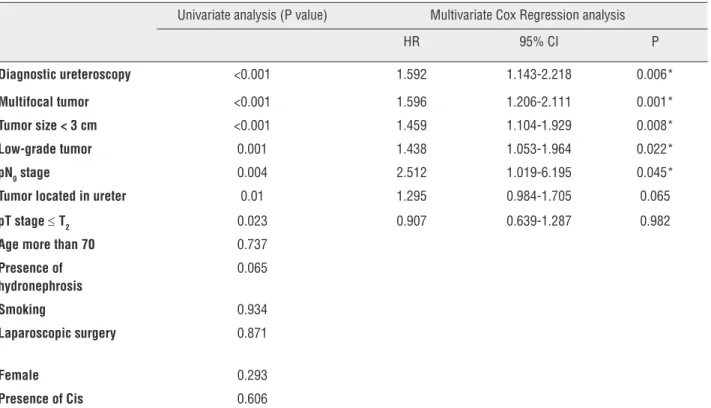
In univariate analysis, diagnostic ureteros-copy and tumor multifocality, tumor size, tumor location, T stage, N stage and grade were all asso-ciated with intravesical recurrence while in mul-tivariate Cox regression analysis only the diag-nostic ureteroscopy (p=0.006), multiple tumors (p=0.001), tumor size <3cm (p=0.008), low-grade
tumor (p=0.022) and pN0 stage (p=0.045) were
in-dependent predictors (Table-2).
DISCUSSION
RNU with bladder cuff excision is the gold standard for managing UTUC (4). However, a high potential of intravesical recurrence after RNU has
been reported. In the guidelines for NCCN, all UTUC patients after RNU are recommended to un-dergo cystoscopy for routine bladder surveillance (12). In this retrospective study, the incidence of IVR was 33.6%, which is in agreement with pre-vious reports (22-47%) (5, 6). The explanation of such a high incidence of IVR can only be hypothe-sized, including the field cancerization hypothesis and intraluminal seeding of the tumor (13, 14).
Several studies have evaluated the risk factors for IVR after RNU, such as age, gender, tumor multiplicity, TNM stage, grade, tumor location, size, previous/concomitant bladder tumors, carcinoma in situ, surgical mode and distal ureter management (7, 15-22). Among these factors, a history of a prior bladder tumor and a multifocal primary tumor are the most frequently reported, while others are still under debate. In the present study, however, we excluded the patients with previous/concomitant bladder cancer because the incidence of IVR in those patients is related to local disease instead of UTUC or ureteroscopic
from ureteroscope manipulation and irrigation. Retrograde flow, increased urine flow rate and in-traluminal pressure might lead to the shedding of tumor cells, which implant in the bladder to deve-lop recurrences. There are only 3 previous studies on the impact of diagnostic ureteroscopy for IVR after RNU, and they do not reach a consistent con-clusion (9-11). Nison et al. reported that there was intravesical recurrence 146 times, which was 28% in the URS group and 27.5% in the URS+group (not significantly different). In addition, they did not find that ureteroscopy is an independent risk factor for IVR (9). Ishikawa et al. reached the same conclusion as Nison, and the 2-year bladder recurrence-free survival rate was 60.0% in their URS+group and 58.7% in their control group (10). Luo et al., by contrast, reported that ureteroscopy was associated with an increased incidence of in-travesical recurrence in patients with or without a history of bladder cancer (11). In the present stu-dy, it is possible that diagnostic ureteroscopy is an procedure. The presence of multiple tumors
remains the predictive factor for IVR when patients with a history of bladder cancer are excluded.
Additionally, low-grade tumors, pN0 stage and
tumor size <3cm are associated with IVR. In our previous study (7), the influence of tumor grade on bladder recurrence was not that significant when excluding the patients that died during follow-up without bladder recurrence (p=0.061). Thus, we consider this result may be attributed to
the fact that high-grade, N+ patients or those with
large tumors may suffer from tumor dissemination and die prior to the detection of IVR.
With the development of medical devices, diagnostic ureteroscopy is becoming a powerful tool for patients with UTUC, and it is used to vi-sualize and biopsy the entire upper urinary tract with a technical success approaching 95% (23). Coupled with biopsies, it provides satisfactory diagnostic accuracy (24). However, concerns have been raised that tumor implantation may result
Table 2 - Univariable and multivariate Cox regression analyses predicting intravesical recurrence in 664 patients after nephroureterectomy for UTUC.
Univariate analysis (P value) Multivariate Cox Regression analysis
HR 95% CI P
Diagnostic ureteroscopy <0.001 1.592 1.143-2.218 0.006*
Multifocal tumor <0.001 1.596 1.206-2.111 0.001*
Tumor size < 3 cm <0.001 1.459 1.104-1.929 0.008*
Low-grade tumor 0.001 1.438 1.053-1.964 0.022*
pN0 stage 0.004 2.512 1.019-6.195 0.045*
Tumor located in ureter 0.01 1.295 0.984-1.705 0.065
pT stage ≤ T2 0.023 0.907 0.639-1.287 0.982
Age more than 70 0.737
Presence of hydronephrosis
0.065
Smoking 0.934
Laparoscopic surgery 0.871
Female 0.293
Presence of Cis 0.606
independent predictive factor for IVR, providing evidence for the intraluminal seeding hypothesis.
The question remains whether we should use diagnostic ureteroscopy as a routine preo-perative examination. The European guidelines suggest that diagnostic ureteroscopy should be performed in the preoperative assessment of any UTUC patient (8). However, diagnostic ureteros-copy may have the potential risk of future in-travesical recurrence by increasing tumor cell shedding during manipulation and irrigation. We should find a balance between misdiagnosis without preoperative URS, which may result in unnecessary nephrectomy, and the potential risk of IVR after RNU.
There are several limitations of this study, including the retrospective design and data collec-tion, which may lead to selection and recall bias. No strict criteria for preoperative ureteroscopy were established, and each surgeon independently made the decision to perform URS. In spite of the-se limitations, our study is still the largest single--center study in China on IVR after RNU for pa-tients without a history of bladder cancer. Further molecular genetic studies and randomized control trials are needed to help determine the mechanism for intravesical recurrence.
CONCLUSIONS
Diagnostic ureteroscopy is independently associated with intravesical recurrence after ra-dical nephroureterectomy. Urologists should re-consider the use of diagnostic ureteroscopy as a routine preoperative assessment. We should find a balance between misdiagnosis without preoperati-ve URS, which may result in unnecessary nephrec-tomy, and the potential risk of IVR after RNU.
ABBREVIATIONS
UTUC = Upper tract urothelial carcinoma
RNU = Radical nephroureterectomy
IVR = intravesical recurrence
ACKNOWLEDGEMENTS
Pei Liu, Xiao-hong Su
These authors contribute equally
CONFLICT OF INTEREST
None declared.
REFERENCES
1. Munoz JJ, Ellison LM. Upper tract urothelial neoplasms: incidence and survival during the last 2 decades. J Urol. 2000;164:1523-5.
2. Siegel R, Naishadham D, Jemal A. Cancer statistics, 2012. CA Cancer J Clin. 2012;62:10-29.
3. Cosentino M, Palou J, Gaya JM, Breda A, Rodriguez-Faba O, Villavicencio-Mavrich H. Upper urinary tract urothelial cell carcinoma: location as a predictive factor for concomitant bladder carcinoma. World J Urol. 2013;31:141-5.
4. Rouprêt M, Babjuk M, Compérat E, Zigeuner R, Sylvester RJ, Burger M, et al. European Association of Urology Guidelines on Upper Urinary Tract Urothelial Cell Carcinoma: 2015 Eur Urol. 2015;68:868-79.
5. Zigeuner RE, Hutterer G, Chromecki T, Rehak P, Langner C. Bladder tumour development after urothelial carcinoma of the upper urinary tract is related to primary tumour location. BJU Int. 2006;98:1181-6.
6. Novara G, De Marco V, Dalpiaz O, Gottardo F, Bouygues V, Galfano A, et al. Independent predictors of metachronous bladder transitional cell carcinoma (TCC) after nephroureterectomy for TCC of the upper urinary tract. BJU Int. 2008;101:1368-74.
7. Fang D, Xiong GY, Li XS, Chen XP, Zhang L, Yao L, et al. Pattern and risk factors of intravesical recurrence after nephroureterectomy for upper tract urothelial carcinoma: a large Chinese center experience. J Formos Med Assoc. 2014;113:820-7.
8. Rouprêt M, Babjuk M, Compérat E, Zigeuner R, Sylvester R, Burger M, et al. European guidelines on upper tract urothelial carcinomas: 2013 update. Eur Urol. 2013;63:1059-71. 9. Luo HL, Kang CH, Chen YT, Chuang YC, Lee WC, Cheng
10. Ishikawa S, Abe T, Shinohara N, Harabayashi T, Sazawa A, Maruyama S, et al. Impact of diagnostic ureteroscopy on intravesical recurrence and survival in patients with urothelial carcinoma of the upper urinary tract. J Urol. 2010;184:883-7.
11. Nison L, Rouprêt M, Bozzini G, Ouzzane A, Audenet F, Pignot G, et al. The oncologic impact of a delay between diagnosis and radical nephroureterectomy due to diagnostic ureteroscopy in upper urinary tract urothelial carcinomas: results from a large collaborative database. World J Urol. 2013;31:69-76.
12. Ishioka J, Saito K, Kijima T, Nakanishi Y, Yoshida S, Yokoyama M, et al. Risk stratification for bladder recurrence of upper urinary tract urothelial carcinoma after radical nephroureterectomy. BJU Int. 2015;115:705-12.
13. Miyake H, Hara I, Kamidono S, Eto H. Multifocal transitional cell carcinoma of the bladder and upper urinary tract: molecular screening of clonal origin by characterizing CD44 alternative splicing patterns. J Urol. 2004;172:1127-9. 14. Catto JW, Hartmann A, Stoehr R, Bolderson E, Rehman
I, Rosario DJ, et al. Multifocal urothelial cancers with the mutator phenotype are of monoclonal origin and require panurothelial treatment for tumor clearance. J Urol. 2006;175:2323-30.
15. Matsui Y, Utsunomiya N, Ichioka K, Ueda N, Yoshimura K, Terai A, et al. Risk factors for subsequent development of bladder cancer after primary transitional cell carcinoma of the upper urinary tract. Urology. 2005;65:279-83.
16. Favaretto RL, Shariat SF, Chade DC, Godoy G, Adamy A, Kaag M, et al. effect of tumor location on prognosis in patients treated with radical nephroureterectomy at Memorial Sloan-Kettering Cancer Center. Eur Urol. 2010;58:574-80.
17. Lughezzani G, Sun M, Perrotte P, Shariat SF, Jeldres C, Budäus L, et al. Gender-related differences in patients with stage I to III upper tract urothelial carcinoma: results from the Surveillance, Epidemiology, and End Results database. Urology. 2010;75:321-7.
18. Xylinas E, Rink M, Cha EK, Clozel T, Lee RK, Fajkovic H, et al. Impact of distal ureter management on oncologic outcomes following radical nephroureterectomy for upper tract urothelial carcinoma. Eur Urol. 2014;65:210-7.
19. Shariat SF, Godoy G, Lotan Y, Droller M, Karakiewicz PI, Raman JD, et al. Advanced patient age is associated with inferior cancer-specific survival after radical nephroureterectomy. BJU Int. 2010;105:1672-7. Erratum in: BJU Int. 2015;115:E13.
20. Novara G, Matsumoto K, Kassouf W, Walton TJ, Fritsche HM, Bastian PJ, et al. Prognostic role of lymphovascular invasion in patients with urothelial carcinoma of the upper urinary tract: an international validation study. Eur Urol. 2010;57:1064-71.
21. Yuan H, Chen X, Liu L, Yang L, Pu C, Li J, et al. Risk factors for intravesical recurrence after radical nephroureterectomy for upper tract urothelial carcinoma: a meta-analysis. Urol Oncol. 2014;32:989-1002.
22. Chen XP, Xiong GY, Li XS, Matin SF, Garcia M, Fang D, et al. Predictive factors for worse pathological outcomes of upper tract urothelial carcinoma: experience from a nationwide high-volume centre in China. BJU Int. 2013;112:917-24. 23. Rojas CP, Castle SM, Llanos CA, Santos Cortes JA, Bird V,
Rodriguez S, et al. Low biopsy volume in ureteroscopy does not affect tumor biopsy grading in upper tract urothelial carcinoma. Urol Oncol. 2013;31:1696-700.
24. Razavi SA, Sadigh G, Kelly AM, Cronin P. Comparative effectiveness of imaging modalities for the diagnosis of upper and lower urinary tract malignancy: a critically appraised topic. Acad Radiol. 2012;19:1134-40.