Artigo Original
Renata Parente de Almeida1 Carla Gentile Matas2
Keywords
Hearing Malnutrition Audiometry Event-related potentials, P300
Descritores
Audição Desnutrição Audiometria Potencial evocado P300
Correspondence address:
Renata Parente de Almeida (Coordenação de Fonoaudiologia)
Avenida Washington Soares, 1.321, Edson Queiroz, Fortaleza (CE), Brasil, CEP: 60811-905.
E-mail: [email protected] Received: 09/12/2012
Study carried out at the Speech Language Pathology and Audiology Department, Center of Integrated Medical Attention, Universidade de Fortaleza – UNIFOR – Fortaleza (CE), Brazil.
(1) School of Medicine, Universidade de São Paulo – USP – São Paulo (SP), Brazil.
(2) Department of Physical Therapy, Speech Language Pathology and Audiology and Occupational Therapy, School of Medicine, Universidade de São Paulo – USP – São Paulo (SP), Brazil.
Conlict of interests: nothing to declare.
potentials in malnourished children
Potenciais evocados auditivos de
longa latência em crianças desnutridas
ABSTRACT
Purpose: To characterize the indings obtained in the long latency auditory evoked potentials in malnourished children, as well as to compare them to the results obtained for children at the same age who present typical development. Methods: Sixty-ive children aged between 7 and 12 years old, of both genders, were evaluated. The control group consisted of 34 children with normal development and the study group consisted of 31 children diagnosed with malnutrition. All children underwent conventional pure tone audiometry, acoustic impedance measurement, dichotic digit test and long latency auditory evoked potentials. Results: The study group presented a statistically signiicant difference for latencies of the components P1, N1 and P300. The latencies of these components were higher than those of the control group. Concerning the types of alterations found in the study group, increased latency for P1 and P300 and the absence of response in N1 were predominant. The control group showed a statistically signiicant difference in the amplitude of P300 when compared to the right and left ears. Conclusion: Malnourished children present with changes in the long latency auditory evoked potentials, suggesting a deicit in central auditory pathways and alterations in the processing of acoustic information.
RESUMO
INTRODUCTION
Protein-energy malnutrition is one of the major public health issues in Brazil, affecting mainly young children. It consists of a spectrum of pathological conditions resulting from the simul-taneous lack of different proportions of proteins and calories, being more frequent amongst preschoolers and determining the impairment of their growth(1).
Childhood malnutrition can begin in intrauterine life and can be prolonged until preschool. The main consequences of malnutrition for the health of children younger than 5 years old are growth retardation and increased morbidity and mortality(2).
Malnutrition(3,4) can also lead to changes in the central nervous
system, depending on its intensity, time of incidence and dura-tion of the disease, as follows: reduced weight, brain size and volume; reduced number of cells and myelin; and changes in the concentration of some enzymes.
Several studies have shown the high prevalence of hearing impairment among newborns with very low birth weight(5) and
among older children with some level of malnutrition(6).
Hearing loss was highly prevalent among newborns with very low birth weight in the neonatal intensive care unit of Hospital das Clínicas in Porto Alegre(5). A study with 48
chil-dren with some level of malnutrition who underwent hearing evaluation observed that 45 (94%) children presented some level of hearing impairment(6).
It is a known fact that the early years of life are considered as the most important ones for the development of hearing and language skills because the maturation of the central auditory nervous system (CANS) occurs in this period(7).
CANS is a complex system which, anatomically, includes the brainstem nuclei and pathways, subcortex, primary and secondary cortical association areas and corpus callosum(8).
In order to objectively assess the integrity of this system, the use of auditory evoked potentials (AEPs) is emphasized since they refer to a series of electrical changes that occur both in the peripheral nervous system and in the central nervous system, usually related to sensory pathways(9).
Among these AEPs, long latency auditory evoked po-tentials (LLAEP), also called late popo-tentials, mainly relect the thalamic and cortical activities, which are responsible for the cognitive functions of discrimination, integration and attention(10,11).
As observed in the peripheral auditory system, studies in literature show changes in the CANS, by means of AEPs, in malnourished children(12,13), thus emphasizing the importance
to investigate the peripheral and central auditory pathways in this population. Therefore, knowing about the probable negative effects that childhood malnutrition can cause in the auditory system will lead to the establishment of proper corrective and/ or preventive measures.
So, the objective of this study was to characterize the LLAEPs in malnourished children, as well as to compare them to the results obtained from children with normal development at the same age group.
The hypothesis of this study is that the central auditory pathway of malnourished children is damaged due to the
nature of this pathology, and such damage can be visualized with the AEPs.
METHODS
This study was approved by the Research Ethics Committee (COÉTICA) of Universidade de Fortaleza, report no. 443/2009 and by the Research Ethics Committee of the School of Medicine of Universidade de São Paulo, research protocol no. 086/10. All members in charge for the children signed the informed consent.
Sixty-ive children of both genders were assessed, aged between 7 and 12 years old. The control group (CG) was comprised of 34 healthy children, 13 female and 21 male sub-jects, without malnutrition, assisted at the Center of Integrated Medical Attention without complaints related to hearing, language and hearing processing. The study group (SG) was comprised of 31 children, 16 female and 15 male subjects, di-agnosed with malnutrition. They were followed-up by Instituto de Prevenção à Desnutrição e à Excepcionalidade(IPREDE) in Fortaleza, Ceará.
Data on malnutrition, such as level, time of malnutrition and onset of treatment, were collected from the medical records of patients in the SG in IPREDE.
Normal hearing (mean of hearing thresholds in frequencies of 500, 1000 and 2000 Hz lower than or equal to 15 dB NA) proven by pure tone threshold audiometry and no impairment in the middle ear (presence of Type A tympanometry curve and ipsilateral and contralateral acoustic relexes) proven in acoustic immittance measures were conditions for the children in the SG and CG to be included in the study.
Exclusion criteria for both groups were: presence of secretion in the external auditory canal, presence of risk factors for hearing loss, according to the Joint Committee on Infant Hearing(14), malformation in ear auricle (agenesis
or canal atresia) and disagreement of parents or respon-sible parties regarding the participation of the child in the study.
After anamnesis and inspection of the ear canal, conven-tional pure tone audiometry and acoustic immittance measures were performed to select children with no hearing impairment who would be part of the study and would be submitted to LLAEP. To complement the hearing behavioral assessment, the dichotic digit test (DDT) was performed in all of the as-sessed children.
In the electrophysiological hearing assessment (LLAEP), the equipment MK 22 was used (brand: Amplaid), with the TDH 49 supra-aural earphones. Tests were performed with the child lying down, with a mild elevation on the head and in an acoustically and electrically treated room. Skin surface (forehead, mastoids and scalp) was cleaned with abrasive paste, and afterwards, electrodes were ixed with an electrolyte paste and microporous tape. Electrodes were placed on the vertex (Cz), right and left mastoids (A2 and A1) and on the forehead (Fpz), according to the guidelines of the International Electrode System 10–20(15). Impedance values of the electrodes were
In LLAEPs, tone-burst stimuli were used and presented monaurally, at 75 dB NA, in frequencies of 1000 Hz (fre-quent stimulus) and 1500 Hz (rare stimulus). A total of 200 stimuli were presented, comprising of 20% of rare stimuli. The analysis window was 750 ms. For the genera-tion of P300, the children were told to pay attengenera-tion to the rare stimuli that appeared randomly in a series of frequent stimuli. They were asked to raise their ingers every time a rare stimulus came up. There was no replication of records. All of the procedures were conducted in a single session, lasting about 90 minutes, beginning with the LLAEPs, with the objective to perform them with a restful child, thus avoid-ing interference in the results.
Values of latency and amplitude of P300 were analyzed in the report corresponding to the rare stimulus, and latency values of components P1, N1, P2 and N2 corresponded to the frequent stimuli. In cases in which the studied components were absent, latency values were stipulated to each component, so there would be no loss of data during statistical analysis. For each absent component, the established latency value was the maximum latency value obtained in the sample (in each group) plus 25% of normality variance for each component proposed in literature(16). The latency values stipulated for each
absent potential, both in the CG and in the SG, are described in Charts 1 and 2, respectively.
In the statistical treatment of data, the analysis of quantita-tive data was irst conducted by mean, median and standard deviation of the results of each component of the LLAEP, for each group and among groups. The adopted signiicance level was 0.05 (5%) and conidence interval was 95%. Wilcoxon and Mann-Whitney tests were used.
Afterwards, in the qualitative analysis, results obtained for each component were classiied as normal when latency values were within the normality pattern proposed in litera-ture(17) for the age group of the study; they were classiied
as altered when there was increased latency or the absence of the component. The child was considered to present changes when at least one of the ears, or one of the sides, presented alterations.
Therefore, the qualitative analysis was conducted by com-paring normal and altered results in each group and among groups, and also by comparing the types of changes found. Pearson’s χ2 test was used.
RESULTS
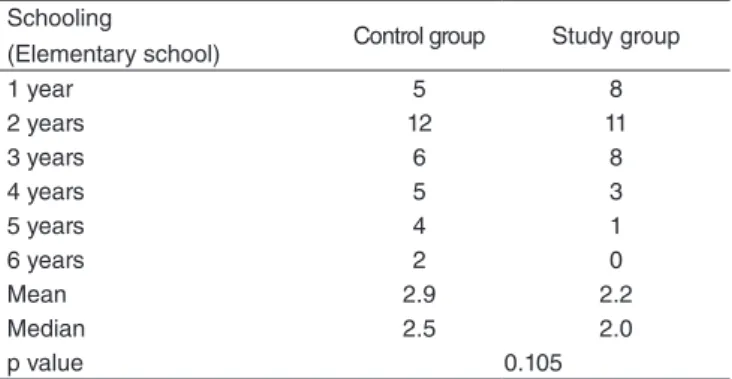
In the characterization of the sample, there was no statisti-cally signiicant difference between the CG and the SG with regard to age and gender (Table 1). With regard to schooling, most children from CG and SG attended the second year of high school (Table 2), and there was no statistically signiicant difference between groups.
With regard to hearing behavioral evaluation and consider-ing the results obtained in DDT, a larger proportion of children had changes in the SG (67.7%; 21 children) when compared to the CG (38.2%; 13 children), with statistically signiicant differences (p=0.017).
Concerning the study of the LLAEPs (quantitative data analysis), there was no statistically significant difference between the right and the left ears both for the CG and the SG, when comparing latency values of components P1, N1, P2, N2 and P300. Therefore, results of ears for each group and the comparison between groups were put together, and a statistically signiicant difference was found for latencies in components P1, N1 and P300 (Table 3). All of the analyses presented signiicance, and latencies in the SG were always higher than the ones in the CG.
A statistically signiicant difference was also observed be-tween the right and the left ears in the CG when comparing the amplitude values of P300, the amplitude of the left ear being lower than the amplitude of the right ear.
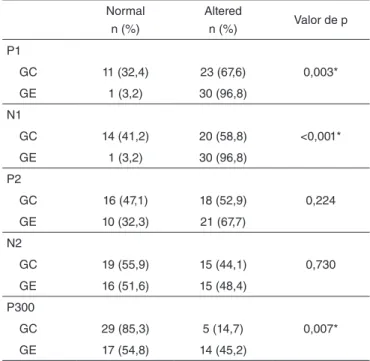
In the qualitative data analysis (occurrence of normal and altered results for LLAEP components), there was a statistically signiicant difference between the CG and the SG for components P1, N1 and P300 (Table 4). In relation to the types of changes found in LLAEPs in the SG, both for components P1 and P300, the prevalent type of change was increased latency, 93.3% and 100%, respectively. For component N1, the prevalent type of change was the absence of response (43.3% of the cases). There was no statistically
Chart 1. Latency value stipulated for absent component N1, in the control group
Component Latency (ms)
N1 205
Chart 2. Latency values stipulated for absent components P1, N1 and P2, in the study group
Component Latency (ms)
P1 128
N1 238
P2 284
Table 1. Descriptive analysis of the control and study groups in relation to age and gender
Control group Study group p-value
: 13:21 16:15 0.279
Age* 8.44±1.50 7.74±0.93 0.079
*In years (mean±standard deviation); Mann-Whitney test
= female gender; = male gender
Table 2. Distribution of schooling in the control and study groups
Schooling
(Elementary school) Control group Study group
1 year 5 8
2 years 12 11
3 years 6 8
4 years 5 3
5 years 4 1
6 years 2 0
Mean 2.9 2.2
Median 2.5 2.0
signiicant difference between the CG and the SG in relation to the type of change.
In this study, mild malnutrition was prevalent (58.1%), and there was no signiicant correlation (or a positive one) between the occurrence of normal and altered results of components N1, P1, N2, P2 and P300 and level of malnutrition.
DISCUSSION
It is undeniable that the intake of a proper diet in terms of quantity and quality is an important factor for the human being, from conception to death, since it is the reason why nutrients (oxygen, iron, protein, fatty acids etc.) that are essential for neurological functioning and development are absorbed by the body(18,19). Therefore, it is clear that children who do not have
access to such nutrients at the right dosage are prone to presenting more minor neurological dysfunctions, such as attention deicit, hyperactivity and school performance below expectations.
It is a known fact that malnourished children may also present less brain growth in relation to children with normal development, besides an important reduction in the number of synapses per neuron in cortical areas(20,21).
Another factor to be considered is that, according to litera-ture, malnutrition causes changes in the neural function from the brainstem(22), so it damages the processing of acoustic
information until higher levels of cortical areas. Such argu-ments justify the need to perform procedures that aim at the electrophysiological investigation of the cortical functioning in this population, once it seems logical that, if lower levels of the CANS are affected by dysfunctions, such as the “domino effect”, these dysfunctions pile up in various locations generat-ing the AEPs.
The LLAEPs, such as P300, are useful for the study of cognitive and attention functions(11). The LLAEPs mainly relect
thalamic and cortical activities, which are structures responsible for discrimination, integration and attention skills(10).
There are a few studies in specialized literature relating malnutrition and LLAEPs. Because of that, and also under-standing the importance to assess the CANS, this study aimed to investigate and characterize the LLAEPs in malnourished children. Facing the obtained results, it is possible to observe statistically signiicant differences in the latencies of compo-nents P1, N1 and P300; also, latencies in the SG were higher than those in the CG (Table 3), which suggests the reduced velocity of acoustic information processing at the cortical level.
Such indings corroborate with those obtained by Barnet et al.(12)
and Flinn et al.(13), which demonstrated that cortical AEPs are
affected by malnutrition, thus expressing the probable neural dysfunction resulting from nutritional deprivation.
Barnet et al.(12) assessed 26 malnourished children aged from
3 to 12 months old by means of the LLAEPs (latencies and amplitudes of components N1, P2, N2 and P3) and observed changes in these AEPs, which diverge from children with nor-mal development at the same age group; they showed that brain dysfunctions caused by malnutrition in these children improved during treatment, even if they continued to show differences in comparison to children with normal development, probably due to the replacement of vital nutrients required for adequate brain functioning.
With the objective to investigate the inluence of malnutri-tion in cortical AEPs, Flinn et al.(13) assessed 23 malnourished
children at hospital admission and 17 malnourished children with hospital discharge by analyzing cortical AEPs by counting the number of peaks in the register. Results showed changes
Table 3. Comparison of latencies of components P1, N1, P2, N2 and P300 between the control and study groups
Latency (ms)
P1 N1 P2 N2 P300
CG SG CG SG CG SG CG SG CG SG
Mean 85.2 96.5 149.9 189.3 191.9 201.5 271.1 275.3 367.2 381.8
Median 86.0 99.0 142.5 199.5 189.0 194.0 274.5 273.0 371.0 382.5
Standard deviation 19.6 19.0 39.4 53.6 39.9 38.9 29.6 26.4 28.4 34.9
N 68 62 68 62 68 62 68 62 68 62
p value <0.001* <0.001* 0.123 0.599 0.022*
*Statistically significant; Mann-Whitney test
Caption: CG = Control Group; SG = Study Group
Table 4. Distribution of the occurrence of normal and altered results in components P1, N1, P2, N2 and P300 in the control and study groups
Normal n (%)
Altered
n (%) Valor de p
P1
0,003*
GC 11 (32,4) 23 (67,6)
GE 1 (3,2) 30 (96,8)
N1
<0,001*
GC 14 (41,2) 20 (58,8)
GE 1 (3,2) 30 (96,8)
P2
0,224
GC 16 (47,1) 18 (52,9)
GE 10 (32,3) 21 (67,7)
N2
0,730
GC 19 (55,9) 15 (44,1)
GE 16 (51,6) 15 (48,4)
P300
0,007*
GC 29 (85,3) 5 (14,7)
GE 17 (54,8) 14 (45,2)
*Statistically significant; Pearson´s χ2 test
in AEPs with statistically signiicant differences at hospital admission, thus showing the presence of CANS impairment as a result of malnutrition. The conclusion was that this is a reli-able measure to observe the development and the functioning of the central nervous system.
Even though this study is in accordance with those con-ducted by other authors(12,13) who studied the LLAEPs in
mal-nourished children and observed changes in this potential, the speciic comparison of the types of changes observed in the la-tencies and amplitudes of LLAEP components was impaired because the method used to analyze the results was signiicantly different between the authors. As an example, there is the study by Barnet et al.(12), who analyzed LLAEP based on the
evalua-tion of the sum of absolute standard deviaevalua-tion values from the mean values of the latencies of components N1, P2, N2 and P3 and the amplitudes of the corresponding components (N1-P2, P2-N2, N2-P3); another study was conducted by Flinn et al.(13),
who analyzed cortical AEPs by counting the number of peaks present in the register, stating that it was a reliable measure to observe the development and functioning of the central nervous system. Such analysis methods are different from the ones in this study, which separately assessed latencies (P1, N1, P2, N2 and P300) and the amplitude (P300) of LLAEP components, thus making it dificult to compare results between studies. The other methods used for analysis may have been used due to the age group of the children assessed in the different studies, that is, very young children. Anyway, regardless of the used method, our results corroborate those obtained by other authors, sug-gesting CANS impairment in malnourished children.
Specialized literature points out that the analysis of the complex P1-N1-P2 provides information about how the sound stimulus reaches the auditory cortex and how the onset of the cortical acoustic processing occurs(23). P1 presents some
genera-tors, such as the primary auditory cortex, especially Heschl’s gyrus; N1 presents the primary and secondary auditory cortex, the latter being related to attention to sound arrival, sensory information reading by the auditory cortex and the formation of sensory memory of sound stimuli in the auditory cortex(23).
On the other hand, P300 can be considered as an index of cog-nitive function, and the prolonged latency of this component suggests a delay in the cognitive processing of the acoustic information(10). Therefore, longer latencies of components P1,
N1 and P300 obtained from malnourished children in this study are suggestive of changes in acoustic information processing at the cortical level in this population.
The LLAEP is an important electrophysiological exami-nation used to assess the processing of acoustic information, which, together with the behavioral evaluation of hearing, can bring relevant information concerning the monitoring of chil-dren with hearing disorders, being also indicated for individuals with learning and concentration issues.
The analyzed literature mentions that malnourished children or those with food deprivation may present with changes in language development(24) and cognition(25), as well as
dificul-ties in learning, assimilation and memory, considering that hunger makes concentration more dificult, thus compromising learning(26,27) and school performance(28); besides, they can also
present changes in central auditory processing. Indeed, Turini et al.(28) assessed 157 malnourished children aged from 7 to 8
years old and observed that 43.31% of these children (68 cases) presented unsatisfactory school performance.
Therefore, the importance to perform AEPs as an elec-trophysiological procedure to investigate these aspects in the population of malnourished children is emphasized and is allied to a behavioral hearing test.
DDT is also very useful to detect cortical injuries and can also be useful to detect brainstem injuries. Musiek and Geurkink(29) assessed ten individuals with brainstem injury, out
of which seven presented changes at DDT. They also reported that since the test is easy and fast, it can be indicated as a screen-ing test to detect brainstem and cortical problems, as well as interhemispheric lesions. They emphasized that altered indings in DDT should be a warning and lead to the performance of other central auditory tests.
It is known that the hearing process can cause or be associ-ated with dificulties in reading, writing, language and learning. Many studies found in literature on malnutrition report learning, memory(26) and language changes(24), as well as school failure(28)
among malnourished children; however, speciic studies about malnutrition and changes in hearing processing were not found in literature.
In this study, it was observed that malnourished children presented a higher proportion of changes at DDT when com-pared to healthy children. So, this test is believed to be a useful tool, since it enables the assessment of the hearing pathway from the brainstem until cortical regions, both affected by nutritional deprivation.
The qualitative assessment (Table 4) showed that the SG had more altered results for components P1, N1 and P300, suggesting that malnourished children presented changes in the central auditory pathway, which is in ac-cordance with findings in literature(12,13,30) that emphasized
the presence of brain dysfunctions in this population, considering that malnutrition during the period of neural development can affect brain growth, leading to cognitive dysfunctions. Results observed in DDT corroborate the findings of LLAEPs (P1, N1 and P300), emphasizing the presence of changes in acoustic information processing in the studied population.
According to the described results, it was not possible to establish a correlation between the level of malnutrition and the presence of changes in LLAEPs. In this study, it is believed that the major occurrence of mild malnutrition is due to the work of the multidisciplinary team and educational actions conducted by the institution of which the children and family members were a part (Growth Center – Núcleo de Crescimento); this is a program that comprehends basic actions of assistance to children with several levels of malnutrition and their families, besides a Nutritional Education Center (Núcleo de Educação Nutricional) which is in charge of the nutritional guidance provided in the program.
studies contemplating different levels of malnutrition and their relation with the indings of LLAEPs.
It is also worthy to mention that malnourished children should go through a complete audiological, behavioral and electrophysiological evaluation, especially investigating the LLAEPs.
CONCLUSION
In face of the obtained results, it is possible to conclude that malnourished children present changes in LLAEPs, especially in components N1, P1 and P300, suggesting central auditory pathway deicit and changes in acoustic information processing.
It is necessary to conduct more studies assessing the central auditory pathway of malnourished children by means of a hear-ing behavioral and electrophysiological evaluation, in order to obtain a better characterization of the central auditory function in this population.
*RPA was in charge of data collection, tabulation and analysis, as well as the writing of the manuscript; CGM collaborated with data tabulation and analysis, as well as the elaboration of the manuscript.
REFERENCES
1. Speridião PGL, Unegbu HC, D’Alessandro SB. Programas de atendimento ao desnutrido na cidade de São Paulo. Caderno UniABC de Nutrição. 2000;2(11):11-9.
2. Soares NT, Parente WG. Desnutrição e resultados de reabilitação em Fortaleza. Rev Nutr. 2001;14(2):103-10.
3. Moyses MA, Collares CA. Desnutrição, fracasso escolar e merenda. In: Patto MHS. Introdução à psicologia escolar. São Paulo: Casa do Psicólogo; 1997.p.225-56.
4. Dobbing J. Nutrition, the nervous system and behavior. Scientific Publication. n.251. Washington: OPAS; 1972.
5. Uchôa NT, Procianoy RS, Lavinsky L, Sleifer P. Prevalência de perda auditiva em recém-nascidos de muito baixo peso. J Pediatr (Rio J). 2003;79(2):123-8.
6. Magalhães MSQ, Oliveira PRP, Assencio-Ferreira VJ. Desnutrição como fator etiológico de deiciência auditiva em crianças de 0 a 2 anos. Rev CEFAC. 2001;3:183-6.
7. Azevedo MF. Avaliação audiológica no primeiro ano de vida In: Lopes Filho OC. Tratado de fonoaudiologia. São Paulo: Roca; 1997. p.239-63.
8. ASHA: American Speech-Language-Hearing Association. Central auditory processing: current status of research and implication clinical practice. Rockville: ASHA; 1995.
9. Schochat E. Avaliação eletroisiológica da audição. In: Ferreira LP, Bei-Lopes DM, Limongi SCO. Tratado de fonoaudiologia. São Paulo: Roca; 2004. p.656-68.
10. Kraus N, McGee T. Potenciais auditivos evocados de longa latência. In: Katz J, editor. Handbook of Clinical Audiology. Baltimore: Williams and Wilkins; 1994. p. 406-23.
11. Schochat E. Medidas eletroisiológicas da audição. C-Respostas de Longa Latência. In: Carvallo RMM. Fonoaudiologia – Informação para a formação, Procedimentos em Audiologia. Rio de Janeiro: Guanabara Koogan; 2003. p.71-85.
12. Barnet AB, Weiss IP, Sotillo MV, Ohlrich ES, Shkurovich ZM, Cravioto J. Abnormal auditory evoked potentials in early infancy malnutrition. Science.1978;201(4354):450-2.
13. Flinn JM, Barnet AB, Lydick S, Lackner J. Infant malnutrition affects cortical auditory evoked potentials. Percept Mot Skills.1993;76(3 Pt 2):1359-62. 14. American Academy of Pediatrics, Joint Committee on Infant Hearing.
Year 2007 position statement: principles and guidelines for early hearing detection and intervention programs. Pediatrics. 2007;120(4):898-921. 15. Jasper HA. The ten-twenty system of the international federation.
Electroencephalogr Clin Neurophysiol. 1958;10:371-75.
16. Alonso R. P300 em indivíduos com transtorno de processamento auditivo (central) submetidos a treinamento auditivo [Dissertação]. São Paulo: Faculdade de Medicina, Universidade de São Paulo; 2008.
17. McPherson DL. Late potentials of auditory system (evoked potentials). San Diego: Singular Publishing Group; 1996.
18. Lekskulchai R, Cole J. Effect of a developmental program on motor performance in infants born preterm. Aust J Physiother. 2001;47(3):169-76. 19. Goldenberg RL, Hoffman HJ, Cliver SP. Neurodevelopmental outcome
of small-forgestational-age infants. EurJ Clin Nutr.1998;52 Suppl 1:54-8. 20. Rocha DF. [Internet]. Desnutrição e aprendizagem. 2005. [citado out. 2010]. Disponível em: http://www.ilosoiabarata.com.br/blog/pediatria. php?p=57&more=1&c=1&tb=1&p1#more57
21. Monteiro B, Oliveira E, Lopes J, Diniz K. A desnutrição infantil energético-protéica e suas implicações no processo de memória e aprendizagem motora. In: Anais do VI Congresso Goiano de Ciências do Esporte, 2009. Jun 10-12. Goiania.
22. Pettigrew AG, Edwards DA, Henderson-Smart DJ. The inluence of intra-uterine growth retardation on brainstem development of preterm infants. Dev Med Child Neurol. 1985;27(4):467-72.
23. Martin BA, Tremblay KL, Stapells DR. Principles and applications of cortical auditory evoked potentials. In: Burkard RF, Don M, Eggermont JJ. Auditory evoked potentials. Basic principles and clinical application. Baltimore: Williams and Wilkins; 2007. p.482-507.
24. Santos JN, Lemos SMA, Lamounier JA. Estado nutricional e desenvolvimento da linguagem em crianças de uma creche pública. Rev Soc Bras Fonoaudiol. 2010;15(4):566-71.
25. Esposito YL. Desnutrição e cognição. Cad Pesqui. 1975;14:87-96. 26. Frota MA, Pásco EG, Bezerra MDM, Martins MC, Martin MC. Má
alimentação: fator que inluencia na aprendizagem de crianças de uma escola pública. Rev APS. 2009;12(3):278-84.
27. Guitti JCS. Estudo sobre a condição nutritiva de uma população infantil da cidade de Londrina, PA (Brasil). Rev Saúde Pública. 1974;8(1):67-73. 28. Turini TL, Takata PK, Turini B, Ribeiro AB, Landgraf A, Schmidt S,
et al. Desnutrição e aproveitamento escolar – estudo entre escolares da primeira série do primeiro grau da zona urbana periférica de Londrina, PR, Brasil. Rev Saúde Pública. 1978;12(1):44-54.
29. Musiek FE, Geurkink N. Auditory brainstem response and central auditory test indings for patients with brainstem lesions: a preliminary report. The Laryngoscope. 1982;92(8):891-900.