Original Article
Artigo Original
Aspects of the speaking voice of elderly
women with choral singing experience
Características da voz falada de idosas
com prática de canto coral
Fernanda Salvatico de Aquino1
Marta Assumpção Andrada e Silva1
Lídia Cristina da Silva Teles2
Léslie Piccolotto Ferreira1
Keywords
Aging Voice Elderly Singing Quality of Life
Descritores
Envelhecimento Voz Idoso Canto Qualidade de Vida
Correspondence address:
Fernanda Salvatico de Aquino Pontifícia Universidade Católica de São Paulo – PUC-SP
Rua Monte Alegre, 984, Perdizes, São Paulo (SP), Brazil, CEP: 05014-901. E-mail: [email protected]
Received: May 20, 2015
Study carried out at the Pós-graduação em Fonoaudiologia, Pontifícia Universidade Católica de São Paulo – PUC-SP - São Paulo (SP), Brazil.
1 Pontifícia Universidade Católica de São Paulo – PUC-SP - São Paulo (SP), Brazil. 2 Universidade de São Paulo – USP - Bauru (SP), Brazil.
Financial support: Comissão de Aperfeiçoamento de Pessoal do Nível Superior – CAPES.
Conlict of interests: nothing to declare. ABSTRACT
Introduction: Despite several studies related to singing and aging voice found in the literature, there is still the need for investigation seeking to understand the effects of this practice in the speaking voice of the elderly. Objective: To compare the characteristics of the speaking voice of elderlies with experience in choral singing with those of elderlies without this experience. Method: Participants were 75 elderly women: 50 with experience in choral singing - group of singers (SG) and 25 without experience - group of nonsingers (NSG). A questionnaire was applied to characterize the elderly and collect data with respect to lifestyle and voice. Speech samples (sustained vowels, repetition of sentences, and running speech excerpts) were collected in a quiet room in sitting position. The voices were analyzed by three expert speech-language pathologists according to the protocol Consensus Auditory-Perceptual Evaluation of Voice (CAPE-V). Data were submitted to descriptive and statistical analysis. Results: The voices of elderly nonsingers (NSG) showed signiicant increase in scores
related to the overall degree of deviance and presence of roughness and strain. Conclusion: Analysis of the aspects of the speaking voice of subjects in the SG, compared with that of subjects in the NSG, showed better overall degree of deviance due to lower roughness and strain.
RESUMO
Introdução: Apesar dos vários estudos relacionados à voz na terceira idade e o canto, ainda são necessárias pesquisas que busquem entender os efeitos dessa prática na voz falada de idosos. Objetivo: comparar as características da voz falada de idosas com prática de canto coral às de idosas sem essa vivência. Método: izeram
parte deste estudo 75 idosas, sendo 50 com prática de canto coral que compuseram o grupo corista (GC) e 25 sem essa prática (GNC), que foram comparadas. Para caracterização das idosas e levantamento de dados referentes aos hábitos de vida e voz, foi aplicado um questionário. Foram coletadas amostras de fala (vogal sustentada, repetição de frases e um trecho de fala espontânea) em uma sala silenciosa com as idosas sentadas. As vozes foram analisadas por três juízes fonoaudiólogos segundo o protocolo Consensus Auditory–Perceptual Evaluation of Voice (CAPE-V). Os dados foram submetidos à análise descritiva e estatística. Resultados: as
vozes das idosas do GNC apresentaram aumento signiicativo nos escores relacionados à alteração do grau geral
INTRODUCTION
Changes in the body as a whole also occur in the laryngeal structures involved in phonation, which can lead to speciic aspects of aging voice - the so-called presbyphonia. Presbyphonia can interfere with the role played by the elderly in society(1,2).
The main vocal changes caused by presbyphonia commonly cited in the literature are hoarseness, strain, instability, and breathiness (1,3-6). Fundamental frequency during speaking also undergoes changes with increasing age. In women, it tends to decrease, especially in the postmenopausal period(5,7,8). Loudness, the perceptual correlate of vocal intensity, also presents a decreasing tendency owing to arching of the vocal folds, dificulty in the muscle control of the larynx, and respiratory limitation resulting from the natural process of aging (1,7,9-11).
Choral singing is among the numerous initiatives, such as gymnastics, painting, sewing, etc., adopted by the elderly for social interaction and cultural development. Speciically, choral singing allows for humanization and socialization, because the experience of group participation stimulates the relationship between members as well as with the community in which the group is inserted(12-14). In addition, elderlies who participate in a choir are encouraged to be active by performing a pleasant activity which enhances their self-esteem and values their individuality.
Research indicates that choral singing can also help promoting the vocal health of the elderly population(15-21), mainly because this practice provides guidance on the habits that are harmful to vocal health and discourages individuals from having them, encouraging healthy habits. For example, the intense vocal demand of choral singing encourages increased water consumption, which is considered a health promotion measure because it prevents the wear of laryngeal structures. Most of the times, choral singing helps individuals become more careful with their vocal health; it is, therefore, a preventive action because it allows access to information(2,22-24).
It is worth noting that choral singing promotes increased respiratory support to practicing individuals, balances resonance and loudness modulation, in addition to increasing vocal range, which is considered excellent for the elderly, considering that monotone voice (which uses fewer musical notes) is one of the aspects of presbyphonia(24-26).
However, there are differences between speaking voice and singing voice that should be considered: in singing, breathing is programmed according to the musical phrases; greater vocal range is used; loudness is stronger and less constant than in speaking; resonance is high with greater participation of the vocal tract; and voice quality is more stable and richer in harmonics(25). Despite the several studies on the voice of the elderly, and considering the dissociation between the two types of vocal use - speaking and singing, there is need for further research that seek to understand
the speciic implications of singing practice in the speaking voice of the elderly and in how we listen to it(21).
The objective of the present study was to compare the aspects of the speaking voice of elderly women with experience in choral singing with those of elderlies without this experience.
METHODS
This prospective, cross-sectional study was approved by the Research Ethics Committee of the aforementioned institution under the number CAEE: 07252712.7.0000.5482. All subjects agreed to participate voluntarily; they were informed of the objectives and procedures of the study and signed an Informed Consent Form.
Participants
Inclusion criteria were as follows:
• Female;
• Aged 60 or older; this is the age range which deines elderly in developing countries, as proposed by the World Health Organization;
• Report being healthy on the day of data collection; • Nonsmoker or having stopped smoking more than ten years
ago;
• Report no vocal complaints.
During the questioning on treatments and surgeries in the larynx, one participant reported having performed thyroidectomy in the past and was excluded from the sample. Study participants were 75 elderly women: 50 with experience in choral singing for at least one year - group of singers (GS) and 25 without experience - group of nonsingers (GNS), who comprised the control group paired according to age. Mean age of participants was 71 years (SD=5.2), with median of 70 years, and age range between 63 and 82 years.
The group of singers (SG) was composed of elderly women from the choir ‘Vozes de Ouro’, Mokiti Okada Foundation; choir ‘Canto En-Canto’; choir ‘Encantus’, Community Center for the Elderly of the Municipality of Pirapozinho, Sao Paulo state; choir of the Social Assistance Reference Center of the Municipality of Tarabai, Sao Paulo state; and choir of the Association of Retired Teachers of the State of Sao Paulo in the Municipality of Presidente Prudente, Sao Paulo state.
Regarding past professional experience, 90% of the participants in the SG and 88% of the participants in the NSG reported having exercised professional activities in the past. Professional classiication based on the national categorization of occupations disclosed by the Employment and Vocational Training Institute was as follows:
For participants of the SG, 26% were specialists in intellectual and scientiic professions (mostly teachers): 26% were service and sales clerks; 22% were administrative assistants; 8% were farmers; 6% were factory workers; and 4% were unskilled workers.
For participants of the NSG, 36% were specialists in intellectual and scientiic professions (mostly teachers); 24% were factory workers, 12% were administrative assistants; 12% were unskilled workers; 12% were housewives; and 4% were service and sales clerks.
Regarding current professional experience, the SG showed 8% of specialists in intellectual and scientiic professions, 10% of administrative staff, and 6% of service and sales clerks - which accounted for 24% of the sample; whereas the NSG presented 8% of unskilled workers, 8% of service and sales clerks, and 4% of administrative staff - which also corresponded to 24% of the sample.
The average time of participation in choir for subjects of the SG was ive years and eight months (SD=8.7 years), and varied from one to 58 years. The average weekly choral singing practice was three and a half hours (SD=1.9 hours), and ranged between two and ten hours.
Procedures
A questionnaire based on the research by Paes(27) was applied to characterize the subjects of this study. It included questions related to sample characterization such as age, previous occupation, and vocal health habits, e.g., hydration, throat clearing, coughing, speaking loudly, and shouting; and vocal aspects such as dificulties, fatigue, vocal change over time; and inally, mentioning a word to describe their own voice. Exclusively for the SG, questions were asked regarding time of participation in choir, weekly choral singing practice, and perceived dificulties in singing. The questions were read and recorded by the researcher.
Speech samples were collected in a quiet room, but without control of external noise, in sitting position. Subjects were requested to sustain the vowel /a/, spontaneously respond to the question “Tell me how is your voice functioning”, and repeat the following sentences in Portuguese: “Érica tomou suco de pera e amora; Agora é hora de acabar; Sônia sabe sambar sozinha; Minha mãe namorou um anjo; Olha lá o avião azul; Papai trouxe pipoca quente”. The participants were instructed to say them in usual frequency, intensity, and rate.
It is worth mentioning that all speech samples were collected in the afternoon and, in the case of singers, during the rehearsals with their choirs. This material was
audio-recorded using a Sony, ICD-PX312/PX312F recorder and a microphone that is part of the Vocalgrama software, positioned at 45° elevation and ive centimeters away from the mouth of the individuals.
Three referees, who were speech-language pathologists with at least three years of experience and specialized in the ield of voice, analyzed the following parameters according to the CAPE-V protocol (Consensus Auditory–Perceptual Evaluation of Voice – ASHA, 2003)(28): overall degree of deviance, roughness, breathiness, strain, pitch, loudness, and resonance, in addition to the aspect of instability, because it can be associated with aging voice.
In this instrument, each parameter is assessed by means of an analog scale in cm (0-10 cm). As for assessment of resonance, referees are requested to suggest a term to deine it.
The referees were given a notebook and the edited recordings, being aware that they corresponded to voices of elderly women. They were instructed to assess all speech samples obtained (sustained vowel, sentences, and running speech).Ten speech samples (5 from SG and 5 from NSG) were randomly selected to be delivered to the referees in duplicate, so that an analysis of reproducibility of responses could be made to estimate the reliability of each referee.
Analysis of data
Data of sample characterization and the questions addressed speciically to the singers were analyzed descriptively. Questions concerning habits and vocal aspects were analyzed comparatively between the groups. The speech samples that were offered in duplicate for the auditory-perceptual assessment of referees were submitted to analysis of reproducibility, where the intraclass correlation coeficient (ricc) was used for the quantitative variables, whereas the Kappa coeficient (k) was used for the qualitative variables. Based on this analysis, the referee that showed the highest concordance in the responses was selected, with high values for rcci and k for most of the variables analyzed (Charts 1 and 2).
The following analyses were used for statistical comparison between SG and NSG: descriptive analysis of data through absolute and relative frequencies, measures of central tendency (mean and median) and dispersion (standard deviation, minimum and maximum).
The Kolmogorov-Smirnov test was applied to verify adherence of the quantitative variables to normality and, as most of these were not normally distributed, the nonparametric Mann-Whitney test was applied for comparison between the groups. The Chi-square correlation test was applied for the qualitative variables and, the Fisher’s exact test was used for those which presented expected values smaller or equal to 5. Descriptive statistical signiicance of 5% (p≤0.05) was
adopted.
values of p≤20% in the previously described tests. At this
stage, quantitative variables were transformed into terciles. The data were entered in Excel software and were analyzed using SPSS 17.0 software for Windows.
RESULTS
Eight elderly women (16%) reported singing dificulties such as failure in voice, entrained voice, sporadic hoarseness, and detuning.
Participants in neither of the groups consumed alcohol. Table 1 shows the frequency of the participants’ habits. Statistically signiicant difference is observed between the groups with regard to the practice and frequency of physical activity (PA) and water consumption.
Table 2 shows how the subjects perceive the auditory changes in their voices with aging. No statistically signiicant difference was found.
When asked to deine the current condition of their voices in one word, the participants used the following terms according to group: for the SG, 10 terms were used, with seven positive words (metamorphosis, clear, calm, good, beautiful, loud, love) and three other words (regular, hoarse, acute/high); for the NSG, 14 terms were used, with 10 positive words (calm, strong, soft, sonorous, cheerful, feelings, sweet, smooth, good, beautiful.) and four other words (regular, hoarse, deep/low, acute/high). No signiicant difference was found with regard to frequency of voice perception between participants of the SG and NSG, except for the term deep/low (18.0% vs. 0.0% - p=0.025). However, this term was not used in the logistic regression analysis because it showed zero (0) value in one of the cells. Frequency of voice perception in the SG and NSG, respectively, was as follows:
regular, 28.0% vs. 20.0% (p=0.453); hoarse, 10.0% vs. 12.0% (p=1.000); acute/high 12.0% vs. 20.0% (p=0.490); in addition to the positive characteristics, 32.0% vs. 48.0% (p=0.177).
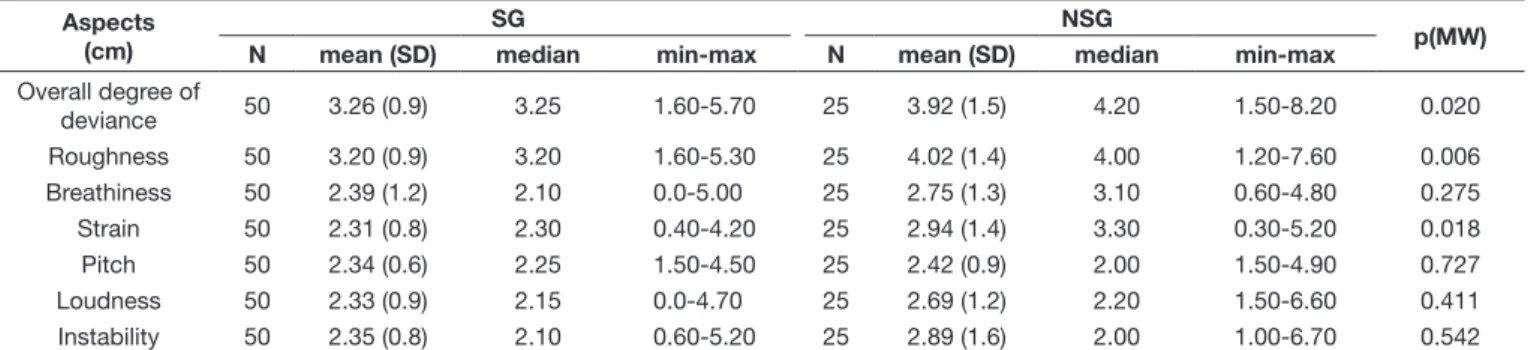
Regarding the auditory-perceptual analysis of voices, mean values for overall degree of deviance, roughness, and strain were higher for NSG compared with SG (Table 3).
The auditory-perceptual data shown in Table 3 were transformed into terciles and are shown in Table 4 to identify the categories which present higher frequency of the analyzed aspect, as well as if any outlier could have statistical signiicance. Once again, the three parameters were highlighted: overall degree of deviance, roughness, and strain. This datum is presented as a protective factor in the univariate logistic regression. Participants of the SG are less likely to be in the last tercile of the overall degree of deviance, that is, with greater degree of vocal change. Similarly, roughness presents a greater proportion for the participants of the NSG in the last tercile.
The variable strain presented two directions: the second tercile (from 1.9 to 3.0 cm) showed greater frequency among the participants of the SG, whereas the third tercile (from 3.1 to 5.2 cm) showed greater frequency among those of the NSG.
No statistically signiicant correlation was found with respect to resonance.
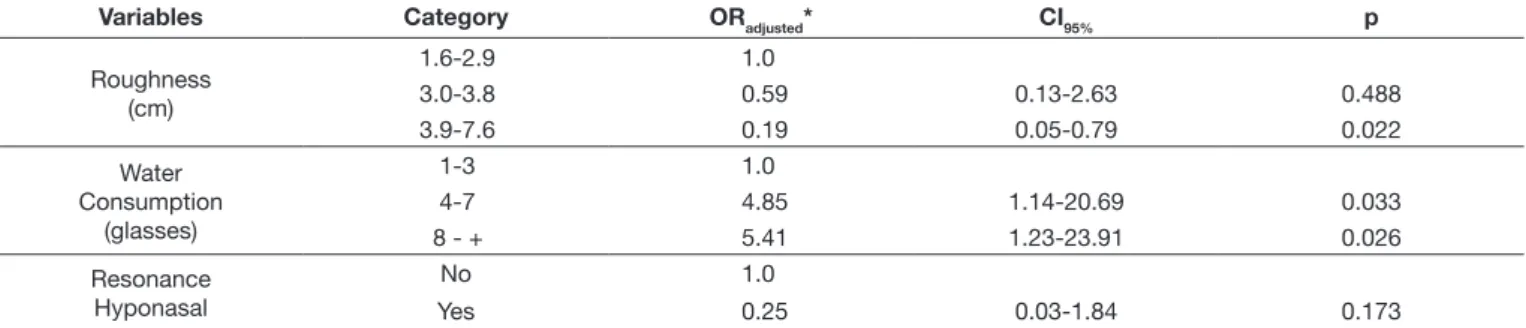
Table 5 shows that, in the analysis of multiple logistic regression, the independent factors are roughness and water consumption. Elderly women in the SG are less likely to present roughness between the 3.9 and 7.6 values than those in the NSG. Regarding water consumption, participants in the SG are more likely to consume four to seven glasses of water/day and eight or more glasses of water/day compared with participants in the NSG.
Chart 1. Intraclass correlation coefficient (ricc) according to the referees
Variables N Referee 1 Referee 2 Referee 3
ricc P ricc p ricc p
Overall Degree of deviance 10 0.78 0.022 0.70 0.055 0.91 0.001
Roughness 10 0.90 0.001 0.48 0.171 0.88 0.002
Breathiness 10 0.80 0.008 0.51 0.153 0.74 0.024
Strain 10 0.59 0.117 0.56 0.079 0.81 0.012
Pitch 10 0.85 0.007 0.53 0.154 0.94 <0.001
Loudness 10 0.79 0.017 –0.99 0.836 0.50 0.148
Instability 10 0.99 <0.001 0.58 0.112 0.90 0.002
Chart 2. Kappa coefficient (k) according to the referees
Variables N Referee 1 Referee 2 Referee 3
K P K p K p
Hypernasal Resonance 10 1.0 0.002 1.0 0.002 --
--Hyponasal Resonance 10 -- -- -- -- --
--Pharyngeal Resonance 10 -- -- -- -- 0.38 0.236
Typical 10 1.0 0.002 0.62 0.035 0.38 0.236
Table 1. Numeric and percentage distribution of practice and frequency of physical activity, habits harmful to laryngeal voice, and water consumption for the groups of singers (SG) and nonsingers (NSG)
Habits Category SG NSG p (χ2) OR
unadjusted
§ CI
95% p
N (%) N (%)
Practice of Physical Activity
No 9 (18.0) 12 (48.0)
0.006 1.0
Yes 41 (82.0) 13 (52.0) 4.21 1.45-12.21 0.008
Physical Activity Weekly Frequency
None 9 (18.0) 12 (48.0)
0.021
1.0
1 to 3 times 26 (52.0) 7 (28.0) 4.95 1.49-16.47 0.009
4 or more times 15 (30.0) 6 (24.0) 3.33 0.93-12.01 0.066
Throat clearing No 35 (70.0) 20 (80.0) 0.356 1.0
Yes 15 (30.0) 5 (20.0) 1.71 0.54-5.42 0.359
Coughing* No 43 (86.0) 21 (84.0) 1.000 1.0
Yes 7 (14.0) 4 (16.0) 0.86 0.23-3.25 0.818
Speaking loudly No 37 (74.0) 17 (68.0) 0.585 1.0
Yes 13 (26.0) 8 (32.0) 0.75 0.26-2.14 0.586
Shouting* No 47 (94.0) 24 (96.0) 1.000 1.0
Yes 3 (6.0) 1 (4.0) 1.53 0.15-15.53 0.718
Water Consumption
(glasses)
1 to 3 5 (10.0) 11 (44.0)
0.003
1.0
4 to 7 25 (50.0) 7 (28.0) 7.86 2.04-30.28 0.003
8 or more 20 (40.0) 7 (28.0) 6.29 1.61-24.57 0.008
Total 50 (100.0) 25 (100.0)
Caption: * Fisher’s exact test; § category of reference for the NSG
Table 2. Numeric and percentage distribution according to self-perception of voice changes and its aspects and results of statistical analysis for the groups of singers (SG) and nonsingers (NSG)
Auditory
Perception Category
SG NSG
p (χ2) OR
unadjusted§ CI95% p
N (%) N (%)
Difficulty* No 48 (96.0) 24 (96.0) 1.000 1.0 0.09-11.59 1.000
Yes 2 (4.0) 1 (4.0) 1.00
Fatigue* No 47 (94.0) 24 (96.0) 1.000 1.0 0.15-15.53 0.718
Yes 3 (6.0) 1 (4.0) 1.53
Changes with aging
No 19 (38.0) 13 (52.0)
0.248 1.0 0.67-4.67 0.250
Yes 31 (62.0) 12 (48.0) 1.77
Aspects mentioned
Lowness No 34 (68.0) 19 (76.0) 0.473 1.0 0.50-4.45 0.475
Yes 16 (32.0) 6 (24.0) 1.49
Weakness No 38 (76.0) 21 (84.0) 0.425 1.0 0.48-5.79 0.428
Yes 12 (24.0) 4 (16.0) 1.66
Hoarseness* No 44 (88.0) 23 (92.0) 0.711 1.0 0.29- 8.40 0.599
Yes 6 (12.0) 2 (8.0) 1.57
Total 50 (100.0) 25 (100.0)
Caption: * Fisher’s exact test; § category of reference for the NSG
Table 3. Descriptive analysis of parameters of the Auditory-Perceptual Evaluation
Aspects (cm)
SG NSG
p(MW) N mean (SD) median min-max N mean (SD) median min-max
Overall degree of
deviance 50 3.26 (0.9) 3.25 1.60-5.70 25 3.92 (1.5) 4.20 1.50-8.20 0.020
Roughness 50 3.20 (0.9) 3.20 1.60-5.30 25 4.02 (1.4) 4.00 1.20-7.60 0.006
Breathiness 50 2.39 (1.2) 2.10 0.0-5.00 25 2.75 (1.3) 3.10 0.60-4.80 0.275
Strain 50 2.31 (0.8) 2.30 0.40-4.20 25 2.94 (1.4) 3.30 0.30-5.20 0.018
Pitch 50 2.34 (0.6) 2.25 1.50-4.50 25 2.42 (0.9) 2.00 1.50-4.90 0.727
Loudness 50 2.33 (0.9) 2.15 0.0-4.70 25 2.69 (1.2) 2.20 1.50-6.60 0.411
Instability 50 2.35 (0.8) 2.10 0.60-5.20 25 2.89 (1.6) 2.00 1.00-6.70 0.542
DISCUSSION
Most of the elderly women who participated in the present study have worked professionally in their lives (90% in the SG and 88% in the NSG), and approximately one fourth of them are still working (24% for both groups). This information agrees with the data published in the last census of the Brazilian Institute of Geography and Statistics - IBGE, which reveals that 24% of the Brazilian elderly population still works to supplement the family income and maintain inancial independence.
Results of the survey show that most of the elderly in the SG began choral singing activities at third age. Considering that the average time of participation in choral singing was ive years and eight months, these women probably joined a choir because it was a pleasant recreational activity that contributed
to expand their social circles. It is worth mentioning that the rate of complaints regarding singing (16%) can be attributed to the auditory reinement acquired with choral singing, a fact that improves the self-perception of singers about their own voices(12-14).
Results also show that, owing to the practice of singing, the subjects in the SG were more careful and abused less of their voices compared with the subjects in the NSG(2,16,22-24). Such a fact can be observed in the variable water consumption, which was signiicantly greater in the higher categories of consumption in the SG compared with the NSG (Table 1).
The SG also showed greater reference to the practice of physical activities, a variable that presented statistically signiicant difference between the groups. Therefore, it can be inferred that choral singing motivates and encourages the
Table 5. Analysis of multiple binary logistic regression
Variables Category ORadjusted* CI95% p
Roughness (cm)
1.6-2.9 1.0
3.0-3.8 0.59 0.13-2.63 0.488
3.9-7.6 0.19 0.05-0.79 0.022
Water Consumption
(glasses)
1-3 1.0
4-7 4.85 1.14-20.69 0.033
8 - + 5.41 1.23-23.91 0.026
Resonance Hyponasal
No 1.0
Yes 0.25 0.03-1.84 0.173
Caption: * category of reference for the NSG
Table 4. Descriptive analysis of the Auditory-Perceptual Evaluation for the groups of singers (SG) and nonsingers (NSG), presented in terciles, and results of statistical analysis
Aspects Category (cm)
SG NSG
p (χ2) OR unadjusted
§ CI
95% p
N (%) N (%)
Overall degree of deviance
1.5-2.7 18 (36.0) 7 (28.0)
0.005
1.0
2.9-3.8 20 (40.0) 3 (12.0) 2.59 0.58-11.56 0.212
3.9-8.2 12 (24.0) 15 (60.0) 0.31 0.10-0.99 0.048
Roughness
1.6-2.9 21 (42.0) 4 (16.0)
0.004
1.0
3.0-3.8 18 (36.0) 6 (24.0) 0.57 0.14-2.35 0.438
3.9-7.6 11 (22.0) 15 (60.0) 0.14 0.04-0.52 0.004
Breathiness
0.0-1.6 15 (30.0) 6 (24.0)
0.222
1.0
1.7-3.2 21 (42.0) 7 (28.0) 1.20 0.34-4.30 0.779
3.3-5.0 14 (28.0) 12 (48.0) 0.47 0.14-1.58 0.221
Strain
0.3-1.8 16 (32.0) 8 (32.0)
<0.001
1.0
1.9-3.0 25 (50.0) 2 (8.0) 6.25 1.18-33.26 0.032
3.1-5.2 9 (18.0) 15 (60.0) 0.30 0.09-0.98 0.046
Pitch
1.5-1.9 13 (26.0) 7 (28.0)
0.790
1.0
2.0-2.3 15 (30.0) 9 (36.0) 0.90 0.26-3.09 0.864
2.4-4.9 22 (44.0) 9 (36.0) 1.32 0.40-4.38 0.654
Loudness
0.0-1.8 13 (26.0) 6 (24.0)
0.269
1.0
1.9-2.4 22 (44.0) 7 (28.0) 1.45 0.40-5.26 0.571
2.5-6.6 15 (30.0) 12 (48.0) 0.58 0.17-1.97 0.381
Instability
0.6-1.9 14 (28.0) 8 (32.0)
0.282
1.0
2.0-2.3 21 (42.0) 6 (24.0) 2.00 0.57-7.02 0.279
2.4-6.7 15 (30.0) 11 (44.0) 0.78 0.24-2.50 0.675
Total 50 (100.0) 25 (100.0)
elderly to be more active physically and socially, which can inluence their vocal quality. It may also be appropriate to think distinctively, that is, the most active elderly individuals are the ones who engage in various activities for the opportunity of relating(12-22).
The other aspects related to habits (throat clearing, coughing, speaking loudly, and shouting) and vocal signs (dificulty and fatigue) account for less than a third of the occurrences, and no signiicant differences were found in the comparison between the groups (Tables 1 and 2).
When requested to deine their own voices in one word, the term deep/low was signiicantly more cited by the subjects in the SG (18% vs. 0% of the NSG), a datum which corroborates the literature regarding reduction of the speaking fundamental frequency of the voice in aging women(1,2,4-7). It is noteworthy that this perception of deep/low voice by the women in the SG occurs due to the improved self-perception developed with the choral singing experience, as well as because they have a more intense and reined vocal demand(17,18,24).
As for the auditory-perceptual analysis of the speaking voice, signiicant differences were found between the groups regarding the overall degree of deviance and the presence of roughness and strain, with occurrence of greater values for the NSG (Table 3). The aspects of the voice of the elderly in the NSG are in compliance with the literature, which describes a worsening of the vocal quality with aging(1,3). These indings corroborate research which indicates that choral singing can help promoting vocal health and preventing vocal aging(15,16,18,19,21-24). Speciically for vocal strain, statistical analysis of the terciles shows that the results presented two directions (Table 4). The irst direction corresponds to the second tercile (1.9 to 3.0 cm), which represents typical voices, as proposed by Yamasaki et al.(29). This tercile showed higher proportion for the SG (50%) compared with the NSG (8%), which may be related to the increased laryngeal control of singers, who need to adjust their the vocal tracts to produce the singing voice, as suggested by some authors(19).
The second direction corresponds to the third tercile (3.1 to 5.2 cm), a score similar to that suggested by Yamasaki et al.(29) (3.5 to 5.0 cm), which represents the presence of light-to-moderate change. In this tercile, the proportions are inverted, with higher frequency for the NSG (60% vs. 18% for the SG). This information may be correlated with the strainer glottic standard characteristic of aging owing to biomechanical changes in the tissues, which contribute to decreased laryngeal control, as indicated by Ahamad et al.(9). Thus this fact suggests that choral singing would be delaying the worsening of this vocal aspect, which is common in the elderly.
Although no difference between the groups investigated was observed in the statistical analysis, the breathiness parameter draws attention because it is one of the main stereotypes of aging voice(30). This parameter did not characterize the voice of elderlies in the groups analyzed.
Based on the previously mentioned data, it appears that singing may have helped in the vocal performance of the
participants of the group analyzed. Therefore, speech-language pathologists and other health professionals who care for the well-being of the elderly could use choral singing as a prevention agent for vocal disorder and a facilitator of health promotion. However, the way participants were paired constitutes a limitation of this study: three elderly women - two singers and one nonsinger. Ideally, it would be more appropriate to perform a one-to-one pairing. Nevertheless, it was quite dificult to recruit elderly women without choral singing experience. Many of them showed no interest in participating in the study most likely because they ignored the importance of voice or did not present an intense vocal demand compared with elderlies with choral singing experience.
It is also worth noting that the SG presented a greater number of healthy habits, such as the practice of physical activity and intake of water, which can also be a helping factor to delay the effects of voice aging and its consequent disorders.
CONCLUSION
Analysis of the aspects of the speaking voice of singers, compared with that of nonsingers, shows improved overall degree of deviance due to lower roughness and strain.
REFERENCES
1. Menezes LN, Vicente LCC. Envelhecimento vocal em idosos instucionalizados. Rev. CEFAC. 2007;9(1):90-8. http://dx.doi.org/10.1590/ S1516-18462007000100012.
2. Penteado ZP, Penteado LAPB. Percepção da voz e saúde vocal em idosos coralistas. Rev. CEFAC. 2010;12(2):288-98. http://dx.doi.org/10.1590/ S1516-18462009005000053.
3. Gama ACC, Alves CFT, Cerceau JSB, Teixeira LC. Correlação entre dados perceptivo-auditivos e qualidade de vida em voz de idosas. Pro Fono. 2009;21(2):125-30. http://dx.doi.org/10.1590/S0104-56872009000200007. PMid:19629322.
4. Teles-Magalhães LC, Pegoraro-Krook MI, Pegoraro R. Study of the elderly females’ voice by phonetography. J Voice. 2000;14(3):310-21. http://dx.doi.org/10.1016/S0892-1997(00)80077-6. PMid:11021499. 5. Pontes P, Brasolotto AG, Behlau M. Glottic characteristics and voice
complaint in the elderly. J Voice. 2005;19(1):84-94. http://dx.doi. org/10.1016/j.jvoice.2004.09.002. PMid:15766853.
6. Gorham-Rowan MM, Laures-Gore J. Acoustic-perceptual correlates of voice quality in elderly men and women. J Commun Disord. 2006;39(3):171-84. http://dx.doi.org/10.1016/j.jcomdis.2005.11.005. PMid:16360669. 7. Machado MAMP, Aldrighi JM, Ferreira LP. Os sentidos atribuídos à voz
por mulheres após a menopausa. Rev Saude Publica. 2005;2(39):261-9. http://dx.doi.org/10.1590/S0034-89102005000200018. PMid:15895147. 8. Nishio M, Niimi S. Changes in speaking fundamental frequency
characteristics with aging. Folia Phoniatr Logop. 2008;60(3):120-7. http://dx.doi.org/10.1159/000118510. PMid:18305390.
2012;26(6):751-9. http://dx.doi.org/10.1016/j.jvoice.2011.12.002. PMid:22633334.
10. Hodge FS, Colton RH, Kelley RT. Vocal intensity characteristics in normal and elderly speakers. J Voice. 2001;15(4):503-11. http://dx.doi. org/10.1016/S0892-1997(01)00050-9. PMid:11792026.
11. Silva TS, Master S, Andreoni S, Pontes P, Ramos LR. Acoustic and long-term average spectrum measures to detect vocal aging in women. J Voice. 2011;25(4):411-9. http://dx.doi.org/10.1016/j.jvoice.2010.04.002. PMid:20817474.
12. Pereira E, Vasconcelos M. O processo de socialização no canto coral: um estudo sobre as dimensões pessoal, interpessoal e comunitária. Musica Hodie. 2007;7(1):99-120.
13. Amato RFO. Canto coral como prática sócio-cultural e educativo-musical. Opus. 2007;13(1):75-96.
14. Prazeres MMV, Lira LC, Lins RG, Cárdenas CJ, Melo GF, Sampaio TMV. O canto como sopro de vida: um estudo dos efeitos do canto coral em um grupo de coralistas idosas. Revista Kairós Gerontologia. 2013;16(4):175-93.
15. Brown WS Jr, Morris RJ, Michel JF. Vocal jitter and fundamental frequency characteristics in aged, female professional singers. J Voice. 1990;4(2):135-41. http://dx.doi.org/10.1016/S0892-1997(05)80138-9. 16. Brown WS Jr, Morris RJ, Hollien H, Howell E. Speaking fundamental
frequency characteristics as a function of age and professional singing. J Voice. 1991;5(4):310-5. http://dx.doi.org/10.1016/S0892-1997(05)80061-X. 17. Hazlett D, Ball MJ. An acoustic analysis of the effects of ageing on the
trained singer’s voice. Logoped Phoniatr Vocol. 1996;21(2):101-7. http:// dx.doi.org/10.3109/14015439609098749.
18. Boone DR. The three ages of voice: the singing/acting voice in the mature adult. J Voice. 1997;11(2):161-4. http://dx.doi.org/10.1016/ S0892-1997(97)80073-2. PMid:9181538.
19. Sonninen A, Hurme P. Vocal fold strain and vocal pitch in singing: radiographic observations of singers and nonsingers. J Voice. 1998;12(3):274-86. http://dx.doi.org/10.1016/S0892-1997(98)80018-0. PMid:9763178. 20. Lamarche A, Ternström S, Pabon P. The singer’s voice range profile:
female professional opera soloists. J Voice. 2010;24(4):410-26. http:// dx.doi.org/10.1016/j.jvoice.2008.12.008. PMid:19837561.
21. Prakup B. Acoustic measures of the voices of older singers and nonsingers. J Voice. 2012;26(3):341-50. http://dx.doi.org/10.1016/j.jvoice.2011.05.007. PMid:21889299.
22. Cassol M, Bós AJG. Canto coral melhora sintomas vocais em idosos saudáveis. Rev. Bras. Cienc. Env. Hum. 2006;3(2):113-122
23. Fuchs M, Meuret S, Thiel S, Täschner R, Dietz A, Gelbrich G. Influence of singing activity, age, and sex on voice performance parameters, on subjects’ perception and use of their voice in childhood and adolescence. J Voice. 2009;23(2):182-9. http://dx.doi.org/10.1016/j.jvoice.2007.09.007. PMid:18060740.
24. Aquino FS, Teles LCS. Autopercepção vocal de coristas profissionais. Rev. CEFAC. 2013;15(4):986-93. http://dx.doi.org/10.1590/S1516-18462013000400028.
25. Camargo TF, Barbosa DA, Teles LCS. Características da fonetografia em coristas de diferentes classificações vocais. Rev Soc Bras Fonoaudiol. 2007;12(1):10-7. http://dx.doi.org/10.1590/S1516-80342007000100004. 26. Gregory ND, Chandran S, Lurie D, Sataloff RD. Voice disorders in
the elderly. J Voice. 2012;26(2):254-8. http://dx.doi.org/10.1016/j. jvoice.2010.10.024. PMid:21530163.
27. Paes MB. Características vocais e do envelhecimento, queixa e saúde vocal em mulheres idosas de diferentes faixas etárias [dissertação]. São Paulo: Pontifícia Universidade Católica de São Paulo; 2008.
28. Zraick RI, Kempster GB, Connor NP, Thibeault S, Klaben BK, Bursac Z, et al. Establishing validity of the Consensus Auditory-Perceptual Evaluation of Voice (CAPE-V). Am J Speech Lang Pathol. 2011;20(1):14-22. http://dx.doi.org/10.1044/1058-0360(2010/09-0105). PMid:20739631. 29. Yamasaki R, Leão S, Madazio G, Padovani M, Azevedo R, Behlau M.
Correspondência entre escala analógico-visual e a escala numérica na avaliação perceptivo-auditiva de vozes. In: 16º Congresso Brasileiro de Fonoaudiologia; 2008 Set 24-27; Campos do Jordão. Anais. São Paulo: Sociedade Brasileira de Fonoaudiologia; 2008. p. 1080.
30. Oliveira G, Behlau M. Descrição da Qualidade Vocal de personagens idosos dos filmes de Hollywood. Rev, CEFAC. 2010;12(3):483-9. http:// dx.doi.org/10.1590/S1516-18462010005000022.
Author contributions