Abstract
PIV (particle image velocimetry) has been spreading in studies that use the move-ment of particles to monitor the displacemove-ment of an object or the low of a luid by means of velocity vectors using optical techniques and second order statistics. PIV is also known as laser speckle velocimetry when associated with speckle patterns. This technique has been used in works involving luids, in general, building a map of veloc-ity vectors representing the low under analysis. This paper presents an approach by using PIV associated to speckle patterns for deformation measurements in a cantilever beam (ASTM A36 steel), one of the most common examples used in civil engineer-ing, without the introduction of external particles. Results showed that the difference between PIV associated to speckle patterns and the analytic displacement values is increased along the beam length for a load of 1.96 N as an evidence of sensitivity of the proposed measurement method. This indicates that PIV is also capable for detecting displacement ields associated with laser speckle patterns in solid mechanics generating a map of deformation as an additional option for non-destructive tests.
Keywords: Particle image velocimetry, displacement vectors, solid mechanics, measure-ment techniques.
Maps of deformations in a
cantilever beam using particle image
velocimetry (PIV) and speckle patterns
Roberto Alves Braga Jr.
Professor Associado University of Lavras, Engineering department Lavras – Minas Gerais – Brasil [email protected]
Ricardo Rodrigues Magalhaes
Professor Adjunto University of Lavras, Engineering department Lavras – Minas Gerais – Brasil [email protected]
Rafael Pego Melo
Bolsista de Iniciação Científica University of Lavras,
Engineering department Lavras – Minas Gerais – Brasil [email protected]
Joao Vitor Gomes
Bolsista de Iniciação Científica University of Lavras,
Engineering department Lavras – Minas Gerais – Brasil [email protected]
Civil Engineering
http://dx.doi.org/10.1590/0370-44672013680016
1. Introduction
Deformations that occurred in industrial parts caused by external loads (fatigue) or manufacturing processes (residual stresses) affect resistance and generally compromise the product’s life. Measurement of these deformations in terms of displacements with no product damages has signiicant importance in industries and also in researching.
Methods for measuring deforma-tions to detect failures in components can be used in industry as a way of destructive techniques, such as torsion tests (Barcelos, 2013) or semi-destructive, such as the hole drilling method (Diaz et al., 2000).
Non-destructive tests (e.g. x-ray, ultrasound, shearography and holography) can be useful when one does not want to destroy or even stay in contact with the material under analysis. These optical methods can
be classiied as in-plane and out-of-plane techniques. One feasible technique to measure displacements is particle image velocimetry (PIV), which had its origin in the researches of solid mechanics displace-ments and is commonly linked to laser speckle velocimetry (LSV) (Adrian, 2005). Therefore, PIV and LSV can only be dis-tinguished by the so called source density, which means the amount of particles in the same place. In a speckle pattern, one has a high density of particles, character-izing the LSV approach, while the low density of particles are commonly linked to the PIV applications in luids measure-ments (Adrian, 1991; Volker et alli, 2011;
Ertürk et alli, 2013; Xu and Chen, 2013).
Otherwise, PIV has been used in solid mechanics measuring, for instance, the movement of soil which has a white powder
scattered over the surface to act as particles (Baba and Peth, 2012) or to monitor the growth of a root (Hamza et al. 2006).
In order to avoid the introduction of external particles, Soares et al. (2013)
sug-gested the association of PIV with speckle patterns in order to provide micro-luid measurements, and therefore, the main hypothesis of this work was to prove the feasibility of the association of the PIV technique to speckle laser patterns, also known as the LSV technique, to measure deformations and create maps of vectors in a steel beam.
274
because it does not need special heat treat-ments (Magalhaes et al., 2014). Also ASTM
A36 has a large number of applications in structural assemblies as a result of its
per-formance in terms of mechanical resistance. This work was focused on apply-ing PIV as an optical technique related to in-plane deformations in solids
me-chanics, where the speckle patterns were taken before and after application of loads on a steel cantilever beam with a rectangular cross section.
2. Material and methods
In the experiments, used was an ASTM A36 steel cantilever beam with a
rectangular cross section (28 x 3.175 mm) and length of 130 mm. Table 1 and Table
2 show the chemical and mechanical prop-erties, respectively, for this kind of steel.
Carbon
(max, %) Manganese(%) Phosphorus (max, %) (max, %)Sulfur (max, %)Silicon Copper (N/m2)
0.26 --- 0.04 0.05 0.40 0.20
Density
(kg/m3) Poisson’sratio strengthYield
(N/m2)
Tensile strength
(N/m2)
Young’s modulus (N/m2)
Shear modulus
(N/m2)
7850 0.26 2.5x10⁸ 4.0x10⁸ 2.0x10¹¹ 7.9x10¹⁰
In the experiments, the laser beam illuminated the sample in a speciic region and the scattered light was captured by a CCD camera for the irst image without any deformation of the steel. The second
image was similar to the irst one, but with the displacement of the particles introduced after the load application and the deforma-tion of the beam. The difference between the two speckle images (before and after
load application of the load) was the inputs from PIV which generated the map of ve-locity vectors. A speciic device setup was built in order to proceed with the experi-ments, schematically showed in Figure 1.
Table 1
ASTM A36 steel chemical properties (ASTM, 2012)
Table 2
ASTM A36 steel mechanical properties.
Figure 1
Experimental setup scheme.
Results were compared to analytic displacements which are represented by
Equation 1. The vertical displacement at the beam centerline is represented as:
where v is the vertical displace-ment (mm), P is the load (N), E is the material Young’s modulus (MPa), I is
the moment of inertia (mm4), L is the
length of the beam (mm) and x is the distance between the displacement
measurement point and clamping po-sition (mm) (Dym and Shames, 2013).
)
3
(
2
3 2x
Lx
EI
P
v
=
−
(1)3. Results
The speckle pattern was obtained from the illuminated sample by a solid state laser of 632 nm with 3mW and the images were captured by a CCD camera before and after the application of the loads. Standard loads were applied with a range of 0.01 to 5.0 kg in order to evaluate the sensitivity level of the technique. In
order to generate displacements vectors, the commercial software (MATLAB® version 7.8.0.347 R2009A) was used, which performed image analyses from the code MPIV (version 0.97) by using the parameters [xi, yi, iu, iv] = mpiv (im1, im2, 128, 128, 0.5, 0.5, 20, 20, 1, 'color', 2, 1).
The PIV outcomes were used to
each window is therefore a summary as a mean value of length and direction (Adrian, 1991). In Fig. 2c each arrow represents the summary of the displace-ment of all particles with in each area of the image, where the particles before and
after the displacement are represented by the speckle grains showed in Fig. 2a and Fig. 2b, respectively.
Some Finite Element Method (FEM) commercial software can also represent displacements vectors. Figure 2d shows
the representation of FEM displacements vectors caused by a simulated load of 1.96 N. Recent works showed good agree-ment between PIV and FEM in terms of displacements as presented by Magalhaes
et al. (2015).
Figure 2 a) Picture before the load application;
b) Picture after the load application;
c) PIV results; d) FEM results.
By applying Equation 1, the analytic displacements were obtained at the same points of the PIV results in order to
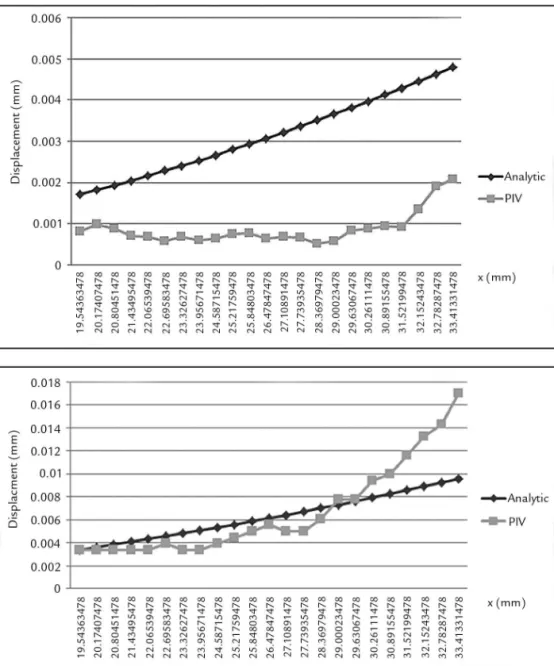
com-pare them. Figure 3 shows the results from loads of 0.98 N (Fig 3a), 1.96 N (Fig 3b) and 4.9 N (Fig 3c) which presented no loss
of correlation during image processing in a range from 19.54 mm to 33.41 mm from the clamping position (zero x coordinate).
(a)
(b)
(c)
(d)
Figure 3.a Analytic and PIV displacements for load of 0.98 N.
276
Figure 3.c Analytic and PIV
displacements for load of 4.9 N.
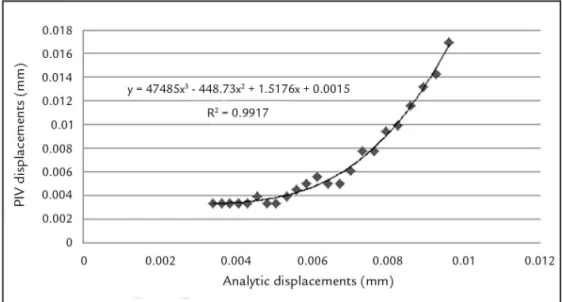
Figure 4 shows the correlation be-tween PIV and analytic data related to the results obtained from the load of 1.96
N, in the same portion of the beam which presented best displacements itness. Also displayed is a 3rd order polynomial
equa-tion and its respective R-squared value on chart.
Figure 4
Analytic and PIV correlation data.
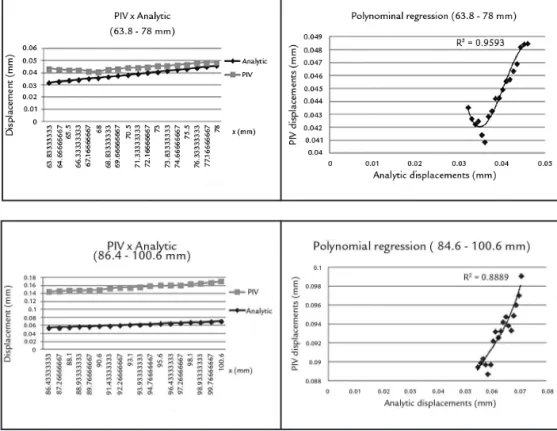
Other laser positions were con-sidered for covering a larger range of points in the cantilever beam, and new
values were obtained from windows of 41.8 mm to 54.7 mm, 63.8 mm to 78 mm and 86.4 mm to 100.86 mm as
regards to the clamping position (zero x coordinate) as shown in the Figure 5.
Figure 5.a
Figure 5.b PIV vs. Analytic for 63.8-78 mm and its respective R-squared correlation.
Figure 5.c PIV vs. results for 86.4-100.6 mm and its respective R-squared correlation.
Figure 6 shows the results of the dis-placements comparing PIV and analytic
values covering almost the total length of the cantilever beam at each point
mea-sured due to the load of 1.96 N.
Figure 6 PIV vs. Analytic results for total length of cantilever beam.
Considering almost the total length of the cantilever beam (Fig. 6), it is noted that as soon as PIV measured points in-creased the distance from the clamping position (zero x coordinate), the difference between PIV and analytic displacements values increased as well. It can be consid-ered as a sensitivity output of the proposed measurement method and that would be considered an advantage for applications which require high sensitivity.
One advantage of this kind of
coniguration is the absence of external particles in the sample, since the particles themselves are generated by the laser beam, thereby creating the grid of the speckle pattern that will be used as a high density source of particles. The high densi-ty source of the particles is responsible for the high sensitivity of the association of the PIV technique with the speckle pattern, where the sensitivity is related to the size of the grains formed in the surface, which can be adjusted by the distance between
the observer and the illuminated object. An additional advantage of the proposed association (PIV and speckle) is the absence of a reference laser beam, as demanded in the holography and DSPI techniques.
Although the results displayed in this paper showed good itness only for a speciic load and limited positions, the methodology presented here could be extended to other geometries or materials.
4. Conclusions
A new method for measuring dis-placements in a cantilever beam by using particle image velocimetry associated to speckle laser patterns was proposed. Compared with analytical data, the
proposed method presented accurate measurements for a speciic load (1.96 N) in positions close to the clamping (zero x coordinate). For the position between 19.54 mm and 33.41 mm, the
278
In addition, PIV could be applied in an attempt to obtain non-contact
displace-ment measuredisplace-ments in solid mechanics with high sensibility, which has great
technological interest for new develop-ments in non-destructive tests.
5. References
ADRIAN, R.J. Particle imaging techniques for experimental luid mechanics. Ann. Rev. Fluid Mech., v.23, p.261-304, 1991.
ADRIAN, R.J. Twenty years of particle image velocimetry. Experiments in luids, v.39, p.159-169, 2005.
ASTM A36 / A36M - 12.Standard Speciication for Carbon Structural Steel. West Conshohocken, PA: ASTM, 2012.
BABA, H.O., PETH, S. Large scale soil box test to investigate soil deformation and creep movement on slopes by Particle Image Velocimetry (PIV). Soil & Tillage Research, v. 125, p.38-43, 2012.
BARCELOS, M.V. et alli. Analysis of mechanical behavior of a structural steel throu-gh torsion tests. REM: Revista Escola de Minas, v.66, n.3, p.317-322, 2013. DIAZ, F.V. et al. Determination of residual stresses using hole drilling and digital
speckle pattern interferometry with automated data analysis. Optics and Lasers in Engineering, v.33, n.1, p.39-48, 2000.
DYM, C.L., SHAMES, I.H. Solid mechanics, a variational approach. Augmented Edi-tion, Springer New York, ISBN 978-1-4614-6034-3 (eBook), 2013. 685 p.
ERTÜRK, N. et al. Small-scale characteristics and turbulent statistics of the low in an external gear pump by time-resolved PIV. Flow Measurement and Instrumenta-tion, v.29, p.52-60, 2013.
HAMZA, O. et al. Biomechanics of plant roots: estimating localised deformation with particle image velocimetry. Biosystems Engineering, v.94, p.119-132, 2006. MAGALHAES, R.R. et al.The use of conventional strain gauges evaluation for
mea-surements of residual stresses in welded joints. Journal of the Brazilian Society of Mechanical Sciences and Engineering, v.36, n.1, p.173-180, 2014.
MAGALHAES, R.R. et al. Young's modulus evaluation using particle image veloci-metry and inite element inverse analysis.Optics and Lasers in Engineering, v.70, p.33–37, 2015.
RAFFEL M. et al. Paricle image velocimetry: a pratical guide. Berlim: Springer Ver-lag, 1998. 448 p.
SOARES, et al. Biospeckle PIV (particle image velocimetry) for analyzing luid low.
Flow Measurement and Instrumentation, v. 30, p.90-98, 2013.
VOLKER W. et al. PIV measurements in environmental lows: recent experiences at the Institute for Hydromechanics in Karlsruhe. Journal of Hydro-environment Research, v.5, n.4, p.231-245, 2011.
WHITE D.J. et al. Soil deformation measurement using particle image velocimetry (PIV) and photogrammetry. In: INTERNATIONAL CONFERENCE ON COM-PUTER METHODS AND ADVANCES IN GEOMECHANICS, 10. v.53, n.7, p. 619-631, 2003.
XU, D., CHEN, J. Accurate estimate of turbulent dissipation rate using PIV. Experi-mental Thermal and Fluid Science, v.44, p.662-672, 2013.