International Journal of Marketing, Communication and New Media. ISSN: 2182-9306. Special Number 2 - MDB, OCTOBER 2017 106 Research Paper
The influence of WOM and Peer Interaction in the Decision-Making
Process of Generation Z within the family
Susana Costa e Silva * Joana César Machado **
Marta Cruz ***
ABSTRACT
Young people comprise a lucrative market for many goods and influence adult spending patterns. Generation Z is the first generation who has grown up in the middle of an era of developed information technology, being one of the most critical users of social networking sites (SNS), constantly engaging in online exchanging of information and conversation among its peers. The study of this generation’s current behaviors is an opportunity for marketers to get to know them, understanding the best way to target them, comprehending their preferences and influencers through their decision-making process. Trough studying the effect of Peer Interaction and word-of-mouth (WOM) throughout the decision-making process, it will be possible to uncover key influencers of Generation Z. To understand consumer preferences a survey was designed, and data on 180 observations was analyzed through Confirmatory Factor Analysis and Structural Modeling Equations (SEM), using the statistical software SPSS AMOS 21.0. The results show that Peer Interaction positively influences Generation Z’s decision-making, most predominantly in the first stages of the process, while the influence of WOM was not statistically supported. Further influencers should be considered in the future, to uncover what may drive Generation Z’s decisions, so that marketers can develop more accurate strategies to best target this younger generation.
Keywords: Generation Z, Peer Interaction, Word-of-Mouth, Decision-Making Process, Portugal.
* Católica Porto Business School, Universidade Católica Portuguesa. Portugal. E-Mail: [email protected] ** Católica Porto Business School, Universidade Católica Portuguesa. Portugal. E-Mail: [email protected] *** Católica Porto Business School, Universidade Católica Portuguesa. Portugal. E-Mail: [email protected],
Received on: 2017.09.06 Approved on: 2017.10.29
Evaluated by a double blind review system
1. INTRODUCTION
The field of consumer behavior studies how individuals, groups, and organization select, buy, and dispose of goods, services, ideas, or experiences to satisfy their needs and desires. Nevertheless, studying consumers provides clues also for developing new products, product features, price, channels, messages, and other marketing mix elements (Kotler and Keller, 2012). Since marketers frequently wish to influence the decision made by families, it is essential to understand how such decisions are made within a family unit.
According to Kowalksa (2012), young consumers can be differentiated in different groups: young teenagers (13 to 15 years old), older teenagers (16-18 years old) and young adults (19 to 24 years old). Moreover, Badzisnka (2011, p. 67) mentions that these “young consumers differ from other buyers by making conscious actions, changing indicators of social status and needs’ creation”.
Marketers and experts have attempted to name the generation of those born after 2000, the so-called post-millennial generation. Suggestions include Net Generation or Generation Z (Caumont, 2014), emphasizing this generation’s deep connection to technology. According to the same author, the relationship of brands with this generation is substantially different from the relationship with the previous generation and therefore, brands addressing these young fellows should be more aware of these group preferences.
The Generation Z sees the world through screens, mainly through Social Networking Sites (Palfrey & Gasser, 2008). They expose their opinion about the products and services they use, they need to feel appreciated by the brands and they want to be connected with everyone, everywhere. This requires brands to know them well, to know their preferences and patterns of behaviors, to be present at the right time to sell and communicate, and to provide them tailored made solutions (Palfrey & Gasser, 2008). It is equally relevant to know which influences them and what influences can they cause.
International Journal of Marketing, Communication and New Media. ISSN: 2182-9306. Special Number 2 - MDB, OCTOBER 2017
108 As technology changes, generations change along with it. The best way to truly accept this new digital culture and the business landscape that it has created is to observe, learn, understand, and then become involved with the digital native in order to create new opportunities for business and marketing (Hall & Keynes, 2011). The role that Generation Z is playing represents an opportunity that needs to be studied and addressed by the brands; otherwise, they will risk losing the attention of these young customers (Kitchen & Proctor, 2015).
Identifying these changing generations is one of the first steps that will provide knowledge about younger consumers. Nevertheless, identifying them is not enough. It is important to understand the best way to truly connect and get in touch with these consumers and impacting their decisions. Nowadays, marketers have access to more and different communication tools. Communication is not anymore addressed to the masses, and is more and more individual and personalized (Kotler & Keller, 2012). WOM has contributed to this change, as consumers are now encouraged to share their opinions and to recommend products proactively, acting as brand endorsers. This increases both the potential of real time communication and the importance of consumers, since they have most of the control in these types of one-to-one communications. In addition, since this is changing, brands need to understand their role and adapt themselves to this new reality so that they keep advocating and engaging consumers in a positive way. However, WOM is not the only resource consumers possess, and the interaction with peers is another form of recommendation that can also have a big impact for them. Different authors have already studied this resource, but it has never been considered together with other resources that can have superior influence in this generation’s decision-making process within the family unit. This is, hence, the main goal of this work.
2. LITERATURE REVIEW AND PROPOSED MODEL
A generational cohort is a group of individuals with shared similar experiences and unique common characteristics around these experiences (Beldona et al., 2009). According to Schewe et al. (2000), generation cohorts are one efficient way to segment markets, as these different cohorts have been impacted in a similar way by external events. Moreover, Norum (2003) suggests that generational differences in consumer
purchase patterns do exist and should be further addressed. The three major influences found in generational marketing research are life stage, current conditions and cohort experiences (Wolburg & Pokywczynski, 2001). Actually, cohorts are considerably influenced by their experiences and external events that happened when they were coming of age (Schewe et al., 2000). The members of a generational cohort are unified because they share the same cultural experiences during their formative years, which in turn, results in similarity in their values, beliefs, preferences, motivations, and behaviors. The early modeling of generational cohorts has been shown to be long-lasting, with shared characteristics remaining consistent throughout the lifespan (Stewart & Healy, 1989; Schuman & Scott, 1989). Over the last 80 years, five generation groups were identified by Kane (2010), as it can be seen on the following table (see Table 1).
Traditionalists Also known as the Silent Generation or the Veterans, comprises
employees and retirees who were born between the years of 1922 and 1945.
Baby Boomers Born within the years of 1946 and 1964 with many holding positions
such as firm leaders, corporate executives, senior paralegals, and legal managers.
Generation X Members of Generation X were born within the years of 1965 to 1980
and are considered smaller in number than the Boomers.
Generation Y Millennials, Digital Natives or Generation Y, was born within the
years of 1980 to 2000.
Generation Z Members of Generation Z came after Generation Y, and were born
approximately between the years of 1995 to the present. Table 1: Generations evolution according to Kane (2010)
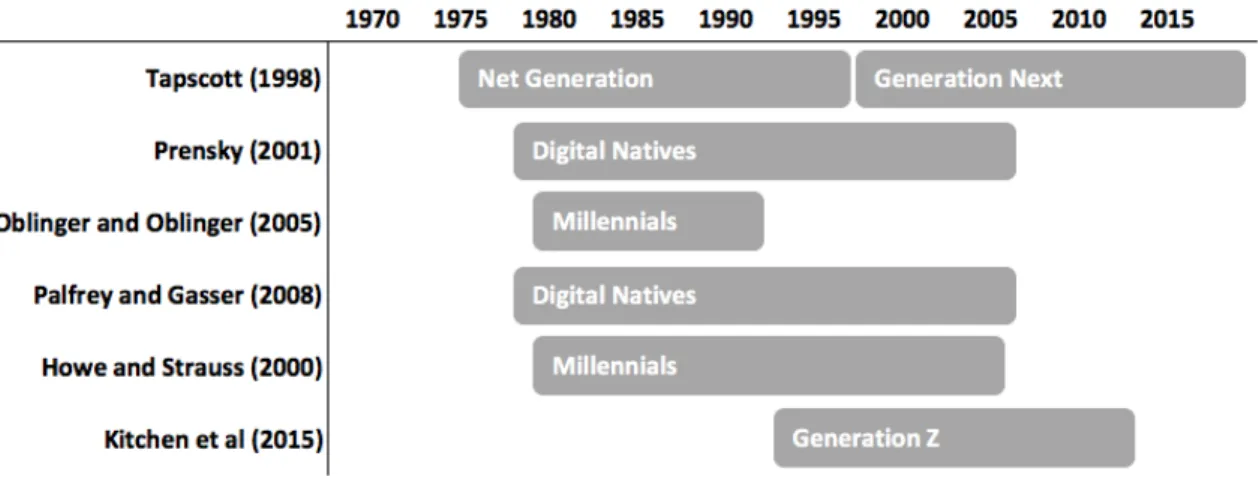
Researchers suggest that the generation born after 1980 grew up with access to computers and Internet, and is therefore inherently technology-savvy (Oblinger & Oblinger, 2005; Palfrey & Gasser, 2008; Prensky, 2001; Tapscott, 1998). In Prensky’s (2001) definition, those born in or after 1980 are called ‘digital natives’ while those born before 1980 are considered to be ‘digital immigrants’. The supporters of this idea claim that, not only does this generation have sophisticated skills in using digital
International Journal of Marketing, Communication and New Media. ISSN: 2182-9306. Special Number 2 - MDB, OCTOBER 2017
110 technologies, but also that through their exposure to these technologies they have developed radically new cognitive capacities and learning styles (Prensky, 2001). On the other hand, the young consumers of Generation Z, people born anytime between 1995 and 2012 (Kitchen & Proctor, 2015), are a unique group, rapidly gaining economic power (see Figure 1). The Generation Z is the first generation who has grown up in the middle of an era of developed information technology, being one of the most critical users of SNS, constantly engaging in online exchanging of information and conversation among its peers (Kitchen & Proctor, 2015). Hence, this generation was born into a global world, constantly connected with a seamless understanding of when and how to use communications and media technology, facing global terrorism, the repercussions of 9/11, school violence, economic uncertainty, recessions and the mortgage crisis (Williams et al., 2011). According to the same author, in terms of what characterizes this generation, their lifestyle and attitudes, they are considered to be individuals that are the new conservatives embracing traditional beliefs, valuing the importance of the family, self-controlled and more responsible, adapted to high-tech and multiple information sources, with messages bombarding them from all sides. For them, peer acceptance is very important since they need to feel that they belong to something, and their self-concept is partially determined by the group to which the teen belongs (Soltan, 2004). Overall, they are a global and diverse generation who come from a wider mix of backgrounds with different experiences and ideas.
Figure 1: Time span with the identification of Generations
Generation Z is part of a big and profitable market for many goods, and they heavily influence adult spending patterns (Business Week, 1969). Hence, their consumption experiences will presumably affect the patterns of adult consumer behavior (Guest, 1955) as they are also one of the most relevant targets for digital marketing (Montgomery, 2007). These young people have grown up with full access to the internet, and they have supported part of the development of information technology by being constantly connected to it. The combination of these factors has made them particularly valuable to marketers, including their role as ‘‘early adopters’’ of new media practices and their steadily rising spending power. Besides their role as early adopters, they are also influenced by other groups and it is relevant to get to know how these influences occur.
According to Isler, Poper and Ward (1987), parents’ influence of their children’s consumption decision is very important until the age of 12. When they begin to associate themselves more with their peers rather than the family, they start consuming certain objects to affiliate themselves to a particular social group (Auty and Elliot, 1998). Material possessions are used as a way of establishing their identity and gaining prestige among peers (Belk, 1988). Gen Zs influence their families to purchase these material possessions and in this sense they are strong influencers of family decisions. Indeed, they have a larger and influent role on the family purchases (Belch et al., 2005). The participation of a teenager in the family purchase decision depends upon several factors such as the teenager’s characteristics (age, gender, and involvement), socialization variables (family, peers), the family characteristics (income, social class, and family life cycle) and the overall context of the decision-making and the stages of this process (Aoud et al., 2008).
Family decision making when there are Gen Zs has been investigated by several authors, and most of them divide this process into several phases: initiation (or problem recognition), search and evaluation, assessment and the final decision (Martinez & Polo, 1999; Szybillo & Sosanie, 1977; Wang, Holloway, Beatty & Hill, 2007). According to Belch et al. (1985), teenagers exert greater influence during need recognition and search stages but have very little influence during final choice stage for activities such as the choice of restaurants, consumer durables and vacations. Other authors such as Holdert
International Journal of Marketing, Communication and New Media. ISSN: 2182-9306. Special Number 2 - MDB, OCTOBER 2017
112 and Antonides (1997) proposed that teenagers are more relevant during the later stages of the purchase process (evaluating the alternatives and making the final decision), rather than initiating it. So, it is relevant to understand the phases that can represent an opportunity for marketers to communicate with these younger consumers.
2.1 Influences of Generation Z decision making process within the family
Peer interaction and opinion seeking through word-of-mouth can be considered two relevant forces influencing the decision making of Generation Z within the family, However, this influential role can be different from category to category. For instance, in clothing purchase, peers exert a relevant influence on adolescents’ purchase behavior (El Aoud & Neeley, 2008). Another category that may deserve a closer attention is smart phones, which have gained global acceptance from consumers in a rather short period of time (Barnes & Scornavacca, 2004). Smartphone is key in the lives of many consumers. It is not only a tool for communication, but it is also an extension of the consumers’ personality, which enhances their private and social lives (Barutcu, 2007; Grant & O’Donohoe, 2007; Roach, 2009). Therefore, the influence of referential people in the decision making of such a symbolic product seems to be very important. This specific category of product can be the starting point to address the influence that variables such as peer interaction and WOM have in GEN Z’s decision-making process. 2.2 Peer interaction
The initial attempts to develop constructs that analyzed adolescent peer interaction were made by authors such as Moschis and Mitchell (1986) and D’Astous et al., (1990). According to Singh and Nayak (2014), the word peer means people at the same level and, during the adolescence period, a teenager’s main goal is to belong to a certain peer group. Hence, peer pressure is the influence exerted by peer groups, individuals that encourage the change in their attitudes and values. According to Caruana and Vassalo (2003), one of the major aspects in the study of teen peer interaction is the consumer socialization, along with its influence in family purchases. Ward (1987) stated that consumer socialization is a process by which teenagers acquire knowledge, attitudes and skills, which are relevant to their functioning in the marketplace. Hence, the term “influence” means a change in one’s behavior due to pressure from others and in this process, a peer is considered an influencer to a teenager when its peer pressure resulted in a change to another teen’s behavior.
As teens grow, peers exert even more influence over attitudes and decisions. While some researchers recognize the importance of peer influence upon teenagers (Bachmann et al., 1993; Roedder-John, 1999), little research considers the interrelationships between peer influence and a teenager’s purchase decision (Moschis & Mitchell, 1986; Shim, 1996). Aoud et al. (2008) are among the few authors that study the impact of peer interaction in the teenagers’ decision-making within family. Moreover, Singh and Nayak (2014) developed a study to uncover the influence of teen peer interaction and enduring product involvement in the teenagers’ decision making for the electronic items. Singh and Nayak (2014)’s main conclusion is that that the more the teenagers interact with peers, the more they contribute in the initiation stage of the decision-making process.
Therefore, we propose the following hypothesis:
H1: Peer interaction positively influences Generation Z’s purchase decision within the family.
2.3 Word-of-mouth
Word-of-mouth communications have received extensive attention from both academics and practitioners for decades (De Bruyn & Lilien, 2008). The use of social media has increased the relevance of WOM. According to Brown (2007), WOM is a consumer-dominated channel of marketing communication where the sender is independent of the market. The benefits of using WOM lie in its power to be more credible than other commercial tools provided to consumers. This is based on the trust on the people that usually share information, but is also due to the fact that it is a two-way communication, that has potential to reduce purchase risk and uncertainty through user experience; and, finally, the fact that it is live and consumers can interact in a more complete and relevant way with updated information (Silverman, 1997).
The appearance of social media created a distinction between organic and amplified WOM, where organic occurs naturally when someone wants to tell others his/her experience with a product/company, while amplified occurs when a marketer launches a campaign or encourages people to speak about its products/company (Word of Mouth Marketing Association, 2011). Besides these two concepts, WOM can also take the form of e-WOM (electronic word-of-mouth). Henning-Thurau et al. (2004) define E-WOM as any positive or negative statement made by potential, actual or former customers about a product or company, which is made available to a multitude of
International Journal of Marketing, Communication and New Media. ISSN: 2182-9306. Special Number 2 - MDB, OCTOBER 2017
114 people via the Internet.
De Bruyn and Lilien (2008) studied the WOM behavior, focusing on three concepts: opinion seeking (seekers), giving (leaders) and sharing. Previous research reinforces that both opinion giving and seeking are part of the construct of WOM (Flynn, Goldsmith and Eastman, 1996; Reynolds & Darden, 1971), and that opinion seeking is an essential dimension of WOM communications, because it facilitates information diffusion in the interpersonal communication process. In this study, we focus on opinion seeking. In this regard, Goldsmith and Horowitz (2006) investigated what motivates consumers to seek for online opinions, and found out that factors such as risk reduction, popularity, lower costs, and easy access to information, pre-purchase information acquisition and perception are critical.
Studying the influence of opinion seeking can be helpful to understand the relevance of WOM for this Generation. Therefore, we will propose the following hypothesis:
H2: Opinion seeking through word-of-mouth positively influences Generation Z’s purchase decision within family.
2.4 Proposed Model
The dependent variable of our model will be the Generation Z decision making process within the family. Beatty and Talpade (1994) and Aoud et al (2008) studied this phenomenon and realized it comprises five phases: (1) initiation, (2) information search, (3) information search with salesperson, (4) assessment and (5) final decision. For this research, we excluded stage 3, considering that Gen Z’s consumption pattern is different from other generations, and therefore internet is much more relevant than the interaction with salespeople.
The second concept analyzed is Peer Interaction. As it was mentioned previously, it is of major importance to understand the influence exerted by peers, as well as its impact on the overall decision process of Generation Z. Mourali et al. (2005) studied the sources of information (friends) and their impact on family decision-making supporting the findings of Moschis and Mitchell’s (1986). Later in 2008, Aoud et al studied the effect of teenager-peer interaction and its contribution to a family purchase decision, in the context of enduring product involvement as the mediating role. Past attempts were made to develop scales that measured peer interaction, for example Moschis and Mitchell (1986) and D’Astous at al. (1990). Aoud et al. (2008) based on items that resulted from the Moschis and Mitchell (1986) scale and from focus group conducted.
This scale was proved to be reliable with a Cronbach’s Alpha equal to 0.77. All the items will be fully used for this study, so the original scale was maintained within this context.
As for the WOM construct, its main advantage is that when consumers perceive a risk in a certain situation, actively seeking out for information or advice will allow them to make informed decisions, regarding buying. In 1996, Flynn et al. developed and validated a scale to measure opinion seeking for specific product or service domains. This scale was designed after the authors made five separate studies and its reliability was verified (α=0.88). Given the increasing importance WOM, it is of major relevance to study the impact that it might have on Generation Z’s ability to decide, either through uncovering the need of a product, or through the phase of information search/assessment of alternatives.
The theoretical model that will be tested intents to illustrate the research questions. In summary, the model developed in this research considers that Peer Interaction and Opinion Seeking positively influence Generation Z’s ability to make a decision (see Fig. 2).
Figure 2: Conceptual model Source: Own systematization
Although previous authors attempted to address the relationship between peer interaction and how adolescents’ influence the family purchase decision, this is the first study that combines more than one influence. Moreover, previous studies were conducted with adolescents. The target market of this research will be distinct, since
P E ER IN T ER A C T I O N O P I N I O N S EE KI NG : W O RD - O F - M O U T H G E N ER A T I O N Z DE C I S I O N- M AK I NG P RO C ESS Within the Family
H 1
H 2 + +
International Journal of Marketing, Communication and New Media. ISSN: 2182-9306. Special Number 2 - MDB, OCTOBER 2017
116 Generation Z will be its focus.
3. METHODOLOGY
In order to understand the relationships, as well as to analyze the proposed theoretical model, we designed a web-based survey considering the different variables. This survey was distributed in Portugal, and it was written in Portuguese. The questionnaire was divided in five parts, namely: (1) specific information about the participant, (2) scale to analyze social media behaviors and usage, (3) scale to analyze their peer-interaction, (4) scale to analyze their WOM behaviors and finally (5) their decision-making process. Four phases of the family decision making process were considered, namely: (1) initiation, (2) information search, (3) assessment and (4) final decision. The scale to measure the family decision making process was initially developed by Beatty and Talpade (1994), and was subsequently used in several studies (Belch et al. (1985), Szybillo and Sosanie (1977), Jenkins (1979), and it was updated by Aoud et al (2008), after focus groups conducted.
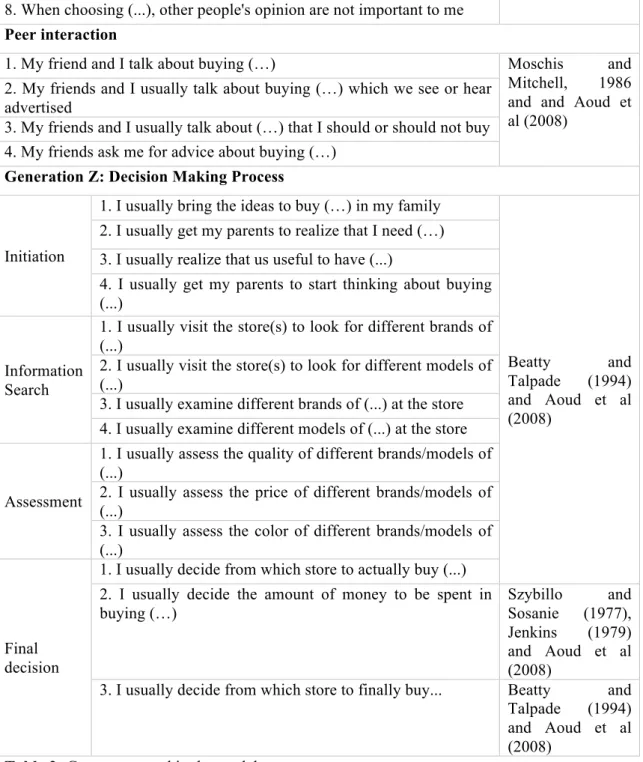
At first, our participants were asked a few questions about demographics such as their age, gender, education level and city of residence. Secondly, it was deemed important to characterize each respondent’s social media usage. Respondents were asked whether they have a smartphone, their internet usage, as well as their online behaviors when using Facebook. This last scale was developed by Junco (2012), in an attempt to measure respondent’s frequency of performance of different online activities within a social media platform. The third part evaluated respondent’s peer interaction behaviors’ while talking about smartphones. For this purpose, we relied on Aoud et al. (2008) to measure peer interaction. As for the WOM construct, the scale of Flynn (1996) was used. The scales used are listed in the next table (see Table 2).
WOM: Measured through opinion seeking
1. When I consider buying a (...), I ask other people for advice Flynn et al., 1996 2. I don't need to talk to others before I buy a (…)
3. Other people influence my choice of buying a (…)
4. I would not choose a (…) without consulting someone else 5. I rarely ask other people what (…) to buy
6. I like to get others' opinions before I buy a (…)
7. I feel more comfortable buying a (…) when I have gotten other people's opinion on it
8. When choosing (...), other people's opinion are not important to me
Peer interaction
1. My friend and I talk about buying (…) Moschis and
Mitchell, 1986 and and Aoud et al (2008)
2. My friends and I usually talk about buying (…) which we see or hear advertised
3. My friends and I usually talk about (…) that I should or should not buy 4. My friends ask me for advice about buying (…)
Generation Z: Decision Making Process
Initiation
1. I usually bring the ideas to buy (…) in my family
Beatty and
Talpade (1994) and Aoud et al (2008)
2. I usually get my parents to realize that I need (…) 3. I usually realize that us useful to have (...)
4. I usually get my parents to start thinking about buying (...)
Information Search
1. I usually visit the store(s) to look for different brands of (...)
2. I usually visit the store(s) to look for different models of (...)
3. I usually examine different brands of (...) at the store 4. I usually examine different models of (...) at the store
Assessment
1. I usually assess the quality of different brands/models of (...)
2. I usually assess the price of different brands/models of (...)
3. I usually assess the color of different brands/models of (...)
Final decision
1. I usually decide from which store to actually buy (...) 2. I usually decide the amount of money to be spent in buying (…) Szybillo and Sosanie (1977), Jenkins (1979) and Aoud et al (2008)
3. I usually decide from which store to finally buy... Beatty and Talpade (1994) and Aoud et al (2008)
Table 2: Constructs used in the model
4. DATA ANALYSIS
A convenience sample of 250 people received a link to the survey that was developed with Google Forms. The sample was selected within authors SNS network and 180 contacts effectively responded the survey. Only participants with less than 21 years old (born from 1995 to 2012) were considered. The survey was pre-tested in order to identify possible errors and problems, and scales items were analyzed to check if they
International Journal of Marketing, Communication and New Media. ISSN: 2182-9306. Special Number 2 - MDB, OCTOBER 2017
118 were correctly understood.
The majority of the respondents were females (74%), with an age between 18 to 20 years old. People of this range of ages accounted for 63% of the sample. 85% of our respondents reported to have at least finished High School or be enrolled at the University (85% of respondents). All the participants were Portuguese, and 53% of them located in Lisbon. 96% of the respondents stated that they possess a smartphone. 99,5% reported to use Internet daily. In terms of social media usage, the majority of respondents reported to search for information published by other users.
Only the completed surveys were considered for this study. The sample obtained was considered acceptable given the number of constructs in analysis. Sampling, coverage and measurement errors were also evaluated. In the responses, there are no missing values since all the questions were marked as mandatory. The model’s specification was subject to a confirmatory factor analysis (CFA), conducted with the support of AMOS 21.0, with a maximum likelihood discrepancy estimation method in order to assess the construct and convergent validity. CFA is useful in the scales’ validation for the analysis and measurements of specific constructs (Hair et al., 1998) as well as the multidimensionality of a theoretical construct (Byrne, 2001). In the current analysis, the specified relationships between the 3 constructs were tested.
4.1 Confirmatory Factor Analysis
The internal scales’ consistency was measured through the Cronbach’s Alpha value. All Alphas were considered to be good (see Table 3).
According to Hair et al. (1998, p.612), “the indicator reliabilities should exceed 0.50 which roughly corresponds to a standardized loading of 0.70”. The composite reliability exceeded the minimum value of 0.60. According to the same author, the variance-extracted value should exceed 0.50 for a construct. Almost all values of the average variance extracted exceeded the minimum value. Therefore, the extracted variance reveals the basis of convergent validity. The convergent validity through the factor loadings obtained is presented in Table 4. The factor loadings reveal the correlation between the original variables and the factors (Hair et al., 2006). According to the same author, “factor loadings of 0.40 are minimally acceptable, the values greater than ± 0.50 are generally considered necessary for practical significance”.
According to Park (2006, p.104), convergent validity refers to the “degree that indicators of the same construct are highly correlated and show a uniform pattern of
inter-correlations”. The same author (p.93) recommends that items with factor loadings lower than 0.40 should be excluded. According to the current study sample, the minimum factor loading should be between 0.40 and 0.45 (Hair et al., 2006). Table 3 shows the results from the CFA. Some of the scales items were deleted due to low factor loadings in the standardized regression. The variable WOM has three items whose factor loadings are lower than 0.50, which is not acceptable.
Variable Items loadings Factor
Squared Multiple Correlation Coefficie nt Alpha Composite Reliability Average Variance Extracted WOM WOM1 0.86 0.73 0.86 0.89 0.63 WOM2 0.36 0.13 WOM3 0.61 0.37 WOM4 0.51 0.26 WOM5 0.28 0.08 WOM6 0.96 0.92 WOM7 0.94 0.88 WOM8 0.40 0.16 PI PI1 0.83 0.69 0.87 0.87 0.63 PI2 0.78 0.60 PI3 0.82 0.66 PI4 0.75 0.57 DM IN1 0.85 0.72 0.91 0.96 0.69 IN2 0.91 0.83 IN3 0.76 0.58 IN4 0.73 0.53 IS/ASS1 0.88 0.78 IS/ASS2 0.91 0.83 IS/ASS3 0.93 0.86 IS/ASS4 0.96 0.92 IS/ASS5 0.78 0.61 IS/ASS6 0.72 0.52 IS/ASS7 0.65 0.42 FD1 0.81 0.66 FD2 0.80 0.64 FD3 0.97 0.93
Table 3: Results from CFA
International Journal of Marketing, Communication and New Media. ISSN: 2182-9306. Special Number 2 - MDB, OCTOBER 2017
120 construct inter-correlations are significantly different from one another, and the shared variance between any two constructs is less than the average variance explained in the items by the construct”. The discriminant validity is visible in the current model, as shown in the Table 5 where the values of the main matrix diagonal are calculated based on the squared average variance extracted obtained (Fornell and Larcker, 1981) from Table 4.
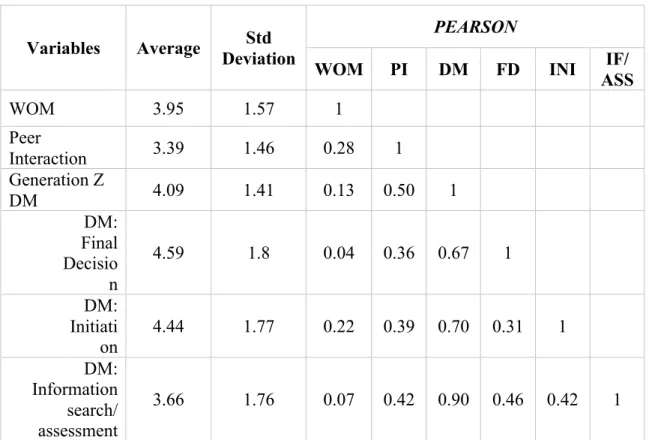
Variables Average Deviation Std
PEARSON
WOM PI DM FD INI ASS IF/
WOM 3.95 1.57 1 Peer Interaction 3.39 1.46 0.28 1 Generation Z DM 4.09 1.41 0.13 0.50 1 DM: Final Decisio n 4.59 1.8 0.04 0.36 0.67 1 DM: Initiati on 4.44 1.77 0.22 0.39 0.70 0.31 1 DM: Information search/ assessment 3.66 1.76 0.07 0.42 0.90 0.46 0.42 1
Table 4: Correlation between constructs/items
The values from the Pearson’s Correlation show the positive associations between the variables and items under study. All the correlations ranged between 0.07 and 0.90 (low and high, respectively). Within constructs, the strongest correlation observed occurs between Generation Z decision-making and Peer Interaction. This means that the more interaction exists between peers, the more positive will be its contribution to the decision-making process of Generation Z. Analyzing the correlations between the different stages of the decision-making process for Generation Z (final decision, initiation and information search/assessment) and each construct, it is possible to observe that PI has a greater outcome during the stage of information search and
assessment of alternatives, followed by the initiation. This is consistent with the existing literature, since according to Aoud et al. (2008), peer interaction contributes more in the first stages of the decision-making process. This happens because consumers search for information within their sources, and these sources may be their peers, the internet, opinion leaders, and so on. Thus, we can say that peer’s roles is to share their experiences as users, influencing Gen Zs before they reach a final decision. The final decision of the Gen Z can be assessed is through the observation of two behaviors: the final selection of the store where to buy the product, and the amount of money to be spent in that purchase. This amount of money, in the case of younger consumers with small buying power, can be dependent on the family.
WOM has a greater influence in the decision-making process through influencing the first phase – initiation - which means that when consumers engage in opinion seeking through WOM, the contribution for the initiating phase of the decision-making process of Generation Z will increase in 0.22 units. The same conclusion that explains PI’s correlation values in the previous paragraph also applies to the results obtained with WOM. The first stage of the decision-making process is characterized by bringing the ideas to the family, getting the parents to realize the product need, realizing that it is useful to have the product and to get the parents to start thinking about it. On the other hand, the information search and assessment stage are evaluated by visiting the stores (online or offline) to look for different brands/models, examining those brands/models and assessing their quality, price or color. Opinion seeking has a higher influence in the first stage, where consumers look and present the information of a certain product, based on the recommendations or reviews of other people. Once they possess their opinion, consumers make their own final judgments regarding the purchase and the amount of money to spend. At this stage they are not so influenced by others, except for their families that may control their decision ability.
The final structural equation model is presented in Figure 3, with the standardized parameter estimate above.
International Journal of Marketing, Communication and New Media. ISSN: 2182-9306. Special Number 2 - MDB, OCTOBER 2017
122
Figure 3: Model results
The model has 3 constructs and 31 observed variables, considering measurement and latent variable errors and inter-correlations between the latent constructs. The null model (X2 = 448.17 / df = 220) has a statistical significance level of 0.00. The normed chi-square (X2 / df) has a recommended level range between 1.0 and 2.0. The current model chi-square equals 1.99 (448.17 / 220), falling in recommended values. The Incremental Fit Index (IFI), Tucker-Lewis Index (TLI) and Comparative Index (CFI) reveal acceptable results. These indices should present values above 0.90 (Hair et al., 1998). In the current model, IFI = 0.87, TLI = 0.92 and CFI = 0.93. Regarding the Root Mean Square Error of Approximation (RMSEA), values below 0.10 are considered acceptable, while values, which are greater than 0.10 indicate an unacceptable, fit (Browne and Cudeck, 1992). Moreover, according to Thompson and Daniel (1996), values below 0.08 are desirable and below 0.05 outstanding. The current model RMSEA = 0.07, which is included in the desirable range. Given that all the fit indices were inside conventional cut-off values, the model was deemed acceptable.
After reviewing the model fit with the data, it is important to test the research hypothesis previously defined. In order to do that, the standardized estimates and the t-values were analyzed, as presented in the Table 5.
PEER INTERACTION OPINION SEEKING: WORD-OF-MOUTH GENERATION Z DECISION-MAKING PROCESS 0.66 -0.04 R2=0.42 X2= 448.170 df = 220 IFI = 0.88 TLI = 0.92 CIF = 0.93 RMSEA = 0.07
Research Hypothesis Expected Relation Parameter Estimated p-value Significance level Supported
H1: Peer interaction positively influences Generation Z’s purchase decision. POSITIVE 0.66 <0.01 99% YES H2: Opinion seeking through word-of-mouth positively influences Generation Z’s purchase decision POSITIVE -0.04 .64 99% NO
Table 5: Results of research hypothesis
Only one of the two hypotheses proposed in the initial model was supported for a significance of 99% (p-value < 0.01). Therefore, based on the data presented in Table 6, when the impact of PI increases one unit, Generation Z’s purchase decision within the family increases 0.66 units, which means that Peer Interaction has a positive effect on the purchase decision of Generation Z. On the other hand, when the opinion seeking through WOM increases one unit, Generation Z’s purchase decision lowers 0.04 units, showing that there is no significant relation between seeking information through WOM and the purchase decision.
5. DISCUSSION OF RESULTS
This study investigated the role of WOM and peer interaction in the decision-making process of Generation Z within their families. Relating previous studies about the opinion seeking process and peer interaction, this study developed and tested a theoretical model that investigated potential key influencers of the generation, through the different decision-making stages.
The first hypothesis tested was related to the relationship between peer interaction and Generation Z’s purchase decision. The results showed that there is a positive relationship between these two variables, which means that when consumers interact with their peers, the overall decision process is positively affected. This is aligned with previous findings from Aoud et al. (2008). The correlations amongst these two variables and its items are also aligned with the existing literature where, according to Belch et al. (1985), peers exert greater influence during need recognition and search stages, but have little influence during final choice stage. This can be explained by the fact that this study was conducted in a rather young sample, with ages ranging from 13 years to 21
International Journal of Marketing, Communication and New Media. ISSN: 2182-9306. Special Number 2 - MDB, OCTOBER 2017
124 years, and for the smartphones’ category. This category implies some level of investment. Most of the respondents are students that do not work, which means that ultimately their parents may be more responsible for the final stage of the buying process. The influence of peers is effective due to the trust factor, once there is an existing relationship among them, and they feel more related to each other. This closer relationship helps to influence the overall decision process, but is more important in the first stages, when consumers look for opinions on products, or when they are deciding among different alternatives.
The second hypothesis was not supported. This hypothesis tested whether opinion seeking through WOM positive influenced Generation Z’s purchase decision. The p-value obtained showed that there is no significant relation between these two variables. Therefore WOM seems to have little influence in the overall decision process. Nevertheless, analyzing the correlations amongst items, WOM seems to have a greater influence in the overall decision-making through the first phase: initiation. These results are different from the previous findings, which stated that WOM had a powerful influence on behavior, especially on consumers’ information search and evaluation stages (Cox, 1963; Brown & Reingen, 1987; Money, Gill & Graham, 1998; Silverman, 2001). One of the potential explanations for this is the fact that the product considered in our study involved a higher investment than commodities, for instance. Given this, Generation Z can seek for the existing information about a certain product/brand, using that information as a cue to choose amongst different alternatives, and then present that information to their family to get a the final decision. Here, the influence exerted by WOM is visible in the first stages of the process, and not so much on the final decision. To the best of our knowledge, this was the first time that Generation Z’s decisions were studied in Portugal. Nowadays, the number of information sources is greater, and consumers have access to many resources from which to choose, prior to make a decision. With the advent of the internet, and moreover with the growth of SNS, opinions and ideas are now more widespread, and consumers can gather information more easily. Information search can be obtained in different ways and WOM is one relevant alternative. The use of bloggers and brand ambassadors is another form of providing and sharing information, and this generation may be closer to them, rather than taking into account opinions from other consumers, with whom they do not have a
relationship, or that do not have any power of influence over them. Referrent’s opinions seem to constitute an important source of information used by Gen Zs in their decision-making process and in our study we concluded this effect to be stronger than the effect than WOM may have.
6. CONCLUSIONS
This research provided theoretical implications for understanding the influences of Generation Z’s decision-making process within family, using WOM and Peer Interaction as main determinants. Several studies were conducted before on Millennials decision process, but there are not many studies focusing on Generation Z. This study was one of the firsts attempting to study this generational cohort in Portugal, which can be understood as a first step for the understanding of this new generation that is now ready to enter the labor market.
The main findings of this study are the positive influence that Peer Interaction exerts in the overall decision-making process of Generation Z and the fact that it was not possible to confirm the same significant influence for the WOM construct. Nevertheless, there is some correlation between this variable and some stages during the process of making for this generation, which shows that WOM has a greater influence in decision-making during the initiation stage, where consumers become aware that they need a certain product. The relationship between Peer Interaction and adolescent family decision-making was studied for Tunisian adolescents with Aoud et al. (2008), and their results were aligned with some of the results attained in this study, for Portugal. Nonetheless, the new variable included (WOM) did not provided the expected results for our sample. One important consideration is that age can provide different consuming patterns, considering that the population under study was mostly under 20 years old. This paper offers some interesting insights for marketers. We believe that the understanding of the main influences in the decision-making process of Generation Z witihin their families can provide relevant clues to best target these young consumers, providing strategies that are aligned with their behaviors, or even exceeding their expectations and ensuring their satisfaction and loyalty levels. With this study, marketers understood the positive influence that peer interaction exerts on Generation Z’s. This generation has grown up with the internet, and they are used to look for information more easily and faster than the previous generations. By knowing this,
International Journal of Marketing, Communication and New Media. ISSN: 2182-9306. Special Number 2 - MDB, OCTOBER 2017
126 marketers should consider this and adapt their communication, ensuring that peers represent a valuable role in the decision-making process of each other. Investing in the relationship between brands and online users is a cleaver bet, once these peers can act as brand advocates while they share their opinion about their experience and usage of a certain product/brand. In this sense, recurring to bloggers, vloggers, youtubers and other major endorsers for some categories could be considered by brands if they are able to become trustable by Gen Zs. This means that these agents are only supposed to be part of firms strategies if they are indeed able to be considered as “peers” by Gen Zs. If not, it would be better to stimulate peer interaction through brands’ SNS’ pages: providing peers the resources and information that are more useful from the marketers’ point of view, and encouraging the conversation amongst them. Since peers know each other, their trust level is higher, and therefore they will take each other’s opinion into account in a faster way. Peers provide an easy cue to advocate opinions, easily influencing other consumers.
Even though our study did not prove a significant relationship between WOM and the generation’s decision-making process, we believe that marketers should invest in this communication tool once it provides relevant information for consumers with little investment. With social media, consumers are empowered to share their opinions and experiences, which can be a powerful cue for other consumers that are considering the hypothesis of buying the same product, or visiting the same place. That said, this type of communication requires smaller investment for marketers, compared to advertising. If consumers have a positive opinion about something, they will positively influence another consumer, and that is of major importance for companies. On the other hand, if their opinion is negative and they share it, marketers risk losing more than just one unsatisfied consumer, once he/she will influence several consumers by sharing that experience. By managing and engaging this information sharing, marketers can positive influence the information flow, which can be valuable for them to ensure satisfaction of consumers.
Overall, peer interaction and WOM exert more influence during the first stages of the decision-process. The final decision of this process is not heavily influenced by these tools due to the influence that parents have over this generation’s decision-making ability. For marketers, it is important to set different strategies to address both
Generation Z and their parents, once this generation’s decision-making process is not entirely decided by them. Throughout the process, consumers of this generation are responsible to identify their needs, search for the product/brands that satisfy those needs, and looking for information that will help them to choose amongst different alternatives. Nevertheless, parents still represent the major influencer and perhaps the main deciders within the last stage. To address this opportunity, marketers should design strategies that consider this information, besides regarding only for younger consumers.
6.1 Limitations and future research
Overall, the hypothesis that tested whether WOM positive influences the decision-making process was not supported, since the results did not prove a significant influence in the decision-making process. One of the recommendations is to include the two concepts that were not studied throughout this research: opinion sharing and opinion giving; and by re-evaluating the existing scale for opinion seeking to ensure that the new items can provide better results to the overall model. Moreover, this study considered only one product category, which is smartphones. This category implies some level of financial investment, once the product is expensive when compared to other categories such as clothing or food. With different categories, the results can be different, and the influence of WOM can be larger.
Another suggestion is to include different variables in the study, therefore enlarging the field of analysis that was considered. The new proposed model should include new variables such as the use of bloggers, viral marketing, brand ambassadors and user generated content. Uncovering the relationship between these variables and their decision-making process may help marketers to best target these consumers, understanding what motivates and engages them. Also, by enlarging the number of variables included in the study, it would be possible to understand different key influencers that are part of Generation Z’s decision-making. Since there exists limited research about this new generation, it would be interesting to continue investigating how to reach these customers.
Finally, it would have been important to have more respondents, not only to collect more responses and different opinions, but also to ensure an efficient coverage of respondents, in terms of ages, city of residence and sex. 74% women composed the current sample, and most of them were located in Lisbon. If the sample was evenly distributed through Portugal, results could be more reliable and credible, and therefore it
International Journal of Marketing, Communication and New Media. ISSN: 2182-9306. Special Number 2 - MDB, OCTOBER 2017
128 could produce more information valuable to both scholars and professionals. Moreover, taking into account the composition of the sample, it was not possible to compare results between different groups, such as the age or the sex of the respondents. Specific information about social media usage could have also been an interesting measure to be compared between demographic groups, which could be possible in a wide and diverse sample.
REFERENCES
Aoud, N. H., and Neeley, S. M. (2008). Teenager–peer interaction and its contribution to a family purchase decision: The mediating role of enduring product involvement.
International Journal of Consumer Studies, 32, 242–252.
Arndt, J. (1967). Word of mouth advertising – A review of the literature. New York:
Advertising Research Foundation.
Bachmann, G. R., John, D. R., and Rae, A. (1993). Children’s susceptibility to peer group purchase influence: An exploratory investigation. Advances in Consumer Research, 20, 463–468.
Barnes, S. J., Scornavacca, E. (2004). Mobile marketing: The role of permission and acceptance. International Journal of Mobile Communications, 2(2), 128-139.
Beatty, S. E., and Talpade, S. (1994). Adolescent influence in family decision-making - a replication with extension. Journal of Consumer Research, 21(2), 332–341.
Belch, G.E., Belch, M.A. and Ceresin, G. (1985). Parental and teenage child influences in family decision making. Journal of Business Research, 13, 163–176.
Beldona, S., Nusair, K. and Demicco, F. (2009). Online travel purchase behavior of generational cohorts: A longitudinal study. Journal of Hospitality Marketing and
Management, 18, 406-20.
Belk, Russell W. (1988). Possessions and the extended self. Journal of Consumer Research, 15, 139-68.
Brown, J. J. and Reingen, P. H. (1987). Social Ties and word-of-mouth referral behavior.
Journal of Consumer Research, 14, 350–62.
Brown, J., Broderick, A. J., and Lee, N. (2007). Word-of-mouth communication within online communities: Conceptualizing the online social network. Journal of Interactive
Marketing, 21(3), 2–20.
word-of-mouth intentions and behaviors in a retailing context. Journal of the Academy of
Marketing Science, 33(2), 123–138.
Business Week. 1969. Getting Across to the Youth. October 18 89-90.
Byrne, B. (2001). Structural Equation Modeling with AMOS: Basic Concepts, Applications,
and Programming. New Jersey: Lawrence Erlbaum Associates.
Caruana, A. and Vassallo, R. (2003). Children’s perception of their influence over purchases: The role of parental communication patterns. Journal of Consumer Marketing, 20, 55–66.
Caumont, A. (2014). What would you name today’s youngest generation of Americans.
Pew Research Center. Retrieved from:
http://www.pewresearch.org/fact-tank/2014/03/12/what-would-you-name-todays-youngest-generation-of-americans/ (2016/02/20; 15H 05M).
Child, D. (1990). The Essentials of Factor Analysis, 2nd edition. London: Cassel Educational Limited.
Cox, D. F. (1963). The audiences as communicators. American Marketing Association, December, 58–72.
Cude, B. (2004). Collecting research online: A primer for extension, research, and instruction. Proceedings of the Eastern Family Economics and Resource Management
Association, 31-34.
D’Astous, A. (1990). An inquiry into the compulsive side of normal consumers. Journal of
Consumer Policy, 13(1), 15-31.
De Bruyn, A., Lilien, G.L. (2008). A multi- stage model of word of mouth influence through viral marketing. Journal of Research in Marketing, 25, 151–163.
Flynn, L. R., Goldsmith, R. E., and Eastman, J. K. (1996). Opinion leaders and opinion seekers: Two new measurement scales. Journal of the Academy of Marketing Science, 24(2), 137–147.
Fornell, C., and Larcker, D.F. (1981). Evaluating structural equation models with unobservable variables and measurement error. Journal of Marketing Research, 18(February), 39–50.
Goldsmith, R. E., and Horowitz, D. (2006). Measuring motivations for online opinion seeking. Journal of Interactive Advertising, 6(2), 1-16.
Grant, I., O’Donohoe, S. (2007). Why young consumers are not open to mobile marketing communications. International Journal of Advertising, 26(2), 223-246.
Guest, P., (1955). Brand loyalty: Twelve years later. Journal of Applied Psychology, 39 (December), 405-408.
International Journal of Marketing, Communication and New Media. ISSN: 2182-9306. Special Number 2 - MDB, OCTOBER 2017
130
de Dados, 5th edition, Porto Alegre: Bookman
Hair, J. F., Black, W. C., Babin, B. J., Anderson, R. E., and Tatham, R. L. (2006). Multivariate Data Analysis, 6th edition. Upper Saddle River, NJ: Pearson.
Hair, J.F. Jr., Anderson, R.E., Tatham, R.L., and Black, W.C. (1998). Multivariate Data Analysis, 5th edition, Upper Saddle River, NJ: Prentice Hall.
Hall, W., and Keynes, M. (2011). The net generation and digital natives: Implications for higher education. Higher Education Academy, (June), 1–56.
Isler, L., Popper, E.T., and Ward, S., (1987). Children's purchase requests and parental responses: Results from a diary study. Journal of Advertising Research. October/November, 28-39.
Jenkins, R. L. (1979). The influence of children in family decision-making: Parents’ perceptions. Advances in Consumer Research, 6, 413–418.
Junco, R. (2012). The relationship between frequency of Facebook use, participation in Facebook activities and student engagement. Computers and Education, 58(1), 162-171.
Kane, S. (2010). Baby Boomers. Retrieved from
http://legalcareers.about.com/od/practicetips/a/Babyboomers.htm (2016/01/05; 12H 08M).
Kane, S. (2010). Generation X. Retrieved from
http://legalcareers.about.com/od/practicetips/a/GenerationX.htm (2016/01/05; 12H 08M).
Kane, S. (2010). Generation Y. Retrieved from
http://legalcareers.about.com/od/practicetips/a/GenerationY.htm (2016/01/05; 12H 08M). Kitchen, P. J., and Proctor, T. (2015). Marketing communications in a post-modern world.
Journal of Business Strategy, 36(5), 34–42.
Kotler, P., and Keller, K. L. (2012). Marketing Management. Upper Saddle River, N.J: Pearson Prentice Hall.
Martinez, E., Polo, Y. (1999). Determining factors in family purchasing behavior: An empirical investigation. Journal of Consumer Marketing, 16(5), 461–81.
Money, R. B., Gilly, M. C., and Graham, J. L. (1998). Explorations of national culture and word-of-mouth referral behavior in the purchase of industrial services in the United States and Japan. Journal of Marketing, 62, 76–87.
Montgomery, K.C. (2007). Generation Digital: Politics, Commerce, and Child- hood in the
Age of the Internet. Cambridge, MA: MIT Press.
Moschis, G. P., and Mitchell, L. G. (1986). Television advertising and interpersonal influences on teenagers’ participation in family consumer decisions. Advances in Consumer
Research, 13, 181–186.
expenditures. Family and Consumer Sciences Research Journal, 32(1), 52-75.
Oblinger D.G. and Oblinger J.L. (2005). Educating the net generation. An Educause E-book
Publication. Available at: http://www.educause.edu/ir/library/pdf/pub7101.pdf. (2016/01/05;
12H 08M).
Palfrey J. and Gasser U. (2008). Born Digital: Understanding the First Generation of Digital Natives, New York: Basic Books.
Prensky M. (2001a). Digital natives, digital immigrants. On the Horizon, 9, 1–6.
Prensky M. (2001b). Digital natives, digital immigrants part II: Do they really think differently? On the Horizon, 9, 1–9.
Reynolds, F. D., and Darden, W. R. (1971). Mutually adaptive effects of interpersonal communication. Journal of Marketing Research, 8(4), 449–454.
Roach, G. (2009). Consumer perceptions of mobile phone marketing: A direct marketing innovation. Journal of Research in Interactive Marketing, 3(2), 124-138.
Roedder-John, D. (1999). Consumer socialization of children: A retrospective look at 25 years of research. Journal of Consumer Research, 26(December), 183-213.
Schewe, C.D., Meredith, G.E. and Noble, S.M. (2000). Defining moments: Segmenting by cohorts. Marketing Management, 9(3), 48-53.
Schuman, H. and Scott, J. (1989). Generations and collective memories. American
Sociological Review, 54, 359-81.
Shim, S. (1996). Adolescent consumer decision-making styles: The consumer socialization perspective. Psychology and Marketing, 13(6), 547-569.
Silverman, G. (1997). Harvesting the power of word-of-mouth. Potentials in Marketing, 30(9), 14-16.
Silverman, G. (2001). The Secrets of Word-of-Mouth Marketing: How to Trigger
Exponential Sales Through Runaway Word-of-Mouth. New York: American Marketing Association.
Singh, R., and Nayak, J. K. (2014). Peer interaction and its influence on family purchase decision: A study among Indian teenagers. Vision: The Journal of Business Perspective, 18, 81–90.
Soltan, R. (2004). The tween market: Keeping our collections attractive, practical and effective. Library Youth Services Consultant and Staff Person, Educational Resources
Laboratory at Oakland University,
http://www.mlaforum.org/volumeIII/issue1/Article2Tweens.html (2016/01/05; 12H 08M). Sousa, C. M. P. and Ruzo, E. (2011). Managerial determinants of export performance: Direct and moderating effects. Handbook of Research in International Marketing, 249-266. Stewart, A.J. and Healy, J. (1989). Linking individual development and social changes.
International Journal of Marketing, Communication and New Media. ISSN: 2182-9306. Special Number 2 - MDB, OCTOBER 2017 132 American Psychologist, 44, 30-42.
Szybillo, G. J., Sosanie, A. (1977). Family decision making: Husband, wife and children.
Advances in Consumer Research, 4, 46–49.
Tapscott, D. (1998). Growing Up Digital: The Rise of the Net Generation, New York: McGraw-Hill.
Tapscott, D. (2008). Grown Up Digital: How the Net Generation is Changing Your World, New York: McGraw-Hill.
Thompson B, Daniel LG. (1996). Factor analytic evidence for the construct validity of scores: A historical overview and some guidelines. Educational and Psychological
Measurement, 56(2), 197-208.
Wang, S., Holloway, B. B., Beatty, S. E., Hill, W. W. (2007). Adolescent influence in family purchase decisions: An update and cross-national extension. Journal of Business
Research, 60, 1117–1124.
Wolburg, J.M. and Pokrywczynski, J. (2001). A psychographic analysis of Generation Y college students. Journal of Advertising Research, September/October, 33-52.
APPENDIX – Structure of the questionnaire used
Age
Sex Male
Female Local of residence
Educational Attainments Primary school Middle school Secondary school University frequency Bachelor Degree Do you possess a smartphone: Yes
No Do you use the Internet every day? Yes
No
In average, how much of your daily time do you spend in activities within Social Media?
In average, how much times a day do you enter social media?
From 1 to 7, indicate the frequency of usage of the following social media activities: (1=Never; 2=Rarely; 3=Occasionaly; 4=Sometimes; 5=Frequently; 6=Most often; 7=Always)
1 2 3 4 5 6 7
Share links
Make publications in your own Facebook Wall Comment (status, friends' publications, pictures) Look for information published by other users Publish pictures
See pictures Publish videos See videos
International Journal of Marketing, Communication and New Media. ISSN: 2182-9306. Special Number 2 - MDB, OCTOBER 2017
134 In terms of Peer Interaction, from 1 to 7 evaluate your opinion according to these sentences:
(1=Totally disagree; 2=Disagree 3=Partially disagree; 4=Do not agree or disagree; 5=Partially agree; 6=Agree; 7=Totally agree)
1 2 3 4 5 6 7
My friend and I talk about buying...’
My friends and I usually talk about buying ... which
we see or hear advertised’
My friends and I usually talk about ... that I should or
should not buy’
My friends ask me for advice about buying...’
In terms of Opinion Seeking, from 1 to 7 evaluate your opinion according to these sentences:
(1=Totally disagree; 2=Disagree 3=Partially disagree; 4=Do not agree or disagree; 5=Partially agree; 6=Agree; 7=Totally agree)
1 2 3 4 5 6 7
When I consider buying a smartphone, I ask other people
for advice
I don't need to talk to others before I buy a smartphone Other people influence my choice of buying a
smartphone
I would not choose a smartphone without consulting
someone else
I rarely ask other people what smartphone to buy I like to get others' opinions before I buy a smartphone I feel more comfortable buying a smartphone when I
have gotten other people's opinion on it When choosing a smartphone, other people's opinion are
In terms of your Decision-Making Process, from 1 to 7 evaluate your opinion according to these sentences:
(1=Totally disagree; 2=Disagree 3=Partially disagree; 4=Do not agree or disagree; 5=Partially agree; 6=Agree; 7=Totally agree)
1 2 3 4 5 6 7
Initiation
I usually bring the ideas to buy a smartphone in my
family
I usually bring the ideas to buy a smartphone in my
family
I usually realize that us useful to have a smartphone I usually get my parents to start thinking about buying a
smartphone
Information search
I usually visit the store(s) to look for different brands of
smartphones
I usually visit the store(s) to look for different models of
smartphones
I usually examine different brands of smartphones at the
store
I usually examine different models of smartphones at the
store
Assessment of alternatives
I usually assess the quality of different brands/models of
smartphones
I usually assess the price of different brands/models of
smartphones
I usually assess the color of different brands/models of
smartphones
Final decision
I usually decide from which store to actually buy a
International Journal of Marketing, Communication and New Media. ISSN: 2182-9306. Special Number 2 - MDB, OCTOBER 2017
136 I usually decide the amount of money to be spent in
buying a smartphone
I usually decide from which store to finally buy a
smartphone
How to cite this article:
Silva, S. S.; Machado, J. C. & Cruz, M. (2017) The influence of WOM and Peer Interaction in the Decision-Making Process of Generation Z within the family. International Journal of Marketing, Communication and New Media. Special Number 2 – Marketing and Digital Business, 106-136, Available at http://u3isjournal.isvouga.pt/index.php/ijmcnm.