Ana Alexandra Lopes Rodrigues de Moura
A Micro-analytic approach to Mother's
Touch Behavior in a Structured Social
Interaction with 12-month-old Infants
Ana Alexandra Lopes Rodrigues de Moura
junho de 2019 UMinho | 2019 A Micr o-anal ytic appr oac h to Mo ther's T ouc h Beha vior in a Str uctur ed Social Inter action wit h 1 2-mont h-old Inf ants
junho de 2019
Tese de Mestrado
Mestrado Integrado em Psicologia
Trabalho efectuado sob a orientação do
Professor Doutor Alfredo Pereira
Ana Alexandra Lopes Rodrigues de Moura
A Micro-analytic approach to Mother's
Touch Behavior in a Structured Social
Interaction with 12-month-old Infants
Declaração
Nome: Ana Alexandra Lopes Rodrigues de Moura
Endereço eletrónico: [email protected] Telemóvel: 915839096
Número do cartão de cidadão: 14688507
Título da dissertação: A Micro-analytic approach to Mother's Touch Behavior in a Structured Social Interaction with 12-month-old Infants
Orientação: Professor Doutor Alfredo Pereira Ano de conclusão: 2019
Designação do Mestrado: Mestrado Integrado em Psicologia
É AUTORIZADA A REPRODUÇÃO INTEGRAL DESTA DISSERTAÇÃO, APENAS PARA EFEITOS DE INVESTIGAÇÃO, MEDIANTE DECLARAÇÃO ESCRITA DO INTERESSADO, QUE A TAL SE COMPROMETE.
Universidade do Minho, 04/06/2019 Assinatura:
DECLARAÇÃO DE INTEGRIDADE
Declaro ter atuado com integridade na elaboração do presente trabalho académico e confirmo que não recorri à prática de plágio nem a qualquer forma de utilização indevida ou falsificação de informações ou resultados em nenhuma das etapas conducente à sua elaboração.
Index
Acknowledgments ... iii
Abstract ... iv
Resumo... v
A Micro-analytic approach to Mother's Touch Behavior in a Structured Social Interaction with 12-month-old Infants ... 6
Touch: A Primary Channel of Communication ... 6
Defining Social Touch ... 6
Intent and Function of Touch in Mother-Infant Interaction ... 8
Categorizing Touch Functions – Mothers Touch Patterns ... 9
Method ... 11
Participants ... 11
Apparatus and Procedures ... 12
Measures and Data Processing ... 12
Mother Touch Scale ... 12
Results ... 14 Discussion ... 16 References ... 21 Appendix A... 26 Appendix B ... 28 Appendix C ... 29 Index Figures Figure 1: Proportion of interaction time, per OMTS Category of Touch per Task... 15
Acknowledgments
First, I would like to thank all the parents and infants who participated in the study. This study was conducted at Psychology Research Centre (UID/PSI/01662/2013), University of Minho, and supported by the Portuguese Foundation for Science and Technology and the Portuguese Ministry of Science, Technology and Higher Education through national funds and co-financed by FEDER through COMPETE2020 under the PT2020 Partnership Agreement (POCI-01-0145-FEDER-007653). This research was also supported by: PhD grants from Portuguese Science and Technology Foundation to JS (PD/BD/142819/2018) and HM
(SFRH/BD/86694/2012), research grants PTDC/MHC-PCN/1530/2014 and IF/00217/2013 attributed to AP. To my adviser, Professor Dr. Alfredo Pereira, for the guidance and patience during this process. For all the knowledge, opinions and constructive criticism, and full collaboration and support, thank you!
To my research colleagues, in particular to Dr. Juliana Serra, for all your kindness, patience, motivation, understanding and fundamental help and support throughout this process, thank you!
To everyone who I’ve come across in the CCG, especially Isabel, Vladimiro, Emanuel and Catarina, for all the warm welcomes, sympathy, laughs and new experiences, thank you!
To my friends, Inês, Débora, Ana, Bibiana and Rui, for the friendship, strength and support in the hardest times; with all my heart, thank you!
To my person, Filipa, for in the past 7 years always being there for me and never giving up! For the unquestionable friendship, to all the support, daily inspiration and a lot more that can’t be put into words; this journey wouldn’t be the same without you, thank you!
To my family, for all the unconditional support during not only this adventure, but my entire life! To all the good moments and the craziest ones, I love you all to the moon and back, thank you!
A Micro-analytic approach to Mother's Touch Behavior in a Structured Social Interaction with 12-month-old Infants
Abstract
Social touch is a complex system to define having two major lines of research, the
neurophysiological approach (CT-fibers) and the studies of the contextual (behavioral) aspects of touch between the dyad. The present study focusses on the behavioral aspects such as the intent and function of the touch event in a mother-infant structed social interaction. Being touch the primary channel of
communication between the dyad but still the most neglected in research, our two main objectives were: 1) to explore how often each category of touch occurs depending on different play tasks (face-to-face or object oriented); 2) to analyse if maternal touch behavior is modulated by the demands of different play tasks, not only in terms of frequency of touch but also considering the types of touch used by the mother.
Hypothesising that mothers will adjust their touch behavior to the demands of the play task, touching more frequently and using a greater number and differentiated touch categories in the free play without objects task (face-to-face) compared to the object exploration tasks.
Mothers touch behavior was segmented and categorized into categories using the Ordinalized Mother Touch Scale (OMTS Category). In a 3 (Play Task) x 8 (OMTS Category) ANOVA, all effects were found significant: mothers touch behavior appeared to adapt to the demands of the task and engaging in more frequent touch behaviors during the face-to-face task. An interesting finding was the significant higher use of caregiving touch category in the challenging object task when compared to the face-to-face interaction.
Toque Materno numa Interação Social Estruturada aos 12 meses: uma abordagem Micro-analítica
Resumo
O toque social é um construto complexo para se definir que atualmente segue duas linhas principais de investigação, a abordagem neuro-psicofisiológica (fibras CT) e os aspetos contextuais
(comportamentais) do toque entre a díade. A presente investigação focou-se nos aspetos comportamentais, tais como a intenção e a função do evento de toque numa interação social estruturada mãe-criança. Considerando que o toque é o meio de comunicação principal entre a díade, mas ainda assim o mais negligenciado na investigação, os dois objetivos deste estudo foram: 1) explorar com que frequência cada categoria de toque ocorre consoante as diferentes tarefas (face-a-face ou orientada-a-objetos); 2) analisar se o comportamento do toque materno é modulado pelas exigências das diferentes tarefas, não só em termos de frequência mas tendo em conta também os tipos de toque utilizados pela mãe. Hipótese: mães irão ajustar o seu comportamento de toque às exigências da tarefa, tocando com mais frequência e recorrendo a um maior número e a mais categorias de toque na tarefa jogo livre sem objetos (face-a-face) quando comparada com as tarefas de exploração de objetos.
O toque materno foi segmentado e categorizado em categorias, recorrendo à Ordinalized Mother Touch Scale (Categoria OMTS). Numa ANOVA, 3(Tarefas) x 8(Categoria OMTS), todos os efeitos foram considerados significantes: as mães mostraram adaptar o seu comportamento de toque às exigências da tarefa, tendo comportamentos de toques mais frequentes durante a tarefa face-a-face. Adicionalmente, um resultado interessante foi que as mães usaram com mais frequência a categoria de toque caregiving na tarefa do objeto desafiante quando comparada à interação face-a-face.
Palavras-chave: Toque Social; Comportamento do Toque Materno; Interação Mãe-Criança; Microanálise
A Micro-analytic approach to Mother's Touch Behavior in a Structured Social Interaction with 12-month-old Infants
Touch: A Primary Channel of Communication
Touch (cutaneous sensitivity) is the first sensory system to develop, being one of the most developed at birth but also the least researched about. Studies of touch support its key role in the development of social-emotional processes, e.g. it is the primary channel of communication between the new-born and the caregiver (Miguel, 2017).
Recent literature also shows parental touch, signals the quality of the environment surrounding the infant, allowing him to adapt and even reduce the stress levels. This leads to the belief that touch is the primary mean of communication of feelings such as comfort, warning, caregiving, playfulness or even affection, between a caregiver and the new-born (Cascio, Moore, & McGlone, 2018). Whence deprived of a contingent behavioral touch from a caregiver, the infants’ aptitude to share attentional, affective or mental states with others may be compromised; setting a development pathway that might disrupt the structural consolidation of the person (Beebe et al., 2008, 2012). Emphasizing the consequences of neglecting the impact of touch in the development of social-emotional and cognitive systems, e.g. infant lacks strategies to cope with negative emotions and distress (Beebe et al., 2012; Moszkowski, Stack, & Chiarella, 2009).
Defining Social Touch
Social touch is a complex system to define as it circumscribes innumerous concepts and topics, generating a fragmented literature. The first major line of research is the neurophysiological approach (CT-fibers) being the second studies of the contextual (behavioral) aspects of touch between the dyad.
According to neurophysiological research, touch is perceived as affectionate when the optimal stimulation of unmyelinated, low-threshold mechanoreceptive (LMTs) afferents, also known as, C-tactile fibers (CT) afferents occurs. These fibers are found in hairy skin sharing their anatomical location with other LMTs, that encode thermal and chemical stimuli, allowing the perception of pressure/vibration, temperature, itch and pain (Cascio et al., 2018; McGlone, Wessberg, & Olausson, 2014; Tuulari et al., 2017).
The stimulation of CT afferents through gentle touch in 6 to 10 months infants has been positively corelated with the development of an affective attachment with the caregiver, regulation capacities, symbolic
competence, cognitive skills and has also been linked to other health benefits (Croy, Sehlstedt, Wasling, Ackerley, & Olausson, 2017; McGlone et al., 2014).
CT afferents that have a lower conduction velocity rate than the other LMTs (0.5–2 m/s < 20–80 m/s) are associated to social touch, being optimally stimulated by human touch creating an overlapping of the physiological (perception of the skin) and psychological (perception of who is delivering the touch) responses (Cascio et al., 2018; Gliga, Farroni, & Cascio, 2018; McGlone et al., 2014). The perception of touch is associated with the psychological response to who is delivering the touch e.g., invoking feelings of comfort, security and satisfaction (‘pleasantness’/’unpleasantness’); producing an interoceptive pathway where touch is perceived as a feeling rather than a sense (Cascio et al., 2018; Croy et al., 2017; Lee Masson, Van De Plas, Daniels, & Op de Beeck, 2018; McGlone et al., 2014).
A different approach on social touch focuses on the contextual (behavioral) aspects of touch between the dyad rather than the physiological and neural responses to stimulation. Two factors are typically examined: who is delivering the touch and the intent behind the tactile stimulation (function of the touch) (Cascio et al., 2018).
Since birth there is an interpersonal relationship established between the caregiver and the new-born. The importance of these relationships has been well documented in literature and touch appears to be essential not only as a sensory system but also as a mean of communication between them (Field, 2004, Chapter 4). Being the implications of social touch experiencing in the first years of life in the human development vast and lasting; shaping the social, communicative and cognitive development of the infant into a well-connected system that keeps evolving as social experiences occur (Brauer, Xiao, Poulain, Friederici, & Schirmer, 2016; Cascio et al., 2018; Croy et al., 2017; Gliga et al., 2018).
Social touch has at least three inherent criterions, most authors support: first, a previous
established interpersonal relationship – as it happens in a mother-infant secure attachment (Beebe et al., 2010); secondly, the cultural context – research with American (Filipino, Hawaiian, Japanese, Caucasian) mothers showed an association between the pattern of touch (or no touch) being used as a form to
communicate to the infant their cultural preferences, behavior and beliefs, with differences in the proportion of time of the mothers’ touch behaviors also being found as significant (Della Longa, Gliga, & Farroni, 2017; Field, 2004, Chapter 5; Lew-Williams, Ferguson, Abu-Zhaya, & Seidl, 2017); thirdly, the social context – mothers also use tactile stimulation to communicate to the infant clues the surrounding contexts and/or intentions (Gliga et al., 2018). In spite of this, some studies suggest that even between strangers (no
interpersonal relationship) or solely the visual perception of touch (e.g., viewing in a screen people hugging – no actual touch – only visualization) can activate the same systems (cognitive, social and emotional) as social touch, turning it to a broader subject than previously considered by literature (Cascio et al., 2018; Gliga et al., 2018; Rigato et al., 2017).
For the present research, social touch experience depends on the person delivering, the intention and the function (e.g., nurture) behind the touch behaviors (Brauer et al., 2016; Della Longa et al., 2017); being essential comparing such touch behaviors to their frequencies and durations (proportion of time where touch behaviors occurred), leading to the presumption that such touch patterns may adjust to the task and developing age (Field, 2004, Chapter 4; Lew-Williams et al., 2017).
Intent and Function of Touch in Mother-Infant Interaction
Ferber et al. observed that throughout the first year of life all forms of touch decrease as the dyad relies on more complex multi-modal forms of communication, implying that the mother adapts her form of communication to the development necessities of her infant. Furthermore, the development of crawling and mobility is also associated to the mother’s tendency to give more freedom to the infant and depend on more distal behaviors such as vocalizations, facial expression, and gaze accompanied by touching, which might elucidate this decrease (Ferber, Feldman, & Makhoul, 2008; Jean, Fogel, & Stack, 2009).
In line with this idea, findings from another study suggest that the proportion of time mothers spend touching their infant is significantly more than when they’re toddlers, prioritizing touch (nonverbal communication) when teaching their infants and verbal instruction when addressing their toddler (Field, 2004, Chapter 5). Purposing that the mother adapts her method of teaching (verbal or nonverbal
communication) to their development stage, evolving from predominantly executing all tasks on a passive infant into instructing a toddler to active and independently participate in the task (Field, 2004, Chapter 5).
Arnold and Stack’s (1998), study on mothers and their 5.5-month-old infants consisted of four interaction periods, in which mothers were instructed to free-play with their infants (normal period-baseline), followed by three still-face (SF) periods where the mother was instructed to be silent, still, and maintain a neutral facial expression and to only use touch to elicit certain responses from the infant (the control group wasn’t instructed to elicit any specific response). Their results showed that even with the exclusion of two modalities of communication (facial and vocal), maternal touch alone can maintain positive face-to-face
interactions, elicit specific behaviors in their infants and that infants are sensitive to nuances in them (Stack & Muir, 1992; Arnold & Stack, 1998).
Underlining the importance of touch, gestures and their function for social-emotional and physical development as it is the most frequent mode of communication and regulation between the dyad, in a mother-infant interaction (Field, 2010; Stack & Jean, 2012). Recognizing that infants in time will preserve the rate, rhythm, order and tightness of contingency of the behaviors (touch) as its durations; cumulating in space patterns of procedural interactions (Beebe & Lachmann, 2014). Reinforcing these conclusions, a positive correlation between the frequency of maternal touch and how actively infants touch their mothers has been identified, where highly-touched infants touched more than low-touched infants proposing a causal interdependence between the dyads touch behaviors (Brauer et al., 2016). Considering mothers can elicit certain behaviors in their infants using touch and gestures (Arnold & Stack, 1998) conveys the notion that touch complements other forms of communication, serving different functions (e.g., attention-getting, playful, nurturing or utilitarian) (Stack & Jean, 2012).
Mothers can active (stimulating) or passively (static) touch their infant, adapting it to their age and interaction context, implying that touch may serve different functions (nurture, hold and support,
stimulating) and may follow patterns (Jean et al., 2009; Stack & Jean, 2012). Demonstrating the need to explore the existence of mother’s touch patterns during different tasks, enabling a comparison of the function types of touch behavior may serve. For this purpose, in this study mothers participated in a social structured interaction with their infant, which was divided in three tasks: the first task was a free play with objects; the second task was free play without objects (i.e. face-to-face interaction); the last task was challenging object play – mothers were asked to help their infant play with a difficult object, i.e. above the infant’s developmental level (Serra et al., 2018).
Categorizing Touch Functions – Mothers Touch Patterns
In complement of recent literature there are multiple types of touch, serving different functions and producing different outcomes, although investigation on how often each type occurs and detailed patterns as they occur in actual interactions is required as it is still neglected (Mantis, 2012).
Mothers touch behavior can be measured second-by-second using pre-defined scales categorizing different touch patterns, with two of the scales widely used, accepted by most of the scientific community being: the Mother Touch Scale, MTS (Stepakoff, 1999; Stepakoff, Beebe, & Jaffe, 2000), and the
Caregiver-Infant Touch Scale, CITS (Stack et al., 1996). Even though categories from both scales can be on par with one another, such as Affectionate touch (or nurturing touch), Playful touch (or stimulating touch), Intrusive touch (or harsh negative touch) or Caregiving touch (or utilitarian/instrumental touch), respectably; the clustered categories in the CITS is based on the function of the touch behavior whereas in the MTS is based on the types of touch behaviors ( Mantis, Mercuri, Stack, & Field, 2018; Ferber et al., 2008; Stepakoff et al., 2000). Regardless of existing other scales from these authors, it only considers touch behaviors initiated by the infant (e.g. self-regulatory, touching the mother or other), overlooking touch initiated by the mother (Mantis et al., 2018; Moszkowski, Stack, Girouard, et al., 2009).
As previously mentioned, according to Beebe et al. (2014), considering the frequency, rate, duration, rhythm and tightness of contingency of the touch behaviors will accumulate in space throughout time, creating patterns of touch adjusted to the task and/or development stage of the infant (Beebe & Lachmann, 2014). Furthermore, it has been shown that while performing a task (e.g. free play without objects) the frequency, duration and type of the touch behaviors might be affected; highlighting the MTS due to specifying twenty-one detailed touch behaviors which can be given to five locations in the infants’ body and in two levels of intensity – considering all three factors it clusters in eleven ordinalized categories, serving as a description of the function of touch.
Subsequently enabling a more exhaustive analysis of the touch behaviors and successive patterns in a mother-infant social structured interaction with diversified tasks, contrary to most research that only focus on one (e.g. face-to-face or free play with toys). Hence previous studies mainly focused on earlier stages of infancy (Beebe et al., 2012; Jean et al., 2009) and the existence of pathologies that may alter the mothers touch behavior (Beebe et al., 2008; Mantis et al., 2018; Moszkowski, Stack, Girouard, et al., 2009).
In a venture to supplement recent literature, the present study focused on how mother’s frequency and type of touch behaviors adjust to different play tasks; using a sample of typically developing 12-month-olds, interacting with their mothers, in a structured social interaction design. Implementing a detailed micro-level analysis of the touch patterns of each mother during the three play tasks: free play with objects; free play without objects (i.e. face to face interaction); and object play with a challenging object. The two main objectives were: 1) to explore how often each category of touch occurs depending on different play tasks; 2) to analyse if maternal touch behavior is modulated by the demands of different play tasks, not only in terms of frequency of touch but also considering the types of touch used by the mother. We hypothesized that:
mothers will adjust their touch behavior to the demands of the play task, touching more frequently and using a greater number and differentiated touch categories in the free play without objects task compared to the object exploration tasks.
Method Participants
Fifty-nine mothers and their infants were recruited in day-care centers and maternity support groups in the Braga area to be part of a longitudinal study that evaluated infants at three different stages: 7, 12, and 18 months (for a detailed description of the sample see Miguel, 2017). Considering the importance of touch in attachment, motor and cognitive development; the recent literature focusing on the impact that the presence or absence of touch has in the infants’ development in ages between 3 to 9 months old; the development of seating, crawling and walking which can begin from 6 to 9 months old, increasing the level of dependence of the infant on the mother; the lack of research in the late infancy with no clinical history associated with the dyad; there’s a gap in research in the late infancy for typically developed 12 months old (Beebe et al., 2008; Cascio et al., 2018; Moszkowski, Stack, Girouard, et al., 2009).
Therefore, in the current analysis we only used the data from mothers and their typically developed 12 months old infants, with normal birth weight (> 2500g; there were two infants with less weight: 2350g and 2440g) and no reported hearing problems or neurological conditions. For the analysis of the proportion of time mothers spent in touch events, n = 41 dyads were included (18 female infants, 23 male). Eighteen dyads were excluded from the present study due to missing of the videotape of the dyad interaction (n=15) or more than 25% of the videotape being uncodable and/or obstructed view of the mothers’ hands (n=3). The mothers mean age was 33.7 years (SE = 3.7); five were unemployed and thirty-three had attended college. The mean gestational period was 38.9 weeks (SE = 1.3) and in 23 dyads, the infant was the first child and in all the remaining 18 it was the second child. All mothers gave informed written consent before their participation in the study and agreement of the videotaping of the dyad structured social interaction, respecting their privacy and confidentiality for posterior use for research purposes i.e., coding of mother’s touch patterns. The experimental protocol was approved by the University of Minho Ethics Committee.
Apparatus and Procedures
Mother-infant dyads were recorded using a video camera during a 15-min interaction in a child-friendly room in the Psychology Research Center, University of Minho. The dyad sat on the floor on a soft carpet with the video camera capturing their side view. Mothers were asked to interact, as natural as possibly, with their infants in a structured social interaction composed of three tasks each during
approximately 5 minutes, with a small pause in between. Before every task, the experimenter entered the room and provided general instructions and placed or removed any objects for the task on/from the floor; the period when the investigator was in the room was disregarded in the analysis of the mothers’ touch patterns. To ensure that the infant was in an alert state and more available to perform the tasks, the laboratory visit was scheduled to fit the infant’s eating and sleeping patterns. The first task was (1) free play with objects – the dyad was requested to play freely using objects suitable to the infant’s age selected from Bayley-III and/or Griffiths 0-2; the second task was (2) free play without objects (i.e. face-to-face interaction) – the dyad was invited to play freely, as they usually do at home, without any object; the last task was (3) challenging object play– mothers were asked to help their infant play with a difficult object, i.e. above the infant’s developmental level (we used a shape sorter toy). In addition, before the first task they were informed that they could stop the interaction at any time if they considered the infant wasn’t comfortable or tired due to excessive fretting or crying.
Measures and Data Processing
Mother Touch Scale (Stepakoff, 1999; Stepakoff et al., 2000).
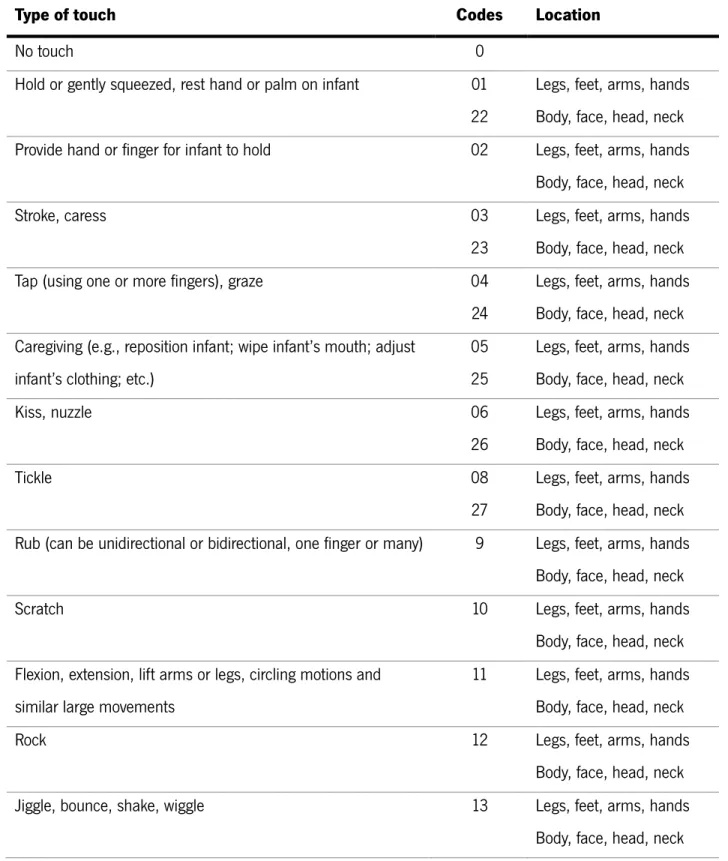
Social touch in mother-child interactions was coded using an adapted version of Beebe and colleagues’ Mother Touch Scale. The original Mother Touch Scale is composed of twenty-one detailed types of touch behaviors coded in five locations in the infants’ body and in two levels of intensity. Type, location, and intensity are further aggregated in an ordinalized scale composed of 11 categories, ordered from the most affectionate to the most intrusive as follows: 1) Affectionate Touch; 2) Static Touch; 3) Playful Touch; 4) No touch; 5) Caregiving; 6) Jiggle/Bounce; 7) Oral Touch; 8) Object Mediated; 9) Centripetal Touch; 10) Rough Touch and 11) High intensity Touch. Since the original Mother Touch Scale was developed to code maternal touch in early infancy (4-months-old), we adapted slightly the criteria for maternal touch coding to fit the behavioral repertoire of 12-month-old infants (see the full details of this adapted version in appendix A and B). Given that in the original scale study, mothers interacted with their four-month-old infants while they
were seated in a chair and whose range of motor movements is very reduced, the maternal touch in the center of the infant´s body (face, body, head, neck) could be considered more stimulating than the touch in infant’s periphery of the body (hands, arms, feet, legs). However, this distinction seems to make less sense in view of the age of the infant, i.e. a 12 months-old infant is able to explore the environment through movement, and the play tasks used in our study (i.e. the infant is playing with mother in a rug), as such, we did not include centripetal touch in our adapted version of Mother Touch Scale. Further, since our study contemplates two playing tasks with objects, contrary to the original study of the scale, we added to Object-mediated Touch code events in which mothers used their touch to assist the infant to performing a task (e.g. mother’s pick up the infant’s hand and demonstrates the infant how to ring a bell).
Maternal touch patterns were coded using the ELAN version 4.9.4 software (Sloetjes & Wittenburg, 2008) (segmentation and categorization of a touch event). Every maternal touch given with the palm of mother’s hand or face, was coded using a microanalytic coding approach system: each individual touch event was segmented by coding onset frame (beginning of touch) and offset frame (end of touch); this was done for the entire interaction. Because multiple touches can happen simultaneously, we segmented the maternal touch events in three separate tiers: one for hand touches, a second for touches made with the face (e.g. kissing), and a third for when the mother was touching the infant with both hands but performing different touch types with each one. After segmentation, each touch event was categorized into one of twenty-two types of touch (see appendix A and B). We also coded periods of the interaction that were considered uncodable due to camera errors or a position that obstructed the view of the mothers’ hands. Our final dataset consisted of 4393 individual touch events.
Following the Mother Touch Scale, touch types were later clustered in nine touch categories
originating – the Ordinalized Mother Touch Scale Category: 1) Affectionate Touch; 2) Static Touch; 3) Playful Touch; 4) No touch; 5) Caregiving; 6) Jiggle/Bounce; 7) Oral Touch; 8) Object Mediated; 9) Rough Touch. The High Intensity Touch was excluded due to low frequency (0% in total).
To establish inter-rater reliability, a trained second coder double coded 25% of randomly selected time-interval in each play episode of 51% of randomly chosen video records of mother-infant interactions. Kappa was calculated using ELAN version 4.9.4 (Holle & Rein, 2014) and a high inter-rater reliability between coders was determined for touch overall (k = 0.82).
Results
The present statistical analyses intended to explore how often each category of touch occurs on different play tasks and if the mother’s frequency and type of touch behaviors adapts to the demands of the task, measured by the Ordinalized Mother Touch Scale Category (OMTS).
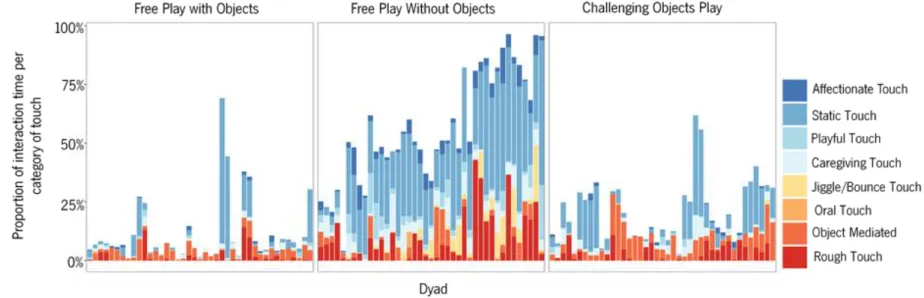
A crucial finding is immediately apparent in Figure 1, that represents per individual dyad, the proportion of time of the number of touch events per level of the OMTS (proportion of No Touch events weren’t included, due to not being necessary for an actual representation in the graph – blank space since the last touch event – considering only eight instead of the previously mentioned, nine categories). We fitted the proportion of time mothers spent touching the infant with a 3 (Play Task: Free Play With Objects, Free Play Without Objects, Challenging Object Play) x 8 (OMTS Category) general linear model where Play Task and OMTS Category were within-subjects factors. The degrees of freedom were Greenhouse-Geisser corrected due to violations of sphericity; post-hoc pairwise comparisons were adjusted for multiple comparisons using Sidak’s method and all p’s < .05 unless otherwise stated.
Both main-effects and the two-way interaction were significant (p < .01). Regarding significant main effect of the Play Task, F(2, 80) = 97.08, mothers used touch significantly more often in the face-to-face interaction than in the object-oriented tasks, 71% for Free Play Without Objects vs. 14% for Free Play With Objects and 26% for Challenging Object Play. Being the difference between the object-oriented tasks also significantly, mothers touched more in the object play with a challenging toy episode than in the free play with objects episode.
Post-hoc analysis of the OMTS Category main effect, F(2.157, 86.264) = 53.20 revealed that mothers used different touch categories: mothers spent more time using Static Touch (M = 14.1%, SE = 1.4%), Rough Touch (M = 4.5%, SE = 0.8%), Object Mediated Touch (M = 3.9%, SE = 0.4%), Caregiving Touch (M = 2.7%, SE = 0.3%), Playful (M = 1.6%, SE = 0.3%), Affectionate Touch (M = 1.5%, SE = 0.2%), Jiggle/Bounce Touch (M = 1.1%, SE = 0.3%) and Oral Touch (M = 0.1%, SE = 0.1%), respectively. Static Touch was significantly more used by mothers than the other types of touch while, Oral Touch was
significantly less used than the other types of touch. Mothers also used significantly less Affectionate Touch compared to Static Touch, Object Mediated Touch and Rough Touch.
Proportion of interaction time per OMTS Category of Touch and per Task:
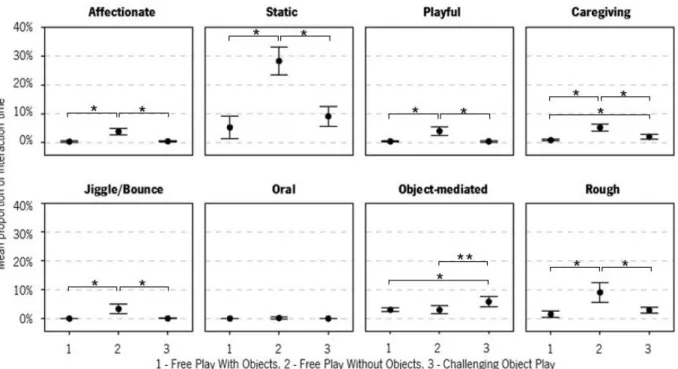
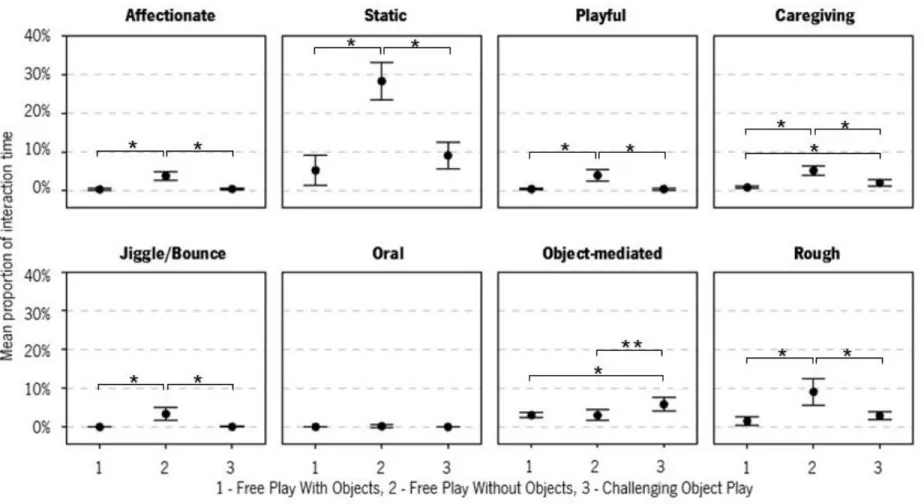
Finally, the 2-way interaction was significant, F (3.979, 159.157) = 26.53, p < 0.01 and post-hoc comparisons indicated that this interaction was explained in great part by the use of Static Touch category in the Free Play Without Objects task. Moreover, mothers spent significantly more time using Affectionate, Static, Playful, Caregiving, Jiggle/Bounce and Rough touches in Free Play Without Objects interaction than in the other two object-oriented tasks. In the Challenging Object Play task, mothers used significantly more Caregiving touch comparably to the Free Play Without Objects task. Additionally, mothers also used
significantly more Object-Mediated touch in the Challenging Object Play task in comparison with both other tasks. No significant differences across play task were observed for Oral Touch. These findings are
illustrated in Figure 2, which shows the mean proportion of interaction time mothers spent touching their infants per category of OMTS.
Figure 1. Proportion of interaction time where the mother was touching the infant, per dyad and per task (Free Play With Objects, Free Play Without Objects, Challenging Object Play). Touch was categorized using a modified version of the OMTS, Ordinalized Mother Touch Scale (see Stepakoff, 1999, Methods section, and appendix A and B). Each vertical bar corresponds to one mother (across tasks, mothers maintain their ordinal position) and the horizontal ordering of mothers was calculated by applying hierarchical clustering (Ward’s method) to the vector composed of proportion of interaction for OMTS category x Play Task. To assist visualization, the No Touch category is not shown.
Mothers Behavioral Touch, per OMTS Category and per Task:
Discussion
Cascio et al., suggested social touch could be described as a highly intricate but flexible platform, which progresses throughout the lifespan conveying all the information conducted from the skin
(neurophysiological systems) and from contextual factors, implying an ability to recognize touch patterns through repetition (Brauer et al., 2016; Cascio et al., 2018; Lee Masson et al., 2018). The present study measured the mothers’ touch behavior in a social structured interaction with their 12-months-old infants, using a modified version of the Ordinalized Mother Touch Scale since it was initially described for mother touch behavior with their 4 months-old infants (Beebe et al., 2010; Beebe & Lachmann, 2014; Stepakoff, 1999). Focused on exploring how often each category of touch occurs and how mother’s frequency and type of touch behaviors adjust to different play tasks, leading to our hypothesis that: mothers will adjust their touch behavior to the demands of the play task, touching more frequently and using a greater number and differentiated touch categories in the free play without objects task compared to the object exploration tasks.
Figure 2. Mean proportion of interaction time where the mother was touching the infant, per OMTS Category and per task (1 - Free Play With Objects, 2 - Free Play Without Objects, 3 - Challenging Object Play). To assist visualization, the No Touch category is not shown. * p<.01, ** p<.05, post-hoc pairwise-comparisons corrected using Sidak method.
Our findings support our hypothesis when referring to the influence that the different play tasks had in the mothers’ touch behavior, specifically touch behavior was more frequent in free play without toys task as well as highly frequent, on average 71% of the interaction period. Being consistent with recent research that states low levels of no touch (high levels of touch behavior) sustain the accumulating evidence that touch is an important communicative channel within the mother-infant dyad and that it is a prominent form of interaction (Brauer et al., 2016; Mantis, 2012).
When comparing both object-oriented play tasks, a significant higher frequency of touch behavior was found in the play with challenging object when compared to the free play with objects tasks. This higher frequency, almost twice as much in the challenging object play when compared to the free play with objects could be possibly explained by the mothers need to motivate and help the infant engage and maintain in task. During the task free play with objects, infants don’t require their mother to autonomously engage in the task – objects provided were adequate to the infant’s development stage – while in the challenging object task, in our case a shape sorter – considering their development stage, is an almost impossible task for the infant to complete helplessly without the mother’s assistance (Street, James, Jones & Smith, 2011). Suggesting that mothers modulate their touch behavior not only to fit their infant’s development needs (e.g., a 12-month-old cannot comprehend complex vocal instructions, nor the perception of depth is fully
developed so by picking up the infants’ hand to help placing the shape or by demonstrating the task herself, but also the demands of the task itself, by adopting in different touch behaviors when compared to other tasks, in an effort to keep the infant engaged in an overly complex task; also showing also that touch can serve many functions on its own e.g., teaching, playful and/or nurture (Della Longa et al., 2017; Lew-Williams et al., 2017; Rigato et al., 2017; Street et al., 2011; Arnold & Stack, 1998; Stack & Muir, 1992).
In consideration of the influence the play task appears to have in the maternal tactile behavior, our study showed that mothers provide a great diversity of tactile stimulation to their infants in all tasks, including static, rough, objected mediated, caregiving, playful, affectionate, oral and jiggle/bounce touches; where static touch was significantly more used while, oral touch was significantly less used than all other types of touch. Although affectionate touch was significantly less used when compared to static, object-mediated and rough touch; we considered to be linked to the demands of the object-oriented tasks due to in object-oriented tasks mothers may have had to use the objects to stimulate and help their infants to engage in the interaction, which could explain the decrease of other forms of tactile stimulation during both tasks.
Additionally, in the free play without toys (face-to-face interaction) mothers spent more time using affectionate, static, playful, caregiving, jiggle/bounce and rough categories of touch when compared to the other play tasks, supporting our hypothesis. Following the assumption that mothers adapt their touch behavior to the infant’s necessities and interaction context, where touch may serve different functions (nurture, hold and support, stimulating) due to the mothers’ ability to active (stimulating) or passively (static) touch their infant (Jean et al., 2009; Stack & Jean, 2012). Demonstrating that the touch behavior presented in the face-to-face interaction, can be explained by the mother’s aptitude to adapt their touch behavior to the development necessities of their 12-months-old infants, who are capable to explore the environment using a wide range of motor behaviors (i.e. crawling, walking), depending on more distal behaviors from the mother (e.g., vocalizations, facial expression, and gaze accompanied by touching) and still be engaged and focused in the task (Ferber et al., 2008; Jean et al., 2009). In face-to-face interactions mothers may use static touch more frequently (to provide physical support to the infant, e.g. hold),
caregiving touch (associated to care deliver, e.g. repositioning the infant in the carpet) and even rough touch (used to inhibit, control or force infant’s movements, e.g. pull, push).
Another relevant result was that, not only did mothers not present a significantly higher frequency of affectionate touch, but also of other stimulating categories of touch, such as playful and jiggle/bounce, in object-oriented tasks when compared to the face-to-face play task. Enlightening the possibility, when given the instructions to play without objects, as naturally as they would at home, mothers may have used a previously established pattern of touch that would create a positive interaction with the infant – maternal touch on its own can signal the quality of the environment surrounding the infant, allowing him to adapt and even reduce the stress levels while communicating feelings such as security, comfort, caregiving,
playfulness, satisfaction or even affection (Gliga et al., 2018). Strengthening the construct that infants may recognize maternal touch patterns, reinforcing the importance of touch and their function, for social-emotional and physical development as it is the most frequent mode of communication and regulation in a mother-infant interaction (Cascio et al., 2018; Field, 2010; McGlone et al., 2014; Stack & Jean, 2012).
Furthermore, in the challenging object play task, mothers used significantly more object-mediated touch when compared to the other play tasks, encouraging the notion that mothers adapt their teaching method (verbal or nonverbal communication) to the infants’ development stage and task, evolving from predominantly executing all tasks on a passive infant – demonstrating how the task is performed in an attempt to elicit the same behavior from the infant so he can gain independence to complete the task – to
the use of verbal instructions when adequate (Arnold & Stack, 1998; Field, 2004, Chapter 5). Suggesting the greater use of object-mediated touch can be explained by the demands of the challenging object play task due to being impossible for the infant to complete on its own – based on previous research that showed only 24 months old are capable to successfully spatially orient a shape for insertion into a slot (Street et al., 2011). Therefore, we assume mothers used more object-mediated touch to help the infant complete task (e.g. mothers pick up the infant’s hand and fit a piece in a shape sorter toy). Also relevant was the significant use of more caregiving touch during this task when compared to the free play without objects task – we conjectured that this use can be explained by the frustration and disengagement of the infant associated with the complexity of the task e.g., in order to keep their infants focused on the task mothers needed to reposition them as they would try to crawl away or engage in exploratory behaviors of the room.
Outlining first, that that our results supported that maternal touch behavior was modulated by the demands of different play tasks, not only in terms of frequency of touch but also considering the types of touch used by the mother; second, that mothers would adjust their touch behavior to the demands of the play task, touching more frequently and using a greater number of touch categories in the free play without objects task when compared to the object exploration tasks. Implying that touch is not only crucial in mother-infant attachment but also, in shaping the social, communicative and cognitive development of the infant (Cascio et al., 2018) into a well-connected system that keeps evolving as social experiences occur (Brauer et al., 2016; Cascio et al., 2018; Gliga et al., 2018; Lee Masson et al., 2018).
Collectively, our findings provide important contributions to the literature focused on the role of social touch in development, being as far as we know the first to analyse how maternal touch behavior is modulated by the demands of three play tasks and to compare the impact of such tasks in the mothers’ touch behavior, in terms of frequency and proportion of interaction time. Emphasizing the notion that different touch behaviors communicate distinct meanings and serve diverse functions, as proposed by literature that mothers communicate through touch to the infant their cultural preferences, behavior and beliefs (Field, 2004, Chapter 5; Lew-Williams et al., 2017; Rigato et al., 2017).
Contributing also to the lack of investigation on later infancy with typically developed infants not only focusing on the impact of the presence or absence of touch has in development, but also the importance that specific touch behaviors have in attachment, motor and cognitive development, always keeping in sight that the implications of social touch experiencing in the first years of life in human
development are vast and lasting (Brauer et al., 2016; Cascio et al., 2018; Lee Masson et al., 2018). Even though our study provided evidence on how mothers adapt their touch behavior to the task and infant development, further research is still required on the topic.
Our study was delimited by several procedure implications such as: different objects in the free play task (Bayley-III and/or Griffiths 0-2) – the infant could be more engaged in the task due to the difference in the objects provided (e.g., the infant could appreciate more certain toys, engaging in task more promptly not needing the assistance of the mother to maintain in task), leading to the wondering if these affected the mothers touch behaviors; different challenging objects in two dyads, although it was also a shape sorter toy, this one appeared to be more complex to manipulate than the one used with most dyads; the position of the camera and only video-tapping the side view of the dyad originated several uncodable touches where another perspective would have been useful; the impact of the instructions given before the task could possibly induced certain touch behaviors on the mother – not all mothers were given the same exact instructions e.g., in the challenging object task mothers sometimes were asked to play with the shape sorter while in other cases were asked to teach the infant to use the shape sorter – leading to different touch behaviors. Nonetheless, the present study was pioneer and had vital contributions to literature although further investigation is essential to gain a more complete understanding on the nuances of the mothers’ touch behaviors.
References
Arnold, S., & Stack, D. (1998). Changes in mothers’ touch and hand gestures influence infant behavior during face-to-face interchanges. Infant Behavior and Development, 21(3), 451–468.
https://doi.org/10.1016/S0163-6383(98)90019-4
Beebe, B., Jaffe, J., Buck, K., Chen, H., Cohen, P., Feldstein, S., & Andrews, H. (2008). Six-week Postpartum Matenal Depressive Symptoms and 4-month Mother-Infant- Self and interactive Contigency. Infant Mental Health Journal, 29(5), 442–471. https://doi.org/10.1002/imhj.
Beebe, B., Jaffe, J., Markese, S., Buck, K., Chen, H., Cohen, P., … Feldstein, S. (2010). The origins of 12-month attachment: A microanalysis of 4-12-month mother-infant interaction. Attachment and Human Development, 12(1–2), 3–141. https://doi.org/10.1080/14616730903338985
Beebe, B., & Lachmann, F. (2014). The Origins of Attachment: Infant Research and Adult Treatment. Special Issue: The intertwining of external and internal events in the changing world. (Vol. 75). Devon: Swales & Willis Ltd.
Beebe, B., Lachmann, F., Markese, S., Buck, K., Bahrick, L., & Chen, H. (2012). On the Origins of Disorganized Attachment and Internal Working Models: Paper II. An Empirical Microanalysis of 4-Month Mother-Infant Interaction. Psychoanalytic Dialogues, 22(3), 352–374.
https://doi.org/10.1080/10481885.2012.679606
Brauer, J., Xiao, Y., Poulain, T., Friederici, A., & Schirmer, A. (2016). Frequency of Maternal Touch Predicts Resting Activity and Connectivity of the Developing Social Brain. Cerebral Cortex, 26(8), 1–9. https://doi.org/10.1093/cercor/bhw137
Cascio, C., Moore, D., & McGlone, F. (2018). Social touch and human development. Developmental Cognitive Neuroscience, 35(September 2017), 5–11. https://doi.org/10.1016/j.dcn.2018.04.009 Croy, I., Sehlstedt, I., Wasling, H. B., Ackerley, R., & Olausson, H. (2017). Gentle touch perception: From
early childhood to adolescence. Developmental Cognitive Neuroscience, (May), 1–6. https://doi.org/10.1016/j.dcn.2017.07.009
Della Longa, L., Gliga, T., & Farroni, T. (2017). Tune to touch: Affective touch enhances learning of face identity in 4-month-old infants. Developmental Cognitive Neuroscience, 35(October 2017), 42–46. https://doi.org/10.1016/j.dcn.2017.11.002
Ferber, S. G., Feldman, R., & Makhoul, I. (2008). The development of maternal touch across the first year of life. Early Human Development, 84(6), 363–370. https://doi.org/10.1016/j.earlhumdev.2007.09.019
Field, T. (2004). Touch and Massage in Early Child Development. (T. Field, Ed.), Child Development. Johnson & Johnson Pediatric Institute, L.L.C. https://doi.org/Artn 84173l\rDoi 10.1117/12.976030 Field, T. (2010). Touch for socioemotional and physical well-being: A review. Developmental Review, 30(4),
367–383. https://doi.org/10.1016/j.dr.2011.01.001
Gliga, T., Farroni, T., & Cascio, C. (2018). Social touch: A new vista for developmental cognitive
neuroscience? Developmental Cognitive Neuroscience. https://doi.org/10.1016/j.dcn.2018.05.006 Holle, H., & Rein, R. (2014). The Modified Cohen’s Kappa: Calculating Interrater Agreement for
Segmentation and Annotation. Understanding Body Movement: A Guide to Empirical Research on Nonverbal Behaviour : With an Introduction to The Neuroges Coding System, 9783631582(April 2016). Jean, A., Fogel, A., & Stack, D. (2009). A Longitudinal Investigation of Maternal Touching across the First
Six Months of Life: Age and Context Effects. National Institutes of Health, 32(3), 344–349. https://doi.org/10.1016/j.infbeh.2009.04.005.A
Lee Masson, H., Van De Plas, S., Daniels, N., & Op de Beeck, H. (2018). The multidimensional
representational space of observed socio-affective touch experiences. NeuroImage, 175(March), 297– 314. https://doi.org/10.1016/j.neuroimage.2018.04.007
Lew-Williams, C., Ferguson, B., Abu-Zhaya, R., & Seidl, A. (2017). Social touch interacts with infants’ learning of auditory patterns. Developmental Cognitive Neuroscience, (september).
https://doi.org/10.1016/j.dcn.2017.09.006
Mantis, I. (2012). Mutual Touch during Mother-Infant Face-to-Face Still-Face Interactions: Influences of Interaction Period and Infant Birth Status. Concordia University.
Mantis, I., Mercuri, M., Stack, D., & Field, T. (2018). Depressed and non-depressed mothers’ touching during social interactions with their infants. Developmental Cognitive Neuroscience, (December 2017). https://doi.org/10.1016/j.dcn.2018.01.005
McGlone, F., Wessberg, J., & Olausson, H. (2014). Discriminative and Affective Touch: Sensing and Feeling. Neuron, 82(4), 737–755. https://doi.org/10.1016/j.neuron.2014.05.001
Miguel, H. O. (2017). Touch processing and social-emotional development - neural and behavioral correlates. (Unpublished doctoral dissertation). University of Minho, Braga, Portugal.
Moszkowski, R., Stack, D., & Chiarella, S. (2009). Infant touch with gaze and affective behaviors during mother-infant still-face interactions: Co-occurrence and functions of touch. Infant Behavior and Development, 32(4), 392–403. https://doi.org/10.1016/j.infbeh.2009.06.006
Moszkowski, R., Stack, D., Girouard, N., Field, T., Hernandez-Reif, M., & Diego, M. (2009). Touching behaviors of infants of depressed mothers during normal and perturbed interactions. Infant Behavior and Development, 32(2), 183–194. https://doi.org/10.1016/j.infbeh.2008.12.009
Rigato, S., Banissy, M., Romanska, A., Thomas, R., van Velzen, J., & Bremner, A. (2017). Cortical signatures of vicarious tactile experience in four-month-old infants. Developmental Cognitive Neuroscience, (June). https://doi.org/10.1016/j.dcn.2017.09.003
Sloetjes, H., & Wittenburg, P. (2008). Annotation by category - ELAN and ISO DCR. In Annotation by category-ELAN and ISO DCR. (pp. 1–5). 6th international Conference on Language Resources and Evaluation (LREC 2008).
Stack, D. M., & Muir, D. W. (1992). Adult tactile stimulation during face-to-face interactions modulates five-month-olds’ affect. Child Development, 63, 1509–1525.
Stack, D. M., LePage, D. E., Hains, S., & Muir, D. W. (1996). Qualitatitive changes in maternal touch as a function of instructional condition during face-to-face social interactions. Infant Behavior and Development, 19, 761. https://doi.org/10.1016/S0163-6383(96)90815-2
Stack, D., & Jean, A. (2012). Full-term and very-low-birth-weight preterm infants’ self-regulating behaviors during a Still-Face interaction: Influences of maternal touch. Infant Behavior and Development, 35(4), 779–791. https://doi.org/10.1016/j.infbeh.2012.07.023
Stepakoff, S. (1999). Mother–infant tactile communication at four months: Effects of infant gender, maternal ethnicity, and maternal depression. St. John’s University, New York, NY.
Stepakoff, S., Beebe, B., & Jaffe, J. (2000). Mother-infant tactile communication at four months: infant gender, maternal ethnicity, and maternal depression. In Poster presented at the International Conference of Infant Studies, Brighton, England, July.
Street, S. Y., James, K. H., Jones, S. S., & Smith, L. B. (2011). Vision for Action in Toddlers: The Posting Task. Child Development, 82(6), 2083–2094. https://doi.org/10.1111/j.1467-8624.2011.01655.x Tuulari, J., Scheinin, N., Lehtola, S., Merisaari, H., Saunavaara, J., Parkkola, R., … Björnsdotter, M. (2017).
Neural correlates of gentle skin stroking in early infancy. Developmental Cognitive Neuroscience, 35(October), 36–41. https://doi.org/10.1016/j.dcn.2017.10.004
Figures Caption
Proportion of interaction time per OMTS Category of Touch and per Task:
Figure 1. Proportion of interaction time where the mother was touching the infant, per dyad and per task (Free Play With Objects, Free Play Without Objects, Challenging Object Play). Touch was categorized using a modified version of the OMTS, Ordinalized Mother Touch Scale (see Stepakoff, 1999, Methods section, and appendices A and B). Each vertical bar corresponds to one mother (across tasks, mothers maintain their ordinal position) and the horizontal ordering of mothers was calculated by applying hierarchical clustering (Ward’s method) to the vector composed of proportion of interaction for OMTS category x Play Task. To assist visualization, the No Touch category is not shown.
Mothers Behavioral Touch per OMTS Category and per Task:
Figure 2. Mean proportion of interaction time where the mother was touching the infant, per OMTS Category and per task (1 - Free Play With Objects, 2 - Free Play Without Objects, 3 - Challenging Object Play). To assist visualization, the No Touch category is not shown. * p<.01, ** p<.05, post-hoc pairwise-comparisons corrected using Sidak method.
Appendix A
Table 1. Coding criteria for the adapted Mother Touch Scale (based from Stepakoff, 1999; Stepakoff et al.,
2007)
Type of touch Codes Location
No touch 0
Hold or gently squeezed, rest hand or palm on infant 01 22
Legs, feet, arms, hands Body, face, head, neck Provide hand or finger for infant to hold 02 Legs, feet, arms, hands
Body, face, head, neck
Stroke, caress 03
23
Legs, feet, arms, hands Body, face, head, neck Tap (using one or more fingers), graze 04
24
Legs, feet, arms, hands Body, face, head, neck Caregiving (e.g., reposition infant; wipe infant’s mouth; adjust
infant’s clothing; etc.)
05 25
Legs, feet, arms, hands Body, face, head, neck
Kiss, nuzzle 06
26
Legs, feet, arms, hands Body, face, head, neck
Tickle 08
27
Legs, feet, arms, hands Body, face, head, neck Rub (can be unidirectional or bidirectional, one finger or many) 9 Legs, feet, arms, hands
Body, face, head, neck
Scratch 10 Legs, feet, arms, hands
Body, face, head, neck Flexion, extension, lift arms or legs, circling motions and
similar large movements
11 Legs, feet, arms, hands Body, face, head, neck
Rock 12 Legs, feet, arms, hands
Body, face, head, neck Jiggle, bounce, shake, wiggle 13 Legs, feet, arms, hands
Type of touch Codes Location
Infant-directed oral touch (e.g., offer finger for infant to suck, put finger in infant’s mouth, put infant’s hand in infant’s mouth, put infant’s toes in infant’s mouth)
14 Legs, feet, arms, hands Body, face, head, neck
Pull 15 Legs, feet, arms, hands
Body, face, head, neck Push, inhibit/constrain movement, force or control infant’s
movement (e.g., force infant’s foot into infant’s face, force infant’s hand down)
16 Legs, feet, arms, hands Body, face, head, neck
Pinch 17 Legs, feet, arms, hands
Body, face, head, neck
Poke, jab 18 Legs, feet, arms, hands
Body, face, head, neck Object-mediated touch (e.g., waves cloth in infant’s face,
dangles toy on infant’s chest, manipulates clothing for non-caregiving purpose; mediates touch with a part of the infant’s body, e.g. mother tap infant’s hand against infant’s face, mother help the infant playing with a toy)
19 Legs, feet, arms, hands Body, face, head, neck
Other (e.g., sniffs, chews, knocks with knuckles) 20 Legs, feet, arms, hands Body, face, head, neck Pat (implies use of whole hand, if only with finger, code as
“tap”; code also when the mother covers the infants face with her hands - ‘cucu’ game)
21 28
Legs, feet, arms, hands Body, face, head, neck Uncodable (e.g., due to changes of position, camera errors,
etc.)
99
Appendix B
Table 2. Coding criteria for Ordinalized Maternal Touch Scale: from affectionate to intrusive. Adapted from
based from Stepakoff, 1999; Stepakoff et al., 2000.
Scale Category Type of Touch
Affectionate Touch (3 and 23) stroke, caress; (6 and 26) kiss, nuzzle; (21 and 28) pat
Static Touch (1 and 22) hold; (2) provide hand or finger for infant to hold
Playful Touch (4 and 24) tap; (8 and 27) tickle; (9) rub; (11) large movements with arms or legs
No Touch (0) no touch
Caregiving (5 and 25) caregiving
Jiggle / Bounce (13) jiggle / bounce
Oral Touch (14) infant-directed oral touch Object Mediated (19) object-mediated touch
Rough Touch (10) scratch; (15) pull; (16) push; (17) pinch; (18) poke
Appendix C
Distribution of mother’s touch events
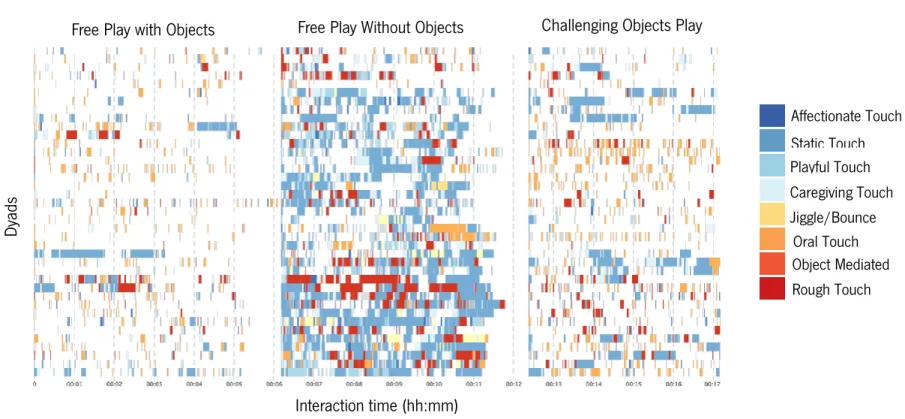
Figure 3. The distribution of mother’s touch events, according to OMTS category, per dyad, across the time of the social structured interaction. Each horizontal line corresponds to one mother
Affectionate Touch Static Touch Playful Touch Caregiving Touch Jiggle/Bounce Oral Touch Object Mediated Rough Touch
Free Play Without Objects Challenging Objects Play Free Play with Objects
Dya
ds