THE ENVIRONMENTAL DIMENSION
IN THE ORGANISATIONAL SUSTAINABILITY
Vera Pontes
Environmental Engineer - Fernando Pessoa University
Ana Fonseca
Associate Professor - Fernando Pessoa University (CIAGEB -UFP)
Abstract
3
1. INTRODUCTION
The European Commission has published, on July 2001, a Green Paper entitled Promoting a European Frame-work for Corporate Social Responsibility, where Corpo-rate Social Responsibility is deined as “(...) a concept whereby companies integrate social and environmen-tal concerns in their business operations and in their interaction with their stakeholders on a voluntary basis” (European Commission, 2001, p.8).
There is a close association between Corporate Social Responsibility and Sustainable Development since organisations must integrate, in their operations, con-cerns relating their environmental, social and economi-cal impacts (European Commission, 2002).
Communication regarding Sustainable Development is an excellent way for companies to openly promote their values, mission, principles and performance, which con-tributes to the building of a trusty relationship between the company and its stakeholders (WBCSD - World Busi-ness Council for Sustainable Development, 2002). The publication of Sustainability Reports is a means to pro-vide communication to the stakeholders regarding the company’s socially responsible behaviour (KPMG, 2007). According to the Global Reporting Initiative (GRI), “Sus-tainability reporting is the practice of measuring, dis-closing, and being accountable to internal and external stakeholders for organisational performance towards the goal of Sustainable Development” (GRI, 2006, p. 3).
According to the website of CorporateRegister.com, the number of organisations publishing information con-cerning Sustainability has increased from a little over 20 cases in 1992 to more than 2200 cases in 2006 (Home Page of CorporateRegister.com). This suggests that organisations are increasingly concerned in guiding their development according to Sustainability princi-ples, as well as in disclosing themselves to the com-munity, publishing information on their behaviour and performance.
In spite of the increasing interest in reporting infor-mation regarding companies’ sustainability practices, a more enlarged agreement is required on the type of information to disclose, the content of the reports, the indicators to use and the reliability of the evaluation and auditing procedures. These are fundamental factors to
enable the measurement and comparison of practices from organisations difering in size, activity sector and location. GRI developed global guidelines for Sustaina-bility Reporting, which came as a basis for the desired consensus. The mission of GRI is to satisfy the needs of communicating sustainability in a clear and transparent way, ofering a reliable structure that may be used by all kinds of organisations (European Commission, 2002; GRI, 2006; WBCSD, 2002).
The guidelines developed by GRI establish a set of Envi-ronmental Indicators on the company’s performance regarding consumptions (materials, energy and water), production (emissions, eluents and waste), biodiver-sity, legal compliance and other relevant information like the environmental impact of products and services. According to the GRI guidelines, Sustainability Reports should contain a short description on the following environmental aspects: materials, energy, water, bio-diversity, emissions, eluents and waste, products and services, legal compliance, transport and overall issues.
In order to improve the credibility of their reports, an increasing number of companies request an indepen-dent body to verify the information published. Never-theless, there is no standardised or generically accepted approach for this process. Companies have to make a cost/beneit analysis for this independent veriication: although favouring credibility, it will possibly arise in considerable additional costs. GRI guidelines provide some global orientation on this subject, and AccountA-bility has created the AA1000 standard series on report veriication, where more speciic guidelines are given (WBCSD, 2002).
WBCSD was created in 1992 and consists on a global association formed by over 190 companies from more than 35 countries dealing exclusively with business and Sustainable Development. The mission of this council is to provide business leadership as a catalyst for chan-ge towards Sustainable Development (Home Pachan-ge of WBCSD). In Portugal, in October 2001, three important Portuguese companies (Sonae, Soporcel and Cimpor) created the Business Council for Sustainable Develop-ment (BCSD), a regional member of WBCSD (Home Page of BCSD).
4
increased in the last few years. As an example, 19 Sus-tainability Reports of Portuguese organisations relating to the year 2005 are published up to the present date in the website of BCSD.On the scope of the subjects exposed, the purpose of the present work is to analyse the communication prac-tices regarding Sustainability of Portuguese companies and to evaluate the role played by the environmental dimension on their Sustainability Strategy. The study consisted in the analysis of Sustainability Reports re-lated to the year 2005 and published in the website of BCSD up to the date of the 30th October 2006.
2. ANALYSIS OF SUSTAINABILITY
REPORTS
The sample of this study consisted of 13 Portuguese companies from a broad scope of activity sectors, as is shown in Table 1.
Table 1. Sample of the study
Company Activity Sector Águas do Cavado S.A. (Águas do Cavado, 2005) Water supply Águas do Douro e Paiva S.A. (Águas do Douro e
Paiva, 2006)
Water supply
Amorim Imobiliária (Amorim Imobiliária, 2006) Construction Banco Espírito Santo – BES (Banco Espírito Santo,
2006)
Banks
Brisa Auto-Estradas de Portugal (Brisa, 2006) Highways EDP – Energias de Portugal S.A. (EDP, 2006) Energy Lipor (Lipor, 2006) Waste Management Millennium bcp (Millennium bcp, 2006) Banks Grupo Portugal Telecom – PT (Portugal Telecom, 2006))
Comunications
Rede Eléctrica Nacional S.A. – REN (Rede Eléctrica Nacional S.A., 2006)
Energy
Santander Totta (Santander Totta, 2006) Banks Unicer – Bebidas de Portugal, SGPS, S.A. (Unicer – Bebidas de Portugal, SGPS, SA., 2006)
Industry
Valorsul (Valorsul, 2006) Waste Management
It is important to point out that the reduced size of the sample strongly conditioned the obtained conclusions. This is particularly relevant in the results obtained regar-ding activity sectors, since half of the activity sectors considered here are only represented by one company.
Analysing Table 1 it can be veriied that the Banks are the activity sector most represented in this sample, fact that might be explained considering the international presence of this type of companies, resulting in greater exposure and demands from stakeholders. Neverthe-less, there are other activity sectors well represented in the sample of this study which work exclusively in national markets: Water Supply and Waste Treatment. This indicates that the degree of internationalisation of a company is not a fundamental factor in the establish-ment of communication practices.
It was veriied that 54% of the companies analysed were publishing their 2nd Sustainability Report, indicating a trend for the continuity of the communication process. Nevertheless the publication practices in Portugal are still scarce and recent, since only 8% of the companies in this sample were publishing their 3rd report.
As for the elaboration of the report, it was veriied that 92% of the companies in this sample followed GRI gui-delines, revealing a high acceptability level of this ins-trument for elaborating Sustainability Reports. However, companies do not strictly follow these guidelines since they do not comply with all its requirements. As an example, the external veriication of the reports, which is a recommendation of the GRI guidelines, was only performed in 54% of the cases analysed in this study.
It was also veriied that the majority of the companies under analysis have a certiied management system: 77% have an ISO 9001 certiicate (quality management); 62% have an ISO 14001 certiicate (environmental management) and 54% have an OHSAS 18001 certii-cate (occupational health and safety management). As a conclusion of these data, although the environment and occupational health and safety are an increasing concern of organisations, quality management seams to still be the priority.
5
Figure 1 shows the distribution of the environmentalactions and indicators identiied in the reports under study in the diferent GRI environmental aspects. It is possible to verify that the environmental aspect most represented is “eluents and waste”.
FIGURE 1 - ENvIRONMENTAl ACTIONS AND INDICATORS REFERRED IN THE REPORTS By ENvIRONMENTAl ASPECT.
0 10 20 30 40 50
Indicators Actions
It was veriied that, in the sample under analysis, more than 50% of either the environmental actions or the indicators described under the category of Emissions, Eluents and Waste were related with waste mana-gement. A possible explanation for this fact is the lar-ge amount of legal requirements related to this issue in Portugal, when compared to other environmental aspects.
Analysing Figure 1 it is possible to see that the environ-mental aspects “materials”, “energy” and “water” have also a relevant role in the sustainability practices reported by the companies representing the present study. Most of the actions deined under these categories were direc-ted to the reduction of resource consumption, which conducts to cost reductions for the organisation.
Regarding the environmental aspect “products and services”, in spite of the reduced fraction of actions and indicators identiied, it should be acknowledged the example of lipor in the development of several projects for the environmental education of the com-munity regarding the company’s activities on waste management.
In the “overall issues” category a large number of actions were identiied, mainly related with environmental noi-se control, environmental education projects, develop-ment of partnerships with environdevelop-mental goals, and environmental awareness of suppliers.
3. DISCUSSION OF RESULTS
The relevance of Pollution Prevention practices on the sustainability strategy of Portuguese organisations was evaluated from the information collected in the Sustai-nability Reports analysis.
According to United States of America Environmental Protection Agency (cit in Bishop 2000, p. 11), a possible deinition of Pollution Prevention is:
“The use of materials, processes, or practices that reduce or eliminate the creation of pollutants or wastes at the source. It includes practices that reduce the use of hazardous materials, energy, water or other resources and practices that protect natural resources through conservation or more eicient use.”
The environmental actions described in the Sustaina-bility Reports analysed were classiied as “preventive” or “non-preventive” actions, according to the deinition given above. All actions concerning waste segregation with the aim of recycling were considered “preventi-ve” in the scope of the given deinition, since they will result in the protection of natural resources. Similarly, all actions promoting improvements in the environmen-tal performance of others (environmenenvironmen-tal education or awareness) were considered “preventive”.
6
FIGURE 2 - “PREvENTIvE” AND “NON-PREvENTIvE” ACTIONS By ENvIRONMENTAl ASPECT0 10 20 30 40 50 60 70 80 90 100
Preventive Non Preventive
The signiicant predominance of “preventive” actions in the aspects “materials”, “energy” and “water” shows that the organisations under study are aware of the impor-tance of the correct management of these aspects in cost reduction beneits. On the other hand, the envi-ronmental aspect “legal compliance” has, in this study, a 100% “non-preventive” actions: all actions classiied under this aspect had monitoring purposes. It is also relevant to note that the environmental aspect “emis-sions and waste” has a similar distribution of the “pre-ventive” and “non-pre“pre-ventive” actions identiied in this study. This indicates that the eforts to reduce environ-mental impacts caused by the generation of waste or emissions focus both preventive approaches (waste recycling, for example) as well as pollution control acti-vities (emission monitoring, for example).
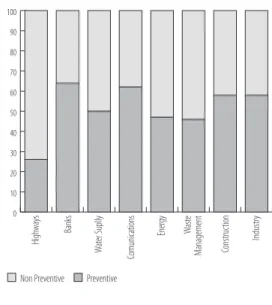
Figure 3 shows the distribution of “preventive” and “non-preventive” actions in the diferent activity sec-tors represented in this study. It was veriied that the environmental actions are fairly equally distributed by the preventive and the non-preventive categories in almost all the activity sectors under analysis, with the exception of the Highways where it was registered, in the sample of this study, a predominance of “non-pre-ventive” actions.
FIGURE 3 - “PREvENTIvE” AND “NON-PREvENTIvE” ACTIONS By ACTIvITy SECTOR
0 10 20 30 40 50 60 70 80 90 100
Preventive Non Preventive
4. CONCLUSIONS
There is an increasing number of companies choosing to publish information regarding their contribution to Sus-tainable Development through Sustainability Reports. These reports have the purpose of describing, in a sen-sed and balanced way, the organisation’s impacts at the environmental, social and economic levels.
The growing interest of organisations in the publication of these reports is due not only to the society’s increa-sing awareness on this subject, but also to regulatory pressures. Nevertheless, the practice of publishing infor-mation regarding sustainability is still scarce in Portugal when compared with other countries. In spite of this fact, it is possible to ind Sustainability Reports of Por-tuguese companies from diferent activity sectors. The degree of internationalization of the companies does not seem to condition these publication practices.
7
Analysing the environmental dimension described inthe Sustainability Reports of the Portuguese compa-nies under study, it was veriied that the environmen-tal aspect presenting the larger number of actions and indicators was “emissions and waste”, where the majority of the actions identiied were related to waste management.
As for the importance given to preventive approaches in the environmental actions described in the reports analysed, it was veriied that the distribution of “preven-tive” and “non-preven“preven-tive” actions was dependent on the environmental aspects’ category. For aspects like “materials”, “energy” and “water”, a majority of “preven-tive” actions was identiied, suggesting that the com-panies are aware of the economic importance of the correct management of these aspects. As for the dife-rent activity sectors analysed in this study, no signiicant diferences were found in the distribution of “preventi-ve” and “non-preventi“preventi-ve” actions in the company’s sus-tainability strategy.
As the main conclusion of this study, the results suggest that the environmental dimension is relevant in the organisations’ sustainability management, since it was associated with a large number of actions implemented in the companies under analysis. Nevertheless, it is very important to continue to inspire and encourage com-panies, so that the importance given to the diferent dimensions of Sustainability continues to increase.
REFERENCES
ÁGUAS DO DOURO E PAIVA (2006). Relatório de Sus-tentabilidade 2005. [Online]. Available in http://www. bcsdportugal.org/content/index.php?action=articles-DetailFo&rec=405. [Consulted on 30/10/2006]. ÁGUAS DO CAVADO (2005). Relatório de Sustenta-bilidade 2004/2005. [Online]. Available in http://www. bcsdportugal.org/content/index.php?action=articles-DetailFo&rec=469. [Consulted on 30/10/2006]. AMORIM IMOBILIÁRIA (2006). Relatório Anual de Sus-tentabilidade 2005. [Online]. Available in http://www. bcsdportugal.org/content/index.php?action=articles-DetailFo&rec=415. [Consulted on 30/10/2006]. BANCO ESPÍRITO SANTO (2006). Relatório de Sus-tentabilidade 2005. [Online]. Available in http://www.
bcsdportugal.org/content/index.php?action=articles-DetailFo&rec=420. [Consulted on 30/10/2006]. BISHOP, P. L. (2000). Pollution Prevention: Fundamen-tals and Pratice. USA, McGraw-Hill.
BRISA (2006). Relatório de Ambiente e Sustenta-bilidade 2005. [Online]. Available in http://www. bcsdportugal.org/content/index.php?action=articles-DetailFo&rec=480. [Consulted on 30/10/2006]. BUSINESS COUNCIl FOR SUSTAINABlE DEvElOP-MENT IN PORTUGAl [Online.] Available in http://www. bcsdportugal.org/. [Consulted in 30/10/2006]. EUROPEAN COMMISSION (2001). Green Paper: Pro-moting a European framework for corporate social responsibility. [Online]. Available in http://ec.europa.eu/ employment_social/soc-dial/csr/greenpaper_en.pdf. [Consulted on 22/11/2006].
EUROPEAN COMMISSION (2002). Corporate Social Responsibility: A business contribution to sustainable development. [Online]. Available in http://ec.europa.eu/ employment_social/soc-dial/csr/csr2002_col_en.pdf. [Consulted on 22/11/2006].
CORPORATEREGISTER.COM. [Online]. Available in http://www.corporateregister.com/charts/byyear.htm. [Consulted in 28/05/07].
EDP. (2006). Relatório e Contas 2005: Caderno de Sustentabilidade. [Online]. Available in http://www. bcsdportugal.org/content/index.php?action=articles-DetailFo&rec=393. [Consulted on 30/10/2006]. GlOBAl REPORTING INICIATIvE (2006). Sustainability Reporting Guidelines. [Online]. Available in http://www. globalreporting.org/NR/rdonlyres/A1FB5501-B0DE-4B69-A900-27DD8A4C2839/0/G3_GuidelinesENG.pdf. [Consulted on 14/12/2006].
lIPOR (2006). Relatório de Sustentabilidade 2005. [Onli-ne]. Available in http://www.bcsdportugal.org/content/ index.php?action=articlesDetailFo&rec=417. [Consul-ted on 30/10/2006].
8
php?action=articlesDetailFo&rec=395. [Consulted on 30/10/2006].SANTANDER TOTTA. (2006). Relatório de Sustentabilidade 2005. [Online]. Available in http://www.bcsdportugal.org/ content/index.php?action=articlesDetailFo&rec=387. [Consulted on 30/10/2006].
UNICER – BEBIDAS DE PORTUGAl, SGPS, SA. (2006). Rela-tório de Sustentabilidade 2005. [Online]. Available in http:// www.bcsdportugal.org/content/index.php?action=arti-clesDetailFo&rec=386. [Consulted on 30/10/2006]. vAlORSUl (2006). Relatório de Sustentabilidade 2005. [Online]. Available in
http://www.bcsdportugal.org/con-tent/index.php?action=articlesDetailFo&rec=498. [Con-sulted on 30/10/2006].
WORlD BUSINESS COUNCIl FOR SUSTAINABlE DEvE-lOPMENT (2002). Sustainable development reporting: Striking the balance. [Online]. Available in http://www. wbcsd.org/web/publications/striking_the_balance.pdf. [Consulted on 15/2/2007].