Skeletal effects of RME in the transverse and vertical
dimensions of the nasal cavity in mouth-breathing
growing children
Mario Cappellette Jr.1, Lucia Hatsue Yamamoto Nagai2, Raquel Mori Gonçalves2, Aparecida Keiko Yuki2, Shirley Shizue Nagata Pignatari1, Reginaldo Raimundo Fujita1
Introduction: Maxillary constriction is a dentoskeletal deformity characterized by discrepancy in maxilla/mandible relationship in the trans-verse plane, which may be associated with respiratory dysfunction. Objective: The objective of this study was to evaluate the skeletal effects of RME on maxillary and nasal transverse dimensions and compare the differences between males and females. Methods: Sixty-one mouth-breathers patients with skeletal maxillary constriction (35 males and 26 females, mean age 9.6 years) were included in the study. Posteroanterior (PA) radiographs were taken before expansion (T1) and 3 months after expansion (T2). Data obtained from the evaluation of T1 and T2 cepha-lograms were tested for normality with the Kolmogorov-Smirnov method. The Student’s t-test was performed for each measurement to de-termine sex differences. Results: RME produced a significant increase in all linear measurements of maxillary and nasal transverse dimensions. Conclusions: No significant differences were associated regarding sex. The RME produced significant width increases in the maxilla and nasal cavity, which are important for treatment stability, improving respiratory function and craniofacial development.
Keywords: Palatal expansion technique. Maxilla. Mouth-breathing.
1 Universidade Federal de São Paulo, Departamento de Otorrinolaringologia e
Cirurgia de Cabeça e Pescoço (São Paulo/SP, Brasil).
3 Private practice (São Paulo/SP, Brasil).
» The authors report no commercial, proprietary or financial interest in the products or companies described in this article. Patients displayed in this article previously approved the use of their facial and intraoral photographs.
Submitted: July 27, 2016 - Revised and accepted: February 03, 2017 DOI: https://doi.org/10.1590/2177-6709.22.4.061-069.oar
How to cite: Cappellette Jr. M, Nagai LHY, Gonçalves RM, Yuki AK, Pigna-tari SSN, Fujita RR. Skeletal effects of RME in the transverse and vertical dimen-sions of the nasal cavity in mouth-breathing growing children. Dental Press J Or-thod. 2017 July-Aug;22(4):61-9.
DOI: https://doi.org/10.1590/2177-6709.22.4.061-069.oar
Contact address: Mario Cappellette Jr.
Rua Salete, 200, conj. 101/102 – CEP: 02.016-001, São Paulo/SP, Brasil E-mail: [email protected]
Introdução: a constrição maxilar é uma alteração dentoesquelética relacionada à diminuição transversal da arcada superior, que pode correlacionar--se com problemas respiratórios. O tratamento nos pacientes em crescimento inclui a expansão rápida da maxila (ERM). A correção precoce resulta em maiores alterações esqueléticas e estabilidade dos resultados, podendo evitar desvios de crescimento facial. Objetivo: avaliar comparativamente, por meio de telerradiografias posteroanteriores (PA), as alterações dimensionais da cavidade nasal pré- e pós-ERM em pacientes respiradores bucais dos sexos masculino e feminino. Métodos: realizou-se o estudo de medidas lineares em telerradiografias PA pré- e pós-ERM de uma amostra composta por 61 pacientes (35 do sexo masculino e 26 do feminino), com média de idade de 9,6 anos. Todos os pacientes eram respiradores bucais com constrição maxilar esquelética, e foram tomadas radiografias PA pré- e pós-ERM (3 meses). Os dados obtidos foram avaliados nos tempos T1 e T2 a normalidade dos dados foi confirmada por meio do teste de Kolmogorov-Smirnov. O teste t de Student foi aplicado para cada mensuração, para determinar diferenças entre os sexos. Resultados: a ERM promoveu aumento significativo em todas as medidas lineares maxilares e das dimensões da cavidade nasal. Conclusão: nenhuma diferença significativa foi associada ao sexo. A ERM produziu aumentos significativos na largura maxilar e volume da cavidade nasal, que são importantes na estabilidade do tratamento Nos pacientes em crescimento e respiradores bucais com constrição maxilar esquelética da maxila, a ERM promoveu aumento do volume da cavidade nasal que melhorou o fluxo aéreo e possibilitou reconduzir o crescimento facial. As alterações transversais não foram significativas quando relacionadas ao sexo.
INTRODUCTION
Maxillary constriction is a narrowing of the upper arch and is one of the most prevalent malocclusions. Some of its typical features are unilateral or bilateral pos-terior crossbite, anpos-terior dental crowding, a high palatal vault, and a decrease in the distance between the lateral walls of the nasal cavity.1 The etiology is believed to be
multifactorial2 and the main factors includes
physiologi-cal problems, genetic and parafunctional habits3 that
could lead to a mixed or mouth-breathing pattern.4,5
Since the airway is assumed to play a role in dentofacial development, the association with respiratory problems, especially nasal obstruction, has been the focus of many researchers who have investigated the possibility that these events are related.6 However, it could be
consid-ered erroneous to associate malocclusions only with the breathing pattern.2
The maxillary bones form approximately 50% of the nasal cavity’s anatomic structure.7 RME is a dentofacial
orthopedic treatment procedure that has been widely used for correcting maxillary transverse deiciency in young patients and it can change the morphology of the maxillary arch, afecting the geometry and function of the nasal cavity.7 Eysel, in 1886, cited by Haas8,9 was the
irst rhinologist who studied the efect of RME on nasal cavity function. He found that, in the post-RME peri-od, various changes occurred in the maxilla and adjacent bones, and RME caused an opening of the nasal cavity and reduction in nasal airway resistance. In addition, af-ter the expansion an increase was found in the nasal cav-ity width and in the nasal base adjacent to the midpalatal suture. The maxillary sutures separate the external walls of the nasal cavity laterally, resulting in an increase in the intranasal capacity. Although orthodontic treatment is carried out to correct dental and skeletal discrepancies, some authors showed that RME outcomes could also be efective on naso-respiratory and sleep-disordered breathing problems of growing children.11 Therefore,
RME has been suggested in the medical treatment of mouth-breathing, septal deformity, nasal infection, al-lergic rhinitis, and obstructive sleep apnea. However, its clinical use for rhinological efects is controversial.12 Its
primary goal is to maximize orthopedic and minimize orthodontic tooth movement13 and there is an
agree-ment among orthodontists that a maxillary constriction should be treated early,9 since the proportion of skeletal
and dental movement depends on patient’s age and
ma-turity level.14,15 In a study of RME efects, sex diferences
proved to be important as it is known that the facial skel-eton signiicantly increases its resistance to expansion with increasing age and maturity.15
The majority of growth studies have used lateral cepha-lometric radiographs to analyze vertical and sagittal dimen-sional changes of the face. However, transverse problems and development of the oronasal area can be better understood by analyzing posteroanterior (PA) cephalometric radio-graphs.5 Structural remodeling of nasal cavity has the efect
of increasing nasal patency ater RME, and the relevance of PA radiograph is to show this remodeling and quantify the increase in nasal cavity,16 especially in the midface, since
its walls are laterally displaced. The purpose of this article was to evaluate the skeletal efects of RME in the transverse and vertical dimensions on nasal cavity in mouth-breathing growing children and to correlate it with both sexes.
MATERIAL AND METHODS
The study sample comprised 61 children (mean age 9.6 years, range 6.5 – 13.10 years; 35 male, 26 female) regardless of facial type or race, who sought treatment at the Depart-ment of Pediatric Otorhinolaryngology of the Universidade Federal de São Paulo, in Brazil. The criteria for selection of the treatment group were as follows: skeletal constricted maxil-lary arches, unilateral or bilateral posterior crossbite requir-ing RME treatment, and mouth-breathrequir-ing. The exclusion criteria were: no maxillary irst molars, metallic restorations, periodontal diseases, previous orthodontic treatment, and genetic disease involving chromosome or mutations.
In order to check for the mouth-breathing pattern, all patients were clinically examined by an experienced oto-rhinolaryngologist that veriied the presence of nasal ob-struction ater anterior rhinoscopy, oroscopy and nasoi-berendoscopy17. Potential candidates for adenoidectomy or
adenotonsillectomy, with complete occlusion of the nasal cavity by nasal turbinates, intranasal tumors or polyps, ad-enoid occupying more than 70% of the choanas were ex-cluded from the study.
Figure 1 - RME appliance, comprising a tooth-anchored device (conventional Hyrax expander).
Figure 2 - Pre-RME and post-RME occlusal radio-graphs.
The orthodontic phase of treatment was undertaken at a local orthodontic clinics under the supervision of the department’s orthodontists.
Pretreatment (T1) orthodontic records, including PA radiographs were taken for all patients. Each patient under-went a standardized RME protocol using a tooth-anchored device activated by means of a modiied Hyrax expander with a soldered framework and orthodontic bands on de-ciduous second molars and extended forward to the palatal surfaces of the deciduous canines (Fig 1); or supported by bilateral maxillary irst premolars and irst molars, in case the irst premolars were suiciently erupted. Ater the ex-pander was cemented, it was activated six turns. Then, the parents or guardians were instructed to activate the jackscrew one turn (0.25 mm) twice a day until the re-quired expansion was achieved. The degree of expansion
was calculated for each patient, including a bilateral over-expansion and buccal tipping of a half-cusp width. Ater a mean active expansion period of 15 days (range 7- 21 days), the expander was tied of with a ligature wire and it was kept on the teeth as a passive retainer for at least 90 days (3 months), ranging from 91 to 106 days. This retention period allowed osseous reorganization of the midpalatal suture ater expansion. All patients did not receive brackets or wires on the maxillary arch until T2 records were taken. Postexpansion (T2) PA cephalograms were taken af-ter removal of the expander. The mean inaf-terval between T1 and T2 was 98 days (range, 91-105 days). As a result, study sample was composed by 122 PA cephalograms, which were hand traced with a 0.5-mm lead pencil on Ultraphan acetate tracing paper. All tracings were per-formed by the same investigator.
Tables 1 and 2 show the skeletal and dental landmarks, and linear measurements (in millimeters) from Ricketts’ cephalometric analysis.17
Statistics analysis
reevalu-Table 1 - Posteroanterior skeletal and dental landmarks.
Table 2 - Posteroanterior planes and linear measurements.
Landmark Description
NC/CN The most lateral point of the nasal cavity
ZL/ZR The most internal point of the frontozygomatic
ANS Anterior nasal spine
JL/JR Deepest point of the alveolar maxillary process
UML/UMR The most prominent lateral point on the buccal surface of permanent irst molar crown
Reference plane and line Reference Plane Description
ZL-ZR Z plane- reference line in the horizontal plane
Occlusal plane Occlusal line in the molars
NC-CN Nasal width
ANS-Z plane (NH) Nasal height
JL-JR Maxillary width
IM Intermolar width - distance between UML-UMR parallel to the occlusal plane.
IM/ JL-JR Ratio between intermolar width and maxillary width
JL-JR/ NC-CN Ratio between maxillary width and nasal width
Figure 3 - PA cephalometric radiograph pre-RME. Figure 4 - PA cephalometric radiograph post-RME, showing lines used for
Table 3 - Comparisons of T1 values between males and females.
NS = nonsignificant; n = number of patients; SD = standard deviation. *Statistically significant (p < 0.05).
Variable Sex Mean n SD P
Age (month) Males 121.5 35 24.8 0.070
Females 108.2 26 31.5
Height (mm) Males 53.9 35 3.4 0.025*
Females 51.6 26 4.3
Nasal width (mm) Males 28.7 35 2.8 0.782
Females 28.5 26 3.2
Área (nasal width x nasal height) (mm2)
Males 1551.8 35 206.5
0.153
Females 1473.1 26 214.5
Maxillary width (mm) Males 63.6 35 3.8 0.026*
Females 61.4 26 3.6
Intermolar width (mm) Males 58.3 35 3.6 0.239
Females 57.2 26 3.7
Intermolar width/ Maxillary width ratio
Males 1.09 35 0.06
0.426
Females 1.08 26 0.08
Maxillary width /Nasal width Males 2.23 35 0.19 0.267
Females 2.17 26 0.20
Table 4 - Comparisons of T2 measurements between males and females.
NS = nonsignificant; n = number of patients; SD = standard deviation. Statistically significant, *p < 0.05, **p < 0.01.
Variable Sex Mean n SD P
Height (mm) Males 56.4 35 3.65 0.05*
Females 54.2 26 4.79
Nasal width (mm) Males 31.3 35 3.27 0.543
Females 31.9 26 3.61
Área (nasal width x nasal height) (mm2)
Males 1770.7 35 248.6
0.548
Females 1730.8 26 263.1
Maxillary width (mm) Males 67.4 35 3.32 0.007**
Females 64.7 26 4.05
Intermolar width (mm) Males 65.4 35 3.44 0.029*
Females 62.9 26 5.08
Intermolar width/ Maxillary width ratio
Males 1.03 35 0.04
0.996
Females 1.03 26 0.07
Maxillary width / Nasal width
Males 2.17 35 0.18
0.014*
Table 6 - Changes from T1 to T2 within the groups of males and females.
n = number of patients; SD = standard deviation. **Statistically significant (p < 0.01). Table 5 - Comparisons of changes from T1 to T2, between males and females.
NS = nonsignificant; n = number of patients; SD = standard deviation. *Statistically significant (p < 0.05).
Variable Sex Mean n SD P
Diferences in height (mm) Males 2.4 35 1.45 0.750
Females 2.6 26 1.82
Diferences in nasal width (mm)
Males 2.6 35 1.40
0.027*
Females 3.4 26 1.20
Diferences in area (nasal width x nasal height) (mm2)
Males 218.8 35 93.9
0.103
Females 257.7 26 86.0
Diferences in maxillary width (mm)
Males 3.8 35 3.11
0.550
Females 3.3 26 2.12
Diferences in intermolar width (mm)
Males 7.1 35 3.15
0.124
Females 5.8 26 3.41
Diferences in intermolar width/Maxillary width ratio
Males -0.06 35 0.06
0.237
Females -0.04 26 0.05
Diferences in maxillary width/Nasal width
Males -0.06 35 0.10
0.019*
Females -0.12 26 0.10
Variable Mean N SD P
Diferences in height (mm) 2.5 61 1.6 0.000**
Diferences in nasal width (mm) 2.9 61 1.4 0.000**
Diferences in area (nasal width x nasal height) (mm2) 235.4 61 91.9 0.000**
Diferences in maxillary width (mm) 3.6 61 2.7 0.000**
Diferences in intermolar width (mm) 6.5 61 3.3 0.000**
Diferences in intermolar width/Maxillary width ratio -0.05 61 0.06 0.000**
Diferences in maxillary width/Nasal width -0.09 61 0.10 0.000**
ated ater approximately 6 months from preliminary data collection. All parameters were measured by the same observer (intraexaminer error). Normality was as-sessed with the Shapiro-Wilk test (p > 0.05). Ater that, Student’s t-tests were used to investigate the diference between both measurements, and intraclass correlation coeicient (ICC) was used to test reliability. Statistical treatment of the data was performed using Statistical Package for the Social Sciences (SPSS), version 22 for Windows. All statistical analyses were performed using SPSS v. 16.0 (SPSS Inc, IL, USA) sotware.
Normality of data
The normality of data was assessed by the Shapiro-Wilk test. Considering a signiicance level of 5%, there were no signiicant deviations from the normality of
the data (p > 0.05), neither in T1 nor in T2. For this reason, the following parametric tests were used to analyze the error and reliability of the measurements: Student’s t-test for paired samples and Intraclass Cor-relation Coeicient (ICC).
Sample calculation
In this study, the efect size of Student’s t-tests was calculated to verify the suitability of the sample for in-dependent samples (comparisons for the sexes) and paired samples (comparison between T1 and T2), with a power of 80 % and a signiicance level of 5%. The clas-siications for efect size proposed by Cohen19 were
Under these conditions, the sample allowed to de-tect mean efects (Cohen’s D = 0.65) in the compari-son between the male group (n = 35) and the female group (n = 26). For the comparison between T1 and T2 (n = 61), the sample allowed to detect small efects (Cohen D = 0.32).
Method error analysis
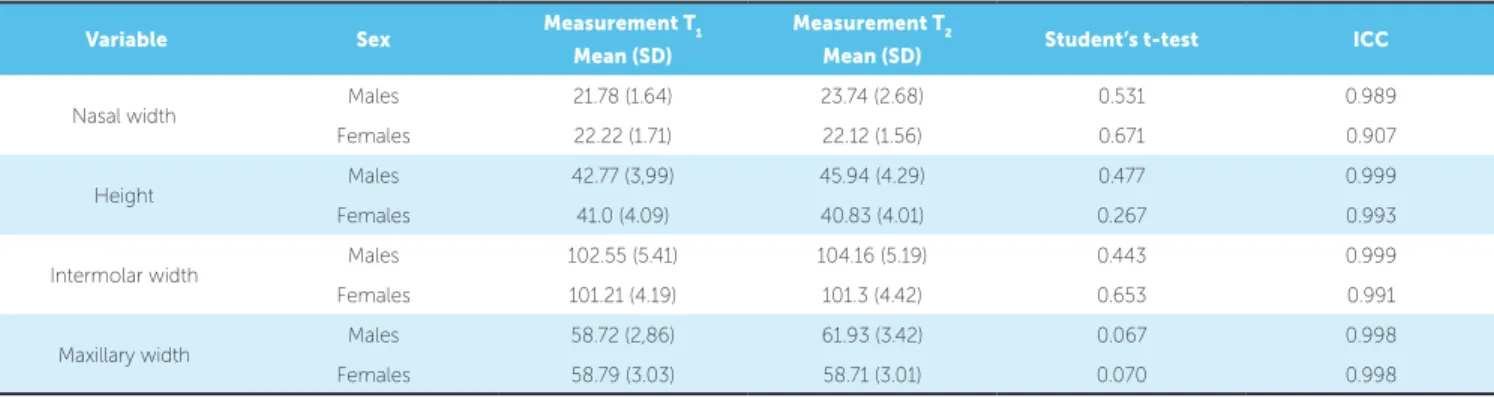
The results obtained through the Student’s t-test for paired samples showed correspondence between the initial measurements and the repetitions by the same evaluator (Intraclass Correlation Coeicient), both in T1 (p > 0.05 and ICC close to 1.000) and in T2 (p > 0.05 and ICC close to 1.000), indicating the absence of mea-surement error, reliability and reproducibility (Table 7).
RESULTS
Table 3 refers to sex diferences in T1 and it shows sta-tistical signiicance for nasal height and maxillary width variables, which were smaller in female group.
Table 4 compares the sex diferences at T2. RME produced greater increases in the male group for nasal height, maxillary width, intermolar width and nasal width/maxillary width ratio.
Table 5 compares the sex diferences at T1 and T2. Sig-niicant changes in the nasal width were observed in fe-male group, and the nasal width/maxillary width ratio was smaller in female group.
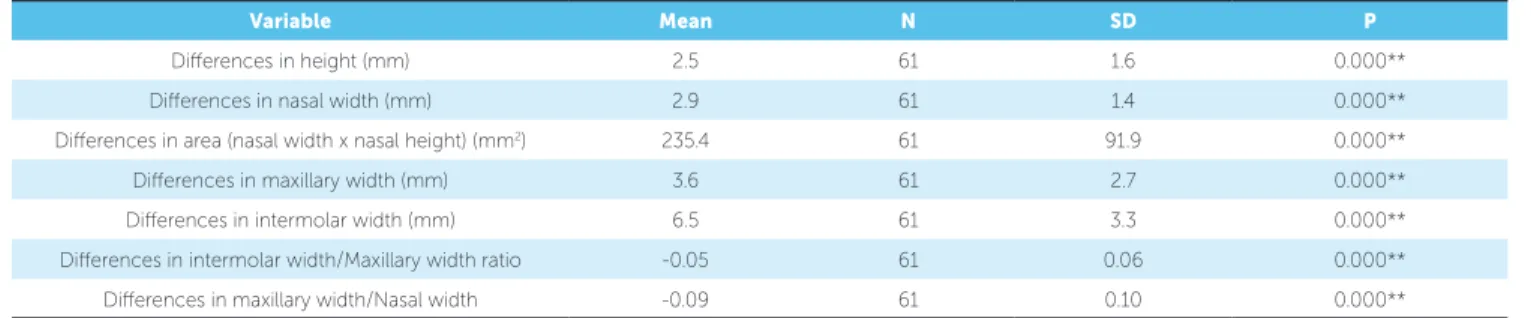
Table 6 shows changes within the groups (T2-T1). RME produced skeletal, dental and nasal increases in both males and females.
All measurements were considered to be reliable, since the reliability statistics were equal to 1, which in-dicates perfect reliability.
DISCUSSION
In both males and females groups, the maxilla showed a significant increase for the linear measure-ments after RME, which is in accordance to the find-ings of other authors that reported post-RME sagittal and transverse increases of skeletal, dental and nasal structures.3,15,21-23 According to Wriedt et al24 and
Warren et al,25 the enlargement of the nasal valve with
an increase of nasal volume can result in improvement of nasal breathing. More controversial is the question of whether RME can achieve a shift from mouth to nasal breathing patterns and change the subjective sensation of nasal obstruction.26 These effects depend
on the existence or not of nasal obstruction and on its cause, location and severity.6
Statistical results in Table 3, which compares the values obtained in the pre-RME (T1) between males and females, show that most of the variables were not significant (p > 0.05) indicating no correla-tion between sex and the linear measurements in T1. The two statistically significant variables — nasal height (p = 0.025) and maxillary width (p = 0.026) — for males are in agreement with other studies in the literature5. Snodell et al5 showed sex differences in
maxillary width at 6 years old and higher values for maxillary width and intermolar width at age 12 years in males. In the composition of the mean values of the nasal cavity found by Ricketts et al,18 the
propor-tion between nasal height and nasal width represents 60%. In this study, this proportion was 56% in both males and females groups, confirming reduced nasal width in the mouth-breathing sample. Whereas the growth in the vertical direction is larger than in the transverse one, from 6 to 18 years of age — with a
Table 7 - Error analysis: mean and standard deviation (SD), Student’s t-test for paired samples and ICC (n = 20).
SD = standard deviation. ** Statistically significant (p < 0.05).
Variable Sex Measurement T1
Mean (SD)
Measurement T2
Mean (SD) Student’s t-test ICC
Nasal width Males 21.78 (1.64) 23.74 (2.68) 0.531 0.989
Females 22.22 (1.71) 22.12 (1.56) 0.671 0.907
Height Males 42.77 (3,99) 45.94 (4.29) 0.477 0.999
Females 41.0 (4.09) 40.83 (4.01) 0.267 0.993
Intermolar width Males 102.55 (5.41) 104.16 (5.19) 0.443 0.999
Females 101.21 (4.19) 101.3 (4.42) 0.653 0.991
Maxillary width Males 58.72 (2,86) 61.93 (3.42) 0.067 0.998
increased percent in males — and by evaluating the mean age of the sample, the proportion between the values of transverse and vertical measures was below the one found in longitudinal studies of facial growth.5
These results are consistent with studies reporting a de-crease in measures of the nasal cavity in mouth-breath-ing patients.6
The results in Table 4 refer to the sex difference at T2. RME produced greater increases in the male group for nasal height (p = 0.05), maxillary width (p = 0.026), intermolar width (p = 0.029) and nasal width/maxillary width ratio (p = 0.014). The maxil-lary width increase correlates with intermolar width, according to longitudinal cephalometric studies, and the nasal width was also correlated with maxillary width and maxillary intermolar width.5 The greatest
increase in the maxillary width and in the intermo-lar width in males can be understood by the higher bone resistance of females, which complete puberty earlier than males, and the higher maxillary growth rate in males, which may affect resistance to the ex-pansion forces,27 leading to increased expression of
dental effects in males. For this reason, timing orth-odontic treatment to coincide with growth may be a considerable factor in the stability of the dentition, and studies agree that the use of orthopedic maxil-lary expansion should be cautiously applied past the age of 15 years for females and 17 years for males.28
The nasal width was correlated with maxillary width for both males and females, indicating the rela-tionship between airway and maxillary width.5 More
than 80% of the maxillary growth is completed at age 6 to 11 years, with a higher rate in females; excluding nasal width — with a higher rate in males, which is only 75% complete in females,5 justifying the greater
increase in nasal width in females found in the present study. The significant maxillary width/nasal width ratio value shows transverse growth of the nasal cavity and control of maxillary constriction, which are im-portant for dental and skeletal relationships and nasal airway increase. The arch width and arch depth are dependent on each other;29 thereby, the increase of
the nasal floor close to the midpalatal suture in width after RME and the growth in the vertical direction with a higher rate in males5 — according to
longi-tudinal studies of facial growth— could explain their nasal height increase.
The analysis between males and females at T1 and T2 is shown in Table 5, which compares the mean values of all variables. The only two signiicant variables were: nasal width (p = 0.027) and nasal width/maxillary width ratio (p = 0.019). Negative values in the nasal width/max-illary width ratio and the radiographic evaluation in fron-tal and occlusal norms conirm that the maxilla was later-ally moved, creating a pyramidal shape with the fulcrum located near frontonasal suture and PNS, with a larger opening in the anterior maxillary base.8
Studies have shown the beneits of RME for the en-largement of the nasal cavity and improvement of nasal permeability through otorhinolaryngologist evaluation, radiographic examination, rhinomanometry, acoustic rhinometry,7,11,12,30-35 and subjective evaluation
conduct-ed among patients reporting improvconduct-ed breathing.6,17
Many studies have emphasized the ability of RME to produce lateral expansion of the nasal cavity and to decrease nasal resistance6,7. According to the present
study results, the use of RME showed favorable results in the treatment of maxillary constriction and increased nasal cavity for both sexes; thereby, a possibility is of-fered that some potential may exist for a young patient to “outgrow” a breathing problem.
The Table 6 shows the efects of RME on the skel-etal, dental and nasal structures at T1 and T2. The results show that both males and females were signiicantly fa-vored (p < 0.01) by the transverse increase of the maxilla and nasal cavity. Ater statistical analysis and compar-ison of measurements in males and females, all linear variables were not signiicant. The transversal changes were not signiicantly diferent between sexes in the treatment of maxillary constriction with RME for a sample with a mean age of 9 years and 7 months.
As this was a short-term study, the alterations ob-served in the pretreatment and immediate posttreatment radiographs represent the efects produced by the ex-pander. It is important to point out that the time inter-val between the irst and the second radiograph in this study did not exceed three months, which minimizes growth as a variable in the interpretation of the results. Therefore, studies of facial growth had to be considered in the interpretation of the diferences between sexes.
CONCLUSION
1. Magnusson A, Bjerklin K, Nilsson P, Jönsson F, Marcusson A. Nasal cavity size, airway resistance, and subjective sensation after surgically assisted rapid maxillary expansion: a prospective longitudinal study. Am J Orthod Dentofacial Orthop. 2011 Nov;140(5):641-51.
2. El H, Palomo JM. Airway volume for diferent dentofacial skeletal patterns.
Am J Orthod Dentofacial Orthop. 2011 June;139(6):e511-21.
3. Cappellette M Jr, Beaini TL. A tomograia computadorizada no diagnóstico e
análise de pacientes submetidos a disjunção maxilar – revisão de literatura e apresentação de caso clínico. Sci Pract. 2014;7(27):134-40.
4. McNamara JA. Inluence of respiratory pattern on craniofacial growth. Angle
Orthod. 1981 Oct;51(4):269-300.
5. Snodell SF, Nanda RS, Currier GF. A longitudinal cephalometric study of
transverse and vertical craniofacial growth. Am J Orthod Dentofacial Orthop. 1993 Nov;104(5):471-83.
6. Ramires T, Maia RA, Barone JR. Alterações da cavidade nasal e do
padrão respiratório após expansão maxilar. Rev Bras Otorrilaringol. 2008;74(5):763-9.
7. De Felippe NLO, Bhushan N, Silveira AC, Viana G, Smith B. Long-term efects
of orthodontic therapy on the maxillary dental arch and nasal cavity. Am J Orthod Dentofacial Orthop. 2009 Oct;136(4):490.e1-8; discussion 490-1.
8. Haas AJ. Rapid expansion of the maxillary dental arch and nasal cavity by
opening the midpalatal suture. Angle Orthod. 1961;31(2):73-90.
9. Haas AJ. Palatal expansion: just the beginning of dentofacial orthopedics.
Am J Orthod. 1970 Mar;57(3):219-55.
10. Basciftci FA, Mutlu N, Karaman AI, Malkoc S, Küçükkolbasi H. Does the timing and method of rapid maxillary expansion have an efect on the changes in nasal dimensions? Angle Orthod. 2002;72(2):118-23.
11. Kiliç N, Oktay H. Efects of rapid maxillary expansion on nasal breathing and some naso-respiratory and breathing problems in growing children: A literature review. Int J Pediatr Otorhinolaryngol. 2008 Nov;72(11):1595-601. 12. Palaisa J, Ngan P, Martin C, Razmus T. Use of conventional tomography
to evaluate changes in the nasal cavity with rapid palatal expansion. Am J Orthod Dentofacial Orthop. 2007;132(4):458-66.
13. Lamparski DG Jr, Rinchuse DJ, Close JM, Sciote JJ. Comparison of skeletal and dental changes between 2-point and 4-point rapid palatal expanders. Am J Orthod Dentofacial Orthop. 2003 Mar;123(3):321-8.
14. Ciambotti C, Ngan P, Durkee M, Kohli K, Kim H. A comparison of dental and dentoalveolar changes between rapid palatal expansion and nickel-titanium palatal expansion appliances. Am J Orthod Dentofacial Orthop. 2001 Jan;119(1):11-20.
15. Cross DL, McDonald JP. Efect of rapid maxillary expansion on skeletal, dental and nasal structures: a postero-anterior cephalometric study. Eur J Orthod. 2000 Oct;22(5):519-28.
16. Cameron CG, Franchi L, Baccetti T, McNamara JA Jr. Long-term efects of rapid maxillary expansion: a posteroanterior cephalometric evaluation. Am J Orthod Dentofacial Orthop. 2002 Feb;121(2):129-35; quiz 193.
17. Izuka EN, Feres MFN, Pignatari SSN. Immediate impact of rapid maxillary expansion on upper airway dimensions and on the quality of life of mouth breathers. Dental Press J Orthod. 2015 May-June;20(3):43-9.
18. Ricketts RM, Roth RH, Chaconas SJ, Schulhof RJ, Engel GA. Orthodontic diagnosis and planning. Denver: Rocky Mountain Data Systems; 1982. 19. Cohen J. A power primer. Psycol Bull. 1992;112(1):155-9.
REFERENCES
20. Faul F, Erdfelder E, Lang AG, Buchner A. G*Power 3: A lexible statistical power analysis program for the social, behavioral, and biomedical sciences. Behav Res Methods. 2007 May;39(2):175-91.
21. Habeeb M, Boucher N, Chung CH. Efects of rapid palatal expansion on the sagittal and vertical dimensions of the maxilla: a study on cephalograms derived from cone-beam computed tomography. Am J Orthod Dentofacial Orthop. 2013 Sept;144(3):398-403.
22. Phatouros A, Goonewardene MS. Morphologic changes of palate after rapid maxillary expansion: A 3-dimensional computed tomography evaluation. Am J Orthod Dentofacial Orthop. 2008 July;134(1):117-24.
23. Hassan B, van der Stelt P, Sanderink G. Accuracy of three-dimensional measurements obtained from cone beam computed tomography surface rendered images for cephalometric analysis: inluence of patient scanning position. Eur J Orthod. 2009 Apr;31(2):129-34.
24. Wriedt S, Kunkel M, Zentner A, Wahlmann UW. Surgically assisted rapid palatal expansion. An acoustic rhinometric, morphometric and sonographic investigation. J Orofac Orthop. 2001 Mar;62(2):107-15.
25. Warren DW, Hershey HG, Turvey TA, Hinton VA, Hairield WM. The nasal airway following maxillary expansion. Am J Orthod Dentofacial Orthop. 1987 Feb;91(2):111-6.
26. Vig KW. Nasal obstruction and facial growth: the strength of evidence for clinical assumptions. Am J Orthod Dentofacial Orthop. 1998 June;113(6):603-11.
27. Cross DL, McDonald JP. Efect of rapid maxillary expansion on skeletal, dental, and nasal structures: a postero-anterior cephalometric study. Eur J Orthod. 2000 Oct;22(5):519-28.
28. Bishara SE, Staley RN. Maxillary expansion: clinical implications. Am J Orthod Dentofacial Orthop. 1987 Jan;91(1):3-14.
29. Lindsten R, Ogaard B, Larsson E, Bjerklin K. Transverse dental and dental arch depth dimensions in the mixed dentition in a skeletal sample from the 14th to the 19th century and Norwegian children and Norwegian Sami children of today. Angle Orthod. 2002 Oct;72(5):439-48.
30. Cappellette M Jr, Carlini D, Pignatari SSN, Cruz OLM, Weckx LLM. Rinometria acústica em crianças submetidas à disjunção maxilar. Rev Dental Press Ortod Ortop Facial. 2006;11(2):84-92.
31. Muniz RFL, Cappellette M Jr, Carlini D. Alterações no volume nasal de pacientes submetidos a disjunção da maxila. Rev Dental Press Ortod Ortop Facial. 2008;13(1):54-9.
32. Cappellette M Jr. Disjunção maxilar. 1ª ed. São Paulo: Ed. Santos; 2014. 432 p.
33. Garrett BJ, Caruso JM, Rungcharassaeng K, Farrage JR, Kim JS, Taylor GD. Skeletal efects to the maxilla after rapid maxillary expansion assessed with cone-beam computed tomography. Am J Orthod Dentofacial Orthop. 2008 July;134(1):8-9.
34. Enoki C, Valera FC, Lessa FC, Elias AM, Matsumoto MA, Anselmo-Lima WT. Efect of rapid maxillary expansion on the dimension of the nasal cavity and on nasal air resistance. Int J Pediatr Otorhinolaryngol. 2006 July;70(7):1225-30.
35. Haralambidis A, Ari-Demirkaya A, Acar A, Küçükkeleş N, Ateş M, Ozkaya S. Morphologic changes of the nasal cavity induced by rapid maxillary expansion: a study on 3-dimensional computed tomography models. Am J Orthod Dentofacial Orthop. 2009 Dec;136(6):815-21.
The treatment of maxillary constriction with RME in mouth-breathing patients without nasal obstruc-tion showed signiicant improvement in the nasal width/maxillary width ratio, representing a transverse increase of the nasal cavity.
Author contributions