392
Revista da Sociedade Brasileira de Medicina Tropical 44(3):392-394, mai-jun, 2011
1. Laboratório de Biologia Molecular, Divisão Hemocentro, Faculdade de Medicina de Botucatu, Universidade Estadual Paulista, Botucatu, SP. 2. Seção de Moléstias Infecciosas, Secretaria Municipal de Bauru, Bauru, SP. 3. Departamento de Clínica Médica, Faculdade de Medicina de Botucatu, Universidade Estadual Paulista, Botucatu, SP.
Address to: Dra Maria Inês de Moura Campos Pardini. Lab. Biol Mol Hemocentro/
FMB/UNESP. Distrito de Rubião Jr s/n, 18618-000 Botucatu, SP, Brasil. Fax: 55 14 3811-6041
e-mail: [email protected] Received in 27/07/2010 Accepted in 24/01/2011
Case Report/Relato de Caso
INTRODUCTION
CASE REPORT
A irst case of protease codon 35 amino acid insertion in a HIV-1
subtype B sequence detected in the Bauru Region, State of São Paulo,
Brazil: case report
Primeiro caso de inserção de aminoácidos no codon 35 da protease em uma sequência de
HIV-1 do subtipo B detectada na região de Bauru, Estado de São Paulo, Brasil: relato de
c
aso
Rejane Maria Tommasini Groto
1, Sílvia Maria Corvino
1, Lilian da Silva Reis Munhoz
1, Cibele Gomes Ghedini
2and Maria Inês de Moura Campos Pardini
1,3ABSTACT
Amino acid insertions in the protease have rarely been described in HIV-infected patients. One of these insertions has recently been described in codon 35, although its impact on resistance remains unknown. his study presents a case of an HIV variant with an insertion in codon 35 of the protease, described for the irst time in Bauru, State of Sao Paulo, Brazil, circulating in a 38-year-old caucasian male with asymptomatic HIV infection since 1997. he variant isolated showed a codon 35 insertion of two amino acids in the protease: a threonine and an aspartic acid, resulting in the amino acid sequence E35E_TD.
Keywords: Codon 35 protease. HIV. Insertion.
RESUMO
Inserções de aminoácidos na protease têm sido raramente descritas em pacientes infectados pelo HIV. Uma destas inserções foi, recentemente, descrita no codon 35, embora seu impacto na resistência mantém-se pouco conhecido. Este trabalho apresenta um caso de uma variante viral com inserção no codon 35 da protease, descrita pela primeira vez em Bauru, São Paulo, Brasil, circulante em um homem, caucasiano, com 38 anos, o qual apresenta infecção assintomática pelo HIV desde 1997. A variante isolada mostrou uma inserção no codon 35 da protease de dois aminoácidos: uma treonina e um ácido aspártico, resultando na sequência de aminoácidos E35E_TD.
Palavras-chaves: Codon 35 da protease. HIV. Inserção.
he principal objective of antiretroviral therapy in HIV infection is to suppress the plasma viral load to undetectable levels using combinations of drug classes1, which slow the progression of the infection2.
he antiretroviral drug selection pressure associated with a high mutation rate3 has led to the emergence of resistant HIV variants. Resistant strains can result from amino acid changes or an insertion/
deletion in the viral sequence, leading to an alteration in enzyme kinetics or antiretroviral drug accessibility4.
Amino acid insertions in the protease (PR) have rarely been described in HIV-infected patients, occurring in 0.1 to 4.6% of patients naïve to or on treatment with protease inhibitors5. hese insertions have been reported mainly in codons 17, 18, 22 to 25, 31 to 31, 35 to 38, 70, 71, 95 and 966.
Insertions in codon 35 of PR have recently been reported7-9, but their impact on enzymatic activity, viral biology and resistance to protease
inhibitors (PI) remains unknown8. hese variants could show an
advantage in proliferation in the presence of drug selection pressure5,8,9. he purpose of this study was to report a case of an HIV variant with an insertion in codon 35 of the protease, described for the irst time in Brazil, which was identiied circulating in an HIV-infected patient on treatment in Bauru, State of São Paulo.
he patient is a 38-year-old caucasian male with asymptomatic HIV infection since 1997 and no history of the conditions associated with AIDS. He had been previously treated with diferent drug
combinations (Table 1), including didanosine, estavudine,
zidovudine, lamivudine and efavirenz, while nowadays using lamivudive, tenofovir, atazanavir and ritonavir. he use of protease inhibitors was initiated in 1998 and continues up to the present, although their use was interrupted for four years (between 2001 and 2005). Since diagnosis, the patient never presented with a CD4 cell
count lower than 200cells/mm3 and the plasma viral load showed
wide variation. Ater one therapeutic scheme that was not tolerated and two that led to failure, a drug resistance test (TRUGENE® HIV-1
TABLE 1 -Drugs combination used by the patient, showing the onset and end of each combination and the reasons for change.
Drugs combination Onset End Reason for change
D4T/ddI/RTV 04/1998 11/2001 intolerance
D4T/ddI 11/2001 05/2004 therapeutic failure
AZT/3TC/EFV 05/2004 06/2005 therapeutic failure
3TC/TDF/ATV/r 06/2005 - in current use
393
Groto RMT et al - HIV- 1 Protease codon 35 amino acid insertion: case reportDISCUSSION
REFERENCES FINANCIAL SUPPORT
Genotyping Test on an OpenGene® DNA Sequencing System,
Siemens Healthcare Diagnostics, Deerield, IL , USA) was performed in the Molecular Biology Laboratory of the Blood Donor Center at the Botucatu School of Medicine, São Paulo State University (Universidade Estadual Paulista, UNESP), a laboratory of the Brazilian
National Network for HIV-1 Genotyping (RENAGENO).At the
time of writing this paper, the patient’s CD4 cell count and the plasma viral load were 415 cells/mm3 and 3.34 log, respectively.
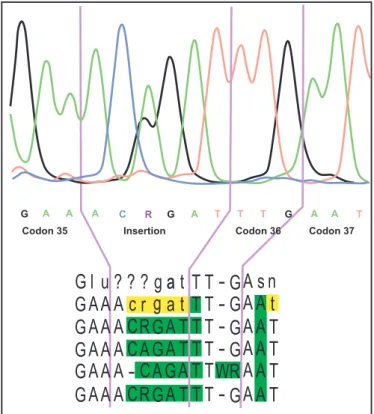
he viral strain was subtype B (93% similarity in protease gene), according to the Viral Genotyping Tool available at the National Center for Biotechnology Information (htp://www.ncbi.nlm.nih. gov/projects/genotyping/formpage.cgi). he sequence obtained showed a codon 35 insertion of two amino acids in the protease gene, a threonine, encoded by ACA and ACG, characterizing a dual viral population, and a single GAT sequence encoding aspartic acid,
resulting in the sequence E35E_TD (Figure 1).
he mutation proile included the mutations I135T, D177E, Q197K, R211K and V245K in the reverse transcriptase gene and I13V, ins35TD, M46I, I62V, L63H, I64V and I72V in the protease gene, according to the Genotypic Resistance Interpretation Algorithm (HIVdb program) available at the Stanford University site (htp://hivdb.stanford.edu/pages/algs/sierra_sequence.html).
T
G A A A C R G A T T T G A A
G
G
G
G
G
G
G
G
G
G
G
WR
s n
l u ? ? ? g
g
aa
a
t
t
t
-A
A
A
A
A
A
A
A
A
A
A
A
A
A
A
A
A
A
A
A
A
A
A
A
A
A
A
A
A
A
A
A
T
T
T
T
T
T
T
T
T
T
T
T T
T
T
T
T
T
T
c
C
C
C
C
R
R
G
G
G
G
r
Codon 35 Insertion Codon 36 Codon 37
FIGURE 1 -Part of the electropherogram of the HIV-1 protease genomic sequence, showing the insertion of two amino acids between codon 35 and 36. he irst amino acid is encoded by ACR, the R represents dual population: A, in green and G, in black (see arrow) and; the other amino acid encoded by GAT.
Codon 35 of the protease has recently been described as a site at which insertions can occur. A two-amino acid insertion in protease codon 35, producing the sequence ETNLNL, circulating in a PI-naive patient and in his partner, was described in 2001. his strain has shown a normal replication capacity and susceptibility to protease
inhibitors7. In our laboratory, of the 472 infected patients tested over
a three-year period, only one showed an insertion in protease codon 35, suggesting that insertions in this region are rare. he sequence obtained in our laboratory (with ins35TD) was submited to the Blastn algorithm (Blast Basic Local Alignment Search Tool) available at NCBI Blast (htp://blast.ncbi.nlm.nih.gov/Blast.cgi). A 95% identity was determined, though no perfect alignment was obtained due to the presence of the insertion.
Various plasma viral load levels and CD4 T counts have been reported for viral variants with insertions in codon 35 of the protease gene, suggesting no relation with disease progression10. In this study,
the isolated viral variant was detected using plasma viral RNA as the source, suggesting that this strain may be stable and manageable with HAART.
he presence of the insertions ins35G and ins35TN alone were not associated with decreased drug susceptibility. In the presence of the ins35TN and resistance mutations, the replication level was lower than when the resistance mutations were present with ins35G8. On
the other hand, studies have shown that ins33L and ins35E can favor resistance to protease inhibitors9. he virus circulating in our patient
did not exhibit a high resistance level to any protease inhibitor, but showed intermediate resistance to nelinavir and potentially low-level resistance to atazanavir/r, fosamprenavir/r, indinavir/r and lopinavir/r. he mutation M46I decreases susceptibility to IDV/r, NFV, FPV/r, LPV/r, and ATV/r, when present with other mutations, suggesting that the low and intermediate resistance veriied could be related to the presence of the M46I mutation. However, one study suggests that the ins35TD may have been selected during protease inhibitor therapy5.
Viral and host conditions may be required for the emergence of insertions5. Our patient could not be evaluated before the initiation
of therapy, and, thus, further studies of ins35TD are required to determine the factors that contribute to the selection of this variant.
Rede Nacional de Laboratórios de Genotipagem (RENAGENO), Departamento de DST/Aids e Hepatites Virais, Unidade de Laboratório and Ministério da Saúde.
1. Hammer SM, Eron Jr JJ, Reiss P, Schooley RT, hompson MA, Walmsley S, et al. Antiretroviral treatment of adult HIV infection: 2008 recommendations of the International AIDS Society-USA panel. JAMA 2008; 300:555-570. 2. Palella Jr FJ, Delaney KM, Moorman AC, Loveless MO, Fuhrer J, Saten GA,
et al. Declining morbidity and mortality among patients with advanced human immunodeficiency virus infection. HIV Outpatient Study Investigators. N Engl J Med 1998; 338:853-860.
3. Preston BD, Poiesz BJ, Loeb LA. Fidelity of HIV-1 reverse transcriptase. Science 1998; 242:1168-1171.
4. Mahalingam B, Louis JM, Reed CC, Adomat JM, Krouse J, Wang YF, et al. Structural and kinetic analysis of drug resistant mutants of HIV-1 protease. Eur J Biochem 1999; 263:238-245.
394
Rev Soc Bras Med Trop 44(3):392-394, mai-jun, 2011
6. Winters MA, Merigan TC. Insertions in the Human Immunodeiciency Virus Type 1 Protease and Reverse Transcriptase Genes: Clinical Impact and Molecular Mechanisms. Antimicrob Agents Chemother 2005; 49:2575-2582.
7. Grant RM, Kahn JO, Wrin T, Drews B, Javier J, Webb M, et al. HIV-1 with an insertion in protease is drug-susceptible, replication-competent and transmissible. Antivir her 2001; 6 (suppl 1):44.
8. Paolucci S, Baldanti F, Dossena L, Gerna G. Amino acid insertions at position 35 of HIV-1 protease interfere with virus replication without modifying antiviral drug susceptibility. Antiviral Res 2006; 69:181-185.
9. Kozísek M, Sasková KG, Rezácová P, Brynda J, vanMaarseveen NM, De Jong D, et al. Ninety-nine is not enough: molecular characterization of inhibitor-resistant human immunodeiciency virus type 1 protease mutants with insertions in the lap region. J Virol 2008; 82:5869-5878.