Original article
breast cancer: a paired case-control study
Prognóstico para pacientes grávidas portadoras de câncer de mama:
estudo caso-controle pareado
Wagner Brant Moreira
I, Eduardo Carvalho Brandão
II, Aleida Nazareth Soares
III,
Clécio Enio Murta de Lucena
IV, Carlos Maurício Figueiredo Antunes
VClinical Oncology Service at Hospital da Santa Casa de Misericórdia, Belo Horizonte, Minas Gerais, Brazil
IMD, MSc. Attending physician at the Clinical Oncology Service, Hospital da Santa Casa de Misericórdia and medical consultant atCentro de Quimioterapia Antiblástica e Imunoterapia (CQAI), Belo Horizonte, Minas Gerais, Brazil.
IIMD. Attending physician at the Clinical Oncology Service, Hospital da Santa Casa de Misericórdia, and atCentro de Quimioterapia Antiblástica e Imunoterapia (CQAI), Belo Horizonte, Minas Gerais, Brazil.
IIIMSc. Biostatistician at the Clinical Oncology Service, Hospital da Santa Casa de Misericórdia, and at Centro de Quimioterapia Antiblástica e Imunoterapia (CQAI), Belo Horizonte, Minas Gerais, Brazil.
IVPhD. Attending physician at the Mastology Service, Hospital da Santa Casa de Misericórdia, Belo Horizonte, Minas Gerais, Brazil.
VPhD. Professor, Parasitology Department, Universidade Federal de Minas Gerais (UFMG), and member of the Postgraduate Studies Board of the Clinical Medicine and
Biomedi-ABSTRACT
CONTEXT AND OBJECTIVE: Previous studies have suggested that the occurrence of pregnancy concomitantly with a diagnosis of breast cancer may affect the evolution of the neoplasia. The present study aimed to compare pregnancy-associated breast cancer (PABC) patients with non-pregnant cancer patients (controls) in relation to the time taken to diagnose the disease, tumor characteristics and mortality.
DESIGN AND SETTING: A retrospective, paired case-control study was conducted at the Hospital da Santa Casa de Misericórdia and Centro de Quimioterapia Antiblástica e Imunoterapia in Belo Horizonte, Brazil.
METHODS: The study involved 87 PABC and 252 control patients. The inluence of covariables (interval between irst symptoms and diagnosis, tumor histology, size of primary tumor, distant metastasis, grade of malignancy, hormone receptor status and axillary lymph node involvement) and the pregnancy variable on overall survival was investigated using univariate and multivariate analyses.
RESULTS: The median overall survival for PABC patients of 30.1 months (95% conidence interval, CI: 19.4-40.9 months) was signiicantly different (P = 0.005) from that of the control group (53.1 months; 95% CI: 35.1-71.0 months). The cumulative overall survivals after ive and ten years were, respectively, 29.7 and 19.2% for PABC patients, and 47.3 and 34.8% for control patients (P = 0.005). Tumor size, grade of malignancy, distant metastasis and pregnancy were independent factors that signiicantly modiied disease prognosis.
CONCLUSIONS: Pregnancy was an independent prognostic factor. The overall survival of PABC patients was shorter than that of non-pregnant patients.
RESUMO
CONTEXTO E OBJETIVO: Estudos prévios sugerem que a ocorrência de gravidez simultaneamente com o diagnóstico de câncer de mama pode afetar a evolução da neoplasia. O presente estudo objetivou comparar pacientes com câncer de mama associado à gravidez (PABC) e pacientes com câncer não grávidas (controles) com relação ao tempo decorrido até o diagnóstico de câncer, características tumorais e mortalidade.
TIPO DE ESTUDO E LOCAL: Estudo retrospectivo, tipo caso-controle pareado, foi conduzido no Hospital da Santa Casa de Misericórdia e Centro de Quimioterapia Antiblástica e Imunoterapia em Belo Horizonte, Brasil.
MÉTODOS: O estudo envolveu 87 pacientes PABC e 252 controles. A inluência das covariáveis (intervalo entre os primeiros sintomas e diagnóstico, histologia do tumor, tamanho do tumor primário, metástase a distância, grau de malignidade, dosagem de receptor hormonal e acometimento dos linfonodos axilares) e da variável gravidez sobre a sobrevida global foram avaliados através de análises univariada e multivariada.
RESULTADOS: A mediana da sobrevida global para as pacientes PABC de 30,1 meses (intervalo de coniança, IC 95%: 19,4-40,9 meses) foi signiicativamente (P = 0,005) diferente daquela dos controles (53,1 meses; IC 95%: 35,1-71,0 meses). A sobrevida global acumulada após 5 e 10 anos foi 29,7 e 19,2% no grupo PABC e 47,3 e 34,8% nos controles. Tamanho do tumor, grau de malignidade, metástase a distância e gravidez foram fatores independentes e signiicativamente condicionantes do prognóstico da doença.
CONCLUSÕES: A gravidez foi um fator independente para o prognóstico da doença. A sobrevida global das pacientes PABC foi mais curta do que aquela dos controles.
KEY WORDS: Breast neoplasms. Prognosis. Pregnancy. Lactation.
Pregnancy complications.
PALAVRAS-CHAVE: Neoplasias da mama. Prognóstico. Gravidez. Lactação.
INTRODUCTION
Conventionally, breast cancer is classiied as pregnancy-associated breast cancer (PABC) when the disease is diagnosed during pregnancy or up to one year after parturition.1 In the United States, breast cancer is
diagnosed in one in every 3,000 to 10,000 pregnant women, resulting in some 3,500 new cases annually.1 In Canada, the incidence of PABC is
somewhat higher (1 case in 1,500 to 4,000 pregnant women).2
Accord-ing to DiFronzo and O’Connell,3 breast cancer afects between 0.2 and
3.8% of all pregnant women, an incidence that is apparently increasing as a result of delayed pregnancy (later than 30 years of age)2 and
high-er levels of detection (by means of mammography) of breast canchigh-er in younger women.1,4
One of the earliest suggestions of an association between pregnancy and unfavorable evolution of breast cancer was published by White in 1954, who noted that less than 20% of pregnant women who developed carcinoma of the breast survived for more than ive years following diag-nosis.5 A number of subsequent studies have provided evidence
support-ing this pessimistic prognosis for PABC patients. Ishida et al.6
conclud-ed that delayconclud-ed diagnosis and treatment, together with a more aggres-sive condition, were responsible for the poor prognosis among pregnant or lactating women sufering from breast cancer. he deleterious efect of pregnancy on the prognosis of women diagnosed with neoplasia has been conirmed even when axillary lymph node involvement and treat-ment of the primary tumor are taken into consideration.7 Additionally,
multivariate analysis carried out on data obtained from PABC patients in a multicenter study has revealed that when cancer is diagnosed dur-ing pregnancy or the postpartum period, the prognosis for the patient is pessimistic.8 A recent population-based study involving a large number
of patients has substantiated the negative prognosis for women sufer-ing from PABC.9
In contrast to the above, several studies have been unable to conirm any association between prognosis and pregnancy in PABC patients. Pe-trek et al.10 investigated axillary lymph node involvement and pregnancy
as possible predictive factors for the development of breast cancer in preg-nant and non-pregpreg-nant women of the same age range, each in various stages of the disease. Only axillary lymph node involvement was decisive for the prognosis of the disease outcome and, when the stage of the ill-ness was taken into consideration, there were no signiicant diferences be-tween the two groups. Similarly, no diferences were found with regard to the median and overall survival rates between a group of pregnant women diagnosed with breast cancer and non-pregnant women in the same con-dition.11 Considering the relevance of the subject and the lack of
informa-tion relating to Brazilian patients sufering from PABC, we undertook a retrospective study from which the results are reported in this paper.
OBJECTIVE
he objective of this study was to compare pregnancy-associated breast cancer (PABC) patients with non-pregnant patients presenting breast cancer (controls), in relation to the time taken to diagnose the disease, the tumor characteristics and mortality.
METHODS
Type of study
his paired case-control study consisted of a retrospective, longitu-dinal analysis on two groups of women sufering from breast cancer. he PABC group consisted of patients diagnosed either during pregnancy or up to 12 months after parturition or abortion, while the control group consisted of women with similar characteristics but with no recent his-tory (within 12 months) of pregnancy or parturition at the time when the symptoms emerged or when the diagnosis was reached.
Setting
he study covered the period between January 1980 and Decem-ber 2000 at the Immunotherapy and Antiblastic Chemotherapy Center (Centro de Quimioterapia Antiblástica e Imunoterapia; CQAI) and the Clinical Oncology Service, Hospital da Santa Casa de Misericórdia, in Belo Horizonte, Minas Gerais, Brazil. Details of the project were pre-sented to, and approved by, the Ethics Committee of Hospital da Santa Casa de Misericórdia prior to commencing the study.
Sample
Data on 1,521 women (≤ 45 years old) diagnosed with breast cancer at the Clinical Oncology Service were obtained from medical records kept at the Oncological Research and Study Center of Minas Gerais (Cen-tro de Estudos e Pesquisas Oncológicas de Minas Gerais; CEOMG). he PABC (n = 87) and control (n = 252) patients were classiied according to the institution at which the patient had been registered, the date of reg-istration and the individual’s age. Each PABC patient was matched with corresponding control patients in accordance with the following criteria: (i) registration in the same institution, (ii) similar age (within two years), and (iii) similar registration year (within two years). For cases in which more than three control patients matched a single PABC patient, selec-tion was based on the closest registraselec-tion date.
Following identiication of the total PABC population (n = 93), an overall sample size was calculated assuming that all study variables contained a maximum of three categories (≤ 2 degrees of freedom) and that the objective was to measure a mean efect to be detected statisti-cally, with a signiicance level of 5% and a power of detection ≥ 80%. he calculations indicated that the total number of patients should be within the range of 200 to 250, according to Cohen’s efect size conven-tions.12 In practice, a larger number of controls was selected (three for
each PABC patient) as a precaution against any need to exclude some of the individuals. hus, 372 patients were available for the study. Howev-er, the inal population selected (n = 339) ensured that the power of the statistical tests for detecting a mean efect (at the 5% signiicance level) was approximately 90%.12
Main measurements
progesterone) receptor status, interval between irst symptoms and diag-nosing of cancer, and interval between diagnosis and irst treatment. he variable used to assess the prognosis was the overall length of survival, which was deined as the interval between diagnosing the breast cancer and the patient’s death (or the date of the last information obtained).
Statistical analysis
he overall survival functions of the two groups of patients were ana-lyzed in accordance with the Kaplan-Meier method and compared using the Mantel-Cox log rank method. he evaluation of covariables followed the methodology described by George,13 and was based on univariate
analysis that aimed to identify the covariables that were individually re-lated to the prognosis. Covariables were considered to be signiicantly as-sociated with the prognosis when the diferences between the two groups presented a P value ≤ 0.20 (χ2 test). Potentially important factors were
in-cluded in a Cox multivariate proportional hazard regression model that was constructed with the objective of identifying the covariables that in-dependently inluenced the prognosis. Statistical analyses were performed using Epi-Info (version 3.3.2; February 2005) and the Statistical Package for the Social Sciences (SPSS) software, version 13.0.
RESULTS
Patients’ characteristics
Out of the total of 1,521 women (≤ 45 years old) sufering from breast cancer, 93 PABC patients (6.1%) were identiied. On the basis of matching criteria, 252 women were selected as controls. Of the PABC patients, six (6.45%) could not be matched with any of the controls (and thus were omitted from the study), one was matched with a single control, seven were matched with two controls each, whilst the remain-der (79 women) were matched with three controls each.
Table 1 presents the distribution of patients according to the cova-riables selected as having potential associations with disease prognosis. Data on the covariables were available for more than 90% of the PABC and control individuals, with the exception of those relating to grade of malignancy and hormone receptor status (Table 1). Lack of information on any of the covariables can negatively afect the quality of a progno-sis study,13 although it is generally agreed that a maximum of 20% of
cases with incomplete data is acceptable. In the present study, however, more than 20% of cases were deicient with regard to data relating to the grade of malignancy and hormone receptor status. Since there were no signiicant diferences (as indicated by P values > 0.05) between the PABC and control groups (either including or excluding the cases with missing data) in relation to the grade of malignancy and hormone re-ceptor status, we chose to include these two covariables in the statistical analysis and to examine the cases with incomplete data separately.
he PABC group presented signiicant diferences in comparison with the control group, in relation to primary tumor size, axillary lymph node involvement, presence of distant metastasis and duration of symp-toms before diagnosis. Information was unavailable concerning disease outcome for 26.3% (89/339) of the remaining individuals involved in the study, including 24.1% (21/87) of the PABC group and 26.9%
(68/252) of the control group. Nine PABC patients and 18 control pa-tients entered the terminal phase during hospitalization and were dis-charged at the request of their families, a practice that was common in the 1980s and the early part of the 1990s. Attempts to obtain informa-tion concerning the fate of these patients generated anxiety among fam-ily members, and hence we considered that these patients died on the date of the last information registered. hus, it may be assumed that 73.6% (64/87) of the PABC group and 59.1% (149/252) of the control group died as a consequence of breast cancer: the diference in these val-ues was statistically signiicant, as indicated by the χ2 test (P < 0.05).
Among the remaining 62 patients (18.2%; 62/339) whose outcomes were unknown, 21 were followed up for a period ≥ 60 months (including eight who were followed up for ≥ 120 months). On this basis, informa-tion on 41 patients (12.1%) who were followed up for a period of < 60 months was considered to be missing data. his situation imposed some diiculties on prognosis analysis and, in order to overcome the problem, patients discharged from hospital whose outcomes were unknown were classiied as “missing/gravely ill”. he data on these patients were analyzed assuming that this classiication represented either death or censored data (i.e. losses from the sample before the inal outcome was observed).
Overall survival
he Kaplan-Meier survival estimator function was applied to data derived from all of the 339 patients studied, and the data in the missing/
Table 1. Characteristics of pregnancy-associated breast cancer (PABC) and control breast cancer patients (not pregnant)
Characteristics PABC group
(n = 87)*
Control group
(n = 252) P
Age (years)
Median value (25th - 75th percentile) 35.0 (31 - 39) 36.0 (32 - 39)
Mean value ± standard error 34.9 ± 4.89 35.5 ± 4.83 Tumor histology (% of cases)
Ductal/lobular 79 (90.8) 232 (92.1) 0.713†
Other 8 (9.2) 20 (7.9) Grade of malignancy (% of cases)
1 and 2 20 (23.0) 61 (24.2) 0.375†
3 22 (25.3) 81 (32.1) Unknown 45 (51.7) 110 (43.7 Primary tumor size (% of cases)
T1 + T2 25 (28.7) 97 (38.8) 0.029†
T3 + T4 61 (70.1) 138 (55.4) Unknown 1 (1.10) 14 (5.80) Axillary lymph node involvement (% of cases)
Negative 9 (10.3) 161 (63.9) < 0.0001†
Positive 78 (89.7) 91 (36.1) Distant metastasis (% of cases)
Negative 57 (65.5) 202 (80.2) 0.007†
Positive 29 (33.3) 49 (19.4) Hormone receptor status (% of cases)
Negative 12 (13.8) 39 (15.5) 0.226†
Positive 39 (44.8) 87 (34.5) Not determined 36 (41.4) 126 (50.0) Interval between irst symptoms and diagnosis (% of cases)
≤ 6 months 32 (36.8) 129 (51.2) 0.009†
> 6 months 55 (63.2) 114 (45.2) Interval between diagnosis and irst treatment (days)
Mean value ± standard error 79.20 ± 377 51.61 ± 109 0.402‡
Median value 22.0 28.5
*Excludes six PABC patients with no matching controls; †Values based on χ2 test; ‡Value based on
gravely ill category were considered either to represent cases of death or censored data. he results obtained are summarized in Table 2. Classi-ication of missing/gravely ill data as being equivalent to an outcome of death resulted in a worse prognosis than when such data were classiied as censored. However, irrespective of the classiication used, the difer-ence in overall survival between the PABC and control groups was high-ly signiicant, as shown by the P value of 0.005 calculated according to the Mantel-Cox log rank method. It is likely that values intermediate
between the two sets of results shown in Table 2 would have been ob-tained from the analysis, had all data been available. In order to simplify the treatment of the results, we chose to classify missing/gravely ill data as equivalent to death in subsequent analyses.
As can be seen from Figure 1, the median overall survival of the PABC group was 30.1 months (95% conidence interval, CI = 19.4-40.9 months), while that of the control group was 53.1 months (95% CI = 35.1-71.0 months). Overall survival within a ive-year period was 29.7% for the PABC group and 47.3% for the control group, while within a 10-year period, the overall survival rates were 19.2 and 34.8%, respectively. hese results clearly demonstrate that the overall survival of patients with breast cancer was signiicantly lower (P = 0.005) when this condition was associated with pregnancy.
Prognostic factor analysis
In order to investigate whether the diference demonstrated between the overall survival of patients was in fact a consequence of pregnancy and not inluenced by concomitant confounding factors, prognostic fac-tor analysis was performed. Univariate analysis revealed that the critical covariables inluencing prognosis (P ≤ 0.20, as determined by the Mantel-Cox log rank method) were the tumor histology (P = 0.004), size of the primary tumor (P = 0.057), distant metastasis (P = 0.022), grade of ma-lignancy (P = 0.005), hormone receptor status (P = 0.003) and interval between irst symptoms and diagnosing of cancer (P = 0.009).
he contributions of the covariables and pregnancy to the patients’ overall survival was analyzed in accordance with the Cox regression method and the results are presented in Table 3. he factors indepen-dently associated with overall survival were the size of the primary tu-mor, distant metastasis, grade of malignancy and pregnancy. hus, preg-nancy signiicantly reduced the overall survival of young women (aged ≤ 45 years) with breast cancer, independent of other factors.
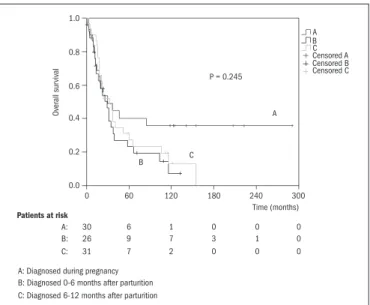
In order to determine whether prognosis was associated with the time at which cancer was diagnosed, the overall survival functions were plotted in relation to three subgroups of PABC patients according to the following models: (i) diagnosis during pregnancy versus diagnosis 0-6 months after parturition versus diagnosis 6-12 months after parturition (Figure 2); and (ii) diagnosis during pregnancy or 0-6 months after par-turition versus diagnosis 6-12 months after parpar-turition (Figure 3). No signiicant diferences were found between these two models, thus indi-cating that the date of diagnosing the cancer in relation to parturition did not signiicantly inluence the prognosis.
DISCUSSION
It became clear during the design phase of this project that mul-tivariate analysis on prognostic factors in a paired-case control study would be a powerful tool through which to evaluate the interde-pendency of the diferent covariables. Hence, following published methodology,6,8,11 the PABC patients were matched with
correspond-ing controls based on the institution of registration, year of registration and patient’s age (± two years). he year of registration was used as the criterion for the purpose of obtaining uniformity regarding the type of
Table 3. Multivariate analysis on the covariables associated with overall survival of patients diagnosed with pregnancy-associated breast cancer (Cox multivariate model)
Covariables Degrees of freedom P* Hazard ratio
Tumor histology 1 0.863 Tumor size 1 < 0.0001 1.62 Distant metastasis 1 < 0.0001 5.08 Grade of malignancy 2 < 0.0001
1 and 2 versus 3 1 0.002 0.54 1 and 2 versus unknown 1 0.226 Hormone receptor status 2 0.162 Positive versus negative 1 0.945 Not determined versus negative 1 0.066
Pregnancy 1 0.011 1.52
Interval between irst symptoms and diagnosis
1 0.207
*Values based on χ2 test (Wald method).
Table 2. Overall survival of pregnancy-associated breast cancer (PABC) and control breast cancer patients
Treatment data Overall survival
Median (months) 95% CI* 5 years (%) 10 years (%) P†
a) Missing/gravely ill data equated to death
Control group 53.1 35.1 - 71.0 47.3 34.8
0.005 PABC group 30.1 19.4 - 40.9 29.7 19.2
b) Missing/gravely ill data equated to censored
Control group 70.1 50.5 - 89.4 52.3 40.3
0.004 PABC group 32.6 21.8 - 43.5 32.8 21.2
*95% conidence interval; †Determined in accordance with Mantel-Cox log rank method.
Patients at risk
PABC group (A): 87 22 10 3 1 0 Control group (B): 252 97 50 14 3 0 0 60 120 180 240 300 1.0
0.8
0.6
0.4
0.2
0.0
P = 0.005
B
A
Ov
erall sur
viv
al
Time (months) B A Censored B Censored A
diagnostic tests, classiication systems and treatment. Indeed, the date of conirmation of diagnosis, as provided by the anatomopathological test, was close to the date of registration at the institution. hus, it was a pre-cise igure that could be obtained from the medical records.
he proportional hazard regression model proposed by Cox is often used when the outcome of an event corresponds to a time interval and when some data are censored. his method is considered valid and is in agreement with more complex methods of analysis, as long as the num-ber of covariables is less than 10% of the numnum-ber of events. Within the population of 339 women studied, the number of death events was 213 (62.8% of the initial population), while the number of covariables was 8. Hence, the level of agreement between the predictable and observable values should be 96.5%.14
In the present study, a pessimistic prognosis for the overall survival of PABC patients, compared with the control patients, was demonstrat-ed. As early as 1943, Haagensen15 had reported that breast carcinoma
that developed during pregnancy or during the lactating phase tended to be so malignant that surgery could not be recommended as part of the therapy. Although the study was based on the outcomes of just 20 patients, all of whom died as a consequence of neoplasia, and despite the author’s subsequent reconsideration of his opinion, the concept of the inoperability of PABC patients prevailed for many years.15
Following a review of 700 PABC cases (some dating back to 1880), White5 concluded that the prognosis for such patients was worse than for
their non-pregnant counterparts and that this was mainly attributable to delayed diagnosis and treatment. Petrek et al.10 used logistic regression
analysis to investigate axillary lymph node involvement and pregnancy as possible predictive factors for the emergence of breast cancer in 56 PABC patients in various stages of the disease. Although these authors found that only axillary lymph node involvement was decisive for the prognosis of the outcome, they reported that delayed diagnosis during pregnancy or postpartum resulted in advanced breast cancer. Delayed diagnosis and treatment, together with a more aggressive condition, were considered by Ishida et al.6 to be responsible for the poor prognosis presented by 192
pa-tients diagnosed with breast cancer during pregnancy or up to two years after parturition, in comparison with 191 non-pregnant and non-lactat-ing breast cancer patients of approximately the same age. hese authors found that the incidence of axillary lymph node involvement and nega-tive hormone receptor status was higher amongst pregnant and lactating women than among controls, although the lack of multivariate analysis precluded determining the relative contribution of each of these factors. A recent study conducted by Rodriguez et al.,9 involving 797 PABC
pa-tients and 4,177 controls, concluded that pregnancy signiicantly (P = 0.046) worsened the prognosis for breast cancer, even when other factors were taken into consideration.
Most investigations concerned with the overall survival of PABC patients have concluded that the prognosis for such patients is more pes-simistic than for non-pregnant patients. One simple explanation for this is that pregnancy is characterized by increased estrogen concentration in the body, which is a well-known breast cancer-promoting factor. Other explanations relate to causes that are not so obvious. A randomized pro-spective clinical experiment would clarify this matter, since the
inlu-ence of unknown confounding factors would be normalized. However, since such an experiment would be impracticable, case-control studies are the best available evaluation method.
A number of case-control studies on PABC patients have been pub-lished over the last decade or so. Bonnier et al.8 studied 154 PABC patients
who were diagnosed with cancer either during pregnancy or no more than six months after parturition, and 308 control patients with breast can-cer that was not associated with pregnancy or the postpartum period, all of whom had been registered in 23 French institutions during the period
Patients at risk
30 6 1 0 0 0
26 A: B: C:
A: Diagnosed during pregnancy B: Diagnosed 0-6 months after parturition C: Diagnosed 6-12 months after parturition
9 7 3 1 0
31 7 2 0 0 0
0 60 120 180 240 300
1.0
0.8
0.6
0.4
0.2
0.0
P = 0.245
B C
A B C A
Censored A
Censored C Censored B
Ov
erall sur
viv
al
Time (months)
Figure 2. Kaplan-Meier overall survival functions for pregnancy-associated breast cancer (PABC) patients diagnosed during pregnancy (trace A), diagnosed 0-6 months after parturition/abortion (trace B) and diagnosed 6-12 months after parturition/abortion (trace C). Median values: (A) 29.17 months (95% conidence interval, CI = 14.47-43.86); (B) 30.13 months (95% CI = 4.69-55.57); (C) 32.63 months (95% CI = 14.52-50.74).
Patients at risk
56 15 8 3 1 0
31 A: B:
A: Diagnosed 0-6 months after parturition B: Diagnosed 6-12 months after parturition
7 2 0 0 0
0 60 120 180 240 300
1.0
0.8
0.6
0.4
0.2
0.0
P = 0.739
B
A
B A
Censored A Censored B
Ov
erall sur
viv
al
Time (months)
1960-1993. he PABC group was matched to the control group in the proportions of 1:2, according to age and date of commencing the treat-ment. Multivariate analysis (using the Cox regression method) revealed that tumor size (≤ 3.0 cm versus > 3.0 cm), axillary lymph node involve-ment (0 versus 1-3 versus ≥ 4) and age (≤ 33 years versus > 33 years) each exerted an independent and signiicant inluence on overall survival and on the emergence of metastasis. In contrast, Ibrahim et al.11 investigated 72
PABC patients together with their matching controls (216 non-pregnant women in the same condition), who were selected according to disease stage, year of diagnosis and age. Only disease stage was identiied as signii-cant with regard to overall survival according to the Cox model.
In the present study, the independent inluence of the covariables of interval between irst symptoms and diagnosis, tumor histology, size of primary tumor, distant metastasis, grade of malignancy, hor-mone receptor status and axillary lymph node involvement and the in-luence of the pregnancy variable on the patients’ overall survival were investigated. Overall survival was independently associated with pri-mary tumor size, grade of malignancy, distant metastasis and pregnan-cy. he interval between irst symptoms and diagnosis and the interval between diagnosis and irst treatment had no signiicant inluence on the prognosis, and hence, the hypothesis that delayed diagnosis and treatment is a cause of pessimistic prognosis could not be conirmed.
Some authors have attributed the pessimistic prognosis for PABC women to the diiculties in diagnosing cancer in this group of patients.5,10
In fact, the diagnosis of breast cancer in patients younger than 40 years is more diicult because of the characteristics of mammary tissue at this age.16 Additionally, in spite of the dissimilar criteria used for patient
selec-tion and the somewhat conlicting results, a number of reports6,8,11 have
suggested that the interval between cancer diagnosis and partum could be an important factor for prognosis and overall survival. hus, on the basis of a retrospective study involving 407 women aged 20-29 years who were diagnosed with cancer during pregnancy or with a history of pregnancy (no limitation of time) prior to diagnosis, Guinee et al.7 proposed that the
shorter the interval between pregnancy and the diagnosing of cancer was, the more negative the prognosis would be. Moreover, following a popula-tion-based study involving 4,299 women (20-54 years old) who had been diagnosed with breast cancer, Whiteman et al.17 also concluded that the
shorter the interval between diagnosing the cancer and the last partum was, the worse the prognosis of the disease was.
However, the indings reported in the present paper do not sup-port this hypothesis, as can be seen from Figures 2 and3. In contrast to the earlier investigation, the present study included only patients whose pregnancy occurred up to a maximum of 12 months prior to diagnos-ing the cancer. Perhaps the diference between the results from these two groups was not large enough to be detected by the tests used. For this reason, no unambiguous conclusion can be drawn from the present re-sults regarding this point.
CONCLUSIONS
Since many of the studies conducted so far have reported divergent results, it is clear that the factors associated with the overall survival and
prognosis for PABC patients require further investigation. However, it may be concluded from the present study that the overall survival of PABC patients is signiicantly lower than for other patients sufering from breast cancer, and that pregnancy is a factor associated with a pes-simistic prognosis, independent of other concomitant factors.
REFERENCES
1. Moore HC, Foster RS. Breast cancer and pregnancy. Semin Oncol. 2000;27(6):646-53. 2. Molckovsky A, Madarnas Y. Breast cancer in pregnancy: a literature review. Breast Cancer
Res Treat. 2008;108(3):333-8.
3. DiFronzo LA, O’Connell TX. Breast cancer in pregnancy and lactation. Surg Clin North Am. 1996;76(2):267-78.
4. Nettleton J, Long J, Kuban D, et al. Breast cancer during pregnancy: quantifying the risk of treatment delay. Obstet Gynecol. 1996;87(3):414-8.
5. White TT. Carcinoma of the breast and pregnancy; analysis of 920 cases collected from the literature and 22 new cases. Ann Surg. 1954;139(1):9-18.
6. Ishida T, Yokoe T, Kasumi F, et al. Clinicopathologic characteristics and prognosis of breast cancer patients associated with pregnancy and lactation: analysis of case-control study in Japan. Jpn J Cancer Res. 1992;83(11):1143-9.
7. Guinee VF, Olsson H, Möller T, et al. Effect of pregnancy on prognosis for young women with breast cancer. Lancet. 1994;343(8913):1587-9.
8. Bonnier P, Romain S, Dilhuydy JM, et al. Inluence of pregnancy on the outcome of breast cancer: a case-control study. Societe Francaise de Senologie et de Pathologie Mammaire Study Group. Int J Cancer. 1997;72(5):720-7.
9. Rodriguez AO, Chew H, Cress R, et al. Evidence of poorer survival in pregnancy-associated breast cancer. Obstet Gynecol. 2008;112(1):71-8.
10. Petrek JA, Dukoff R, Rogatko A. Prognosis of pregnancy-associated breast cancer. Cancer. 1991;67(4):869-72.
11. Ibrahim EM, Ezzat AA, Baloush A, Hussain ZH, Mohammed GH. Pregnancy-associated breast cancer: a case-control study in a young population with a high-fertility rate. Med Oncol. 2000;17(4):293-300.
12. Cohen J. Power tables. In: Cohen J. Statistical power analysis for the behavioral sciences. 2nd
edition. Hillsdale: Lawrence Erlbaum Associates; 1988. p. 227-52.
13. George SL. Identiication and assessment of prognostic factors. Semin Oncol. 1988;15(5):462-71.
14. Harrel FE, Lee KL, Matchar DB, Reichert TA. Regression models for prognostic predic-tion: advantages, problems, and suggested solutions. Cancer Treat Rep. 1985;69(10): 1071-7.
15. Haagensen CD. Results with Halsted’s radical mastectomy. In: Haagensen CD, editor. Disea-ses of the breast. 3rd edition. Philadelphia: WB Saunders; 1986. p. 924-5.
16. Kroman N, Mouridsen HT. Prognostic inluence of pregnancy before, around, and after diag-nosis of breast cancer. Breast. 2003;12(6):516-21.
17. Whiteman MK, Hillis SD, Curtiss KM, et al. Reproductive history and mortality after breast cancer diagnosis. Obstet Gynecol. 2004;104(1):146-54.
Acknowledgements: The authors wish to express their thanks to Dr. Sebastião Cabral Fi-lho, Director of the Clinical Oncology Service and the Centro de Quimioterapia Antiblástica e Imunoterapia (CQAI), for granting permission to access hospital medical records
Sources of funding: None
Conlicts of interest: None
Date of irst submission: June 30, 2008
Last received: May 6, 2010
Accepted: May 10, 2010
Address for correspondence: Wagner Brant Moreira
Centro de Quimioterapia Antiblástica e Imunoterapia Rua Dr. Antônio Mourão Guimarães, 30
Cachoeirinha — Belo Horizonte (MG) — Brasil CEP 31130-110