Rev Odontol UNESP. 2015 Nov-Dec; 44(6): 326-334 © 2015 - ISSN 1807-2577
ORIGINAL ARTICLE
Doi: http://dx.doi.org/10.1590/1807-2577.07214
Can more resilient elderly people be more satisied with
dental services?
Idosos com maior potencial de resiliência podem estar mais satisfeitos com os serviços odontológicos?
Matheus NEVES
a, Aline Blaya MARTINS
b, Otávio Pereira D’ÁVILA
b,
Juliana Balbinot HILGERT
b, Fernando Neves HUGO
b*
aULBRA – Universidade Luterana do Brasil, Canoas, RS, Brasil
bUFRGS – Universidade Federal do Rio Grande do Sul, Porto Alegre, RS, Brasil
Resumo
Introdução: No que diz respeito aos Serviços de Saúde Bucal, poucos estudos têm sido desenvolvidos na ambição de conhecer a satisfação deste grupo etário com tais serviços. Objetivo: Investigar a associação entre a resiliência e satisfação com serviços odontológicos entre os idosos, por meio de um modelo ajustado para fatores de confusão.
Material e método: O lócus da pesquisa foi Lomba-Partenon, em Porto Alegre – RS, onde 771 idosos foram identificados em seus domicílios por meio de amostragem por conglomerado. Os indivíduos responderam a um questionário sócio-demográfico e de comportamentos em saúde, à Escala de Resiliência e a questões relativas ao Serviço Odontológico acessado e à satisfação com o mesmo; além disso, foi realizado um breve exame bucal para
contagem do número de dentes e identificação do uso de prótese dentária. Resultado: Baseado em uma abordagem
hierárquica realizada através de Regressão Logística Multivariada, as odds ratios estimadas das variáveis que ficaram significativamente associadas com o desfecho em estudo, satisfação com o Serviço Odontológico, após a análise totalmente ajustada, foram: 1) obtenção de consulta odontológica classificada como regular: OR= 1,85, 95% IC (1,10 a 3,12); 2) obtenção de consulta odontológica classificada como ruim: OR= 2,17, 95% IC (1,05 a 4,50) e 3) alto potencial de resiliência: OR= 0,60, 95% IC (0,37 a 0,97). Conclusão: Os resultados confirmam a hipótese de associação entre elevado potencial de resiliência e satisfação com os Serviços Odontológicos acessados por idosos.
Descritores: Avaliação de serviços de saúde; resiliência psicológica; assistência odontológica para idosos; saúde do idoso; satisfação do paciente.
Abstract
Introduction: With respect to dental health services, few studies have been developed to understand the satisfaction of this age group with these services. Objective: To investigate the association between resilience and satisfaction with dental services among elderly people, using a model adjusted for confounding factors. Material and method: The locus of the research was the Lomba-Parthenon district management, in Porto Alegre, Rio Grande do Sul, Brazil. 771 elderly people living in their homes were identified through cluster sampling. The subjects responded to a socio-demographic and health behaviors questionnaire, the Resilience Scale and to questions regarding their satisfaction with dental care accessed. Furthermore, a brief oral examination was conducted to count the number of teeth and to identify the use of dental prostheses. Result: Based on a hierarchical approach conducted using Multivariate Logistic Regression and after fully adjusted analysis, the estimated odds ratios of the variables that were significantly associated with the outcome of this study, satisfaction with dental care, were: 1) obtaining a dental appointment, classified as regular: OR= 1.85, 95% CI (1.10 to 3.12); 2) obtaining a dental appointment, classified as bad: OR= 2.17, 95% CI (1.05 to 4.50); and, 3) high potential for resilience: OR= 0.60, 95% CI (0.37 to 0.97). Conclusion: The results confirm the hypothesis of an association between high potential for resilience and satisfaction with the Dental Services accessed by elderly people.
INTRODUCTION
Low fertility rates and the ongoing decrease in mortality have triggered structural changes in the Brazilian population pyramid. Additionally, improvements in health conditions have favored population longevity1. Consequently, the result of such demographic
changes is an important growth in demand for social and health services2.
Moreover, psychological factors, mainly resilience, may be involved both in the process of aging well and in the perception of satisfaction with dental services, since resilience has been associated with life satisfaction, handling of stress, low depression levels, better health and health-promoting behaviors3.
Given this particular demographic, epidemiological, and social scenario, there are elderly individuals with unattended dental health needs, impaired access to dental services and a heritage of excluding and crippling dental practices2. herefore, it is necessary not only
to provide health awareness services but to guarantee access to dental care to this age group and, also, to learn the satisfaction of these individuals with dental services accessed.
hus, incorporating the user into the evaluation process must be considered, not only to construct a sensible quality indicator of services provided but also to include the individual aspects related to satisfaction with this process. his leads to more appropriate use of the service and to its social acceptance4. herefore, it is
urgent to turn to psychological aspects such as resilience when interpreting user satisfaction so as to describe health services from the perspective of users. his is especially true concerning elderly people, who are the target audience for a series of reorientations that the Primary Health Care undergoes.
his study aims to investigate the association between resilience and satisfaction with dental services, using a model adjusted for confounders, among elderly people from the city of Porto Alegre, Rio Grande do Sul, Brazil.
MATERIAL AND METHOD
he study was conducted in Lomba do Pinheiro and Partenon. According to the 2010 Census of IBGE (Brazilian Institute of Geography and Statistics), the population of Porto Alegre is 1,409,939, with 211,986 people who are 60 or older. In the districts where this research was conducted, the estimated population aged 60 or older is 12,8715.
he study was developed following evaluation and approval by the Research Ethics Committee of the School of Dentistry of UFRGS according to Resolution 466/12 of the CNS (National Health Council), which demands that the Statement of Free and Informed Consent be obtained from subjects involved in the research.
his is a cross-sectional, population-based study. Cluster sampling was performed by the random selection of 61 out of 240 census tracts from the Lomba do Pinheiro and Partenon health districts. he number of census tracts was drawn in proportion to the size of population coverage area of each Health Unit in the districts, based on the criteria used in the IBGE census5,6.
Initially, a pilot study was performed with 50 elderly people in order to estimate the sample size. From this pilot study, a prevalence of 57% of high resilience potential and satisfaction with dental health service was found. he prevalence ratio of satisied elderly was 1.32. he sample size was estimated at 398 individuals considering a conidence interval of 95%, admitting a β error of 20%, and consequent statistical power of 80%. here was an additional 10% for possible losses or refusals, and 15% for control of confounding factors. Due to the lack of accurate estimates, to minimize the outlining efect which occurs in cluster sampling, the sample was increased 1.5x in order to perform the adjusted analysis. hen, from the pilot study, the sample was estimated at 755 subjects.
Cluster Sampling Process
Once the sample size was estimated, the ieldwork began, 804 elderly people were invited to join this cross-sectional study. Of those, 10 refused to participate and 794 consented to answer the Mini Mental State Exam – MMSE7. 23 individuals presented
cognitive impairment and were excluded. he inal sample totaled 771 elderly people.
he inclusion criteria for this research were: being 60 or older and living independently within the community.
Data collection was performed through individual interviews, carried out by trained interviewers from the Research Center in Social Dentistry of the School of Dentistry of UFRGS (CPOS/UFRGS), in the homes of the elderly people, according to the above mentioned inclusion criteria.
Measures
Mini mental state exam
he MMSE7 with 30 items was used to evaluate the presence or
absence of cognitive impairments, setting the exclusion criterion adopted in this study. he MMSE uses cutof points related to schooling for the generic diagnosis of “cognitive decline”. he cutof points suggested in the literature7,8 and adopted as exclusion
criteria in the present study were: 13 for illiterates, 18 for basic school (1 to 8 years of study) and 26 for high school (9 years of study or more).
Socio-demographic questionnaire
Socio-demographic data included in the individual questionnaire were: age, gender, skin color, schooling, family income, social support, and smoking habit.
Age was collected from the birth date provided by the individual at the time of the interview. A continuous variable was used for statistical analysis.
Skin color was collected from the self-declaration criterion proposed by IBGE5. he options (white, black, yellow, brown, and
Schooling was collected by adding the years of study completed without failure. It was classiied as “illiterate” (0 years of study), “1 to 8 years of study” or “more than 8 years of study”.
Family income was collected according to the answered value and the following categories were established a posteriori: “0 to 1000 Reais”, “1001 to 1500 Reais”, “1501 to 3000 Reais”, and “more than 3001 Reais”, based on the distribution of sampling data.
Smoking Habit was collected from the answer provided to the question: “Do you currently smoke cigarettes?” he subject could answer either positively or negatively.
Questionnaire on the search for dental care
his instrument included questions on the search for dental care, the type of oral health service accessed, and obtaining an appointment in the referred location.
he following question was used to investigate the search for dental care: “Which statement best describes your search for dental care?” he possible answers were: “I never go to the dentist”, “I go to the dentist when I have a problem or when I know something needs to be ixed”, “I occasionally go to the dentist whether I have a problem or not” and “I regularly go to the dentist”. For analysis, the answers were reclassiied as: “Never goes to the dentist”, “Visits prompted by problems” or “Occasional/Regular visits”.
For the variable type of oral health service accessed, the location of the last dental treatment was classiied as: “public health service”, “health insurance” or “private health service”. his variable was investigated by the question: “Is there a health service you usually use in case of disease or for health advise?”
Lastly, obtaining a dental appointment in the referred health service was investigated by the question: “How do you classify obtaining a dental appointment when you need one?” he answers ranged from poor, regular, good, very good, and excellent. he answers were reclassiied for analysis as: poor, regular and good/very good.
Questionnaire on oral health services evaluation
his questionnaire evaluated satisfaction with oral health services with the question: “How satisied were you with this treatment?”, referring to the last dental treatment accessed by the elderly people. he possible answers were: 1. Very satisied, 2. Satisied, 3. Neither unsatisied nor satisied, 4. Unsatisied and 5. Very unsatisied. For statistical analysis, the answers were dichotomized as “Satisied with Dental Service” or “Unsatisied with Dental Service”.
Resilience Scale - RS
his scale was developed by Wagnild, Young9 in 1993 and was
validated in Brazilian Portuguese by Pesce et al.10 in 2005. his scale
includes 25 items positively described with 4-point Likert-type answers, ranging from “fully disagree” (1) to “fully agree” (4). he scores of the scale range from 25 to 175 points, with high values indicating elevated resilience potential.
he RS was used in this research in order to evaluate individual resilience potential, considering positive personality traits that identify the capacity for individual adaptation9,10.
For statistical analysis, the resilience scores were dichotomized as: “low resilience potential”, which included scores in the range from 25 to 145 points; or, “high resilience scores”, which included scores in the range from 146 to 175 points11.
Oral health conditions exam
his exam evaluated the number of teeth present, the presence of alteration in oral sot tissues and prosthetic condition. he exams were performed according to criteria indicated by the WHO12.
he number of teeth was classiied considering the reduced dental arch, made by at least 20 teeth that were functionally acceptable13. he categories used were: “edentulous”, “1 to 19 teeth”
and “20 or more teeth”.
Regarding the alterations in oral sot tissues, the exam classiied either “presence” or “absence” of alterations from normality.
Lastly, the prosthetic conditions of the upper and lower arches were classiied in the following categories: “without prosthesis”, “ixed and/or removable prosthesis” or “total prosthesis”.
Outcome
he outcome was evaluated by the variable “How satisied were you with this treatment?”. his refers to the question linked to the Health Service, to which possible answers were: 1. Very satisied, 2. Satisied, 3. Neither unsatisied nor satisied, 4. Unsatisied and 5. Very unsatisied. For statistical analysis, the answers were dichotomized as “Satisied with Dental Service” which included the categories: 1. Very Satisied and 2. Satisied; or, “Unsatisied with Dental Service” which included the categories: 3. Neither unsatisied nor satisied, 4. Unsatisied and 5. Very unsatisied.
Conceptual heoretical Model of Oral Health
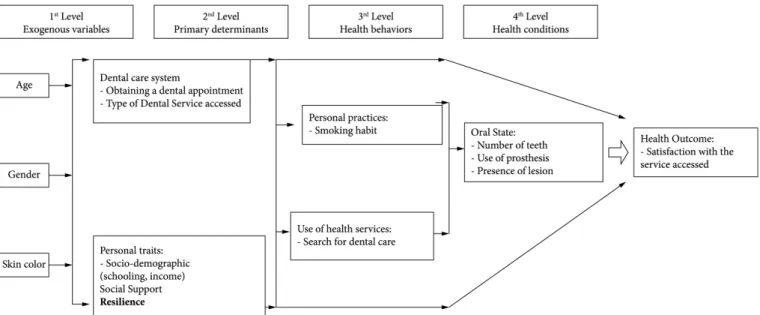
he hierarchical model created for this study is based on the conceptual structure proposed by Andersen, Davidson14 to explain
Oral Health outcomes presents exogenous and distal variables to outcome, in the irst block. he second block includes the primary determinants. In the third block, independent variables regarding oral health behaviors are found. Proximal variables to outcome, such as oral health conditions constitute the fourth block.
According to this hierarchical model, the outcome of satisfaction with dental services results from a complex process. he resilience efect, on multiple factors that may inluence the satisfaction of elderly people with oral health services, is highlighted (Figure 1).
Statistical Analysis
Continuous and discrete variables were described by average and respective standard deviation. Chi-square tests and evaluation of the distribution of categorical variables regarding the study outcome were performed.
he inal model included only variables that maintained a statistically signiicant association (p<0.20)15 in backward analysis.
he magnitudes of the associations between dependent and independent variables in the fully adjusted model were estimated by odds ratios with a signiicance level of 5% and conidence intervals of 95% (Figure 1). All analyses were performed using the SPSS 18.0 (SPSS Inc., USA) sotware.
RESULT
Among the 771 elderly people included in the sample, the average number of years of schooling was 5.9 (±3.8) ater reaching the MMSE9 cutof point. he average MMSE score was 25.7 (±3.7).
Features of the sample were as follows: average sample age, 69.8 (±7.3) years; 516 women (66.8%) and 256 men (33.2%). Regarding schooling, 63 individuals were illiterate (8.2%), 493 had studied from 1 to 8 years (64.6%), and 208 had studied for more than 9 years (27.2%). A great part of the sample was self-declared as having white skin (63.9%). Concerning income, 78 subjects (10.4%) reported family income up to one minimum wage. As for the type of dental service accessed, 13.7% of participants used public service, 60.9% had health insurance and 25.4% accessed private dental services. Most individuals participating in the study (58.3%) reported that the search for dental care was prompted by problems. Lastly, 420 participants (54.4%) had high resilience potential, since 146.5 (±13.25) is the mean resilience score.
he Cronbach’s α Coeicient, calculated to assess the reliability of the RS, was 0.75.
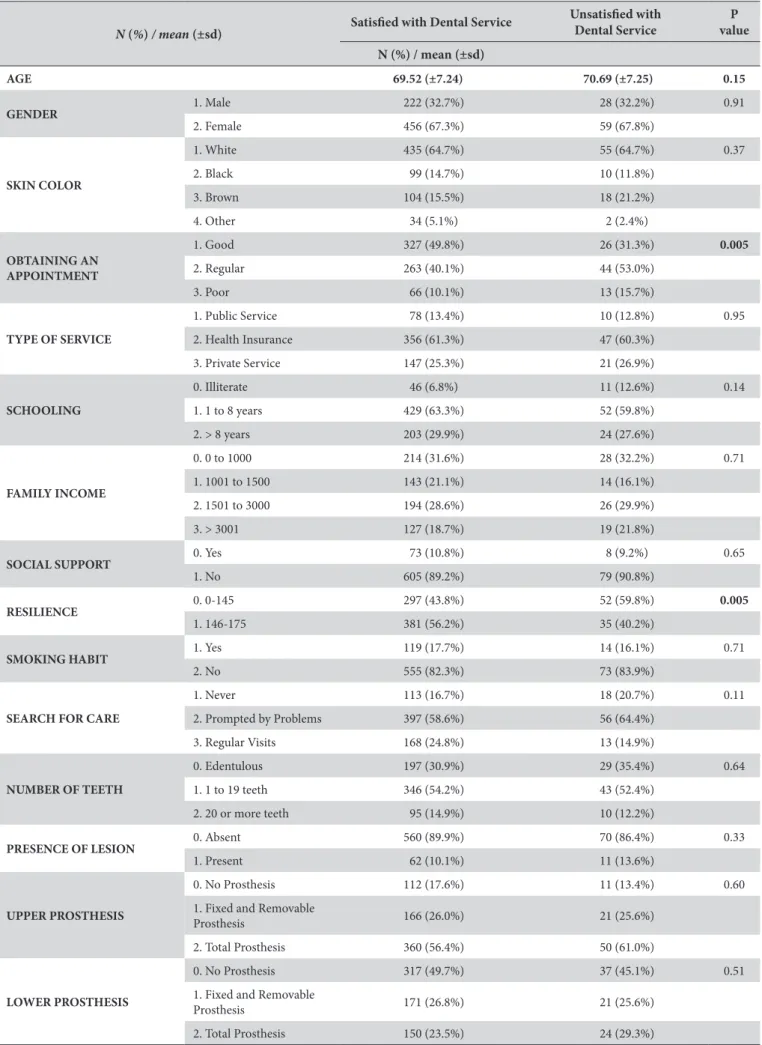
he frequencies of the study variables, regarding the outcome of satisfaction with dental services, are shown in Table 1. Obtaining a dental appointment and resilience were the statistically signiicant variables (P<0.05) relating to the outcome of satisfaction with dental services.
Results of the hierarchical analysis:
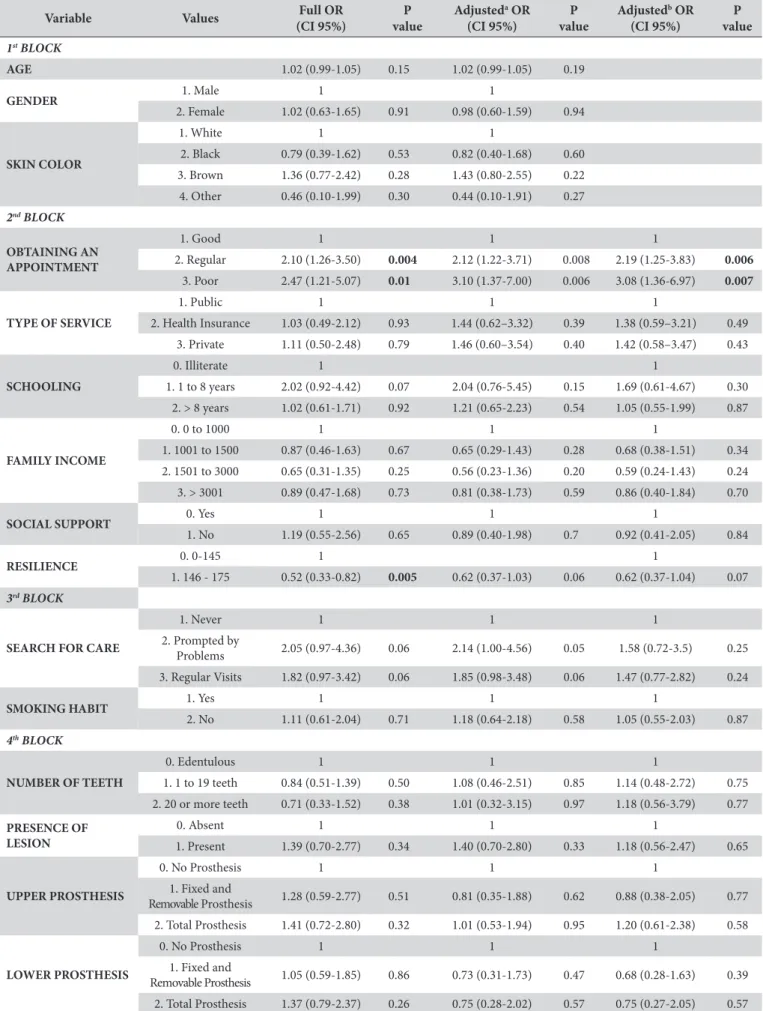
1st Block (Table 2)
here was no statistically signiicant association between the outcome and the variables composing this block, such as: age, gender, and skin color.
2nd Block (Table 2)
here was a statistically signiicant association between the diiculty of obtaining a dental appointment and the outcome (regular, p = 0.004; poor, p = 0.01).
he high resilience potential category also presented a statistically signiicant association with the outcome variable. his association was stronger when adjusted within the block (p = 0.005), and was lost when the adjustment was performed between blocks blocks (p = 0.06 and 0.07).
3rd Block (Table 2)
he variable of search for dental care when “prompted by
problems” was signiicantly associated with the outcome (p = 0.04).
On the other hand, the variable of smoking habit did not have a statistically signiicant association with the outcome in any of the adjustments.
4th Block (Table 2)
he variables of this block, number of teeth, presence of mucosal lesion and use of prosthesis did not present signiicant associations with the outcome.
Fully Adjusted Model (Table 3)
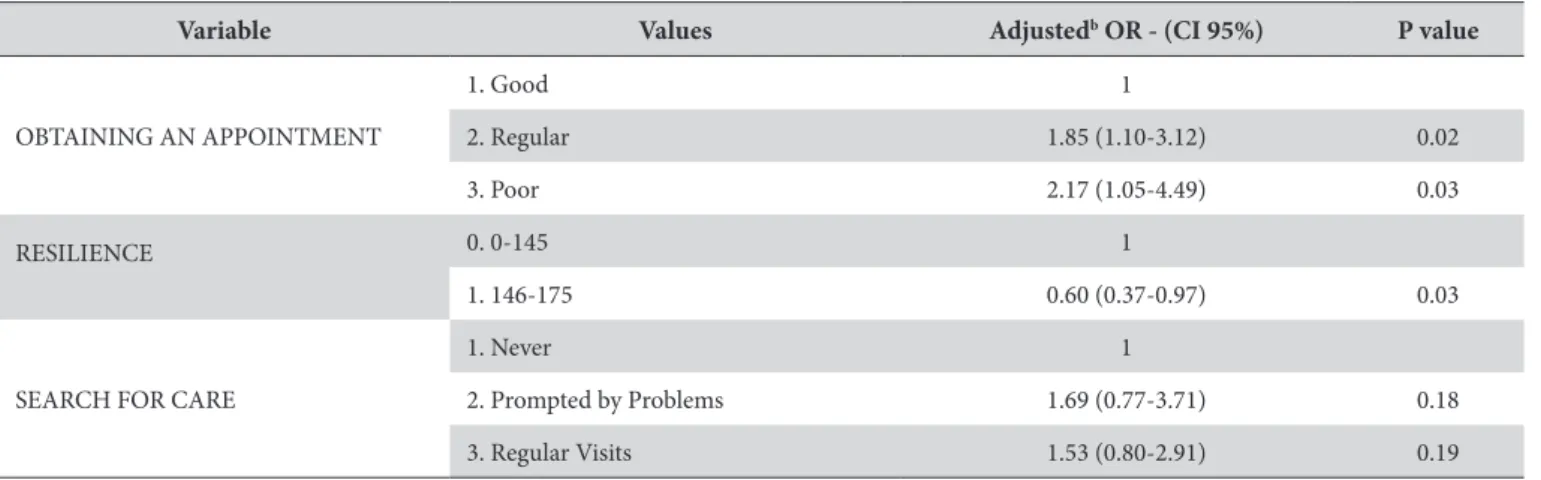
In the fully adjusted model (Table 3), the variable of obtaining a dental appointment in the categories “regular” (OR = 1.85, CI (1.10 to 3.12) and p = 0.02), “poor” (OR = 2.17, CI (1.05 to 4.50) and p = 0.03), and the variable of high resilience potential (OR = 0.60, CI (0.37 to 0.97 and p = 0.03) maintained their signiicant association with the outcome.
Table 1. Frequency distribution of predicting variables regarding satisfaction with Dental Service
N (%) / mean(±sd) Satisied with Dental Service
Unsatisied with Dental Service
P value
N (%) / mean (±sd)
AGE 69.52 (±7.24) 70.69 (±7.25) 0.15
GENDER 1. Male 222 (32.7%) 28 (32.2%) 0.91
2. Female 456 (67.3%) 59 (67.8%)
SKIN COLOR
1. White 435 (64.7%) 55 (64.7%) 0.37
2. Black 99 (14.7%) 10 (11.8%)
3. Brown 104 (15.5%) 18 (21.2%)
4. Other 34 (5.1%) 2 (2.4%)
OBTAINING AN APPOINTMENT
1. Good 327 (49.8%) 26 (31.3%) 0.005
2. Regular 263 (40.1%) 44 (53.0%)
3. Poor 66 (10.1%) 13 (15.7%)
TYPE OF SERVICE
1. Public Service 78 (13.4%) 10 (12.8%) 0.95
2. Health Insurance 356 (61.3%) 47 (60.3%)
3. Private Service 147 (25.3%) 21 (26.9%)
SCHOOLING
0. Illiterate 46 (6.8%) 11 (12.6%) 0.14
1. 1 to 8 years 429 (63.3%) 52 (59.8%)
2. > 8 years 203 (29.9%) 24 (27.6%)
FAMILY INCOME
0. 0 to 1000 214 (31.6%) 28 (32.2%) 0.71
1. 1001 to 1500 143 (21.1%) 14 (16.1%)
2. 1501 to 3000 194 (28.6%) 26 (29.9%)
3. > 3001 127 (18.7%) 19 (21.8%)
SOCIAL SUPPORT 0. Yes 73 (10.8%) 8 (9.2%) 0.65
1. No 605 (89.2%) 79 (90.8%)
RESILIENCE 0. 0-145 297 (43.8%) 52 (59.8%) 0.005
1. 146-175 381 (56.2%) 35 (40.2%)
SMOKING HABIT 1. Yes 119 (17.7%) 14 (16.1%) 0.71
2. No 555 (82.3%) 73 (83.9%)
SEARCH FOR CARE
1. Never 113 (16.7%) 18 (20.7%) 0.11
2. Prompted by Problems 397 (58.6%) 56 (64.4%)
3. Regular Visits 168 (24.8%) 13 (14.9%)
NUMBER OF TEETH
0. Edentulous 197 (30.9%) 29 (35.4%) 0.64
1. 1 to 19 teeth 346 (54.2%) 43 (52.4%)
2. 20 or more teeth 95 (14.9%) 10 (12.2%)
PRESENCE OF LESION 0. Absent 560 (89.9%) 70 (86.4%) 0.33
1. Present 62 (10.1%) 11 (13.6%)
UPPER PROSTHESIS
0. No Prosthesis 112 (17.6%) 11 (13.4%) 0.60
1. Fixed and Removable
Prosthesis 166 (26.0%) 21 (25.6%)
2. Total Prosthesis 360 (56.4%) 50 (61.0%)
LOWER PROSTHESIS
0. No Prosthesis 317 (49.7%) 37 (45.1%) 0.51
1. Fixed and Removable
Prosthesis 171 (26.8%) 21 (25.6%)
Table 2. Association between variables and the outcome of Satisfaction with Dental Services
Variable Values Full OR
(CI 95%)
P value
Adjusteda OR
(CI 95%)
P value
Adjustedb OR
(CI 95%)
P value
1st BLOCK
AGE 1.02 (0.99-1.05) 0.15 1.02 (0.99-1.05) 0.19
GENDER 1. Male 1 1
2. Female 1.02 (0.63-1.65) 0.91 0.98 (0.60-1.59) 0.94
SKIN COLOR
1. White 1 1
2. Black 0.79 (0.39-1.62) 0.53 0.82 (0.40-1.68) 0.60
3. Brown 1.36 (0.77-2.42) 0.28 1.43 (0.80-2.55) 0.22
4. Other 0.46 (0.10-1.99) 0.30 0.44 (0.10-1.91) 0.27
2nd BLOCK
OBTAINING AN APPOINTMENT
1. Good 1 1 1
2. Regular 2.10 (1.26-3.50) 0.004 2.12 (1.22-3.71) 0.008 2.19 (1.25-3.83) 0.006
3. Poor 2.47 (1.21-5.07) 0.01 3.10 (1.37-7.00) 0.006 3.08 (1.36-6.97) 0.007
TYPE OF SERVICE
1. Public 1 1 1
2. Health Insurance 1.03 (0.49-2.12) 0.93 1.44 (0.62–3.32) 0.39 1.38 (0.59–3.21) 0.49
3. Private 1.11 (0.50-2.48) 0.79 1.46 (0.60–3.54) 0.40 1.42 (0.58–3.47) 0.43
SCHOOLING
0. Illiterate 1 1
1. 1 to 8 years 2.02 (0.92-4.42) 0.07 2.04 (0.76-5.45) 0.15 1.69 (0.61-4.67) 0.30 2. > 8 years 1.02 (0.61-1.71) 0.92 1.21 (0.65-2.23) 0.54 1.05 (0.55-1.99) 0.87
FAMILY INCOME
0. 0 to 1000 1 1 1
1. 1001 to 1500 0.87 (0.46-1.63) 0.67 0.65 (0.29-1.43) 0.28 0.68 (0.38-1.51) 0.34 2. 1501 to 3000 0.65 (0.31-1.35) 0.25 0.56 (0.23-1.36) 0.20 0.59 (0.24-1.43) 0.24 3. > 3001 0.89 (0.47-1.68) 0.73 0.81 (0.38-1.73) 0.59 0.86 (0.40-1.84) 0.70
SOCIAL SUPPORT 0. Yes 1 1 1
1. No 1.19 (0.55-2.56) 0.65 0.89 (0.40-1.98) 0.7 0.92 (0.41-2.05) 0.84
RESILIENCE 0. 0-145 1 1
1. 146 - 175 0.52 (0.33-0.82) 0.005 0.62 (0.37-1.03) 0.06 0.62 (0.37-1.04) 0.07
3rd BLOCK
SEARCH FOR CARE
1. Never 1 1 1
2. Prompted by
Problems 2.05 (0.97-4.36) 0.06 2.14 (1.00-4.56) 0.05 1.58 (0.72-3.5) 0.25
3. Regular Visits 1.82 (0.97-3.42) 0.06 1.85 (0.98-3.48) 0.06 1.47 (0.77-2.82) 0.24
SMOKING HABIT 1. Yes 1 1 1
2. No 1.11 (0.61-2.04) 0.71 1.18 (0.64-2.18) 0.58 1.05 (0.55-2.03) 0.87
4th BLOCK
NUMBER OF TEETH
0. Edentulous 1 1 1
1. 1 to 19 teeth 0.84 (0.51-1.39) 0.50 1.08 (0.46-2.51) 0.85 1.14 (0.48-2.72) 0.75 2. 20 or more teeth 0.71 (0.33-1.52) 0.38 1.01 (0.32-3.15) 0.97 1.18 (0.56-3.79) 0.77
PRESENCE OF LESION
0. Absent 1 1 1
1. Present 1.39 (0.70-2.77) 0.34 1.40 (0.70-2.80) 0.33 1.18 (0.56-2.47) 0.65
UPPER PROSTHESIS
0. No Prosthesis 1 1 1
1. Fixed and
Removable Prosthesis 1.28 (0.59-2.77) 0.51 0.81 (0.35-1.88) 0.62 0.88 (0.38-2.05) 0.77 2. Total Prosthesis 1.41 (0.72-2.80) 0.32 1.01 (0.53-1.94) 0.95 1.20 (0.61-2.38) 0.58
LOWER PROSTHESIS
0. No Prosthesis 1 1 1
1. Fixed and
Removable Prosthesis 1.05 (0.59-1.85) 0.86 0.73 (0.31-1.73) 0.47 0.68 (0.28-1.63) 0.39 2. Total Prosthesis 1.37 (0.79-2.37) 0.26 0.75 (0.28-2.02) 0.57 0.75 (0.27-2.05) 0.57
DISCUSSION
User satisfaction is an important element in the evaluation of health services. he results of this study suggest that satisfaction with dental services is inluenced by some of the variables investigated. For example, the hypothesis was conirmed that psychological factors, namely resilience, are associated with satisfaction with dental services used by the elderly, even when other variables are considered. Hence, resilience is understood to enhance the adaptive capacity of elderly people to dental services accessed16.
By showing the association among getting a dental appointment, resilience and satisfaction with dental services accessed, the original purpose of this study is reinforced, because there are no studies found in several publications on user satisfaction with health services that investigate psychological attributes to explain the satisfaction reported by individuals.
An important point to be stressed, among the indings of this study, is the high resilience potential found in the sample. Fortes et al.16 found an increased resilience potential in elderly
people which allows successful aging.
Resilience assumes the dynamic interaction of several factors16.
his concept strengthens the hypothesis conirmed by this study considering that, during the analysis, high resilience potential presented a statistically signiicant association in diferent strengths when considering other variables. his inding agrees with the observations by Martins et al.17, who found an increasing statistical
association as a greater number of variables were included in an analytical model. Hence, it is possible that resilience is one of the factors capable of explaining the paradox that the elderly are satisied with dental services, even when facing limitations in accessing dental treatment and having poor oral health conditions.
In fact, empirical data show a peculiar fact about the universality of access to dental care by elderly people. Studies show that older people have diiculty accessing Primary Health Care, and such access falls dramatically when it comes to oral health18. It is also
necessary to discuss the guarantee of comprehensive care for elderly people, given the fact that many of them access medical care through private health insurance, but face barriers in access to oral health in the public service.
his study found independent associations between satisfaction with dental services and those variables distributed in the primary determinants block (obtaining a dental appointment and resilience potential) and in the health behaviors block (search for dental care), although the latter was not statistically associated with the outcome. he remaining variables were incorporated into the inal model analysis. Such associations demonstrate that those variables more distal to the outcome are possibly more relevant to satisfaction with dental services than the dental clinical variables19.
he associations mentioned above difer from a previous study, which shows associations between the dental clinical variables of need for dental care and user satisfaction20. Although disagreeing
with previous literature, this study includes variables more distal to the outcome, such as resilience. his develops the previous scientiic evidence and suggests that other variables are important in building user satisfaction with dental service accessed.
Regarding obtaining a dental appointment, it is important to stress that the respondents who classiied it as either “regular” or “poor” were more oten unsatisied with dental services accessed. his inding demonstrates the importance of the access to dental services on their perception of satisfaction20,21.
Tuominen, Tuominen22 observed that dentate elderly people were
signiicantly more satisied than edentulous ones. For both dentate and edentulous elderly people, the accessibility to and availability of services were more inluential on their satisfaction with dental services. Contrary to this inding, there was no association between the number of teeth and satisfaction. However, we also veriied an association between availability of services and obtaining an appointment with satisfaction.
herefore, the approach and indings of this study agree with with a review of studies on user satisfaction with dental services which shows that access to services must be considered among the features of health care provision21 in the evaluation of user
satisfaction. Accordingly, a recent cohort study that also dealt with descriptions and dimensions of satisfaction with dental treatment concluded that satisfaction with dental services was, overall, high as related to the most recent dental appointment. he authors state that availability and accessibility of dental care are crucial factors in regard to satisfaction23.
Table 3. Fully adjusted model
Variable Values Adjustedb OR - (CI 95%) P value
OBTAINING AN APPOINTMENT
1. Good 1
2. Regular 1.85 (1.10-3.12) 0.02
3. Poor 2.17 (1.05-4.49) 0.03
RESILIENCE 0. 0-145 1
1. 146-175 0.60 (0.37-0.97) 0.03
SEARCH FOR CARE
1. Never 1
2. Prompted by Problems 1.69 (0.77-3.71) 0.18
Some studies are complementary, considering that, in the case of accessibility to good dental care, the behavior of usage and the standards of dental care would be related to satisfaction. Regular users of dental services are known to be more satisied, given that one of the reasons for not being a regular user may be dissatisfaction with the care provided21,23.
Since the regular use of dental services is associated with satisfaction with it, the results indicated by this research allow expansion of the discussion, as it is clear that maintaining a regular pattern of dental services use only occurs by successfully obtaining a dental appointment. his consideration inds theoretical support in Andersen, Davidson14, who stress that access is one of the essential
elements related to the organization of health services, given that it concerns the entry to health service and continuity of care.
his study presents both strengths and limitations. Among its strengths are sample features and the considerable external validity of indings, which allows it to guide future studies of variables that may help to build explanatory models of user satisfaction with dental services; thus, to better instruct services in the search for qualiications to meet the peculiarities of elderly people. Within the limitations of the study is the lack of a commonly accepted theoretical model of user satisfaction with dental services.
In conclusion, this study analyzed factors that inluence the satisfaction of elderly people with dental services, clarifying the relation between obtaining a dental appointment and the psychological attribute of resilience, suggesting that psychological resources, not only dental clinical and service organization features, may play an important role in perceiving satisfaction.
REFERENCES
1. Instituto Brasileiro de Geografia e Estatística – IBGE [Internet]. Perfil dos idosos responsáveis pelos domicílios. Rio de Janeiro: IBGE; 2002 [cited 2011 Aug 8]. Available from: http://www.ibge.gov.br/home/presidencia/noticias/25072002pidoso.shtm.
2. Moreira RS, Nico LS, Tomita NE, Ruiz T. A saúde bucal do idoso brasileiro: revisão sistemática sobre o quadro epidemiológico e acesso aos serviços de saúde bucal. Cad Saude Publica. 2005 Nov-Dec;21(6):1665-75. http://dx.doi.org/10.1590/S0102-311X2005000600013. PMid:16410850.
3. Wagnild G. Resilience and successful aging. Comparison among low and high income older adults. J Gerontol Nurs. 2003 Dec;29(12):42-9. http://dx.doi.org/10.3928/0098-9134-20031201-09. PMid:14692243.
4. Gouveia GC, Souza WV, Luna CF, Szwarcwald CL, Souza PRB Jr. Satisfação dos usuários com a assistência de saúde no estado de Pernambuco, Brasil, 2005. Ciênc Saúde Coletiva. 2011;16(3):1849-61. http://dx.doi.org/10.1590/S1413-81232011000300020.
5. Instituto Brasileiro de Geografia e Estatística – IBGE [Internet]. Sinopse do Censo Demográfico 2010. Rio de Janeiro: IBGE; 2010 [cited 2011 Oct 10]. Available from: http://www.ibge.gov.br/home/estatistica/populacao/censo2010/sinopse/default_sinopse.shtm.
6. Barros FC, Victora CG. Epidemiologia da saúde infantil: um manual para diagnósticos comunitários. 3a. ed. São Paulo: HUCITEC/UNICEF; 1998.
7. Brasil. Ministério da Saúde. Primary notebook n° 19: aging and health of the elderly. Brasília; 2006.
8. Bertolucci PH, Brucki SMD, Campacci SR, Juliano Y. The Mini-Mental State Examination in a general population: impact of educational status. Arq Neuropsiquiatr. 1994 Mar;52(1):1-7. http://dx.doi.org/10.1590/S0004-282X1994000100001. PMid:8002795.
9. Wagnild GM, Young HM. Development and psychometric evaluation of the Resilience Scale. J Nurs Meas. 1993;1(2):165-78. PMid:7850498. 10. Pesce RP, Assis SG, Avanci JQ, Santos NC, Malaquias JV, Carvalhaes R. Adaptação transcultural, confiabilidade e validade da escala de
resiliência. Cad Saude Publica. 2005 Mar-Apr;21(2):436-48. http://dx.doi.org/10.1590/S0102-311X2005000200010. PMid:15905906. 11. Wagnild G. A review of the resilience scale. J Nurs Meas. 2009;17(2):105-13. http://dx.doi.org/10.1891/1061-3749.17.2.105. PMid:19711709. 12. World Health Organization – WHO. Oral health surveys – basic methods. 4th ed. São Paulo: Santos; 1999.
13. Agerberg G, Carlsson GE. Chewing ability in relation to dental and general health. Analyses of data obtained from a questionnaire. Acta Odontol Scand. 1981;39(3):147-53. http://dx.doi.org/10.3109/00016358109162273. PMid:4531163.
14. Andersen RM, Davidson PL. Ethnicity, aging, and oral health outcomes: a conceptual framework. Adv Dent Res. 1997 May;11(2):203-9. http://dx.doi.org/10.1177/08959374970110020201. PMid:9549985.
15. Hosmer DW, Lemeshow S. Applied logistic regression. New York: Wiley; 1989.
16. Fortes TFR, Portuguez MW, Argimon IIL. A resiliência em idosos e sua relação com variáveis sociodemográficas e funções cognitivas. Estud Psicol. 2009;26(4):455-63. http://dx.doi.org/10.1590/S0103-166X2009000400006.
17. Martins AB, Santos CM, Hilgert JB, de Marchi RJ, Hugo FN, Pereira Padilha DM. Resilience and self-perceived oral health: a hierarchical approach. J Am Geriatr Soc. 2011 Apr;59(4):725-31. http://dx.doi.org/10.1111/j.1532-5415.2011.03350.x. PMid:21438867.
18. Martins AB, D’Ávila OP, Hilgert JB, Hugo FN. Atenção Primária a Saúde voltada as necessidades dos idosos: da teoria à prática. Ciênc. Saúde coletiva. 2014 Aug;19(8):3403-16. http://dx.doi.org/10.1590/1413-81232014198.13312013.
19. al-Qatari G, Haran D. Determinants of users’ satisfaction with primary health care settings and services in Saudi Arabia. Int J Qual Health Care. 1999 Dec;11(6):523-31. http://dx.doi.org/10.1093/intqhc/11.6.523. PMid:10680949.
20. Zils AA, Castro RCL, Oliveira MMC, Harzheim E, Duncan B. Users’ satisfaction with Porto Alegre’s Primary Care Network. Rev Bras Med Fam Comunidade. 2009 Jan-Mar;4(16):270-6.
22. Tuominen R, Tuominen M. Satisfaction with dental care among elderly Finnish men. Community Dent Oral Epidemiol. 1998 Apr;26(2):95-100. http://dx.doi.org/10.1111/j.1600-0528.1998.tb01934.x. PMid:9645402.
23. Ståhlnacke K, Söderfeldt B, Unell L, Halling A, Axtelius B. Patient satisfaction with dental care in one Swedish age cohort. Part II--What affects satisfaction. Swed Dent J. 2007;31(3):137-46. PMid:17970170.
CONFLICTS OF INTERESTS
he authors declare no conlicts of interest.
*CORRESPONDING AUTHOR
Prof. Dr. Fernando Neves Hugo, UFRGS – Universidade Federal do Rio Grande do Sul, Rua Ramiro Barcelos, 2492, 4º andar (CPOS), 90035-003 Porto Alegre - RS, Brasil, e-mail: [email protected]