www.biogeosciences.net/10/5589/2013/ doi:10.5194/bg-10-5589-2013
© Author(s) 2013. CC Attribution 3.0 License.
Biogeosciences
Geoscientiic
Geoscientiic
Geoscientiic
Geoscientiic
High diversity of nitrogen-fixing bacteria in the upper reaches of the
Heihe River, northwestern China
X. S. Tai1, W. L. Mao1, G. X. Liu1, T. Chen1, W. Zhang1, X. K. Wu1, H. Z. Long1, B. G. Zhang1, and Y. Zhang2 1Cold and Arid Regions Environmental and Engineering Research Institute, Chinese Academy of Sciences,
Lanzhou 730000, China
2Hexi University, Zhangye 734000, China
Correspondence to:G. X. Liu ([email protected])
Received: 5 February 2013 – Published in Biogeosciences Discuss.: 13 March 2013 Revised: 12 July 2013 – Accepted: 12 July 2013 – Published: 21 August 2013
Abstract.Vegetation plays a key role in water conservation in the southern Qilian Mountains (northwestern China), lo-cated in the upper reaches of the Heihe River. Nitrogen-fixing bacteria are crucial for the protection of the nitrogen sup-ply for vegetation in the region. In the present study, nifH
gene clone libraries were established to determine differ-ences between the nitrogen-fixing bacterial communities of
thePotentilla parvifoliashrubland and the Carex alrofusca
meadow in the southern Qilian Mountains. All of the iden-tified nitrogen-fixing bacterial clones belonged to the Pro-teobacteria. At the genus level,Azospirillum was only de-tected in the shrubland soil, whileThiocapsa,Derxia, Ectoth-iorhodospira,Mesorhizobium,Klebsiella,Ensifer,
Methylo-cellaandPseudomonaswere only detected in the meadow
soil. The phylogenetic tree was divided into five lineages: lineages I, II and III mainly containednifH sequences ob-tained from the meadow soils, while lineage IV was mainly composed of nifH sequences obtained from the shrubland soils. The Shannon–Wiener index of thenifHgenes ranged from 1.5 to 2.8 and was higher in the meadow soils than in the shrubland soils. Based on these analyses of diversity and phylogeny, the plant species were hypothesised to influ-ence N cycling by enhancing the fitness of certain nitrogen-fixing taxa. The number of nifH gene copies and colony-forming units (CFUs) of the cultured nitrogen-fixing bac-teria were lower in the meadow soils than in the shrubland soils, ranging from 0.4×10⁷to 6.9×10⁷copies g−1soil and 0.97×10⁶to 12.78×10⁶g−1soil, respectively. Redundancy analysis (RDA) revealed that the diversity and number of thenifHgene copies were primarily correlated with above-ground biomass in the shrubland soil. In the meadow soil,
nifHgene diversity was most affected by altitude, while copy number was most impacted by soil-available K. These re-sults suggest that the nitrogen-fixing bacterial communities beneathPotentillawere different from those beneathCarex.
1 Introduction
Biological nitrogen fixation is an important nitrogen input in many terrestrial environments, and is fundamental to the long-term productivity of vegetation, particularly in areas with low nutrient availability, such as alpine ecosystems (Izquierdo and N¨usslein, 2006; Zhang et al., 2006). Nitrogen-fixing bacteria are responsible for nearly one-third of the biologically fixed nitrogen in these ecosystems (Izquierdo and N¨usslein, 2006). Lynch and Hobbie (1988) found that variation in the nitrogen-fixing bacterial community struc-ture has a greater impact on nitrogen fixation rates than do soil characteristics. Nitrogenase is the enzyme responsible for nitrogen fixation, andnifHis the gene that encodes for the iron protein subunit of nitrogenase, which is highly con-served among all nitrogen-fixing groups and serves as an ideal molecular marker for these microorganisms (Deslippe and Egger, 2006). The cloning and sequencing of the nifH
5590 X. S. Tai et al.: High diversity of nitrogen-fixing bacteria
bacteria is still poorly described, and many of these microor-ganisms are yet to be discovered (as reviewed in Gaby and Buckley, 2011).
The nitrogen-fixing bacterial community can be affected by a number of abiotic and biotic factors. Hamelin et al. (2002) indicated that certain plants mediate favourable niches for nitrogen-fixing bacteria. Plant-specific differences in the nitrogen-fixing bacterial community may be related to plant species, biomass, the chemical composition of litter and root exudates (Shaffer et al., 2000; B¨urgmann et al., 2005; Hsu and Buckley, 2009; Knelman et al., 2012). Soil physic-ochemical factors, such as pH and water content (Zhan and Sun, 2011), microbial biomass carbon and microbial biomass nitrogen (Hayden et al., 2010), total nitrogen and total potas-sium (Teng et al., 2009; Hayden et al., 2010), total phospho-rus and reactive phosphophospho-rus (Reed et al., 2010; Zou et al., 2011; Romero et al., 2012), electrical conductivity (Hayden et al., 2010; Hamilton et al., 2011) and nutrient level (Jasro-tia and Ogram, 2008; Zhan and Sun, 2012), have also been identified as drivers ofnifHgene diversity and abundance in many environments.
The Heihe River basin is the second-largest inland river basin in the arid regions of northwestern China, which con-sists of three major geomorphic units: the southern Qilian Mountains, the middle Hexi Corridor and the northern Alxa Highland (Wang et al., 2009). The southern Qilian Moun-tains, located in the upper reaches of the Heihe River basin, is hydrologically and ecologically the most important unit, functioning as the water source for agricultural irrigation in the Hexi Corridor and maintaining the ecological viabil-ity of the northern Alxa Highland (Ma and Frank, 2006). However, a recent global-scale analysis of soil nitrogen by Cleveland and Liptzin (2007) indicated that the soils of the alpine ecosystems in the Qinghai-Tibetan Plateau (including the Qilian Mountains) were mostly nitrogen-limited. Further-more, just as in the soils of the boreal forest and arctic tun-dra, 95 % of the nitrogen in this region’s soils is present as organic nitrogen and nitrogen in senescent leaves, sources that are more difficult for plants to absorb (Xu et al., 2006; Courtney and Harrington, 2010; Jiang et al., 2012). There-fore, the study of the diversity of nitrogen-fixing bacterial communities and the factors that impact them are of great importance in nitrogen-limited regions such as the southern Qilian Mountains.
We hypothesise that the nitrogen-fixing bacterial commu-nities beneath vegetative cover of different plant species and life forms may be distinctive. In this study, we examined the nitrogen-fixing bacterial communities associated with
Po-tentilla parvifolia shrubland and Carex alrofusca meadow,
which are the dominant vegetation types in the southern Qil-ian Mountains. The objectives of the study were (1) to detect the differences innifHgene diversity and abundance in the shrubland and meadow soils, and (2) to determine the envi-ronmental factors that affectnifHgene diversity and abun-dance.
2 Materials and methods
2.1 Study site and soil sampling
Heihe River basin lies between 37◦41′ and 42◦42′N and 96◦42′ and 102◦00′E and has a drainage area of 14.29×10⁴km2. The upper reaches of the Heihe River basin are located on the north slopes of the Qilian Mountains (Li et al., 2001). The precipitation in the Qilian Mountains is concentrated during the summer and tends to decrease from east to west while increasing with altitude, from approxi-mately 200 mm at low altitudes to 600 mm at high altitudes. The vegetation types of the region are varied and include – from low to high altitudes – desert steppe, drying shrubbery grassland, forest grassland, subalpine shrubbery meadow and alpine cold-and-desert meadow (Wang et al., 2009).
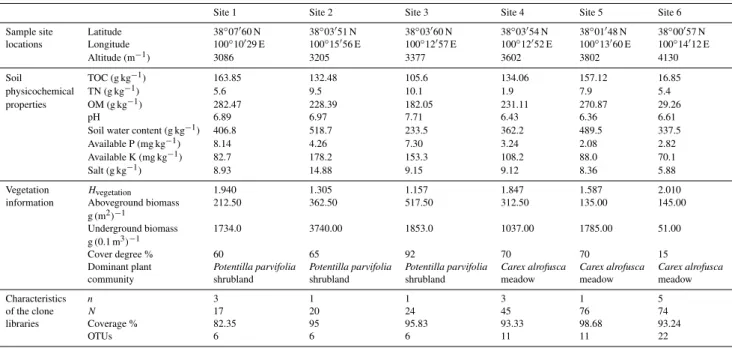
In the present study, six sampling sites along an altitude gradient of 3086 to 4130 m in one typical valley (Binggou) were selected, and soil sampling was conducted between 10 and 11 August 2011. We placed three quadrats within each study site, and five soil samples were collected from each quadrat and pooled, for a total of three samples from each site. The samples were cooled on ice until they were deliv-ered to the laboratory and further processed. Sample site lo-cations, soil physicochemical properties and vegetation in-formation are provided in Table 1.
2.2 Biogeochemical properties of the soil
Soil water content, pH, organic C and total N were mea-sured by previously described methods (Liu et al., 2012). The soil organic matter was determined by loss on ignition, while available P and K were measured following NH4OAc extrac-tion as described previously (Qian et al., 1994). The salt con-tent was calculated as the sum of cations and anions. 2.3 PCR amplification of thenifHgene fragment
We performed three DNA extractions per site from the three composite samples using the PowerSoil DNA Isolation Kit (MoBio Inc., Carlsbad, CA, USA) according to the manu-facturer’s instructions. The three DNA extractions were then pooled for polymerase chain reaction (PCR).
The selected primers nifH-F and nifH-R (5′ -AAAGG(C/T)GG(A/T)ATCGG(C/T)AA(A/G)TC
CACCAC-3′and 5′
-TTGTT(G/C)GC(G/C)GC(A/G)TACAT-(G/C)GCCATCAT-3′) were used to amplify 457 bp nifH
Table 1.Sample site locations, soil physicochemical properties, vegetation information and characteristics of the clone libraries.
Site 1 Site 2 Site 3 Site 4 Site 5 Site 6
Sample site Latitude 38◦07′60 N 38◦03′51 N 38◦03′60 N 38◦03′54 N 38◦01′48 N 38◦00′57 N
locations Longitude 100◦10′29 E 100◦15′56 E 100◦12′57 E 100◦12′52 E 100◦13′60 E 100◦14′12 E
Altitude (m−1) 3086 3205 3377 3602 3802 4130
Soil TOC (g kg−1) 163.85 132.48 105.6 134.06 157.12 16.85
physicochemical TN (g kg−1) 5.6 9.5 10.1 1.9 7.9 5.4
properties OM (g kg−1) 282.47 228.39 182.05 231.11 270.87 29.26
pH 6.89 6.97 7.71 6.43 6.36 6.61
Soil water content (g kg−1) 406.8 518.7 233.5 362.2 489.5 337.5
Available P (mg kg−1) 8.14 4.26 7.30 3.24 2.08 2.82
Available K (mg kg−1) 82.7 178.2 153.3 108.2 88.0 70.1
Salt (g kg−1) 8.93 14.88 9.15 9.12 8.36 5.88
Vegetation Hvegetation 1.940 1.305 1.157 1.847 1.587 2.010
information Aboveground biomass 212.50 362.50 517.50 312.50 135.00 145.00
g (m2)−1
Underground biomass 1734.0 3740.00 1853.0 1037.00 1785.00 51.00
g (0.1 m3)−1
Cover degree % 60 65 92 70 70 15
Dominant plant Potentilla parvifolia Potentilla parvifolia Potentilla parvifolia Carex alrofusca Carex alrofusca Carex alrofusca
community shrubland shrubland shrubland meadow meadow meadow
Characteristics n 3 1 1 3 1 5
of the clone N 17 20 24 45 76 74
libraries Coverage % 82.35 95 95.83 93.33 98.68 93.24
OTUs 6 6 6 11 11 22
2.4 Cloning and restriction fragment length polymorphism (RFLP) analysis
The PCR products were purified using a TIANquick Midi Purification Kit (Tiangen Biotech Co., Ltd., Beijing) and cloned into the pMD 18-T vector (Takara Biotech Co., Ltd., Dalian) according to the manufacturer’s protocols. The plas-mids were transformed into the competentE. coli DH5αby the heat shock method, as described by Huff et al. (1990). All of the white colonies were picked and screened for the desired gene inserts, which were detected using the specific primers M13F/M13R for the pMD 18-T vector.
Unique clones were detected using RFLP analysis with two restriction enzymes (Alu I and Hae III). Enzyme diges-tion and gel electrophoresis of the digested products were performed as described previously (Zhou et al., 2002).
2.5 Sequencing and phylogenetic analysis
To understand the phylogenetic diversity of the samples, rep-resentativenifHclones of the unique RFLP patterns as de-termined by cluster analysis were sequenced. A total of 62
nifHclones were sequenced. The nucleotide acid identities of the sequenced clones were compared to each other using ContigExpress software and to the GenBank database using BLAST software in order to obtain the clone from each pat-tern that was most similar to an existingnifHsequence in the database. The BLAST analyses were conducted on 12 Jan-uary 2013.
A phylogenetic tree was constructed based on a compar-ison of thenifH sequences from the samples of the shrub-land and meadow soils and their closest phylogenetic
rel-atives. The alignment was performed using ClustalX (ver-sion 1.8). The phylogenetic distances (distance options ac-cording to the Jukes–Cantor model) and clustering from the neighbour-joining method were determined using bootstrap values based on 1000 replications with Mega (version 4.0) software (Jukes and Cantor, 1969; Saitou and Nei, 1987; Ku-mar et al., 2001; Zhang et al., 2012). The GenBank accession numbers of thenifHsequences are KC445661–KC445735.
Nitrogen-free medium (NFM) was selected as the selec-tive medium for studying the cultured nitrogen-fixing bacte-ria, as several previous studies had proved this medium to be most selective, least susceptible to overgrowth by other bac-teria that were not nitrogen-fixing and most reproducible, al-lowing for the growth of a broad diversity of nitrogen-fixing bacteria (Beauchamp et al., 1991, 2006). The colony-forming units (CFUs) were determined based on plate counts. Diver-sity of the cultured nitrogen-fixing bacteria from each sample was calculated based on RFLP analysis of 16S rDNA using the previously described method (Dunbar et al., 1999). 16S rDNA sequence analysis was chosen for the identification of the isolates (data not shown). We anticipated that we would findnifHgenes from the isolates in our samples. These iso-lates were characterised as nitrogen fixers by previous stud-ies (Cacciari et al., 1979; Lifshitz et al., 1986; Videira et al., 2009).
2.6 Quantitative PCR analysis ofnifHgene
5592 X. S. Tai et al.: High diversity of nitrogen-fixing bacteria
measuring the quantity of thenifHgene were developed from a clone with the correct insert. A plasmid DNA preparation was obtained from the clone using a Qiagen Miniprep kit (Qiagen, Germantown, MD, USA). The copy number of the target gene in a nanogram of plasmid DNA was determined, and a serial dilution was then prepared, ranging from 108to 102copies. This set of dilutions was used for the standard curve.
Q-PCR was conducted in triplicate for both the standard and the samples. The fluorescence signal was used to cal-culate theCT (cycle threshold) values using the thermocy-cler software for each machine. The copy number of thenifH
gene per gram of soil was determined through comparison to the standard curve of 102∼108gene copies in the assay. The standard curve of Q-PCR wasY = −3.205×log(X)+36.78, based on the average of the triplicate data; theR2value of the curve was 0.996, and the efficiency of Q-PCR was 105.1 %.
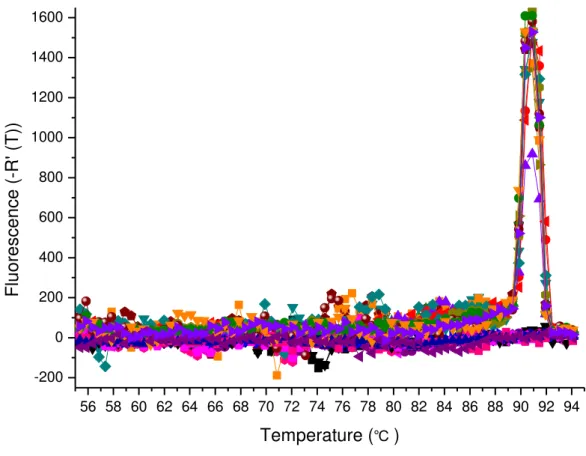
Q-PCR ofnifHwas performed in a 10 µL reaction mixture that contained 5 µL of SYBR Green PCR master mix (2×) (Applied Biosystems, Foster City, CA, US), 0.4 µL of each primer (10 µM), 3.2 µL of sterile ultrapure water and 1 µL of extracted DNA (∼10–25 ng). Amplification was performed using a Stratagene MX3005. The Q-PCR cycling parameters were 30 s at 95◦C, 40 cycles of 95◦C for 5 s, 55◦C for 30 s and 72◦C for 30 s, a dissociation stage of 95◦C for 30 s and 55◦C for 30 s and a final ramp-up to 95◦C. Melting curve analysis was employed to confirm the specificity of the Q-PCR technique.
2.7 Statistical methods
ThenifHoperational taxonomic unit (OTU) calculation was based on RFLP patterns. Clones with same RFLP pattern were clustered into one OTU (Jungblut and Neilan, 2010; Strassert et al., 2012). The coverage of each clone library was calculated using Eq. (1), wherenis the number of OTUs containing unique clones andNis the total number of clones (Table 1). According to the genotypes of the OTUs and the number of clones for each OTU based on the RFLP-clone li-brary approach, the Shannon–Wiener diversity index of the
nifHgene was calculated using Eq. (2), where ni is number
of clones of thei-th OTU, andpi indicates the proportion of
clones of thei-th OTU in the total clone library of the sample (Duc et al., 2009).
Coverage= [1−(n/N )] ×100 % (Huang et al., 2011) (1)
H= −Xpilnpi(pi=ni/N ) (Duc et al., 2009) (2) In order to cluster or separate the samples based on the char-acteristics of the nitrogen-fixing bacterial communities, hier-archical cluster analyses were performed using the SPSS sta-tistical package (version 16.0, SPSS Inc., Chicago, IL, USA) with the average-linkage-between-groups methods (Huang et al., 2011; Nonnoi et al., 2012).
Redundancy analysis (RDA) was performed to analyse the characteristics of the nitrogen-fixing bacterial communities in combination with the environmental parameters using the CANOCO program for Windows (version 4.5) (Braak and Smilauer, 1998; Zumsteg et al., 2012); this approach identi-fies potential or indirect environmental gradients that explain changes in community characteristics. Because the charac-teristics of the nitrogen-fixing bacterial communities exhib-ited linear, rather than unimodal, responses to the environ-mental variables, RDA was employed instead of CCA to analyse the correlations between the characteristics of the nitrogen-fixing bacterial communities and the environmental factors.
The rooted phylogenetic tree created with Mega (ver-sion 4.0) was analysed using the Unifrac interface (http://bmf.colorado.edu/unifrac/), which provides a suite of tools for the comparison of nitrogen-fixing bacterial commu-nities. Unifrac tests the significance of the differences be-tween environments in terms of the phylogenetic branch, which is unique to each environment. The P test uses the phylogenetic tree to test whether the two environments are significantly different using parsimony. The Unifrac and
P-test significance values were corrected using the Bon-ferroni correction for multiple comparisons (Castro et al., 2010). Lineage-specific analysis was performed to determine whether the community differences were concentrated within particular lineages of the phylogenetic tree by applying theG
test for goodness of fit to all clades (subtrees) within the tree at a defined distance (0.0433) from the tree root (Lozupone et al., 2006).
3 Results
3.1 Characteristics of nitrogen-fixing bacterial communities
The colony-forming units (CFUs) and diversity indices (Hcultured) of the nitrogen-fixing bacterial communities are shown in Fig. 1. The CFUs ranged from 0.97 to 12.78 (106g−1 wet soil), while Hcultured ranged from 0.2 to 1.4; both of these measures were lower in the meadow soil than in the shrubland soil along the altitude gradient. The nitrogen-fixing bacterial community in the meadow soil showed a higher Shannon–Wiener diversity index (Hnif) than that of the shrubland soil, and Hnif increased from 1.5 to 2.8 with elevating altitude. Figure 2 shows that the abundance of the
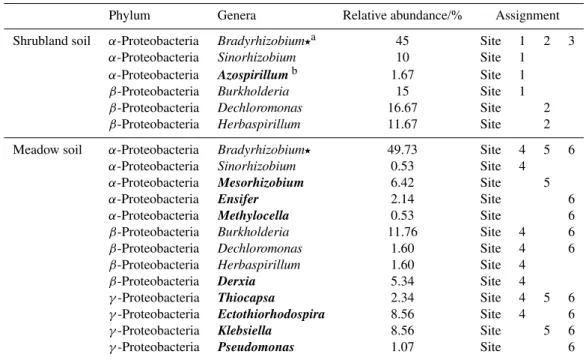
Table 2.Nitrogen-fixing bacterial community composition in the shrubland and meadow soils.
Phylum Genera Relative abundance/% Assignment
Shrubland soil α-Proteobacteria Bradyrhizobium⋆a 45 Site 1 2 3
α-Proteobacteria Sinorhizobium 10 Site 1
α-Proteobacteria Azospirillumb 1.67 Site 1
β-Proteobacteria Burkholderia 15 Site 1
β-Proteobacteria Dechloromonas 16.67 Site 2
β-Proteobacteria Herbaspirillum 11.67 Site 2
Meadow soil α-Proteobacteria Bradyrhizobium⋆ 49.73 Site 4 5 6
α-Proteobacteria Sinorhizobium 0.53 Site 4
α-Proteobacteria Mesorhizobium 6.42 Site 5
α-Proteobacteria Ensifer 2.14 Site 6
α-Proteobacteria Methylocella 0.53 Site 6
β-Proteobacteria Burkholderia 11.76 Site 4 6
β-Proteobacteria Dechloromonas 1.60 Site 4 6
β-Proteobacteria Herbaspirillum 1.60 Site 4
β-Proteobacteria Derxia 5.34 Site 4
γ-Proteobacteria Thiocapsa 2.34 Site 4 5 6
γ-Proteobacteria Ectothiorhodospira 8.56 Site 4 6
γ-Proteobacteria Klebsiella 8.56 Site 5 6
γ-Proteobacteria Pseudomonas 1.07 Site 6
aThe black star indicates the predominant genus in shrubland and meadow soils. bThe generic names in bold indicate those genera unique to each soil.
3086m 3205m 3377m 3602m 3802m 4130m
0 5 10
15 Shrub soil
C
F
U
s
(
1
0
6 /
g
s
o
il)
a*
b b
c
d d
Meadow soil Shrub soil
3086m 3205m 3377m 3602m 3802m 4130m
0.0 0.5 1.0 1.5
Altitude
Meadow soil
D
iv
e
rs
ity
(
H
)
Altitude
Fig. 1.CFUs and diversity indices of cultured nitrogen-fixing bac-teria (∗the letters represent confidence levels above 95 %).
The cluster analysis of the nitrogen-fixing bacterial com-munities in the shrubland and meadow soil in terms of their characteristics (CFUs,Hcultured, number of copies and
Hnif)indicated that the nitrogen-fixing bacterial communi-ties from each environment clustered together (Fig. 3). In other words, the nitrogen-fixing bacterial communities de-rived from the same soil type (shrubland soil or meadow soil) were more similar to each other than to communities from the other soil type.
3086m 3205m 3377m 3602m 3802m 4130m
0 4 8
Altitude
Meadow soil
ab
C
o
p
y n
u
m
b
e
rs (
1
0
7 /
g
so
il)
a*
a
ab
bc
c
Shrub soil
Meadow soil
Altitude
3086m 3205m 3377m 3602m 3802m 4130m
0 1 2 3
Shrub soil
D
iver
sity (
H
)
Fig. 2.Copy numbers and diversity indices of thenifHgene (∗the letters represent confidence levels above 95 %).
3.2 Phylogeny of nitrogen-fixing bacteria
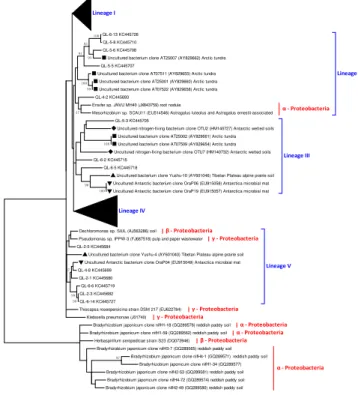
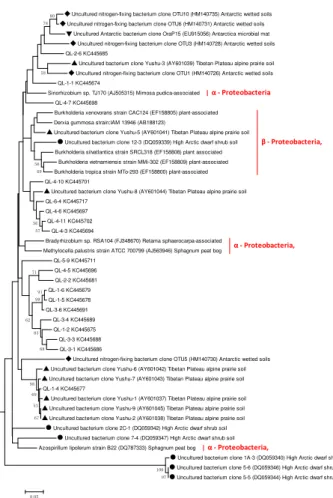
Figure 4 reveals that while many of thenifHgene sequences had close similarity to those of identified nitrogen-fixing bacteria, a number of thenifHsequences clustered without any corresponding diazotroph species identified in GenBank. Among the identified nitrogen-fixing bacterial clones, those associated withBradyrhizobium,Sinorhizobium,
Burkholde-ria,DechloromonasandHerbaspirillumwere found in both
the shrubland and meadow soils, and Bradyrhizobiumwas the dominant genus. Table 2 indicates that Azospirillum
5594 X. S. Tai et al.: High diversity of nitrogen-fixing bacteria
Fig. 3.Hierarchical cluster analysis of the nitrogen-fixing bacterial communities in the study region. Euclidean distance was selected as the interval.
Table 3.The significance tests of the microbial communities.
Unifrac Ptest Lineage-specific significance analysis test
Pvalues∗ 0.03 ≤0.01 Lineage I:<0.001 Lineage II:<0.001 Lineage III: 0.02 Lineage IV:<0.001 Lineage V:<0.001
∗<0.001: highly significant; 0.001–0.01: significant; 0.01–0.05: marginally
significant.
Derxia,Ectothiorhodospira,Mesorhizobium,Klebsiella,
En-sifer,MethylocellaandPseudomonaswere detected only in
the meadow soil. All of the identified nitrogen-fixing bacte-rial clones belonged to the Proteobacteria. The Unifrac sig-nificance (P =0.03) andP-test significance (P =0.01) val-ues all indicated that the nitrogen-fixing bacterial communi-ties were significantly different between the shrubland and meadow soils (Table 3). The phylogenetic tree was divided into five lineages (lineages I–V): lineage I, II and III mainly contained nifH sequences obtained from the meadow soil, while lineage IV was mainly composed ofnifH sequences obtained from the shrubland soil (Fig. 4). TheP values of each lineage indicated that the distributions of the lineages between the two environments were different (Table 3).
3.3 Correlations between characteristics of the nitrogen-fixing bacterial communities and environmental factors
The results of the RDA indicated that PC1 explains more than 90 % of the variance, while PC2 explains less than 10 %. Therefore, the first axis accounted for a valuable part of the variance, while the second axis did not. Underground biomass had a significant positive correlation with the first axis and strongly influenced the bacterial communities in shrubland soil, while available K had a strong influence on the communities in meadow soil (Fig. 5). In the shrubland soil, thenifHgene diversity and copy number were primarily correlated with aboveground biomass. The CFUs of the
Lineage I QL-6-13 KC445726 QL-5-8 KC445710 QL-5-6 KC445708
Uncultured bacterium clone AT25007 (AY829662) Arctic tundra QL-5-5 KC445707
Uncultured bacterium clone AT07511 (AY829655) Arctic tundra Uncultured bacterium clone AT25001 (AY829660) Arctic tundra Uncultured bacterium clone AT07522 (AY829658) Arctic tundra QL-4-2 KC445693
Ensifer sp. JNVU MH40 (JX843759) root nodule
Mesorhizobium sp. SCAU11 (EU514546) Astragalus luteolus and Astragalus ernestii-associated α - Proteo a teria Lineage II
QL-5-3 KC445705
Uncultured nitrogen-fixing bacterium clone OTU2 (HM140727) Antarctic wetted soils Uncultured bacterium clone AT25002 (AY829661) Arctic tundra Uncultured bacterium clone AT07509 (AY829654) Arctic tundra Uncultured nitrogen-fixing bacterium clone OTU7 (HM140732) Antarctic wetted soils QL-6-2 KC445715
QL-6-5 KC445718
Uncultured bacterium clone Yushu-10 (AY601046) Tibetan Plateau alpine prairie soil Uncultured Antarctic bacterium clone OraP06 (EU915058) Antarctica microbial mat Uncultured Antarctic bacterium clone OraP19 (EU915057) Antarctica microbial mat
Lineage III
Lineage IV
β - Proteo a teria
Dechloromonas sp. SIUL (AJ563286) soil
γ - Proteo a teria
Pseudomonas sp. IPPW-3 (FJ687518) pulp and paper wastewater QL-2-5 KC445684
Uncultured bacterium clone Yushu-4 (AY601040) Tibetan Plateau alpine prairie soil Uncultured Antarctic bacterium clone OraP04 (EU915049) Antarctica microbial mat QL-4-8 KC445699
QL-2-1 KC445680 QL-6-6 KC445719 QL-2-3 KC445682 QL-6-14 KC445727
Lineage V
γ - Proteo a teria
Thiocapsa roseopersicina strain DSM 217 (EU622784)
γ - Proteo a teria
Klebsiella pneumoniae (J01740)
α - Proteo a teria
Bradyrhizobium japonicum clone nifH1-18 (GQ289576) reddish paddy soil
α - Proteo a teria
Bradyrhizobium japonicum clone nifH1-59 (GQ289562) reddish paddy soil
β - Proteo a teria
Herbaspirillum seropedicae strain S23 (DQ073946) Bradyrhizobium japonicum clone nifH3-7 (GQ289565) reddish paddy soil
Bradyrhizobium japonicum clone nifH4-1 (GQ289571) reddish paddy soil Bradyrhizobium japonicum clone nifH1-34 (GQ289577) Bradyrhizobium japonicum clone nifH2-53 (GQ289581) reddish paddy soil Bradyrhizobium japonicum clone nifH4-72 (GQ289574) reddish paddy soil Bradyrhizobium japonicum clone nifH2-49 (GQ289580) reddish paddy soil
α - Proteo a teria
100 100
100 99 100
99 99
93 93 91
90
57 57
97
0.1
Fig. 4a.Phylogenetic tree based on a comparison of thenifH quences determined from the samples of shrubland soil (18 se-quences) and meadow soil (44 sese-quences) and their closest phyloge-netic relatives (30 sequences), which were obtained using BLAST. A number of othernifHgene sequences (50) obtained from the Ti-betan Plateau, the Antarctic and the Arctic were included to con-struct a robust phylogenetic tree. The alignment was performed using ClustalX (version 1.8). Phylogenetic distances (distance op-tions according to the Jukes–Cantor model) and clustering with the neighbour-joining method were determined using bootstrap val-ues based on 1000 replications. Bootstrap valval-ues>50 are shown. Clones from this study are designated with the prefix QL, fol-lowed by the soil code (1–6) and the clone code. The accession number follows each clone. Solid circles, squares, triangles, rhom-buses and inverted triangles indicate thosenifHgene sequences ob-tained from high Arctic dwarf shrubland soil, Arctic tundra, Tibetan Plateau alpine prairie soil, Antarctic wetted soil and the Antarc-tic microbial mat, respectively. The scale bar indicates nucleotide substitution per site.
tured nitrogen-fixing bacteria were affected by underground biomass. Altitude affected the diversity of thenifH gene in the meadow soil, where copy number was primarily cor-related with soil-available K. The cultured nitrogen-fixing bacterial diversity was affected by soil water content, while CFUs were correlated with aboveground biomass.
4 Discussion
QL-6-22 KC445735 QL-5-4 KC445706 QL-6-10 KC445723 QL-3-5 KC445690 QL-6-11 KC445724 QL-6-21 KC445734 QL-6-8 KC445721 QL-6-18 KC445732 QL-3-2 KC445687 QL-4-9 KC445700 QL-6-15 KC445728 QL-6-9 KC445722 QL-5-10 KC445712
Uncultured bacterium clone AT07528 (AY829659) Arctic tundra Uncultured bacterium clone 6-1 (DQ059345) High Arctic dwarf shrub soil Uncultured bacterium clone 2-1 (DQ059341) High Arctic dwarf shrub soil QL-6-20 KC445733
QL-5-11 KC445713 QL-5-2 KC445704
Uncultured Antarctic bacterium clone OraP09 (EU915052) Antarctica microbial mat Uncultured nitrogen-fixing bacterium clone OTU8 (HM140733) Antarctic wetted soils
Uncultured nitrogen-fixing bacterium clone OTU9 (HM140734) Antarctic wetted soils QL-1-3 KC445676
QL-6-3 KC445716
Uncultured Antarctic bacterium clone OraP18 (EU915053) Antarctica microbial mat Uncultured bacterium clone 2-3 (DQ059343) High Arctic dwarf shrub soil Uncultured bacterium clone AT07506 (AY829653) Arctic tundra
Uncultured bacterium clone AT07519 (AY829657) Arctic tundra Uncultured bacterium clone AT07516 (AY829656) Arctic tundra QL-4-1 KC445692 QL-6-1 KC445714 QL-6-16 KC445729 QL-6-7 KC445720 QL-6-17 KC445730 QL-6-19 KC445732 QL-5-7 KC445709 QL-4-4 KC445695
Uncultured Antarctic bacterium clone OraP12 (EU915055) Antarctica microbial mat Uncultured Antarctic bacterium clone OraP05 (EU915054) Antarctica microbial mat
QL-5-1 KC445703 QL-6-12 KC445725 QL-2-4 KC445683
Uncultured Antarctic bacterium clone OraP07 (EU915051) Antarctica microbial mat Uncultured nitrogen-fixing bacterium clone OTU4 (HM140729) Antarctic wetted soils
Unidentified nitrogen-fixing bacteria clone HD4-1 (AF216897) rhizosphere of the smooth cordgrass, Spartina alterniflora Unidentified nitrogen-fixing bacteria clone BP3 (AF216912) rhizosphere of the smooth cordgrass, Spartina alterniflora Thiocapsa bogorovii strain BBS (EU622783)
Ectothiorhodospira shaposhnikovii strain DSM 2111 (EF199955) Ectothiorhodospira shaposhnikovii strain DSM 243 (EF199953) Ectothiorhodospira mobilis strain DSM 237 (EF199954)
γ - Proteo a teria
Uncultured bacterium clone 10-5 (DQ059338) High Arctic dwarf shrub soil Uncultured Antarctic bacterium clone OraP02 (EU915050) Antarctica microbial mat
64 99 51 100 66 56 100 94 96 97 91 99 99 98 91 52 68 100 100 96 75 99 0.02
Fig. 4b.The subtree displays the phylogeny of lineage I.
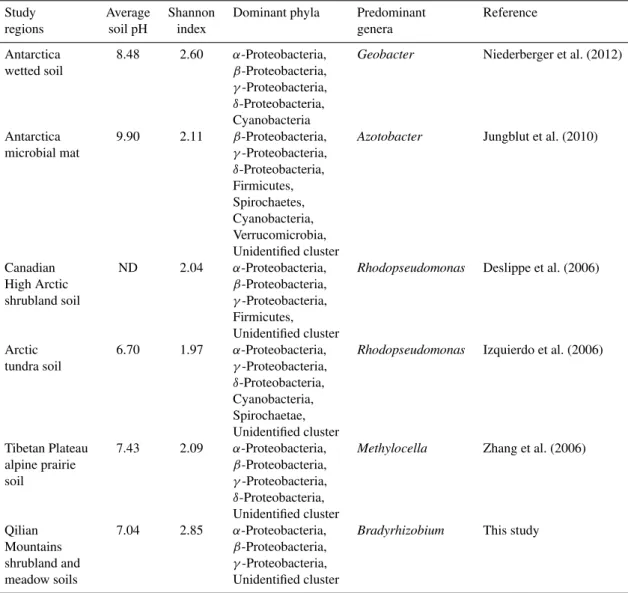
than that observed in other cold regions across the world, such as Antarctic soil (Jungblut and Neilan, 2010; Nieder-berger et al., 2012), Arctic soil (Deslippe and Egger, 2006; Izquierdo and N¨usslein, 2006) and Tibetan Plateau alpine soil (Zhang et al., 2006). The abundance of the nifH
gene was 107copies g−1soil (Fig. 2), a value slightly higher than that of previously published results. Niederberger et al. (2012) found that proteobacterialnifHgenes ranged from 104 to 105copies g−1 soil in Antarctic wetted soil. Coelho et al. (2009) observed 105 to 107copies g−1 soil of nifH
genes in Brazilian farmland soil. The high diversity and abundance of thenifH gene in the southern Qilian tains suggests that the soil pH in the southern Qilian Moun-tains is close to 7 (Table 4), which is the optimum for the majority of nitrogen-fixing bacteria (Tamm, 1991). Further-more, the primers used in this study, nifH-F and nifH-R, targeted a wide range of nitrogen-fixing bacteria and were different from those used in other studies (R¨osch et al., 2002; as reviewed in Gaby and Buckley, 2012). In the south-ern Qilian Mountains, the Shannon diversity index of the nitrogen-fixing bacteria in the shrubland soil was lower than
Uncultured nitrogen-fixing bacterium clone OTU10 (HM140735) Antarctic wetted soils Uncultured nitrogen-fixing bacterium clone OTU6 (HM140731) Antarctic wetted soils
Uncultured Antarctic bacterium clone OraP15 (EU915056) Antarctica microbial mat Uncultured nitrogen-fixing bacterium clone OTU3 (HM140728) Antarctic wetted soils QL-2-6 KC445685
Uncultured bacterium clone Yushu-3 (AY601039) Tibetan Plateau alpine prairie soil Uncultured nitrogen-fixing bacterium clone OTU1 (HM140726) Antarctic wetted soils QL-1-1 KC445674
α - Proteo a teria
Sinorhizobium sp. TJ170 (AJ505315) Mimosa pudica-associated QL-4-7 KC445698
Burkholderia xenovorans strain CAC124 (EF158805) plant-associated Derxia gummosa strain:IAM 13946 (AB188123)
Uncultured bacterium clone Yushu-5 (AY601041) Tibetan Plateau alpine prairie soil Uncultured bacterium clone 12-3 (DQ059339) High Arctic dwarf shrub soil Burkholderia silvatlantica strain SRCL318 (EF158808) plant associated
Burkholderia vietnamiensis strain MMi-302 (EF158809) plant-associated Burkholderia tropica strain MTo-293 (EF158800) plant-associated
β - Proteo a teria,
QL-4-10 KC445701
Uncultured bacterium clone Yushu-8 (AY601044) Tibetan Plateau alpine prairie soil QL-6-4 KC445717
QL-4-6 KC445697 QL-4-11 KC445702
QL-4-3 KC445694
Bradyrhizobium sp. RSA104 (FJ348670) Retama sphaerocarpa-associated
Methylocella palustris strain ATCC 700799 (AJ563946) Sphagnum peat bog α - Proteo a teria, QL-5-9 KC445711 QL-4-5 KC445696 QL-2-2 KC445681 QL-1-6 KC445679 QL-1-5 KC445678 QL-3-6 KC445691 QL-3-4 KC445689 QL-1-2 KC445675 QL-3-3 KC445688 QL-3-1 KC445686
Uncultured nitrogen-fixing bacterium clone OTU5 (HM140730) Antarctic wetted soils Uncultured bacterium clone Yushu-6 (AY601042) Tibetan Plateau alpine prairie soil Uncultured bacterium clone Yushu-7 (AY601043) Tibetan Plateau alpine prairie soil QL-1-4 KC445677
Uncultured bacterium clone Yushu-1 (AY601037) Tibetan Plateau alpine prairie soil Uncultured bacterium clone Yushu-9 (AY601045) Tibetan Plateau alpine prairie soil Uncultured bacterium clone Yushu-2 (AY601038) Tibetan Plateau alpine prairie soil
Uncultured bacterium clone 2C-1 (DQ059342) High Arctic dwarf shrub soil Uncultured bacterium clone 7-4 (DQ059347) High Arctic dwarf shrub soil
α - Proteo a teria,
Azospirillum lipoferum strain B22 (DQ787333) Sphagnum peat bog
Uncultured bacterium clone 1A-3 (DQ059340) High Arctic dwarf shrub soil Uncultured bacterium clone 5-6 (DQ059346) High Arctic dwarf shrub soil Uncultured bacterium clone 5-5 (DQ059344) High Arctic dwarf shrub soil
97 100 67 53 69 98 68 83 91 99 62 71 57 56 69 56 58 80 78 0.05
Fig. 4c.The subtree displays the phylogeny of lineage IV.
that of the bacteria in the meadow soils. Hsu and Buckley (2009) have found that higher levels of vegetation biomass reduce nitrogen-fixing bacterial diversity, and a higher vege-tation biomass was observed in the shrubland soil than in the meadow soil (Table 1).
Five major clusters with homology to nifH have been described. Cluster I is composed entirely of nifH genes from most of the Proteobacteria, all of the Cyanobacte-ria and certain Firmicutes (Paenibacillus) and Actinobac-teria (Frankia). Cluster II contains sequences belonging to certain methanogenic Archaea. Cluster III is dominated by
5596 X. S. Tai et al.: High diversity of nitrogen-fixing bacteria –
-1.0 1.5
-1.0
1.5
H cultured
CFUs H nif Copies
H plant
Aboveground biomass
Underground biomass Cover degreeAltitude
Available K TN
Soil water content
-1.5 1.5
-1.5
1.5
H cultured
CFUs H nif
Copies
H plant
Aboveground biomass Underground biomass
Cover degree
Altitude
Available K TN
Soil water content
meadow soil shrubland soil
P
C
2
(
6
.4
%)
P
C
2
(
9
.7
%
)
PC1 (93.6%) PC1 (90.3%)
Fig. 5.RDA analysis between the nitrogen-fixing bacterial characteristics and environmental factors. The RDA plot was constructed with the biplots method and joint plots between the species and environmental variables based on the linear model using CanoDraw. The red arrows and words represent the environmental factors, while the blue arrows indicate community characteristics.
Table 4.Nitrogen-fixing bacterial communities in different regions of the world.
Study Average Shannon Dominant phyla Predominant Reference
regions soil pH index genera
Antarctica 8.48 2.60 α-Proteobacteria, Geobacter Niederberger et al. (2012)
wetted soil β-Proteobacteria,
γ-Proteobacteria,
δ-Proteobacteria, Cyanobacteria
Antarctica 9.90 2.11 β-Proteobacteria, Azotobacter Jungblut et al. (2010)
microbial mat γ-Proteobacteria,
δ-Proteobacteria, Firmicutes, Spirochaetes, Cyanobacteria, Verrucomicrobia, Unidentified cluster
Canadian ND 2.04 α-Proteobacteria, Rhodopseudomonas Deslippe et al. (2006)
High Arctic β-Proteobacteria,
shrubland soil γ-Proteobacteria,
Firmicutes, Unidentified cluster
Arctic 6.70 1.97 α-Proteobacteria, Rhodopseudomonas Izquierdo et al. (2006)
tundra soil γ-Proteobacteria,
δ-Proteobacteria, Cyanobacteria, Spirochaetae, Unidentified cluster
Tibetan Plateau 7.43 2.09 α-Proteobacteria, Methylocella Zhang et al. (2006)
alpine prairie β-Proteobacteria,
soil γ-Proteobacteria,
δ-Proteobacteria, Unidentified cluster
Qilian 7.04 2.85 α-Proteobacteria, Bradyrhizobium This study
Mountains β-Proteobacteria,
shrubland and γ-Proteobacteria,
X. S. Tai et al.: High diversity of nitrogen-fixing bacteria 5597
≦
56 58 60 62 64 66 68 70 72 74 76 78 80 82 84 86 88 90 92 94 -200
0 200 400 600 800 1000 1200 1400 1600
F
lu
o
re
sce
n
ce
(-R
' (T
))
Temperature (
℃)
–
–
Fig. 6.Melting curve of quantitative PCR.
the nifH clone library from the rhizosphere soil and roots
ofLasiurus sindicusgrass showed a predominance of
Pro-teobacteria. However, the predominant genera in different extreme environments are distinct (Table 4), and
Bradyrhi-zobium is unique to the shrubland and meadow soils of
the southern Qilian Mountains. Furthermore, at the genus level,Azospirillumwas only detected in the shrubland soil, while Thiocapsa, Derxia, Ectothiorhodospira,
Mesorhizo-bium, Klebsiella, Ensifer, Methylocella and Pseudomonas
were only detected in the meadow soil. One possibility is that plants may select for different nitrogen-fixing bacterial communities (Deslippe and Egger, 2006). The dominance of native alpine species (e.g. Potentilla parvifolia and Carex
alrofusca) may have controlled the soil carbon dynamics
through changes in root colonisation and exudation, which in turn may have resulted in changes to the nitrogen-fixing bacterial community structure (Bardgett et al., 1998; Gros et al., 2004). Lineage-specific analysis, the Unifrac signifi-cance test and theP test all indicated that the nitrogen-fixing bacterial communities beneathPotentilladiffered from the ones beneathCarex(Table 3). These results suggest that plant species may influence N cycling by enhancing the fitness of certain nitrogen-fixing taxa.
The cluster analysis showed that soils of the same vegeta-tion type contained similar nitrogen-fixing bacterial
commu-nities (Fig. 3), a result consistent with those of previous stud-ies (Berg et al., 2002; Deslippe and Egger, 2006; Garbeva et al., 2008). They concluded that the abundance and com-position of bacteria functional groups were plant species de-pendent. Similar habitats have similar soils, with similar abi-otic and biabi-otic contexts, and therefore harbour bacterial com-munities that display similar characteristics. A cross-system comparison ofnifHgene diversity and microbial community structure indicated that the distribution of nitrogen-fixing mi-croorganisms is non-random and can be predicted on the ba-sis of habitat characteristics (Zehr et al., 2003).
In the present study, the phylogenetic tree was divided into five lineages: lineages I, II and III mainly containednifH se-quences obtained from the meadow soil, while lineage IV was mainly composed ofnifHsequences obtained from the shrubland soil. This result suggests thatPotentillais highly N proficient and falls into the conservative category, while
Carexis less N proficient and falls into the extravagant cat-egory in terms of N cycling (Yuan et al., 2005; Chapman et al., 2006). As proposed by Chapman et al. (2006), plant species that fall into the conservative category regulate N cycling more strongly than plant species exhibiting extrav-agant N management. Our findings may provide evidence in support of this hypothesis. In the shrubland soil beneath
primar-5598 X. S. Tai et al.: High diversity of nitrogen-fixing bacteria
ily correlated with aboveground biomass. Hsu and Buckley (2009) found that the nitrogen-fixing bacterial community structure differed across treatments as a function of vege-tation biomass. Lovell et al. (2001) also demonstrated that differences in the nitrogen-fixing bacterial community are closely associated with vegetation biomass. In the meadow soil beneathCarex, thenifHgene diversity was primarily af-fected by altitude, while abundance was primarily afaf-fected by soil-available K. Zhang et al. (2006) found that altitude was one of the key factors influencing the nitrogen-fixing bacterial community in alpine prairie soil. Niederberger et al. (2012) demonstrated that temperature, which is closely correlated to altitude, may be a driving factor in the compo-sition of the nitrogen-fixing bacterial community in Antarctic soil. Soil K concentration has also been identified as a driver of thenifHgene in several environments (Teng et al., 2009; Hayden et al., 2010).
5 Conclusions
Our study revealed a high diversity of nitrogen-fixing bac-terial communities in the southern Qilian Mountains. The neutral soil pH of the study region may provide optimum conditions for nitrogen-fixing bacteria and induce higher
nifHgene diversity and abundance compared to other arctic– alpine sites with lower or higher soil pH. Based on the as-sessment of the characteristics of the nitrogen-fixing bacte-rial communities and the phylogenetic analysis, the nitrogen-fixing bacterial communities beneathPotentillawere shown to differ from the ones beneathCarex. Furthermore, Poten-tillais considered to be a highly N proficient and falls into the conservative category, whileCarexis a less N proficient and falls into the extravagant category in terms of N cycling. These results suggest that plant species in combination with distinct soil physicochemical properties may influence N cy-cling by enhancing the fitness of certain nitrogen-fixing bac-terial taxa. To our knowledge, this study is the first report on thenifHdiversity of plant-associated soil microbes in the southern Qilian Mountains.
Acknowledgements. We are grateful to S. W. Li (Lanzhou Jiaotong
University, Gansu, China) and lecturer H. N. Gao (Hexi University, Gansu, China) for their professional advice and support. The project is supported by the Key Project of the Chinese Academy of Sciences (no. KZZD-EW-04-05) and the National Natural Science Foundation of China (no. 31070357; 31100365; 91025002).
Edited by: T. Treude
References
Bardgett, R. D., Wardle, D. A., and Yeates, G. W.: Linking above-ground and below-above-ground interactions: how plant responses to
foliar herbivory influence soil organisms, Soil Biol. Biochem., 30, 1867–1878, doi:10.1016/S0038-0717(98)00069-8, 1998. Beauchamp, C. J., Kloepper, J. W., Lifshitz, R., Dion, P., and
Antoun, H.: Frequent occurrence of the ability to utilize octopine in rhizobacteria, Can. J. Microbiol., 37, 158–164, doi:10.1139/m91-024, 1991.
Beauchamp, C. J., L´evesque, G., Pr´evost, D., and Chalifour, F.-P.: Isolation of free-living dinitrogen-fixing bacteria and their activ-ity in compost containing de-inking paper sludge, Bioresource Technol., 97, 1002–1011, doi:10.1016/j.biortech.2005.04.041, 2006.
Berg, G., Roskot, N., Steidle, A., Eberl, L., Zock, A., and Smalla, K.: Plant-Dependent Genotypic and Phenotypic Diver-sity of Antagonistic Rhizobacteria Isolated from Different Ver-ticillium Host Plants, Appl. Environ. Microb., 68, 3328–3338, doi:10.1128/aem.68.7.3328-3338.2002, 2002.
Braak, C. J. F. T. and Smilauer, P.: CANOCO Reference Manual and User’s Guide to Canoco for Windows: Software for Canoni-cal Community Ordination (Version 4), Centre for Biometry, Wa-geningen, 351 pp., 1998.
B¨urgmann, H., Meier, S., Bunge, M., Widmer, F., and Zeyer, J.: Effects of model root exudates on structure and activity of a soil diazotroph community, Environ. Microbiol., 7, 1711–1724, doi:10.1111/j.1462-2920.2005.00818.x, 2005.
Cacciari, I., Lippi, D., and Bordeleau, L. M.: Effect of oxygen on batch and continuous cultures of a nitrogen-fixingArthrobacter
sp, Can. J. Microbiol., 25, 746–751, doi:10.1139/m79-108, 1979. Castro, H. F., Classen, A. T., Austin, E. E., Norby, R. J., and Schadt, C. W.: Soil Microbial Community Responses to Multiple Ex-perimental Climate Change Drivers, Appl. Environ. Microb., 76, 999–1007, doi:10.1128/aem.02874-09, 2010.
Chapman, S. K., Langley, J. A., Hart, S. C., and Koch, G. W.: Plants actively control nitrogen cycling: uncorking the micro-bial bottleneck, New Phytol., 169, 27–34, doi:10.1111/j.1469-8137.2005.01571.x, 2006.
Chowdhury, S. P., Schmid, M., Hartmann, A., and Tripathi, A. K.: Diversity of 16S-rRNA and nifH genes derived from rhizosphere soil and roots of an endemic drought tolerant grass, Lasiurus sindicus, Eur. J. Soil Biol. 45, 114–122, doi:10.1016/j.ejsobi.2008.06.005, 2009.
Cleveland, C. and Liptzin, D.: C : N : P stoichiometry in soil: is there a “Redfield ratio” for the microbial biomass?, Biogeochemistry, 85, 235–252, doi:10.1007/s10533-007-9132-0, 2007.
Coelho, M. R. R., Marriel, I. E., Jenkins, S. N., Lanyon, C. V., Seldin, L., and O’Donnell, A. G.: Molecular detection and quan-tification of nifH gene sequences in the rhizosphere of sorghum
(Sorghum bicolor) sown with two levels of nitrogen fertilizer,
Appl. Soil Ecol., 42, 48–53, doi:10.1016/j.apsoil.2009.01.010, 2009.
Courtney, R. and Harrington, T.: Assessment of plant-available phosphorus in a fine textured sodic substrate, Ecol. Eng., 36, 542–547, doi:10.1016/j.ecoleng.2009.12.001, 2010.
Deslippe, J. and Egger, K.: Molecular Diversity of nifH Genes from Bacteria Associated with High Arctic Dwarf Shrubs, Microb. Ecol., 51, 516–525, doi:10.1007/s00248-006-9070-8, 2006. Duc, L., Noll, M., Meier, B., B¨urgmann, H., and Zeyer, J.: High
Dunbar, J., Takala, S., Barns, S. M., Davis, J. A., and Kuske, C. R.: Levels of Bacterial Community Diversity in Four Arid Soils Compared by Cultivation and 16S rRNA Gene Cloning, Appl. Environ. Microb., 65, 1662–1669, 1999.
Garbeva, P., Elsas, J. D., and Veen, J. A.: Rhizosphere microbial community and its response to plant species and soil history, Plant Soil, 302, 19–32, doi:10.1007/s11104-007-9432-0, 2008. Gaby, J. C. and Buckley, D. H.: A global census of nitrogenase
diversity, Environ. Microbiol., 13, 1790-1799, 10.1111/j.1462-2920.2011.02488.x, 2011.
Gaby, J. C. and Buckley, D. H.: A Comprehensive Evaluation of PCR Primers to Amplify the nifH Gene of Nitrogenase, PLoS ONE, 7, e42149, doi:10.1371/journal.pone.0042149, 2012. Gros, R., Jocteur Monrozier, L., Bartoli, F., Chotte, J. L., and Faivre,
P.: Relationships between soil physico-chemical properties and microbial activity along a restoration chronosequence of alpine grasslands following ski run construction, Appl. Soil Ecol., 27, 7–22, doi:10.1016/j.apsoil.2004.03.004, 2004.
Hamelin, J., Fromin, N., Tarnawski, S., Teyssier-Cuvelle, S., and Aragno, M.: nifH gene diversity in the bacterial community as-sociated with the rhizosphere of Molinia coerulea, an oligo-nitrophilic perennial grass, Environ. Microbiol., 4, 477–481, doi:10.1046/j.1462-2920.2002.00319.x, 2002.
Hamilton, T., Boyd, E., and Peters, J.: Environmental Constraints Underpin the Distribution and Phylogenetic Diversity of nifH in the Yellowstone Geothermal Complex, Microb. Ecol., 61, 860– 870, doi:10.1007/s00248-011-9824-9, 2011.
Hayden, H. L., Drake, J., Imhof, M., Oxley, A. P. A., Norng, S., and Mele, P. M.: The abundance of nitrogen cycle genes
amoA and nifH depends on land-uses and soil types in South-Eastern Australia, Soil Biol. Biochem., 42, 1774–1783, doi:10.1016/j.soilbio.2010.06.015, 2010.
Hsu, S. F. and Buckley, D. H.: Evidence for the functional signif-icance of diazotroph community structure in soil, ISME J., 3, 124–136, doi:10.1038/ismej.2008.82, 2009.
Huang, L.-N., Tang, F.-Z., Song, Y.-S., Wan, C.-Y., Wang, S.-L., Liu, W.-Q., and Shu, W.-S.: Biodiversity, abundance, and ac-tivity of nitrogen-fixing bacteria during primary succession on a copper mine tailings, FEMS Microbiol. Ecol., 78, 439–450, doi:10.1111/j.1574-6941.2011.01178.x, 2011.
Huff, J. P., Grant, B. J., Penning, C. A., and Sullivan, K. F.: Opti-mization of routine transformation of Escherichia coli with plas-mid DNA, BioTechniques, 9, 570–572, 1990.
Izquierdo, J. and N¨usslein, K.: Distribution of Extensive nifH Gene Diversity Across Physical Soil Microenvironments, Mi-crob. Ecol., 51, 441–452, doi:10.1007/s00248-006-9044-x, 2006. Jasrotia, P. and Ogram, A.: Diversity of nifH Genotypes in Float-ing Periphyton Mats Along a Nutrient Gradient in the Florida Everglades, Curr. Microbiol., 56, 563–568, doi:10.1007/s00284-008-9124-x, 2008.
Jiang, C., Yu, G., Li, Y., Cao, G., Yang, Z., Sheng, W., and Yu, W.: Nutrient resorption of coexistence species in alpine meadow of the Qinghai-Tibetan Plateau explains plant adap-tation to nutrient-poor environment, Ecol. Eng., 44, 1–9, doi:10.1016/j.ecoleng.2012.04.006, 2012.
Jukes, T. H. and Cantor, C. R.: Evolution of protein molecules, in: Mammalian protein metabolism, edited by: Munro, M. N., Aca-demic Press, 21–132, 1969.
Jungblut, A. D. and Neilan, B. A.: NifH gene diversity and expression in a microbial mat community on the Mc-Murdo Ice Shelf, Antarctica, Antarct. Sci., 22, 117–122, doi:10.1017/S0954102009990514, 2010.
Knelman, J. E., Legg, T. M., O’Neill, S. P., Washenberger, C. L., Gonz´alez, A., Cleveland, C. C., and Nemergut, D. R.: Bacterial community structure and function change in asso-ciation with colonizer plants during early primary succes-sion in a glacier forefield, Soil Biol. Biochem., 46, 172–180, doi:10.1016/j.soilbio.2011.12.001, 2012.
Kumar, S., Tamura, K., Jakobsen, I. B., and Nei, M.: MEGA2: molecular evolutionary genetics analysis software, Bioinfor-matics, 17, 1244–1245, doi:10.1093/bioinformatics/17.12.1244, 2001.
Li, X., Lu, L., Cheng, G., and Xiao, H.: Quantifying land-scape structure of the Heihe River Basin, north-west China using FRAGSTATS, J. Arid Environ., 48, 521–535, doi:10.1006/jare.2000.0715, 2001.
Lifshitz, R., Kloepper, J. W., Scher, F. M., Tipping, E. M., and Lal-ibert´e, M.: Nitrogen-FixingPseudomonadsIsolated from Roots of Plants Grown in the Canadian High Arctic, Appl. Environ. Microb., 51, 251–255, 1986.
Liu, G.-X., Hu, P., Zhang, W., Wu, X., Yang, X., Chen, T., Zhang, M., and Li, S.-W.: Variations in soil culturable bacteria commu-nities and biochemical characteristics in the Dongkemadi glacier forefield along a chronosequence, Folia Microbiol., 57, 485–494, doi:10.1007/s12223-012-0159-9, 2012.
Lovell, C. R., Friez, M. J., Longshore, J. W., and Bagwell, C. E.: Re-covery and Phylogenetic Analysis of nifH Sequences from Dia-zotrophic Bacteria Associated with Dead Aboveground Biomass of Spartina alterniflora, Appl. Environ. Microb., 67, 5308–5314, doi:10.1128/aem.67.11.5308-5314.2001, 2001.
Lozupone, C., Hamady, M., and Knight, R.: UniFrac – An online tool for comparing microbial community diversity in a phyloge-netic context, BMC Bioinformatics, 7, 371–378, 2006.
Lynch, J. M. and Hobbie, J. E.: Micro-organisms in action: con-cepts and applications in microbial ecology, Blackwell Scientific Publications, 1988.
Ma, M. and Frank, V.: Interannual variability of vegetation cover in the Chinese Heihe River Basin and its relation to mete-orological parameters, Int. J. Remote Sens., 27, 3473–3486, doi:10.1080/01431160600593031, 2006.
Moisander, P. H., Beinart, R. A., Voss, M., and Zehr, J. P.: Diversity and abundance of diazotrophic microorganisms in the South China Sea during intermonsoon, ISME J., 2, 954–967, http://www.nature.com/ismej/journal/v2/n9/suppinfo/ ismej200851s1.html, 2008.
Niederberger, T. D., Sohm, J. A., Tirindelli, J., Gunderson, T., Capone, D. G., Carpenter, E. J., and Cary, S. C.: Diverse and highly active diazotrophic assemblages inhabit ephemerally wet-ted soils of the Antarctic Dry Valleys, FEMS Microbiol. Ecol., 82, 376–390, doi:10.1111/j.1574-6941.2012.01390.x, 2012. Nonnoi, F., Chinnaswamy, A., Garc´ıa de la Torre, V. S., Coba
5600 X. S. Tai et al.: High diversity of nitrogen-fixing bacteria
Olson, J. B., Steppe, T. F., Litaker, R. W., and Paerl, H. W.: N2-Fixing Microbial Consortia Associated with the Ice Cover of Lake Bonney, Antarctica, Microb. Ecol., 36, 231–238, doi:10.1007/s002489900110, 1998.
Palacios, R. and Newton, W. E.: Genomes and Genomics of Nitrogen-fixing Organisms, Nitrogen Fixation: Origins, Appli-cations, and Research Progress; 3, Springer, Dordrecht, 2005. Qian, P., Schoenaru, J. J., and Karamanos, R. E.: Simultaneous
ex-traction of available phosphorus and potassium with a new soil test: A modification of Kelowna extraction, Commun. Soil Sci. Plan., 25, 627–635, doi:10.1080/00103629409369068, 1994. Reed, S., Townsend, A., Cleveland, C., and Nemergut, D.:
Micro-bial community shifts influence patterns in tropical forest nitro-gen fixation, Oecologia, 164, 521–531, doi:10.1007/s00442-010-1649-6, 2010.
Romero, I. C., Jacobson, M., Fuhrman, J. A., Fogel, M., and Capone, D. G.: Long-term nitrogen and phosphorus fertil-ization effects on N2 fixation rates and nifH gene commu-nity patterns in mangrove sediments, Mar. Ecol., 33, 117–127, doi:10.1111/j.1439-0485.2011.00465.x, 2012.
R¨osch, C., Mergel, A., and Bothe, H.: Biodiversity of Denitrify-ing and Dinitrogen-FixDenitrify-ing Bacteria in an Acid Forest Soil, Appl. Environ. Microb., 68, 3818–3829, doi:10.1128/aem.68.8.3818-3829.2002, 2002.
Saitou, N. and Nei, M.: The neighbor-joining method: a new method for reconstructing phylogenetic trees, Mol. Biol. Evol., 4, 406– 425, 1987.
Shaffer, B. T., Widmer, F., Porteous, L. A., and Seidler, R. J.: Tem-poral and Spatial Distribution of the nifH Gene of N2Fixing Bac-teria in Forests and Clearcuts in Western Oregon, Microb. Ecol., 39, 12–21, doi:10.1007/s002489900183, 2000.
Steward, G. F., Zehr, J. P., Jellison, R., Montoya, J. P., and Hol-libaugh, J. T.: Vertical Distribution of Nitrogen-Fixing Phylo-types in a Meromictic, Hypersaline Lake, Microb. Ecol., 47, 30– 40, doi:10.1007/s00248-003-1017-8, 2004.
Strassert, J. F. H., K¨ohler, T., Wienemann, T. H. G., Ikeda-Ohtsubo, W., Faivre, N., Franckenberg, S., Plarre, R., Radek, R., and Brune, A.: ‘CandidatusAncillula trichonymphae’, a novel lin-eage of endosymbiotic Actinobacteria in termite gut flagellates of the genusTrichonympha, Environ. Microbiol., 14, 3259–3270, doi:10.1111/1462-2920.12012, 2012.
Tamm, C. O.: Nitrogen in terrestrial ecosystems : questions of pro-ductivity, vegetational changes, and ecosystem stability, Ecolog-ical studies, 81, Springer, Berlin [etc.], 1991.
Teng, Q., Sun, B., Fu, X., Li, S., Cui, Z., and Cao, H.: Analysis of nifH gene diversity in red soil amended with manure in Jiangxi, south China, J. Microbiol., 47, 135–141, doi:10.1007/s12275-008-0184-1, 2009.
Videira, S. S., De Araujo, J. L. S., Da Silva Rodrigues, L., Bal-dani, V. L. D., and BalBal-dani, J. I.: Occurrence and diversity of nitrogen-fixing Sphingomonas bacteria associated with rice plants grown in Brazil, FEMS Microbiol. Lett., 293, 11–19, doi:10.1111/j.1574-6968.2008.01475.x, 2009.
Wang, N., Zhang, S., He, J., Pu, J., Wu, X., and Jiang, X.: Trac-ing the major source area of the mountainous runoff generation of the Heihe River in northwest China using stable isotope tech-nique, Chinese Sci. Bull., 54, 2751–2757, doi:10.1007/s11434-009-0505-8, 2009.
Xu, X., Ouyang, H., Kuzyakov, Y., Richter, A., and Wanek, W.: Significance of organic nitrogen acquisition for dominant plant species in an alpine meadow on the Tibet plateau, China, Plant Soil, 285, 221–231, doi:10.1007/s11104-006-9007-5, 2006. Yuan, Z. Y., Li, L. H., Han, X. G., Huang, J. H., Jiang, G. M.,
Wan, S. Q., Zhang, W. H., and Chen, Q. S.: Nitrogen re-sorption from senescing leaves in 28 plant species in a semi-arid region of northern China, J. Arid Environ., 63, 191–202, doi:10.1016/j.jaridenv.2005.01.023, 2005.
Zehr, J. P., Jenkins, B. D., Short, S. M., and Steward, G. F.: Ni-trogenase gene diversity and microbial community structure: a cross-system comparison, Environ. Microbiol., 5, 539–554, doi:10.1046/j.1462-2920.2003.00451.x, 2003.
Zhan, J. and Sun, Q.: Diversity of free-living nitrogen-fixing mi-croorganisms in wastelands of copper mine tailings during the process of natural ecological restoration, J. Environ. Sci., 23, 476–487, doi:10.1016/S1001-0742(10)60433-0, 2011.
Zhan, J. and Sun, Q.: Diversity of free-living nitrogen-fixing mi-croorganisms in the rhizosphere and non-rhizosphere of pioneer plants growing on wastelands of copper mine tailings, Microbiol. Res., 167, 157–165, doi:10.1016/j.micres.2011.05.006, 2012. Zhang, W., Zhang, G., Liu, G., Dong, Z., Chen, T., Zhang, M.,
Dyson, P. J., and An, L.: Bacterial diversity and distribution in the southeast edge of the Tengger Desert and their correla-tion with soil enzyme activities, J. Environ. Sci., 24, 2004–2011, doi:10.1016/S1001-0742(11)61037-1, 2012.
Zhang, Y., Li, D., Wang, H., Xiao, Q., and Liu, X.: Molecular diver-sity of nitrogen-fixing bacteria from the Tibetan Plateau, China, FEMS Microbiol. Lett., 260, 134–142, doi:10.1111/j.1574-6968.2006.00317.x, 2006.
Zhou, J., Xia, B., Treves, D. S., Wu, L.-Y., Marsh, T. L., O’Neill, R. V., Palumbo, A. V., and Tiedje, J. M.: Spatial and Resource Factors Influencing High Microbial Diversity in Soil, Appl. Envi-ron. Microb., 68, 326–334, doi:10.1128/aem.68.1.326-334.2002, 2002.
Zou, Y., Zhang, J., Yang, D., Chen, X., Zhao, J., Xiu, W., Lai, X., and Li, G.: Effects of different land use patterns on nifH ge-netic diversity of soil nitrogen-fixing microbial communities in Leymus Chinensis steppe, Acta Ecologica Sinica, 31, 150–156, doi:10.1016/j.chnaes.2011.03.004, 2011.