Copyright © 20 15 by Academ ic Publishing House
R esear cher
Published in the Russian Federation
European J ournal of Medicine. Series B
H as been issued since 20 14.ISSN: 240 9-6296
Vol. 3, Is. 2, pp. 111-117, 20 15
DOI: 10 .1318 7/ ejm .s.b.20 15.3.111
www.ejournal27.com
UDK 616.124.2−007.61−0.6:616.12−008.331.2:575.1
Le ft Ve n tric u la r H yp e rtro p h y: th e Im p a ct o f C8 2 5 T P o lym o rp h is m o f β3 -S u bu n it G-p ro te in Ge n e in P atie n ts w ith Es s e n tial H yp e rte n s io n
1 Iryna O. Moiseyenko 2 Lyudm yla N. Prystupa 1,2 Sum y State University, Medical Institute, Ukraine
31, Sanatornaya Str., Sum y 40 0 18 Departm ent of Internal Deseases 1 Post-graduate
2 Doctor of Medical science, professor E-m ail: irina.olegovna85@gm ail.com
Abs tra c t
The C8 25T polym orphism of β3-subunit G-protein gene (GNB3) is associated with activation and cell growth that lead to left ventricular hypertrophy (LVH). The aim this research was to analyze the association between the C8 25T polym orphism GNB3 gene and som e central hem odynam ic param eters, left ventricular m ass (LVM) and heart geom etric in patients with essential hypertension (EH) and LVH . We used two-dim ensional-controlled M-m ode echocardiogram s in 155 patients whith EH for evaluation of LVH , the C825T polym orphism GNB3 was determ inated by polym erase chain reaction and restriction digestion. 49 (0 .32) were hom ozygous for the C allele (CC), 86 (0 .55) were heterozygous (CT), and 20 (0 .13) were hom ozygous for the T allele (TT). C- and T alleles carries were 32% and 68 % respestively, T allele frequency was 0 .4. The differences between left ventricular internal end-diastolic diam eter (LVEDD), intraventricular septum thickness (IST), posterior wall thickness (PWT), left ventricular m ass (LVM) and left ventricular m ass index (LVMI) in the patients with EH according to genotypes and alleles of C8 25T polym orphism GNB3 gene were statistical significance (p=0 .0 0 1, p<0 .0 0 1, p=0 .0 25, p<0 .0 0 1 and p=0 .0 0 1 respectively). Norm al geom etry and LV rem odeling (0 .48 and 0 .44 respectively) prevails am ong patients with EH versus eccentric and concentric LVH (0 .0 3 and 0 .0 5 respectively). The frequency of the T allele was significantly higher in patients with LV rem odeling com pare the patients with norm al geom etry (0 .43 versus 0 .365 respectively) and didn’t find significant difference of frequency genotypes and alleles for eccentric and concentric types of LVH .
Thus, the T allele of C8 25T polym orphism of β3-subunit G-protein gene is associated with left ventricular hypertrophy, higher som e echocardiographic param eters left ventricular, left ventricular m ass, left ventricular m ass index but not associated with types of left ventricular geom etry in patients with essential hypertension in Ukrainian population.
Ke yw o rd s : left ventricular hypertrophy, polym orphism of β3-subunit G-protein gene (GNB3), essential hypertension.
1. In tro d u ctio n
Left ventricular hypertrophy (LVH ) is a m ajor independent risk factor for m orbidity and m ortality from cardiovascular disease. Obesity, diabetes and especially hypertension are im portant determ inants of LVH . Epidem iological studies suggest that LVH m ay be influenced by genetic factors, such as: genes that encode com ponents of horm onal pathways, genes of key sym pathetic and parasym pathetic receptors, genes that m odify intracellular ion hom eostasis, energy m etabolism and m otor unit com position and regulation [1; 2; 3]. Genes and their polym orphism s that associated with LVH are angiotensinogen gene, angiotensin-converting enzym e gene, angiotensin receptor type 1 gene, aldosterone synthase gene, nitric oxide synthase gene, type A natriuretic peptide receptor gene, beta(2)-adrenergic receptor gene, β3-subunit G-protein gene (GNB3) [3; 4; 5]. These research show significant im pact of som e gene polym arphysm s on the intensity of protein synthesis in m yocardiocytes and the developm ent of hypertension leads to m echanical overload. Recent studies have dem onstrated an interest in C825T polym orphism GNB3 gene due to participation in the initiation of cell growth and proliferation [6]. C8 25T polym orphism was detected in exon 10 of the gene GN B3, which encodes the β3-subunit of
heterotrim eric G proteins that are key com ponents of intracellular signal cell transduction [7]. Series of studies prove the association between the 8 25T allele and LVH in patients with essential hypertension (EH ) [ 4; 8 ; 9; 10 ; 11]. By contrast, Sedlacek K. et al. 20 0 2 showed any association between T allele GNB3 and cardiac structure [12]. Shlyakhto et al. 20 0 2 also found no association between left ventricular structure or function and the GNB3 gene variant in a St. Petersburg population [13]. Wang X. et al. 20 0 4 did not confer a significantly increased risk for the developm ent of LVH [14]. So, it is not clear understand the role of C8 25T polym orphism in patient with LVH and its association with heart rem odelling and hem odynam ic param eters.
The aim this research was to analyze the association between the C8 25T polym orphism of the β3-subunit G-protein gene and som e central hem odynam ic param eters, left ventricular m ass and heart geom etric in patients with EH and LVH .
2 . S u bje cts a n d m e th o d s 2.1 Study Subjects
155 patients whith EH involved in this study (87 m en (56.1%), m ean age 58 ± 1.0 years, 68 wom en (43.9%), m ean age 64 ± 1.2 years), who had been under m edical surveillance in the Sum y regional clinical hospital. A final diagnosis of EH was established on the basis of clinical, instrum ental and laboratory investigations according to ESH / ESC 20 13 [15]. H ypertension is defined as values >140 m m H g systolic blood pressure (BP) and/ or >90 m m H g diastolic BP in 3 repeated m easurem ents. Patients with any severe concom itant pathological condition, secondary hypertension, pregnant wom en and those taking contraceptive pills were excluded from the study.
The study had been previously approved by the Ethic Com m ittee on Medical Research of Medical Institute of Sum y State University. An appropriate inform ed consent was obtained from all patients.
2.2 Evaluation of LVH
2.2.1. Two-dim ensional-controlled M-m ode echocardiogram s were recorded with each patient in the partial left decubitus position after a rest of at least 10 m inutes by "Sonoline Ultrasound Im aging System " (Siem ens, Germ any). Left ventricular internal end-diastolic diam eter (LVEDD), intraventricular septum thickness (IST), and posterior wall thickness (PWT) were m easured according to the Penn convention just below the tip of the m itral valve as recom m ended by the Am erican Society of Echocardiography.
2.2.2. Left ventricular m ass (LVM) was calculated according to the form ula of Devereux et al.: LVM (in gram s)=(1.0 4[EDD+IST+PWT]³−EDD³)−13.6g. The LVM indexed to body size (LVMI) was obtained according the allom etric signal height2.7). LVH was diagnosed if LWMI exceeded : >50 g/ m2.7 in m en, >47 g/ m2.7 in wom en [16].
2.2.3. Patterns of left ventricular geom etry were defined as proposed by Ganau et al.: norm al geom etry when LVMI was norm al and relative wall thickness (RWT = 2 PWT/ EDD) <0 .45; LV rem odeling when norm al LVMI was com bined with RWT >0 .45; concentric LVH when LVH occurred with a RWT >0 .45; and eccentric LVH when LVH and a RWT <0 .45 were com bined [17].
2.3. Genotype determ ination for GNB3 C8 25T polym orphism
Venous blood sam pling for genotyping was perform ed under sterill conditions into 2,7 m l S−Monovette ("Sarstedt", Germany) containing EDTA potassium salt as an anticoagulant, the samples were frozen and stored at −20 ◦C. DNA was extracted from whole blood by polym erase chain reaction (PCR) using com m ercially available kits ("Isogene Lab Ltd", Russia) according to the m anufacturer's protocol. To identify the GNB3 prom otor C8 25T polym orphism (rs 5443) PCR with subsequent restriction fragm ent length polym orphism (RFLP) analysis were perform ed. The primer pair used for PCR amplification was 5′-TGACCCACTTGCCACCCGTGC-3′ (sense) and 5′-GCAGCAGCCAGGGCTGGC-3′ (antisense). The PCR product was digested with the restriction enzym e BseDI (Ferm entas), electrophoretically resolved on 2.5% agarose, and visualized under UV illum ination. For statistical analysis used nonparam etric Mann-Whitney test, Kruskel-Wallis test and χ2 test.
2.4. Statistical Analysis
The norm al distribution and hom ogeneity of variances were tested before further statistical analyses. The association between genotype distribution and LVH was examined by χ2 test, in which odds ratios and 95% CIs were calculated. Values are expressed m edian (range) in variables due to abnorm al distribution. Differences am ong genotypes of C8 25T polym orphism s of GNB3 gene were com pared by nonparam etric Mann-Whitney test and Kruskel-Wallis test. A value of p<0 .0 5 was considered significant. All statistical analyses were perform ed by using the statistical software package SPSS version 21 (SPSS for Windows, version 21, SPSS Inc., Chicago, IL).
3 . Re s u lts
3.1. Am ong the 155 patients with EH , 49 (0 .32) were hom ozygous for the C allele (CC), 86 (0 .55) were heterozygous (CT), and 20 (0 .13) were hom ozygous for the T allele (TT). Thus 32% were C allele carriers, 68% were T allele carriers. The frequency of T allele was 0 .4. The distribution of genotypes was in H ardy-Weinberg equilibrium .
Table 1 sum m arizes echocardiographic param eters of the patients with EH according to C8 25T polym orphism of GNB3 gene.
Table 1: Echocardiographic characteristics according to C8 25T polym orphism of GNB3 gene in patients with EH
Values are m edian (range). p – value of significance
LVEDD − left ventricular end-diastolic diameter; IST − interventricular septum thickness; PWT − posterior wall thickness; RWT − relative wall thickness ratio; LVM − left ventricular m ass; LVMI − left ventricular m ass index.
СС СТ ТТ р С аllele Т allele p
LVED D, sm 5.3 (4.9-5.5) 5.5 (5.1-5.9) 5.8
(5.6-6.0 ) 0 ,0 0 1
5.3 (4.9-5.5)
5.6
(5.1-6.0 ) 0 .0 0 1 IST, sm 1.2 (1.1-1.3) 1.3 (1.2-1.4) 1.3
(1.2-1.4) < 0 .0 0 1
1.2 (1.1-1.3)
1.3 (1.2-1.4)
< 0 .0 0 1 PWT, sm 1.2 (1.1-1.2) 1.2 (1.0 7-1.3) 1.25
(1.2-1.3) 0 .0 0 6
1.2 (1.1-1.2)
1.2
(1.1-1.3) 0 .0 26 RWT
0 .44 (0 .42-0 .48 )
0 .45 (0 .4-0 .51)
0 .45
(0 .42-0 .48) 0 .8 12
0 .44 (0 .42-0 .48 )
0 .15
(0 .41-0 .50 ) 0 .525
LVM, g 296.7 (259.5-331.1) 343.1 (293.8 -417.4) 399.9 (338 .8 -496.8)
< 0 .0 0 1
296.7 (259.5-331.1) 356.6 (295.9-423.2) < 0 .0 0 1 LVMI,
g/ m ²
70 .8 (61.4-8 0 .(61.4-8 )
8 1.9 (66.2-99.8 )
92.9
(8 2.2-114.3) < 0 .0 0 1
70 .8 (61.4-8 0 .(61.4-8 )
8 3.3
(71.1-10 3.9) 0 .0 0 1
The differences between echocardiographic param eters in the patients with EH according to genotypes and alleles of C8 25T polym orphism of GNB3 gene are statistical significance, exept RWT (p=0 .8 12). Patients with CT and TT genotypes had greater LV dim ensions and thickness com pare the patients with the CC genotype. Furtherm ore, LV dim ensions and thickness in patients with CC genotype were less com pare the patients with CT genotype. But these param eters were significaly higher in patients with TT genotype.
We observed increase LVM and LVMI in patients with CT and TT genotypes versus CC genotype. Moreover, these param eters were significantly higher in hom ozygous for the T allele com pare heterozygous.
Generally, T allele carriers had significantly higher echocardiographic param eters com pared with C allele carriers.
3.2. As shown in Table 2, the distribution of patients with EH according to types of heart geom etry was statistical significance (p<0 .0 0 1).
Table 2: Distribution of patients with EH according to types of heart geom etry
Frequencies
heart geom etric type Norm al
geom etry LV rem odeling Eccentric LVH Concentric LVH
N 74 68 5 8
Frequencies 0 .48 0 .44 0 .0 3 0 .0 5
χ² 10 7.9
p <0 .0 0 1
• χ2 tests were perform ed for analyse distributions frequencies types of heart geom etric
•p – value of significance
Norm al geom etry and LV rem odeling (0 .48 and 0 .44 respectively) prevails am ong patients with EH versus eccentric and concentric LVH (0 .0 3 and 0 .0 5 respectively).
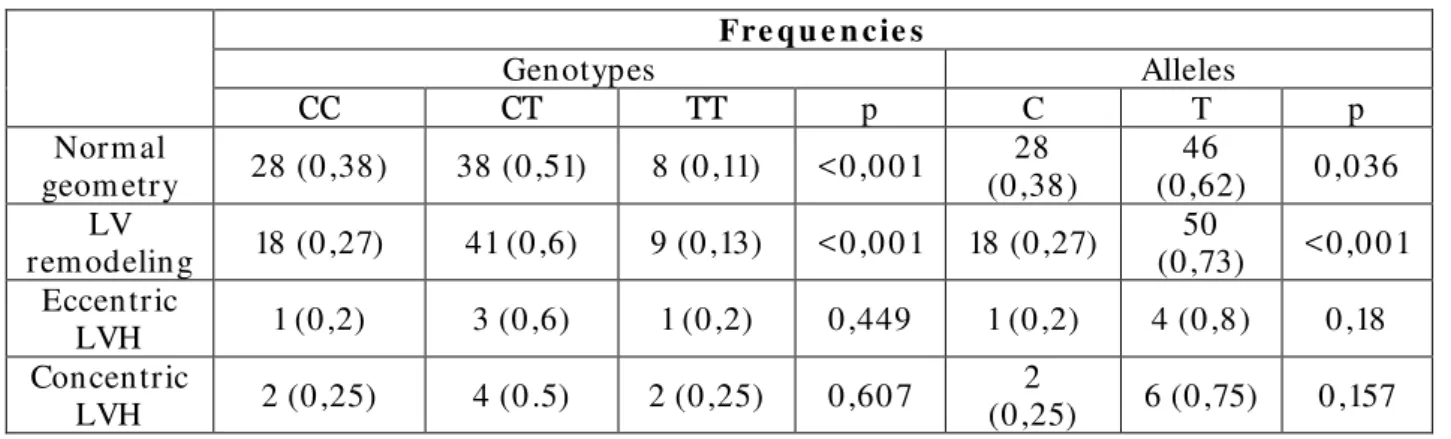
3.3. It is advisable to investigate the distribution of genotypes and alleles of C8 25T polym orphism of GNB3 gene in patients with EH according to types of heart geom etry (Table 3).
Table 3: Distribution of genotypes and alleles of C8 25T polym orphism of GNB3 gene in patients with EH according to types of heart geom etry
Fre q u e n c ie s
Genotypes Alleles
СС СТ ТТ p C T p
Norm al
geom etry 28 (0 ,38) 38 (0 ,51) 8 (0 ,11) <0 ,0 0 1
28 (0 ,38)
46
(0 ,62) 0 ,0 36 LV
rem odeling 18 (0 ,27) 41 (0 ,6) 9 (0 ,13) <0 ,0 0 1 18 (0 ,27)
50
(0 ,73) <0 ,0 0 1 Eccentric
LVH 1 (0 ,2) 3 (0 ,6) 1 (0 ,2) 0 ,449 1 (0 ,2) 4 (0 ,8) 0 ,18 Concentric
LVH 2 (0 ,25) 4 (0 .5) 2 (0 ,25) 0 ,60 7
2
(0 ,25) 6 (0 ,75) 0 ,157
•p – value of significance
The frequency of CC genotype was in 3.5 tim es higher com pare TT genotype in patients with norm al geom etry and in 2.5 tim es higher in patients with LV rem odeling.
The frequency of the T allele was significantly higher in patients with LV rem odeling com pare the patients with norm al geom etry (0 .43 versus 0 .365 respectively). We didn’t find significant difference of frequency genotypes and alleles for eccentric and concentric types of LVH .
4 . D is c u s s io n
Potential candidate genes of LVH include ones encoding proteins regulating cardiac structure, hem odynam ic load, calcium hom eostasis, horm ones, substrate m etabolism , growth factors, energy m etabolism and cell signaling [11]. One of them is C8 25T polym orphism of GNB3 gene. Furthem ore, C8 25T polym orphism s of GNB3 gene associated with LV m ass and LVH in hypertensive patients [18]. H ypertensive patients with echocardiographic criteria of LVH have higher risk cardiovascular com plications and m ortality com pare without these criteria [19].
In the present study we showed the association of C8 25T polym orphism of the GNB3 with LVH in patients with EH and the im pact of these polym orphism s on param eters of som e echocardiographic characteristics and LV geom etry.
The results showed that frequency genotypes and alleles am ong Ukrainian hypertensive patients (0 .4) was sim ilar to that reported in Russian and European populations [8 ; 20 ; 21]. The T allele frequency in hypertensive Asians, Caucasians and Africans was 0 .46, 0 .33 and 0 .79 respectively [22]. Siffert et al.20 0 3 founded that T allele frequency was the lowest in Germ ans (0 ,319), interm ediate in Chinese (0 .477) and the highest in Africans (0 .814 to 0 .8 41) [7].
Our results indicate that hypertensive patients with CT, TT genotypes and T allele carriers had greater LV dim ensions and thickness com pare patients with the CC genotypes and C allele carriers. Poch et al. 20 0 0 had sim ilar results from European population [8]. Sem plicini A. et al. 20 0 1, Sartori et al. 20 0 4 showed that patients carrying the T allele of GNB3 gene had an increased LVM and LVMI in com parison to those with CC genotype and C allele that conform able with our results [18 ; 23].
In contrast our results, Schlyaktho E.V. et al. 20 0 2 showed lack of association of C8 25T polym orphism of GNB3 gene in hypertensive patients. Russian researches did not get differences frequency of the T allele in patients with LVH com pared to those without LVH and the LVMI, echocardiographic param eters were sim ilar hypertensive patients with the CC, CT and TT genotypes [13]. The results from study of Taiwan and Em irati populations showed that C8 25T polym orphism of GNB3 gene not associated with LVH in hypertensive patients [24; 25].
In our study we found that in patients with EH prevails norm al geom etry and LV rem odeling that are m ore favorable variants of heart geom etric. But in the study of Illyash M.G. et al. 20 14 am ong Ukrainian m iners with EH prevailed eccentric type of LV geom etry [26]. Results of Cuspidi C. et al. 20 12 showed that eccentric LVH was m ore frequent than concentric LVH in contrast our results [27]. The distribution of genotypes and alleles of C8 25T polym orphism GNB3 in patients with EH according type of LV geom etry didn’t dem onstrate association C8 25T polym orphism GNB3 and types of LV geom etry. Bella J . et al. 20 12 observed m arginal im pact of genetic variations on form s of LVH and explained it other predictors such as: obesity, high salt diets, glucose m etabolism , age, level of blood pressure, BMI, duration arterial hypertension [11].
In sum m ary, we showed that the T allele of C8 25T polym orphism GNB3 gene is associated with LVH , higher som e echocardiographic param eters LV, LVM, LVMI but not associated with types of LV geom etry in patients with EH in Ukrainian population.
Re fe re n ce s :
1. Brazhnik V.A., Zateĭshchikov D.A., Sidorenko B.A. Hereditary factors and left ventricular hypertrophy. Kardiologiia. 20 0 3;43(1):78 -88 .
2. Iaccarino G., Izzo R., Trim arco V., Cipolletta E., Lanni F., Sorriento D., Iovino G.L., Rozza F., De Luca N., Priante O., Di Renzo G., Trim arco B. Beta2-adrenergic receptor polym orphism s and treatm ent-induced regression of left ventricular hypertrophy in hypertension. Clin Pharm acol Ther. 20 0 6;8 0 (6):633-45.
3. Parry H .M., Donnelly L.A., Van Zuydam N, Doney A.S., Elder D.H ., Morris A.D., Struthers A.D., Palm er C.N., Lang C.C.; Wellcom e Trust Case Control Consortium 2. Genetic variants predicting left ventricular hypertrophy in a diabetic population: a Go-DARTS study including m eta-analysis. Cardiovasc Diabetol. 20 13 ;12:10 9.
4. Arnett D.K., de las Fuentes L., Broeckel U. Genes for left ventricular hypertrophy. Curr H ypertens Rep. 20 0 4;6(1):36-41.
5. H indorff L.A., H eckbert S.R., Psaty B.M., Lum ley T, Siscovick D.S., H errington D.M., Edwards K.L, Tracy R.P. beta(2)-Adrenergic receptor polym orphism s and determ inants of cardiovascular risk: the Cardiovascular H ealth Study. Am J H ypertens. 20 0 5;18 (3):392-397.
6. Rosskopf D., Busch S., Manthey I., Siffert W. G protein beta 3 gene: structure, prom oter, and additional polym orphism s. H ypertension. 20 0 0 ;36(1):33-41.
7. Siffert W. Effects of the G protein beta 3-subunit gene C8 25T polym orphism : should hypotheses regarding the m olecular m echanism s underlying enhanced G protein activation be revised? Focus on "A splice variant of the G protein beta 3-subunit im plicated in disease states does not m odulate ion channels". Physiol Genom ics. 20 0 3;13(2):81-8 4.
8 . Poch E., González D., Góm ez-Angelats E., Enjuto M., Paré J .C., Rivera F., de La Sierra A. G-Protein beta(3) subunit gene variant and left ventricular hypertrophy in essential hypertension. H ypertension. 20 0 0 ;35(1 Pt 2):214-218 .
9. H engstenberg C., Schunkert H ., Mayer B., Döring A., Löwel H ., H ense H.W., Fischer M., Riegger G.A., Holm er S.R. Association between a polym orphism in the G protein beta3 subunit gene (GNB3) with arterial hypertension but not with m yocardial infarction. Cardiovasc Res. 20 0 ;49(4):8 20 -8 27.
10 . Olszanecka A., Kawecka-J aszcz K., Kuznetsova T., Stolarz K., Brand E., Ryabikov A., H errm ann S.M., Nikitin Y., Staessen J .A. European Project on Genes in H ypertension (EPOGH ) Investigators. Am bulatory blood pressure and left ventricular structure and function in relation to the G-protein beta3-subunit polym orphism C8 25T in White Europeans. J Hum ypertens. 20 0 3;17(5):325-332.
11.Bella J . N., Göring H . H . Genetic epidem iology of left ventricular hypertrophy Cardiovasc Dis. 20 12; 2(4): 267– 278.
12.Sedlácek K., Fischer M., Erdm ann J ., H engstenberg C., H olm er S., Kürzinger S., Muscholl M., Luchner A., Riegger G.A., H ense H.W., Schunkert H . Relation of the G protein beta3-subunit polym orphism with left ventricle structure and function. H ypertension. 20 0 2;40 (2):162-167.
13.Shlyakhto E.V., Shwartz E.I., Nefedova Y.B., Zukova A.V., Vinnic T.A., Konrady A.O. Lack of association of G-protein subunit gene C8 25T polym orphism with left ventricular hypertrophy in essential hypertension. Med Sci Monit. 20 0 2;8 (5):337-340 .
14.Wang X., Wang S., Lin R., J iang X., Cheng Z., Turdi J ., Ding J ., Wu G., Lu X., Wen H . GNB3 gene C8 25T and ACE gene I/ D polym orphism s in essential hypertension in a Kazakh genetic isolate. J H um H ypertens. 20 0 4;18(9):663-668 .
15.Mancia G., De Backer G., Dom iniczak A., Cifkova R., Fagard R., Germ ano G., et al. 20 13 ESH / ESC Guidelines for the Managem ent of Arterial H ypertension: The Task Force for the Managem ent of Arterial H ypertension of the European Society of H ypertension (ESH) and of the European Society of Cardiology (ESC). J H ypertens. 20 13; 31(7):1288 – 1298 .
16.Devereux R., Reichek N. Echocardiographic determ ination of left ventricular m ass in m an Anatom ic validation of the m ethod Circulation. 1977;55:613-618 .
17.Canau A., Devereux R., Rom an. Patterns of left ventricular hypertrophy and geom etric rem odeling in essencial hypertension. J . Am . Coll. Cardiol. 1992;196:1550 -1558 .
18 . Sem plicini A., Siffert W., Sartori M., Monari A, Naber C., Frigo C., Santonastaso M, Cozzutti E, Winnicki M, Palatini P. G protein beta3 subunit gene 8 25T allele is associated with increased left ventricular m ass in young subjects with m ild hypertension. Am J H ypertens. 20 0 ;14(12):1191-1195.
19.Metcalfe B.L., H uentelm an M.J ., Parilak L.D., Taylor D.G., Katovich M.J ., Knot H .J ., Sum ners C, Raizada MK. Prevention of cardiac hypertrophy by angiotensin II type-2 receptor gene transfer. H ypertension. 20 0 4;43(6):1233-1238.
20 . Schunkert H., H ense H .W., Döring A., Riegger G.A.J ., Siffert W. Association between a polym orphism in the G protein β3 subunit gene and lower renin and elevated diastolic blood pressure levels. H ypertension. 1998;32:510 – 513.
21.Velittchenko E., Avtandilov A., Bobkov A., Ryabov G. G protein beta 3 subunit 8 25T allele and diastolic dysfunction . European J ournal of Heart Failure Supplem ents. 20 0 5; 4(l):49-50 .
22. Guo L., Zhang L.L., Zheng B., Liu Y., Cao X.J ., Pi Y., Li B.H ., Li J .C. The C8 25T polym orphism of the G-protein β3 subunit gene and its association with hypertension and stroke: an updated m eta-analysis. PLoS One. 20 13;8(6):e658 63
23. Sartori M., Parotto E., Ceolotto G., Papparella I., Lenzini L., Calò L.A., Sem plicini A. C8 25T polym orphism of the GNB3 gene codifying the G-protein beta3-subunit and cardiovascular risk. Ann Ital Med Int. 20 0 4;19(4):240 -248 .
24. Tsai C.H., Yeh H .I., Chou Y., Liu H.F., Yang T.Y., Wang J .C., Wang N.M., Chang J .G. G protein beta3 subunit variant and essential hypertension in Taiwan - a case-control study. Int J Cardiol. 20 0 0 ;73(2):191-195; discussion 197-198 .
25. Mahm ood M.S., Mian Z.S, Afzal A., Frossard P.M. G-protein beta-3 subunit gene 8 25C>T dim orphism is associated with left ventricular hypertrophy but not essential hypertension. Med Sci Monit. 20 0 5;11(1):6-9.
26. Illyash M. G., Andrushchenko T. A., Basanets A. V., Dolinchuk L. V. Molecular and genetic analyses of left ventricular hypertrophy in coal m iners of Ukraine. Ukrainian cardiologic journal 20 14;1: 50 -55.
27. Cuspidi C., Rescaldani M., Sala C. Prevalence of echocardiographic left-atrial enlargem ent in hypertension: a system atic review of recent clinical studies. Am J H ypertens. 20 13;26(4):456-464.