vol. 45, n. 1, jan./mar., 2009
Ar
*Correspondence: O. M. M. F. Oliveira. Depto. de Bioquímica e Tecnologia Química, Instituto de Química – UNESP, R. Prof. Francisco Degni, s/n.- Quitan-dinha - 4800-900 - Araraquara - SP, Brasil. E-mail: [email protected], [email protected]
Salacia campestris root bark extract: peroxidase inhibition,
antioxidant and antiradical profile
José Carlos Rebuglio Vellosa
1,*, Najeh Maissar Khalil
2, Vânia Ortega Gutierres
4, Vânia Aparecida
de Freitas Formenton Macedo dos Santos
3, Maysa Furlan
3, Iguatemy Lourenço Brunetti
4, Olga
Maria Mascarenhas de Faria Oliveira
3,*
1University Laboratory of Clinical Analysis, Toxicological and Clinical Analysis Department, Paraná State University of Ponta
Grossa, 2Pharmacy Department, MidWest Paraná State University,3Biochemistry and Technological Chemistry Department, Chemistry Institute, Sao Paulo State University, 4Clinical Analysis Department, School of Pharmaceutical Sciences, Sao Paulo
State University, 5Organic Chemistry Department, Chemistry Institute, Sao Paulo State University
Reactive oxygen species (ROS) and free radical species have been implicated in initiating or accompanying many diseases in living organisms; there is thus, a continual need for antioxidants molecules to inactivate ROS/free radicals. Many studies of plants crude extracts have demonstrated free-radical scavenging and antioxidant action. Salacia species have long been used, in several countries, as traditional medicines against certain diseases and for their anti-inlammatory properties. In this study, Salacia campestris Walp (Hippocrateaceae) root bark ethanol extract (ScEtOH) was assessed for its ability to scavenge free radicals and reactive oxygen species; the results were expressed as percentage inhibition of the active species. ScEtOH was eficient against studied species: DPPH radical (obtained inhibition = 30%), ABTS•+ (IC
50
= 1.8±0.8 µg/mL), HOCl (IC50 = 1.7 ± 0.1 µg/mL), O2
•- (obtained inhibition = 32%), and NO• (obtained
inhibition = 18 %). Peroxidase activity inhibition was evaluated through the guaiacol oxidation reaction catalyzed by hemin, HRP and myeloperoxidase (MPO); data showed that ScEtOH at 10 µg/mL led to 54 and 51% of inhibition, respectively, for the hemin and HRP systems. In the MPO system, ScEtOH promoted a 50% inhibition at 8.9 µg/mL, whereas quercetin, a powerful MPO inhibitor, inhibited this system at 1.35 µg/mL.
Uniterms: Salacia campestris Walp/antioxidant properties. Hippocrateaceae. Myeloperoxidase. Reactive
oxygen species. Antioxidants. Free radicals.
Espécies reativas do oxigênio (ERO) e radicais livres estão relacionados ao início ou à exacerbação de muitas doenças em organismos vivos; existindo portanto uma necessidade contínua por moléculas antioxidantes que inativem as ERO e radicais livres. Muitos estudos com extratos brutos de plantas têm demonstrado propriedades antioxidantes e seqüestradoras de radicais livres. Espécies de Salacia são utilizadas, em muitos países, como remédio tradicional contra certas doenças e por suas propriedades antiinlamatórias. Neste estudo, o extrato bruto etanólico da casca da raiz da Salacia campestris Walp (Hippocrateaceae) foi avaliado quanto à sua habilidade em seqüestrar radicais livres e espécies reativas do oxigênio; os resultados são expressos como porcentagem de inibição das espécies ativas. ScEtOH mostrou-se eiciente frente as espécies estudadas: radical DPPH (inibição obtida = 30%), ABTS•+ (IC
50 =
1,8±0,8 µg/mL), HOCl (IC50 = 1,7 ± 0,1 µg/mL), O2
•- (inibição obtida = 32%), and NO• (inibição obtida
= 18%). A inibição da atividade peroxidásica foi avaliada através da oxidação do guaiacol catalisada pela hemina, HRP e mieloperoxidase (MPO); os dados mostram que 10 µg/mL de ScEtOH promovem 54 e 51% de inibição, respectivamente para os sistemas da hemina e da HRP. No sistema da MPO, ScEtOH promoveu 50% de inibição na dose de 8,9 µg/mL, enquanto a quercetina, um potente inibidor da MPO promoveu tal inibição com 1,35 µg/mL.
INTRODUCTION
The oxidative burst from polymorphonuclear neu-trophils (PMN) entail the production of reactive oxygen species (ROS) generated by two key enzymes, NADPH oxidase and myeloperoxidase (MPO). Free radicals may play an important role in the origin of life and in biological evolution, and have beneicial effects in living aerobes. For example, oxygen radicals act critically in signal transduc-tion, gene transcription and regulation of soluble guanylyl cyclase activity in cells (Tepe et al., 2005a). However, free radicals and other relative species can oxidize biomolecu-les (e.g., protein, amino acids, lipid, and DNA), leading to cell injury and death. Oxidative stress, a disturbance of the oxidant/antioxidant ratio in living aerobic organisms, may be involved in processes such as mutagenesis, carcinoge-nesis, lipid peroxidation, fragmentation of proteins, and carbohydrate damage (Ferreira, Matsubara, 1997; Babior, 2000). Experimental data have indicated that free radicals play a critical role in a variety of pathological processes,
including aging, multiple sclerosis, inlammation, coro
-nary heart and cardiovascular diseases, senile dementia, arthritis and atherosclerosis (Ferreira, Matsubara, 1997; Babior, 2000; Benedì et al., 2004; Vellosa et al., 2007a).
A continual supply of antioxidant molecules is neces-sary for ROS inactivation. In an effort to prevent or diminish induced ROS damage, investigators have evaluated com-pounds that prevent their generation and reduce the damage. Recent studies shown that a number of plant products, inclu-ding polyphenols, lavonoids and terpenes and various plant extracts, exert a free-radical scavenging and an antioxidant action (Corsino et al., 2000; Pereira et al., 2005; Carvalho
et al., 2005; Cui et al., 2005; Benedì et al., 2004;). Natural antioxidants obtained from plant extracts have attracted increasing interest, owing to consumer concern about the safety of the synthetic antioxidants in food. Extracts from fruits, vegetables, cereals and their by-products have shown effective antioxidant activity in model biological systems (Tepe et al., 2005b; Sun, Ho, 2005).
Several representatives of the related
Hippocratea-ceae and Celastraceae families are claimed to be medi-cally useful as antimicrobial, anticancer and antimalarial.
Some Salacia species (Hippocrateaceae) have long been
used in India, Sri Lanka, and China as traditional medi
-cines for the treatment of rheumatism and skin diseases, and also for their anti-inlammatory properties (Carvalho
et al., 2005).
Quinonemethide triterpenes, secondary metabolites restricted to the higher plant families Celastraceae and Hippocrateaceae, have shown a variety of biological ac-tivity such as antitumoral, antimicrobial and antimalarial
(Corsino et al., 2000). Carvalho et al. (2005) described the occurrence of several quinonemethide triterpenes (salacin, friedelin, pristimerin, maytenin, 20α-hydroxymaytenin
and netzahualcoyene) in S. campestris (Hippocrateaceae)
root barks and compared their anti-radical properties by their DPPH scavenger potential.
Protection of the living organism against oxidative stress relies not only on endogenous antioxidants, but also on exogenous compounds taken in food and beverages. In
view of the therapeutic actions of Salacia species against
rheumatism and inlammation, it is important to evaluate
the antioxidant and antiradical potential of Salacia
cam-pestris Walp. It would also be useful to know if crude
extract or isolated compounds from S. campestris are able
to inhibit ROS generation by peroxidases, mainly MPO.
MATERIALS AND METHODS
Experimental apparatus and analytical condition
This study was undertaken in order to assess the
antioxidant activity of crude ethanol extract of S.
cam-pestris root bark (ScEtOH) by determining its capacity to scavenge free radicals and some reactive oxygen species, and inhibit peroxidase activity from hemin, HRP type VI (horseradish peroxidase; EC 1.11.1.7) and MPO (from
polymorphonuclear neutrophils of Rattus norvegicus var.
albinus). All assays were done with a HP 8453 Diode
Array Spectrophotometer. Various doses of plant extract, uric acid (a natural antioxidant) and trolox (E vitamin analogue) were assayed and their scavenger capacities against oxidant species were calculated as mean values of triplicates assays and expressed as percentage of radical or ROS scavenged (% inhibition) calculated for HOCl assay
by Eq.1, and by Eq.2 for DPPH, ABTS•+, NO• assays.
Eq.1
Where: A0 is test absorbance at 412 nm without
HOCl or sample, A1 is test absorbance at 412 nm with
HOCl, but no sample and AT is test absorbance at 412 nm
with HOCl and sample.
Eq.2
Where: A is test absorbance without sample and
Plant material
Salacia campestris root barks were identiied and
supplied by Prof. Dr. Maria Helena de O. Antunes, from Fazenda Canchin at the São Carlos Federal University, São Carlos (SP, Brazil). The voucher specimens (No.2845) are deposited at the Herbarium of Botany Department of the Federal University of São Carlos (UFSCar), São Carlos (SP, Brazil). The bark root (51.20 g) from the specimen was dried over 40 °C and triturated. After that, the obtained powder was submitted to an ultrasound extraction with
ethanol (300 mL) by 20 minutes in triplicate and concen
-trating the iltrate under reduced pressure for obtaining an ethanolic crude extract (8.6 g).
Chemicals
Quercetin, ABTS [2,2’-azinobis(3-ethylbenzo
-thiazoline-6-sulfonic acid)], DTNB [5,5’-dithiobis(2-nitrobenzoic acid)], guaiacol, hemin, HRP (horseradish peroxidase), trolox, uric acid, phenazine methosulfate (PMS), NADH, NBT (nitrobluetetrazolium), and DPPH
(2,2-diphenyl-1-picrylhydrazyl) were purchased from Sig
-ma Chemicals Co. Griess Reagent was kindly provided by Professor Iracilda Zeppone Carlos (Clinical Immunology Lab. of the School of Pharmaceutical Sciences – UNESP at Araraquara, SP, Brazil). All other reagents were analytical grade and commercially available.
DPPH radical scavenging activity
DPPH is a free radical that, when dissolved in etha-nol, has purple color. Loss of this color indicates radical
scavenging activity. Ethanol solutions of S. campestris
extracts and trolox and aqueous solutions of uric acid at various concentrations were evaluated against 60 µM DPPH. The reaction mixture (total volume 1.0 mL) was shaken vigorously and allowed to react at room tempe-rature. After 15 min remaining DPPH was determined colorimetrically at 531 nm, using absolute ethanol as a blank (Brand-Williams et al., 1995).
ABTS•+ radical scavenging activity
Pellegrini et al. (1999) used the ABTS•+ assay to
evaluate antioxidant capacity of some fruits extracts using absolute ethanol as diluent. In this paper, ethanol was
re-placed by sodium phosphate buffer. ABTS•+ was prepared
by reacting 5 mL of 7 mM ABTS aqueous solution with 88 µL of 140 mM potassium persulphate (molar ratio 1:0.35) and the mixture allowed to stand in the dark at
room temperature for 12–16 h before use. Prior to assay
this ABTS•+ stock solution was diluted with NaH2PO4/
Na2HPO4 (100 mM, pH 7.0, diluted 1:10 before use) buffer
solution (ratio 1:88) to give an absorbance at 734 nm of
0.414±0.013 (n=40). One milliliter ABTS•+ was then
ad-ded to glass test tubes containing various concentrations of each extract and mixed for 15 s. Tubes were incubated for 30 min and then read at 734 nm.
HOCl scavenging activity
TNB (5-thio-2-nitrobenzoic acid) was produced from DTNB, as described by Ching and co-workers (1994). TNB (80 µM) is oxidized to DTNB by HOCl (22 µM) causing the absorbance at 412 nm to fall while
DTNB absorbance (325 nm) appeared. Samples were incu
-bated with HOCl for 5 min in NaH2PO4/Na2HPO4 (50 mM,
pH 7.0) buffered solution. TNB was then added, following
15 min incubation on 25 °C (Ching et al., 1994).
Superoxide radical scavenging activity
Superoxide radicals, produced by NADH and PMS, reduce NBT and produce a formazan compound. The intensity of color is inversely proportional to the
antioxi-dant concentration (Kakkar et al., 1984). The assay was
carried out in sodium pyrophosphate buffer (0.025 M, pH 8.3) and the mixture contained 25 µL of 372 µM PMS, 75 µL of 600 µM NBT, 50 µL of 1560 µM NADH, plant extract (several volumes) and buffer to complete 1mL inal volume. Reactions were started by adding NADH. After incubation at 25 °C for 90 s, 100 µL of glacial acetic acid and 900 µL of sodium pyrophosphate buffer were added. After vigorous homogenization, the color intensity of mixture was measured at 560 nm.
Nitric oxide radical scavenging activity
For this assay, several volumes of ScEtOH (10 µg/mL) were added to test tubes with sodium nitroprusside solu-tion (25 mM) to give a inal volume of 1 mL, and the tubes
were incubated at 25 0C for 1.5 h. An aliquot (0.25 mL)
of the solution was then withdrawn and diluted with
0.15 mL Griess Reagent (1% sulfanilamide in 5% H3PO4
and 0.1% naphthylethylenediamine dihydrochloride). The absorbance of the chromophore, produced during diazo-tization of the nitrite with sulfanilamide and subsequent coupling with naphthylethylenediamine dihydrochloride, was immediately read at 570 nm. Sodium nitroprusside is known to decompose in aqueous solution at
reacts with oxygen to produce the stable products nitrate and nitrite, and the nitrite can be determined with Griess reagent. The inal absorbance at 570 nm is diminished by an NO• scavenger, because less nitrite is produced to form
the chromophore (Yen et al., 2001).
Hemin and HRP assays
We evaluated the effect of S. campestris extract
(10, 1 and 0.1 µg/mL) on: i) Hemin, prosthetic group of peroxidases; the assay was performed in sodium phosphate
buffered saline (PBS) pH 7.0, 250C, using 3 mM hemin,
2.5 mM H2O2, and 5 mM guaiacol; ii) HRP, an important
and well studied peroxidase used as a model for peroxidase inhibition studies; we used Dulbecco’s phosphate buffered
saline (PBS-D), at 37 0C, 7 nM HRP, 2 mM guaiacol and
0.1 mM H2O2 which initiated the reaction, followed for
1 min at 470 nm. The kinetic constant v0 was determined
by graphical analysis. All reactions were monitored in the presence of the S. campestris extract (10, 1 and 0.1 µg/mL)
and in its absence. Quercetin, a MPO inhibitor (Pincemail
et al., 1988) was used as a peroxidasic inhibitor pattern.
Myeloperoxidase (MPO) assay
Reactions with MPO were carried out by guaiacol
oxidation, with several concentrations of S. campestris
extract, in PBS buffer pH 7.0. The absorbance rate was
followed at 470 nm. The inal concentrations in the reac
-tion mixture were 20 mM guaiacol and 0.2 mM H2O2 plus
75 mU MPO. In this system MPO inhibition from ScEtOH and quercetin was evaluated.
MPO extraction from PMN
These procedures were approved by the UNESP-School of Pharmaceutical Sciences Ethical Committee (process 09/2005). Neutrophils (PMN) were isolated
ac-cording to Paino et al. (2005). PMN were obtained from
6 male adults (100-160 grams) Rattus norvegicus var.
albinus. Each rat was intraperitoneally inoculated with 5 mL of 1% oyster glycogen in 0.85% NaCl. The animal was sacriiced 12 h later and its peritoneal cavity washed with 20 mL PBS-D buffer (calcium free) to obtain a suspension of neutrophils. This was centrifuged at 200 xg, for 3 min. The sediment was washed twice with PBS, then resuspen-ded in 500 µL of this buffer, and kept at –20 ºC for 12 h. After cell rupture and centrifuging at 200g a crude extract containing MPO was obtained. MPO was determined by assaying guaiacol oxidation in PBS buffer at pH 7.0. The reaction was followed at 470 nm, with 100 mM guaiacol
and 0.5 mM H2O2 at 25°C. The MPO activity (U/mL) was
deined by eq. 3.
RESULTS AND DISCUSSION
DPPH is a stable free radical that can accept an electron or hydrogen radical to become a stable dia-magnetic molecule; because of its odd electron, in the ethanol solution shows a strong absorption band at 531
nm (Brand-Williams et al., 1995). As DPPH reacts with
suitable reducing agents, this electron becomes paired off causing a color change from purple to yellow and the solution loses color stoichiometrically with the number of electrons taken up. This reactivity has been widely used to test either the ability of diverse compounds to act as free radical scavengers or the antioxidant activity of
plant extracts (Soares et al., 1997). DPPH reduction was
estimated from the bleaching of the radical solution (decay of absorbance at 531 nm) in the presence of the extracts
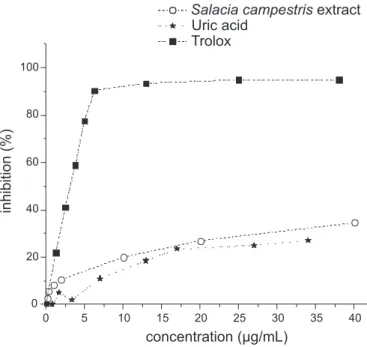
and substances assayed. Fig.1 shows dose-response cur
-ves obtained DPPH scavenging using trolox, uric acid or ScEtOH. Whereas the ethanol extract and uric acid did not promote 50% inhibition within the assayed doses, trolox was shown to be a good free radical scavenger with an
IC50 of 3.3+0.4 µg/mL, raising 94% inhibition at about
13µg/mL. According to these data, ScEtOH was a slightly
FIGURE 1 - DPPH radical (60 µM) scavenger action by S.
campestris extract, uric acid and trolox. The reactions were made
better DPPH scavenger than uric acid. The S. campestris
ethanolic extract inhibition (30% in 40µg/mL) was similar
to the one observed to the ethanolic extract from Maytenus
aquifolium in a previous study (Vellosa et al., 2007b).
The ABTS•+ assay has been used to screen the
relative radical-scavenging capacities of lavonoids and phenolics, which act as electron- or H-donating agent or plant extracts that contains these substances (Pellegrini et
al., 1999). The green cation radical ABTS•+ has absorbance
peaks at 630, 734 and 812 nm. On interaction with antio
-xidants the radical is reduced, suppressing the absorbance of the green radical cation in a dose-dependent way. From the data in Fig. 2, the samples can be classiied in order
of descending scavenging power, by comparing IC50
va-lues (in brackets): trolox (0.7 ± 0.04 µg/mL) > uric acid
(1.2 ± 0.06 µg/mL) > ScEtOH (1.8 ± 0.08 µg/mL). Vello
-sa et al. (2006) and Oliveira et al. (2007) observed good
DPPH scavenger action respectively to Maytenus ilicifolia
(IC50 = 2 µg/mL) and Agaricus Blazei (IC50 = 23 µg/mL).
The S. campestris ethanolic extract is so efficient sca-venger of ABTS•+ as it was M. ilicifolia ethanolic extract
and more eficient than A. blazei ethanolic extract. The
S. campestris ethanolic extract has a bigger scavenger
capacity than Maytenus aquifolium (IC50 = 4 µg/mL)
(Vellosa et al., 2007b).
In biological systems, hypochlorous acid is the most toxic and abundant oxidant agent produced by PMN
(Lapenna, Cuccurollo, 1996; Vellosa et al., 2007c). It can
attack important biological molecules and generate other harmful ROS (Weiss, 1989; Eaton, 1993). This oxidant
specie reacts with ammonia produced by Helicobacter
pylori in human stomach to produce the microbicide monochloramine, which is also related to stomach injury observed in gastric ulcers (Lapenna, Cuccurollo, 1996). Hence, it is important to discover drugs and plant extracts
that are able to ight HOCl. Here, we evaluated the poten
-tial of ScEtOH to scavenge HOCl, in a comparative study with trolox and uric acid. From the results in Fig. 3, the IC50 values can be obtained and used to rank the samples as HOCl scavengers: uric acid (0.3 ± 0.03 µg/mL) > ScEtOH (1.7 ± 0.1 µg/mL) > trolox (3.1 ± 0.3 µg/mL). These values were equal to those ones obtained to Maytenus species in previous studies (Vellosa et al., 2006, 2007b). The results
are very encouraging, because S. campestris leaves, like
Maytenus ilicifolia and Maytenus aquifolium, are currently used in Brazilian folk medicine against gastric ulcers and any gastric protection obtained may be explained, at least partly, by scavenging HOCl.
ScEtOH action over superoxide anion was evaluated by a non-enzymatic method of generating superoxide by reacting phenazine methosulfate with NADH. The supero-xide is stained by NBT. We used this system to evaluate if the samples tested are able to antagonize superoxide anion
in vitro. It is important to note that in this method, NBT must be in excess to evaluate the real potential of samples to scavenge the superoxide anion. Any superoxide sca-venger potential found for ScEtOH could be expected to contribute to a possible protective action in various tissues, including stomach. From Figure 4, it can be concluded that
FIGURE 2 - ABTS•+ radical (55 µM) Scavenger action by S.
campestris extract, uric acid and trolox. The reactions were
made in 10mM sodium phosphate buffer, pH 7.0, 25 0C, and
incubated by 30 min.
FIGURE 3 - HOCl (22 µM) Scavenger action by S. campestris
extract, uric acid and trolox. The reactions were made in 50mM
sodium phosphate buffer, pH 7.0, 25 0C, and incubated by
S. campestris ethanol extract is much better than either uric acid or trolox at scavenging superoxide radical anion.
Recent studies have shown that reactive nitrogen
intermediates, such as nitric oxide (NO•), peroxynitrite
(ONOO•-) and nitrogen dioxide (NO2), also play an
im-portant part in the inflammatory process and possibly
in carcinogenesis (Yen et al., 2001). We constructed an
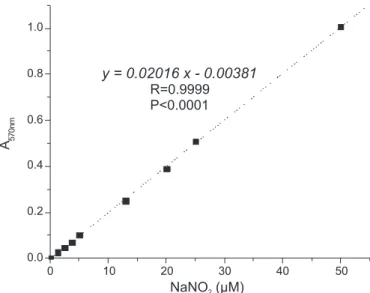
analytical curve with sodium nitrite to calculate the nitric oxide level in the sodium nitroprusside method described above. In this method, using sodium nitroprusside as a source of nitric oxide, control tubes (without scavengers)
had absorbance values of 0.428+0.02 (n=40), representing
about 21 µM NO• (Figure 5). We evaluated the potential
of trolox, uric acid and ScEtOH as nitric oxide scavengers (Figure 6). Note that trolox is unable to scavenge nitric oxi-de. The data show that ScEtOH and uric acid had similar scavenging action against the nitric oxide radical.
ScEtOH is effective over the evaluated systems
- DPPH radical (obtained inhibition = 30%), ABTS•+
(IC50 = 1.8±0.8 µg/mL), HOCl (IC50 = 1.7 ± 0.1 µg/mL),
O2•- (obtained inhibition = 32%), and NO• (obtained
inhi-bition = 18%). According to results previously published
by Vellosa et al. (2007 B), ScEtOH have a similar poten
-tial to Maytenus aquifolium on scavenging these species
(exception against ABTS•+) – DPPH radical (obtained
inhibition = 36 %), ABTS•+ (IC
50 = 3.6±0.3 µg/mL), HOCl
(IC50 = 2.0±0.1 µg/mL), O2•- (obtained inhibition = 36 %),
and NO• (obtained inhibition = 18 %). In previous studies
Carvalho et al. (2005) and Corsino et al. (2000) had
isola-ted from S. campestris some quinonepethides triterpenoids
that presented antioxidant properties that may be related to the results observed in this paper. However, due the
hydrophobic nature of these compounds [(Carvalho et
al. (2005) have extracted these compounds using CH2Cl2
as solvent, and Corsino et al. (2000) had used hexane],
quinonemethides triterpenes must be at low levels in the evaluated ethanolic extract. The results observed must be explicated mainly by the hydrophilic lavonoids extracted by ethanol as solvent.
Peroxidases are heme-containing enzymes that use
FIGURE 4 - Superoxide anion radical Scavenger action by S.
campestris extract, uric acid and trolox. The reactions were
made in 25 mM sodium pyrophosphate buffer, pH 8.3, 250C,
and incubated by 90 s.
FIGURE 5 - Analytical curve of sodium nitrite developed by Griess Reagent. The reactions were made in 50 mM sodium
phosphate buffer, pH 7.0, 25 0C, and incubated by 15 min.
FIGURE 6 - Nitric oxide Scavenger action by S. campestris
extract, uric acid and trolox. The reactions were made in 50 mM
sodium phosphate buffer, pH 7.0, 25 0C, and incubated by 90
H2O2 to oxidize a variety of biomolecules and xenobiotics. The heme in the native enzyme is usually ferriprotopor-phyrin IX, with four pyrrole nitrogens bound to the Fe(III). The ifth coordination position on the proximal side of the heme is usually occupied by the imidazole side chain of a histidine residue. The sixth coordination position is vacant in the native enzyme on the distal side of the heme. Plant peroxidases, e.g. horseradish peroxidase, consist of about
300 amino acids and a non-covalently bound heme, whe
-reas mammalian peroxidases are much larger (576–738 amino acids) and the heme is covalently bound (O’Brien, 2000). In this paper, we evaluated the effect of quercetin,
a powerful MPO inhibitor (Pincemail et al., 1988), and
ScEtOH on hemin (free heme from peroxidases) and HRP activity. The results are showed in Tables 1 and 2. At the highest concentration (10 µg/mL) ScEtOH inhibited guaiacol oxidation by hemin and by HRP. So, it is possible that the mechanism of peroxidase inhibition by ScEtOH is related to an action over the enzymes prosthetic group.
MPO is an important peroxidase from neutrophils
that uses H2O2 and chloride ions to catalyze the
produc-tion of the reactive and cytotoxic oxidant hypochlorous
acid (Jerlich et al., 2000). Effects of ScEtOH and
quer-cetin on MPO inhibition were evaluated by guaiacol oxidation method. ScEtOH promoted a 50% inhibition at
8.9 µg/mL whereas quercetin (Pincemail et al., 1988) inhi
-bited by 50% at 1.35 µg/mL, both responses being clearly dose-dependent (Figure 7). Quercetin and ScEtOH were able to inhibit guaiacol oxidation by peroxidases (MPO and HRP) and their prostetic group, where quercetin was a more efficient inhibitor. The inhibition observed by the extract may be related to its lavonoids contends and further studies must clarify which lavonoids are able to act as MPO inhibitor and what would be their potential compared to quercetin, a well known lavonoid.
CONCLUSION
We demonstrated that S. campestris ethanol extract
was able to scavenge various oxidant and radical species and inhibit myeloperoxidase, an enzyme involved in many physiological and pathological conditions. We conclude that ScEtOH is eficient against several species assayed. The results provide useful pharmacological information related to free radicals and oxidant species. It is possible that the use of this plant to treat certain pathologies could
prevent or ight tissue damage when this involves an es
-tablished oxidative stress. Of course, further studies are necessary, including: i) isolation and characterization of
active compounds from this plant; ii) in vivo studies of
biological properties that conirm the possibility suggested
TABLE 1 - Guaiacol (5 mM)/H2O2 (2.5 mM) oxidation by hemin
(3 µM) in presence and absence of S. campestris ethanolic
extract or quercetin; v0 values – mean±SD (p<0.05). The reactions were made in 50mM sodium phosphate buffer, pH
7.0, 25°C, and incubated by 60 s
Sample v0 (1.10-4 s-1) Control (no
sample) 54 ±7
10 µg/mL 1 µg/mL 0.1 µg/mL
S. campestris
extract 23±2 56±7 51±1 quercetin 3±1 35±4 52±3
TABLE 2 – Guaiacol (2 mM)/H2O2 (0.1 mM) oxidation by HRP(7
nM) in presence and absence of S. campestris ethanolic extract or quercetin; v0 values – mean±SD (p<0.05). The reactions were
made in 50mM sodium phosphate buffer, pH 7.0, 37 °C, and
incubated by 60 s
Sample v0 (1.10-4 s-1)
Control (no sample)
144±10
10µg/mL 1 µg/mL 0.1 µg/mL
S. campestris
extract
70±10 145±7 135±7
quercetin 15±2 129±2 138±9
FIGURE 7 - Myeloperoxidase (75 mU) inhibition, by quercetin
and ScEtOH, in a system with H2O2 (0.2 mM) and guaiacol (20 mM) The reactions were made in 50 mM sodium phosphate
here; and iii) toxicological studies to evaluate the safety of this plant as a medicinal agent.
ACKNOWLEDGEMENTS
This work was supported by grants provided by FAPESP. Maysa Furlan is grateful to CNPq for research fellowship. José Carlos R. Vellosa and Vânia A. F. For-menton are grateful to CAPES and CNPq, respectively, for scholarship.
REFERENCES
BABIOR, B.M. Phagocytes and Oxidative Stress. Am. J. Med.,
v.109, p.33-44, 2000.
BENEDÍ, J.; ARROYO, R.; ROMERO, C.;
MARTÍN-ARAGON, S.; VILLAR, A.M. Antioxidant properties and
protective effects of standardized extract of Hypericum perforatum on hydrogen peroxide-induced oxidative
damage in PC12cells. Life Sci., v.75, p.1263-1276, 2004.
BRAND-WILLIAMS, W.; CUVELIER, M.E.; BERSET, C.
Use of free radical method to evaluate antioxidant activity.
Lebensm. Wiss. Technol., v.28, p.25-30, 1995.
CARVALHO, P.R.F.; SILVA, D.H.S.; BOLZANI, V.S.; FURLAN, M. Antioxidant Quinonemethide Triterpenes
from Salacia campestris. Chem. Biodivers., v.2,
p.367-372, 2005.
CHING, T.; JONG, J.; BAST, A. A method for screening hypochlorous acid scavengers by inhibition of the oxidation of 5-thio-2-nitrobenzoic acid: application to anti-asthmatic drugs. Anal. Biochem., v.218, p.377-381, 1994.
CORSINO, J.; CARVALHO, P.R.F.; KATO, M.J.; LATORRE, L.R.; OLIVEIRA, O.M.M.F.; ARAÚJO, A.R.; BOLZANI, V.S.; FRANÇA, S.C.; PEREIRA, A.M.S.; FURLAN, M.
Biosynthesis of friedelane and quinonemethide triterpenoids is compartmentalized in Maytenus aquifolium and Salacia campestris. Phytochemistry, v.55, p.741-748, 2000.
CUI, Y.; KIM, D.S.; PARK, K.C. Antioxidant effect of Innotus obliquus. J. Ethnopharmacol., v.96, p.79-85, 2005.
EATON, J. W. Defenses against hypochlorous acid: parrying the neutrophil’s rapier thrust. J. Lab. Clin. Méd., v.121,
p.197-198, 1993.
JERLICH, A.; FRITZ, G.; KHARRAZI, H.; HAMMEL, M.; TSCHABUSCHNIG, S.; GLATTER, O.; SCHAUR, R.J.
Comparison of HOCl traps with myeloperoxidase inhibitors in prevention of low density lipoprotein oxidation. Biochim. Biophys. Acta, v.1481, p.109-118, 2000.
KAKKAR, P.; DAS, B.; VISWANATHAN, P. N. A modiied
spectrophotometric assay of superoxide dismutase. Indian J. Biochem. Biophys., v.21, p.130-132, 1984.
KIOKIAS, S.; GORDON, M.H. Antioxidant properties of annatto carotenoids. Food Chem., v.83, p.523-529, 2003.
LAPENNA, D.; CUCCUROLLO, F. Hypochlorous acid and
its pharmacological antagonism: an update picture. Gen. Pharmacol., v.27, p.1145-1147, 1996.
OLIVEIRA O.M.M.F., VELLOSA J.C.R., FERNANDES A.S., BUFFA-FILHO W., HAKIME-SILVA R.A., FURLAN M.,
BRUNETTI I.L. Antioxidant activity of Agaricus blazei.
Fitoterapia, v. 78, p.263-264, 2007.
O`BRIEN, P.J. Peroxidases. Chem. Biol. Interact., v.129,
p.113-139, 2000.
PAINO I.M.M., XIMENES V.F., FONSECA L.M. DA, KANEGAE M.P.P., KHALIL N.M., BRUNETTI I.L. Effect
of therapeutic plasma concentrations of non-steroidal
anti-inlammatory drugs on the production of reactive oxygen
species by activated rat neutrophils. Braz. J. Med. Biol. Res.,
v.38, p.543-551, 2005.
PELLEGRINI, N.; RE, R.; YANG, M.; EVANS, C. R.
Screening of dietary carotenoids and carotenoid-rich fruit
extracts for antioxidant activities applying
2,2’-azinobis(3-ethylenebenzothiazoline-6 sulfonic acid radical cation decolorization assay. Methods Enzymol., v.299, p.379-389,
1999.
PEREIRA, A.M.S.; JANUÁRIO, A.H.; QUEIROZ, M.E.E.; BIONDO,R.; FRANÇA, S.C. Evaluation of Maytenus aquifolia Mart. and Maytenus ilicifolia Mart. chemotypes for tannins, total phenols and triterpenes. Rev. Bras. Pl. Med., v.8, p.13-17, 2005.
PINCEMAIL, J.; DEBY, C.; THIRION, A., DE
BRUYN-DISTER, M.; GOUTIER, R. Human myeloperoxidase activity is inhibited in vitro by quercetin. Comparison with three related compounds. Experientia, v.44, p.450-453,
SOARES, J.R.; DINIS, T.C.; CUNHA, A.P.; ALMEIDA, L.M.
Antioxidant activities of some extracts of Thymus zygis.
Free Radic. Res., v.26, p.469-478, 1997.
SUN, T.; HO, C.T. Antioxidant activities of buckwheat extracts.
Food Chem., v.90, p.743-749, 2005.
TEPE, B.; SOKMEN, M.; AKPULAT, A.; DAFERERA, D.; POLISSIOU, M.; SOKMEN, A. Antioxidative activity of
the essential oils of Thymus sipyleus subsp. sipyleus var.
sipyleus and Thymus sipyleus subsp. sipyleus var. rosulans.
J. Food Eng., v.66, p.447-454, 2005a.
TEPE, B.; DAFERERA, D.; SOKMEN, A.; SOKMEN, M.;
POLISSIOU, M. Antimicrobial and antioxidant activities of
the essential oil and various extracts of Salacia tomentosa
Miller (Lamiaceae). Food Chem., v.90, p.333-340, 2005b.
VELLOSA, J.C.R.; BARBOSA, V.F.; OLIVEIRA, O.M.M.F.
Pesquisa de produtos naturais: plantas e radicais livres.
REF, v.4, p.119-130, 2007a.
VELLOSA, J.C.R; BARBOSA, V.F.; KHALIL, N.M.; SANTOS, V.A F. F. M..; FURLAN; M.; BRUNETTI, I.L.;
OLIVEIRA, O.M.M.F.Profile of Maytenus aquifolium
action over free radicals and reactive oxygen species. Rev. Bras. Cienc. Farm., v. 43, p. 447-453, 2007b.
VELLOSA, J.C.R., KHALIL, N.M., FONSECA, L.M. BRUNETTI, I.L.; OLIVEIRA, O.M.M.F. Does cotinine
act over reactive oxygen species and peroxidases?.Eclet. Quím., v.32, p.65-70, 2007c.
VELLOSA, J.C.R; KHALIL, N.M.; FORMENTON, V.A.; XIMENES, V.F.; FONSECA, L.M.; FURLAN; M.; BRUNETTI, I.L.; OLIVEIRA, O.M.M.F. Antioxidant
activity of Maytenus ilicifolia root bark. Fitoterapia, v.77,
p.243-244, 2006.
WEISS, S. J. Tissue destruction by neutrophils. N. Engl. J. Med.,
v. 320, p. 365-376, 1989.
YEN, G. C.; LAI, H. H.; CHOU, H. Y. Nitric oxide scavenging
and antioxidant effects of Uraria crinita root. Food Chem.,
v. 74, p. 471-478, 2001.