290 Radiol Bras. 2013 Set/Out;46(5):290–298
Construction of an index of information from clinical practice
in Radiology and Imaging Diagnosis based on text mining and
thesaurus
*
Construção de um índex de informação da prática clínica em Radiologia e Diagnóstico por Imagem baseada em mineração de texto e tesauro
Paulo Roberto Barbosa Serapião1, Rogério Honório Junior2, Marcelo Alexandre Santos3, Luiz Ricardo Albano dos Santos3, José Carlos Bueno de Moraes3, Paulo Mazzoncini de Azevedo Marques4
Objective: To construct a Portuguese language index of information on the practice of diagnostic radiology in order to improve the standardization of the medical language and terminology. Materials and Methods: A total of 61,461 definitive reports were collected from the database of the Radiology Information System at Hospital das Clínicas – Faculdade de Medicina de Ribeirão Preto (RIS/HCFMRP) as follows: 30,000 chest x-ray reports; 27,000 mammography reports; and 4,461 thyroid ultrasonography reports. The text mining technique was applied for the selection of terms, and the ANSI/ NISO Z39.19-2005 standard was utilized to construct the index based on a thesaurus structure. The system was created in *html. Results: The text mining resulted in a set of 358,236 (n = 100%) words. Out of this total, 76,347 (n = 21%) terms were selected to form the index. Such terms refer to anatomical pathology description, imaging techniques, equipment, type of study and some other composite terms. The index system was developed with 78,538 *html web pages. Conclusion: The utilization of text mining on a radiological reports database has allowed the construction of a lexical system in Portuguese language consistent with the clinical practice in Radiology.
Keywords: Radiology reports; RadLex; Medical education; Information technology; Health informatics.
Objetivo: Construir um índex de informação da prática diagnóstica radiológica em língua portuguesa, com o intuito de auxiliar a uniformizar o uso da linguagem médica e sua terminologia. Materiais e Métodos: Foi extraído um total de 61.461 laudos definitivos do Banco de Dados do Sistema de Informação em Radiologia do Hospital das Clínicas da Faculdade de Medicina de Ribeirão Preto (RIS/HCFMRP), sendo 30.000 laudos de radiografia de tórax, 27.000 laudos de mamografia e 4.461 laudos de ultrassonografia de nódulos de tireoide. Após, foi aplicada a técnica de mineração de texto para seleção dos termos. Foi utilizada a norma ANSI/NISO Z39.19-2005, para a construção do índex baseado em uma estrutura de tesauro. O sistema foi gerado em *html. Resultados: A mineração de texto resultou em 358.236 (n = 100%) palavras. Deste total, 76.347 (n = 21%) termos foram selecionados para formar o índex. Esses termos estão distribuídos em descritivos anatômicos de patologia, de técnica de obtenção de imagem, de equipamento, de tipo do exame e de alguns termos compostos. O sistema índex foi desenvolvido com 78.538 páginas web plenamente navegá-veis. Conclusão: Mineração de texto em base de laudos radiológicos permite a construção de sistemas lexicais, em língua portuguesa, condizentes com a prática clínica em Radiologia.
Unitermos: Laudos radiológicos; RadLex; Educação médica; Tecnologia da informação; Informática em saúde.
Abstract
Resumo
* Study developed at Faculdade de Medicina de Ribeirão Preto da Universidade de São Paulo (FMRP-USP), Ribeirão Preto, SP, Brazil.
1. MD, Fellow PhD degree in Medical Practice, Faculdade de Medicina de Ribeirão Preto da Universidade de São Paulo (FMRP-USP), Ribeirão Preto, SP, Brazil.
2. Graduate Student of Biomedical Information Technology (TT-1 Scholarship/Fapesp) at Faculdade de Medicina de Ribei-rão Preto da Universidade de São Paulo (FMRP-USP), RibeiRibei-rão Preto, SP, Brazil.
3. Graduate Student of Biomedical Information Technology (USP Scientific Initiation), Faculdade de Medicina de Ribeirão Preto – Universidade de São Paulo (FMRP-USP), Ribeirão Preto, SP, Brazil.
4. PhD, Associate Professor at Centro de Ciências das Ima-gens e Física Médica (CCIFM) – Departamento de Clínica
Mé-Serapião PRB, Honório Junior R, Santos MA, Santos LRA, Moraes JCB, Azevedo-Marques PM. Construction of an index of information from clinical practice in Radiology and Imaging Diagnosis based on text mining and thesaurus. Radiol Bras. 2013 Set/Out;46(5): 290–298.
of terminology for the clinical practice, at least in the recent decades, has become a matter of study for multidisciplinary basic
and applied research(1–3). The search and
later conquest of medical information har-monization represent a great advance for the area of Health. This occurs because they favor a better preparation of clinical data recordings (with greater agility, facility and lower maintenance costs), a more accurate administrative management of the stored
INTRODUCTION
In the medical area, particularly among Radiology and Imaging Diagnosis special-ists, the preoccupation with unified systems
dica, Faculdade de Medicina de Ribeirão Preto da Universidade de São Paulo (FMRP-USP), Ribeirão Preto, SP, Brazil.
Mailing Address: Dr. Paulo Mazzoncini de Azevedo Marques. FMRP-USP – Departamento de Clínica Médica. Avenida dos Bandeirantes, 3900, Monte Alegre. Ribeirão Preto, SP, Brazil, 14049-900. E-mail: [email protected].
information, a more accurate patients’ his-tory data retrieval and better management of the information for both public and
pri-vate health segments(1–4).
The medical language is the type of spe-cialty vocabulary utilized in the oral and written communication connected with the
Professional practice(5). On the other hand,
the medical terminology is the set of terms classified and related to expressions uti-lized principally in clinical documents such as imaging, laboratory and
histopathologi-cal reports(1,2,4). Multiple and varied
rea-sons lead to problems in the standardization
of such terminology(2). Amongst the most
relevant reasons, the following can be men-tioned: the scale and multiplicity of the tasks involving the utilization of the medical ter-minology; the inter-clinic terminological relationship; the inter-area terminological
relationship (for example, Medicine versus
Nursing; Nutrition, Phonoaudiology, etc.), linguistic problems (pragmatism, neolo-gism, orthography, redundancy, cohesion, lexical polysemy, synonyms, etc.); logic problems (generally failures in structure and narrative density), and ontological prob-lems (how the terms are related to each other in a certain knowledge domain), besides the prospect of using the medical language on the grounds of each professional excellence
level in a health care institution(1–3,5).
Two different types of information are utilized in the practice of Radiology and Imaging Diagnosis, namely, the medical imaging itself and the textual information, i.e., the reports. As regards medical images, the most advanced systems of images gen-eration, processing, transmission and data storage are available in this field. All these systems follow rigorous protocols and communication Standards, particularly the PACS (Picture Archiving Communication System) environment and the DICOM (Digital Imaging and Communications in Medicine) standard. On the other hand, it may be considered that the textual informa-tion involves little technology
implemen-tation(2,6), since it has presented small
ad-vances in spite of efforts towards the design of lexical systems, such as the American College of Radiology’s Index for
Radio-logical Diagnoses (ACR Index)(6), the
Breast Imaging Reporting and Data System
(BI-RADS Atlas©)(7), the Radlex©(8), and
also the vocabularies included in the DICOM and PACS communication
stan-dards(9). Most of such lexical systems and
vocabularies designed for communication
are available only in English. Studies(10–13)
demonstrate that the application of such systems directly into the medical practice results in positive changes in the medical assistance quality, but, in certain circum-stances, the application of a closed model of knowledge may bring difficulties to the use by specialists and even problems for the developer in the programming of techno-logical solutions. The difficulty in the trans-position of a closed terminology into the practice results fundamentally from the distancing between the theoretical perspec-tive of using the developed terminology (how to use it, with which purpose, and who should/can use it), and the actual con-ditions of local use where such terminology will be utilized (which involves the insti-tutional culture and the proper formalisms
of each individual physician)(14). Thus, at
the end of the day, the desired benefits from the utilization of a terminological system ate not completely achieved, since there is a gap between the proposed model and the daily medicine practice.
The work presently described is aimed at introducing and discussing the method and the results from the construction of an index* of information directly extracted from the clinical practice, as a possibility of simultaneously proposing a local alter-native to the use of international informa-tional standards such as the ACR Index, Radlex complementary to BI-RADS Atlas; and, also, as an attempt to minimize the issue of standardization of the medical lan-guage and its terminology for the specialty of Radiology and Imaging Diagnosis, particularly in the Portuguese language.
MATERIALS AND METHODS
Three successive development phases were established for the construction of the index. In the first phase, the data were ex-tracted from the reports for the index
struc-turing. For the proof of concept and, con-sidering the initial practical impossibility to work with all the types of exams in the field of Radiology and Imaging Diagnosis, re-ports meeting the following criteria were included: best representation of anatomical distribution; informational complexity; and possibility of comparison with other simi-lar studies.
Selection and extraction of data from radiological reports
A total of 61,461 definitive reports were collected from the database of the Radiol-ogy Information System at Hospital das Clínicas – Faculdade de Medicina de
Ribeirão Preto (RIS/HCFMRP)(1,17–20) as
follows: 30,000 chest x-ray reports; 27,000 mammography reports; and 4,461 thyroid nodules ultrasonography (US) reports. The difference in the number of reports per type of exam results from the greater or smaller demand according to the workflow in the Unit of Radiodiagnosis of the research headquarters institution. The selected im-ages were acquired in the period from Janu-ary 2000 to JanuJanu-ary 2009. Previously to the initiation of the research activities, the present study was approved by the Com-mittee for Ethics in Research of the head-quarters institution (CEP/HCFMRP), (Pro-cess CEP-HCFMRP 10791/2007)*.
The file Oracle*dmp from the RIS/
HCFMRP database required modulation to a friendly extension in order to meet the needs of the research and to facilitate the researchers’ work. Reverse engineering was utilized in this process, transforming the
Oracle file into Microsoft Data Base*mdb.
extension. Although the Oracle database is
equally friendly, the file coming from the RIS/HCFMRP included markings and struc-turing of proprietary database of the insti-tutions’ Center of Information and Analy-sis (CIA-HCFMRP). Thus, the authors opted for modulating the file into a different for-mat with the aid of an easy-to-run, free
da-tabase management software(21), just to
re-trieve the information from the original file, in order to facilitate the study development,
* Index is a comprehensive term, both in Portuguese and in English, meaning(15,16) “index of selected
infor-mation essentially serving the purpose of allowing or facilitating the retrieval of any type of record of knowl-edge either by physical or electronic means”.
* The present study was planned and conducted in compliance with the research integrity guidelines in-cluded in the Code of Good Scientific Practices”(17) for
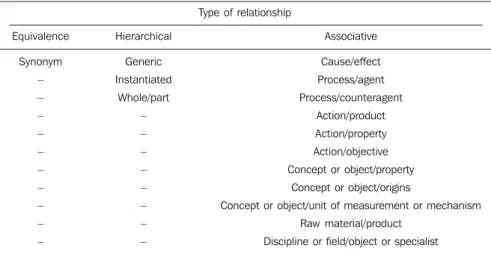
Table 1 Semantic relationship between terms utilized in the construction of the index based on the ANSI/ NISO Z39.19-2005 standard.
Type of relationship
Equivalence
Synonym – – – – – – – – – –
Hierarchical
Generic Instantiated
Whole/part – – – – – – – –
Associative
Cause/effect Process/agent Process/counteragent
Action/product Action/property Action/objective Concept or object/property
Concept or object/origins
Concept or object/unit of measurement or mechanism Raw material/product
Discipline or field/object or specialist
reducing the time and, eventually, the costs
of implementation of a mirror Oracle
da-tabase professionally dedicated to the re-search headquarters institution.
Each report from the RIS/HCFMRP in-cludes administrative and hospital informa-tion in a total of 12 fields to be filled. The administrative information included in the fields “performed on”, “disk number”, “name of the patient”, “clinic code”, “study status”, “equipment” and “issuer” were anonymized and disregarded for the devel-opment of the index. The fields “region”, “clinical suspicion”, “clinic name”, “report conclusion” and “report description” were considered as the source of terms for the index. Once the phase of reports extraction and collection was completed, the follow-ing phase was initiated to select the indi-vidual terms for the index.
Text mining (contents analysis and categorization process)
The text mining (contents analysis)
tech-nique(22) was utilized with a commercial,
specialized software suite called Provalis
Research (SimStat2.5, WordStat6.1 and
QDA Miner4)(23), with academic license for the study. The text mining work consisted in importing the organized tables (similar as regards the terms origin) from the reports database into the specialized software, tak-ing the type of each individualized exam into account. The design of the study’s ter-minological grouping was performed at two different, but complementary moments of the technique itself application: catego-rization process and contents analysis. The categorization process utilized the words removal code. The following stop-words were excluded from the linguistic
corpus: conjunctions, numbers, special characters, unknown words (most digitiza-tion errors), articles (definite and indefi-nite) and prepositions.
The contents analysis(22) was aimed at
extracting singular terms. Additionally, it sought the identification of the most uti-lized medical terms for each type of exam, by correlating six measurements of words frequency in order to get an integral key-words list. The following measurements were utilized: frequency (number of occur-rences of the word), percentage (based on the total number of words retrieved by
means of text mining), total percentage of words (based on the total number of words, except for those removed by the stopwords process), number of cases (number of sub-jects-report where a word is found) and
TF*IDF – term frequency weighted by
in-verse document frequency.
With the application of the previously described technique, the experiments with the study’s linguistic corpus resulted in a list of terms utilized on subjects-report by specialists for each type of exam (chest ra-diography, mammography and thyroid nod-ules US). Such words were grouped as fol-lows: single medical terms (the vocabulary actually utilized by specialists); non single terms multiplied by the number of their repetition in the linguistic corpus of the study); and the total of words representing the sum of single and non single words. Then, the list of single words was repro-cessed in another text mining modality, still
focused on contents analysis(22), named
keyword in context. Such a technique – keyword in context – delimits the term and the context where the term is found on the document, cutting out and separating a set of one to seven anterior and posterior words to the delimited term, so formalizing a semi-complex phrase. Such a methodologi-cal procedure was utilized to retrieve the most common related phrasal structures or information structures based on the terms included in the index.
At the end of the text mining application, a statistical test was performed with the group of single terms found by the contents analysis. Such statistical test was aimed at
verifying the percentage of single terms in relation to the total number of reports and the hypothesis that the proportion of single terms found in the three types of exam (mammography, chest radiography and thy-roid nodules US) are indeed different. For the percentage, the centesimal ratio was calculated between values corresponding to “single terms” by “total of subjects-report” for each type of exam. The proportion hy-pothesis was validated by means of a
para-metric chi-square test(21). The level of
sig-nificance corresponded to 5% (p < 0.05).
Index construction
The index architecture was developed and based on a controlled vocabulary fo-cused on a knowledge representation sys-tem called thesaurus. For such a purpose, the authors selected a standard with inter-national coverage and an interdisciplinary approach updated and compatible with the operational reality of systems of health in-formation. And also, as a complement, it should be grounded on the theories of Fac-eted Classification, Concept and Terminol-ogy. The standard which met the planned approach and, therefore, utilized in the present study, was the American National Standard/National Information Standards Organization – Guidelines for the Con-struction, Format, and Management of Monolingual Controlled Vocabularies Z39.
19-2005 (ANSI/NISO Z39.19-2005)(19).
The relationships supported by the index structure are shown on Table 1.
soft-ware [MultiTes Pro, academic license, ver-sion (usage authorization) 2008/2009 and 2010/2011] was utilized for the index con-struction. Such software not only performs the terms linkage, but also generates an initial structure in web language as a for-malization of the accomplished work. The
native option of the MultiTes Pro utilized
for structure extension was the HyperText
Markup Language, *html. Among others, such a language was selected because it is the root-format of generation emitted by the
MultiTes Pro. After feeding the index with the terms and words, with subsequent gen-eration in a webbrowsable system format, the screens underwent a last modeling pro-cess to be used in a school hospital. The developed tool was characterized with ba-sis on a comparative analyba-sis of the requi-sites, functionality and scope between the locally developed index and the most rel-evant lexicons in the area, namely, ACR Index, BI-RADS Atlas and Radlex.
RESULTS
The text mining as a first application of terminological extraction resulted in
11,210,832 (n = 100%) words, constituting
a semantic complex utilized in the 61,461 reports included in the present study. After selection and routine stopwords removal,
a total of 358,236 (n = 3.19%) words was
reached. With the application of the text mining techniques in order to delimit the
specificity of the words, 24,488 (n =
0.21%) single terms could be selected. The single terms, with the application of the
context word routine, made 51,859 (n =
0.46%) information structures (semi-com-plex phrases) available. The index
con-struction was completed with 76,347 (n =
0.68%) words and semi-complex phrases (vocabulary terms). Such terms are divided into descriptive anatomic terms of pathol-ogy, of imaging technique, of equipment, of type of exam and composite terms (and, therefore, repeated in the index), consider-ing the addition of another specialty term and/or word grammatically necessary for its understanding (connective, for example: of, with, for, etc.). The index system was developed with 78,538 fully-browsable web *html pages and with possibility of
terms linkage with the operational system Figure 2. Browsing screenshot with composite terms, herein demonstrating the letter “T” entry.
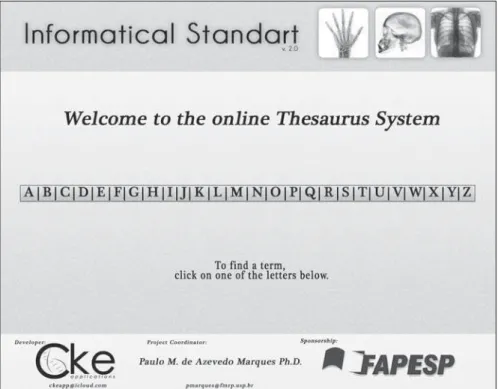
Figure 1. Initial index screen, with the terms entry index itself and general information on the system.
of reports or with any eventually created system supporting a compatible language, including 2,191 pages for terms input and navigation structure (initial and feedback screens) and 76,347 pages dedicated to each individual term.
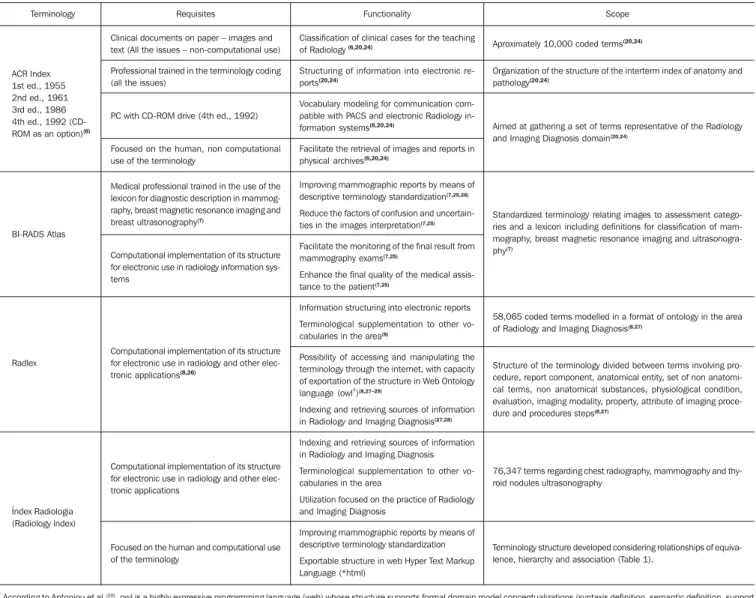
comparative analysis of requisites, func-tionality and scope, between the terminol-ogy of the area and the presently described index, revealed a considerable degree of appropriateness as regards the characteris-tics of such international tools, as demon-strated by Table 4.
DISCUSSION
Text mining application
The contents analysis process(22) may be
described as a systematic, objective and quantitative method of analysis of the char-acteristics of a message. The most relevant advantages in the application of contents
Table 4 Comparative table of characteristics of requisites, functionality and scope of the systems of representation of knowledge in Radiology and Imaging Diagnosis.
Terminology
ACR Index 1st ed., 1955 2nd ed., 1961 3rd ed., 1986 4th ed., 1992 (CD-ROM as an option)(6)
BI-RADS Atlas
Radlex
Índex Radiologia (Radiology index)
Requisites
Clinical documents on paper – images and text (All the issues – non-computational use)
Professional trained in the terminology coding (all the issues)
PC with CD-ROM drive (4th ed., 1992)
Focused on the human, non computational use of the terminology
Medical professional trained in the use of the lexicon for diagnostic description in mammog-raphy, breast magnetic resonance imaging and breast ultrasonography(7)
Computational implementation of its structure for electronic use in radiology information sys-tems
Computational implementation of its structure for electronic use in radiology and other elec-tronic applications(8,26)
Computational implementation of its structure for electronic use in radiology and other elec-tronic applications
Focused on the human and computational use of the terminology
Functionality
Classification of clinical cases for the teaching of Radiology (6,20,24)
Structuring of information into electronic re-ports(20,24)
Vocabulary modeling for communication com-patible with PACS and electronic Radiology in-formation systems(6,20,24)
Facilitate the retrieval of images and reports in physical archives(6,20,24)
Improving mammographic reports by means of descriptive terminology standardization(7,25,26) Reduce the factors of confusion and uncertain-ties in the images interpretation(7,25)
Facilitate the monitoring of the final result from mammography exams(7,25)
Enhance the final quality of the medical assis-tance to the patient(7,25)
Information structuring into electronic reports Terminological supplementation to other vo-cabularies in the area(8)
Possibility of accessing and manipulating the terminology through the internet, with capacity of exportation of the structure in Web Ontology language (owl†)(8,27–29)
Indexing and retrieving sources of information in Radiology and Imaging Diagnosis(27,28)
Indexing and retrieving sources of information in Radiology and Imaging Diagnosis Terminological supplementation to other vo-cabularies in the area
Utilization focused on the practice of Radiology and Imaging Diagnosis
Improving mammographic reports by means of descriptive terminology standardization Exportable structure in web Hyper Text Markup Language (*html)
Scope
Aproximately 10,000 coded terms(20,24)
Organization of the structure of the interterm index of anatomy and pathology(20,24)
Aimed at gathering a set of terms representative of the Radiology and Imaging Diagnosis domain(20,24)
Standardized terminology relating images to assessment catego-ries and a lexicon including definitions for classification of mam-mography, breast magnetic resonance imaging and ultrasonogra-phy(7)
58,065 coded terms modelled in a format of ontology in the area of Radiology and Imaging Diagnosis(8,27)
Structure of the terminology divided between terms involving pro-cedure, report component, anatomical entity, set of non anatomi-cal terms, non anatomianatomi-cal substances, physiologianatomi-cal condition, evaluation, imaging modality, property, attribute of imaging proce-dure and proceproce-dures steps(8,27)
76,347 terms regarding chest radiography, mammography and thy-roid nodules ultrasonography
Terminology structure developed considering relationships of equiva-lence, hierarchy and association (Table 1).
† According to Antoniou et al.(29), owl is a highly expressive programming language (web) whose structure supports formal domain model conceptualizations (syntaxis definition, semantic definition, support
to the efficient reasoning, sufficient expressiveness power and expression convenience).
Table 2 Distribution of the number of processed words in relation to the analyzed type of exam.
Exam
Mamography Thyroid nodule Chest radiography
Processed words
Single
6,434 4,162 14,892
Non sungle
2,229,261 568,770 8,387,313
Total
2,235,695 572,932 8,402,205
p-value*
< 0.001
* p-value: chi-square test.
Table 3 Percentage of single words in relation to the total number of reports. Exam
Mamography Thyroid nodule Chest radiography
Single
6,434 4,162 14,892
Total number of reports
27,000 4,461 30,000
Percentage
analysis correspond to the direct observa-tion of the following aspects: the validity, interpretation and explanation on how such information are formalized in a given data
set in a long time span(22). Furthermore,
there is the analysis of information pro-duced by a heterogeneous specialists’ com-munity (which may include professions in areas other than Medicine). In the case of the present study, the RIS information is pro-duced by resident physicians, contracted specialists and also medical professors. Differently from studies more focused on computational or methodological and con-ceptual aspects of text mining, the funda-mental view described in the present study on the application of the technique, as in-dicated by the results (Tables 2 and 3), is that it allows to establish possible termino-logical categories for the clinical and peda-gogical use and, eventually may also
facili-tate processes of development of softwares
in Portuguese language, compatible with the radiological practice in Brazil.
From the point of view of development of a semantic corpus with possibility of serving as basis for the creation of a stan-dard for medical vocabularies, the results presented on Tables 2 and 3 show different terminological distributions for each type of report. Such heterogeneity hinders the development of a single model of extrac-tion and formaextrac-tion of medical dicextrac-tionaries or automatic and comprehensive descrip-tive diagnostic standards, requiring an in-dividualized observation of each type of exam and technique for creation of a termi-nological extraction design. It is important to highlight that the results presented as whole on Tables 2 and 3 confirm that the utilization of a diagnostic standard, such as the BI-RADS, clearly provide a decrease in the utilization of different terms for a single type of report.
The problematic of use of information
Firstly, the present study results demon-strate that a database of a RIS, in general longitudinal and representative of a unit of Radiology and Imaging Diagnosis, may serve as a tool for constructing intensive knowledge systems. Despite the explicity of this later assertion for specialists in Com-puter Sciences and in Engineering in
gen-eral, such detail regarding the finding about a RIS database is opportune a necessary for the present study as it alerts the radiologists community on the scientific, and even cor-porative and financial potential that is present in databases at each Brazilian clinic and hospital. They may even serve as a substitute for conventional lexical systems which, almost in their totality, are written in foreign language. Such aspect may favor the process of teaching the correct use of the specialty terminology, with direct reper-cussion on the radiologists’ product, i.e., the radiological report, and on the commu-nication among medical specialists. Addi-tionally, they allow for a transposition of lexical systems and their utilization in the assistance in a less mechanical and more flexible manner, since the information coming from RIS databases for clinical use represent a daily professional practice (guarantee of use). In terms of harmoniza-tion of use of medical terminology, the guarantee of use allows us to cope with two problems, namely, the scale and multiplic-ity of tasks involving the use of the medi-cal terminology. The usage smedi-cale is a “X” amount of information produced by a “Y” number of individuals. On the other hand, multiplicity of tasks is a “X” amount of information produced for a “Y” number of objectives and distinct tasks. Such two con-ditions where a lot of information is pro-duced by a high number of individuals for several objectives, either complementary or not, favor the emergence of the information inconsistency problems mentioned in the introduction of the present article. The text mining method utilized in the present study allows for the establishment of limits re-garding the variability of terms utilized in reports, reducing the occurrence of dispari-ties in the narrative accuracy of the text and developments connected with the usage scale and multiplicity of tasks. Then, it is possible to reduce to a minimum the termi-nological set available in the index. Thus, the reductions resulting from the described method allow for an usage scale and mul-tiplicity of radiological information tasks based on a controlled and stable environ-ment in relation to the applied terminology, favoring the decrease in the occurrence of
linguistic problems(1).
Comparison of the index with the ACR Index, BI-RADS Atlas and Radlex
The ACR Index (Table 2) is a system or-ganized with terms originated from anatomy and pathology, potentially utilized by radiologists in the description of radio-logical findings. In such system, the terms receive a code (two to four digits for anatomy terms, and two to five digits for pathology terms) separated by a dot delimi-tating their origin, firstly indicating location (anatomy) and subsequently the lesion or
condition (pathology)(6,20,24). Such coding
allows a set of up to ten digits to formalize an informational reference. Such standard-ization based on a decimal classification system above all serves to retrieve informa-tion. Differently from a proper terminology which offers complex semantic relation-ships and which may be useful in the mod-eling of electronic information systems, with inference trees and descriptive dictio-naries. Both the ACR Index and BI-RADS Atlas present a limited set of terms, with-out complex and organized relationships, in order to facilitate the utilization by the user, of a singular term and not a set of terms. An example of such aspect is the use of the ACR Index. For a reference to the term “calcic tendinitis of the supraspinatus muscle” (Figure 2), it is necessary to
con-sult the skeletal system (shoulder girdle
and arm), select the most proximal ana-tomical area which, in this case, is the shoulder joint, whose code is 414.; and subsequently combine with the pathology which, on Figure 2 is calcic tendinitis,
de-scribed in the group of periarticular and
Under the letter “t”, the user finds the term “tendinitis” as a single term and all the phrasal formations (structures) utilized by specialists. With two clicks it is possible to retrieve any information related to the term “tendinitis” classified in the index. Another improvement is related to the use of deci-mal classification. The coding utilized by the ACR Index, besides being difficult to be assimilated by users, causes a termino-logical reduction of the description.
The BI-RADS Atlas (Table 2), on its turn, is a system specific for standardiza-tion of the descripstandardiza-tion and conclusion of
mammographic reports(7,25). It is widely
utilized in the practice of Radiology and Imaging Diagnosis, as well as by correlated areas involved in diagnostic investigation. Its functioning model emphasizing the standardization of findings, descriptive terms and possible conclusions, serves as a basis for other similar initiatives as re-gards gains in terms of quality of the infor-mation and, consequently, quality of the
diagnosis(7). Among the lexical systems
discussed in the present study, BI-RADS is the only to allow the simultaneous utiliza-tion with the developed index, since it is utilized in mammography reporting and is included in the set of terms of the index.
On the other hand, Radlex (Table 2) is the most recent amongst the three men-tioned systems. Its development was initi-ated in the middle of the last decade as a response to the limitations imposed by the classification with the codified use of the
ACR Index(8,27). The Radiological Society
of North America (RSNA) has proposed the expansion and terminological review of the ACR Index tree. For this purpose, the Systematized Nomenclature of Medicine –
Clinical Terms (SNOMED-CT®)(8) was
utilized. With the terminology review, ex-pansion and re-design into a new structure, the Radlex allows for the use of informa-tion related to devices, procedures and imaging techniques in Radiology and Im-aging Diagnosis; descriptive terms on the difficulty in the perception and analysis of interpretation and diagnostic quality of
images(8,27). From the technological point
of view, the Radlex allows the manipula-tion of the system informamanipula-tion in several ways. One of such ways is the possibility of exporting its structure to the Open
Docu-ment Format (*odf) by means of the exten-sible markup language (*xml) and resource description framework (*rdf), since both of them are included in the *owl language syntaxis. The extension *odf is a file for-mat readable by several computer pro-grams, among them, Google Docs, IBM®
Lotus® Simphony™ and OpenOffice.org.
Considering that it is designed as ontology, it also allows for the automatic and scalable interoperability of health information sys-tems within the terminology coverage do-main. It is the lexical system most similar to the presently described index. The dif-ference in relation to the presently de-scribed index is that the terms included in the Radlex are units, without the composi-tion of phrasal structures, which tends to limitate its use in references with greater terminological complexity. Differently from the construct index, the reference tree of Radlex may also present some obstacles to access, since it utilizes the separation of descriptive terms of anatomy and pathology in their determined terminological niches, differently from the constructed index. Considering that it is developed as an on-tology model, which is a system of knowl-edge representation more adaptable than the thesaurus, with Radlex it is possible to import just the parts of interest from its ter-minological structure, for example, a given anatomical area or a set of pathologies of a same type, which does not occur in the in-dex, since it is not possible to export infor-mation from its structure (only terms can be imported), increasing its database with new terms. On the other hand, the developed index presents the great advantage of al-lowing the direct relationship between terms and the clinical practice in the report-ing process in Portuguese language.
Study limitations and future challenges
The choice for a thesaurus to organize the information collected from reports has shown to be partially effective in dealing with logic problems related to the use of information. The semi-complex phrases (up to seven words) articulated with terms included in the database and constructed with text mining techniques in contents
analysis (keyword and keyword in context)
are, in truth, structures of information. However, it is not possible to construct
completely structured reports by simply utilizing the index and such phrases with-out the implementation of additional auto-mation technologies involving program-ming resources and studies about the cur-rent healthcare communication protocols. Additionally, the validation of a structured radiological report demands the construc-tion of a specific tool with a comprehensive group of specialized observers available to
complete such a task(30). Therefore, one
could not assure that the method and the index of the present study serve the purpose of solving and/or attenuate problems re-lated to structural failures and narrative density. But one may consider that the present study describes viable methods to achieve such a purpose.
As regards ontological problems, the formalization of relationships like those utilized in the present study (Table 1) estab-lishes a versatile form of reference/use of the semantic set displayed on the index. This is because it considers comprehen-sively three different types of relationships and their logical developments (Table 1). The equivalence relation allows for the option of use/reference by the radiologist for the best term among a set of synonyms. The hierarchical relationship allows for the selection of a term in a category or closed group of terms (set of terms related to a determined anatomical region, pathology or other formalizations of groups and/or subgroups of terms). The associative rela-tionship allows that terms related to areas different and/or distant as regards hierarchy and equivalence (antonyms) may be orga-nized due to diagnostic associations (cause-effect ratio) (Table 1), for example. How-ever, even considering the versatility in the construction of relationships, a thesaurus does not favor the establishment of rela-tionships automatically processable by
machines(1,9). Ontology is an appropriate
knowledge representation system which
allows for computer processing(18) and also
establishes robust inference rules for the
medical practice(31–34). It is the model on
which the Radlex, for example, was devel-oped.
An ontology(27) is also the most
indi-cated knowledge representation system to get semantic interoperability between
of-fers a possibility of solution for problems connected with interclinic communication in Medicine and health inter-areas, allow-ing that heterogeneous systems communi-cate in a multiple manner and with formal-ization of complex information. This does not occur with the developed index, since its structure cannot stand a communication protocol between electronic healthcare sys-tems. On the other hand, the established
informational organization(37–40) should
fa-cilitate the construction of an ontology model in Portuguese language compatible with the clinical practice.
Despite the technological limitations as-sociated with de model of index utilized in the present study, the prospect of develop-ment of information tools which may friendly and transparently help radiologists, particularly the Brazilian community of radiologists, in their daily clinical practice, seems to be promising. The evidence that supports such assertion is that ontology is an advanced computational instrument which can be developed from a thesaurus (that is an index structure). Additionally, the information technology apparatuses repre-sent the second greater category of research & development in the area of Radiology and Imaging Diagnosis, promoting techno-logical innovation both at national and
in-ternational levels(41). The index developed
by the present study is an intermediate tool which may serve as basis for a series of applications with repercussions on educa-tion, research and assistance, with poten-tial utilization in the modeling of innova-tive technological inputs, particularly for
the Brazilian reality(1,9,12,36,42–44).
CONCLUSION
The study presented a method for infor-mation extraction from radiological re-ports, allowing the construction of a termi-nological system in Portuguese language on the grounds of the practice of Radiology and Imaging Diagnosis.
Acknowledgements
To Fundação de Amparo à Pesquisa do Estado de São Paulo (Fapesp), Fundação de Apoio ao Ensino, Pesquisa e Assistência do Hospital das Clínicas de Ribeirão Preto (Faepa-HCFMRP). and Conselho Nacional
de Desenvolvimento Científico e Tecnoló-gico (CNPq), for the financial support. To Prof. Dr. Jorge Elias Júnior, for his collabo-ration regarding peculiarities and diagnos-tic descriptive differences between chest radiography and thyroid ultasonography reports; to Dr. Normand Péladeu, of Pro-valis Research, for his assistance for under-standing the utilization of the data mining tool, and also for the valuable indication of bibliography; to CKE applications, for the web design work.
REFERENCES
1. Serapião PRB, Suzuki KMF, Azevedo-Marques PM. Uso de mineração de texto como ferramenta de avaliação da qualidade informacional em lau-dos eletrônicos de mamografia. Radiol Bras. 2010;43:103–7.
2. Rector AL. Clinical terminology: why is it so hard? Methods Inf Med. 1999;38:239–52.
3. Torlai FG, Meirelles GSP, Miranda Jr F, et al. Pro-posta para padronização do relatório de tomogra-fia computadorizada nos aneurismas da aorta ab-dominal. Radiol Bras. 2006;39:259–62. 4. Shortliffe EH, Perreault LE, Wiederhold G, et al.
Medical informatics: computer applications in health care and biomedicine. 2nd ed. New York: Springer; 2003.
5. Rezende JM. Linguagem médica. 3ª ed. Goiânia: AB Editora; 2004.
6. American College of Radiology. Index for radio-logical diagnoses. 4th ed. Reston: American Col-lege of Radiology; 1992.
7. American College of Radiology. Breast Imaging Reporting and Data System (BI-RADS©). 4th ed. Reston: American College of Radiology; 2003.
8. RSNA Informatics. What is Radlex? [acessado em 13 de junho de 2011]. Disponível em: http://www. rsna.org/Informatics/radlex.cfm.
9. Salomão SC, Azevedo-Marques PM. Integrando ferramentas de auxílio ao diagnóstico no sistema de arquivamento e comunicação de imagens. Radiol Bras. 2011;44:374–80.
10. Koch H, Castro MVK. Qualidade da interpreta-ção do diagnóstico mamográfico. Radiol Bras. 2010;43:97–101.
11. Geraldeli FE, Carvalho ACP, Koch HA, et al. Pro-dução de material instrucional para o ensino da radiologia por meio da digitalização de imagens. Radiol Bras. 2002;35:27–30.
12. Angelo MF, Schiabel H. Uma ferramenta para treinamento na avaliação de imagens mamográ-ficas via Internet. Radiol Bras. 2002;35:259–65.
13. Oliveira MC, Azevedo-Marques PM, Cirne Filho WC. Grades computacionais na otimização da recuperação de imagens médicas baseada em con-teúdo. Radiol Bras. 2007;40:255–61.
14. Elias Jr J, Semelka RC, Altun E, et al. Graduat-ing 4th year radiology residents’ perception of op-timal imaging modalities for neoplasm and trauma: a pilot study from four U.S. universities. Radiol Bras. 2011;44:283–8.
15. Houaiss A. Novo dicionário Houaiss da língua portuguesa. 1ª ed. São Paulo: Objetiva; 2009.
16. Oxford University Publisher. New Oxford Ameri-can dictionary. 3rd ed. Oxford: Oxford University Publisher; 2010.
17. Fapesp. Código de boas práticas científicas. [aces-sado em 22 de junho de 2012]. Disponível em: www.fapesp.br/FAPESP-Codigo_de_Boas_ Praticas_Cientificas_jun2012.pdf.
18. Azevedo-Marques PM, Trad CS, Elias Jr E, et al. Implantação de um mini-pacs (sistema de arqui-vamento e distribuição de imagens) em hospital universitário. Radiol Bras. 2001;34:221–4. 19. ANSI/NISO Z39.19-2005. Guidelines for the
construction, format, and management of mono-lingual controlled vocabularies. Bethesda: NISO Press; 2005.
20. Azevedo-Marques PM, Caritá EC, Benedicto AA, et al. Integração RIS/PACS no Hospital das Clí-nicas de Ribeirão Preto: uma solução baseada em “web”. Radiol Bras. 2005;38:37–43.
21. Chen YT, Chen MC. Using chi-square statistics to measure similarities for text categorization. Expert Systems with Applications. 2011;38:3085– 90.
22. Weber RP. Basic content analysis. 2nd ed. Lon-don: Sage University Paper; 1990.
23. Provalis Research. [acessado em 2 de novembro de 2012]. Disponível em: http://provalisresearch. com/solutions/applications/open-ended-question-analysis/.
24. Yam CS, Kruskal J, Sitek A, et al. A web-based ACR index for radiological diagnoses. AJR Am J Roentgenol. 2004;183:1517–21.
25. Godinho ER, Koch HA. Breast imaging reporting
and data system (BI-RADS AtlasTM): como tem
sido utilizado? Radiol Bras. 2004;37:413–7.
26. Mongkolwat P, Bhalodia P, Makori A, et al. Informatics in Radiology (infoRAD): integrating MIRC-compliant semiautomated teaching files into PACS work flow. Radiographics. 2005;25: 543–8.
27. Rubin DL. Creating and curating a terminology for radiology: ontology modeling and analysis. J Digit Imaging. 2008;21:355–62.
28. Baneyx A, Charlet J, Jaulent MC. Building an on-tology of pulmonary diseases with natural lan-guage processing tools using textual corpora. Int J Med Inform. 2007;76:208–15.
29. Antoniou G, van Harmelen F. Web ontology lan-guage: OWL. In: Staab S, Studer R, editors. Hand-books on ontologies. 2nd ed. New York: Springer; 2009. p. 91–101.
30. Plumb AA, Grieve FM, Khan SH. Survey of hos-pital clinicians’ preferences regarding the format of radiology reports. Clin Radiol. 2009;64:386– 94.
31. Serapião PRB, Azevedo-Marques PM. A elabo-ração de um Tesauro para a estrutuelabo-ração de infor-mações médicas. In: Ulbricht VR, Pereira ATC, editores. Hipermídia: um desafio da atualidade. 1ª ed. Florianópolis: Editora Pandion; 2009. p. 205–18.
32. Bosmans JM, Peremans L, Menni M, et al. Struc-tured reporting: if, why, when, how-and at what expense? Results of a focus group meeting of ra-diology professionals from eight countries. In-sights Imaging. 2012;3:295–302.
34. Gibaud B. The quest for standards in medical im-aging. Eur J Radiol. 2011;78:190–8.
35. Azevedo-Marques PM. Diagnóstico auxiliado por computador na radiologia. Radiol Bras. 2001;34: 285–93.
36. Azevedo-Marques PM, Santos AC, Elias Jr J, et al. Implantação de um sistema de informação em radiologia em hospital universitário. Radiol Bras. 2000;33:155–60.
37. Sampaio Netto O, Coutinho LOL, Souza DC. Aná-lise da nova classificação de laudos de densito-metria óssea. Radiol Bras. 2007;40:23–5. 38. Souza Jr AS, Araújo Neto C, Jasinovodolinsky D,
et al. Terminologia para a descrição de tomogra-fia computadorizada do tórax: sugestões iniciais para um consenso brasileiro. Radiol Bras. 2002; 35:125–8.
39. Torlai FG, Meirelles GSP, Miranda Jr F, et al. Pro-posta para padronização do relatório de tomogra-fia computadorizada nos aneurismas da aorta ab-dominal. Radiol Bras. 2006;39:259–62. 40. Müller MR, Rodrigues LN, Silva MA.
Elabora-ção e implementaElabora-ção de um programa para veri-ficação dos cálculos das unidades monitoras em radioterapia. Radiol Bras. 2005;38:415–20.
41. Serapião PRB, Ribeiro EA, Porto GS, et al. O
perfil brasileiro de propriedade intelectual em ra-diologia e diagnóstico por imagem em um con-texto internacional, nos anos 2000–2009. Radiol Bras. 2011;44:238–43.
42. Scatigno Neto A. A radiologia, o radiologista e as demais especialidades. Radiol Bras. 2005;38(2):iii. 43. Camargo Junior HSA. BI-RADS®-ultra-som: vantagens e desvantagens dessa nova ferramenta de trabalho. Radiol Bras. 2005;38:301–3.