156 Radiol Bras. 2011 Mai/Jun;44(3):156–162
Comparison between transvaginal ultrasonography
and sonohysterography in the assessment of patients
with abnormal uterine bleeding
*
Comparação entre ultrassonografia transvaginal e histerossonografia na avaliação de pacientes com sangramento uterino anormal
Iêda Maria Silveira Diógenes Feitosa1, Helvécio Neves Feitosa2, Francisco Herlânio Costa Carvalho3,
Silvia Menescal Pereira1, Francisco das Chagas Medeiros4
Objective: To comparatively evaluate the effectiveness of transvaginal ultrasonography (TVUS) and sonohysterography (SHG) in the assessment of endometrial diseases in women with abnormal uterine bleeding. Materials and Methods: Cross-sectional study with 30 patients, aged from 29 to 71 years, 21 (70%) of them premenopausal and 9 (30%) postmenopausal. Saline solution (at 9%) was utilized as contrast agent for SHG. The MacNemar test was utilized for comparison of diagnostic studies. Results: Hysteroscopy diagnosed 18 cases (60%) of intracavitary alterations, and 10 polyps (33.3%). TVUS demonstrated 83.3% sensitivity and specificity, and SHG showed 94.4% sensitivity and 91.6% specificity. The MacNemar test showed similar sensitivity (p = 0.500) and specificity (p = 1.000) between TVUS and SHG in the detection of endometrial diseases. In the diagnosis of polyp, SHG showed the highest sensitivity (90.9% vs. 27.3%; p = 0.016) with similar specificity (89.5% vs. 94.7%; p = 1.000). Conclusion: SHG and TVUS present a good predictive value for endometrial diseases in patients with abnormal uterine bleeding. SHG and TVUS present similar sensitivity and specificity in the detection of such diseases, but SHG is more sensitive in the detection of polyps. Keywords: Transvaginal ultrasonography; Sonohysterography; Hysteroscopy; Abnormal uterine bleeding.
Objetivo: Avaliar a eficácia da ultrassonografia transvaginal (USTV) e da histerossonografia (HSG) e compará-las na avaliação de alterações endometriais em portadoras de sangramento uterino anormal. Materiais e Métodos: Estudo transversal com 30 pacientes, idade entre 29 e 71 anos, 21 delas (70%) na pré-menopausa e 9 (30%) na pós-me-nopausa. Utilizou-se solução salina a 0,9% para contraste na HSG. Foi considerado o achado histeroscópico e/ou histopatológico como método padrão. Utilizou-se o teste de MacNemar para comparação dos testes diagnósticos. Resultados: A histeroscopia diagnosticou 18 casos (60%) de alterações intracavitárias, sendo 10 pólipos (33,3%). A USTV apresentou sensibilidade e especificidade de 83,3% e a HSG mostrou sensibilidade de 94,4% e especificidade de 91,6%. O teste de MacNemar evidenciou sensibilidade (p = 0,500) e especificidade (p = 1,000) semelhantes entre a USTV e a HSG para detecção de alterações endometriais. No diagnóstico de pólipo, a HSG apresentou maior sensibilidade (90,9% × 27,3%; p = 0,016), com especificidade semelhante (89,5% × 94,7%; p = 1,000). Conclu-são: A HSG e a USTV apresentam boas taxas de predição para doenças endometriais em pacientes com sangramento uterino anormal. A HSG apresenta sensibilidade e especificidade semelhantes às da USTV na detecção dessas doen-ças, porém apresenta sensibilidade maior para pólipos.
Unitermos: Ultrassonografia transvaginal; Histerossonografia; Histeroscopia; Sangramento uterino anormal. Abstract
Resumo
* Study developed at Maternidade-Escola Assis Chateaubriand – Universidade Federal do Ceará (UFC), Fortaleza, CE, Brazil.
1. Masters in Obstetrics and Gynecology, MDs, Gynecologists at the Municipality of Fortaleza and Ceará State Secretariat of Health, Fortaleza, CE, Brazil.
2. PhD, Professor at the School of Medicine – Universidade de Fortaleza (Unifor), Fortaleza, CE, Brazil.
3. PhD, Vice-coordinator for the Program of Mastership in Collective Health, Universidade Federal do Ceará (UFC), Forta-leza, CE, Brazil.
4. PhD, Vice-coordinator for the Department of Maternal-infantile Health, Universidade Federal do Ceará (UFC), Fortaleza, CE, Brazil.
Mailing Address: Dr. Francisco Herlânio Costa Carvalho. De-partamento de Saúde Comunitária – UFC. Rua Professor Costa
Feitosa IMSD, Feitosa HN, Carvalho FHC, Pereira SM, Medeiros FC. Comparison between transvaginal ultrasonography and sonohys-terography in the assessment of patients with abnormal uterine bleeding. Radiol Bras. 2011 Mai/Jun;44(3):156–162.
INTRODUCTION
Pelvic ultrasonography, and in particu-lar transvaginal ultrasonography (TVUS), is a propedeutic method extensively uti-lized in gynecology and obstetrics. In preg-nancy, it is widely utilized to analyze
em-bryonic and fetal anatomy at the first tri-mester(1) and to evaluate the biometry and morphology of the uterine cervix in more advanced gestations(2), demonstrating to be an excellent predictor of preterm deliv-ery(3). It leaves no doubts about the benefit of evaluating adnexal masses(4), including deep endometriosis and its intestinal in-volvement – with effectiveness comparable to magnetic resonance imaging(5). It is the most frequently utilized propedeutic imag-Mendes, 1608, 5º andar, Bairro Rodolfo Teófilo. Fortaleza, CE,
ing method as a first line of investigation in patients with abnormal uterine bleed-ing(6).
Abnormal uterine bleeding is one of the main complaints at gynecological clinics at any age group, possibly as a consequence of anovulation, disorders related to preg-nancy, hormonal changes or lesions of be-nign or malignant nature. The etiology of such abnormality may range from local anatomic causes to endocrine disorders, or even other organic diseases or iatrogenic factors. The main focus in the diagnostic investigation of such patients is ruling out the possibility of endometrial carcinoma and correctly identify local anatomic causes, such as polyps and uterine myomas, which may require surgical treatment, or functional disorders that require clinical treatment(6).
Sonohysterography (SHG) – instillation of sterile saline solution by means of a cath-eter – was initially described by Nannini et al. in 1981(7). Other authors also utilized fluids as expanders of the uterine cavity, in order to allow echographic contrast with adjacent structures, thus allowing better evaluation of the endometrium(8–11). The use of SHG yields better images as com-pared with TVUS, providing a more accu-rate measurement of the endometrial thick-ness, which allows a more clear evaluation of the heterogeneity or of the thickening etiology, besides allowing the distinction between focal and diffuse abnormalities(12). The present study was aimed at deter-mining the value of SHG and TVUS in the detection of endometrial changes in pa-tients with abnormal uterine bleeding, and comparing the sensitivity and specificity of the methods in the detection of such dis-orders.
MATERIALS AND METHODS
This is a comparative, cross-sectional and observational study on diagnostic im-aging methods, developed at the Unit of Ultrasonography of Maternidade-Escola Assis Chateaubriand – Universidade Fed-eral do Ceará (UFC), Fortaleza, CE, Bra-zil. The sample comprised 30 patients with ages ranging from 29 to 71 years, present-ing abnormal uterine bleedpresent-ing (menor-rhagia, metrorrhagia or postmenopausal
bleeding without using hormonal therapy). Twenty-one (70%) of the patients were pre-menopausal women, and nine (30%) were postmenopausal women. All the pregnant patients as well as those using contracep-tives were excluded. The project was ap-proved by the UFC Committee for Ethics in Research, and the study was developed in the period between July and December of 2003.
After signing a term of free and in-formed consent, all the patients were sub-mitted to anamnesis and underwent gyne-cological examination as initial steps of propedeutics, as well as to diagnose and treat genital infectious processes. Subse-quently, pelvic ultrasonography, TVUS, SHG and hysteroscopy (HSC) were per-formed, in this order.
The following criteria were adopted to express the sonographic results: normal cavity, endometrial thickening (> 14 mm for premenopausal women and ≥ 5 mm for postmenopausal women) and endometrial atrophy (endometrial thickness < 4 mm)(13). Hyperechogenic nodular lesions in the en-dometrial cavity were considered as polyps, while lesions with mixed echogenicity or hypoechoic lesions altering the contours of the endometrial cavity were considered as submucosal myomas. Findings were con-sidered as suspected for malignancy in cases where the endometrial echo was ir-regular or with a variable echotexture(10). All the patients underwent SHG following TVUS, even when the TVUS results were normal. A Sonoline Versa Pro model US apparatus (Siemens; Erlangen, Germany) was utilized with a 6.5 MHz transvaginal probe and a 3.5 MHz convex probe for pelvic examination, both of them multifre-quency. All the TVUSs and SHGs were performed by a single investigator, with a title of Specialist in Gynecology and Ob-stetrics, qualified in Ultrasonography in Gynecology and Obstetrics by Federação Brasileira de Ginecologia e Obstetrícia (Brazilian Federation of Gynecology and Obstetrics). During the SHG, with the pa-tient in gynecological positioning, a specu-lum examination was also performed in order to visualize the uterine cervix and rule out the presence of purulent mucus. After that, the vaginal antisepsis was made with iodinated povidone topical solution.
Catheterization of the cervical canal was made with an Nelaton® urethral catheter Nbr.8, already filled with liquid (sterile saline solution at 0.9%) coupled to a 20 ml syringe, to reduce the production of arti-facts such as the presence of air in the uter-ine cavity. The catheter was fixed with a Cherron clamp inserted until the bottom of the uterine cavity is achieved. Whenever necessary a Pozzi forceps was utilized for better immobilization of the uterine cervix and to facilitate the catheter insertion. Sub-sequently, the speculum was carefully re-moved and the vaginal transducer was in-serted, to analyze the images concomitantly with the solution infusion. The endometrial thickness was separately measured in its anterior and posterior layers, in the sagit-tal plane, excluding the adjacent hypo-echoic zones.
The results of the SHG examination were expressed according to the criteria preconized by Bernard et al.(13): normal cavity, endometrial thickening (single layer endometrial thickening > 6 mm for pre-menopausal women and > 3 mm for post-menopausal women), endometrial atrophy (endometrial thickness < 2 mm). Polyps were diagnosed when a well delimited hypoechogenic focal thickening was found.
with or without atypia, myoma or endome-trial carcinoma.
The calculation of the sample size was made by utilizing, within the considered period, the total number of available obser-vation units (women) equal to 200, at a sig-nificance level of 5%, and considering an estimation error margin of 16%, n
corre-sponding to 30. The statistical analysis was performed with the aid of the software SPSS 10.0 (SPSS Co.; Chicago, IL, USA) and comprised descriptive analysis, calculation of sensitivity estimates, specificity and re-spective standard deviations, positive pre-dictive values (PPV), negative prepre-dictive values (NPV), positive (FP) and false-negative rates (FN), predictive values
(ac-curacy), positive likelihood ratio (PLR) and negative likelihood ratio (NLR) for endome-trial changes. The McNemar’s test was uti-lized for comparison of sensitivities and specificities of diagnostic methods. The adopted significance level was 0.05 (5%).
RESULTS
Initially, the present study included 40 patients with abnormal uterine bleeding. However, ten women were excluded, for the following reasons: four presented cer-vical stenosis that impaired the SHG per-formance, five, for not having undergone HSC (standard method) and one for refusal in participating in the study. Complications
were not observed; only two patients re-ported a mild discomfort.
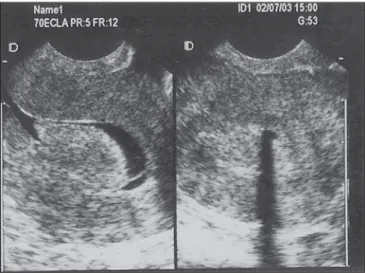
At HSC, 12 patients (40%) presented normal endometrial cavity, and 18 patients were diagnosed with intracavitary abnor-malities (60%). Polyps were the most fre-quent lesions, and were found in 10 pa-tients (33.3%), followed by diffuse en-dometrial thickening in three patients (10%), focal endometrial thickening in one (3.3%), submucosal myoma in two (6.7%), diffuse endometrial thickening with syn-echia in one (3.3%) and submucosal myoma with polyp in another case (3.3%) (Figures 1 to 4; Table 1). Histopathologi-cal study found simple endometrial hyper-plasia without atypias in one patient and
Figure 1. TVUS demonstrating endometrial thickening with variable echo-texture.
Figure 4. SHG demonstrating multifocal hyperechogenic images suggestive of endometrial polyps. Same patient as on Figure 3, after changing the trans-ducer position – parasagittal plane.
Figure 3. SHG demonstrating single hyperechogenic image suggestive of endometrial polyp – sagittal plane.
Table 1 Abnormal findings at HSC, TVUS and SHG in patients with abnormal uterine bleeding. Abnormal hysteroscopic finding
Polyp
Diffuse endometrial thickening Submucosal myoma Focal endometrial thickening
Diffuse endometrial thickening + synechiae Polyp + submucosal myoma
Subtotal
Abnormal sonographic finding
Endometrial thickening Polyp
Submucosal myoma
Endometrial thickening + myoma Subtotal
Abnormal hysterographic finding
Polyp
Symmetrical endometrial thickening Submucosal myoma
Asymmetrical endometrial thickening Submucosal myoma + polyp Subtotal n 10 3 2 1 1 1 18 10 4 2 1 17 11 4 2 1 1 19 % 33.3 10 6.7 3.3 3.3 3.3 60 33.3 13.3 6.7 3.3 56.6 36.7 13.3 6.7 3.3 3.3 63.3
Table 2 Comparison between findings at TVUS, SHG and HSC for the diagnosis of endometrial abnormalities. HSC Abnormal 15 3 17 1 18 Normal 2 10 2 10 12 Total 17 13 19 11 30 TVUS Abnormal Normal SHG Abnormal Normal Total
HSC, hysteroscopy; TVUS, transvaginal ultrasonography; SHG, sonohysterography.
Table 3 Comparison between findings at TVUS, SHG and HSC for the diagnosis of polypoid endo-metrial masses. Endometrial polypoid masses HSC TVUS Present Absent SHG Present Absent Present 11 3 8 10 1 Absent 19 1 18 2 17 Total 30 4 26 12 18
HSC, hysteroscopy; TVUS, transvaginal ultrasonography; SHG, sonohysterography.
Table 4 Sensitivity (S), specificity (E), positive predictive value (PPV), negative predictive value (NPV), false-positive (FP), false-negative (FN), predictive value (PV), positive likelihood ratio (PLR) and negative likelihood ratio (NLR) for TVUS and SHG in the diagnosis of intracavitary abnormalities and endometrial polyps in patients with abnormal uterine bleeding.
Abnormal endometrial findings
TVUS SHG
TVUS SHG
S (± SD)
83.3 (± 8.7)% 94.4 (± 5.4)%
27.3 (± 13.4)% 90.9 (± 8.7)%
E (± SD)
83.3 (± 10.8)% 83.3 (± 10.8)%
94.7 (± 5.1)% 89.5 (± 7.0)%
PPV 76.9% 79.0% 68.9% 78.7% FP 23.1% 20.9% 31.1% 21.3% NPV 88.2% 95.7% 75.2% 95.8% FN 11.8% 4.3% 24.8% 4.2% PV 83.3% 87.8% 74.5% 89.9% PLR 5.00 5.67 5.18 8.64 NLR 0.20 0.07 0.77 0.10 Endometrial polyps
SD, standard deviation; TVUS, transvaginal ultrasonography; SHG, sonohysterography.
endometrial clear cell carcinoma in an-other. In the first case, both TVUS and SHG were normal while HSC revealed endometrial polyp. In the second case, TVUS and SHG revealed endometrial thickening, and HSC revealed endometrial thickening with atypical vascularization.
Analysis of the TVUS and SHG results was performed for the diagnosis of all the abnormalities (Table 2) and specifically for the finding of endometrial polyp (Table 3). Hysteroscopy (HSC) was utilized as the standard method, and the properties of each method were evaluated. The estimated prevalence of endometrial abnormalities (40%) and polyps (30%) were considered (Table 4).
SHG allowed the detection of 17 of the 18 women with intracavitary abnormalities (sensitivity of 94.4%) and was in agree-ment with HSC in 10 of the normal exams (specificity of 83.3%). There were two false-positive results and one false-nega-tive result. For the specific polyp diagno-sis, the method was consistent in the detec-tion of 10 among the 11 cases (sensitivity of 90.9%) and was compatible with ab-sence of polyps in 17 of the 19 cases with-out such finding (specificity of 89.5%). In two opportunities, the method provided a false-positive result, with one case being false-negative.
the specific diagnosis of polyp, the method allowed the detection of three among the 11 cases (sensitivity of 27.3%) and was compatible with absence of polyps in 18 of the 19 cases without such a finding (speci-ficity of 94.7%). The method result was false-positive in one case and false-nega-tive in eight cases.
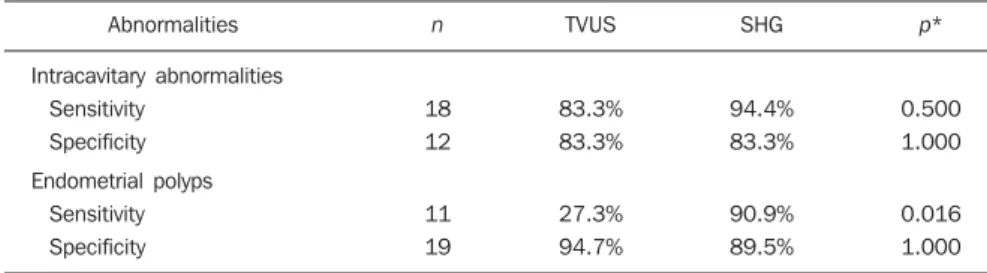
The McNemar’s test revealed statistical similarity regarding sensitivity (83.3% × 94.4%; p = 0.500) and specificity (83.3%
× 83.3%; p = 1.000) for the methods
(TVUS and SHG) in the diagnosis of int-racavitary lesions. Specifically for the di-agnosis of polyps, the specificity was sta-tistically similar (94.7% × 89.5%; p =
1.000) and the sensitivity was greater for SHG (90.9% × 27.3%; p = 0.016) as
com-pared with TVUS (Table 5).
DISCUSSION
Sonohysterography improves the detec-tion of endometrial disorders, such as pol-yps, myomas, hyperplasia, cancer and syn-echiae. Additionally, it helps avoiding in-vasive diagnostic procedures and improv-ing the preoperative evaluation of women requiring therapeutic intervention. It is eas-ily and quickly performed, at a reasonable cost and is well tolerated by patients, be-sides being free from relevant complica-tions(10).
In the present study aimed at comparing SHG and TVUS in the diagnosis of en-dometrial abnormalities, in most of cases HSC was utilized as the standard method, rather than the anatomopathological study of the complete surgical specimen, as the indication for hysterectomy was restricted to a few cases. Thus, considering that its high sensitivity and specificity in the detec-tion of intracavitary abnormalities has
al-ready been demonstrated(14), HSC was uti-lized for this purpose.
The authors decided to include patients with abnormal uterine bleeding, indepen-dently from sonographic findings, so that subtle endometrial abnormalities under-diagnosed at TVUS were not excluded, which might limit the results interpretation, and to allow the comparison between the different methods. Another Brazilian study has included only patients with abnormali-ties found at TVUS(15).
A single investigator performed TVUS and SHG, so interobserver variability was eliminated. One single investigator per-formed all the HSCs with guided-biopsy, blind to the previous studies results to avoid possible influence on the diagnoses. Hysteroscopy allowed the diagnosis of 18 intracavitary abnormalities (60% of the patients with abnormal uterine bleeding). Polyps were the most prevalent lesions (33.3%). Similar data have been described by other authors. Clevenger-Hoeft et al.(16) have found 32.5% (26 cases) in patients with abnormal uterine bleeding, and 10% (10 cases) in asymptomatic patients. Schwärzler et al.(17), in preoperative evalu-ation of the uterine cavity in 98 patients with abnormal uterine bleeding, in spite of clinical treatment, have found endometrial abnormalities in 52 of them (53%). Dueholm et al.(18) have observed 35% of polyps or myomas in a series of 470 pre-menopausal patients with abnormal uterine bleeding.
In the present study there was only one case of endometrial hyperplasia, which pre-sented “normal” results at TVUS and SHG. Similar finding was observed by Ceccato Jr. et al.(19). Endometrial (clear cell) carci-noma was correctly identified by the “en-dometrial thickening” observed at TVUS,
and “asymmetrical endometrial thicken-ing” at SHG.
Sonohysterography was quite effective in the diagnosis of uterine abnormalities. Sensitivity of 94.4% and specificity of 83.3% were observed, similarly to the re-sults reported by other studies(13,17,20).
In the same comparison between these methods, other authors have demonstrated a greater sensitivity for SHG in the diagno-sis of intracavitary abnormalities(12,17). Additionally, a high NPV was demonstrated, implying a low number of undiagnosed lesions. Schwärzler et al.(17), in a study with 104 patients, have showed that SHG in-creased the polyps’ detection rate from 56% to 84%, however they have observed that the detection of preneoplastic and neoplas-tic lesions in the endometrium was not im-proved by SHG. Perhaps, this may be due to the fact that SHG has greater accuracy in the identification of focal lesions than in the diagnosis of diffuse lesions particularly more associated to malignant lesions. In the present casuistry, a very small number of such lesions were observed, so a specific analysis was not feasible.
As regards the evaluation of polyps, SHG presented greater sensitivity (90.9% × 27.3%; p < 0.016) and the same
speci-ficity (89.5% × 94.7%; p = 1.000) as
com-pared with TVUS. Sonohysterography al-lowed a reduction of the number of false-negative results for polyps from eight to one, increasing the number of false-posi-tive results from one to two. Schwärzler et al.(17) have observed that SHG decreased the incidence of false-negative results from 11 to four without increasing the number of false-positive results. Jacques et al.(21) have reported accuracy of 91.3% and Kamel et al.(22) 93.3% in the diagnosis of polyps with SHG in patients with abnormal uterine bleeding. Gunes et al.(23), evaluat-ing 83 patients with suspected endometrial cavity abnormalities, have found 16 pol-yps. In their study, SHG presented sensitiv-ity of 80%, specificsensitiv-ity of 87%, PPV of 25%, NPV of 93%, PLR of 6.1 and NLR of 0.23. In the present study casuistry, such values were respectively 90.9%, 89.5%, 78.7%, 95.8%, 8.64 and 0.10. In other words, the values observed in the present study for SHG and those reported by Gunes et al.(23) are approximately the same, except
Table 5 Test on the equality of sensitivity and specificity of TVUS and SHG in the diagnosis of abnormal endometrial findings and polyps in patients with abnormal uterine bleeding.
Abnormalities
Intracavitary abnormalities Sensitivity
Specificity
Endometrial polyps Sensitivity Specificity
n
18 12
11 19
TVUS
83.3% 83.3%
27.3% 94.7%
SHG
94.4% 83.3%
90.9% 89.5%
p*
0.500 1.000
0.016 1.000
for the higher sensitivity and the much higher PPV in the present study’s popula-tion. Albuquerque et al.(24) have reported a greater capacity of SHG to identify polyps as compared with TVUS.
The present study aimed at the evalua-tion of pre- and postmenopausal patients, based on the understanding that such a group is one of the most frequently found at gynecological clinics. Several casuistries have evaluated such patients separately.
Karageyim Karsidag et al.(25), evaluat-ing 36 postmenopausal women with recur-rent uterine bleeding following dilation and curettage, have analyzed the capacity of several methods to diagnose focal intrac-avitary lesions. Curettage has not allowed the diagnosis of 70% of the focal lesions. In the comparison between SHG and TVUS, the authors have observed greater sensitivity (93% × 63%) and lower speci-ficity (56% × 78%) for SHG and therefore concluded that, in experienced hands, SHG can be an initial method for the evaluation of the uterine cavity in these patients.
In a prospective study, Erdem et al.(26) have analyzed 122 women with abnormal pre- and postmenopausal uterine bleeding. Sonohysterography demonstrated sensitiv-ity of 97.7% and specificsensitiv-ity of 82.4%, while TVUS demonstrated sensitivity of 83% and specificity of 70.6%. In their study, the histological findings were: 34 normal endometrial cavities, 61 polyps, 19 submucosal myomas, four myomas not related with the cavity and four endometrial hyperplasias. Approximately one third (38/ 122; 31.1%) of the performed HSCs did not present endometrial cavity abnormali-ties and could have been considered as “unnecessary”. The authors have con-cluded that SHG is better than TVUS alone in the evaluation of the endometrial cavity. Moschos et al.(27) have prospectively evaluated 88 peri- and postmenopausal women (age ≥ 40 years) with abnormal uterine bleeding and TVUS, identifying an “abnormal endometrium”. The authors have concluded that SHG was superior to biopsy (Pipelle’s probe) in the diagnosis of endometrial diseases (89% × 52%; p <
0.001), describing a level of evidence II. Albuquerque et al.(24) have compared TVUS, SHG and HSC in patients with ab-normal uterine bleeding (53 pre- and
post-menopausal patients) considering the his-topathological finding as the standard method. They have found, respectively, sensitivity of 83%, 94% and 94% (statisti-cally similar) and specificity of 69%, 77% and 91%. A statistically significant differ-ence was observed between TVUS and HSC specificities of (p = 0.008).
Elsayes et al.(10), in a review article, have considered SHG typically indicated in cases of abnormal uterine bleeding, both for premenopausal patients to distinguish anovulatory bleeding from anatomical le-sions, and postmenopausal patients, to dif-ferentiate endometrial atrophy from intra-cavitary abnormalities that may require biopsy and/or surgical resection. The main objective of the method is not the histo-pathological result, but rather differentiating normal from abnormal cases, and when ab-normal, whether the disease is focal (< 25% of the involved cavity) or diffuse, which allows the next step in the patient’s follow-up: either HSC or dilation and curettage. Such data are also consistent with those reported on an editorial published in 2007 that suggested a role for SHG in the evalu-ation of patients with abnormal (pre- or postmenopausal) uterine bleeding after normal TVUS(6).
The excellent diagnostic accuracy of SHG, in association with the cost of some unnecessary HSCs, may motivate the use of combined TVUS and SHG in the evalu-ation of patients with abnormal uterine bleeding in the pre- and post-menopause to evaluate benign disorders – the main cause for abnormal uterine bleeding both in the premenopausal period (polyps, myomas) as well as in the postmenopausal period (at-rophy) -, as there is no limit for the endome-trial thickness, below which benign disor-ders can be ruled out, avoiding further in-vestigation of the uterine cavity(6,28). Skaznik-Wikiel et al.(28) have found ap-proximately 25% of benign disorders with endometrial thickness < 5 mm.
For other authors, the greatest applica-bility of SHG would be to evaluate the risk for endometrial cancer which, when early diagnosed, presents a practically 100% chance of being cured. The incidence of endometrial cancer in postmenopausal women with abnormal uterine bleeding is of approximately 10%, and the abnormal
uterine bleeding is the main form of clini-cal presentation of such a disease(29). How-ever, SHG will not replace the role of TVUS as the initial tool in the evaluation of postmenopausal abnormal uterine bleed-ing, considering the extremely high sensi-tivity of TVUS (greater than the other di-agnostic methods such as SHG, HSC and even nonfocal biopsy), besides the wide availability, tolerability, reasonable cost, possibility of diagnosing other non-cavi-tary problems, etc.(28,29).
Sonohysterography has been playing its role in the evaluation of benign and malig-nant diseases in pre- and postmenopausal patients with abnormal uterine bleeding as well as asymptomatic patients with en-dometrial abnormalities at TVUS. Consid-ering the excellent correlation between SHG and the hysteroscopic evaluation, it becomes an alternative whenever HSC is not available, particularly in developing countries, as it is easily and quickly per-formed, besides being inexpensive and well tolerated(6,23,29). However, some ques-tions still remain unanswered: is SHG ca-pable of decreasing the incidence of nega-tive HSCs? In which population would it be best applied? Is its clinical benefit only for focal abnormalities? Some studies on cost effectiveness are also necessary before its total inclusion in protocols for evaluat-ing patients with abnormal uterine bleed-ing and extrapolation to larger populations.
CONCLUSIONS
Sonohysterography and Transvaginal ultrasonography present good predictive value for endometrial disorders in patients with abnormal uterine bleeding. Sonohys-terography presents sensitivity and speci-ficity similar to those of TVUS in the de-tection of such abnormalities; however it presents greater sensitivity in the detection of polyps.
REFERENCES
1. Rios LTM, Oliveira RVB, Martins MG, et al. Anormalidades do primeiro trimestre da gravidez: ensaio iconográfico.Radiol Bras. 2010;43:125– 32.
3. Novaes CEF, Koch HA, Montenegro CAB, et al. Diagnóstico do parto pré-termo pela medida ul-trassonográfica do comprimento do colo uterino. Radiol Bras. 2009;42:295–8.
4. Andrade Neto F, Palma-Dias R, Costa FS. Ultras-sonografia nas massas anexiais: aspectos de ima-gem.Radiol Bras. 2011;44:59–67.
5. Cardoso MM, Werner Jr H, Berardo PT, et al. Avaliação da concordância entre a ultrassonogra-fia transvaginal e a ressonância magnética da pelve na endometriose profunda, com ênfase para o comprometimento intestinal. Radiol Bras. 2009;42:89–95.
6. Lee SI. An imaging algorithm for evaluation of abnormal uterine bleeding: does sonohysterog-raphy play a role? Menopause. 2007;14:823–5. 7. Nannini R, Chelo E, Branconi F, et al. Dynamic
echohysteroscopy: a new diagnostic technique in the study of female infertility. Acta Eur Fertil. 1981;12:165–71.
8. Syrop CH, Sahakian V. Transvaginal sonographic detection of endometrial polyps with fluid con-trast augmentation. Obstet Gynecol. 1992;79: 1041–3.
9. Parsons AK, Lense JJ. Sonohysterography for en-dometrial abnormalities: preliminary results. J Clin Ultrasound. 1993;21:87–95.
10. Elsayes KM, Pandya A, Platt JF, et al. Technique and diagnostic utility of saline infusion sono-hysterography. Int J Gynaecol Obstet. 2009;105: 5–9.
11. Berridge DL, Winter TC. Saline infusion sonohys-terography: technique, indications, and imaging findings. J Ultrasound Med. 2004;23:97–112. 12. Krampl E, Bourne T, Hurlen-Solbakken H, et al.
Transvaginal ultrasonography sonohysterography and operative hysteroscopy for the evaluation of abnormal bleeding. Acta Obstet Gynecol Scand. 2001;80:616–22.
13. Bernard JP, Lécuru F, Darles C, et al. Saline con-trast sonohysterography as first-line investigation for women with uterine bleeding. Ultrasound Obstet Gynecol. 1997;10:121–5.
14. Emanuel MH, Verdel MJ, Wamsteker K, et al. A prospective comparison of transvaginal ultra-sonography and diagnostic hysteroscopy in the evaluation of patients with abnormal uterine bleeding: clinical implications. Am J Obstet Gynecol. 1995;172(2 Pt 1):547–52.
15. Diniz ALD, Gonçalves EG. Papel da histerosso-nografia no estudo da cavidade uterina em pacien-tes com sangramento uterino anormal. Rev Bras Ginecol Obstet. 2000;22:293–9.
16. Clevenger-Hoeft M, Syrop CH, Stovall DW, et al. Sonohysterography in premenopausal women with and without abnormal bleeding. Obstet Gynecol. 1999;94:516–20.
17. Schwärzler P, Concin H, Bösch H, et al. An evalu-ation of sonohysterography and diagnostic hyst-eroscopy for the assessment of intrauterine pa-thology. Ultrasound Obstet Gynecol. 1998;11: 337–42.
18. Dueholm M, Forman A, Jensen ML, et al. Trans-vaginal sonography combined with saline con-trast sonohysterography in evaluating the uterine cavity in premenopausal patients with abnormal uterine bleeding. Ultrasound Obstet Gynecol. 2001;18:54–61.
19. Ceccato Jr BPV, Melo VH, Lira Neto JB. A histe-rossonografia na avaliação da cavidade uterina de pacientes menopausadas. Rev Bras Ginecol Obs-tet. 2002;24:541–5.
20. Widrich T, Bradley LD, Mitchinson AR, et al. Comparison of saline infusion sonography with office hysteroscopy for the evaluation of the en-dometrium. Am J Obstet Gynecol. 1996;174: 1327–34.
21. Jacques E, Verma U, Whitted RW. Accuracy of saline infusion sonohysterography in diagnosis of
uterine intracavitary pathology. Obstet Gynecol. 2001;97(4 Suppl 1):S18.
22. Kamel HS, Darwish AM, Mohamed SA. Com-parison of transvaginal ultrasonography and vagi-nal sonohysterography in the detection of en-dometrial polyps. Acta Obstet Gynecol Scand. 2000;79:60–4.
23. Gunes M, Erol O, Kayikcioglu F, et al. Compari-son of saline infusion Compari-sonography and histologi-cal findings in the evaluation of uterine cavity pathologies. Arch Gynecol Obstet. 2008;278: 513–6.
24. Albuquerque LGT, Hardy E, Bahamondes L. Histerossonografia: avaliação da cavidade uterina com sangramento anormal. Rev Assoc Med Bras. 2006;52:247–50.
25. Karageyim Karsidag AY, Buyukbayrak EE, Kars B, et al. Transvaginal sonography, sonohysterog-raphy, and hysteroscopy for investigation of fo-cal intrauterine lesions in women with recurrent postmenopausal bleeding after dilatation & curet-tage. Arch Gynecol Obstet. 2010;281:637–43.
26. Erdem M, Bilgin U, Bozkurt N, et al. Compari-son of transvaginal ultraCompari-sonography and saline infusion sonohysterography in evaluating the endometrial cavity pre- and postmenopausal women with abnormal uterine bleeding. Meno-pause. 2007;14:846–52.
27. Moschos E, Ashfaq R, McIntire DD, et al. Saline-infusion sonography endometrial sampling com-pared with endometrial biopsy in diagnosing en-dometrial pathology. Obstet Gynecol. 2009;113: 881–7.
28. Skaznik-Wikiel ME, Jelovsek JE, Andrews B, et al. Accuracy of endometrial thickness in detect-ing benign endometrial pathology in postmeno-pausal women. Menopause. 2010;17:104–8.