Case Report
372
RIBEIRO MCB, LEAL RF, COY CSR, OLIVEIRA PSP, ROSSI DHG, FAGUNDES JJ, AYRIZONO MLS. Chagasic megacolon and large bowel neoplasms: case series and literature review. J Coloproctol, 2012;31(4): 372-377.
AbstRACt: there is a clear association between chagasic megaesophagus and the esophageal cancer. On the other hand, the associa-tion between chagasic megacolon and intestinal neoplasm is uncommon. there are only a few cases described in literature. We selected two cases of colorectal adenocarcinoma associated with adenoma from 2000 to 2011, which are added to the four patients already described by this group. the mean age of the patients, was 68.5 years. both had been submitted to surgical resection of the neoplasm. survival rates ranged and were directly related to tumor staging at the time of diagnosis. In this context, we report our case series and reviwed the corresponding literature, especially the clinical and epidemiological aspects of this rare association.
Keywords: megacolon; Chagas disease; adenocarcinoma.
Chagasic megacolon and large bowel neoplasms: case series and
literature review
MAXWEL CAPSY BOGA RIBEIRO1, RAQUEL FRANCO LEAL2, CLÁUDIO SADDY RODRIGUES COY3,
PRISCILLA DE SENE PORTEL OLIVEIRA4, DÉBORA HELENA GONÇALVES ROSSI5, JOÃO JOSÉ FAGUNDES6
,
MARIA DE LOURDES SETSUKO AYRIZONO2
1Resident of Digestive System Surgery in the School of Medical Sciences of Universidade Estadual de Campinas (UNICAMP) – Campinas (SP), Brazil. 2Doctor Professor of the Coloproctology Group in the subject of diseases of the digestive system in the School of Medical Sciences of UNICAMP – Campinas (SP), Brazil; Permanent at the Brazilian Society of Coloproctology.
3Associate Professor and Coordinator of the subject of diseases of the Digestive System in the School of Medical Sciences of UNICAMP – Campinas (SP), Brazil; Permanente in the Brazilian Society of Coloproctology. 4Medical Assistant of the Coloproctology Group in the subject of diseases of the digestive system in the school of Medical Sciences of UNICAMP – Campinas (SP), Brazil; Associated to the Brazilian Coloproctology Society. 5Medical Assistant of the Coloproctology Group
in the subject of diseases of the digestive system in the school of Medical Sciences of UNICAMP – Campinas (SP), Brazil. 6Associate Professor of the Coloproctology Group in the subject of diseases of the digestive system in the School of Medical
Sciences of UNICAMP Campinas (SP), Brazil; Permanent at the Brazilian Society of Coloproctology.
Study carried out at the Coloproctology Service in the subject of Diseases of the Digestive System in the Department of Surgery of the School of Medical Sciences of Universidade Estadual de Campinas (UNICAMP) – Campinas (SP), Brazil.
Financing source: none.
Conlict of interest: nothing to declare.
Submitted on: 07/27/2011 Approved on: 09/16/2011
INtRODUCtION
The association between esophageal cancer and chagasic megaesophagus is very clear, indexes that range from 22.4 to 9.2%1-10. Chronic esophagitis
se-condary to eating cholestasis and the prolonged expo-sure of the esophageal mucosa to carcinogens that are present in the diet would be predisposing factors for this relation11.
Such association seems to be invalid, and even negative, for large intestine neoplasm and chagasic colopathy, due to the few described cases5,7,10,12. In
endemic regions for Chagas disease, the inciden-ce of colorectal caninciden-cer is about 0.1%1. From 1984
had already been reported12. We bring two cases that
occurred in the last decade, their clinical and epide-miological aspects, besides the corresponding litera-ture review.
CAsE REPORt
Patient n° 1
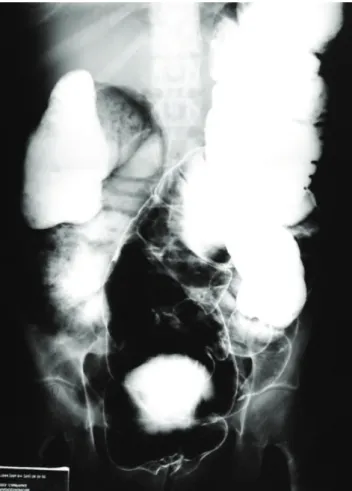
A 58 year-old black woman with positive sero-logy and medical record for Chagas disease reported history of intestinal constipation for 15 years, with many episodes of fecaloma. Thirty six months befo-re, she complained of intermittent and painless ente-rorrhagia. She underwent enema, which showed me-garectum and megasigmoid (Figure 1). Colonoscopy showed many polyps, and six were resected (Figu-re 2). The anatomopathological test (AP) showed intramucosal adenocarcinoma in one of the polyps,
located in the rectosigmoid transition. The patient was submitted to total colectomy. The AP of the sur-gical piece showed 20 polyps distributed in the colon with no malignancy (Figure 3). She presented with postoperative evolution without intercurrences, and remains in outpatient follow-up, without intestinal complaints.
Figure 1. Enema demonstrating megarectum and megasigmoid.
Figure 2. Colonoscopy showing many polyps. Endoscopic resection for the anatomopathological study.
Chagasic megacolon and large bowel neoplasms: case series and literature review Maxwel Capsy Boga Ribeiro et al.
374
Journal of Coloproctology October/December, 2011
Vol. 31 Nº 4
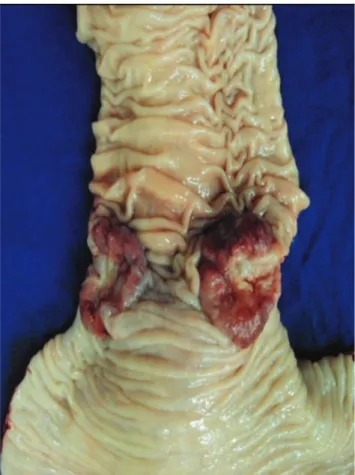
Figure 4. Surgical piece with megasigmoid.
Figure 5. Detail of the colic tumor adjacent to the dilated segment.
Patient n° 2
A 79 year-old white man with positive serology and medical record for Chagas disease reported his-tory of intestinal constipation for a year, associated with recurring abdominal pain and poorly characteri-zed. He also reported losing 11 pounds in this period. The colonoscopy showed ulcerative lesions in descen-ding colon. The biopsy showed a moderately diffe-rentiated adenocarcinoma. The abdominal computed tomography showed dilated rectum and sigmoid, with a great amount of feces and image suggesting descen-ding colon neoplasm, besides multiple hepatic lesions compatible with metastasis. Due to the bowel suboc-clusion, he was submitted to a segmental colectomy and primary anastomosis (Figures 4 and 5). He had a mixed shock (cardiogenic and pulmonary sepsis), lea-ding to death on the 34th postoperative day due to
mul-tiple organ failure.
Cases reported in literature concerning the asso-ciation between chagasic megacolon and large intesti-ne intesti-neoplasm are demonstrated in Table 1.
DIsCUssION
The relation between chagasic megacolon and large intestine neoplasm is a paradox and also intri-guing. First, fecal stasis would lead to chronic bowel irritation and to the prolonged exposure of the mucosa to the carcinogenic factors in the diet. On the other hand, the incidence of chagasic megacolon cancer in endemic regions for Chagas disease is only 0.1%1.
Garcia and Garcia et al.13,14 experimentally
indu-ced megacolon with the topic application of benzalko-nium chloride in the intestinal serosa of Wistar rats, and observed that these animals presented a lower incidence of tumors after being exposed to dimethy-lhydrazine. Oliveira and Oliveira et al.8,15 observed that Wistar rats chronically infected by Tripanossoma cruzi presented a lower frequency of benign and ma-lignant chemically induced neoplastic colics.
Studies with necropsies and surgical specimens
conirmed these indings. Meneses et al.16 found only
one case of colorectal cancer in 198 necropsies of pa-tients with chagasic megacolon, and no cases in 129 surgical pieces from patients with chagasic colopathy. Garcia13, on the other hand, found one rectal
Chagasic megacolon and large bowel neoplasms: case series and literature review
Maxwel Capsy Boga Ribeiro et al.
375
octology
, 201
1
V
ol. 31
Nº 4
N.R.: non reported; M: male; F: demale.
The studies by Lima and Pucci were reported by Meneses et al.16
adenoma
Rezende9 1988 N.R. N.R. Ascending colon N.R. N.R. N.R. N.R. 21
Lima16 1988 N.R. N.R. Rectosigmoid 2 villous
adenomas
N.R. N.R. N.R. 21
Pucci16 1988 N.R. N.R. Sigmoid Familial
adenomatous polyposis
N.R. N.R. N.R. 21
Meneses et al.16 1989 N.R. N.R. Rectum No Necropsy inding N.R. 21
Oliveira et al.8 1997 64 M Transverse colon No N.R. T2N0M0 7 months 26
57 F Transverse colon No N.R. T2N0M0 9 months
Gabriel-Neto et al.18 1998 84 M Cecum No Right
hemicolectomy
Dukes C N.R. 11
Crema et al.19 1999 60 M Sigmoid No Hartman Dukes C Much after 24
months
7
Adad et al.1 2002 60 M Sigmoid No Hartman T4N1M0 Much after 20
months
3
Fagundes et al.12 2002 47 F Descending colon No Exploratory
laparotomy
T4N3M1 3 months 8
60 M Rectosigmoid 5 adenomas in the left colon
Duhamel-Haddad T4N3M1 8 months
74 F Transverse colon 1 adenoma in descending colon
Total colectomy T4N0M0 Much after 48 months
64 M Sigmoid 1 adenoma in
sigmoid
Duhamel-Haddad T1N0M0 Much after 12 months
Presente trabalho 2011 58 M Rectosigmoid 20 polyps in the colon
Total colectomy TisN0M0 Much after 60 months
Presente série
79 M Descending colon 1 polyp in rectosigmoid
Chagasic megacolon and large bowel neoplasms: case series and literature review Maxwel Capsy Boga Ribeiro et al.
376
Journal of Coloproctology October/December, 2011
Vol. 31 Nº 4
Changes in the bacterial lora and intestinal pH,
as well as in the composition of the affected intestinal wall that would lead to changes in the neurotransmit-ter and neuropeptide levels, have been studied as pro-tective factors to the occurrence of neoplasms in these patients13,14,17,18. Concerning the described case series,
mean age of our patients was 68.5 years, very close to that observed by Fagundes et al.12, in 2002; it is also
close to the age group of colorectal cancer incidence in non-chagasic patients.
Men were prevalent in the sample of the service. As to location, we observed that the distal lar-ge bowel was mostly affected, and one case was in descending colon, and the other in the sigmoid. Both described adenocarcinomas presented conco-mitant adenomas. A literature review showed a 36% incidence of adenoma in patients with chagasic me-gacolon and colorectal neoplasm12. Thus, adenoma
seems to be also a risk factor for colorectal cancer in these patients.
The surgery was related to the tumor location and staging. For patient 1, due to the high number of polyps distributed in the colon, the choice was total colectomy. In case 2, because of the presence of dis-seminated hepatic metastasis, as well as the clinical
performance of the patient, the choice was a palliative partial colectomy.
Generally, literature relates the worst prognosis to intestinal neoplasms that are incident in the chaga-sic megacolon. This would be related to the late diag-nosis in these patients, once the colic dilatation could slow the appearance of obstructive symptoms. We still question if such tumors could not present more aggressive genetics, once they occur in an apparen-tly inhospitable environment for the development of neoplasms.
CONCLUsION
The rarity of large intestine neoplasms in patients with chagasic megacolon does not justify the additio-nal colonoscopic monitoring or the performance of enema in patients whose symptomatology does not in-dicate it. A high level of suspicion is demanded with the occurrence of any change in the clinical picture of patients with chagasic colopathy.
Finally, more studies are necessary to clear up the factors that are really involved in the rela-tion between chagasic megacolon and colorectal carcinogenesis.
REsUmO: Há uma clara associação entre megaesôfago por doença de Chagas e o câncer esofágico. Ao contrário, tal relação, entre mega-cólon chagásico e neoplasias do intestino grosso é, reconhecidamente, incomum. Existem poucos casos relatados na literatura. Desta-camos, entre 2000 e 2011, dois casos, sendo ambos adenocarcinomas colorretais e associados a adenomas, que se somam aos outros quatro já descritos por este grupo. A média de idade dos pacientes, foi de 68,5 anos. todos foram submetidos à ressecção cirúrgica da neoplasia. A sobrevida foi variável e diretamente relacionada ao estádio do tumor no momento do diagnóstico. Dentro desse contexto, relatamos essa série de casos e revisamos a literatura correlata, com relação aos aspectos clínicos e epidemiológicos dessa rara associação.
Palavras-chave: megacólon; doença de Chagas; adenocarcinoma.
REFERENCEs
1. Adad SJ, Etchebehere RM, Araújo JR, Madureira AB, Lima VGF, Silva AA, et al. Association of chagasic megacolon and cancer of the colon: case report and review of the literature. Rev Soc Bras Med Trop 2002;35:63-8.
2. Abreu RB, Quaglieri P, Ribeiro MF, Corsi PR, Castro LT, Gagliardi D, et al. Megaesôfago: doença precursora do câncer de esôfago. Rev Bras Cirur 1990;80:91-4.
3. Brandalise NA, Andreollo NA, Leonardi LS, Callejas Neto F. Carcinoma associado a megaesôfago chagásico. Rev Col Bras Cir 1985;12:196-9.
4. Huggins D. Carcinoma do esôfago associado ao megaesôfago chagásico (relato de um caso). An Inst Hig Med Trop 1976;4:57-62.
5. Livstone EM, Skinner DB. Tumors of the esophagus. In: Berr JE (ed). Bockus Gastroenterology. 4th ed. Philadelphia: WB Saunders Co; 1985. p.814-840.
6. Lopes ER. Megaesôfago, megacólon e câncer. Rev Soc Bras Med Trop 1988;21:91-4.
7. Lustig ES, Puricelli L, Lansetti JC. Association of Chagas’ disease and cancer. Medicina 1980;40:43-6.
ratos [Dissertação de Mestrado]. Goiânia (GO): Universidade Federal de Goiás; 1998.
9. Rezende JM, Rosa H, Vaz MGM, Andrade-Sá N, Porto JD, Neves Neto J, et al. Endoscopia no megaesôfago. Estudo prospectivo de 600 casos. Arq Gastroenterol 1985;22:53-62. 10. Rocha A, Almeida HO, Esper FE, Moraes DM, Santos EP,
Teixeira VPA. Associação entre megaesôfago e carcinoma de esôfago. Rev Soc Bras Med Trop 1983;16:94-7.
11. Pinotti HW, Pollara WM, Gemperi R, Raia AA. O problema do câncer no megaesôfago. Rev Ass Méd Bras 1980;26:379-81. 12. Fagundes JJ, Góes JRN, Coy CSR, Ayrizono MLS, Mochizuki
M, Chadu M, et al. Associação entre megacólon chagásico e câncer do intestino grosso: apresentação de casos e revisão da literatura. J Coloproctol 2002;22:252-6.
13. Garcia SB. O câncer no megacólon: estudos da incidência no homem e experimental em ratos [Tese de Doutorado]. Ribeirão Preto (SP): Faculdade de Medicina da Universidade de São Paulo; 1995.
14. Garcia SB, Oliveira JSM, Pinto LZ, Muccillo G, Zucoloto S. The relationship between megacolon and carcinoma of the colon: an experimental approach. Carcinogenesis 1996;17:1777-96.
15. Oliveira EC, Leite MSB, Miranda JA, Andrade AL, Garcia
SB, Luquetti AO, et al. Chronic Trypanosoma cruzi infection associated with low incidence of 1,2-dimethylhydrazine-induced colon cancer in rats. Carcinogenesis 2001;22:737-40. 16. Meneses ACO, Lopes MAB, Rocha A, Fatureto MC, Lopes
GP, Lopes ER, et al. Megas e câncer. Câncer de intestino grosso em chagásicos com megacólon. Arq Gastroenterol 1989;26:13-6.
17. Gabella G. Size of neurons and glial cells in the intramural ganglia of the hypertrophic intestine of the guinea-pig. J Neurocyt 1984;13:73-84.
18. Gabriel-Neto S, Oliveira EC, Carmo FV, Conceição DC, Mendonça GG, Leite MSB, et al. Megacólon chagásico associado à adenocarcinoma de cólon. Rev Soc Bras Med Trop 1998;31:46-9.
19. Crema E, Lima VGF, Madureira AB, Adad SJ, Silva AA, Oliveira CB, et al. Associação de neoplasia obstrutiva com megacólon chagásico. J Coloproctol 1999;19:87-9.
Correspondence to: Maxwel Capsy Boga Ribeiro