Introduction
The training schedule of high-level competitive swimming teams is planned according to the competitive calendar. Hence, the plan-ning is performed so that athletes can reach their best physical itness and technique in the most important competition in the season1. It is well established that nutrition plays a crucial role in
sports performance2, since a proper diet providing the athlete’s nutritional requirements helps to obtain morphological and physi -ological adaptations and optimizes performance in training and competitions1,3,4. In this sense, the current dietary recommenda-tions demonstrate the importance of energy intake and speciic nutrients in each training phase3, as an example, during the general
preparation phase (high volume and low intensity) emphasis should be given to high energy ingestion. In the speciic phase (low volume and high intensity) carbohydrate availability should be high, but caloric ingestion needs to be controlled; highlighting the need for an individual and continuously adjusted approach2.
Some narrative review studies have explored important as-pects of nutrition in swimming athletes in relation to the supply of energy and nutrients1,3,4. Cross-sectional studies examining the adequacy of nutritional parameters in swimmers present conlicting results5,6,7, while longitudinal studies are scarce8,9.
Barr & Costill9 evaluated a North-American collegiate swim
team by three times during a 25-week training program, and found that an increase in training volume appears to result in an increased consumption of the athletes’ usual diets9. In the
other hand, Kabasakalis, Kalitsis, Tsalis, Mougios8 assessed nine
Greek national top-level swimmers by four times throughout a competitive season of 32 weeks, and concluded that energy and macronutrient intake did not change signiicantly over time8.
In summary, there is no consensus whether competitive swim-mers change their energy and macronutrient intake throughout the season. Moreover, there is a lack on the literature regarding the adequacy of dietary intake of these athletes according the speciic demands of each training phase of the competitive season. Therefore, the aim of this study was to determine whether high-level swimmers have adequate energy and macronutrient intake during each training phase of a 32-week season. Considering previous indings8, our hypothesis was that athletes would not
change their energy and macronutrient intake patterns throughout the season, and this intake would not meet the speciic demands of each phase of training.
Methods
Study design
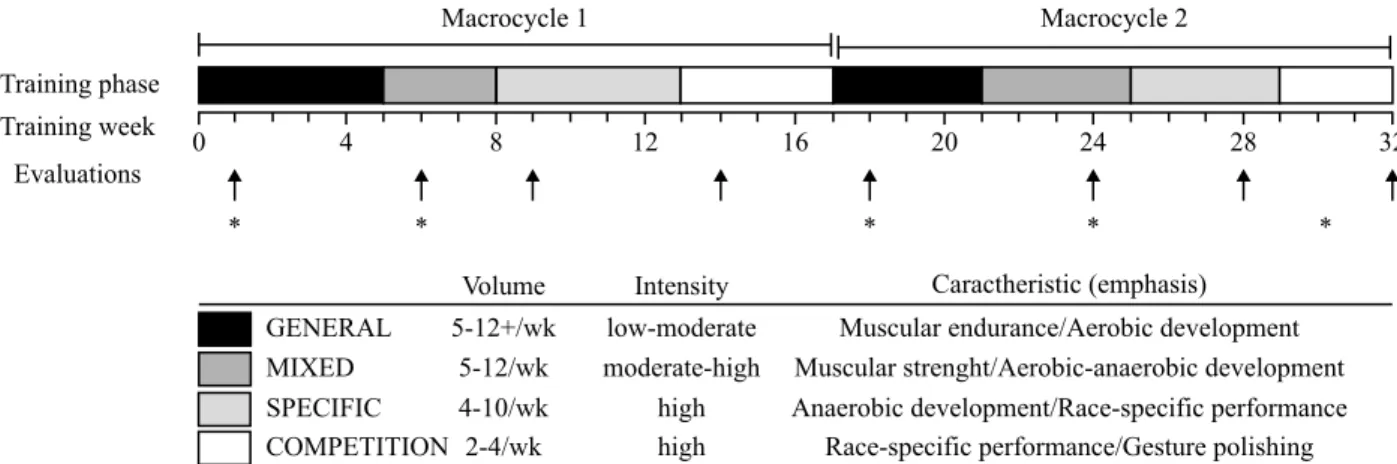
This was a prospective cohort study conducted from January to August 2015 (32 weeks), a period composed of two macro-cycles for the competitive swimming season. Swimmers were evaluated during the four phases of training (general, mixed, speciic and competition) of each macrocycle, resulting in a total of eight evaluations (Figure 1). The study was approved by the institutional ethics committee (protocol 882.361).
Original Article (short paper)
Dietary intake in high-level swimmers A 32-week prospective cohort study
Karina Romeu Montenegro Cláudia Dornelles Schneider
Universidade Federal de Ciências da Saúde de Porto Alegre,UFCSPA, Porto Alegre, RS, Brazil
Cássia Daniele Zaleski Trindade Flávio Antônio de Souza Castro
Universidade Federal do Rio Grande do Sul, UFRGS, Porto Alegre, RS, Brazil
Bruno Manfredini Baroni
Universidade Federal de Ciências da Saúde de Porto Alegre, UFCSPA,Porto Alegre, RS, Brazil
Abstract — Aims: To determine whether high-level swimmers present adequate energy and macronutrient intake during each training phase of the season. Methods: A 32-week prospective cohort study was conducted with 18 elite swimmers (10 men, 20±2 years; 8 women, 20±3 years) from a competitive swimming club. This period comprised two training macrocycles, each one divided in four training phases: general, mixed, speciic and competition. Dietary intake, estimated energy expenditure and daily energy requirements were assessed in every training phase. Body composition was evaluated ive times throughout the season. Energy and macronutrient consumption were compared with the energy expenditure and the literature recommendations, respectively. Results: Athletes maintained a relatively constant dietary intake throughout the season, regardless the different needs of each training phase. The balance between energy consumption and expenditure was negative in all training phases (p=0.02; d between 1.5-6.2) for women, while men did so in half of phases (p<0.01; d between 0.3-4.1). Swimmers had higher protein intake than recommendations in 73% of the evaluations, while carbohydrate and lipids intake were lower than recommendations in 76% and 69% of the evaluations, respectively. Conclusion: Athletes did not meet the energy demands and speciic macronutrient
requirements of each training phase of the competitive season.
Participants
All members of the main team of a competitive swimming club in Brazil were invited to participate in the study (total of 20 athletes). All athletes and/or their legal sponsor agreed to participate and signed the Informed Consent Form prior to data collection. During the beginning of the season, two athletes left the team and hence were excluded from the study. Thus, 18 swimmers (10 men and 8 women; aged 20.0±2.5 and 19.9±3.0 years, respectively) completed the full study schedule.
All athletes had at least 4 years of experience in competitive swimming training, and competed at the national and international level. Most of athletes (94%) were or had already been part of the Brazilian national swimming team. Three (16.7%) were sprinters, while seven (38.9%) and eight (44.4%) were middle and long distance swimmers, respectively. The predominant stroke was the front crawl (15 athletes, 83.3%).
The swimmers trained at an Olympic-size pool, twice a day, 5-6 days a week, each training session lasting about 2 hours, ex-cept for the competition period when the training volume reduced considerably. Moreover, athletes executed a complementary training at a itness center for 30 to 50 min/d. Researchers had complete access to the training schedule (updated daily) and directly observed most of the training sessions.
Assessment of dietary intake
In the irst training phase, a two-day dietary record including food and nutritional supplements was used (referring to 2 typical days of training), while the habitual dietary recall (referring to 1 typical training day) was used in all other training phases. The habitual dietary recall was adopted to maximize the athletes’ adherence to the study, since a two-day dietary record is more laborious and can lead to potential biases due to low compli-ance. Altogether, eight dietary assessments were taken over the course of the study (Figure 1). In order to minimize errors in the reporting of food portions, photographic food material was provided to the athletes. The Avanutri Online® program (Avanutri
& Nutrição Serviços e Informática Ltda Me, Brazil) was used
to calculate total energy intake (kcal/d), as well as proteins, carbohydrates and lipids intake (g/kg/d). The adequacy of mac -ronutrients consumed at each stage of training was evaluated according to the recommendations preconized by Stellingwerf, Maughan, Burke2: 6.0-12.0 g/kg of carbohydrate, 1.5-1.7 g/kg
of protein, 1.5-2.0 g/kg of fat.
Estimated Energy Expenditure
The FAO/WHO10 equation was used to calculate resting energy
expenditure, and occupational activity was calculated accord-ing to the factorial method. Exercise energy expenditure was calculated according to the metabolic equivalents (MET)11 from
the athletes’ weekly training schedule. Details on the training program were collected in each training phase by direct observa-tion to measure time spent on each exercise and series, using a stopwatch, and the weekly training spreadsheet was provided with information about swimming style, distance swam, intensity, and number of repetitions; making possible to choose the best matching MET. The estimated energy expended during weekly training was divided by seven to determine daily exercise energy expenditure. Total energy expenditure (TEE) was determined by summing resting energy expenditure, occupational activity expenditure and exercise energy expenditure. This strategy was repeated in each training phase12.
Body Composition Assessment
The athletes were evaluated at ive different time points through -out the season, which comprised different phases of training: general (1 wk) and speciic (9 wk) during the irst macrocycle of the year; and general (18 wk), speciic (28 wk) and compe -tition (30 wk) during the second macrocycle. Anthropometric information was collected from the club’s medical department, including body mass (kg), height (m), sum of four skinfolds - triceps, subscapular, iliac crest, abdominal (mm) - and body fat (%) estimated using Cescorf® scientiic caliper, and the protocol proposed by Faulkner13.
4 8 12 16 20 24 28 32
0 Training phase
Training week
Evaluations
GENERAL MIXED SPECIFIC COMPETITION
Volume Intensity Caractheristic (emphasis)
5-12+/wk 5-12/wk 4-10/wk 2-4/wk
low-moderate moderate-high
high high
Muscular endurance/Aerobic development Muscular strenght/Aerobic-anaerobic development Anaerobic development/Race-specific performance
Race-specific performance/Gesture polishing
Macrocycle 1 Macrocycle 2
* * * * *
Statistical Analysis
Data are presented as mean and standard deviation for age and 95% mean conidence interval for anthropometric data, energy expenditure and dietary intake. Total energy expenditure, training energy expenditure, energy intake, and carbohydrate, protein and fat intake were compared between phases of training by Generalized Estimating Equations (GEE) with Bonferroni post hoc analysis. Paired t tests were used to compare total energy expenditure with energy intake during each phase of training, as well as to compare macronutrients intake with the literature recommendationsduring each training phase2. Effects size for
single-sample t test was calculated applying the equationd = x-x0/s, where d is the effect size, x the sample mean, x0 the null value and s the sample standard deviation; we confederated criteria of classiication accordantly Hopkins14 where: 0 to 0.2
trivial, 0.21 to 0.6 small, 0.61 to 1.20 moderate, 1.21 to 2 large and greater than 2 vary large. When GEE was applied, effects size was identiied using statistic η2 and criteria of classiica
-tion accordantly Cohen15 where: 0 to 0.13 small, 0.14 to 0.26 moderate and grater than 0.26 large. The signiicance level
was set at alpha value < 0.05 and SPSS 22.0 was used to run all data analysis.
Results
Body Composition (Table 1)
Men did not change their body weight throughout the season (p = 0.237, η2=0.008) whereas women signiicantly reduced their body mass values between the irst and last evaluations (p < 0.001, η2=0.007). Both sexes had the highest average
body fat percentages and sum of skinfold thickness at base-line that corresponds to the vacation return. Moreover, it was observed signiicant reductions in men and women body fat percentage (p = 0.04, η2=0.2; p = 0.03, η2=0.06) and skinfold
thickness (p = 0.01, η2=0.2; p = 0.01, η2=0.06) at the 30th week
of training (table 1). On average, men were 1.80 m (1.77-1.83) tall, and women were 1.70 m (1.68-1.72) tall, both men and women without signiicant changes over the year (p = 1.00,
η2=0.08, η2=0.05).
Table 1. Anthropometric data of male (n=10) and female (n=8) swimmers during a competitive season. Data presented as mean (conidence interval).
Parameter Sex Baseline (general phase)
6 wk (mixed phase)
18 wk (general phase)
24 wk (mixed phase)
30wk
(competition phase) p-value
Body mass (kg) Male Female
72.0 (66.7-77.3) 67.9 (64.8-71.1)a
71.4 (66.7-77.0) 67.1 (64.3-70.0)a,b
72.3 (66.7-77.9) 67.8 (64.4-71.2)a,b
72.0 (66.5-77.6) 66.7 (63.4-69.9)a,b
72.9 (68.5-77.4) 64.3 (61.0-67.6)b
p =0.237 p <0.001
Body fat (%) Male Female
12.0 (10.8-13.3)a 15.1 (13.2-17.0)a
11.0 (10.1-12.0)b 13.3 (11.9-14.7)b
11.1 (10.3-11.8)b 14.4 (12.3-16.4)a,c
10.7 (9.8-11.5)b 12.7 (11.0-14.4)b
9.8 (8.9-10.6)b 13.5 (11.5-15.6)c,b
p =0.007 p <0.001
∑ 4 skinfold (mm) FemaleMale 40.7 (32.5-48.9)60.8 (48.5-73.2)aa
34.4 (28.3-40.4)b 48.9 (39.7-58.0)b
34.8 (29.5-40.1)b 56.2 (42.9-69.6)a,c
33.2 (28.0-38.3)a,b 45.2 (34.2-56.1)b
30.5 (27.1-33.9)b 50.7 (37.2-64.2)b,c
p =0.008 p <0.001
Different letters indicate signiicant difference between training weeks (a, b, c)
Energy Intake and Energy expenditure (Figure 2)
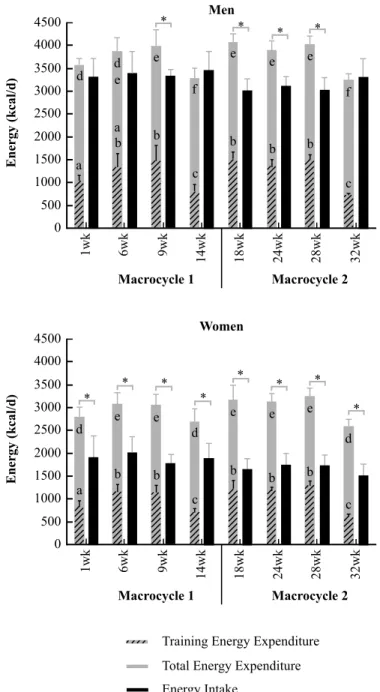
The energy expended in training by men and women accounted respectively for 29-37% and 30-38% the total energy expended in the phases of general preparation (1 wk and 18 wk), 35% and 37-38% in the phases of mixed preparation (6 wk and 24 wk), 37% and 37-40% in speciic phases (9 wk and 28 wk) and 24-22% and 26-25% in the competition phases (14 wk and 32 wk) (Figure 2).
In the competitive phases (14 wk and 32 wk), both TEE (p < 0.001, η2=0.4, η2=0.3, results of effect size for men and
women, respectively) and in training energy expenditure (p < 0.001, η2=0.5, η2=0.6) were lower than the ones in other
phases of training, in both sexes. However, energy intake was kept constant over all phases for both men (p = 0.261, η2=0.4)
and women (p = 0.522, η2=0.2), with mean values of 3079
Macronutrient intake (Figures 3-5)
Among all swimmers (men and women), carbohydrate intake (Figure 3) was below the recommendation2 for the respective
training phase in 76% of the evaluations. This represents that 95% of female evaluations were below the recommended range. There was a signiicant reduction in carbohydrate intake by women between week 9 [3.7 (3.0-4.4) g/kg/d] and week 18 [3.0 (2.4-3.7) g/kg/d] (p < 0.001, η2=0.1), and also by men
when comparing week 14 [5.5 (4.5-6.6) g/kg/d] to week 18 [4.8 (4.0-5.6) g/kg/d], week 24 [5.0 (4.3-5.7) g/kg/d] and week 28 [5.0 (4.2-5.8 g/kg/d] (p < 0.001, η2=0.3). Over the course of the
study, average carbohydrate intake was 5.4 (5.0-5.9) g/kg/d for men and 3.5 (3.0-3.9) g/kg/d for women.
Protein intake (Figure 4) was above recommendation2 in 73%
of swimmers, with men consuming above the reference values in 86% of the evaluations. There were differences in protein consumption by women between week 1 [1.4 (1.1-1.7) g/kg/d] vs week 14 [1.9 (1.5-2.3) g/kg/d], week 24 [2.0 (1.6-2.3) g/kg/d] and week 28 [2.0 (1.7-2.3) g/kg/d] (p < 0.001, η2=0.4). There
was no difference in protein intake between phases of training for men (p = 0.104, η2=0.1). Over the course of the study, mean
protein intake was 2.5 (2.3-2.6) g/kg/d for men and 1.8 (1.6-1.9) g/kg/d for women.
4500
4000
3500
3000
2500
2000
1500
1000
500
0
1w
k
6w
k
9w
k
14w
k
18w
k
24w
k
28w
k
32w
k
Macrocycle 1 Macrocycle 2
* *
* *
En
er
gy (k
cal
/d
)
Men
Women
d d e
a a b
e
b f
c e
b e
b e
b f
c
4500
4000
3500
3000
2500
2000
1500
1000
500
0
1w
k
6w
k
9w
k
14w
k
18w
k
24w
k
28w
k
32w
k
Macrocycle 1 Macrocycle 2
*
*
* *
En
er
gy (k
cal
/d
)
d e
a b
e
b d
c e
b e
b e
b d
c
* *
*
*
Training Energy Expenditure
Total Energy Expenditure
Energy Intake
Lipid intake (Figure 5) was lower than recommendation2 in the irst two phases of training (general and mixed) of the two macrocycles in 68% of evaluations for men and 100% of evaluations for women. In other phases of training (speciic and competition), men did not reach the recommended values in 35%
of the evaluations, and women in 75% of the evaluations. There was no difference in lipid intake between training phases by men (p = 0.356, η2=0.2) or women (p = 0.911, η2=0.1). The average
of lipids consumed throughout the study was 1.2 (1.2-1.3) g/ kg/d for men and 0.75 (0.7-0.8) g/kg/d for women.
1 wk 18 wk
0 2 4 6 8 10 12
Ca
rbohydra
te
(g/
K
g/
d)
6 wk 24 wk
0 2 4 6 8 10 12
Ca
rbohydra
te
(g/
K
g/
d)
14 wk 32 wk
0 2 4 6 8 10 12
Ca
rbohydra
te
(g/
K
g/
d)
9 wk 28 wk
0 2 4 6 8 10 12
Ca
rbohydra
te
(g/
K
g/
d)
Women Men
General Mixed
Competition Specific
Figure 3. Individual carbohydrate intake and recommendation (grey band) for each training phase (in two macrocycles) by male (n=10) and female (n=8) swimmers.
4.0 3.5 3.0 2.5 2.0 1.5 1.0 0.5 0.0
1 wk 18 wk
P
rot
ei
n (g/
K
g/
d)
4.0 3.5 3.0 2.5 2.0 1.5
1.0 0.5 0.0
6 wk 24 wk
P
rot
ei
n (g/
K
g/
d)
4.0 3.5 3.0 2.5 2.0 1.5
1.0 0.5 0.0
14 wk 32 wk
P
rot
ei
n (g/
K
g/
d)
4.0 3.5 3.0 2.5 2.0 1.5
1.0 0.5 0.0
9 wk 28 wk
P
rot
ei
n (g/
K
g/
d)
General Mixed
Competition Specific
Women Men
Discussion
The main indings of the study were: (1) athletes maintained a relatively constant dietary intake throughout the season, re-gardless the different needs of each training phase; and (2) the athletes, especially women, reported inadequate energy and macronutrient intakes when compared to the speciic demands of the training phases.
Our indings corroborate previous cross-sectional studies regarding low energy intake by swimmers5,6,7 although an ad-equate energy consumption has been reported by other trials16,17.
In the 90’s decade, a longitudinal study encompassing a 25-week training program also found low energy intakes among male col-lege swimmers9. However, our results show that female athletes require greater attention from the sports team, coaches and staff as their reports of energy intake are dramatically lower than their needs in all training phases. Since energy expenditure was not estimated in the only longitudinal study involving top-level swimmers8, this previous study was not able to determine the athletes’ adequacy of energy intake. Thus, our study seems to be the irst one to call attention for this reduced energy intake among high-level swimmers throughout the season.
Male and female participants of our study exceeded a deicit of 600 kcal∙d in 50% and 100% of the training phases, respec -tively. Although men presented no changes in body mass, women lose ~3.6 kg throughout the season. Specially when looking to the mean energy deicit found for the female athletes (~1220 kcal ∙d), one might suspect of the participants’ underreporting in dietary records, as already mentioned by previous studies8,18.
Nonetheless, even considering an underreporting of 16%19, the
indings suggest a low energy intake by high-level swimmers throughout the season. This marked low energy availability may compromise exercise performance20 and can also be harmful to one’s health. Consequently, it increases the chance of athletes developing the RED-S syndrome (Relative Energy Deiciency in Sport), characterized by the insuficient energy to support body functions21.
Cross-sectional22 and longitudinal8 studies support our ind
-ings that swimmers have low values of daily carbohydrate intake and that men consume larger amounts of carbohydrates than women. Even though the mean values reported here are higher than those reported for elite Greek swimmers8, our results show
that athletes’ carbohydrate intake was below the recommenda-tion2 for the respective training phase in 76% of evaluations,
and this percentage increased to 95% among women. Moreover, even though this study did not intend to report individual data, we observed that several athletes presented a chronic deicit in carbohydrate consumption throughout the season. Thus, although some studies suggest that carbohydrate restriction in speciic situations can enhance adaptations to training22, carbohydrates
are traditionally considered as the fundamental source to energy supply23 and post-exercise recovery1. In other words, it is likely
that a chronically low carbohydrate diet has negative effects on conditioning and sports performance.
As shown in some previous studies8,16, our indings indicate
that most swimmers consume excessive amounts of protein. The average values reported in this study are similar to those found in another longitudinal studywith top-level swimmers8, suggesting
this excessive protein intake seems to be a common feature of this category of athletes. Despite recommendations to increased 0.0
0.2 0.4 0.6 0.8 1.0 1.2 1.4 1.6 1.8 2.0 2.2 2.4 2.6
1 wk 18 wk
F
at
(g/
K
g/
d)
0.0 0.2 0.4 0.6 0.8 1.0 1.2 1.4 1.6 1.8 2.0 2.2 2.4 2.6
6 wk 24 wk
F
at
(g/
K
g/
d)
0.0 0.2 0.4 0.6 0.8 1.0 1.2 1.4 1.6 1.8 2.0 2.2 2.4 2.6
14 wk 32 wk
F
at
(g/
K
g/
d)
0.0 0.2 0.4 0.6 0.8 1.0 1.2 1.4 1.6 1.8 2.0 2.2 2.4 2.6
9 wk 28 wk
F
at
(g/
K
g/
d)
General Mixed
Competition Specific
Women Men
protein intake (~35% total energy intake) by watersport athletes who need to lose total body mass with minimal muscle loss21,
the excessive consumption increases the protein oxidation rates, and long-term effects are unknown24.
Lipid consumption was largely below the recommendations2 in all phases of training. Inadequate intake of lipids reduces the intake of essential fatty acids and can negatively affect the absorption of fat-soluble vitamins, hormone synthesis and the composition of cell membranes and myelin sheaths25. Other
swimming studies have reported high levels of lipid consump-tion6,8, but the values were presented in total grams and/or in
percentage. Food consumption data should preferentially show considering the individual’s body mass (g/kg/d) than the total energy intake percentage12. These dissimilar forms of data pre-sentation make impossible the comparison between our indings with those reported by previous longitudinal studies8,9.
A reduction in the athletes’ body fat during the competitive season has been supported by indings from previous studies with swimmers8. The mean values of fat reduction found in
this study may seem negligible to a population of non-athlete individuals, but can interfere in the athletes’ performance when it comes to high-level competitive sports26. The discrete changes
in body composition of athletes throughout the 32-week train-ing period might be related to the high level of their physical conditioning, as a result of years engaged in a demanding sport training routine.
Different phases of training have particular intensity, vol-ume and types of exercises, which lead to different nutritional requirements3. General preparation phase has high volume and low intensity, so it is expected suficient energy intake to support training; at the same time, it is the best time to lose weight2.
However, it cannot be assert that athletes were intentionally consuming less calories to adequate their body composition. Mixed phase has moderate to high intensity and high volume so a habitual high carbohydrate diet helps to maintain glycogen stor-age necessary in high intensity demands2; however, no change
was seen in carbohydrate intake trough phases. Competition phase, which has high intensity and moderate volume, needs high carbohydrate availability4; but energy intake should be
carefully adapted to avoid weight gain. Competition phase have less energy expenditure compared to other phases, so it necessary supply energy (especially from carbohydrate) for the high intensity races demands and protein to recovery and be careful with lipid intake to avoid weight gain2. However, lipid
intake was shown to be constant throughout the season; and only clinically negligible differences between training phases were found in carbohydrate and protein consumption; total energy consumption was affected by both, the low fat and low carbohydrate, intakes. It means that athletes did not change their dietary intake throughout the competitive season, leading to energy and macronutrient consumption patterns that were in-consistent with the speciic demands of some phases of training. Dietary record and habitual dietary recall are assessment methods routinely used by clinics and researchers5,7. However, a
meth-odological limitation of the present study should be pointed out: it was used only two-day dietary record in the irst phase and one habitual dietary recall in all other training phases. It
is recommended a minimum of three days diet monitoring (including a weekend day) in order to adequate estimation of habitual energy and macronutrient consumption27, however,
it was prioritized an increased adherence since dietary record is more laborious, and swimmers were followed by a long period of 32 weeks. Nevertheless, the bias induced from par-ticipants’ underreporting dietary intake is an important factor to consider. To minimize errors inherent to this method, we provided printed materials with pictures of food portions and utensils. Moreover, athletes were encouraged to take pictures of their meals to facilitate the determination of the portion sizes. Therefore, despite some limitations in terms of accuracy, the dietary intake assessment methods used in this study provide reliable data and consist in an accessible tool for nutritionists in the sports ield.
Conclusions
To our knowledge, this is the pioneer longitudinal study on the inadequacy of high-level swimmers’ diets during the different training phases of a competitive season. The main indings of this study allow us to conclude that the athletes did not adjust their eating pattern according to the speciic energy and macronutri -ent demands of each phase of training during the competitive season. Based on these results, it is advisable that dietitian, coach and other team members work together to ensure an individual-ized and sustained nutritional counseling to athletes, frequently taking into account the speciic dietetic needs of each training phase since the energy and macronutrient deicit maybe could lead to reduction in performance and/or perhaps over-training.
References
1. Mujika I, Stellingwerff T, Tipton K. Nutrition and Training Adaptations in Aquatic Sports. Int J Sport Nutr Exerc Metab. 2014;24(4):414-24.
2. Stellingwerff T, Maughan RJ, Burke LM. Nutrition for power sports: Middle-distance running, track cycling, rowing, canoeing/ kayaking, and swimming. J Sports Sci. 2011; 29 Suppl 1:S79-89. 3. Shaw G, Boyd KT, Burke LM, Koivisto A. Nutrition for
Swimming. Int J Sport Nutr Exerc Metab. 2014; 24(4):360-72. 4. Burke LM, Mujika I. Nutrition for Recovery in Aquatic Sports.
Int J Sport Nutr Exerc Metab. 2014;24(4):425-36.
5. Hoogenboom BJ, Morris J, Morris C, Schaefer K. Nutritional knowledge and eating behaviors of female, collegiate swimmers. N Am J Sports Phys Ther. 2009;4(3):139–148.
6. Noland RC, Baker JT, Boudreau SR, Kobe RW, Tanner CJ, Hickner RC, McCammon MR, Houmard JA. Effect of intense training on plasma leptin in male and female swimmers. Med Sci Sports Exerc. 2001;33(2):227–231.
8. Kabasakalis A, Kalitsis K, Tsalis G, Mougios V. Imbalanced nutri-tion of top-level swimmers. Int J Sports Med. 2007;28(9):780–786. 9. Barr SI, Costill DL. Effect of increased training volume on
nutrient intake of male collegiate swimmers. Int J Sports Med. 1992;13(1):47-51.
10. World Health Organization. Energy and protein requirements – WHO 1985;724:1–154.
11. Ainsworth BE, Haskell WL, Whitt MC, Irwin ML, Swartz M, Strath SJ, et al. Compendium of physical activities: an update of activity codes and MET intensities. Med Sci Sports Exerc. 2000;32(9):498–504.
12. ACSM - American College of Sports Medicine. Nutrition and Athletic Performance. Med Sci Sports Exerc. 2016;48(3):543–568. 13. Faulkner J. Physiology of swimming and living. In H. Falls 1968;
Academic Press, Baltimore.
14. Hopkins WG. Measures of reliability in sports medicine and sci-ence. Sports Med. 30 2000; (1):1-15.
15. Cohen J. Statistical Power Analysis for the Behavioral Sciences, ed. Hillsdale, NJ: Lawrence Erlbaum. 1988; 281–285.
16. Paschoal VCP, Amancio OMS. Nutritional Status of Brazilian Elite Swimmers. Int J Sport Nutr Exerc Metab. 2004;14(1):81–94. 17. Sato A, Shimoyama Y, Ishikawa T, Murayama N. Dietary thiamin
and ribolavin intake and blood thiamin and ribolavin concentra -tions in college swimmers undergoing intensive training. Int J Sport Nutr Exerc Metab. 2011;21(3):195–204.
18. Burke LM, Cox GR, Cummings NK, Desbrow B. Guidelines for daily carbohydrate intake: do athletes achieve them? Sports Med. 2001;31(4):267–299.
19. Westerterp KR, Saris WH, Van EM, Ten Hoor F. Use of the dou -bly labeled water technique in humans during heavy sustained exercise. J Appl Physiol. 1986;61(6):2162–2167.
20. Scroll P, For D. IOC consensus statement on sports nutrition. J Sports Sci. 2011;29:3–4.
21. Mountjoy M, Sundgot-Borgen J, Burke L, Carter S, Constantini N, Lebrun C, et al. The IOC consensus statement: beyond the Female
Athlete Triad--Relative Energy Deiciency in Sport (RED-S). Br J Sports Med. 2014a;48(7):491–7.
22. Burke LM. Fueling strategies to optimize performance: training high or training low? Scand J Med Sci Sports. 2010;20(2):48–58. doi:10.1111/j.1600-0838.2010.01185.x.
23. Farajian P, Kavouras SA, Yannakoulia M, Sidossis LS. Dietary intake and nutritional practices of elite Grek aquatic athletes. Int J Sport Nutr Exerc Metab. 2004;14(5):574–585.
24. Tipton KD. Eficacy and consequences of very-high-protein diets for athletes and exercisers. Proc Nutr Soc. 2011;70(2):205–214. 25. Rodriguez NR, Di Marco NM, Langley S. American College of
Sports Medicine position stand. Nutrition and athletic perfor-mance. Med Sci Sports Exerc. 2009;41(3):709–31.
26. Flynn MG, Pizza FX, Boone JB, Andres FF, Michaud TA, Rodriguez-Zayas JR Indices of training stress during com-petitive running and swimming seasons. Int J Sports Med. 1994;15(1):21–6.
27. Magkos F, Yannakoulia M. Methodology of dietary assessment in athletes: concepts and pitfalls. Curr Opin Clin Nutr Metab Care. 2003;6:539–549.
Corresponding author
Cláudia Dornelles Schneider
Universidade Federal de Ciências da Saúde de Porto Alegre. Sarmento Leite St., 245 – Porto Alegre, RS, Brazil. CEP: 90050-170.
Email: [email protected]
Manuscript received on March 28, 2017
Manuscript accepted on July 21, 2017
ERRATUM
In the article “Dietary intake in high-level swimmers A 32-week prospective cohort study”, published in volume 23, number 3, 2017: DOI: 10.1590/s1980-6574201700030021 and identiication: e101745.
Where it was written
Karina Romeu Montenegro Bruno Manfredini Baroni Cláudia Dornelles Schneider
Universidade Federal de Ciências da Saúde de Porto Alegre,UFCSPA, Porto Alegre, RS, Brazil
Cássia Daniele Zaleski Trindade Flávio Antônio de Souza Castro
Universidade Federal do Rio Grande do Sul, UFRGS, Porto Alegre, RS, Brazil
Should read:
Karina Romeu Montenegro
Cláudia Dornelles Schneider
Universidade Federal de Ciências da Saúde de Porto Alegre,UFCSPA, Porto Alegre, RS, Brazil
Cássia Daniele Zaleski Trindade Flávio Antônio de Souza Castro
Universidade Federal do Rio Grande do Sul, UFRGS, Porto Alegre, RS, Brazil
Bruno Manfredini Baroni